Tag: Recep Tayyip Erdogan

  • Over 15,000 confirmed dead in Turkey-Syria earthquake as some Turks lambast President Erdogan

    Over 15,000 confirmed dead in Turkey-Syria earthquake as some Turks lambast President Erdogan

    The window for finding survivors under the rubble is rapidly closing, experts have warned, but many distressed families claim that a lack of rescuers and supplies is reducing their chances of finding loved ones.

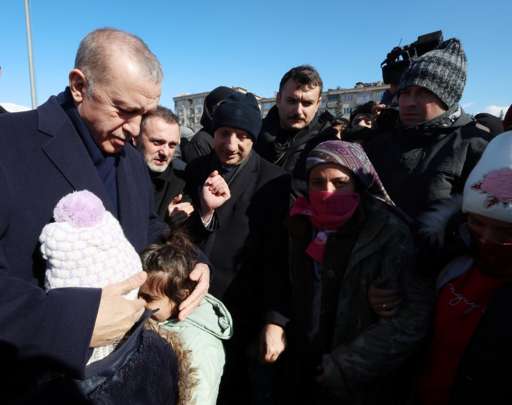
    The president of Turkey has acknowledged that his nation’s response to the devastating earthquake that has claimed more than 15,000 lives has had “shortcomings.”

    As the likelihood that more survivors will be discovered decreases, Recep Tayyip Erdogan is coming under increasing pressure from families who are frustrated by the rescue teams’ slow response.

    At least 15,865 people across Turkey and Syria are now known to have lost their lives – 12,873 of whom were in Turkey.
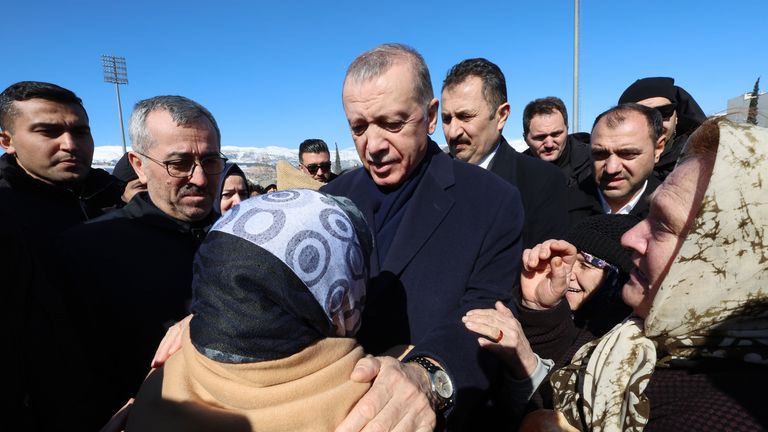
    President Recep Tayyip Erdogan speaks to an earthquake survivor. Pic: AP
    Image:President Recep Tayyip Erdogan speaks to an earthquake survivor. Pic: AP

    Many Turks have complained of a lack of equipment, expertise and support to help those who are trapped – leaving them helpless as they hear cries from under the rubble.

    During a visit to Hatay province, where more than 3,300 people have died and entire neighbourhoods have been destroyed, Erdogan said: “It is not possible to be prepared for such a disaster. We will not leave any of our citizens uncared for.”

    Similar issues are being reported in neighbouring Syria, with the country’s UN ambassador conceding the government has a “lack of capabilities and a lack of equipment”.

    Across Turkey and Syria, many of those in areas hardest hit by the 7.8 magnitude quake – and subsequent aftershocks – are afraid of going back into buildings.

    “We survived the earthquake, but we will die here due to hunger and cold,” one man in the Turkish city of Antakya said.

    Some survivors are still being found – with footage showing a young girl in pyjamas and an older man holding an unlit cigarette between his fingers being lifted from debris.
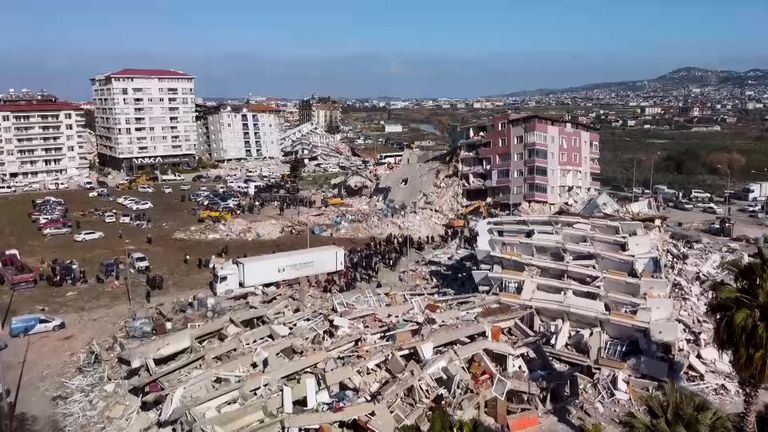
    Hatay province in Turkey

    https://imasdk.googleapis.com/js/core/bridge3.555.1_en.html#goog_1817367946Play Video – Dead bodies lie in the streetsDead bodies lie in the streets

    Chances of survival are diminishing

    According to experts, the survival window for those trapped is now closing rapidly – but nonetheless, it is too early to abandon all hope.

    Natural hazards expert Steven Godby said: “The survival ratio on average within 24 hours is 74%, after 72 hours it is 22% and by the fifth day it is 6%.”

    David Alexander, a professor of emergency planning and management at University College London, said: “Statistically, today is the day when we’re going to stop finding people. That doesn’t mean we should stop searching.”

    He went on to warn that the final number of fatalities may not be known for many weeks because of the sheer amount of rubble spanning Turkey and Syria.
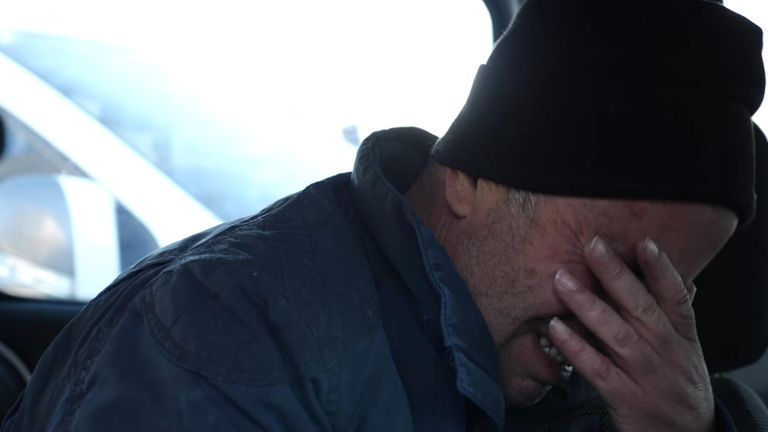
    Sky's John Sparks reports from Kahramanmaras

    https://imasdk.googleapis.com/js/core/bridge3.555.1_en.html#goog_635229091Play Video – ‘My children are in the building”My children are in the building’

    ‘Our hands cannot pick anything up’

    While some rescue teams have access to excavators, others have little choice but to use their bare hands.

    Ozel Pikal, who assisted with search efforts in the Turkish city of Malatya, fears some of those trapped may have frozen to death after temperatures fell to -6C.

    “As of today, there is no hope left in Malatya. No one is coming out alive from the rubble,” he said.

    Mr Pikal warned that damage to local roads – and a shortage of rescuers – was exacerbating attempts to save people.

    He added: “Our hands cannot pick anything up because of the cold. Work machines are needed.”

    Erdogan hits back at critics

    Turkey’s president has pledged that the government will distribute 10,000 Turkish lira (£440) to families affected by the earthquake.

    The natural disaster comes at a testing time for Mr Erdogan, who is facing an already challenging election campaign in May – fuelled by high inflation and an economic downturn.

    Speaking to reporters, he criticised those spreading “lies and slander” about his government’s actions – and said it was a time for unity and solidarity.

    “I cannot stomach people conducting negative campaigns for political interest,” he added.

    Police in Turkey have been attempting to crack down on misinformation related to the earthquake response, and have arrested 18 people and identified over 200 accounts accused of “spreading fear and panic”.

    Some internet service providers in the country have also restricted access to Twitter – affecting trapped survivors who have been using the social network to alert rescuers and their families.

    The Turkish government has been known to temporarily restrict access to social media during national emergencies and terror attacks – and Twitter’s owner Elon Musk said: “We are reaching out to understand more.”

  • Erdogan says he and Putin ‘agreed’ to send grains to poor African countries for free

    Turkey’s president has said that he and Putin agreed that Russian grains sent under the Black Sea export deal should go to poor African countries for free.

    “In my phone call with Vladimir Putin, he said ‘Let’s send this grain to countries such as Djibouti, Somalia and Sudan for free’ – and we agreed,” Recep Tayyip Erdogan said in a speech to businesspeople in Istanbul.

    His remarks on Friday came two days after Moscow resumed its participation in the UN and Turkish-brokered grain agreement, ending four days of non-cooperation that still saw exports continue from Ukrainian ports.

    Putin has said that even if Russia withdraws from the deal again, it will substitute the entire volume of grain destined for the “poorest countries” for free from its own stocks.

    Source: Aljazeera.com

  • Erdogan: Turkey poised to press forward with Black Sea grain deal

    President Recep Tayyip Erdogan says Turkey is determined to “serve humanity” and move forward with the UN-brokered Black Sea grain export deal after Moscow withdrew from the initiative over the weekend.

    “Even if Russia behaves hesitantly because it didn’t receive the same benefits, we will continue decisively our efforts to serve humanity,” Erdogan said in a televised address.

    “Our effort to deliver this wheat to countries facing the threat of starvation is evident. With the joint mechanism that we established in Istanbul, we contributed to the relief of a global food crisis,” the Turkish leader added, noting the deal had already provided 9.3 million tonnes of food to world markets.

    Source:


  • Greece-Turkey border: UN blasts ‘deeply distressing’ discovery of 92 naked migrants

    The UN refugee agency has expressed great worry over the finding of around 100 naked males at the Greek-Turkish border.

    Two countries have laid blame for the fate of the 92 migrants.

    Greece criticised Turkey for its “behaviour,” calling it a “shame for civilization.”

    Turkey branded its neighbour’s claims as “fake news” and accused it of “cruelty”.

    As both sides blamed each other, the United Nation’s refugee agency called for an investigation and said it was “deeply distressed by the shocking reports and images”.

    Greek police said they rescued the 92 men who were discovered naked, and some with injuries, close to its northern border with Turkey on Friday.

    They said an investigation by them and officials from the EU border agency Frontex, found evidence that the migrants crossed the Evros river into Greek territory in rubber dinghies from Turkey.

    “Border policemen… discovered 92 illegal migrants without clothes, some of whom had injuries on their bodies,” the statement said.

    Greek authorities said the men were immediately given clothing, food and first aid.

    It was not clear how and why the men had lost their clothes.

    Frontex said the men were mainly from Afghanistan and Syria, and that the organisation’s fundamental rights officer had been informed of a potential rights violation.

    Greek minister for civil protection, Takis Theodorikakos, accused Turkey of “instrumentalising illegal immigration” in the latest in a row over migration between the neighbours.

    Speaking on Greek television he claimed that many of the migrants had told Frontex that “three Turkish army vehicles had transferred them” to the river which acts as a border between the two countries. The BBC has not been able to independently verify this claim.

    “One would expect a working explanation from the Turkish government’s side,” Mr Theodorikakos said.

    A day earlier, Greek Migration Minister Notis Mitarachi said in a tweet that Turkey’s treatment of the migrants was a “shame for civilisation”. He said Athens expected Ankara to investigate the incident and “protect… its border with the EU”.

    The dispute has reached the highest level of government in Turkey, with tweets on behalf of the president denying any responsibility for what had happened and blaming Greece for the “inhuman” situation.

    “The Greek machine of fake news is back at work,” President Recep Tayyip Erdogan’s top press aide Fahrettin Altun wrote on the social media site.

    He described the allegations as “futile and ridiculous”, accusing Greece of not respecting the refugees by posting their pictures.

    In response, the UNHCR said it is “deeply distressed by the shocking reports and images”, but said it had not been able to speak to the group directly yet – something which it hoped would happen in the coming days.

    “We condemn any cruel and degrading treatment and call for a full investigation,” the UNHCR told the BBC.

    The discovery of the men comes days after a leaked report by an EU agency criticized some senior staff at Frontex for covering up illegal pushbacks of migrants by Greece to Turkey, something Athens denies. Frontex says such practices by its staff are a thing of the past.

    Last month, Turkish President Recep Tayyip Erdogan used a UN address to accuse Greece of transforming the Aegean Sea into a “cemetery” and said it had “oppressive policies” on immigration.

    Greece was on the frontline of a European migration crisis in 2015 and 2016, when around a million refugees fleeing war and poverty in Syria, Iraq, and Afghanistan arrived in the country, mainly via Turkey.

    The number of arrivals has fallen since then, but Greek authorities said they had recently seen an increase in attempted arrivals through the Turkish land border and the Greek islands.

    Greece has urged Turkey to respect a 2016 deal with the European Union in which Ankara agreed to contain the flow of migrants to Europe in exchange for billions of euros in aid.

    Athens will soon extend a 25-mile (40-kilometer) fence along its northern border with Turkey to prevent migrants from entering the country, Mr Theodorikakos said.


  • Russia-Ukraine war: List of key events, day 233

    As the Russia-Ukraine war enters its 233rd day, we take a look at the main developments.

    • Civilians in the southern Kherson region have started to flee to Russia amid Ukrainian advances, and evacuees were expected to begin arriving there on Friday. A Russian-installed official suggested residents should leave for safety, a sign of Moscow’s weakening hold on territory it claims to have annexed.
    • A Russian region adjoining Ukraine said it was preparing to receive refugees from the Russian-held part of Kherson.
    • Ukraine’s armed forces have retaken more than 600 settlements in the past month, including 75 in the strategic Kherson region, the government said.
    • The governor of a Russian border region accused Ukraine of shelling an apartment block, but a Kyiv official said a stray Russian missile was to blame – one of a series of apparent attacks on Russian towns.
    • Russian missiles hit the Ukrainian port of Mykolaiv. A five-storey residential building was hit, the two upper floors completely destroyed, the mayor said.
    • Three drones attacked the small town of Makariv, west of the capital Kyiv, with officials saying critical infrastructure facilities were hit by Iran-made drones.
    • NATO said it will closely monitor an expected Russian nuclear exercise but will not be cowed into dropping support for Ukraine.
    • Zelenskyy accused the International Committee of the Red Cross of inaction in upholding the rights of Ukrainian prisoners of war and urged it to undertake a mission to Olenivka – a notorious camp in eastern Ukraine.
    •  Kremlin spokesman Dmitry Peskov was quoted as saying in Izvestia newspaper that the goals of Russia’s “special military operation” could be achieved through negotiations.
    • The leaders of Commonwealth of Independent States (CIS) countries, including Russian President Vladimir Putin, are meeting for the CIS summit in Astana.

    • Putin is scheduled to take part in the first Russia-Central Asia summit later on Friday.


    Economy

    • Russia has submitted concerns to the United Nations about an agreement on Black Sea grain exports and is prepared to reject renewing a deal next month unless its demands are addressed, Russia’s UN ambassador in Geneva told Reuters.
    • Putin courted Turkish President Recep Tayyip Erdogan with a plan to pump more Russian gas via Turkey, turning it into a new supply “hub”, bidding to preserve Russia’s energy leverage over Europe.
    Source: Aljazeera


  • Inflation in Turkey surges to 83%

    The three industries with the most price increases are transportation, food, and housing.

    The true yearly rate, according to independent specialists at the Inflation Research Group, is 186.27%.

    Recep Tayyip Erdogan, the president of Turkey, deviated from tradition last year by lowering interest rates in an effort to stimulate the economy.
    To combat inflation, the majority of central banks hike interest rates.

    The largest annual price increases were in the transportation industry (117.66%), followed by food and non-alcoholic beverages (93%).

    Mr Erdogan has described interest rates as “the mother and father of all evil”, and his economic policies include intervening in foreign exchange markets.

    Last year’s cut in interest rates from 19% to 14% has led to a fall in the value of the Turkish lira, which means it costs more for the country to import goods from abroad.

    The lira, meanwhile, hit a new record low of 18.56 against the US dollar.

    US Banking giants JP Morgan said Turkey’s inflation would remain in the “abnormally high range until policies get orthodox”.

    “We will build the century of Turkey together, hopefully by overcoming the inflation issue,” said Mr Erdogan in a televised address on Monday.

    The record high is the sharpest inflation surge since World War Two, according to former Turkish central bank chief economist Hakan Kara.

    High inflation and the economic crisis is the main problem facing Mr Erdogan’s ruling party, as he looks to secure another term in next year’s election.

    Prices are rising quickly around the world, due to factors including Covid-related supply shortages and the Ukraine war, which has driven energy and food prices higher.