Tag: Referendum

  • Preparations underway for Sunday’s referendum in Central African Republic

    Preparations underway for Sunday’s referendum in Central African Republic

    On Sunday, voters in the Central African Republic, a country known for its ongoing conflicts and economic struggles, will participate in a crucial election. The election centers around a contentious proposal to amend the constitution, potentially paving the way for President Faustin Archange Touadera to serve a third term.

    Having faced a tumultuous period lasting over a decade, the land-locked nation remains one of the poorest and most unstable countries globally. It endured a civil war marked by sectarian divisions following a coup, during which France and the United Nations offered assistance to help stabilize the situation.

    Despite some decrease in violence in recent times, pockets of territory are still under the control of rebel groups, and President Touadera continues to hold power with the support of Russian paramilitary forces.

    Touadera was initially elected in 2016, amid the country’s post-war recovery. His re-election in 2020, however, was marred by accusations of fraud and a low voter turnout. Many citizens, particularly in rebel-held areas, were discouraged from casting their ballots due to intimidation.

    The proposed constitutional amendment aims to extend the presidential term from five to seven years while eliminating the two-term limit. Proponents of the change argue that this would reset Touadera’s tenure, enabling him to run for the presidency once more.

    “The will of the people” forms the basis of this constitution, as expressed in a public dialogue held in March 2022, according to Evariste Ngamana, the deputy parliamentary speaker and spokesperson for the pro-Touadera majority in parliament. The aim is to establish institutional stability and create favorable conditions for development.

    However, the main opposition parties and civil society groups are calling for a boycott of the upcoming poll, citing an incomplete electoral roll and electoral overseers lacking independence, thereby branding it flawed. Martin Ziguele, the president of the Central African People’s Liberation Movement (MLPC), accuses the government of attempting a constitutional coup d’etat with the goal of allowing unlimited presidential terms, thereby seeking to hold on to power indefinitely.

    In Bangui, citizens are voicing concerns that the focus should be on addressing poverty, corruption, and violence rather than pursuing a third term for the president. Some feel that critical issues, such as insurgencies, theft, and loss of lives, are being neglected in favor of extending the president’s tenure.

    While there have been some protests against the referendum, they have been relatively muted, with reports of opponents facing threats and harassment. The judiciary also dealt a blow to President Touadera by scrapping the establishment of a committee tasked with drafting the new constitution.

    Despite approximately 1.9 million eligible voters, intimidation in rebel-held areas raises questions about their ability to participate in the upcoming vote. President Touadera has stated that both Russia and Rwanda will provide support for the vote’s security.

    The revision of constitutions to justify extending presidential terms has become a growing trend in Africa, seen in countries like Guinea and Ivory Coast in 2020. This trend also emerged as a possibility in Senegal, but the incumbent, Macky Sall, announced he would step down at the end of his second term. Mali, with the support of Wagner-linked forces, recently pushed through a new constitution following a controversial referendum, with the promise that it would guide the country’s return to civilian rule next year.

  • Chad prepares for a crucial referendum

    Chad prepares for a crucial referendum

    Chad is making preparations for the scheduled referendum on 17th December, which aims to adopt a new constitution aimed at transitioning the country back to civilian rule. To facilitate the process, the government initiated a campaign on Monday to revise and update the electoral register from the 2021 biometric file.

    A team, led by the Minister of Territorial Administration, who also serves as the chairman of the national committee responsible for organizing the referendum, along with other government officials, launched this initiative in the Moyen-Chari region.

    The publication of the new electoral register is anticipated on 12th November, paving the way for campaign activities in the lead-up to the referendum.

    The provisional results of the referendum are scheduled to be announced on 26th December, after which they will be transmitted to the Constitutional Court for validation.

    It’s worth noting that on 27th June, the majority of the members of the Transitional National Council approved the new constitution aimed at returning Chad to civilian rule. However, the process has faced challenges due to significant divisions among the government, opposition, and civil society groups over some provisions of the new constitution.

    Currently, Chad is under the leadership of transitional President General Mahamat Idriss Déby Itno, who assumed office in April 2021 following the passing of his father, President Idriss Déby, during a military operation.

  • Mali: Results of referendum vote yet to be declared

    Mali: Results of referendum vote yet to be declared

    Vote counting is underway in Mali after a referendum was held to determine the adoption of a new constitution that outlines the path towards restoring democratic civilian governance in the country.

    In 2021, military leaders had taken control but pledged to transfer power to an elected government in the coming year.

    The revised constitution introduces a second parliamentary chamber aimed at enhancing representation throughout Mali.

    However, detractors argue that it grants excessive authority to the president and object to military involvement in the constitution’s redrafting process.

    Provisional results are expected to be released on Tuesday, shedding light on the outcome of the referendum and the potential implications for Mali’s future political landscape.

  • Mali to hold referendum on new Constitution on June 18

    Mali to hold referendum on new Constitution on June 18

    The Mali government has declared that on June 18, 2023, a long-awaited referendum on a new constitution would be held in the West African nation.

    The referendum is a major milestone on the road to elections promised for February 2024, after a coup in May 2021.

    Government spokesperson Colonel Abdoulaye Maiga on Friday read out a decree on state television saying the country was called upon “to decide on the Constitution project” in June, after missing a previous deadline of March 19.

    “Voters will have to respond by a ‘yes’ or a ‘no’ to the following question,” on the referendum, the spokesperson said. “Do you approve of the draft constitution?”

    Members of the security forces in the nation will vote early on June 11.

    The delay in March had been expected since nearly no arrangements had been made for the vote and the draft constitution was only handed over to interim president and coup leader Assimi Goita on February 27.

    The Economic Community of West African States lifted a set of trade and financial sanctions against Mali in July after the military government committed to a March 2024 handover.

    The sanctions were imposed in January 2022 when the military government was considering remaining in power for up to five years.

    The draft constitution significantly strengthens the power of the president. Under it, the president rather than the government appoints the prime minister and ministers and has the right to sack them as well as dissolve parliament.

    Other sections of the draft have already triggered controversy.

    A part of the draft states that Mali is an “independent, sovereign, unitary, indivisible, democratic, secular and social republic”. Imams, a powerful class in the country, have been contesting the principle of secularism and have called on Muslims to oppose it.

    The draft also proclaims any coup as an “imprescriptible crime”. But those who carried out the 2020 coup and another one in 2021 to consolidate their hold on power would be safe since acts prior to the constitution going into effect would be covered by amnesty laws.

    Mali is in the throes of an 11-year-old security crisis triggered by a regional revolt in the north that developed into a full-blown rebellion. Frustration that French troops, who had been in the country since 2013, could not root out the rebels led to rising anti-French sentiments.

    That and military rule in the country led to soured relations with France, the country’s traditional ally and former coloniser, and closer ties with Russia.

  • Final day of flawed voting in Ukraine under Russian control during the war

    Tuesday marks the penultimate day of a vote for regions of Ukraine controlled by Russia, which the government in Kyiv and its Western allies call a fraud.

    Nearly four million people from the eastern regions of Donetsk and Luhansk, and the southern regions of Kherson and Zaporizhzhia, are being asked to attend polling stations and vote in so-called referendums on joining Russia.

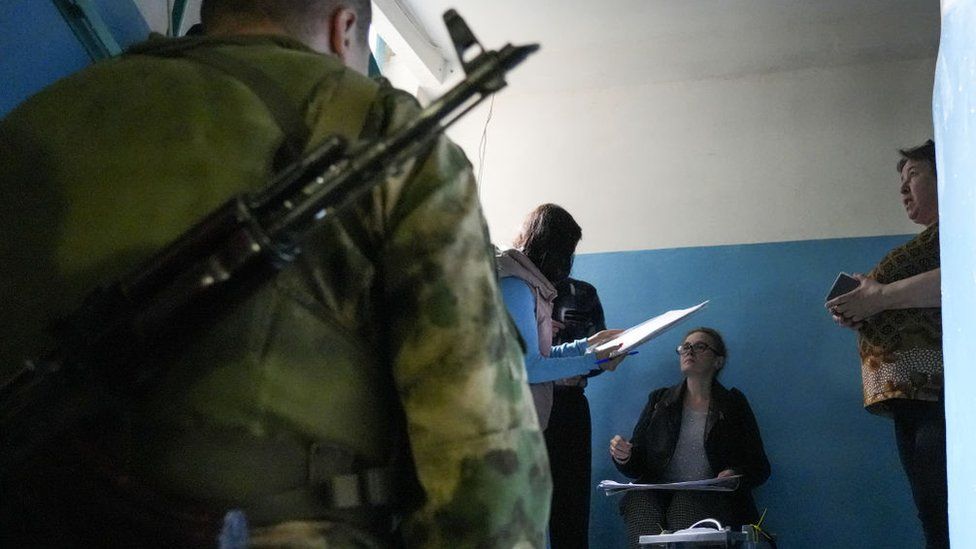
    This follows four days of early voting during which allegations of intimidation multiplied as election officials went house to house accompanied by armed guards.

    The votes, called with just a few days’ notice, serve a deadly serious purpose as they will be used by the Kremlin to legitimise its invasion aims.

    If Russia absorbs these regions, making up about 15% of Ukraine’s territory, it could take the war to a new and more dangerous level, with Moscow portraying any attempt by Ukraine to regain them as an attack on its sovereign territory.

    There is now speculation that Russian President Vladimir Putin may announce the four regions’ annexation in a speech to a joint session of Russia’s parliament on Friday.

    In March 2014 he announced that Ukraine’s Crimea Peninsula had been annexed just a few days after a likewise unrecognised referendum was held.

    ‘At gunpoint’

    Were the guns there to protect you as you voted, or to cow you into voting? That was a question passing through people’s minds in recent days as election officials escorted by soldiers come to knock on their doors.

    Serhiy Haidai, the governor-in-exile of the Luhansk region, accused the separatist authorities there of taking down the names of people who voted against joining Russia or who refused to vote at all.

    “Representatives of the occupation forces are going from apartment to apartment with ballot boxes,” he said, quoted by Reuters news agency. “This is a secret ballot, right?”

    Talking separately to the Associated Press news agency, he suggested the Russians were using the process as a pretext to search homes for men they could mobilise as soldiers as well as checking for “anything suspicious and pro-Ukrainian”.

    One woman described for BBC News how her parents had voted in the city of Melitopol in the Zaporizhzhia region.

    Two local “collaborators” had arrived with two Russian soldiers at their flat to give them a ballot paper to sign, she said.

    Voting in Donetsk, 23 September
    IMAGE SOURCE, GETTY IMAGES Image caption, Soldiers are escorting electoral workers going door to door in Donetsk

    “My dad put ‘no’ [to joining Russia],” the woman said. “My mum stood nearby and asked what would happen for putting ‘no’. They said, ‘Nothing’. Mum is now worried that the Russians will persecute them.”

    Another woman in the embattled town of Enerhodar, where the Zaporizhzhia nuclear power station is located, told the BBC: “You have to answer verbally and the soldier marks the answer on the sheet and keeps it.”

    Ukrainian journalist Maxim Eristavi tweeted to say that his family had been “forced to vote at gunpoint” in southern Ukraine.

    “They come to your house,” he wrote. “You have to openly tick the box for being annexed by Russia (or for staying with Ukraine if you feel suicidal). All while armed gunmen watch you.”

    Petro Kobernik, who left Kherson just before the voting began, told AP in an interview by phone: “The situation is changing rapidly, and people fear that they will be hurt either by the Russian military, or Ukrainian guerrillas and the advancing Ukrainian troops.”

    The vote on paper

    The questions on the ballot papers (there is no digital voting) differ according to region.

    This is because pro-Russian separatists have been running parts of Donetsk and Luhansk since 2014 when they held unrecognized independence referendums.

    Voters, there are being asked whether they “support their republic’s accession to Russia as a federal subject”.

    In the parts of Kherson and Zaporizhzhia occupied by Russian forces since the invasion in February, people are being asked if they “favour the region’s secession from Ukraine, creation of an independent country and subsequent accession to Russia as a federal subject”.

    The ballot papers there are printed in both Ukrainian and Russian whereas in the eastern regions they are printed in Russian only.

    Voting was spread over five days to allow for ballots to be “organized in communities and in a door-to-door manner for security reasons”, Russian state news agency Tass reports.

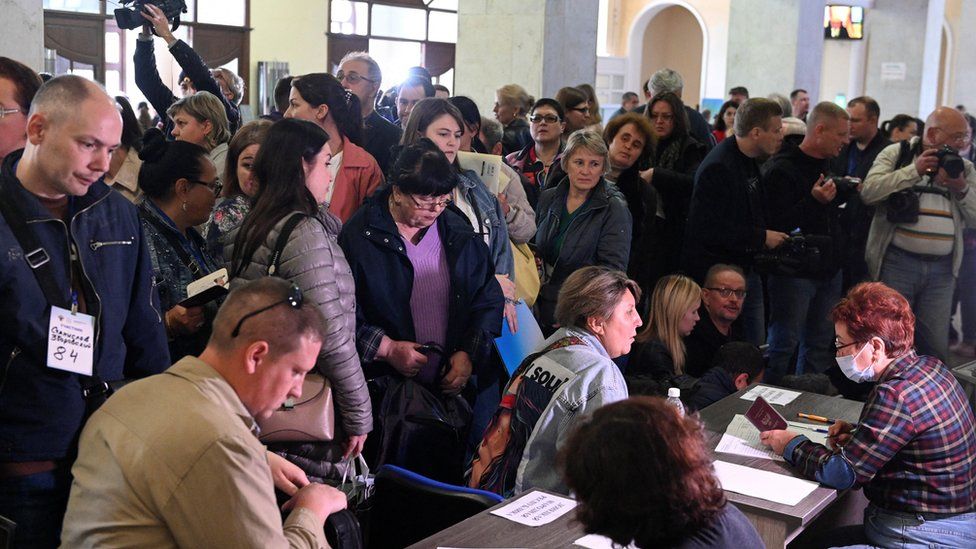
    Refugees now scattered across Russia can vote in as many as 200 polling stations there.

    The vote is being heavily guarded by Russian or Russian-backed security forces and with reason.

    Not only have Ukrainian forces been pushing the Russians and their separatist allies back in both the east and south, but attacks on figures associated with the Russian occupation have mounted.

    Voters in Rostov-on-Don, 24 September
    IMAGE SOURCE, REUTERS Image caption, People voted at a polling station in the Russian city of Rostov-on-Don

    Former Ukrainian MP Oleksiy Zhuravko, who championed the Russian invasion, was killed along with another person in a missile attack on a hotel in Kherson on Sunday.

    Reports say that Russian journalists who were also staying at the hotel escaped uninjured.

    In the city of Berdyansk in the Zaporizhzhia region, the deputy head of the city administration and his wife who headed the city election commission were killed in an attack a week before the referendum.

    Members of a guerrilla group called the Yellow Band have spread leaflets threatening anyone who votes and urging others to send photos and videos of anyone who does in order to track them down later, AP reports.

    The guerrillas have also sent around phone numbers of election commission chiefs in the Kherson region, asking activists to “make their life unbearable”, the agency reports.

    Ukraine has threatened anyone organizing or supporting the so-called referendums with eventual criminal prosecution, saying they face up to 15 years in prison if convicted.

    International outcry

    Even Serbia, which has close ties with Moscow and is one of the few European countries not to join sanctions on Russia, has announced it will not recognise the results of the voting.

    Foreign Minister Nikola Selakovic said that to do so would be “completely contrary” to his country’s policy of “preserving territorial integrity and sovereignty and… commitment to the principle of inviolability of borders”.

    But in the face of international opposition, Russia’s Foreign Minister, Sergei Lavrov, insisted that the votes were “the expression of the will” of the people who lived in the regions.

    He confirmed that if the four regions joined Russia they would have the same protection as any other part of its territory, including protection with nuclear weapons.

    The White House says the US will never recognise “Ukrainian territory as anything other than part of Ukraine”.

    In its view, the referendums are a “sham – a false pretext to try to annex parts of Ukraine by force in flagrant violation of international law”.

    The UK has responded with new sanctions targeting top Russian officials involved in enforcing the votes among others.

  • Cuba Family Code: Country votes to approve same-sex marriage

    In a national referendum, Cubans decided to legalise same-sex marriages.

    A new Family Code that will also permit surrogate pregnancies and grant gay couples the ability to adopt children was approved by around two-thirds of the electorate.

    It marks a big moment for Cuba, which saw gay people persecuted and sent to work camps in the 1960s and 70s.

    However, there was significant opposition to the reforms among religious groups and conservatives.

    The referendum on Sunday was for a new Family Code – a 100-page document that went through more than two dozen drafts and hours of debate in community-level meetings.

    Cuba’s government had backed the law change and ran a nationwide campaign urging people to approve it.

    Speaking as he voted on Sunday, the country’s President, Miguel Díaz-Canel, said he expected most of the population would vote yes and that the new code reflected the diversity of people, families, and beliefs.

    On Monday, preliminary results indicated an “irreversible trend”, with 66% of votes counted so far in favour of the reform, electoral council president Alina Balseiro said on state television, according to AFP news agency. The law required 50% of voters’ approval to be adopted.

    The reforms were the culmination of efforts by gay rights activists in Cuba.

    Official attitudes towards homosexuality on the Communist-run island have changed over the past decades, partly thanks to the efforts of former leader Raúl Castro’s daughter Mariela.

    In the early part of communist leader Fidel Castro’s rule after the 1959 revolution, homosexual men and women were sent to work camps for supposed “re-education”.

    However, many in Cuba still oppose the step, including evangelical churches and other non-religious conservatives.

    Parts of the opposition also campaigned for a “no” vote, urging Cubans to seize a unique opportunity to hand the country’s communist government a defeat in the polls.

    Some anti-government activists consider the referendum an effort by the state to improve its human rights image following a brutal crackdown on all forms of dissent in recent years.

    The referendum also comes during a serious energy crisis, which has led to daily power cuts affecting millions of people across the island.

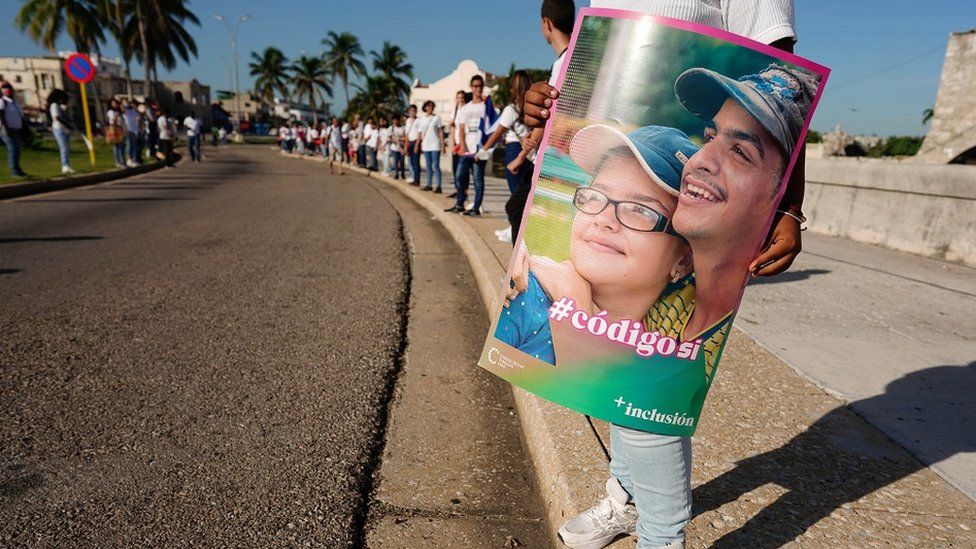
    A child holds a banner which reads "Code Yes" referring to a family code referendum to take place on September 25, during a state organized pro-referendum demonstration in Havana, Cuba, September 17, 2022. REUTERS/Alexandre Meneghini
    A child holds a banner that reads “code yes”

  • ‘Sham’ referendums’: UK sanctions Russians

    The United Kingdom has imposed new round of sanctions.in response to what it described as Russia’s “sham” referendums in four occupied regions of Ukraine.

    “The Russian regime has organised these sham referendums in a desperate attempt to grab land and justify their illegal war,” the Foreign, Commonwealth & Development Office (FCDO) said in a statement.

    “The process reflects their approach in Crimea in 2014, combining disinformation, intimidation, and fake results. These referendums do not represent the demonstrated will of the Ukrainian people and are a severe violation of Ukraine’s territorial integrity and political independence,” it added, citing Moscow’s seizure of the Black Sea peninsula eight years ago.

    The FCDO said the measures will specifically target individuals behind the votes in Kherson, Donetsk, Luhansk and Zaporizhia on whether to join Russia, including several Moscow-installed officials in the occupied regions, a number of oligarchs, board executives from major state-owned banks and IMA Consulting, a firm described as Russian President Vladimir Putin’s “favourite PR agency”.

  • Ukraine’s ‘referendums’: Soldiers canvass homes for votes in sham votes

    Armed soldiers have reportedly gone door-to-door in Ukraine’s seized regions to solicit votes for sham “referendums” on joining Russia.

    “You have to answer verbally and the soldier marks the answer on the sheet and keeps it,” one woman in Enerhodar told the BBC.

    In southern Kherson, Russian guardsmen stood with a ballot box in the middle of the city to collect people’s votes.

    The door-to-door voting is for “security”, Russian state media says.

    “In-person voting will take place exclusively on 27 September,” Tass reported. “On the other days, voting will be organized in communities and in a door-to-door manner.”

    One woman in Melitopol told the BBC that two local “collaborators” arrived with two Russian soldiers at her parents’ flat, to give them a ballot to sign.

    “My dad put ‘no’ [to joining Russia],” the woman said. “My mum stood nearby and asked what would happen for putting ‘no’. They said, ‘Nothing’.

    “Mum is now worried that the Russians will persecute them.”

    The woman also said there was one ballot for the entire apartment block building, rather than per person.

    Although the evidence is anecdotal, the presence of armed men conducting the vote contradicts Moscow’s insistence that this is a free or fair process.

    Experts say the self-styled referendums, taking place across five days, will allow Russia to claim – illegally – four occupied or partially-occupied regions of Ukraine as their own.

    In other words, a false vote on annexation, seven months into Russia’s invasion.

    The self-styled “annexation” could lead to Russia claiming that its territory is under attack from Western weapons supplied to Ukraine, which could escalate the war further.

    British Foreign Secretary, James Cleverly, said the UK had evidence that Russian officials had already set targets for “invented voter turnouts and approval rates for these sham referenda”.

    Mr Cleverly said Russia planned to formalize the annexation of the four regions – Luhansk, Donetsk, Kherson, and Zaporizhzhia – by the end of the month.

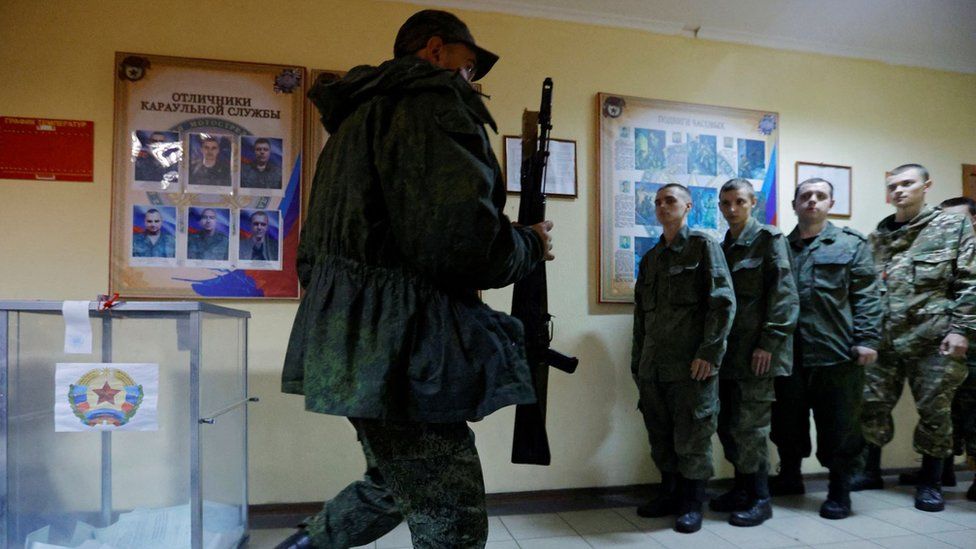
    Armed soldier walks past ballot box as people line up to vote
    IMAGE SOURCE, REUTERS Image caption, Ballot boxes being guarded by armed soldiers in Luhansk

    A source in Kherson told the BBC there was no public effort to encourage voting, apart from an announcement on the Russian news agency that people can vote at a port building, which had been disused for 10 years.

    Another woman in Kherson said she saw “armed militants” outside the building where the vote seemed to be taking place. She pretended to forget her passport, so she didn’t have to vote.

    The woman said all her friends and family were against the referendum. “We don’t know how our life will be after this referendum,” she said. “It is very difficult to understand what they want to do.”

    Kyiv says the referendums will change nothing, and its forces will continue to push to liberate all of the territories.

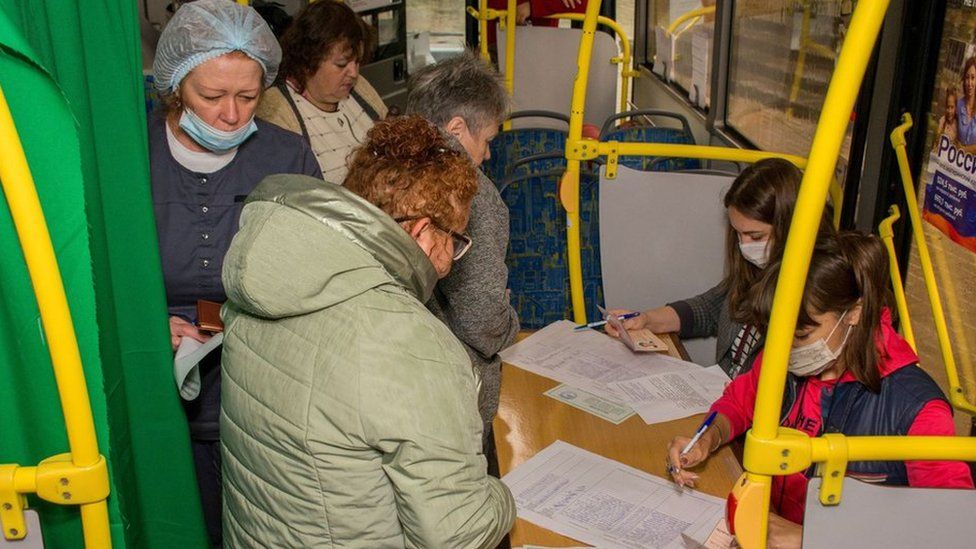
    Women line up to cast vote in referendums on bus.
    IMAGE SOURCE,REX/SHUTTERSTOCK Image caption, These women in Luhansk voted in a converted bus

    Meanwhile, Russian President Vladimir Putin’s recent mobilisation of at least 300,000 extra troops has caused many Russian men of fighting age to flee.

    One young Russian man who left St Petersburg for Kazakhstan to avoid the draft told BBC World Service that most of his friends were also on the move.

    “Right now, I feel like it’s a total collapse. I know only maybe one or two folks that don’t think about exile right now,” he said.

    He said some, like him, are travelling across the border, whereas others have gone to small Russian villages to hide.

    “The big problem of Russia is that we didn’t think about the war in Ukraine in February as we think about it right now,” he said.

  • What does Russia wants from the votes in occupied Ukraine?

    Four seized regions of Ukraine are being held over by Russian-backed officials, who are holding so-called referendums on joining Russia.

    These so-called elections, which have been denounced as invalid and fraudulent by Ukraine and the West, are being held over the course of five days in four front-line regions: two in the east and two in the south.

    An annexation could lead to a claim by Russia that its territory is coming under attack from Western weapons supplied to Ukraine.

    This could escalate the war further.

    What is going on and why now?

    Seven months after Russia’s invasion began, Vladimir Putin is on the back foot. Ukraine’s counter-offensive has recaptured swathes of territory seized since the 24 February invasion.

    A vote on annexation is one of three steps taken by the Kremlin in an attempt to reset the war.

    By annexing another 15% of sovereign Ukraine, Russia will be able to claim its territory is under attack from weapons provided by Nato and other Western countries to Ukraine. By calling up 300,000 extra troops, it can defend a front line of 1,000km (620 miles). The Kremlin has also criminalized desertion, surrender and going absent without leave during mobilization.

    If Russia’s leader annexing territory sounds familiar, it is. When he ordered troops to seize Crimea in 2014, he followed it up with a vote rejected as an illegitimate sham by the international community.

    This latest event has also been denounced as illegal by many Western countries, including international monitoring groups, the OSCE, and Russian media have already said that a Yes-vote is beyond doubt.

    It is taking place over five days in Russia’s two proxy areas in Luhansk and Donetsk in the east, and in occupied parts of Kherson and Zaporizhzhia in the south.

    What makes these votes a sham?

    We have already seen how Crimea was annexed by Russia in 2014. While the Kremlin claimed 96.7% support, a leaked report from Russia’s Human Rights Council said only around 30% had voted and barely half supported annexation.

    Not a shot had been fired in Crimea, and yet in this latest case voting is expected to take place in the middle of a war.

    The four regions involved are either partially or completely under occupation.

    In the south, the city of Kherson is not a safe place right now, with Russian soldiers struggling to hold back a big Ukrainian counter-offensive. The central administration building was hit by a series of missiles only last week.

    A secure vote is impossible, and yet officials talk of 750,000 people registered and plans to incorporate occupied parts of another Ukrainian region, Mykolayiv, into the annexed area.

    Russian media reported that elected officials would go from door-to-door with portable ballot boxes from Friday to Monday.

    Polling stations will only operate on the fifth day, 27 September, with officials citing security reasons.

    Hundreds of stations are scheduled to open that day, with voters also able to cast ballots in regions outside their own – and refugees eligible to vote in parts of Russia itself.

    Then there’s Zaporizhzhia’s capital, which remains securely in Ukrainian hands, so any vote to annex that region makes little sense.

    Donetsk in the east is only 60% under Russian occupation and very much at the heart of the conflict.

    Russia does control most of Luhansk in the northeast even if it has begun to lose ground. Russian news agencies showed flyers being handed out entitled “Russia is the future”.

    Much of the pre-war population has fled the conflict. The head of Russia’s proxy authority in Donetsk, Denis Pushilin, ordered a mass evacuation days before the invasion.

    Russian-backed leaders have been keen to stage votes for several months, but the decision to hold the vote was taken just three days in advance and smacks of desperation.

    There will be no independent observers. Much of the voting will be online, although officials have promised extra security at polling stations.

    What will change?

    Ukrainian defense ministry adviser Yuriy Sak told the BBC the so-called referendums were doomed. “We are seeing that local populations are all in favour of returning to Ukraine, and this is why there’s so much guerrilla movement resistance in these territories.”

    In any event, Kyiv says nothing will change and its forces will continue to push to liberate the territories.

    Russia analyst Alexander Baunov says merely redefining the occupied areas as Russian territory is unlikely to stop Ukraine’s army, but it does send a message of intent to the populations under their control. And the Kremlin’s hope is that the West will balk at having its weapons fired at land declared by Moscow as Russian.

    Alarmingly President Putin has spoken of using all means at his disposal “to protect Russia”. And in case there was any doubt at all. the deputy head of Russia’s security council, Dmitry Medvedev, made clear that nuclear weapons could also be used to protect annexed territories.

    US Secretary of State Antony Blinken has spoken of a “dangerous escalation”, but reaffirmed Washington’s position that no Russian claim to Ukrainian soil could take away Ukraine’s right to defend itself.

    Even Turkey, which has sought to play a mediating role, has damned the vote as illegitimate.

  • No vote campaigners equal ‘angst’ of Ghanaians – Franklin Cudjoe to Akufo-Addo

    IMANI Africa President, Franklin Cudjoe is of the firm belief that the angst of the “No” vote campaigners in the aborted referendum reflect things Ghanaians are not happy about.

    In a Facebook post, Mr Cudjoe wrote that even as the government has withdrawn the referendum, they (government) should not think that they are impacting lives as the macro stories are stating.

    Read: President Akufo-Addo calls off referendum for lack of broad, national consensus

    “I believe, however, the angst of the ‘NO’ campaigners is subtly about just everything people are not happy about. So, while there has been a retreat on the referendum, I think the government must demonstrate beyond believable macro stories that they are indeed impacting lives- not easy but they can else, they’d be in overdrive in 2020,” his post read.

    Chronicling major events that have happened in 2019, Franklin Cudjoe wrote that, the President took a cue from the major inequality protests around the globe hence his decision to retreat on the December 17 referendum.

    “Looks like 2019 is the year of protests. Hong Kong, France, Lebanon, Bolivia, Chile, Ecuador, Venezuela, Colombia, Guinea, Malta, Iraq, Iran etc. Some protests have led to resignations and sacking of presidents. The protests are largely about inequality though. Looks like our President took a cue from the marauding ‘NO’ referendum campaigners and beat a retreat.”

    Withdrawal of referendum

    President Akufo-Addo in his address to the nation on Sunday, December 1, 2019, stated that his government will work to attain a broad national consensus on the referendum because it is important, as the amendment of an “entrenched provision of the Constitution”, is critical.

    He said, “I do not believe that such an amendment should be driven as a party matter. There has to be a clear national consensus and agreement amongst the populace that a particular entrenched provision no longer serves the interest of the people, and thus, has to be removed.”

    Read: President has authority to suspend referendum Kyei Mensah Bonsu

    Below is Franklin’s full post on Facebook

    “Looks like 2019 is the year of protests. Hong Kong, France, Lebanon, Bolivia, Chile, Ecuador, Venezuela, Colombia, Guinea, Malta, Iraq, Iran etc. Some protests have led to resignations and sacking of presidents. The protests are largely about inequality though. Looks like our President took a cue from the marauding NO referendum campaigners and beat a retreat. I believe, however, the angst of the NO campaigners is subtly about just everything people are not happy about. So, while there has been a retreat on the referendum, I think the government must demonstrate beyond believable macro stories that they are indeed impacting lives- not easy but they can else, they’d be in overdrive in 2020. That said, IMANI has a story on what percentage of the ruling government’s promises as contained in the 2016 manifesto have been attained. That would be soon. We wish the government well.”


    Source: www.ghanaweb.com

  • NALAG calls for postponement of December 17 referendum

    The General Secretary of the National Association of Local Authorities of Ghana (NALAG) Mr Kokro Amankwah has called for postponement of the upcoming December 17 elections and referendum.

    According to him, majority of Ghanaians have not been reached and informed on the referendum to make an informed decision and it will be prudent to postpone the date for the referendum to get many Ghanaians well educated to enable them make an informed decision.

    Read: EC accountants ordered not to disburse referendum cash

    He was speaking in an interview with the Media at a programme organized by NALAG to sensitize market women on the upcoming December 17 referendum at Koforidua in the Eastern Region.

    The programme which was attended by market women from Suhum, Jamapo, Koforidua and its environs was part of NALAG National sensitization programme and engagement with key stakeholders on the December 17 referendum.

    Mr Amankwah said, Ghanaians have matured enough to elect their Metropolitan, Municipal and District Chief Executives on political lines this he said is the way to brake the winner takes-all syndrome. .

    He said , research indicate that none of the district assembly elections conducted so far recorded 40 per cent of registered voters whilst often over 70 per cent of registered voters often vote in the presidential elections.

    Mr Amankwah said this reveals that when political parties are involved in elections they mobilize political support to get the needed voter turnout during elections.

    Read: President has authority to suspend referendum Kyei Mensah Bonsu

    Delivering her closing remarks, the chairperson of the programme, President of the Koforidua Central Market Women Association (CMWA) Ms Florence Oteng Okyere urged all market women to vote yes in the December 17 referendum to enable them elect MMDCEs on partisan lines.

    According to her yes vote will bring consistent development in various communities as the MMCEs will be accountable to the local people and not the President as it holds now.

    Ms Felicia Mensah, a plantain seller at the Koforidua central market in an interview with the Ghana News Agency(GNA) commend NALAG for the education on the referendum because that was her first time of hearing about the referendum.


    Source: ghananewsagency.org

  • Referendum: The President himself says ‘YES’, what is wrong if I say ‘NO’? – Sefa Kayi

    Astute morning show host, Kwame Sefa Kayi, affectionately called Chairman General, believes there’s absolutely nothing wrong with him campaigning for ‘NO’ votes in the upcoming December 17th referendum.

    Speaking on his ‘Kokrokoo’ show on Peace FM Thursday, monitored by Ghanaguardian.com, the award-winning journalist said people ‘attacking’ him over his ‘NO’ position on the referendum should put an end to it as according to him, he only spoke his mind just as any other.

    Read: Executive can withdraw Bill on referendum from Parliament Martin Kpebu

    Chairman General said if there was something wrong with someone declaring his state on the referendum, why then will the first gentleman of the land, President Nana Akufo-Addo and Members of Parliament (MPs) publicly campaign for ‘YES’ or ‘NO’ votes?

    “Even the President himself says his vote is YES, MPs have stated their positions. So what is wrong if I state my position as well?”, he rhetorically quizzed.

    Read: President Akufo-Addo has no power to halt Dec 17 referendum Haruna Iddrisu

    According to Sefa Kayi, nothing could move him from his ‘NO’ position in the upcoming national exercise.

    “I’ve long stated my position to be NO. I started saying this about 3 months ago ..and I still stand by that”, he added.

    Meanwhile, some Ghanaians are also pushing for the postponement of the referendum, thinking it will allow some space for a national consensus-building on the issue.


    Source: Ghanaguardian.com

  • Women and PLWDs schooled on upcoming referendum in Dambai

    Women and Persons Living With Disabilities (PLWDs) in the Krachi East District of the Oti region have undergone a day’s training on the forthcoming referendum.

    The workshop, which was organized by the Electoral Commission (EC) was aimed at sensitizing the participants on the importance of the referendum.

    Read: Electoral integrity in Africa can be improved Prof Jega

    It also aimed at building the capacity of the female candidates and to educate Persons Living With Disability on sign language, illustrative, and pictorial educational materials.

    Mr Lawrence Sarpong, Director of Administration, EC, Headquarters, said the Commission was making all the necessary efforts to ensure that Women and PLWDs participated fully in both District Level Election and the Referendum.

    He said in order not to disenfranchised eligible voters who would have problem with their finger prints to be captured by verification device, the EC has put measures in place so they could be identified by their faces only on the Election Day.

    Mr Sarpong said the inclusive participation and representation at all levels of decision-making processes was critical in deepening democracy and for rapid development.

    Read: Women participation in district level elections worrying EC

    Mr Sarpong said “it is a proven fact that diverse groups make better decisions, especially where it comes to task as challenging as representing the interests of citizens at all levels.”

    Mr. Nuhu Mahama, Oti Regional Director of the EC said his outfit would continue with the inclusive voter education and information directed at enhancing voters’ awareness of the electoral processes and equipping them with knowledge on the processes.

    It is also to increase the voters’ understanding of Election Day activities, informing them of voting date and time and other related issues.


    Source: Ghananewsagency.org

  • Akufo-Addo petitioned to halt election of MMDCEs

    The election of Metropolitan, Municipal and District Chief Executives along party lines will further polarise Ghana, some three citizens have said in a petition to the President.

    Peter Antwi Boasiako, Bill Boampong Darlington and Felix Hilton Kwamena Hamilton want Nana Addo Dankwa Akufo-Addo to use his “prerogative as the President of the nation, to halt this amendment…”

    Read: Election of MMDCEs: EC sets referendum for December 17

    The amendment would allow political parties to field and sponsor candidates for local government elections, which is currently barred by Article 55/3 of the 1992 Constitution.

    “55 (3) Subject to the provisions of this article, a political party is free to participate in shaping the political will of the people, to disseminate information on political ideas, social and economic programmes of a national character, and sponsor candidates for election to any public office either than to district assemblies or lower local government unit.”

    But the petitioners are worried that allowing political parties into local government elections “would undoubtedly create sharp divisions at the grassroots in our communities and will not help to maintain harmony among the local people.”

    “We believe that the political factionalism at the grassroots will destroy friendships and families, considering our fragile young democracy,” they wrote.

    Read: NCCE urges massive participation in referendum on MMDCEs election

    According to them, “there is also no concrete evidence which clearly suggests that the proposed election of the MMDCEs will actually improve on the current system” where the President appoints the MMDCEs.

    “…we are of the view that the current system which allows you to appoint the MMDCEs can achieve the purpose for quicker development of our communities,” the petition said.


    Source: Myjoyonline.com