Thirteen children and one adult lost their lives after a lightning strike hit a refugee camp in Uganda, police reported.
According to authorities, the victims were gathered for a church service on Saturday evening when the strike occurred, leaving 34 others injured.
The incident took place at the Palabek Refugee Settlement in the country’s northwest, a region that has been experiencing intense thunderstorms and heavy rains.
Uganda Police spokesperson Kituuma Rusoke informed BBC News that the adult victim was 21 years old, though he did not disclose the specific ages of the children who perished.
According to the UN’s refugee agency, Palabek Refugee Settlement houses over 80,000 refugees and asylum seekers, most of whom have fled from neighboring South Sudan.
In another tragic incident four years ago, lightning claimed the lives of 10 children in Arua, a city also located in northwestern Uganda.
These children were struck while taking a break from playing football.
At least 70 individuals were reported killed in an Israeli air strike on the Al-Maghazi refugee camp in central Gaza, as confirmed by Gaza’s Hamas-run health ministry.
The death toll is expected to rise due to the significant number of families residing in the area. The Israeli military is investigating the reports of the strike.
Simultaneously, there are indications from Israeli and Arab media that Egypt, sharing a border with the Gaza Strip, has proposed a new ceasefire between Israel and Hamas.
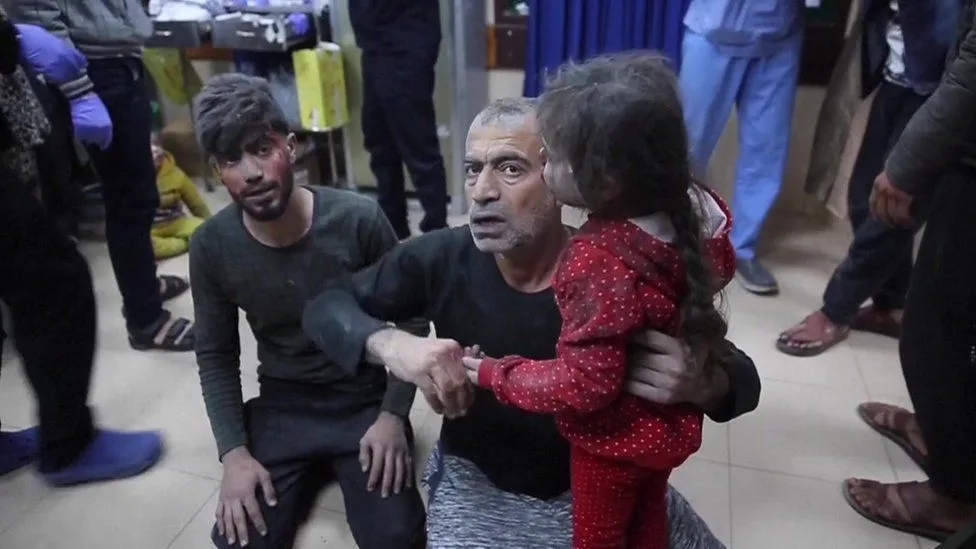
Numerous injured individuals, including children, were swiftly transported from Maghazi to Al-Aqsa Hospital, with distressing scenes of bloodied faces and body bags outside.
The health ministry stated that three houses were struck in the late Sunday attack, resulting in the destruction of a densely populated residential block.
A father said he had lost his daughter and grandchildren, adding that his family had fled from the north for safety in central Gaza.
“They lived on the third floor of one of the buildings,” he said. “The wall collapsed on them. My grandchildren, my daughter, her husband – all gone.
“We are all targeted. Civilians are targeted. There is no safe place. They told us to leave Gaza City – now we came to central Gaza to die.”
The Palestine Red Crescent Society says “intense” Israeli air strikes have led to the closure of main roads between Maghazi and two other refugee camps, Al-Bureij and Al-Nuseirat, “hindering the work of ambulances and rescue teams”.
In a statement to the BBC, the Israeli military said it had received “reports of an incident in the Maghazi camp”.
“Despite the challenges posed by Hamas terrorists operating within civilian areas in Gaza, the IDF [Israeli Defense Forces] is committed to international law including taking feasible steps to minimize harm to civilians,” it added.
According to the health ministry, more than 20,000 people have been killed – mostly children and women – and 54,000 injured in Gaza since 7 October, when Hamas and other Palestinian groups attacked Israel, killing 1,200 people and taking about 240 hostages.
According to the Israeli military, over a dozen soldiers have lost their lives in Gaza since Friday, bringing the total number of casualties from the ground offensive that began on October 7 to 156.
Despite Saturday being one of the deadliest days, Mr. Netanyahu insisted that there was “no choice” but to continue the conflict.
The new ceasefire proposal by Egypt would be implemented in three parts:
The first phase of the ceasefire would see a humanitarian pause of seven to ten days during which Hamas would release all civilian hostages in exchange for some Palestinian prisoners from Israeli jails
In the week-long second phase, Hamas would release all Israeli female soldiers in return for more prisoners and the exchange of corpses held since 7 October
The third phase, which would last a month, would see the release of the remaining hostages and a number of Palestinian prisoners and Israel withdrawing from the Gaza Strip and suspension of all aerial activities.
Indirect negotiations would be held in Egypt with Qatari and US participation.
An Israeli source told Maariv newspaper that the Egyptian initiative could lead to negotiations. Hamas says it is studying the proposal.
Meanwhile, the Danish shipping giant, Maersk, says it is preparing to resume shipping operations through the Red Sea and Gulf of Aden.
The announcement came after an international military operation, led by the US, was deployed to prevent the targeting of commercial ships by drones from areas of Yemen controlled by Houthi rebels. The Houthis have declared their support for Hamas and have said they would target any ship travelling to Israel.
Maersk and other shipping companies stopped sending ships through the Red Sea and the Suez Canal earlier this month as a result of drone attacks. US Central Command said two days ago that a US navy destroyer had shot down four drones in the Red Sea launched from Yemeni territory.
In another development, Pope Francis appealed for peace in the Middle East as he presided over a Christmas Eve Mass at Saint Peter’s Basilica in the Vatican.
Referring to the war between Israel and Hamas, the Pope said Jesus’s message of peace was being drowned out by the “futile logic of war” in the very land where he had been born.
Palestinians say , Mahmoud al-Saadi,18, was killed by the Israeli army on his way to school from the Jenin refugee camp.
During an Israeli raid on the northern occupied West Bank city of Jenin, a Palestinian high school student was reportedly shot dead while on his way to school.
Mahmoud al-relatives Saadi’s confirmed to Al Jazeera that he was killed on Monday. According to the Palestinian Ministry of Health, he was 18 years old and was shot in the stomach.
According to the ministry and local journalists, at least four other Palestinians were injured after being shot.
The Palestinian Ministry of Education mourned al-Saadi in a statement on Monday. It said he was a student at the Farhat Hashad Boys Secondary School in Jenin and and that he had been killed on his way to school.
Local journalist Mujahed al-Saadi told Al Jazeera that the teen was his distant relative and that witnesses he spoke to confirmed that he was killed while standing on the street headed to the classroom.
“He was headed out of the camp. He was surprised by the army, and the army shot him moments before they pulled out [of the camp],” Mujahed told Al Jazeera.
The Israeli army said in a statement that they had returned fire during an operation to arrest nine wanted Palestinians.
“During the activity, shots were fired, and charges were thrown at the forces in the area, the fighters shot at suspects who shot at them,” the statement said.
The Palestinian foreign affairs ministry described the killing as a ” field execution” and a “heinous crime,” adding that it is “part of the daily series of killings against our people, with cover and approval at the Israeli political level.”
It said it holds the “Israeli government fully and directly responsible for this crime,” and called on “the international community to provide international protection for our people.”
Mujahed told Al Jazeera that Mahmoud was shot on the street adjacent to the one where Al Jazeera journalist Shireen Abu Akleh was shot dead on May 11 while she was covering an Israeli army raid on the Jenin refugee camp. Mujahed was a few metres away from Abu Akleh when she was killed.
Speaking about Mahmoud, Mujahed said his relative “was at the top of his class” and had three sisters.
While on his way to school this morning, the Israeli occupation forces shot dead the student Mahmoud Saadi in #Jenin. The MoE condemns the continuous targeting of Palestinian education & calls on the international community to stop the ceaseless Israeli aggression on Palestinians pic.twitter.com/7LerHpohVG
Dozens of Israeli armoured jeeps raided Jenin and its refugee camp on Monday, just before 8am (05:00 GMT). The raid lasted about an hour.
In the camp, Israeli forces besieged the home of a wanted Palestinian man, Rateb al-Bali, while his family, including his children, were inside, and targeted the house with bullets and missiles.
Mujahed said al-Bali was “at home with his father and other family members, including his nieces and nephews, and a pregnant relative”.
“The army targeted the home with Energa grenades and bullets,” continued Mujahed, noting that no family members were injured.
Al-Bali, who escaped unhurt, eventually emerged from the house with his father and handed himself over to the Israeli army.
He has previously spent a year in Israeli prisons under administrative detention without trial or charge.
Israeli forces have been carrying out near-daily raids, arrests and killings in the northern West Bank cities of Jenin and Nablus, where Palestinian armed resistance is growing.
Across the West Bank, however, Israeli forces have for decades regularly carried out raids into Palestinian cities and villages, often leading to injuries or killings of unarmed Palestinians.
This year marks the highest number of Palestinians killed by Israel in the West Bank since 2006.
Since the start of 2022, Israeli forces have killed at least199 Palestinians, including 47 children, in the West Bank, occupied East Jerusalem and the Gaza Strip.
Close to 8,900 others have been wounded by the Israeli army this year until November 7, in the West Bank alone, the UN has reported.
At least 25 people in Israel have also been killed this year in Palestinian attacks.