The government is considering tough new laws amid the winter’s strikes, according to Rishi Sunak.
The legislation, which unions claim is anti-worker, is anticipated to include a ban on strikes from all blue light services and minimum service levels for public services.
Mr Sunak said: “I’m not going to get into details now, we’re looking at all options.
“But what I can say is my priority is to always be reasonable – and that’s what we’re going to continue to do – but also to make sure we protect lives and minimise the disruption to people’s lives.”
He added: “We’re looking at everything right now at pace but my priority is going to be to protect lives and to minimise the disruption on people’s lives.
“So the government is trying its best to act reasonably, that’s why we’ve accepted in full the recommendations of independent bodies who make recommendations to the Government about pay settlements in the public sector, and often those pay settlements have been higher than what many people in the private sector are receiving, but the government accepted them in full to be reasonable, to be fair.
“But it’s right now that we also look to minimise the disruption on people’s lives and that’s why we’re looking at tough new laws.”
Rishi Sunak is set to announce a collaboration between the UK, Italy and Japan to develop a new fighter jet that uses artificial intelligence.
The prime minister says the joint venture aims to create thousands of UK jobs and strengthen security ties.
The nations will develop a next generation fighter – due to enter service in the mid-2030s – that will eventually replace the Typhoon jet.
It is hoped the new Tempest jet will carry the latest weapons.
Work on developing it is already under way – with the aim to create a combat aircraft that will provide speed stealth, use advanced sensors and even artificial intelligence to assist the human pilot when they are overwhelmed, or under extreme stress.
It could also be flown without a pilot’s input if required and could be able to fire hypersonic missiles.
But building such a complex aircraft is extremely expensive – developing the F35 jet was the most expensive programme ever undertaken by the Pentagon – so Britain has been looking for partners.
Italy was already on board, and the addition of Japan is a significant move – at a time when Britain is building closer ties with allies in the Indo-Pacific region worried about a more assertive China.
Other countries could still join the programme. France, Germany and Spain are already working together on their own separate design – as is the United States.
For the UK, this agreement is not just about security but also economics. The hope is that developing a new fighter jet could create and sustain thousands of UK jobs and open doors to more arms exports.
Mr Sunak will launch the first major phase of the programme during a visit to RAF Coningsby, in Lincolnshire, on Friday.
Ahead of the visit, he said: “The security of the United Kingdom, both today and for future generations, will always be of paramount importance to this government.
“That’s why we need to stay at the cutting-edge of advancements in defence technology – outpacing and out-manoeuvring those who seek to do us harm.
“The international partnership we have announced today with Italy and Japan aims to do just that, underlining that the security of the Euro-Atlantic and Indo-Pacific regions are indivisible.
“The next-generation of combat aircraft we design will protect us and our allies around the world by harnessing the strength of our world-beating defence industry – creating jobs while saving lives.”
John Healey, Labour’s shadow defence secretary, said his party backed the partnership but warned about training.
“Ministers must make clear how this fits with wider plans for the RAF’s future, including how they will prevent delays in fast-jet pilot training,” he said.
Rishi Sunak has said the so-called “golden era” of relations with China is over, as he vowed to “evolve” the UK’s stance towards the country.
In his first foreign policy speech, the PM said the closer economic ties of the previous decade had been “naïve”.
He said the UK now needed to replace wishful thinking with “robust pragmatism” towards competitors.
But he warned against “Cold War rhetoric”, adding that China’s global significance could not be ignored.
Mr Sunak has faced pressure from Tory backbenchers to toughen the UK’s stance on China since he took over as Tory leader and UK prime minister last month.
The speech, to the Lord Mayor’s Banquet in London, comes after protests in China over the weekend against the country’s strict Covid lockdown laws.
Police have made several arrests, and a BBC journalist was detained while covering a protest in Shanghai on Sunday. He was beaten and kicked by the police during his arrest, and held for several hours before being released.
Mr Sunak told the audience of business leaders and foreign policy experts that, in the face of the protests, Chinahad “chosen to crack down further, including by assaulting a BBC journalist”.
“We recognise China poses a systemic challenge to our values and interests, a challenge that grows more acute as it moves towards even greater authoritarianism,” he said.
He added that the “golden era” of UK-China relations was “over”, along with the “naïve idea” that more trade with the West would lead to Chinese political reform.
The phrase “golden era” is associated with closer economic ties under former prime minister David Cameron – but relations between London and Beijing have since deteriorated.
However, Mr Sunak stressed that “we cannot simply ignore China’s significance in world affairs – to global economic stability or issues like climate change”.
He added that the UK would work with allies including the US, Canada, Australia, and Japan to “manage this sharpening competition, including with diplomacy and engagement”.
“It means standing up to our competitors, not with grand rhetoric but with robust pragmatism,” he added.
Mr Sunak and Chinese President Xi Jinping were set to meet for the first time at the G20 summit in Indonesia earlier this month, but the encounter was cancelled following a missile blast in Poland.
Mr Sunak’s predecessor Liz Truss was reportedly planning to re-categorise China as a “threat” to the UK as part of a review of its foreign policy.
In his speech, Mr Sunak echoed the phrase used in the review – that China is a “systemic challenge”. He said there would be more details of the review in the new year.
The truth is, right now, we don’t know in practical terms what this new approach will actually amount to.
Mr Sunak is promising more detail in what is known as the Integrated Review – which will set out the UK’s national security and foreign policy – in the new year.
But we know already how China is now described: a “systemic challenge”.
The government hopes that people will understand that international relations, like any human relations, are complex and nuanced; that a binary approach, as they see it, would not be in the UK’s interests.
But for the prime minister’s critics, failing to describe Beijing as a “threat” is a big mistake.
Read more from Chris here.
But the “robust pragmatism” line in the speech was criticised by former Tory leader Iain Duncan Smith, one of a number of backbenchers pushing for a tougher line.
Reacting to a preview of the speech, he wrote in the Daily Express that China had become a “clear and present threat to us and our allies”.
“I wonder if robust pragmatism now sounds more and more like appeasement,” he added.
Labour’s shadow foreign secretary David Lammy called the speech “thin as gruel”, accusing the prime minister of “flip-flopping its rhetoric on China”.
Elsewhere in his speech, Mr Sunak promised to continue support for Ukraine, adding: “We will stand with Ukraine for as long as it takes.”
He promised to “maintain or increase” British military aid to the country next year, and provide new air support to protect civilians and critical infrastructure.
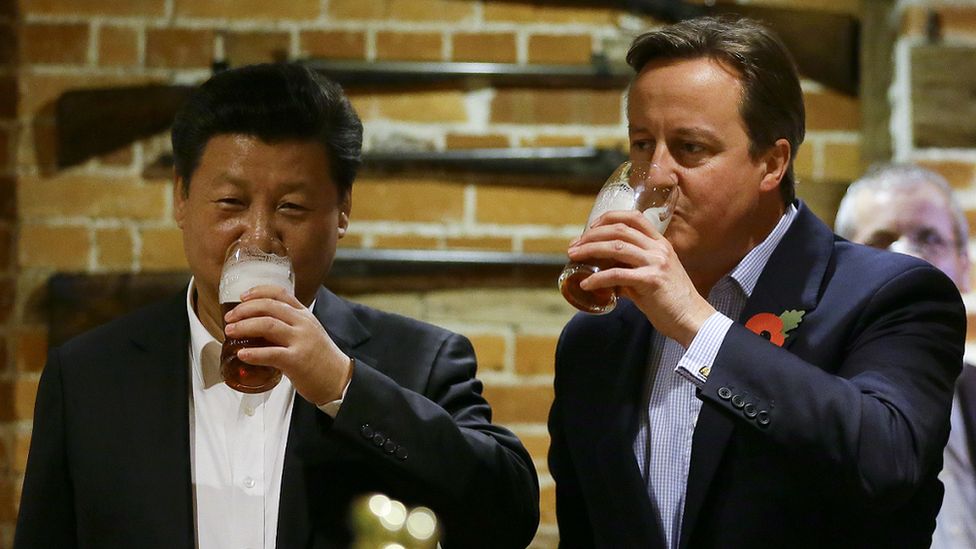
Getty Images China’s President Xi Jinping and former prime minister David Cameron drink a beer together during his state visit to the UK in 2015
Mr Sunak visited Ukrainian President Volodymyr Zelensky earlier this month, in his first visit to Kyiv since entering Downing Street.
During the visit, he announced the UK would supply Ukraine with additional anti-aircraft guns and radars, and increase the training offer to Ukraine’s armed forces.
President Zelensky’s wife, Olena Zelenska, made her own visit to London on Monday where she spoke about sexual violence allegedly being perpetrated by Russian troops in Ukraine.
Gareth Johnsonaccused the group of causing “misery and mayhem” and asked the prime minister to take the extreme measure.
Just Stop Oil should be labelled a terrorist organisation, a Tory MP has said.
Gareth Johnson urged Rishi Sunak to make the environmental group a “proscribed” organisation, a term for groups involved in terrorism, at Prime Minister’s Questions this afternoon.
“These people are not protesters, they are criminals,” he said.
“Will the prime minister therefore consider making Just Stop Oil a proscribed organisation so that they can be treated as the criminal organisation they actually are?”
Mr Sunak agreed the protests had caused “mass misery for the public” and claimed they “put people in danger”.
But he did not go as far as agreeing with the MP’s suggestion, saying: “The police have our full support in their efforts to minimise this disruption and tackle reckless and illegal activity.
“The Public Order Bill will give them the powers they need.”
Proscribing an organisation is a measure available to the home secretary under the Terrorism Act 2000 if they think a group commits, participates, prepares, promotes or encourages terrorism.
It makes being a member of the group illegal, as well as “expressing an opinion or belief that is supportive of a proscribed organisation”, and can result in up to 14 years in prison and a fine.
There are 78 groups on the government’s list, including Islamic and far right extremists.
Just Stop Oil wants the government to commit to ending all new licenses and consents for the exploration, development and production of fossil fuels in the UK.
The group’s recent actions have attracted a lot of attention, after they staged four days of protests on the M25.
In all 63 people were arrested during the protest, with 58 later being charged.
A spokesperson from the group said: “Gareth Johnson is right to be cross about the disruption caused by supporters of Just Stop Oil – but as we saw in the floods, days after the M25 actions were halted, the terror and mayhem from extreme weather events cannot be arrested, injuncted or proscribed.
“But the government can end the disruption today, by following the advice of the United Nations, the International Energy Agency and the world’s scientists and ending new oil and gas.”
The spokesperson also said the members were “ordinary people who use all possible peaceful means to protect all they love”, adding: “Gareth Johnson needs to read some climate science, to face up to reality and then seek to protect his constituents by calling for the end to new oil and gas.”
Britain’s King Charles III on Tuesday welcomed South African President Cyril Ramaphosa to London for the first state visit of his reign.
After the two men inspected the guard of honour together, they travelled to Buckingham Palace in a carriage procession escorted by mounted soldiers from the Household Cavalry.
Climate change, trade, and the Commonwealth are expected to be on the agenda in discussion between the two.
Ramaphosa will also visit parliament for an address to both the upper and lower houses, attend a state banquet at Buckingham Palace, and hold talks with Prime Minister Rishi Sunak during his stay.
At the start of the visit, the two governments announced the launch of the next phase of the UK-South Africa Infrastructure Partnership.
‘South Africa is already the UK’s biggest trading partner on the continent, and we have ambitious plans to turbocharge infrastructure investment and economic growth together,’ Sunak said.
Britain’s Foreign Secretary, James Cleverly, said the choice of Ramaphosa for Charles’ first state visit was a sign of the country’s ‘enduring commitment’ to Africa, even as it eyes new partners in Asia.
Rishi Sunakhas pledged £50m in defence aid to Ukraine as he met President Volodymyr Zelensky in his first visit to Kyiv since becoming prime minister.
Mr Sunak said it was “deeply humbling” to be in Kyiv and that the UK would continue to stand by Ukraine.
“Since the first days of the war, Ukraine and the UK have been the strongest of allies,” Mr Zelensky said following the meeting.
The aid package is intended to counter Russian aerial attacks.
The £50m defence aid comprises 125 anti-aircraft guns and technology to counter deadly Iranian-supplied drones, including dozens of radars and anti-drone electronic warfare capability.
Mr Sunak also announced the UK will increase the training offer to Ukraine’s armed forces, sending expert army medics and engineers to the region to offer specialised support.
It follows more than 1,000 new anti-air missiles announced by the UK’s Defence Secretary Ben Wallace earlier this month.
On his visit the prime minister saw captured Iranian-made drones which have been used to target and bomb Ukrainian civilians in recent months.
Mr Sunak also laid flowers for the war dead and lit a candle at a memorial for victims of the 1930s Holodomor famine, before meeting emergency workers at a fire station.
The prime minister said: “I am proud of how the UK stood with Ukraine from the very beginning. And I am here today to say the UK and our allies will continue to stand with Ukraine, as it fights to end this barbarous war and deliver a just peace.
“While Ukraine’s armed forces succeed in pushing back Russian forces on the ground, civilians are being brutally bombarded from the air. We are today providing new air defence, including anti-aircraft guns, radar and anti-drone equipment, and stepping up humanitarian support for the cold, hard winter ahead.
He added that it was “deeply humbling” to be in the Ukrainian capital and have the opportunity to meet people “paying so high a price, to defend the principles of sovereignty and democracy”.
Mr Sunak’s pledge to send more air defence support is exactly what President Zelensky would want to hear at a time when Russian airstrikes have destroyed nearly 50% of the country’s energy infrastructure, according to the government in Kyiv.
The men’s hopes for peace and a just outcome to the conflict may feel like distant prospects, but Mr Sunak’s promise to hold a reconstruction conference for Ukraine next year in London will be good news for the government and companies, which desperately need access to international finance.
During the visit, Mr Sunak also confirmed £12m for the World Food Programme’s response to Ukraine, as well as £4m for the International Organisation for Migration.
Downing Street said the funding would help provide generators and mobile health clinics, with the UK also sending tens of thousands of extreme cold winter kits for Ukrainian troops.
Labour’s shadow defence secretary John Healey tweeted: “The government continues to have Labour’s fullest backing to support Ukraine, reinforce Nato allies and confront Russia’s aggression.”
Ukraine has been requesting assistance from Western nations in recent months amid intense Russian aerial attacks on Kyiv and across the country.
Earlier in the week, Russia hit Ukraine with one of its biggest barrages of missiles yet, days after its troops were forced to withdraw from Kherson.
Kyiv was hitand there were strikes across the country, from Lviv in the west to Chernihiv in the north.
That attack coincided with the G20 summit in Indonesia this week where, in a virtual speech, Mr Zelensky said he was “convinced now is the time when the Russian destructive war must and can be stopped”.
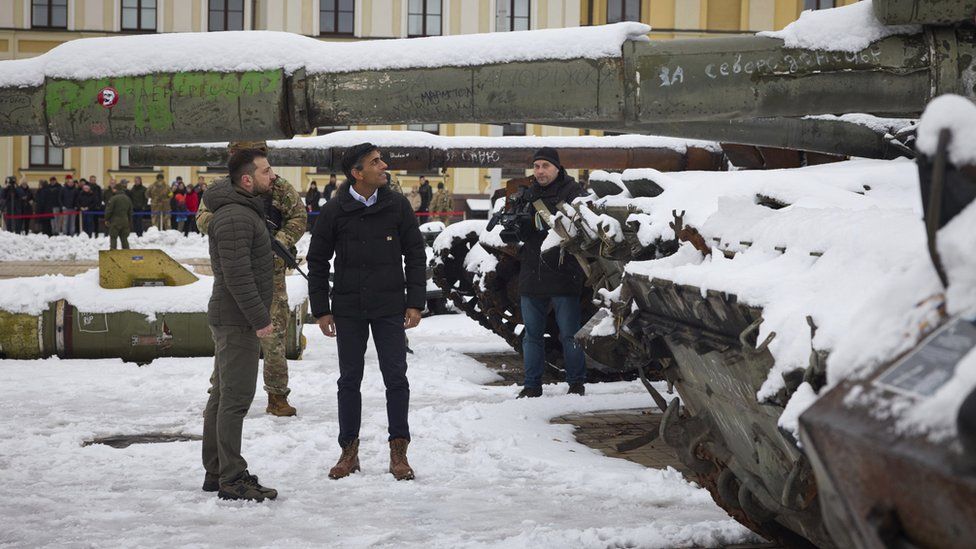
IMAGE SOURCE,UKRAINIAN PRESIDENT’S OFFICE Image caption, Mr Sunak was shown destroyed military Russian vehicles by the Ukrainian president
While Mr Sunak was at the Bali summit, which was attended by Russia’s foreign minister Sergei Lavrov, the UK prime minister urged Russia to “get out of Ukraine” and condemned the country for its “barbaric invasion”.
He stressed the UK would “back Ukraine for as long as it takes”.
Britain is currently the largest provider of military aid to Ukraine aside from the US. So far the UK has committed about £2.3bn and has pledged to match that amount in 2023, according to the House of Commons library.
The UK is also hosting a programme which will aim to train 10,000 new and existing Ukrainian personnel within 120 days.
Mr Johnson became almost a cult figure in Ukraine, after he was one of the first international figures to publicly support Ukraine and send military assistance.
It is a tough comparison for Mr Sunak to live up to so early on in his premiership. Many people in Ukraine do not know the new prime minister well and they will want to see how committed he is to supporting the country.
Rishi Sunak has pledged £50m in defence aid to Ukraine as he met President Volodymyr Zelensky in his first visit to Kyiv since becoming prime minister.
Mr Sunak said it was “deeply humbling” to be in Kyiv and that the UK would continue to stand by Ukraine.
“Since the first days of the war, Ukraine and the UK have been the strongest of allies,” Mr Zelensky said following the meeting.
The aid package is intended to counter Russian aerial attacks
The £50m defence aid comprises 125 anti-aircraft guns and technology to counter deadly Iranian-supplied drones, including dozens of radars and anti-drone electronic warfare capability.
Mr Sunak also announced the UK will increase the training offer to Ukraine’s armed forces, sending expert army medics and engineers to the region to offer specialised support.
It follows more than 1,000 new anti-air missiles announced by the UK’s Defence Secretary Ben Wallace earlier this month.
On his visit the prime minister saw captured Iranian-made drones which have been used to target and bomb Ukrainian civilians in recent months.
Mr Sunak also laid flowers for the war dead and lit a candle at a memorial for victims of the 1930s Holodomor famine, before meeting emergency workers at a fire station.
The prime minister said: “I am proud of how the UK stood with Ukraine from the very beginning. And I am here today to say the UK and our allies will continue to stand with Ukraine, as it fights to end this barbarous war and deliver a just peace.
“While Ukraine’s armed forces succeed in pushing back Russian forces on the ground, civilians are being brutally bombarded from the air. We are today providing new air defence, including anti-aircraft guns, radar and anti-drone equipment, and stepping up humanitarian support for the cold, hard winter ahead.
He added that it was “deeply humbling” to be in the Ukrainian capital and have the opportunity to meet people “paying so high a price, to defend the principles of sovereignty and democracy”.
IMAGE SOURCE,UKRAINIAN PRESIDENT’S OFFICE
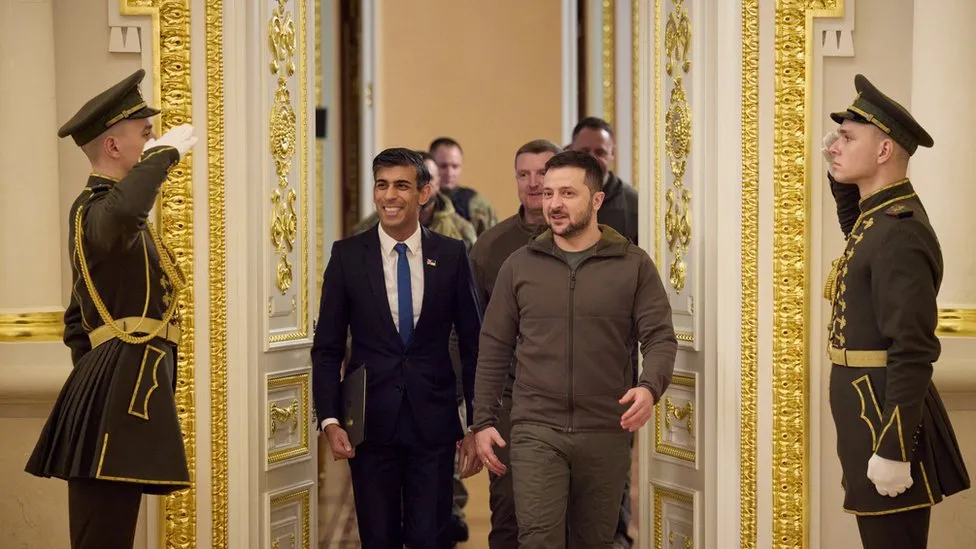
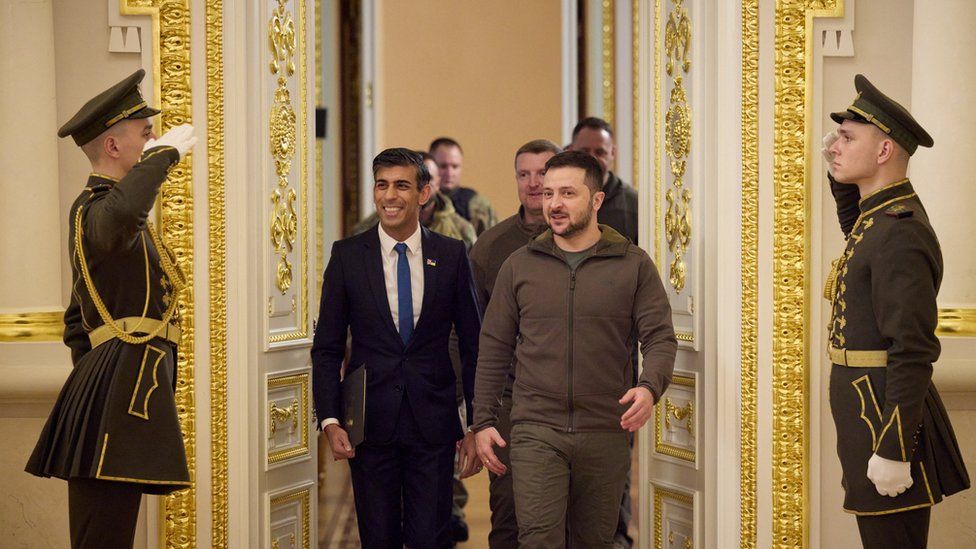
Image caption, Prime Minister Rishi Sunak said he was “humbled” to be in Ukraine as he met President Volodymyr Zelensky
Mr Sunak’s pledge to send more air defence support is exactly what President Zelensky would want to hear at a time when Russian airstrikes have destroyed nearly 50% of the country’s energy infrastructure, according to the government in Kyiv.
The men’s hopes for peace and a just outcome to the conflict may feel like distant prospects, but Mr Sunak’s promise to hold a reconstruction conference for Ukraine next year in London will be good news for the government and companies, which desperately need access to international finance.
During the visit, Mr Sunak also confirmed £12m for the World Food Programme’s response to Ukraine, as well as £4m for the International Organisation for Migration.
Downing Street said the funding would help provide generators and mobile health clinics, with the UK also sending tens of thousands of extreme cold winter kits for Ukrainian troops.
Labour’s shadow defence secretary John Healey tweeted: “The government continues to have Labour’s fullest backing to support Ukraine, reinforce Nato allies and confront Russia’s aggression.”
Ukraine has been requesting assistance from Western nations in recent months amid intense Russian aerial attacks on Kyiv and across the country.
Earlier in the week, Russia hit Ukraine with one of its biggest barrages of missiles yet, days after its troops were forced to withdraw from Kherson.
Kyiv was hit and there were strikes across the country, from Lviv in the west to Chernihiv in the north.
That attack coincided with the G20 summit in Indonesia this week where, in a virtual speech, Mr Zelensky said he was “convinced now is the time when the Russian destructive war must and can be stopped”.
IMAGE SOURCE,UKRAINIAN PRESIDENT’S OFFICE
Image caption,
Mr Sunak was shown destroyed military Russian vehicles by the Ukrainian president
While Mr Sunak was at the Bali summit, which was attended by Russia’s foreign minister Sergei Lavrov, the UK prime minister urged Russia to “get out of Ukraine” and condemned the country for its “barbaric invasion”.
He stressed the UK would “back Ukraine for as long as it takes”.
Britain is currently the largest provider of military aid to Ukraine aside from the US. So far the UK has committed about £2.3bn and has pledged to match that amount in 2023, according to the House of Commons library.
The UK is also hosting a programme which will aim to train 10,000 new and existing Ukrainian personnel within 120 days.
Mr Sunak’s predecessor Boris Johnson previously met Mr Zelensky in Kyiv in June and August, and Liz Truss was also a vocal supporter of Ukraine.
Mr Johnson became almost a cult figure in Ukraine, after he was one of the first international figures to publicly support Ukraine and send military assistance.
It is a tough comparison for Mr Sunak to live up to so early on in his premiership. Many people in Ukraine do not know the new prime minister well and they will want to see how committed he is to supporting the country.
Let’s rewind a moment. In July, Boris Johnson resigned. The leadership contest to replace him took all summer, meanwhile a crisis was brewing over soaring energy prices, largely driven by the war in Ukraine.
Liz Truss became prime minister in September, and her chancellor, Kwasi Kwarteng, quickly unveiled an emergency mini-budget, including help with energy bills for households and businesses.
But it wasn’t clear how the government was going to pay for its plans, which included a raft of tax cuts promised in order to boost economic growth.
This triggered turmoil on financial markets, and the value of the pound plummeted.
Three weeks after the mini-budget, Truss sacked Kwarteng, and replaced him with Jeremy Hunt, who ditched most of her plans. He also promised he would give a detailed statement on the economy.
Then Truss resigned, and Rishi Sunak was selected to replace her and Hunt stayed on as chancellor.
Hunt delayed unveiling his plan, and decided it would be a full Autumn Statement.
The governmentis set to announce tens of billions of pounds worth of spending cuts and tax rises, which will affect the take-home pay and household budgets of millions of people, as well as money for key public services.
Autumn Statements take place annually, between yearly Budgets (which happen in the spring). But this one is a bigger deal than usual.
When Rishi Sunak became prime minister, he said the UK faced a “profound economic crisis”. This will be the moment where we learn exactly how his government is going to tackle the crisis.
We’re expecting Chancellor Jeremy Huntto outline what’s going to happen to some of the things that shape our daily lives, such as taxes, benefits, pensions and help with energy bills.
Hunt has said his priorities are economic stability and restoring confidence. It comes in the wake of his predecessor Kwasi Kwarteng’s disastrous so-called mini-budget. That caused market turmoil and led to the resignations of both Kwarteng and former PM Liz Truss.
The Prime Minister’s plane from the other side of the world has just landed after a 17-hour shlep from the G20 Summit in Bali in Indonesia.
It’s fair to say none of us are rivalling daisies in the freshness stakes.
Today is likely to be a defining moment for the Prime Minister– as he maps out the contours of his governing strategy.
Rishi Sunak spoke to the Chancellor every day while he was away, despite the time difference, and his back to back appointments with world leaders.
“We will face into the storm,” Jeremy Hunt will tell the Commons later.
Not exactly the “let sunshine win the day” optimism of David Cameron all those years ago.
The brutal truth is that what sounds like good news to the financial markets – that the government is economically credible – will sound like bad news for millions of households.
Bad news is rarely politically popular and Conservative MPs in particular are no fans of tax rises.
But after the near death experience for the Tories in recent months they are – in the most part – likely to swallow it, and hope that being seen as competent, if they are, is the start of repairing their reputation and opinion poll ratings.
The latest case of alleged bullying to put pressure on Prime Minister Rishi Sunak is British Deputy Prime Minister Dominic Raab’s request for an independent investigation into two formal complaints about his behaviour.
Raab said on Wednesday that he had received notification of two separate complaints, one from his previous tenure as foreign minister and one from his previous tenure as justice minister.
Some officials who worked for him describe him as a tough and demanding boss, while others have been quoted in local media as being rude, aggressive, and a bully. Raab has denied the charges.
“I have written to the prime minister to request an independent investigation into two formal complaints that have been made against me,” Raab said on Twitter. “I look forward to addressing these complaints.”
Raab said in a letter he attached to his tweet he had “never tolerated bullying”, and had always sought to empower teams working in his departments.
‘Integrity, professionalism and accountability’
The new allegations put more pressure on Sunak, who used his first speech as prime minister last month to say his government would demonstrate “integrity, professionalism and accountability”.
Sunak defended his deputy this week, saying he did not recognise allegations that Raab had bullied staff.
Also on Wednesday, Sunak said that an investigation requested by Raab was the correct course of action.
“I know that you will be keen to address the complaints made against you and agree that proceeding in this way is the right course of action,” Sunak told Raab in a letter.
“Integrity, professionalism and accountability are core values of this Government. It is right that these matters are investigated fully.”
A cabinet minister, Gavin Williamson, resigned from the government last week over allegations he had bullied colleagues, raising questions about Sunak’s judgement just weeks into the job.
Rishi Sunak has said he is “hopeful” he will be able to meet with China’s President Xi Jinping at the G20 summit in Bali as he described how the county posed a “systemic challenge” to the UK.
Speaking to Sky’s political editor Beth Rigby, the prime minister said it was important to “engage” with the Chinese leader to try and tackle “shared challenges”.
He said: “I’m very clear that China poses a systemic challenge to both our values and our interests, and it represents the single biggest threat to our economic security.
“And that’s why it’s right that we take the steps that are necessary to protect ourselves against a threat or a challenge.”
Asked if he would be able to have a collaborative relationship with President Xi, he added: “I think our approach to China is one that is very similar to our allies, whether it’s America or Australia and Canada.
“I think it’s an indisputable fact of the global economy that China is a big part of it.
“And if we want to solve big global challenges like public health, like Russia and Ukraine,fixing the global economy or indeed climate change, it’s important to have a dialogue and to engage with China.”
The prime minister intends to use the summit to press the world’s most powerful economies to do more to reduce their reliance on Russian exports, while also encouraging others to do the same.
As he confronted Vladimir Putin’s officials at the G20 summit, Rishi Sunak said Russia must “get out of Ukraine and end this barbaric war.”
The prime minister made the remarks during the first session on Tuesday, criticising the absence of Russian President Vladimir Putin from the talks on the Indonesian island of Bali.
“It is notable that Putin didn’t feel able to join us here,” he said. “Maybe if he had, we could get on with sorting things out.
“Because the single biggest difference that anyone could make is for Russia to get out of Ukraine and end this barbaric war.
“The UK rejects this aggression. We will back Ukraine for as long as it takes.”
Mr Putin chose not to attend the talks, with the Kremlin blaming scheduling conflicts, but observers say officials are seeking to shield him from condemnation by world leaders.
Mr Sunak also rebuked Russia by saying “countries should not invade their neighbours”.
“It is very simple – countries should not invade their neighbours, they should not attack civilian infrastructure and civilian populations and they should not threaten nuclear escalation,” he said.
“Surely these are things on which we can all agree.”
The prime minister sat down with leaders of the world’s 19 biggest economies in Bali – the first meeting in the group’s 15-year history to be held in the shadow of a major European war instigated by one of its members.
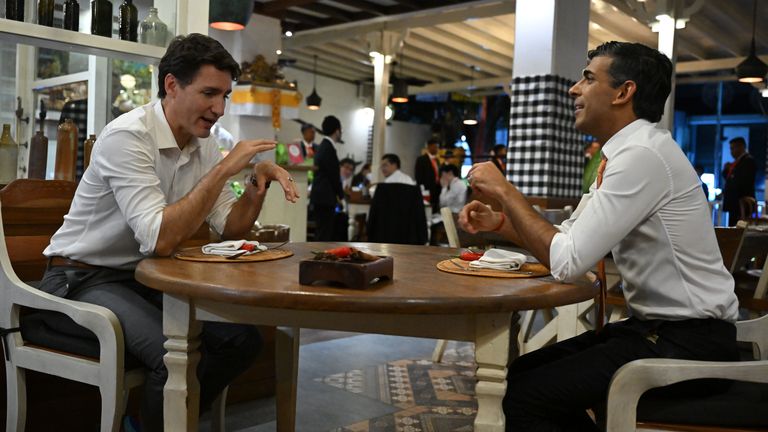
Image:Justin Trudeau, the Canadian leader, and Mr Sunak met at a Bali cafe on Monday
‘Chorus of opposition to Putin’
Mr Sunak will use the summit to push the world’s most powerful economies to do more to reduce their dependence on Russian exports, while supporting others to do the same.
He will also reiterate the UK’s financial support for Ukraine, saying he committed £4.1bn in aid when he was chancellor.
This included £2.3bn in military aid, while Mr Sunak will promise to match this level of spending next year.
Before the meeting, he said: “Putin and his proxies will never have a legitimate seat at the table until they end their illegal war in Ukraine.”
He continued: “At the G20, the Putin regime – which has stifled domestic dissent and fabricated a veneer of validity only through violence – will hear the chorus of global opposition to its actions.”
Many countries have stood firm, supporting Ukraine with weapons and aid, while imposing various sanctions on Russia.
Mr Putin sent Sergei Lavrov, the foreign minister, to the talks in his place.
He was taken to hospital on his arrival at the talks with a heart condition, the Indonesian authorities said – though the Russian foreign ministry dismissed the claims as “fake news”.
Last week, the UK introduced legislation to stop countries using its maritime services to transport Russian oil unless it is purchased below a price cap – which Number 10 described as a “hugely influential measure, given the UK provides around 60% of global maritime insurance”.
Three weeks to the day into the job; Rishi Sunak is on the world stage.
At the formal opening session of the G20 Summit, he said the “Putin regime” had “stifled domestic dissent and fabricated a veneer of validity only through violence” and is hearing “a chorus of global opposition to its actions”.
Sunak also addressed Russia’s representative in the room, the Foreign Minister Sergei Lavrov – the first time a British Prime Ministerhas confronted a senior Russian figure face-to-face since the war began.
Global leaders are debating topics like debt relief and food security at the G20 summit, which has begun on the Indonesian island of Bali.
Here’s what’s happened so far:
Ukraine President Volodymyr Zelensky made a virtual appearance at the summit, where he called for Russia’s “destructive war” to end
Similarly, UK PM Rishi Sunak criticised the “Putin regime”, saying it had “stifled domestic dissent and fabricated a veneer of validity only through violence”
Russian Foreign Minister Sergei Lavrov was in the room listening to Sunak’s comments – Vladimir Putin has decided not to attend.
Sunak also said he believed China posed a “systematic challenge” to the UK’s values, but did not clarify if he would commit – like his predecessor Liz Truss – to recategorising China as a “threat” to national security
About an hour ago, the leaders took a break from the summit to head for lunch at the luxury Apurva Kempinski hotel – with some of them being driven to the venue by Indonesian President Joko Widodo himself
Rishi Sunak’s only been in office for a matter of weeks.
This is his second overseas trip in the job — he dashed to the COP27 climate summit last week.
This summit will provide the first chance for a British PM to condemn Russia’s war in Ukraine to a senior Russian minister face to face.
Sunak will do that when all the countries’ representatives get together for a discussion involving all of them.
Russia’s Foreign Minister Sergei Lavrov is representing Vladimir Putin.
The prime minister confronts what he calls “the biggest economic crisis in a decade.”
It is a crisis, shared; big chunks of the world economy are already shrivelling or expected to soon.
But Rishi Sunakalso has to patch up what he calls the “mistakes” of his predecessor Liz Truss, and take on critics in his own party who fear cranking up taxes while simultaneously cutting spending risks making a bad situation worse.
On the first leg of this long flight to Bali, he told us the UK has stabilised “because people expect the government to take the decisions that will put our public finances on a sustainable trajectory… and that’s what the chancellor will do.”
Rishi Sunak has promised to “call out Putin’s regime” at an international summit in Indonesia.
On Sunday afternoon, the prime minister will travel to Bali for a G20 summit of the world’s largest economies.
British officials had planned for this meeting assuming Russia‘s president would attend.
The prime minister was expected to join other world leaders in publicly condemning Vladimir Putin.
But Moscow said last week he wouldn’t be attending and the Kremlin would be sending Russia’s foreign minister, Sergei Lavrov, instead.
So the words of anger will be directed at him.
Speaking before setting off for Indonesia, the prime minister said: “Putin’s war has caused devastation around the world – destroying lives and plunging the international economy into turmoil.
“This G20 summit will not be business as usual. We will call out Putin’s regime, and lay bare their utter contempt for the kind of international cooperation and respect for sovereignty forums like the G20 represent.”
The G20 is a hotchpotch of countries with little in common beyond big economies.
IMAGE SOURCE, SHUTTERSTOCK Image caption, None of the other G20 leaders want to pose for a smiling photo with Russia amid its invasion of Ukraine
An economic forum whose members have been hammered, economically, by one of their own, Russia.
The other leaders refuse to be seen smiling in the presence of Russia.
Recent precedent suggests another usual staple of these affairs, what is known as a communique, a set of agreed conclusions published at the close of the summit, probably won’t happen either.
Almost three weeks into the job, this is Mr Sunak’s second overseas trip as prime minister, after last week’s dash to the COP27 climate summit in Egypt.
He managed to see a good number of fellow European leaders in Sharm el-Sheikh.
The trip to Bali will mean he can meet plenty from the Indo-Pacific region, a part of the world the government has been increasingly focused on since Brexit.
And, perhaps, a first chance to meet US President Joe Biden.
Meanwhile, back home, as Laura Kuenssberg writes, Chancellor Jeremy Huntwill continue preparing what is called the Autumn Statement, a budget in all but name, to be delivered on Thursday, just hours after the prime minister gets back home.
Downing Street is seeking to frame both the summit and the Autumn Statement as responses to the same shock: the consequences of the war in Ukraine.
A desperate global economic situation, as they describe it, with big domestic implications, that they seek to be trusted to grapple with, after the chaos of the Liz Truss administration.
But a fractious summit followed by what many will see as a bad news Budget won’t make for an easy week for Mr Sunak.
The Guardian stated that after his reappointment by Rishi Sunak, civil servants in his office were provided with a “route out.”
The paper was told Mr Raab acted in a “rude” and “aggressive” manner between September 2021 and September 2022.
His spokesman said he “always acts with the utmost professionalism”.
The Guardian said it had spoken to multiple sources who claimed Mr Raab had created a “culture of fear” at the Ministry of Justice (MoJ), and who alleged his behaviour with civil servants had been “demeaning” and “very rude and aggressive”.
The paper claimed several sources told it that about 15 members of staff from Mr Raab’s private office were taken into a room where MoJ officials acknowledged they may be anxious about his return and gave them the option of moving roles.
It added it had been told that Antonia Romeo, the most senior civil servant in the MoJ, had spoken to Mr Raab on his return to the department to warn him that he must treat staff professionally and with respect.
No formal complaints have been made against the cabinet minister.
Labour has described the allegations as “deeply troubling” and has called for them to be investigated “urgently and independently”.
The party’s deputy leader Angela Rayner said Prime Minister Rishi Sunak must “come clean” about whether he knew about the claims when he reappointed Mr Raab to the MoJ, and said it raised questions about the PM’s judgement.
Ms Rayner said: “He claimed zero tolerance for bullying,promised a government of integrity and pledged to urgently appoint an ethics adviser, yet is falling far short on every promise.
“Rishi Sunak is already showing he is not just failing to stop the rot but letting it fester.”
Liberal Democrat deputy leader Daisy Cooper said the Tory government did not have “a shred of integrity left”.
“These latest reports are deeply disturbing and must be investigated immediately by the Cabinet Office,” she said.
Mr Raab, who was also previously deputy prime minister, was removed from his post by Liz Truss when she became prime minister in September.
But he was re-instated as deputy prime minister and justice secretary by Mr Sunak in October.
‘Zero tolerance of bullying’
A source close to Dominic Raab did not deny the option of a transfer was given to staff on his return, but pushed back against any suggestion of bullying.
They said Mr Rabb could be direct with staff and had high standards, but stressed there had not been a significant turnover of employees.
A spokesman for Mr Raab said: “Dominic has high standards, works hard, and expects a lot from his team as well as himself.
“He has worked well with officials to drive the government’s agenda across Whitehall in multiple government departments and always acts with the utmost professionalism.”
A MoJ spokeswoman said: “There is zero tolerance for bullying across the civil service.
“The deputy prime minister leads a professional department, driving forward major reforms, where civil servants are valued and the level of ambition is high.”
It comes after cabinet minister Sir Gavin Williamson resigned this week over allegations of bullying.
He is accused of sending abusive messages to a fellow Tory MP last month and of bullying a senior civil servant as defence secretary.
Sir Gavin said he “refuted” how his conduct had been characterized.
On Sunday, the first day of the COP27 climate summit in Sharm el-Sheikh, Egypt, Alaa Abd El-Fattah stopped eating and began refusing water.
According to his mother, Egyptian prison authorities intervened medically days after jailed British-Egyptian pro-democracy activist Alaa Abd El-Fattah escalated his hunger strike.
The nature of the intervention is unknown, but Mr Abd El-family Fattah’s is concerned that prison officials will force-feed him.
According to the family, this would be torture.
She told the Associated Press news agency she asked “if it was by force, and they said no” and told her “Alaa is good”.
Mr Abd El-Fattah had been on a partial hunger strike of 100 calories a day for the past six months.
He stopped all calorie intake and began refusing water on Sunday – the first day of the COP27 climate summit held in Sharm el-Sheikh in Egypt.
His hope was to get the attention of British Prime Minister Rishi Sunak, who attended the UN-led summit this week, and persuade him to take immediate action for his release.
Mr Abd El-Fattah is now in a prison hospital following the escalation in his hunger strike.
The activist said in an earlier letter that he was prepared to die in prison if not freed.
Ms Soueif has called for her son to be transferred to a civilian hospital rather than a prison facility.
“I need proof for this. I don’t trust them,” she said.
She has been waiting outside the prison every day this week, asking for proof her son is alive.
Mr Abd El-Fattah’s sister Mona Seif has said she has now been informed by prison officials that he is undergoing “medical intervention”.
The activist’s family have been increasingly worried for his health and continuously campaigned for his release ahead of COP27.
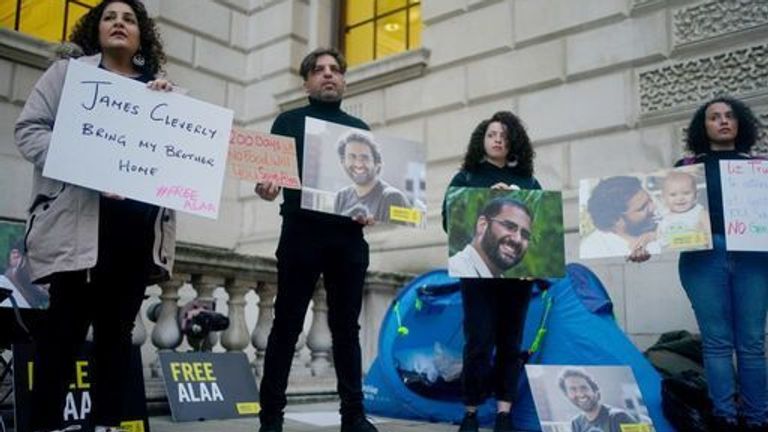
Image:Mona Seif (left), the sister of writer Alaa Abd el-Fattah, outside the Foreign Office in October
Mr Abd El-Fattah’s younger sister Sanaa Seif said last week in a public address to world leaders at COP27: “You are going to be in the same land as a British citizen dying.
“And if you don’t show that you care, it will be interpreted as a green light to kill him. My brother can be saved.”
“If you don’t save him, you have blood on your hands.”
Mr Abd El-Fattah rose to prominence during the pro-democracy uprisings in 2011 which took place throughout the Middle East and played a role in dismounting Egypt’s long-time president Hosni Mubarak.
World leaders and activists have repeatedly called for Egyptian authorities to release him.
At COP27, UK Prime Minister Rishi Sunak, French President Emmanuel Macron and German Chancellor Olaf Scholz raised the activist’s case in their talks with Mr el-Sissi.
Celebrities who have spoken out in support of Mr Abd El-Fattah include Dame Judi Dench, Dame Emma Thompson, Mark Ruffalo, Carey Mulligan andKhalid Abdalla.
Sir Keir Starmer referred to Sir Gavin as “a sad middle manager getting off on intimidating those beneath him” and a “cartoon bully with a pet spider”.
Rishi Sunak has said it is “absolutely right” that Sir Gavin Williamson resigned and admitted he has “regret” over appointing him as a cabinet minister in light of the allegations he is facing.
The prime minister insisted he “did not know about any of the specific concerns” relating to Sir Gavin’s alleged “unacceptable” behaviour in his former positions.
“How does the prime minister think the victim of that bullying felt when he expressed great sadness at his resignation?” the Labour leader asked.
Mr Sunak replied: “Unequivocally, the behaviour complained of was unacceptable and it is absolutely right, it is absolutely right, that the right honourable gentleman has resigned.
“For the record, I did not know about any of the specific concerns relating to his conduct as secretary of state or chief whip, which date back some years.
“I believe that people in public life should treat others with consideration and respect, and those are the principles that this government will stand by.”
Sir Keir later referred to Sir Gavin as “a sad middle manager getting off on intimidating those beneath him” and a “cartoon bully with a pet spider”.
Calling the prime minister “so weak” for not removing Sir Gavin from his post, the Labour leader continued: “What message does he think it sends when rather than take on the bullies, he lines up alongside and thanks them for their loyalty?” Sir Keir said.
Mr Sunak replied: “I obviously regret appointing someone who has had to resign in these circumstances but I think what the British people would like to know is that when situations like this arise that they will be dealt with properly.
“And that’s why it is absolutely right that he resigned and it’s why it is absolutely right that there is an investigation to look into these matters properly. I said my government will be characterised by integrity, professionalism, and accountability and it will.”
‘Do you regret appointing Gavin Williamson?’
Sir Gavin’s departure on Tuesday evening came shortly after an ex-civil servant – who claimed the MP told them to “slit your throat” – made a formal complaint.
A Number 10 source told Sky News it was Sir Gavin’s decision to resign following further allegations being made against him.
He is understood to have spoken to the PM in the early evening to offer his resignation.
In his resignation letter, the former cabinet minister vowed to clear his name of wrongdoing – and said he “refutes the characterisation of these claims”.
“I recognise these are becoming a distraction for the good work this government is doing,” Sir Gavin wrote to Mr Sunak.
Accepting the resignation “with great sadness”, Mr Sunak told Sir Gavin: “I would like to thank you for your personal support and loyalty.”
Sir Gavin – who had already been sacked by Theresa May and Boris Johnson – has also been accused of sending expletive-laden messages to former chief whip Wendy Morton where he complained about being refused an invitation to the Queen’s funeral.
He was also the subject of claims he bullied a former official at the Ministry of Defence and engaged in “unethical and immoral” behaviour while he was chief whip.
Late last night, Sir Gavin said he would not be taking severance pay, tweeting: “This is taxpayers’ money and it should go instead toward the government’s priorities like reducing the NHS’s waiting lists.”
Williamson vows to clear his name
Senior Tory MPs have alleged to Sky News that Sir Gavin “has been bullying for most of his career” and that his behaviour has “always been well known”.
One senior Tory MP, who was in cabinet with Sir Gavin, told Sky News: “He’s a bully, no two ways about it, it’s well known, it’s always been well known.
“His only talent is bullying. It was a mistake for Rishi to give him a job.”
The senior MP also claimed Sir Gavin, who was chief whip under Mrs May, “modelled his whipping style” on US drama House of Cards.
Another senior Tory MP was even more disparaging of Sir Gavin, calling him “an absolute little sh***” who “should never have been allowed in government”.
The MP called his appointment to Mr Sunak’s cabinet “beyond the pale”, adding: “I’d be surprised if the Cabinet Office didn’t warn the PM there would be a dim view taken if he was given a job.
“I have no idea on earth why anyone would employ him, he’s been bullying for most of his career.
“The spider in the box, the idea he’s got something over somebody… it astonished us all when he got into cabinet.”
Williamson ‘did right thing’ in resigning
The MP went on: “Thoroughly incompetent, thoroughly pathetic. He’s a nasty piece of work, who adds no value whatsoever. Rishi thinks he owes him, he doesn’t. If Gavin Williamson is the answer I don’t know what the hell the question is.”
Sky News has approached Sir Gavin for comment.
The PM’s press secretary said it would be a question for the Forfeiture Committee whether Sir Gavin should be stripped of his knighthood.
Sir Gavin’s third stint in the cabinet was by far his shortest, having made his return to the government only two weeks ago, when Mr Sunak appointed him as a minister without portfolio in the Cabinet Office.
The Times reports that, Mr Johnson has nominated two of his loyal advisers – Ross Kempsell, the Conservative Party‘s former political director, and Charlotte Owen, the former PM’s former assistant – to become the youngest life peers in history.
Labour has called on Rishi Sunak to block Boris Johnson’s “conveyer belt of cronies” resignation peerages.
Scotland Secretary Alister Jack, former culture secretary Nadine Dorries, former minister Nigel Adams and the outgoing COP26 President Alok Sharma are among those expected to be nominated by the former prime minister to be elevated to the House of Lords.
The Times newspaper also reports that Mr Johnson has nominated two of his loyal advisers – Ross Kempsell, the Conservative Party’s former political director and Charlotte Owen, a former assistant to the former PM – to become the youngest life peers in history.
A source close to Mr Johnson said: “We never comment on speculation about honours.”
Labour’s deputy leader Angela Rayner said the prime minister should “refuse to do Boris Johnson’s bidding” and reject his demands.
“This disgraced ex-prime minister’s plot to dodge democracy by trying to reward his MP lackeys with promised jobs for life in the House of Lords yet again puts the Tory Party’s interests before the public’s,” she said in a statement.
“These underhand attempts to game the system by installing a conveyor belt of cronies and skewing parliament in the Tories’ favour for decades to come should never see the light of day.
“Rishi Sunak should make it clear in no uncertain terms that he will refuse to do Boris Johnson’s bidding and reject his disreputable demands.”
Earlier today, a Conservative MP criticised those nominated by Mr Johnson for peerages.
“What a shameful list of bootlickers, bimbos and tropical island holiday facilitators who between them can be proud to have pushed trust in politics to an extreme low during their tenures and offered very little in return to the British people,” they told Sky News.
The politicians on the list are all understood to have agreed to delay heading to the Lords until the end of the current parliament to spare Mr Sunak the challenges of by-elections.
How the peerages for MPs would be delayed was unclear, but the suggestion was that the King would have to approve the arrangement, in a move appearing to be without precedent.
Shaun Bailey, the former London mayoral candidate who faced a backlash for attending a mid-lockdown Christmas party, was also said to be on the former prime minister’s list.
The prime minister’s resignation honours are distinctions granted by an outgoing prime minister.
A PM can request the reigning monarch to grant peerages, knighthoods, damehoods or other awards in the British honours system to any number of people.
Zayn Malik has asked Prime Minister to “give all children living in poverty” a free school meal.
In a letter to Rishi Sunak, the ex-One Direction member admits that as a child in Bradford, he relied on free school lunches.
Children are stealing food from canteens “because they are so hungry but can’t afford to buy lunch,” he writes.
He is supporting a Food Foundation campaign to make free school meals available to all children in Universal Credit households.
The charity estimates 800,000 children in England live in poverty but do not qualify for free school meals.
Although Malik, now known simply as Zayn, is not an ambassador for the charity, he said he felt compelled to write to the prime minister and to share his own experiences.
He wrote: “These children are suffering from lack of concentration, some even resorting to stealing food from school canteens because they are so hungry but can’t afford to buy lunch.
“I know what that shame feels like, I have seen it first-hand, as growing up in Bradford, I relied on free school meals.”
He is the latest famous name to support wider access to free school meals, joining England football star Marcus Rashford and celebrity chef Jamie Oliver.
Oliver has previously said he believed investing in free school meals for children would help the economy.
He said: “The reality is, if you speak to the best minds in economics, in the country, in the world, they will tell you that if you output healthier kids, you’re going to have a more productive, more profitable country.”
Teaching organisations claiming to represent a million teaching staff, governors and school trustees across the UK have also backed the campaign.
They warned not expanding eligibility to all Universal Credit households “would undermine all the great efforts of the education workforce to tackle inequalities”.
Zayn hopes his letter convinces the government to include a free school meal for all children living in poverty as part of the Autumn statement on 17 November.
The government has previously said it has already expanded access to free school meals more than any other in recent decades.
It has warned that the Feed the Future campaign has under-estimated the cost of expanding the scheme.
The government has said that, during term time, the government “provides more than 1.6 million free school meals, providing pupils from the lowest-income families with a free, nutritious lunchtime meal”.
Who is eligible for free school meals in England?
About 1.9 million children in England are eligible for free school meals, the government says, 22.5% of all pupils.
All infant-school pupils are eligible but children in Year 3 and above must live in a household receiving income-related benefits, with an annual income – after tax and not including welfare payments – no higher than £7,400.
About 40% of people who claim universal credit already have jobs and may earn above this threshold.
In Northern Ireland, the threshold is £14,000.
Scotland and Waleshave recently committed to offering free school meals to all primary pupils.
Rishi Sunak promised “more details in the coming weeks” while promising to “grab this challenge” with his French counterpart.
A deal between the UK and France to deal with people crossing the Channel in small boats is in its “final stages,” according to Downing Street.
Rishi Sunak met with French President Emmanuel Macron earlier today at the COP27 climate talks in Egypt to discuss the issue, and the prime minister said he left “with renewed confidence and optimism.”
Mr Sunak said there would be “more details in the coming weeks”.
Pressed on those details later, his official spokesman revealed a deal was close to being done and talks on the specifics were taking place separately, indicating they would involve Home Office officials.
Mr Sunak reportedly wants to agree targets with Mr Macron for stopping boats, and a minimum number of French officers patrolling beaches, and to be able to deploy Border Force officers in France.
The prime minister said he was “determined to grip” the situation, but added there was “not one simple solution that’s going to solve it overnight”, pledging to work with other European leaders on the “shared challenge”.
Speaking after the meeting, the French president also said he wanted better coordination between the two countries to cope with the issue.
Earlier, Labour leader Sir Keir Starmer said he would “work upstream” with Mr Macron “to stop the smugglers in the first place” if he were prime minister, adding: “Before I was a politician, I was director of public prosecutions, I know how these cross-border operations work.
“That is the discussion I would have, I hope it is the discussion that our prime minister will have.”
‘Challenge far from over’
The migrant crisis was brought into focus last week by overcrowding at the Manston processing centre in Kent, where 4,000 people who had made the crossing were packed into a space designed to hold 1,600.
It led to growing pressure on Mr Sunak over his reappointment of Home Secretary Suella Braverman, with claims she ignored legal advice and blocked people being moved to hotels, accusations she denies.
Speaking in the Commons this afternoon, Sir Roger Gale, the veteran Tory MPwho had described the Manston situation as “a breach of humane conditions”, said: “We are now nearly back to where we need to be with the Manston processing centre operating efficiently.”
He asked for assurance from Robert Jenrick, the immigration minister, that “Manston is a processing centre and not an accommodation centre”.
Mr Jenrick said the numbers were now down to less than 1,600 and that it was not the government’s “intention that Manston is turned into a permanent site for housing migrants”.
He said: “The population is now back at an acceptable level and that is a considerable achievement. It’s essential that it remains so and he is right to say that the challenge is far from over… we have to be aware of that and to plan appropriately.”
Conservative MP for North Thanet Sir Roger Gale told Sky News last week that the situation in the Manston migrant centre was a ‘breach of humane conditions’.
During the debate Lee Anderson, a Tory MP in Nottinghamshire, said that sourcing accommodation for “illegal immigrants” left him a “bitter taste” in his throat.
“I’ve got 5,000 people in Ashfield who want to secure council housing and they cannot get one. Yet, we’re here debating this nonsense once again,” he said.
“The blame lies in this place right now – when are we going to go back and do the right thing and send them straight back the same day?”
Mr Jenrick said the government “should be guided by both our common desire for decency because those are our values, but also hard-headed common sense”.
At the climate summit,Sanaa Seif said she will put pressure on leaders to release her activist brother Alaa Abd el-Fattah.As British Prime Minister Rishi Sunak and other world leaders kicked off the COP27 climate summit in Sharm el-Sheikh, the sister of Egyptian-British hunger striker Alaa Abd el-Fattah arrived to campaign for his release.
“I’m here to do my best to try and shed light on my brother’s case and to save him,” said Sanaa Seif, Abd el-Fattah’s sister, after arriving in Sharm el-Sheikh in the early hours of Monday.
“I’m really worried. I’m here to put pressure on all leaders coming, especially Prime Minister Rishi Sunak,” said Seif, who had recently been leading a sit-in outside the British Foreign Office in London.
Sunak has said he will raise Abd el-Fattah’s case with Egypt’s leadership. Abd el-Fattah had informed his family that he would stop drinking water on Sunday in an escalation of his protest.
The 40-year-old political activist rose to prominence with Egypt’s 2011 uprising but has been jailed for most of the period since. Sentenced most recently in December 2021 to five years on charges of spreading false news, he has been on hunger strike for 220 days against his detention and prison conditions.
Egyptian officials have not responded to calls for comment on Abd el-Fattah’s case, but have said previously that he was receiving meals and was moved to a prison with better conditions earlier this year.
Abd el-Fattah’s family said he was only consuming minimal calories and some fibre to sustain himself earlier in the year. After family visits in October, Seif said: “He looks very weak. He’s fading away slowly. He looks like a skeleton.”
Some rights campaigners have criticised the decision to allow Egypt to host COP27,citing a long crackdown on political dissent in which rights groups say tens of thousands have been imprisoned and raising concern over access and space for protests at the talks.
President Abdel Fattah el-Sisi has said security measures are needed to stabilise Egypt after the country’s 2011 revolution. Egypt is hoping to raise its diplomatic profile by hosting the United Nations climate talks.
Low expectations
More than 100 world leaders are preparing to discuss a worsening problem that climate scientists call Earth’s biggest challenge – greenhouse gas emissions – which leads to global warming.
The climate events are being held amid multiple global crises surrounding food, energy and rising inflation, and expectations for breakthroughs are seen to be low.
Dozens of heads of states or governments will take the stage on Monday, the first day of “high-level” international climate talks, in Egypt, with more to come in the following days.
“The fear is other priorities take precedence,” top UN climate change official Simon Stiell told a news conference.
The “fear is that we lose another day, another week, another month, another year – because we can’t”, he said.
In 2009, developed countries pledged to provide $100bn a year by 2020 for climate protection in poor countries. The pledge remained largely unfulfilled.
Only 29 of 194 countries have presented improved climate plans, as called for at the UN talks in Glasgow last year, Stiell noted.
French President Emmanuel Macron urged the United States, China and other non-European rich nations to “step up” their efforts to cut emissions and provide financial aid to other countries.
“Europeans are paying,” Macron told French and African climate campaigners on the sidelines of COP27. “We are the only ones paying.”
‘Loss and damage’
Fresh from his election victory, Brazil’s President Luiz Inacio Lula da Silva is expected to attend the summit later on, with hopes that he will protect the Amazon from deforestation after defeating climate-sceptic leader Jair Bolsonaro.
Sunak, another new leader, reversed a decision not to attend the talks and is due to urge countries to move “further and faster” in transitioning away from fossil fuels.
On Sunday, the heads of developing nations won a small victory when delegates agreed to put the controversial issue of money for “loss and damage” on the summit agenda.
Pakistan, which chairs the powerful G77+China negotiating bloc of more than 130 developing nations, has made the issue a priority.
“We definitely regard this as a success for the parties,” said Egypt’s Sameh Shoukry, who is chairing COP27.
The US and the European Union have dragged their feet on the issue for years, fearing it would create an open-ended reparations framework.
But European Commission Vice President Frans Timmermans welcomed the inclusion of loss and damage, tweeting that the “climate crisis has impacts beyond what vulnerable countries can shoulder alone”.
Screenshots acquired by The Sunday Times appear to show Sir Gavin Williamson sending expletive-laden messages, including a warning that “there is a price for everything.”
Downing Street has stated that Rishi Sunak has “full confidence” in Sir Gavin Williamson, despite the Cabinet Office minister being accused of bullying.
Sir Gavin allegedly sent abusive text messages to ex-chief whip Wendy Morton, complaining about being barred from attending the Queen’s funeral for political reasons.
However, Sir Gavin“expressed regret” about the messages sent to his colleague, according to the prime minister’s official spokesman.
He went on to say that the PM has a zero-tolerance policy for bullying within government.
“I think the prime minister has said that it’s right to let that process happen and he welcomes that Gavin Williamson has expressed regret about those comments, which as you say he doesn’t think are acceptable.”
The spokesman added that Mr Sunak believes Sir Gavin has an “important contribution” to make to government.
Mr Sunak is under pressure over bringing Sir Gavin back into the government.
The PM’s official spokesman said at the time Mr Sunak “knew there was a disagreement”, but was not aware of the “substance” of the messages.
Clarifying this on Sunday, Chancellor of the Duchy of Lancaster Oliver Dowden told Sky News’ Sophy Ridge on Sunday programme that the PM knew there was a “difficult relationship” between Sir Gavin and the-then chief whip, but “wasn’t aware” of “specific allegations” until Saturday evening.
Williamson ‘shouldn’t have sent’ texts
Mr Dowden added that Sir Gavin “regrets the language he used” and also suggested that a number of individuals had “a difficult relationship” with Ms Morton.
“These were sent in the heat of the moment expressing frustration. It was a difficult time for the party. He now accepts that he shouldn’t have done it and he regrets doing so. Thankfully, we are in a better place now as a party,” he said.
But Labour has called for an “urgent independent investigation” into the appointment of Sir Gavin, with shadow climate secretary Ed Miliband warning against a “cover-up” over the allegations.
Speaking on Sky News’ Sophy Ridge on Sundayprogramme, Mr Miliband said the matter “really calls into question Rishi Sunak’s judgement and the way he made decisions about his cabinet”, adding Sir Gavin’s reappointment was “not in the public interest”.
“There needs to be an urgent independent investigation into exactly what happened. We can’t have a cover-up, we can’t have a whitewash here,” he said.
“What did Rishi Sunak know? When did he know it? What did Gavin Williamson do and what are the implications of that?”
While Labour leader Sir Keir Starmer said Sir Gavin is “clearly not suitable” for the job, calling his appointment a sign of how “weak” Rishi Sunak is.
“I think that the prime minister has got people who are clearly not fit for the job around the cabinet table,” he told reporters.
Screenshots leaked to The Sunday Times appear to show expletive-laden messages from the South Staffordshire MP, including a warning that “there is a price for everything”.
Another message reads “think very poor how [Privy Councillors] who aren’t favoured have been excluded from the funeral”.
A source confirmed to Sky News that the contents of the messages were accurate.
Former chairman of the Conservative Party, Sir Jake Berry, has said he told Mr Sunak a bullying complaint had been made against Sir Gavin a day before he entered Number 10.
Sir Gavin has been approached for comment.
The Sunday Times quoted the Cabinet Office minister as saying: “I of course regret getting frustrated about the way colleagues and I felt we were being treated. I am happy to speak with Wendy and I hope to work positively with her in the future as I have in the past.”
Liberal Democrat deputy leader Daisy Cooper accused Mr Sunak of ignoring the complaint and called for Sir Gavin to be sacked.
But former environment secretary George Eustice described the matter as “a storm in a teacup”.
“I think Gavin’s apologised for this, he accepts it’s wrong to use that kind of language but equally he was very frustrated and I’m not quite sure why the chief whip referred this up the party instead of trying to resolve it between the two of them,” he told Sky News.
Mr Eustice continued: “It was wrong, he shouldn’t have used that sort of language – and the chief whip probably should have been talking to him instead of texting him – but it is a storm in a teacup in the context of the great challenges we face”.
At the weekend, a Tory party spokesman said: “The Conservative Party has a robust complaints process in place. This process is rightly a confidential one, so that complainants can come forward in confidence.”
Sir Gavin was sacked as defence secretary in 2019 following the leaking of confidential information from the National Security Council.
After being appointed education secretary by Boris Johnson, he was dismissed from cabinet again in 2021 following controversy around the grading of exams during the pandemic.
It marks the second major controversy to erupt over Mr Sunak’s cabinet appointments, with the PM already under fire for making Suella Braverman his home secretary days after she was sacked for security breaches.
Prime Minister Rishi Sunakhas written to the family of a jailed British-Egyptian writer as he demanded an end to the detainee’s “unacceptable treatment” in prison in Cairo.
Alaa Abd El-Fattah has been kept behind bars in Egypt for most of the past decade and was sentenced in December after being accused of spreading fake news.
His sisters, Sanaa and Mona Seif, along with other family members, are protesting the imprisonment of the pro-democracy writer and activist.
They started a sit-in in Whitehall on 18 October and intend to continue it until the COP27 conference.
In an official letter, shared by the prisoner’s family with Sky News, Mr Sunak said he had been “following Alaa’s case closely and was concerned to hear about his deteriorating health”.
He added: “I appreciate this must be an extremely painful time for your time for your brother’s case; he remains a priority for the British government, both as a human rights defender and as a British national.
“Ministers and officials continue to press for urgent consular access to Alaa as well as calling for his release at the highest levels of the Egyptian government.”
Mr Sunak told El-Fattah’s family his predecessor Boris Johnson had raised the case with Egyptian President Abdel Fattah al Sisi.
However, his sister Sanaa told Sophy Ridge on Sunday that it might be “too late” by the time the COP27 conference is over, because her brother has stopped drinking water.
She adds she believes Mr Sunak can make a difference – but he needs to work hard with the Egyptians to do so.
Sanaa has also urged the British government to secure proof of life.
Workers are set to see more money in their pay packets as a rise in National Insurance is being reversed today.
National Insurance contributions rose by 1.25 percentage points in April as part of plans to help pay for social care and deal with the NHS backlog.
Most employees will see a cut to their contribution directly via their employer’s payroll in their November pay – although some may be delayed until December or January.
Almost 28 million people will keep an extra £330 of their money on average next year, while 920,000 businesses will save an average of almost £10,000, the Treasury said.
The measure, introduced by Boris Johnson’s government with Rishi Sunak as chancellor, was reversed by former chancellor Kwasi Kwarteng in his controversial mini-budget last month.
Its scrapping is one of few economic policies planned by Liz Truss and Mr Kwarteng that has not been ditched by new chancellor Jeremy Hunt.
More now fromcabinet minister Oliver Dowden, who is doing the media rounds this morning.
He said Rishi Sunak is “totally committed” to dealing with the issue of migrants crossing the Channel.
Mr Dowden told the BBC that there was no easy “panacea” but that voters were entitled to expect ministers to “grip” the problem.
“This is a totally deplorable situation. It is dangerous for the people concerned. It enriches (people trafficking) gangs. That is exactly why the prime minister is totally committed to gripping this,” he said.
“I do not dispute for a second that this situation has gone too far and why people are angry about it. Clearly we need to do more on this.
“The prime minister is totally seized of this to make sure that we work through each aspect of this to make sure that we start to control these numbers. I am not saying this is going to be easy at all.”
Prime Minister Rishi Sunak has sworn to get the UK off polluting fossil fuels and on to more clean power in order to secure energy supplies, bucking claims by his predecessor Liz Truss that oil and gas expansion was vital.
Addressing world leaders at COP27 in Egypt on Monday, Mr Sunak will argue the “shock” to global energy markets triggered by Russia’s invasion of Ukraine underscores the need to move to cheaper, cleaner, safer energy sources.
Amid domestic economic woes, the PM had declined the invite to the biggest climate summit of the year.
But this week, Mr Sunak made a dramatic U-turn following intense criticism he was missing an environmental and geopolitical opportunity.
In a statement before his departure on Sunday for Sharm El-Sheikh on the Red Sea, Mr Sunak said fighting climate change is not just a “moral good” but “fundamental to our future prosperity and security”.
“Russia’s invasion of Ukraine and contemptible manipulation of energy prices has only reinforced the importance of ending our dependence on fossil fuels,” he said.
Number 10 will hope the promise to make the UK a “clean energy superpower” smooths the way for negotiations at COP27, where almost 200 countries must each bring something to the table in the expectation others do the same.
She was given the job back. That was already controversial.
There was a view amongst some that Rishi Sunak had done that in order to bring the right of the party, because Suella Braverman is considered a figurehead on the right, to bind the right of the party into his government, because he doesn’t want all these divisions.
But at the same time, there’s no sense that Rishi Sunakin the way that Boris Johnson stood firmly behind Priti Patel, who is the former home secretary, so there’s not a sense that Rishi Sunak is necessarily standing behind Suella Braverman.
And one source said to me, one ally of Rishi Sunak said to me this week, that actually there’s a view that perhaps the migrant crisis, the small boat crisis, is such an intractable, difficult problem.
Maybe he is happy for her to own that, to take responsibility for that problem.
And if she falls on her sword because of that problem, maybe for Rishi Sunak, that’s quite useful because he can say to the right of the party, Well, I gave her the opportunity.
Rishi Sunak’s spokesperson saysclaims they are ditching the £20bn project are not accurate and the government hopes to get a deal over the line as soon as possible.
But the site’s future was cast into doubt overnight after reports claimed it was being reviewed ahead of the chancellor’s autumn statement in just under two weeks – with Treasury sources telling Sky News “all options are on the table” to fill the fiscal black hole in government finances.
Now, Rishi Sunak’s official spokesperson says the reports are “not accurate” and “our position remains the same”, adding negotiations are “ongoing and constructive”.
The £20bn Sizewell C project aims to generate enough low-carbon electricity to supply six million homes and help protect the UK from energy market volatility.
The plant is a joint endeavour with French energy giant EDF and is expected to take a decade to build.
While it has the backing of the Labour Party and unions, critics say the plans are too expensive and the new power source will take too long to come online.
Rishi Sunakhas said he will attend the COP27 climate summit in Egypt in a U-turn from his previous snub.
Rishi Sunak has said he will go to COP27 in Egypt, in a reversal of his previous snub.
In a statement on Twitter, the prime minister said: “There is no long-term prosperity without action on climate change.
“There is no energy security without investing in renewables. That is why I will attend COP27 next week: to deliver on Glasgow’s legacy of building a secure and sustainable future.”
The pressure was growing on the PM after Boris Johnson confirmed to Sky News yesterday that he would be going to the climate summit.
Labour’s deputy leader, Angela Rayner, said Mr Sunak had to be “dragged kicking and screaming into doing the right thing”, and called the U-turn “embarrassing”.
Ed Miliband, the shadow climate secretary, said: “The prime minister has been shamed into going to COP27 by the torrent of disbelief that he would fail to turn up.
“He is going to avoid embarrassment not to provide leadership.”
Caroline Lucas, the Green Party’s only MP, said: “Glad to see Sunak’s screeching U-turn on COP27, but what an embarrassing mis-step on the world stage.
“Let this be a lesson to him – climate leadership matters.
“Now he urgently needs to increase UK ambition on emission reduction targets& pay what we owe to global climate funds.”
Mr Sunak initially said he was not going to head to the conference in Sharm El-Sheikh due to “other pressing domestic commitments”.
But the PM faced a raft of criticism, with Labour leader Sir Keir Starmer accusing him of displaying a “failure of leadership” and Greenpeace UK saying he was not taking climate change “seriously enough”.
Within days, Downing Street changed course, saying the PM’s attendance was “under review”, depending on progress around preparation for the economic statement, set for 17 November.
A No 10 source told Sky News that Mr Sunak and Chancellor Jeremy Hunt have made “good progress” on the autumn statement after working on it over the weekend and this week.
Suella Braverman,the Home Secretary, is expected to give a speech in the House of Commons this afternoon.
It comes as she faces mounting scrutiny for her handling of government information and decisions to postpone the transfer of migrants from overcrowded detention centres to hotels.
In a letter to the Home Affairs Select Committee published in the last hour, Ms Braverman admitted to breaching rules around using her personal email address for government business on six occasions.
The home secretary has been urged to get a “grip” of the situation with migrants in the south of England.
Some 4,000 people have been held at Manston in Kent, a facility designed to hold fewer than 2,000 people.
It is believed her statement today will be on the situation in Manston.
Almost 500 people crossed the Channel in small boats yesterday, and a person threw incendiary devices at a facility in Dover.
One issue has stoodout like a sore thumb amid the relative political calm that has washed over Westminster in the last five days.
Suella Braverman’s reappointment as home secretary a week after she resigned over security breaches has perplexed and befuddled Conservative MPs and officials.
Given Rishi Sunak’s commitment to integrity, the perception that a great office of state was traded away for support in the race for Number 10 has riled some.
A former cabinet minister said: “Rishi has screwed up and done a grubby deal to get support… he comes out and says ‘I am the savior, I’m whiter than white’ but he’s grey when push comes to shove.”
Another former minister said Mr Sunak was “desperate for her not to back Boris as they were terrified of an election. He needed a coronation as he’s frightened of any electorate.”
Downing Street denied any deal was done.
But there are also live questions about Mrs Braverman’s suitability for the role.
Her resignation just 11 days ago came after she sent a sensitive government document from her personal email account.
One of the recipients was a veteran Conservative MP who is said to be a regular confidante of the home secretary.
But she also accidentally copied in a parliamentary staffer who works for another Tory MP.
The government says Home Secretary Suella Bravermanprevented migrants from being transferred from short-term holding centres to hotel rooms in order to “speed up” their applications.
According to Environment Minister Mark Spencer, the government is facing “huge challenges” in managing the migrant situation.
Over the weekend, petrol bombs were thrown at a migrant centre in Dover, while MRSA and diphtheria were reported at another one (Manston, see the previous post) amid overcrowding.
Asked about reports Ms Braverman blocked migrants being moved from short-term holding centres to hotels, Mr Spencer said this was done because the home secretary “wants to process them quickly” and make sure only “genuine” asylum seekers are admitted to the UK.
He added that the way to cut down on migrants crossing the channel is to “break the model” of people traffickers.
Meanwhile, Mr Spencer said that Rishi Sunak would go to COP27 “if he’s got time” and that the prime minister has “an inbox which is full to the brim“.
Rishi Sunak has congratulated Lula da Silva for winning the election in Brazil, beating out incumbent Jair Bolsonaro.
Mr Sunak said this morning on Twitter: “Congratulations to Lula da Silva on his victory in Brazil’s election.
“I look forward to working together on the issues that matter to the UK and Brazil, from growing the global economy to protecting the planet’s natural resources and promoting democratic values.”
Labour Leader Sir Keir Starmer also congratulated Mr da Silva, saying: “This win must also be the start of a new era of global cooperation and action in the fight against climate change.”
Labour is demanding that Rishi Sunak “come clean” about Suella Braverman’s security breach.
Ms Braverman resigned as home secretary under Liz Truss last week after violating the ministerial code by sending an official document from a personal email account. Rishi Sunak reappointed her on Wednesday.
Her reappointment has been criticized.
Labour’s Shadow Home Secretary Yvette Cooper said her party will try to “force the government to come clean”.
A number of sources have disputed Ms Braverman’s account of events.
So far new Prime Minister Mr Sunak has resisted demands to launch an inquiry into Ms Braverman’s security breach, despite Labour and the Liberal Democrats raising “national security” concerns and calling for a Cabinet Office probe.
Ms Braverman has also refused to appear before MPs to explain what happened.
Labour wants ministers to share risk assessments of this and other alleged leaks, as well as the information given to the prime minister before he put her back in the Home Office.
Shadow Home Secretary Yvette Cooper said Ms Braverman’s appointment “raises serious doubts” about the prime minister’s judgment and that the pair could not continue to hide from questions.
“Rishi Sunak’s decision to reappoint Suella Braverman was deeply irresponsible.
“Labour will use every parliamentary mechanism open to force the government to come clean over her reappointment, to get answers, and to require detailed documents to be released to the Intelligence and Security Committee.”
Sources dispute events
BBC News has spoken to several people with knowledge of the events surrounding Ms Braverman’s resignation.
A number of them dispute Ms Braverman’s claim to have reported her mistake to the cabinet secretary – the head of the civil service – as soon as she realised.
When confronted about her transgression she attempted to play down and explain away what had happened, sources suggested.
Ms Braverman had emailed a draft written ministerial statement on immigration policy to her close political ally, Conservative MP Sir John Hayes, using her personal email instead of her official government account.
Speaking to reporters on Friday, Labour leader Sir Keir Starmer demanded the home secretary was fired, accusing Mr Sunak of brokering a “grubby deal trading security for support” in the Conservative leadership contest.
But the prime minister insisted Ms Braverman had “learned from her mistake” and that he does not regret the appointment despite some Tory MPs adding also expressing concern.
Backbench MP Caroline Nokes backed opposition calls for an inquiry and former Tory chairman Sir Jake Berry described the breach as “really serious”.
After a backlash over a skit he did about Rishi Sunak’s appointment as Prime Minister, comedian Trevor Noah says he did not claim “the entire UK is racist.”
Earlier this week, Noah said on the US news show The Daily Show that there had been a “backlash” over Mr Sunak.
In the UK, many people, including ex-chancellor Sajid Javid, called Noah’s remarks “simply wrong.”
But Noah has now defended his segment, saying he was reacting to racists, and: “That’s why I said. ‘Some people’.”
Mr Sunak is the UK’s first British Asian prime minister and officially took over as Conservative leader and PM on Tuesday, after a leadership process.
In the original comments on the US programme, Noah – who is South African and grew up during apartheid – said: “You hear a lot of the people saying ‘Oh, they’re taking over, now the Indians are going to take over Great Britain and what’s next?’
“And I always find myself going ‘So what? What are you afraid of? I think it’s because the quiet part that a lot of people don’t realise what they’re saying is, ‘We don’t want these people who were previously oppressed to get into power because then they may do to us what we did to them.’”
During his skit, Noah played a clip from radio station LBC during the latest Conservative leadership race a week ago, when a caller falsely claimed Mr Sunak was “not even British”.
Mr Javid tweeted in response that the comments from the comedian were “so wrong” and that Britain “is the most successful multiracial democracy on earth and proud of this historic achievement”.
Former Tory leadership contender Rory Stewart said Mr Noah’s remarks were “completely bizarre” and an example of “lazy stereotyping”.
Downing Street said on Thursday that Mr Sunak did not believe Britain was a racist country.
Presenter Piers Morgan also tweeted that US media was “falsely portraying Britain as a racist country”.
Noah finally responded on Friday evening, saying: “C’mon Piers, you’re smarter than that.
“I wasn’t saying “The entire UK is racist”, I was responding to the racists who don’t want Rishi as PM because of his race. That’s why I said. “Some people”.”
C’mon Piers you’re smarter than that. I wasn’t saying “The entire U.K. is racist”, I was responding to the racists who don’t want Rishi as PM because of his race. That’s why I said. “Some people” 🙃https://t.co/QQgEQ45wJUhttps://t.co/bhurdPvsE8
Noah has long spoken about racial equality, publishing a book in 2017 titled Born a Crime, a reference to the fact he was born in South Africa to a white Swiss father and a black Xhosa mother, at a time when such a relationship was punishable by imprisonment.
He began his career in South Africa, releasing a string of stand-up specials and hosting a late-night talk show before relocating to the US in 2011.
He has hosted The Daily Show – a late-night talk and satirical news programme – since 2015 but last month announced he would be standing down.
Mr Sunak was born in Hampshire, south-east England, to Indian parents – a pharmacist mother and a GP father – and is married to Akshata Murty, with whom he has two young daughters Krishna and Anoushka.
Downing Street announced that the UK and France will step up cooperation to combat migrant crossings in the English Channel.
Rishi Sunak spoke with President Emmanuel Macron for the first time as Prime Minister on Friday.
According to No. 10, the two men expressed a commitment to “deepening” their work to prevent “deadly journeys.”
A statement from the Elysée Palace after the call made no specific mention of migrant boats.
There have already been promises to deepen cooperation earlier in October after then-Prime Minister Liz Truss met with Mr Macron in Prague earlier this month.
The pair pledged an “ambitious package of measures” to be announced this autumn.
Downing Street has refused to give details on any future plans or when an announcement will be made.
But Mr Sunak is said to have “stressed the importance for both nations to make the Channel route completely unviable for people traffickers”.
In 2021, the UK agreed to pay France £54m to boost patrols along France’s northern coast.
A report, in The Times, says Mr Sunak wants to close a new deal with France, including targets for how many boats are stopped.
It has been claimed that the French “pulled the plug” on a draft agreement back in the summer after Liz Truss said the “jury’s out” on whether Emmanuel Macron was a friend or foe.
The Elysée has previously declined to comment while Ms Truss and Mr Macron appeared to patch things up after their October meeting in Prague.
The new prime minister chose on Friday to strike a markedly warm tone towards the French president.
Following their phone call, No 10 emphasized areas of cooperation – including climate change, defence, the war in Ukraine, and energy.
According to Downing Street, Mr Sunak “stressed the importance he places on the UK’s relationship with France – our neighbour and ally”.
The Elysée said Mr Macron spoke of his willingness to deepen ties in defence and energy.
The UK and France have clashed in recent years over post-Brexit fishing rights, the AUKUS security pact, and migration.
In November 2021, 27 people died in the worst-recorded migrant tragedy in the Channel.
But the UK was disinvited from a ministerial meeting on the issue after Mr Macron accused Boris Johnson– prime minister at the time – of not being serious.
There is speculation that Mr Sunak may forge a more positive relationship with the French president than with his two predecessors.
They are close in age, often seen as “slick” in appearance, and worked in banking before turning to politics.
IMAGE SOURCE, REUTERS Image caption, They clashed but before leaving office, Mr Johnson described the French president as “a très bon buddy”
“I think in terms of style, they’re quite compatible,” says Lord Ricketts, who previously served as the UK’s ambassador to France.
However, the cross-bench peer notes that in substance, they’re a long way apart on certain issues.
Mr Sunak was a Brexit supporter in 2016 while Emmanuel Macron is passionately pro-European.
The new prime minister has also signalled he intends to push ahead with certain policies, strongly disliked by the Elysée.
They include sending asylum seekers to Rwanda and pursuing legislationthat could allow ministers to override parts of the post-Brexit deal for Northern Ireland.
“But at least there’ll be a more serious dialogue than there ever was under Boris Johnson, provided Rishi Sunak can stay away from using France as a political football,” says Lord Ricketts.
In August, before leaving Downing Street, Boris Johnson said Emmanuel Macron was a “très bon buddy” and described the UK-France relationship as one of “huge importance.”
Sir Jeffrey Donaldson, the DUP leader, has stated that his party does not believe any progress has been made to alleviate concerns about the Northern Ireland Protocol, and thus will not support the nomination of ministers to the executive.
Speaking to reporters today, Sir Jeffrey said: “We were given a clear mandate in the assembly elections that we would not nominate ministers to an executive until decisive action is taken on the protocol to remove the barriers to trade within our own country and to restore our place within the United Kingdom internal market.
“That remains our position.
“And so today we will not be supporting the nomination of ministers to the executive.”
He went on to say he would “not rest” until the issue was resolved.
Rishi Sunaktold Australia’s Prime Minister Anthony Albanese that he is “excited” about the two countries relationship.
During a phone call today, the new Tory leader told Mr Albanese that the free trade agreement, Aukus, and the UK’s potential accession to a comprehensive and progressive Trans-Pacific Partnership agreement were all examples of the two countries’ strong relationship.
A Downing Street spokeswoman said: “The prime minister said he was excited by the relationship between the UK and Australia, which was built on deep friendship and a shared approach to global challenges.”
The new prime minister also “welcomed” Australia’s strong support to Ukraine, including the decision to deploy the Australian military to the UK to train Ukrainian forces.
“Both looked forward to meeting in person at the G20 next month,” the spokeswoman added.
In his first week in office, the PM is fighting a battle on two fronts: over his home secretary and the widely anticipated government spending squeeze.
The latter has already stirred Tory unrest, with former minister Maria Caulfield suggesting the government should stick to the 2019 manifesto and saying indecision over pensions means “people start to worry”.
The PM notably hasn’t ruled out that the pensions triple lock could be on the chopping board, unlike his predecessor Liz Truss, as speculation mounts over a new age of austerity when the chancellor unveils his budget plans next month.
Rishi Sunak has repeatedly said “difficult decisions” are on the horizon.
The more immediate threat, though, is Suella Braverman.
The home secretary, whose backing boosted Mr Sunak’s leadership bid, broke the minister code “multiple times”, Tory MP Jake Berry said last night.
The former party chairman’s comments were seized on by Labour this morning – and they show backbench MPs are already able to make Mr Sunak’s life difficult.
This morning another Tory MP, Caroline Nokes, said there are “big questions hanging over this whole issue”.
There are indeed questions: Was the PM warned by the cabinet secretary when he appointed Mrs Braverman (as one source told political editor Beth Rigby)?
Why did he not heed that warning? And what were the exact circumstances of her breach of the ministerial code?
For a new prime minister who says he wants to do things differently, Mr Sunak may well need to address these questions directly.
One cabinet source told me the PM would not risk losing his home secretary, sacking her would certainly be a bold move that would rumble the carefully balanced semblance of party unity.
The government says she admitted her mistake and is allowed a second chance, but it is clear Mr Sunak’s decision to appoint Mrs Braverman has come at a political cost.
DISCLAIMER: Independentghana.com will not be liable for any inaccuracies contained in this article. The views expressed in the article are solely those of the author and do not reflect those of The Independent Ghana
A Conservative MPhas demanded an investigation into Suella Braverman’s appointment as Home Secretary.
Ms Braverman resigned on Wednesday last week after using a private email to share government information with a backbench MP. This week, she was rescheduled for Tuesday.
Speaking to the BBC this morning, Caroline Nokes said there are “big questions hanging over this whole issue”.
“And to be frank I would like to see them cleared up so that the home secretary can get on with her job,” she added.
“If that means a full inquiry then I think that’s the right thing to do.”
Meanwhile, the government confirmed Rishi Sunak “sought assurances” from Ms Braverman that she would not breach the ministerial code again when he re-appointed her home secretary.
Oliver Dowden, the chancellor of the Duchy of Lancaster was asked in the House of Commons by Labour about the claims Ms Braverman breached the ministerial code “multiple” times (6.31 am post).
Mr Dowden said the home secretary had accepted she made “errors of judgment” – and that the prime minister had “sought assurances to ensure that would not happen again”.
He once again refused to share any private communications between the cabinet secretary and prime minister about the appointment of Ms Braverman, saying this was never done in government.
Mr Dowden repeated what was being said by Downing Street yesterday, in that an independent ethics adviser is set to be appointed soon.
Liz Truss liftedthe Conservatives’ 2019 ban on fracking for shale gas, claiming it would help with rising energy costs. However, the measure was opposed by many Conservatives whose constituents are opposed to fracking in their areas.
Rishi Sunak is reinstating the ban on fracking that Liz Truss controversially lifted.
During Prime Minister’s Questions on Wednesday, the new prime minister said he stands “by the manifesto” on fracking.
The Conservative 2019 manifesto placed a moratorium on fracking in England following opposition from environmentalists and local communities.
Mr Sunak’s spokesman explicitly confirmed he was reinstating the ban after PMQs.
Ms Truss lifted the ban last month as part of her plan to limit rising energy costs but said fracking would only resume where there was local consent.
Fracking was ultimately what brought her government down after Labour tabled an opposition day motion last Wednesday calling for a draft law to ban fracking.
But the Tory party whips said the motion was actually a vote of confidence in the government and told Conservative MPs they had to vote against it or face being suspended.
However, many of them and their constituents are opposed to fracking and said they could not vote to support fracking, even if the whips saw the vote as something different.
As the vote was taking place there were accusations of “bullying” and “manhandling” of Tory MPs who were being told to vote against the motion.
Ed Miliband, Labour’s shadow climate and net zero secretaries, said Mr Sunak voted against Labour’s fracking ban last week and is now putting a moratorium on the practice.
“Whatever their latest position, the truth is that the Tories have shown that they cannot be trusted on the issue of fracking,” he said.
Ms Truss had to make a number of U-turns after her chancellor Kwasi Kwarteng brought in a raft of unfunded tax cuts which unleashed economic turmoil in the UK for weeks.
Mr Sunak has, so far, kept most of those U-turns but the fracking ban is the first Truss policy he has reversed since he became PM on Tuesday.
President Nana Addo Dankwa Akufo-Addo has congratulated the newly-appointed British Prime Minister, RishiSunak.
In a tweet on Tuesday, President applauded the 42-year-old premier on “becoming the 57th British prime Minister in this difficult period of his country’s and the world’s fortunes”
“I am hopeful that his tenure of office will strengthen and deepen even further the ties of cooperation, collaboration and friendship between Ghana and Great Britain, and provide us with the platform to create progress and prosperity for our respective peoples,” he wrote.
Sunak, a member of the Conservative Party, officially took over from Liz Truss on Tuesday.
He became the United Kingdom’s third prime minister this year and the first non-white person to hold the job.
Rishi Sunak has announced that he will appoint a new independent ethics adviser to fill the vacancy left by Boris Johnson and Liz Truss.
Downing Streetannounced on Wednesday that the new Prime Minister will soon appoint a new independent ministerial interests adviser.
Lord Geidt, the previous ministerial interests adviser, resigned in June and was not replaced when Boris Johnson resigned.
Ms Truss, during her brief tenure in Downing Street, had not appointed an ethics adviser.
The prime minister’s official spokesman said that the appointment of the new ethics adviser would be “done shortly”.
Cabinet Office minister Jeremy Quin also confirmed in the Commons that “it is absolutely the prime minister’s intention to appoint an independent adviser”.
Under Mr Johnson’s tenure, two ethics advisers quit within two years.
Veteran civil servant Sir Alex Allan resigned as ethics adviser in November 2020 after Mr Johnson failed to act on a critical report on alleged bullying by then Home Secretary Priti Patel.
His successor, Lord Geidt, resigned in June this year after accusing Mr Johnson of proposing a “deliberate” breach of the ministerial code.
Earlier in the day, Rishi Sunak asked Sir Keir Starmer his first Prime Minister questions.
Body language expert Darren Stanton says the new prime minister “came alive” in the Commons, and was far more “animated” than his “lacklustre” speech outside Number 10.
He said: “Rishi Sunak was definitely thrown in at the deep end. The pleasantries were short-lived as both the PM and Sir Keir wasted no time in the gloves coming off.
“Sir Keir vigorously challenged Mr Sunak’s decision to reinstate the Home Secretary [Suella Braverman] after she had resigned – Sir Keir was robust, articulate and animated as he challenged Mr Sunak, and it encouraged Mr Sunak to adopt a very different stance to his lacklustre and hollow speech outside of Number 10 yesterday.
“From a non-verbal perspective, Mr Sunak came alive having to deliver information at short notice.
“Responding to rebuttals from his peers, Mr Sunak gave a much more polished and much stronger performance than we have recently seen.
“He was far more animated and his arms weren’t static like they previously were.
“Instead, he used illustrators – like finger pointing – to hammer home his points, proving that his mind and body were congruent with the messages he was sending.
“It suggests his words during PMQs were much more genuine and from the heart.”
White House has reported that US President Joe Biden and UK Prime Minister Rishi Sunak have agreed to work together to support Ukraine.
They first spoke just hours after Sunak became Britain’s third prime minister this year.
The two leaders also reaffirmed the “special relationship” between the US and the UK, and said they would work together to advance global security and prosperity, the White House said in a read-out of the conversation.
“The leaders agreed on the importance of working together to support Ukraine and hold Russiaaccountable for its aggression,” the statement said.
Former home secretary Sajid Javid has responded to criticism about the number of women in Rishi Sunak’scabinet by drawing attention to the party’s diversity.
Earlier today, shadow women and equalities secretary, Anneliese Dodds, criticized the lack of women in the top jobs, pointing out that just one in five members of the cabinet were women.
She said: “This isn’t a fresh start, it’s just jobs for the boys.”
In response, Mr Javid said Ms Dodds should “come back to us” when Labour had seen a Jewish, Asian, and female prime minister.
Today provided some insight into what a Rishi Sunakpremiership would entail.
The man who had just taken over at No. 10 appeared confident, relaxed, and ready for the challenges that lay ahead.
Labour clearly think his vast personal wealth will put off voters, but the criticism couldn’t wipe the smiles from most Conservative faces.
Desperate to put the past few weeks behind them, a majority of Tory MPs clearly feel they’ve got the unity candidate they need to begin the recovery.
But there was also a hint of some of the obstacles he will face.
Firstly, his newly appointed home secretary is already giving him a bit of a headache, with Labour calling for an inquiry into Suella Braverman’s recent security breach.
Other issues will be his lack of mandate, the party’s tricky fracking policy, and, of course, the partygate inquiry which the opposition will try to drag him into.
But so far he hasn’t stumbled.
And although it was a low bar, he’s delivering on his promise to bring the party together and provide competent and professional leadership.
DISCLAIMER: Independentghana.com will not be liable for any inaccuracies contained in this article. The views expressed in the article are solely those of the author’s, and do not reflect those of The Independent Ghana