Tag: Robert Habeck

  • Is Germany’s economic reliance on China excessive?

    The government in Berlin wants to reduce dependence on the country’s most important trading partner. But German businesses are not convinced.

    The Port of Hamburg, Germany’s biggest seaport, is considered the country’s gateway to the world. But above all, it is a gateway to China, which is the port’s largest customer. In the first half of 2022 alone, more than 1.3 million containers from China arrived here.

    Now, Chinese shipping giant COSCO wants to take a 35% stake in the harbor, and its operators would like that, too. They say this would make the container terminal a prime transshipment hub in Europe for the world’s largest shipping company. But the Economy Ministry in Berlin has reservations and may not approve COSCO’s investment in the Hamburg Port. The dispute over COSCO’s involvement illustrates how rethinking ties with China impacts the German economy.

    Germany’s dependence on Russian gas has proved to be a weak point following Russia’s invasion of Ukraine. This realization has led the government to revisit the country’s relationship with China as well. Some 5,000 German companies operate in China today.

    How to deal with an autocracy that has been Germany’s largest trading partner for years? How to deal with the country that EU documents refer to as a “partner,” a “competitor” and “strategic rival” — with the balance shifting toward the latter?

    ‘End of naivety’

    German Economy Minister and Vice-Chancellor, Robert Habeck from the Green Party, has already announced a “more robust trade policy” toward China. “The time of naivety toward China is over,” Habeck declared in mid-September after a meeting of G7 economy ministers.

    Back in May, Habeck denied the VW Group guarantees for investments in China. That came as a shock: For decades, German companies’ business in China had been backed by guarantees on both investments and exports.

    “In the near future, if German companies want to invest, if they trade with China, they are likely to do so at their own risk and will no longer be able to rely on government guarantees and safeguards,” says China expert Tim Rühlig of the German Council on Foreign Relations (DGAP). He sees a change of course: the German government “no longer wants to provide incentives for German companies to expand business in China,” Rühling tells DW in an interview.

    But that does not stop them from doing so anyway. According to a study by Jürgen Matthes, an economist with the German Economic Institute (IW), the German industry invested around €10 billion in China in the first half of this year alone — a record figure.

    Car manufacturers and chemical companies in particular are continuing to seek a foothold in the Chinese market. According to a study published by the Rhodium Group in mid-September, the four German industrial giants — carmakers VW, BMW, Mercedes and chemical company BASF — alone account for a third of European direct investment in China.
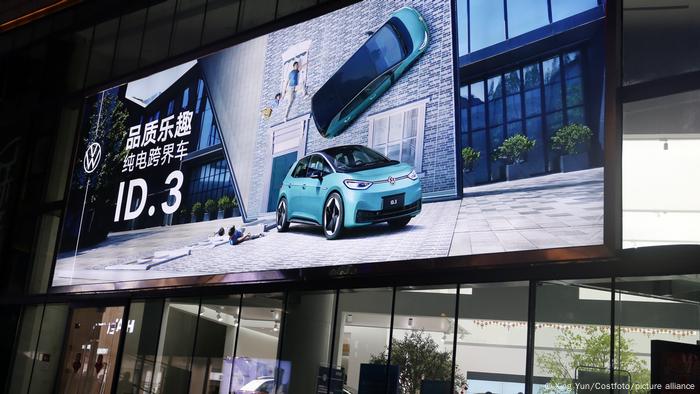
    Volkswagen advertisement in Shanghai

    Volkswagen is one of the major German investors in China

    Or is the dependence overestimated?

    80% of European investments are made by just 10 large European companies, according to Jörg Wuttke, president of the European Chamber of Commerce in China. “The others are not leaving China, but are currently interested in other countries for new investments and are also thinking about diversification,” Wuttke observes.

    Europe’s top ten companies, however, are heavily reliant on China, he warns, pointing to dependence on China for imports of rare-earth elements, preliminary products for the pharmaceutical industry, and photovoltaic systems. But dependence on China is fundamentally different from reliance on Russian energy, he says: “We have a pipeline with oil and gas from Russia. But from China, we have a ‘pipeline’ with toys, furniture, sports equipment, clothing, and shoes. Most of those products — I would say 90% of them — are easily replicable elsewhere.”

    Around 3% of German jobs depend on exports to China, economist Matthes points out. “That’s over 1 million jobs. That is a considerable number, but over 45 million people are employed in Germany today,” he says, and concludes: “On a macroeconomic level, the dependence on China as an export market is relevant, but it’s not as huge as media reports often make it out to be.”
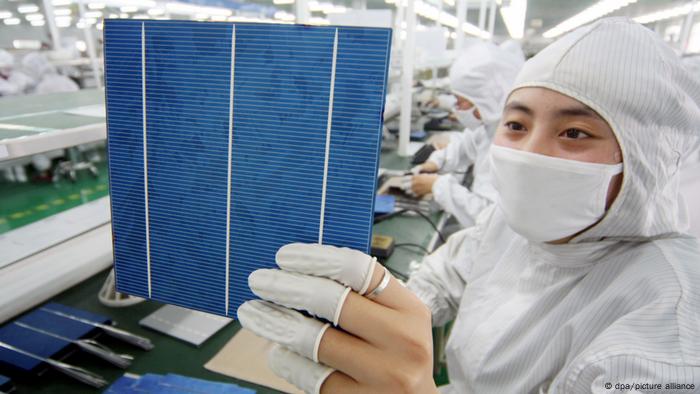
    Chinese worker examining photovoltaic cells of solar panels at the plant of Eoplly New Energy Technology Co., Ltd. in Nantong city, east Chinas Jiangsu province

    Important for the energy transition: Solar cells from China

    Pressure from the Green Party

    Nevertheless, within Germany’s new center-left coalition government of Social Democrats (SPD), neoliberal Free Democrats (FDP), and environmentalist Greens, the latter in particular are putting pressure on companies to rethink their ties with China.

    At the beginning of September, Foreign Minister Annalena Baerbock told business leaders: “We can’t afford to just hope that things won’t be so bad after all with these autocratic regimes.” The Green Party politician, who stands for “a values-based and feminist foreign policy,” announced the development of a new China strategy as part of a new National Security Strategy. “It is important to the German government and to me personally that we transfer what we have learned from our dependence on Russia to our new China strategy,” she says.

    The Economy Ministry is considering ways to encourage companies to turn to other Asian countries, instead of China. Government investment and export guarantees are being reappraised. The government-owned KfW Bank is to examine whether it could scale back its China program and instead offer more loans for business in countries including Indonesia.

    Last year, the Federation of German Industries (BDI) was already debating rules for foreign trade policy cooperation with autocracies. It suggested a “concept of responsible coexistence in foreign economic policy and clear boundaries for any cooperation.”

    For many managers, however, the change of course in the Economy Ministry goes too far.

    “Government support and protection of German companies’ business in China must remain, in principle,” Friedolin Strack, chief executive of the Asia-Pacific Committee of German Business (APA), told the news agency Reuters.

    Chinese investments should be welcome in Germany and Europe, he insisted. Whether this should also apply to the specific case of COSCO’s entry into the Hamburg Port, however, Strack did not want to say.

  • Germany’s Olaf Scholz heads to Canada for energy talks

    During the visit, the chancellor is set to sign a long-term deal to receive green hydrogen from Canada. German carmakers are keen to source minerals for electric vehicle batteries from the North American country.

    German Chancellor Olaf Scholz on Sunday left for a three-day visit to Canada focused on boosting energy security in Europe’s largest economy.

    Faced with the possibility of reduced or zero gas imports from Russia — in retaliation for Western sanctions over the war in Ukraine —  the chancellor is stepping up efforts to secure alternatives.

    Scholz and his deputy and energy minister, Robert Habeck of the Greens, landed in Montreal late on Sunday local time and were greeted by Prime Minister Justin Trudeau and his deputy, Chrystia Freeland.

    Scholz praised Canada on arrival, calling it one of Germany’s closest friends outside the EU and saying that it was a country rich in natural resources like Russia, but by contrast was also a reliable democracy.

    LNG and hydrogen deals planned

    Up for discussion will be the supply of liquefied natural gas (LNG), although it was unclear whether this would meet Germany’s short-term needs.

    Canada currently has no LNG terminals for export and new facilities would take years to build.

    Germany’s gas requirements are limited due to plans to phase out fossil fuels by 2035.

    A longer-term deal on closer cooperation on renewable energies like green hydrogen is expected to be signed.

    Canada is planning to build a hydrogen plant in Newfoundland that will use wind energy to produce the fuel, the Globe & Mail reported.

    Germany is also keen to source minerals available in Canada — nickel, cobalt, lithium and graphite — which are important for the production of batteries for electric vehicles.

    Scholz, who is joined on the trip by Economy Minister and Vice Chancellor Robert Habeck, will hold talks with Canadian Prime Minister Justin Trudeau.

    Support for Ukraine likely to dominate talks

    The leaders are due to discuss the need for political, economic and military support for Ukraine’s battles against Russia, and on dealings with China.

    The two German politicians will first meet Trudeau in his Montreal constituency on Monday.

    The trio will then attend a German-Canadian economic conference in Toronto.

    A delegation of more than a dozen business leaders is accompanying Scholz and Habeck, including the CEOs of Volkswagen and Siemens.

    Before they leave, the German leaders will visit the remote town of Stephenville in Newfoundland, to spotlight the development of hydrogen technologies and hydrogen supply chains.

    As Germany scrambles to wean itself off Russian gas, Habeck has already visited countries like Qatar, the United Arab Emirates and Norway on missions to diversify energy imports.

    Scholz interrupted by topless protest

    Earlier Sunday, Scholz found himself suddenly flanked by topless women during a press event, as part of a protest calling for an embargo on Germany’s import of Russian gas.

    A dpa photographer at the scene reported that security guards immediately intervened and led the two women away.

    Habeck, meanwhile, said Sunday that Germans shouldn’t panic about a shortage of gas this winter.

    He said the government was helping to secure additional gas supplies, including LNG from the United States, but stressed that the country would still need to cut gas usage by 15-20%.

    Source; DW

  • Germany takes step closer to gas rationing

    Germany has taken a step closer to gas rationing after a drop in supplies from Russia.

    The country has triggered the “alarm” stage of an emergency gas plan to deal with shortages, Germany’s economy ministry said.

    It is the latest part of a standoff between the European Union and Russia over its invasion of Ukraine.

    German economy minister Robert Habeck said Russia was using gas “as a weapon” in response to EU sanctions.

    “We must not fool ourselves. The cut in gas supplies is an economic attack on us by [Russian President Vladimir] Putin,” Mr Habeck said, adding Germans would have to reduce consumption.

    Mr Habeck said there would “hopefully never” be a need to ration gas for German industry, but he added: “Of course, I can’t rule it out.”

    Emergency plan

    Germany has now moved to the second stage of its three-part emergency plan, which is triggered when there is disruption or very high demand for gas.

    The government will provide €15bn (£13bn) of loans to try to fill gas storage facilities, and will start auctioning gas to industry to encourage big businesses to use less.

    Moving to stage two of the plan puts more pressure on suppliers and network operators to balance out disruption by taking measures such as finding alternative sources for gas.

    However, the country stopped short of letting utilities pass on soaring costs to customers, although that is theoretically possible under stage two.

    Gas firms already had to ensure supplies under the first stage of the emergency plan, while gas network operators were reporting to the Economy Ministry at least once a day, and electricity grid operators had to ensure grid stability.

    State intervention would happen under the third stage when there is a significant disruption to supply which the market cannot cope with, meaning supplies are rationed.

    In the third stage, supply to industry would be restricted first, while households and critical institutions such as hospitals would continue to get available gas.

    Twelve European Union countries have now been affected by cuts to gas supply from Russia, EU climate policy chief Frans Timmermans said on Thursday.

    Russia cut flows through its Nord Stream 1 pipeline to 40% of capacity last week citing problems with equipment, affecting countries including Germany.

    Nord Stream 1 is due to undergo maintenance from 11 to 21 July when flows will stop.

    The head of the International Energy Agency, Fatih Birol, has warned that Russia may cut off gas supplies to Europe entirely and that Europe needs to prepare now.

    Russia has already cut gas supplies to Poland, Bulgaria, the Netherlands, Denmark and Finland over their refusal to comply with a new payment scheme.

    Source: BBC