The Kremlin has restated its stance regarding theBlack Sea grain deal, noting that Moscow would re-engage once the portion pertaining to Russia had been executed.
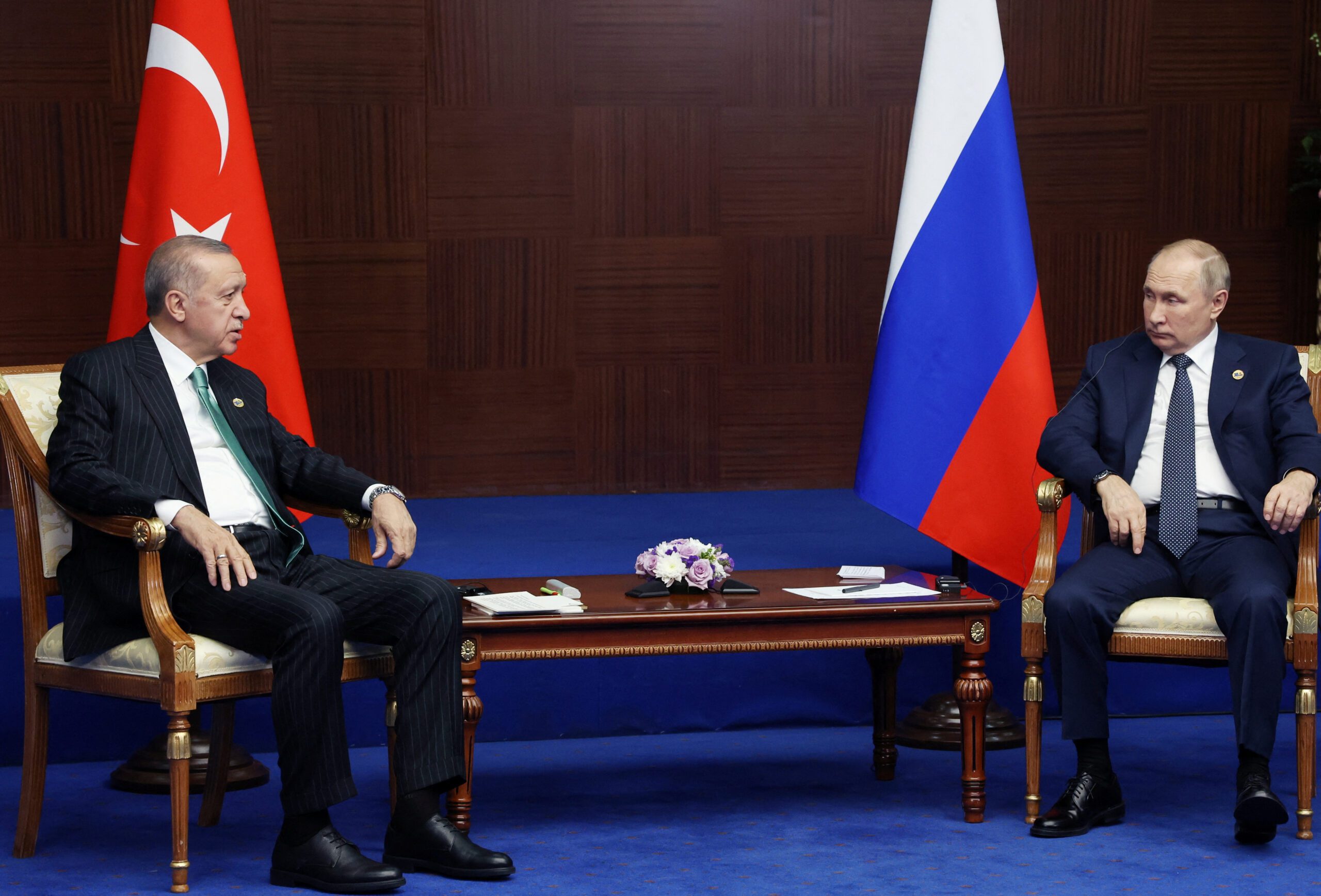
Kremlin spokesperson Dmitry Peskov informed journalists that President Vladimir Putin had a conversation with Turkey’s President Recep Tayyip Erdogan on Wednesday morning.
Two weeks ago, Moscow withdrew from the grain deal, citing ongoing hindrances to its grain and fertilizer exports.
The U.S. envoy to the United Nations remarked on Tuesday that there were “indications” of Russia’s potential interest in resuming discussions about the grain deal.
In a phone call with his Russian counterpart, Turkey’s President Recep Tayyip Erdogan expressed his commitment to reinstating the Black Sea grain deal and called on Russia to avoid escalating the conflict, as stated by Erdogan’s office.
The statement from the presidents office added, “President Erdogan expressed the importance of refraining from steps that could escalate tensions during the Russia-Ukraine war, emphasising the significance of the Black Sea initiative, which he described as a bridge of peace”.
Meanwhile, Putin says Russia will return to grain deal if expectations are met Putin has told Turkey’s Erdogan that Moscow is ready to return to the Black Sea grain deal as soon as the West meets its obligations to Russia’s grain exports, the Kremlin said.
In a phone call withErdogan, Putin also listed its reasons for exiting the deal last month.
According to a statement by the Turkish presidency, the two leaders also agreed that Putin would visit Turkey.
A senior Turkish official added that discussions between Ankara and Moscow are ongoing for a visit in late August.
On January 11, the Russian defence ministry announced that Chief of the General Staff Valery Gerasimov is now heading the Russian forces fighting in Ukraine. General Sergei Surovikin who had been appointed to the same position just three months earlier was demoted to Gerasimov’s deputy. The reshuffle sparked speculations about frustration in the Kremlin with the lack of progress on the battlefield.
Ironically enough, Surovikin had been recognised by Russian and Ukrainian combatants alike as one of the more competent of Moscow’s commanders. He considered holding on to the isolated city of Kherson as a lost cause and managed to persuade President Vladimir Putin to allow him to abandon it. This is despite the fact that the president wanted the city to remain under Russian control. Even though a withdrawal under fire is a difficult operation to conduct, Surovikin managed it neatly and with limited casualties.
At another flashpoint – the city of Bakhmut, where severe fighting was going on – Surovikin concentrated on consolidation. He established the so-called “Surovikin lines” of defence to the south and prepared the ground for the influx of mobilised reservists expected before an offensive this year. He also oversaw the ruthless bombardments of Ukraine’s energy and water infrastructure, as much a political as economic campaign, intended to demoralise the population, force a diversion of resources and perhaps drive more refugees into Europe.
Indeed, he appeared relatively competent. It was not enough for Putin, though. Surovikin’s cautious approach was not bringing victory on the battlefield, nor were the Ukrainians losing their will to resist.
The last straw seems to have been the Ukrainian missile attack on a barracks outside Makiivka on New Year’s Day, in which hundreds of Russian reservists may have been killed. It was hardly Surovikin’s direct responsibility, rather it was more a symptom of incompetence on the part of a Russian officer corps that cannot come to terms with the range and precision of Ukrainian artillery.
Nonetheless, Putin wanted a scapegoat, and Surovikin was it. In many ways, this episode illustrates the degree to which Russian warfighting is being defined and distorted by politics.
Putin’s whole political system is deliberately competitive and even cannibalistic. Individuals and institutions are encouraged to clash, because this allows Putin to exercise the role of the “great decider”. Everyone has to seek his favour and he can pick and choose whom to reward, and whom to punish, to maintain his power.
What may work in politics, though, is proving much more dysfunctional when translated to the battlefield. Surovikin was given the title of joint forces commander, but Putin never gave him the necessary political backing to allow him to wield all the disparate elements under his command as one unified force. In particular, he had no control over the personal troops of Chechen strongman Ramzan Kadyrov and, above all, the Wagner mercenary army under businessman Yevgeny Prigozhin.
This undermined any chances of Surovikin being able to make gains on the battlefield. For this, he had to pay the price, because a second aspect of Putinism which has proven so problematic is an emphasis on the “heroic leader” able instantly to turn a problem into a triumph. Encouraged by his entourage of cronies and yes-men, Putin seems to have convinced himself that he is such an instantly transformative leader. That is deeply questionable, as whatever goes right is presented as his achievement, but whatever goes wrong is blamed on the failures of his underlings.
The more stress Putin is under, the more unrealistic his expectations are. Last week, for example, loyal industry minister Denis Manturov was publicly upbraided for delays in the domestic production of aircraft. As Manturov tried to explain the formidable practical challenges, especially now that Russia is sanctioned and denied Western technology and investment and cannot buy some parts from Ukraine, Putin cut him off: “Don’t you understand the circumstances we live in? It needs to be done in a month, no later.”
Likewise, Putin – who has no meaningful military experience and little sense of the complexities of modern warfare – appears to have had unrealistic expectations of Surovikin. His answer, as usual, is not to recognise the scale of the challenge, but to blame the man on the spot. While Surovikin remains in place, he is now just one of three field commanders under their new joint commander: General Gerasimov.
Although the official line is that this was not a demotion of Surovikin, simply a recognition that the growing scale of the role required a more senior commander, the irony is that this is in effect a demotion not just for him but also for Gerasimov. It is very unusual for a chief of the General Staff to step into a field role and this also places him in an unenviable position.
It has long been clear that the Russians plan to launch new offensives early this year, using 150,000 mobilised reservists who have been preparing behind the lines. This is a substantial force, but given that the Ukrainians have also been regrouping, armed with new supplies of Western weapons, the odds of the Russians being able to make lasting and substantial gains are low.
Gerasimov’s career now presumably depends on not failing to meet Putin’s high hopes, so his temptation may be to escalate. Although there are periodic fears that Russia may use tactical nuclear weapons, this is still extremely unlikely. It is more credible that Moscow will try to pressure Belarus’s President Alexander Lukashenko to join the war or that Russia’s forces will be expanded further through a new wave of mobilisations or else with conscripts.
These are essentially political decisions above Gerasimov’s pay grade, though. Lukashenko is clearly very reluctant to be directly involved. As for a new mobilisation or deploying conscripts – who have, up to now, largely not fought, these measures would be extremely unpopular at home. Although Putin is overseeing a creeping militarisation of Russian society and economy, he is also clearly aware of the potential risks to a regime whose legitimacy is on the decline. Indeed, part of the reason behind demoting Surovikin was to try and use him as a scapegoat for recent reversals.
Likewise, although Gerasimov’s appointment was also heralded as a way of improving coordination, unless Putin is willing to lay down the law with Kadyrov or Prigozhin, nothing will change in the field. Prigozhin has already made his contempt for Gerasimov clear, with no pushback from the Kremlin.
Thus, Gerasimov is the latest and highest-profile officer to be given a task he cannot achieve unless Putin is willing to take a political risk and provide him with the necessary support. So long as the ageing Russian leader is unwilling to back his generals, it is hard to see how Gerasimov can succeed. Yet he is the senior officer in the Russian military – and Surovikin was his most likely successor. If and when he also fails, it will be all the harder for people not to pin the ultimate responsibility on the commander-in-chief,Vladimir Putin.
DISCLAIMER: Independentghana.com will not be liable for any inaccuracies contained in this article. The views expressed in the article are solely those of the author’s, and do not reflect those of The Independent Ghana
‘Hundreds of thousands of rounds of artillery ammunition’ will be included in the new package, according to Sunak’s office, for use against Russia.
A new $304 million package of military aid for Ukraine to support its counteroffensive against Russia will be announced by British Prime Minister Rishi Sunak.
According to a statement from the prime minister’s office released on Monday, the package contains “hundreds of thousands of rounds of artillery” and is intended to guarantee “a constant flow of critical artillery ammunition to Ukraine throughout 2023.”
Later on Monday, according to his office, Sunak will make the declaration at a Joint Expeditionary Force (JEF) summit in Latvia.
The JEF summit brings together leaders from Denmark, Estonia, Finland, Iceland, Latvia, Lithuania, the Netherlands, Norway, Sweden and the United Kingdom, and was called to discuss the “ongoing efforts to counter Russian aggression in the Nordic and Baltic regions”, the statement said.
At the meeting, Sunak will call on Nordic, Baltic and Dutch counterparts to maintain or exceed 2022 levels of support for Ukraine in 2023.
“The UK is already Europe’s leading provider of defensive aid to Ukraine, including sending Multiple Launch Rocket Systems and recently, 125 anti-aircraft guns,” the statement added.
“We have also provided more than 100,000 rounds of ammunition since February, with the deliveries directly linked to successful operations to retake territory in Ukraine.”
Since Russia invaded Ukraine on February 24, the UK has committed some $7.43bn in aid, according to the Kiel Institute for the World Economy, a Germany-based group that tracks support for Kyiv.
The UK is the second-biggest donor nation to Ukraine after the United States, which has pledged some $51bn in humanitarian, financial and military aid, according to the Kiel Institute.
Sunak’s office said the British leader had updated Ukrainian President Volodymyr Zelenskyy on the latest aid last week.
The pair had met in person when Sunak visited Kyiv last month.
Zelenskyy is meanwhile expected to address the JEF summit in the Latvian capital, Riga, via video link, according to Sunak’s office.
The JEF meeting will also discuss further air defence support for Ukraine, which has been scrambling to fend off Russian missile attacks on its critical infrastructure, including its power grid, it said.
In recent days, war analysts have painted a picture of Russian forces struggling to make significant gains across Ukraine.
According to the Institute for the Study of War in the United States, they are “not making significant progress around Bakhmut, Donetsk Oblast, or anywhere else along the front lines in Ukraine.”
However, it said Russia is still trying to push a narrative that it is making major progress in Bakhmut, a city in Ukraine’s eastern Donetsk region.
Analysts said the information operation is likely an attempt to “improve morale” and “possibly the personal standing” of Russian oligarch Yevgeny Prigozhin, who is behind the Wagner mercenary group.
The notorious Wagner group is “largely responsible” for the minimal gains around Bakhmut, but the ISW said the advances have been “at a languid speed and a significant cost”.
Mr Prigozhin, who reportedly confronted Vladimir Putin over Russia’s stalling war effort, acknowledged the slow pace of the ground operations near Bakhmut last week.
He said his Wagner forces were advancing just 100 to 200m per day, which he absurdly claimed was a normal rate for modern advances.
A central bank poll,indicates that the business climate for Japanese manufacturers deteriorated in three monthsbetween July and September as the third-largest economy in the world struggled with rising expenses, a falling yen, and pandemic restrictions.
Big manufacturers’ business outlook fell to plus 8 in September from plus 9 in June, the Bank of Japan’s “tankan” survey showed on Monday.
Service sector sentiment improved slightly from three months ago, the survey showed, although retailers were less optimistic due to rising living costs stemming from higher commodity prices and the weakening yen.
The index measures corporate sentiment by subtracting the number of companies saying business conditions are negative from those that view them as positive.
Japan’s economy is under strain as the plummeting yen exacerbates the cost of living pressures sparked by Russia’s invasion of Ukraine.
The declining value of the yen, which last month hit a 24-year low against the US dollar, has driven up the cost of food and energy imports, burdening households and retailers.
Asia’s second-largest economy, which has struggled with stagnant growth for decades, is also grappling with more than two and a half years of pandemic-related border restrictions that are set to be lifted from October 11.
Japan’s economy grew an annualised 3.5 percent in the second quarter, but analysts expect it to have slowed in the third quarter as slowing global demand and rising materials costs sap exports and consumption.