Finance Minister, Ken Ofori-Atta, has noted that government’s introduction of debt exchange programme in the 2023 budget read in parliament will help revive the ailing economy from the shocks of the global pandemic – coronavirus – and Russia-Ukraine war.
According to him, the bouncing back of the local economy will help create jobs, protect the income of depositors, as well as, restore hope in Ghanaians.
The finance minister stressed that the domestic debt exchange programme “is an orderly way to put our economy back on track in order to create jobs, protect income and restore hope to the Ghanaian people.”
“The government expects overwhelming support for this exchange programme,” he stated.
Ken Ofori-Atta explained that the debt exchange programme was necessary to address the country’s debt servicing challenges.
He noted that almost 70% of government’s revenue was used to service debts.
Americans are fearing that Russia’s invasion of Ukraine could lead to a knock-on effect in Europe and possibly influence China to do something similar in Taiwan, the Wall Street Journal reported.
According to a national defence survey, while Americans support the US government sending weapons and providing financial support for Kyiv, they have less trust in their military leadership.
In total, the survey found that 57 percent of respondents said the US needs to continue supporting Ukraine, while 33 percent said they should focus on domestic issues and avoid angering Russia.
The U.S.has sent more than $19 billion in military aid to Ukraine this year, which 39% of Americans said was the right amount.
He claims that the policy’s goal of stockpiling domestically mined gold in return for finished petroleum products will lessen the need for foreign currency to pay for the annual imports of petroleum products worth around US$3 billion.
“As a result, we will avoid spending $3 billion on foreign exchange since the Bank of Ghana won’t need it.
The pressure on the cedi is instantly relieved as a result, and the currency will depreciate much, much less as a result, he said.
This comes on the back of the Russia-Ukraine war, which continues to impact the global oil market.
Subsequently, the price of Russian crude fell following sanctions imposed by the EU and U.S.; although it is now selling more oil to countries like China and India, which have not imposed sanctions on Moscow.
On the demand side, the easing of COVID-19 restrictions globally has led to increasing demand for crude oil – thereby pushing prices on the world market to go up amid the shortfall of supply with Russia being ‘cut-out’.
More recently, prices are beginning to fall on the world market due to a contraction in global output.
According to the minister, the January to September 2022 receipts exclude US$14.61million petroleum receipts from Corporate Income Tax and PHF Income that spilled over from 2021 to 2022.
This brings the total petroleum receipt available for distribution to US$1.18billion. The Carried and Participating Interest (CAPI) contributed the highest, at 50.8 percent, to total petroleum receipts for the period; followed by Royalties, 23.9 percent; and Corporate Income Tax, 25.1 percent.
The rest include Surface Rental of 0.17 percent to petroleum receipts for the period.
However, the minister said there were no receipts from gas for the period under review. This is despite recording a total of 189,469.44 million standard cubic feet (Mscf) of gas produced in the first to third quarters of the year from the three producing fields.
Total crude oil production for January to September 2022 was 39.15 million barrels. This comprises Greater Jubilee’s output of 23.09 million barrels, Tweneboa Enyenra-Ntomme (TEN) of 6.43 million barrels and Sankofa-Gye Nyame (SGN), 9.64 million barrels, representing 58.97, 16.41 and 24.62 percent respectively of the total output.
But the first to third-quarter of 2022 crude oil production of 39.15 million, according to the minister, is 5.73 percent lower than the production of 41.53 million barrels for the same period in 2021.
“The reduction in crude oil production is generally due to natural field decline from the TEN and SGN fields,” he added.
Meanwhile, of the total crude oil production for January to September 2022 of 39.15 million barrels, Ghana National Petroleum Corporation (GNPC) on behalf of the state lifted 7.55 million barrels – comprising 4.71 million barrels from the Jubilee field, 0.99 million barrels from TEN field and 1.85 million barrels from Sankofa Gye Nyame (SGN) field.
Petroleum Receipts for January to September 2022
Total receipts from crude oil liftings only by GNPC for January-September was US$873.25million (GH₵8.34billion), comprising the 63rd – 67th Jubilee liftings; 20th and 21st TEN liftings; and the 9th and 10th liftings from the Sankofa Gye-Nyame field.
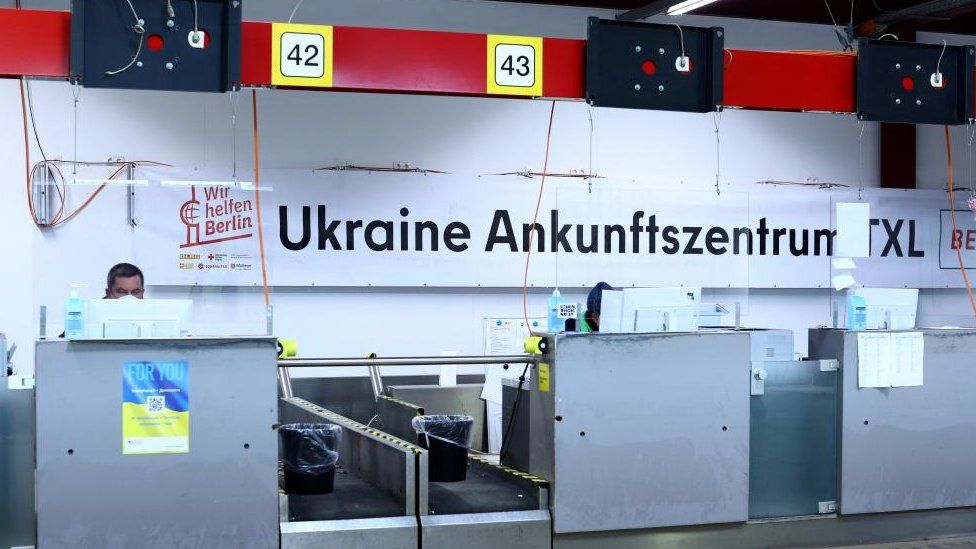
Almost 1,000 people sleep in giant heated tents on an old airfield on Berlin’s outskirts. The German capital is struggling to house Ukraine’s refugees properly.
As winter deepens and Russia continues to attack Ukraine’s energy infrastructure, authorities here are rushing to build more emergency shelters in preparation for the arrival of up to 10,000 more people.
According to the most recent figures, a million Ukrainians have fled to Germany since the beginning of the war.
This has brought back memories of 2015 and 2016, when a comparable number of people sought asylum in the United States.
Germany, as before, extended a warm welcome. However, there are growing concerns about how to best accommodate such a large population.
In Berlin, around 100 Ukrainians arrive every day at the city’s main reception centre for refugees which is sited in a terminal at a converted former airport.
Workers in brightly coloured tabards lead them past defunct baggage carousels to the old departure halls which are now filled with crowded trestle tables.
There’s food here, medical aid and a bed for a few nights.
It’s designed to be temporary; strangers sleep in bunks in shared cubicles or tents.
But many of the people here will stay longer; it’s getting harder to find permanent accommodation in a city where the rental market is under pressure, and sending people on to other parts of Germany is getting harder too.
IMAGE SOURCE,REUTERS Image caption, Germany is now housing many refugees at Berlin’s former Tegel airport
Despite the logistical difficulties, there’s a relaxed atmosphere in the centre.
Ms Tümmler and her colleagues appear committed to making life as easy and comfortable as possible for the people here.
They’re trying to adapt to the needs of longer-term guests. They’ve bought washing machines, they’re trying to provide some entertainment, and they’re extending the educational facilities for the 300 children on site, some of whom are home-schooling via video link to their Ukrainian schools.
They have learnt, they say here, from the experience of 2015.
But their positivity is not mirrored elsewhere.
One politician from northwest Germany recently used an editorial in a national newspaper to warn that communities like his were “massively challenged” by numerous Ukrainian refugees as well as a growing influx of asylum seekers.
The number of people seeking asylum has indeed risen, fuelled largely by people from Syria and Afghanistan.
Getty Images
I expect tens, if not hundreds of thousands more Ukrainian women and children… already more migrants are living in many communities than in the year of the 2015-16 refugee crisis
Frederik Paul said he was reminded of the atmosphere during the migrant crisis when an initially warm welcome gave way to a bitter national debate over how much support Germans could and should offer to those seeking asylum.
He echoed comments made earlier in the year by Martina Schweinsburg, a district councillor from Thuringia, who said her area had relied on private landlords to house Ukrainians – mainly women, children and elderly people at first – but were now reluctant to do so.
“Our capacities are exhausted,” she said. “Our backs are against the wall.”
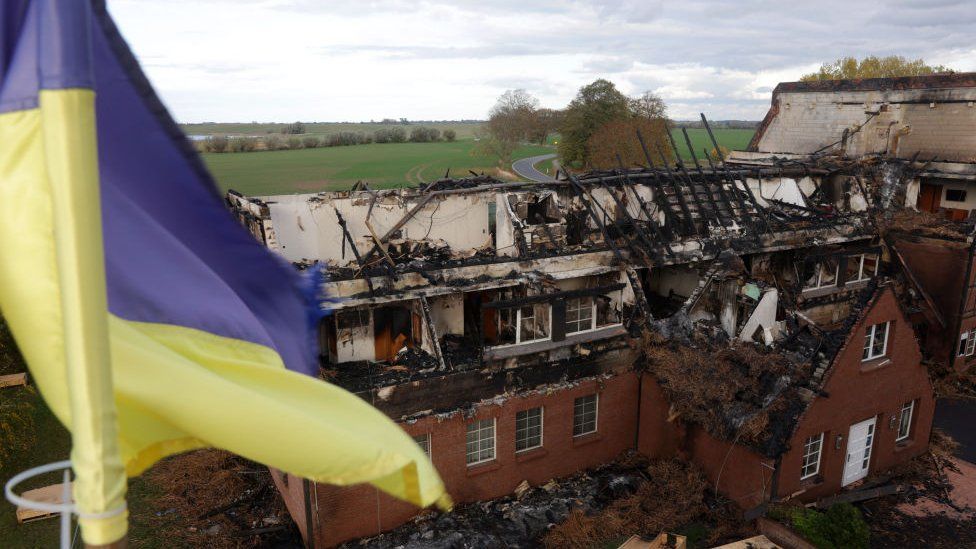
The mood is darkening; the authorities recorded 65 attacks on refugee accommodation so far this year, a significant increase on 2021.
IMAGE SOURCE,GETTY IMAGES Image caption, This hotel sheltering Ukrainian refugees was burned down in a suspected arson attack last month
And a recent survey for the national broadcaster found that concerns about immigration had increased in the last year: 53% of those asked were concerned that too many people were coming to Germany, up by 11% from September 2021.
Those fears and that social division are exactly what Russia’s Vladimir Putin hassought to exploit in his latest campaign to render Ukraine uninhabitable and drive yet more of its citizens into Europe.
That will test the tolerance of this German government, which came to power with a far more liberal attitude towards refugees than its predecessor.
How this country, itself much changed by the experience of the migrant crisis, reacts will matter.
After four months of staying in state housing, the Polish governmentintends to charge Ukrainian refugees for food and housing.
Since Russia’s invasion of Ukraine on February 24, more than a million Ukrainian refugees sought refuge in Poland, Ukraine’s western neighbour, relying on the generosity of strangers who opened their homes and government aid.
However, resources are running out, and refugees are having a more difficult time finding housing and receiving assistance, as Poland faces a cost-of-living crisis and budget constraints.
“Citizens of Ukraine who stay in Poland in collective accommodation centres will participate in the costs of housing and meals,” the government said in a statement.
Those staying in such accommodation, for example, government-funded hotel rooms or school dormitories, longer than 120 days will have to cover 50 percent of the cost up to 40 zlotys ($8.87) per day, per person.
After 180 days, it would be 75 percent of the cost up to 60 zlotys ($13.27). Those unable to work because of their age or disability would be excluded, as would pregnant women, according to the plan.
The government wants the new rules to apply from March 1, 2023. The bill will go to parliament, where it is expected to pass.
NATO foreign ministers met in Bucharest in Romania to work out how to keep millions of Ukrainian civilians safe and warm and sustain Kyiv’s military through winter.
“Russia does not have a veto” on countries joining the security alliance, he said in reference to the recent entry of North Macedonia and Montenegro.
The former Norwegian prime minister said Russian President Vladimir Putinwill also “get Finland and Sweden as NATO members soon”, after they applied for membership in April over concerns Russia might target them next.
“We stand by that, too, on membership for Ukraine,” he added.
It came as NATO foreign ministers met in Bucharest in Romania to pledge to step up support for Ukraine and help repair its energy infrastructure as Russian strikes knock out power supplies and heating for millions.
“Russia’s aggression, including its persistent and unconscionable attacks on Ukrainian civilian and energy infrastructure, is depriving millions of Ukrainians of basic human services,” the foreign ministers said in a statement.
“We will continue and further step up political and practical support to Ukraine as it continues to defend its
sovereignty and territorial integrity… and will maintain our support for as long as necessary,” the statement added.
UK Foreign Secretary James Cleverly said Russia was targeting energy infrastructure to “freeze” Ukrainians into submission.
“We have seen Vladimir Putin attempting to weaponise energy supplies right from the very start of this conflict,” he said before the meeting.
Image:Romanian Foreign Minister Bogdan Aurescu, British Foreign Secretary James Cleverly and NATO Secretary-General Jens Stoltenberg in Bucharest
Call for Patriot missiles and power transformers
Ukraine’s foreign minister called for NATO members to supply it with air defence systems and transformers.
“We need air defence, IRIS, Hawks, Patriots, and we need transformers,” Dmytro Kuleba said on the sidelines of the meeting, identifying various Western air defence systems.
“If we have transformers and generators, we can restore our energy needs. If we have air defence systems, we can protect from the next Russian missile strikes. In a nutshell: Patriots and transformers is what Ukraine needs the most.”
Focus on defeating Russia
Ukraine is unlikely to join NATO anytime soon, as Russia has annexed the Crimean Peninsula, and troops and pro-Moscow separatists hold parts of the south and east, meaning it is unclear what the country’s borders would look like.
Many of NATO’s 30 members believe the focus should now be on defeating Russia and Mr Stoltenberg warned any attempt to move ahead on membership could divide them.
“We are in the midst of a war and therefore we should do nothing that can undermine the unity of allies to provide military, humanitarian, financial support to Ukraine, because we must prevent President Putin from winning,” he said.
The two-day meeting in Romania, which shares NATO’s longest land border with Ukraine, will likely see NATO make new pledges of non-lethal support to Ukraine including fuel, generators, medical supplies, winter equipment and drone-jamming devices.
Individual nations are also likely to announce new shipments of military equipment to Ukraine, such as air defence systems and ammunition, but NATO as an organisation will not make such a commitment to avoid being dragged into a wider war with nuclear-armed Russia.
The Russian invasion of Ukrainehas increased demand for American-made weapons and ammunition, while US allies in Eastern Europe are ordering a variety of arms to supply Kyiv.
As the West struggles to meet the demand for more weapons, the Pentagon is considering supplying Ukraine with cheap, small precision bombs mounted on readily available rockets, allowing Kyiv to strike far behind Russian lines.
As the war drags on, US and allied military inventories are dwindling, and Ukraine’s need for more sophisticated weapons grows.
According to industry sources, Boeing’s proposed system, dubbed Ground-Launched Small Diameter Bomb (GLSDB), is one of about a half-dozen plans for putting new munitions into production for Ukraine and the US’s Eastern European allies.
GLSDB could be delivered as early as spring 2023, according to a document reviewed by Reuters news agency and three people familiar with the plan. It combines the GBU-39 Small Diameter Bomb (SDB) with the M26 rocket motor, both of which are common in US inventories.
Doug Bush, the US Army’s chief weapons buyer, told reporters at the Pentagon last week the military was also looking at accelerating production of 155mm artillery shells – currently manufactured only at government facilities – by allowing defence contractors to build them.
The invasion of Ukraine drove up demand for American-made weapons and ammunition, while US allies in Eastern Europe are “putting a lot of orders” in for a range of arms as they supply Ukraine, Bush added.
“It’s about getting quantity at a cheap cost,” said Tom Karako, a weapons and security expert at the Center for Strategic and International Studies.
He said falling US inventories help explain the rush to get more arms now, saying stockpiles are “getting low relative to the levels we like to keep on hand and certainly to the levels we’re going to need to deter a China conflict”.
Karako also noted the US exit from Afghanistan left lots of air-dropped bombs available. They cannot be easily used with Ukrainian aircraft, but “in today’s context we should be looking for innovative ways to convert them to standoff capability”.
‘Most appropriate systems’
Although a handful of GLSDB units have already been made, there are many logistical obstacles to formal procurement.
The Boeing plan requires a price discovery waiver, exempting the contractor from an in-depth review that ensures the Pentagon is getting the best deal possible. Any arrangement would also require at least six suppliers to expedite shipments of their parts and services to produce the weapon quickly.
A Boeing spokesperson declined to comment. Pentagon spokesman Lieutenant-Commander Tim Gorman declined to comment on providing any “specific capability” to Ukraine, but said the US and its allies “identify and consider the most appropriate systems” that would help Kyiv.
Although the United States has rebuffed requests for the 297km (185-mile) range ATACMS missile, the GLSDB’s 150km (94-mile) range would allow Ukraine to hit valuable military targets that have been out of reach, and help it continue pressing its counterattacks by disrupting Russian rear areas.
GLSDB is made jointly by Saab AB and Boeing Co and has been in development since 2019, well before the invasion, which Russia calls a “special military operation”. In October, SAAB Chief Executive Micael Johansson said of the GLSDB: “We are imminently shortly expecting contracts on that.”
$40,000 each
According to the document – a Boeing proposal to US European Command (EUCOM), which is overseeing weapons headed to Ukraine – the main components of the GLSDB would come from current US stores.
The M26 rocket motor is relatively abundant, and the GBU-39 costs about $40,000 each, making the completed GLSDB inexpensive and its main components readily available. Although arms manufacturers are struggling with demand, those factors make it possible to yield weapons by early 2023, albeit at a low rate of production.
GLSDB is GPS-guided, can defeat some electronic jamming, is usable in all weather conditions, and can be used against armoured vehicles, according to SAAB’s website. The GBU-39 – which would function as the GLSDB’s warhead – has small, folding wings that allow it to glide more than 100km if dropped from an aircraft and targets as small as 1 metre (3 feet) in diameter.
At a production plant in rural Arkansas, Lockheed Martin is redoubling efforts to meet surging demand for mobile rocket launchers known as HIMARS, which have been successful in hitting Russian supply lines, command posts, and even individual tanks. The number one US defence contractor is working through supply chain issues and labour shortages to double the production to 96 launchers a year.
HIMARS fires Guided Multiple Rocket Launch System missiles (GMLRS), which are GPS-guided rounds with 90kg (200-pound) warheads. Lockheed Martin makes about 4,600 of the missiles per year; more than 5,000 have been sent to Ukraine so far. The US has not disclosed how many GMLRS rounds have been supplied to Ukraine.
Repurposing weapons for regular military use is not a new tactic. The NASAMS anti-aircraft system, developed by Kongsberg Defence and Aerospace and Raytheon, uses AIM-120 missiles – originally meant to be fired from fighter jets at other aircraft. Another weapon, the Joint-Direct Attack Munition (JDAM), ubiquitous in US inventories, is a standard unguided bomb that has been fitted with fins and a GPS guidance system.
The European Parliament bases its work on emotions, the Kremlin spokesperson Dmitry Peskov told Russian media as reported by TASS news agency, adding that Moscow takes its resolve into little consideration.
His remarks came after the EU institution labelled Russia a state sponsor of terrorism, a move that is not legally binding but rather symbolic.
“It’s no secret to us that in the recent years the European Parliament has had little love for us. In return, we have had little desire to take into account what’s going on there,” Peskov was quoted as saying.
“And emotions is such a changeable thing. Today they are Russophobic, tomorrow there will be something else. And then, maybe a moment of clarity will come,” he said, adding that Russia belived the European parliament lacked a professional approach.
The UK’s Ministry of Defence has said heavy fighting is taking place in Pavlivka and Vuhledar, two towns in eastern Donetsk province. There has been intense combat in the area over the last two weeks, it said.
“This area remains heavily contested, likely partially because Russia assesses the area has potential as a launch point for a future major advance north to capture the remainder of Ukrainian-held Donetsk Oblast,” the ministry said.
“However, Russia is unlikely to be able to concentrate sufficient quality forces to achieve an operational breakthrough.”
Latest Defence Intelligence update on the situation in Ukraine – 27 November 2022
People share wartime survival techniques as Russian missile attacksplunge the nation’s capital into darkness.
If you have no electricity, but don’t want your frozen foods to melt, Anastasiya Zasyadko has a useful life hack for you.
“Put a bottle of water in the freezer when the electricity is on,” the 79-year-old retiree told Al Jazeera.
The ice will take many hours to melt – and keep the freezer, well, frozen.
“The bottle has to be plastic because the glass will crack” when the water freezes, Zasyadko, a former physics teacher, said expertly.
Her experience is first-hand.
She lives in a two-bedroom apartment in a northern Kyiv district of drab concrete buildings surrounded by potholed roads, leafless trees and melting snow.
It had no electricity for more than 24 hours after Wednesday’s shelling of the capital and other Ukrainian cities by Russian cruise missiles.
A Ukrainian woman buys a power bank in the capital, Kyiv [Mansur Mirovalev/Al Jazeera]
Low-tech response
But Zasyadko was ready – and saved several kilogrammes of frozen pork, minced meat and vareniki, the Ukrainian ravioli she cannot live without and made weeks earlier.
On October 10, Russian President Vladimir Putin ordered a string of attacks to destroy power transmission and heating stations, and damage key infrastructure throughout Ukraine.
Zasyadko was already used to the hours-long blackouts – she, her son and her daughter-in-law have plenty of batteries, two power banks, and flashlights you can attach to your head with elastic bands.
“They make you look like a coal miner and ruin your hairdo,” she pouted.
She also can advise you on how to extend the lifetime of a candle and make it heat your bedroom.
Just put it in a glass jar and fill it with vegetable oil. The light will not die out for 12 hours – as long as you make sure that the jar doesn’t fall and start a fire.
You can also combine the contraption with a “flower pot heater” – an ultimate, low-tech response to the lack of central heating.
Take three ceramic flower pots of different sizes, connect them with a long steel bolt so there are a couple of centimetres between them, and put the structure above the burning candle.
The candle-warmed air will not rise to the ceiling but will heat the pots and raise the temperature by several degrees.
Most of the apartment buildings in Ukraine are heated by Soviet-era power stations that have been largely destroyed by the Russian shelling.
A motorcycle is used as a flashlight at a Kyiv mall [Mansur Mirovalev/Al Jazeera]
The cold has been debilitating.
“I went to bed in a flannel gown, put the hood and two pairs of socks on,” Zasyadko said.
Wednesday’s attack was especially devastating for Kyivans because it damaged the water supply in the entire capital and made people buy bottled water, ration it and collect porous snow.
The lack of water is worse than any blackout, Zasyadko said, especially when your family members need to flush the toilet.
Kyiv, howhow to extend the lifetime of a candleever, is already covered with several centimetres of snow, and her son Konstantin collected some in tin buckets and melted it on a gas stove.
“Otherwise it will take hours to melt,” she said.
‘I weep every time’
With the news reports about the deaths of civilians, including a newborn killed by a Russian missile in the eastern town of Vilniansk on Wednesday, Zasyadko has not been feeling well.
That is why she took a seat on a bench in a shopping mall in northern Kyiv, waiting for her daughter-in-law to come back from a grocery shop.
The daughter-in-law, Maryana, showed up with two heavy bags – and offered the ultimate advice on patience.
“As long as everyone in our family is alive, we keep thanking God,” the 45-year-old cook said.
“I weep every time I hear about those little kids killed by the bloody Rashists,” she said, using a derogatory term that combines “Russian” and “fascist”.
Just a few metres away, a wartime generation of Ukrainian mall rats is glued to their mobile phone screens. The mall has its own power generator – and offers a chance to reload batteries free of charge.
Dozens of people sit or stand next to power sockets – and many are teenagers with more than one gadget.
Most of the sockets are in drafty, barely lit halls, but there are some in the warmer corridors leading to public toilets.
Denys Kyrilenko, 19, was standing close to a ladies’ room, but paid no attention to the women passing by. The university student was typing a text message to his girlfriend who fled to Poland with her family in early March.
He cannot join her because Ukrainian men aged 18 to 60 are not allowed to leave the country. But the eight-months-long separation only made their feelings stronger, he said.
“War makes you see things better,” he said.
Denys Kyrilenko texts his girlfriend from a mall in Kyiv [Mansur Mirovalev/Al Jazeera]
The mall is an oasis of carefree consumerism. And it offers things that have become essential and life-saving.
A small crowd stood around a kiosk with power banks, connecting cables and USB-powered flashlights.
The salesman, Andriy Shevchenko, patiently explained why even the largest power bank in his kiosk cannot be used to power a laptop.
The customers, two women in their early 20s, nodded and bought one anyway – even though the price was almost $80.
That’s not Shevshenko’s fault.
“I hate when suppliers raise prices,” he said. “It ruins my reputation.”
‘We can withstand anything’
Kyiv residents living in private houses with firewood-fuelled stoves feel safe and privileged.
Many stockpiled hundreds of kilogrammes of firewood – and use the stoves to slow-cook their food in metal containers or pots.
And one house owner shared his observation on the resilience of fellow Ukrainians around him.
On Wednesday, Mykhailo Gorshenin, who lives in a two-storey house in northeastern Kyiv, saw how a Russian cruise missile hit a transmission station.
“People came out of a store to take a look,” he said.
Within seconds, another missile hit the same spot.
“They started filming the fire and the smoke with their cell phones,” he said.
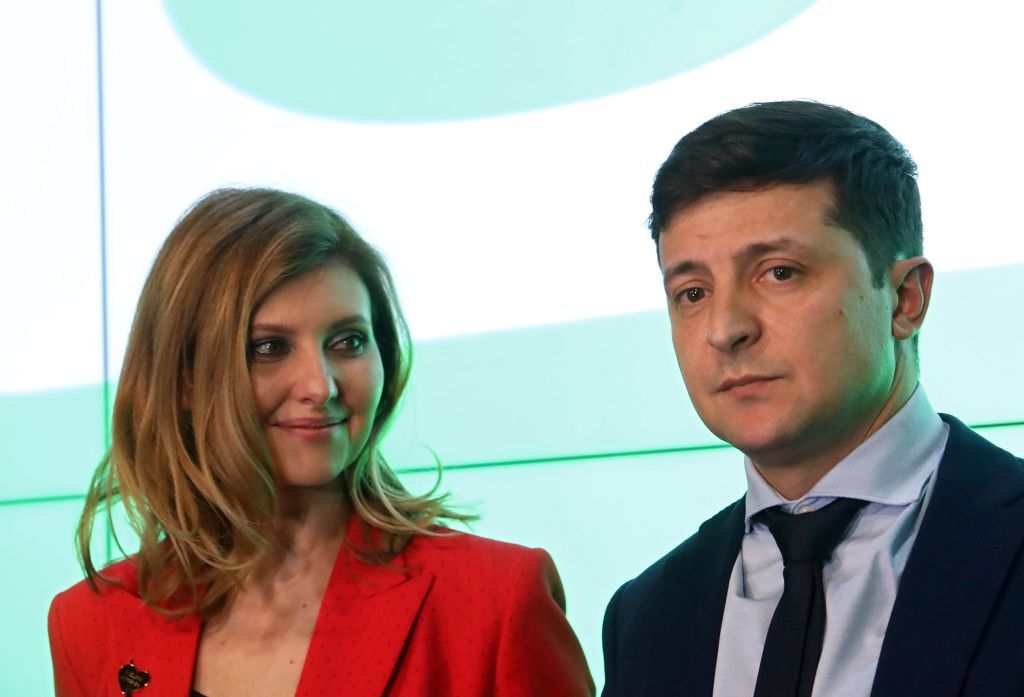
Ukrainian first lady Olena Zelenska tells the BBC that Ukraine will endure this coming winter despite the cold and the blackouts caused by Russian missiles, and will keep fighting what she describes as a war of world views, because “without victory there can be no peace”.
We meet in a storied city where a winter’s chill is biting, where charming street lamps are dimmed, where buildings are going dark and cold in the midst of blackouts as Russia keeps striking Ukraine’s energy grid. The Ukrainian people have won plaudits for standing their ground against Russia’s blistering assault. But this is yet another painful test of fortitude.
“We are ready to endure this,” Olena Zelenska asserts when we sit down in a heavily secured compound tucked inside a sandbagged labyrinth of buildings in Kyiv.
“We’ve had so many terrible challenges, seen so many victims, so much destruction, that blackouts are not the worst thing to happen to us.” She cites a recent poll where 90 % of Ukrainians said they were ready to live with electricity shortages for two to three years if they could see the prospect of joining the European Union.
That seems like an awfully long cold road, and she knows it.
“You know, it is easy to run a marathon when you know how many kilometres there are,” she says. In this case, though, Ukrainians don’t know the distance they have to run. “Sometimes it can be very difficult,” she says. “But there are some new emotions that help us to hold on.”
All Ukrainians will become stronger because of this war, Ukraine’s first lady stoically predicts.
IMAGE SOURCE,GETTY IMAGES Image caption, President Zelensky now lives at 10 Bankova Street (left), opposite the House of Chimaeras (right)
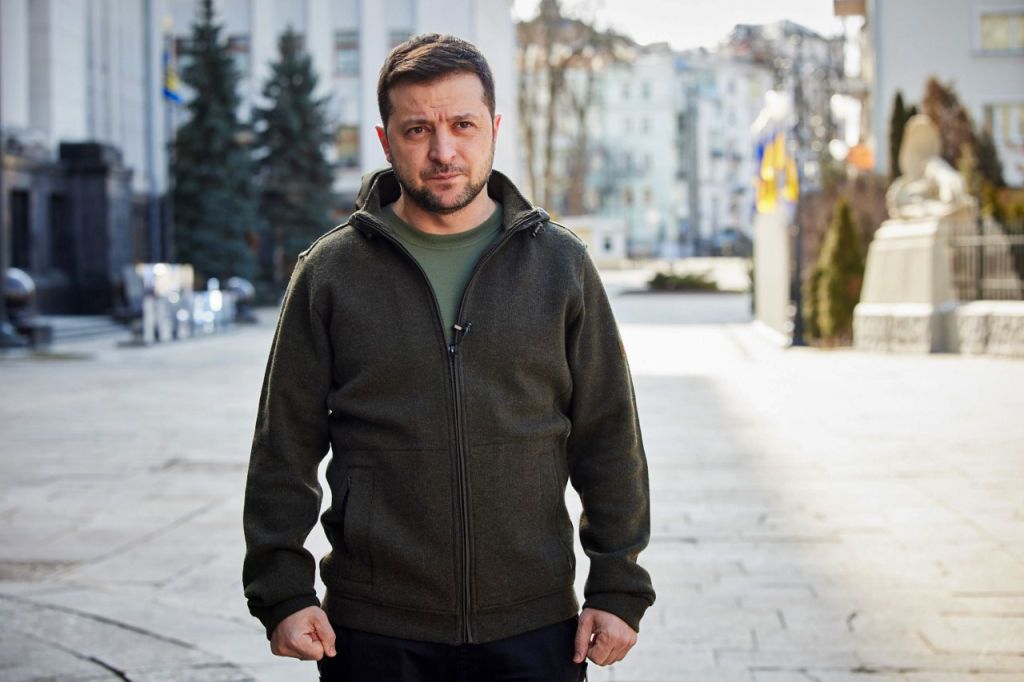
Our wide-ranging almost hour-long interview, recorded for the BBC’s annual 100 Women season, takes place in the iconic House of Chimaeras, adorned with elephant-head gargoyles and sculptures of mythical creatures, facing 10 Bankova Street – Ukraine’s version of 10 Downing Street. The building formed the backdrop for President Zelensky’s famous 26 February speech to rally Ukrainians, filmed on his phone two days after Russian tanks rolled across the border. “I’m here. We won’t lay down our arms,” he declared.
The night before, in one of what became nightly addresses, he had announced in another selfie video that Russia “has designated me as target number one, and my family as target number two”.
“And so it was from the first day and it continues now,” Olena Zelenska recalls, her words barely hiding the enormous strain that her family, like all Ukrainian families now ripped apart, are going through.
A few walls of sandbags and circles of security checks away, President Zelensky carries on, around the clock. So close and yet so far. She won’t give an exact date for when they last had dinner together with their children, 18-year-old Oleksandra and nine-year-old Kyrylo. “It’s very rare nowadays. Very rare,” she says.
“I live separately with my children and my husband lives at work,” she explains. “Most of all, we miss simple things – to sit, not looking at the time, as long as we want.”
Every Ukrainian’s life has been turned inside out – from engineers to ballerinas now fighting on front lines, to some eight million,mainly women and children, forced to flee into new lives across the border.
The president and first lady’s lives have long been entwined. High school sweethearts, they went on to work together in a comedy troupe and TV studio, he a comic actor and she, backstage, a scriptwriter. When he ran for president three years ago, she made it clear this wasn’t a life she wanted. But this war has thrust her into the spotlight, on a global stage.
IMAGE SOURCE,GETTY IMAGES Image caption, Olena Zelenska advised her husband not to run for president
After Russia missiles started whistling into Kyiv in the early hours of 24 February, Olena Zelenska spent months in hiding in secret locations with her children. She emerged on 8 May – Mothers’ Day this year in Ukraine, and many other countries – when she joined the US First Lady Jill Biden at a shelter for the displaced in the relatively safe western Ukrainian city of Lviv.
Now she keeps popping up in speeches on zoom, or at times in person, with her smartly styled hair and classic shirts or jackets, with a shy smile which gives way to strongly worded speeches which come from “a mother, a daughter, a first lady”.
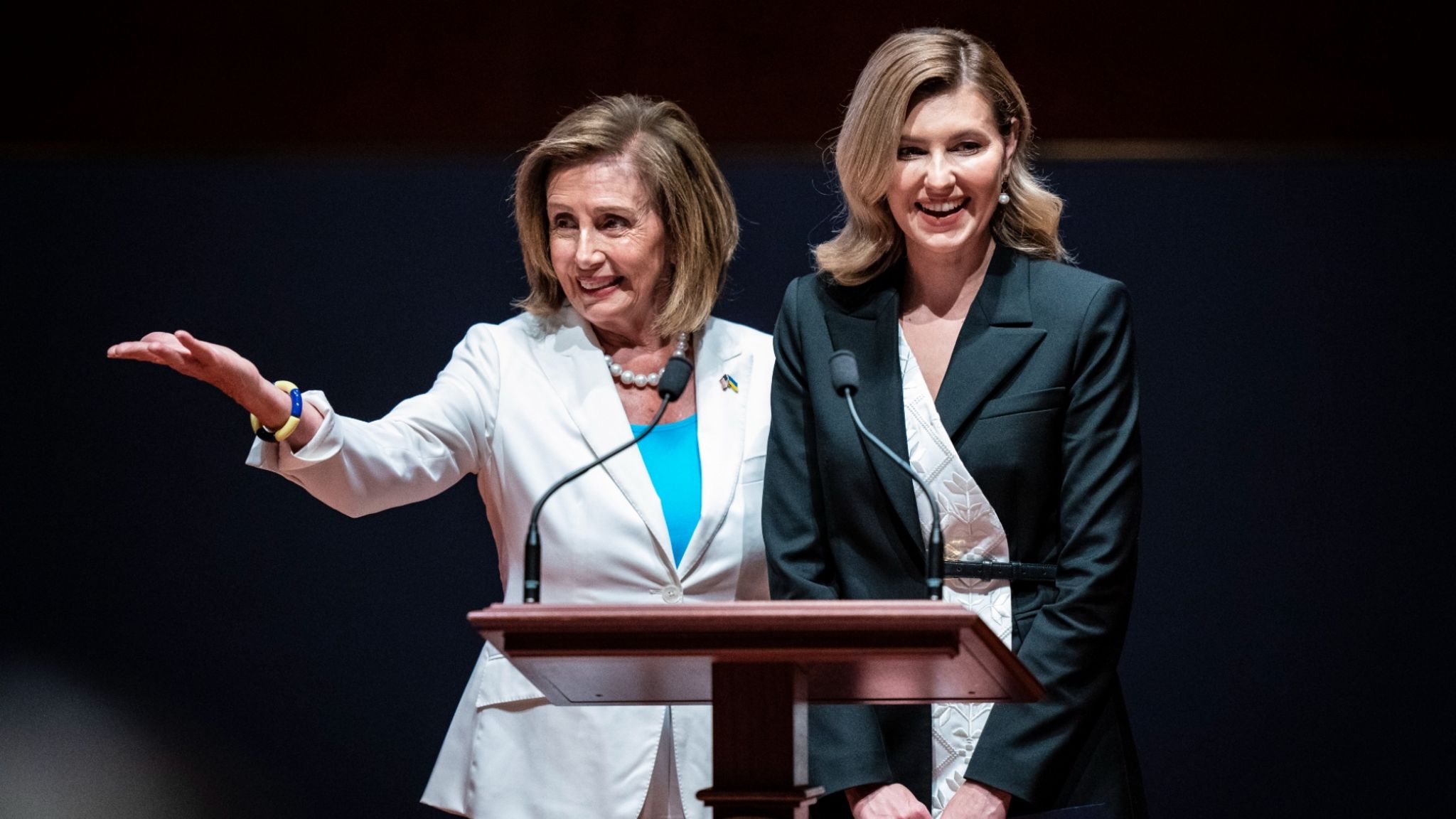
When the US Congress gave a standing ovation, twice, for a Ukrainian leader in July, it wasn’t President Zelensky at the podium – he hasn’t travelled since Russia invaded – it was his wife. And the first foreign first lady granted the privilege of addressing the US legislature never liked public speaking.
In an exclusive interview in Kyiv, Ukraine’s first lady talks to the BBC’s Lyse Doucet about the impact of war on mental health, the new roles Ukrainian women are taking on, and what victory would look like.
“I was scared,” she admits. “But I understood this mission… it was impossible to miss this chance.”
She emphasised, as she always does, the profound suffering of Ukrainian children, condemning what she called Russia’s “hunger games”. Then, she went much further, asking the US Congress to send weapons.
Had a first lady, without official powers, crossed a line? “It was not politics, it was what I had to say,” she says. “I asked for weapons, not to attack, but to prevent our children from being killed in their homes.”
IMAGE SOURCE,GETTY IMAGES Image caption, Olena Zelenska – pictured with House speaker Nancy Pelosi – never liked public speaking
The year before these momentous months, Olena Zelenska had already established a Summit of First Ladies and Gentlemen. Now it’s a powerful global network which has helped evacuate Ukrainian children needing cancer treatment and provide opportunities for education. It has arranged access to Ukrainian books in the countries that have welcomed millions of Ukrainian women and children forced to flee – without their husbands, who are barred from leaving in a time of war.
I ask whether she now senses a certain “fatigue” in other capitals, as this crisis pushes up energy and food prices beyond the borders. “I don’t feel they are tired of us. They all understand that this is not just a war in Ukraine. It is a war of world views.”
Her prominent role makes her the most visible face of a shattered society where women are taking up new roles everywhere, from fighting on front lines to taking charge as single parents. Check any UN document about Ukrainian society pre-war and it uses language like “patriarchal”, “traditional”, with women’s roles limited by gender.
Olena Zelenska is adamant that Ukrainian society was changing even before war overwhelmed everything, and that this change is now accelerating. “Kitchen, children, church – this is not for our society any more. A woman who has lived through this will not take a step back.”
Her newly formed Olena Zelenska Foundation deals with the toughest of challenges including mental health and domestic violence. As much as war can toughen individuals, it can also tear them apart.
In a reflection of the hardening public view as allegations and evidence of Russian war crimes keep emerging, as entire cities and towns are pummelled to the ground, she insists, “We cannot betray those who are now in occupied territories. We cannot leave people who are waiting for liberation.”
She hastens to add: “This is not a political position of the president or the government. This is the position of Ukrainians.”
Heart breaking photo. Missile destroyed this couple’s home. It took away their happy carefree future. But there is something Russia could not take away from them. Each other. I am often asked about where do I find strength to fight daily. There is only one answer: in our people. pic.twitter.com/LY04J06V1p
Carefully stepping through this political minefield, the first lady is categorical. “We all understand that without victory, there will be no peace. It would be a false peace and wouldn’t last long.”
And what does “victory” mean to her?
She answers without hesitation. “A return to a normal life… sometimes it seems we have put everything on pause.” That includes a different kind of life with her husband. “We’re not just spouses. I can safely say we are best friends,” she says.
My first question to the first lady had been, “How are you?” She replied that, for all Ukrainians, their answer was, “We are holding on.”
But, for how long? It’s a question no-one can answer.
Former German Chancellor Angela Merkel has defended her policy toward Russia prior to the February invasion of Ukraine,claiming she had exhausted her diplomatic options with Vladimir Putin.
She stated that she attempted to organise European talks with Russian President Vladimir Putin and French President Emmanuel Macron in the summer of 2021.
“But I didn’t have the power to get my way,” she explained to Spiegel News.
“really everyone knew in autumn she’ll be gone,” she explained.
Mrs. Merkel stepped down as chancellor in December after four terms in office. She made her final trip to Moscow in August 2021, telling a German news magazine that “the feeling was very clear: ‘In terms of power politics, you’re finished.’”
She added that “for Putin, only power counts”.
It was significant that, for their final meeting, Mr Putin brought Foreign Minister Sergei Lavrov with him, she said. Previously they had met one-to-one, she noted.
In light of President Putin’s invasion – preceded by weeks of massive military build-up on Ukraine’s borders – many have argued that Mrs Merkel and other EU leaders should have adopted a tougher approach to the Kremlin.
A foreign policy expert in her Christian Democrat (CDU) party, MP Roderich Kiesewetter, is among those who say she knew that Mr Putin was trying to split and weaken Europe, but she believed “soft power” was the right approach. He argued before the invasion that Germany was too dependent on Russian gas.
In the Spiegel interview, Mrs Merkel said her stance on Ukraine in the Minsk peace talks had bought Kyiv time to defend itself better against the Russian military.
A ceasefire deal was reached in Minsk after Russia’s 2014 annexation of Ukraine’s Crimea peninsula and during its proxy war in the Donbas region. But key points, including disarmament and international supervision, were not implemented.
Mrs Merkel said she did not regret leaving office in December, because she felt her government was failing to make progress not only on the Ukraine crisis, but also on the conflicts in Moldova, Georgia, Syria, and Libya, all of which involved Russia.
She and Mr Putin both had direct experience of life in communist East Germany – she grew up there, and he served there as a Soviet KGB officer, doing secret intelligence work. Mr Putin speaks fluent German, and Mrs Merkel speaks some Russian.
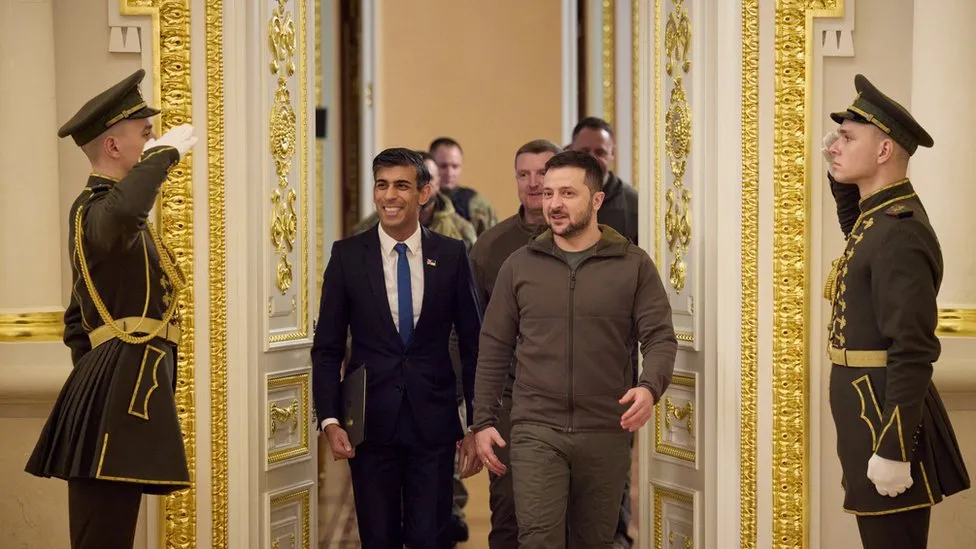
Rishi Sunakhas pledged £50m in defence aid to Ukraine as he met President Volodymyr Zelensky in his first visit to Kyiv since becoming prime minister.
Mr Sunak said it was “deeply humbling” to be in Kyiv and that the UK would continue to stand by Ukraine.
“Since the first days of the war, Ukraine and the UK have been the strongest of allies,” Mr Zelensky said following the meeting.
The aid package is intended to counter Russian aerial attacks.
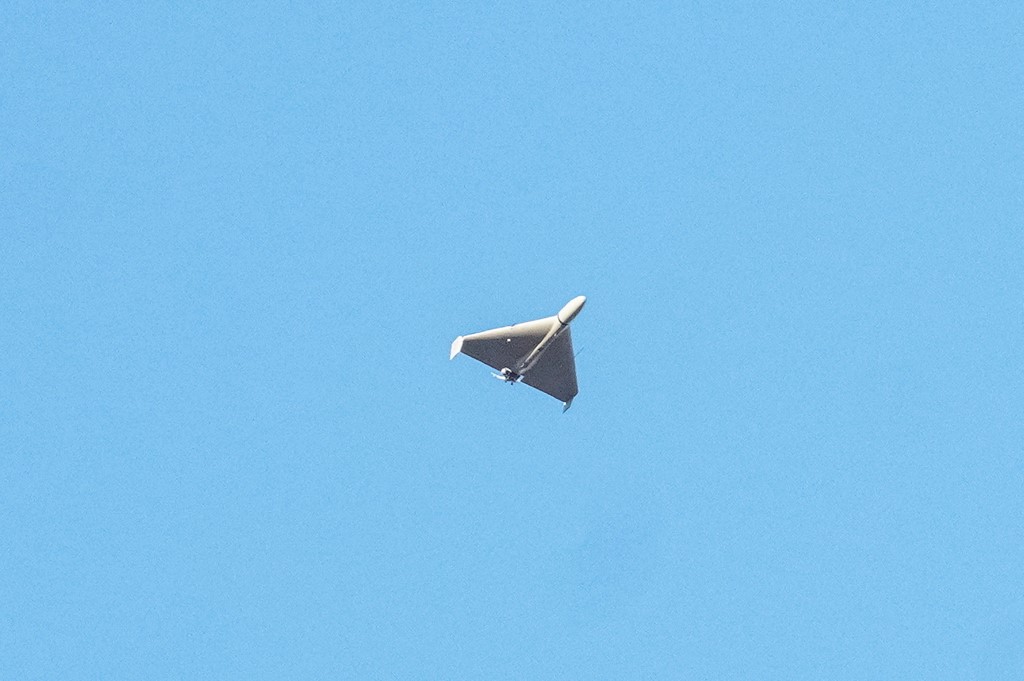
The £50m defence aid comprises 125 anti-aircraft guns and technology to counter deadly Iranian-supplied drones, including dozens of radars and anti-drone electronic warfare capability.
Mr Sunak also announced the UK will increase the training offer to Ukraine’s armed forces, sending expert army medics and engineers to the region to offer specialised support.
It follows more than 1,000 new anti-air missiles announced by the UK’s Defence Secretary Ben Wallace earlier this month.
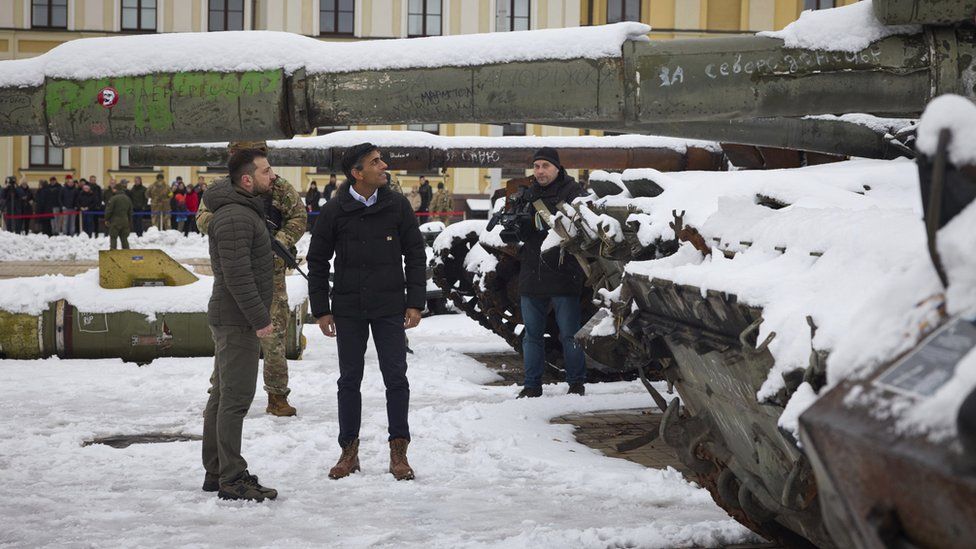
On his visit the prime minister saw captured Iranian-made drones which have been used to target and bomb Ukrainian civilians in recent months.
Mr Sunak also laid flowers for the war dead and lit a candle at a memorial for victims of the 1930s Holodomor famine, before meeting emergency workers at a fire station.
The prime minister said: “I am proud of how the UK stood with Ukraine from the very beginning. And I am here today to say the UK and our allies will continue to stand with Ukraine, as it fights to end this barbarous war and deliver a just peace.
“While Ukraine’s armed forces succeed in pushing back Russian forces on the ground, civilians are being brutally bombarded from the air. We are today providing new air defence, including anti-aircraft guns, radar and anti-drone equipment, and stepping up humanitarian support for the cold, hard winter ahead.
He added that it was “deeply humbling” to be in the Ukrainian capital and have the opportunity to meet people “paying so high a price, to defend the principles of sovereignty and democracy”.
Mr Sunak’s pledge to send more air defence support is exactly what President Zelensky would want to hear at a time when Russian airstrikes have destroyed nearly 50% of the country’s energy infrastructure, according to the government in Kyiv.
The men’s hopes for peace and a just outcome to the conflict may feel like distant prospects, but Mr Sunak’s promise to hold a reconstruction conference for Ukraine next year in London will be good news for the government and companies, which desperately need access to international finance.
During the visit, Mr Sunak also confirmed £12m for the World Food Programme’s response to Ukraine, as well as £4m for the International Organisation for Migration.
Downing Street said the funding would help provide generators and mobile health clinics, with the UK also sending tens of thousands of extreme cold winter kits for Ukrainian troops.
Labour’s shadow defence secretary John Healey tweeted: “The government continues to have Labour’s fullest backing to support Ukraine, reinforce Nato allies and confront Russia’s aggression.”
Ukraine has been requesting assistance from Western nations in recent months amid intense Russian aerial attacks on Kyiv and across the country.
Earlier in the week, Russia hit Ukraine with one of its biggest barrages of missiles yet, days after its troops were forced to withdraw from Kherson.
Kyiv was hitand there were strikes across the country, from Lviv in the west to Chernihiv in the north.
That attack coincided with the G20 summit in Indonesia this week where, in a virtual speech, Mr Zelensky said he was “convinced now is the time when the Russian destructive war must and can be stopped”.
IMAGE SOURCE,UKRAINIAN PRESIDENT’S OFFICE Image caption, Mr Sunak was shown destroyed military Russian vehicles by the Ukrainian president
While Mr Sunak was at the Bali summit, which was attended by Russia’s foreign minister Sergei Lavrov, the UK prime minister urged Russia to “get out of Ukraine” and condemned the country for its “barbaric invasion”.
He stressed the UK would “back Ukraine for as long as it takes”.
Britain is currently the largest provider of military aid to Ukraine aside from the US. So far the UK has committed about £2.3bn and has pledged to match that amount in 2023, according to the House of Commons library.
The UK is also hosting a programme which will aim to train 10,000 new and existing Ukrainian personnel within 120 days.
Mr Johnson became almost a cult figure in Ukraine, after he was one of the first international figures to publicly support Ukraine and send military assistance.
It is a tough comparison for Mr Sunak to live up to so early on in his premiership. Many people in Ukraine do not know the new prime minister well and they will want to see how committed he is to supporting the country.
The military alliance and analysts say the deadly blast in Poland highlights the need to further strengthen NATO’s eastern flank.
Russia’s war in Ukraine jolted NATO this week when a missile exploded in a Polish village near the Ukrainian border, killing two people.
Immediately after Tuesday’s blast, Polish President Andrzej Duda said the explosive that hit Przewodow, a village of hundreds of people, was “most likely Russian-made” as an investigation was still ongoing.
His statement sent shockwaves across the world, and NATO leaders expressed their will to defend every inch of territory in the world’s largest military alliance, of which Poland is a member.
Military analysts took to social media to suggest that this could be a moment when the alliance would invoke Article 4, a consultation between NATO countries when one member feels threatened, or Article 5, when an attack is considered violence against the entire alliance, allowing NATO to decide on action it deems fit to protect its members.
The same day, Russia pummelled critical Ukrainian infrastructure with a wave of missile strikes.
Ukrainian President Volodymyr Zelenskyy called the explosion in Poland “a very significant escalation” and said, “We must act.”
But NATO and Western nations, including the United States have since calmed fears, suggesting the missile was a stray, likely part of Ukraine’s air defence systems. Nevertheless, they said Russia bears overall responsibility as the aggressor and instigator of the war.
NATO Secretary General Jens Stoltenberg has maintained a cautious stance throughout the episode and did not blame Russia as he waited for Polish intelligence.
A day after the explosion, Duda joined his Western allies to say the blast was probably a Ukrainian accident and did not invoke any NATO article.
Stoltenberg said a preliminary analysis suggests a Ukrainian air defence missile landed in Poland and was fired to defend Ukrainian territory against Russian cruise missile attacks.
“But let me be clear, this is not Ukraine’s fault,” he said, stressing that Russia was still ultimately responsible.
Jim Townsend, US deputy assistant defence secretary for Europe and NATO under former President Barack Obama, welcomed NATO’s approach.
“I think NATO did a great job of being very deliberative and cautious, by putting a story together based on facts,” he told Al Jazeera. “I think the US was like that too amid an environment where everything was very murky with a lot of conflicting information out there.”
“The conflicting information was mainly picked up by the press, and it became a real frenzy,” he said.
Alexander Lanoszka, assistant professor of international relations at Canada’s University of Waterloo, told Al Jazeera that the incident demonstrates that “NATO territory cannot be purely insulated from the air defence challenges that Ukraine faces”.
But a direct military intervention against Russia “is too risky”, he said, “because of states’ reasonable concerns about nuclear escalation. Nevertheless, they might let go of some of the hang-ups they have had about the provision of certain platforms to Ukraine.”
Had NATO concluded the missile was Russian and the blast was an intentional attack, the most likely response would have been “an increase of that military assistance”, Lanoszka said.
“Most likely with air defence but perhaps involving the MGM-140 Army Tactical Missile System surface-to-surface missiles that Ukraine has long been coveting,” he added.
Speaking from the G20 summit in Bali, Indonesia, US President Joe Biden said “it was unlikely” the missile was fired by Russia.
His restraint was lavished with rare praise by the Kremlin.
But Russia slammed some Western countries, especially Poland, over their initial responses.
“We have witnessed another hysterical, frenzied Russophobic reaction, which was not based on any real data,” Kremlin spokesman Dmitry Peskov told reporters.
The blast occurred a day before NATO was due to convene a virtual meeting of the Ukraine Defence Contact Group, in which participants would decide on future packages of military assistance.
“Whatever the actual course of events that led to the tragedy in that Polish village,” Lanoszka said, “it took place on a day when Russia launched a massive missile barrage across all of Ukraine.
“Whenever Russia has suffered a very visible loss on the battlefield, it has tended to retaliate by launching a major air attack against Ukrainian cities.
“Part of the strategy is to create a situation of terror that would have psychological effects on the Ukrainian population so that, as the theory goes, it would be more willing to accept Russian terms.”
Harry Nedelcu, geopolitics director at Rasmussen Global and leader of its Ukraine Advisory Service, also stressed that the incident happened on a day “when a string of Russian missiles hit several Ukrainian cities with an aim of terrorising civilians and targeting power grids. Ukraine, in turn, used its air defence systems. So whichever way you look at it, context matters.”
Townsend said that with Moscow’s intensified campaign, the West and NATO must focus on sending more air defence systems to Poland and countries bordering Russia and Ukraine.
“They may need some more Patriot [missile] systems or something along those lines because there could be other missiles down the road as the war continues,” he said. “Next time it might be a real Russian missile, and we need to be ready for it.”
Speaking to reporters in Brussels, Stoltenberg said the blast in Poland underscores the importance of strengthening the alliance’s eastern flank further and supporting Ukraine.
“At least in the winter weeks ahead, air defence systems will help Ukraine because already we see that the country’s air defence is managing to target a lot of Russian missiles,” Nedelcu said. “So now it’s just about closing that gap and making sure that Russian missiles do not hit their targets.”
Meanwhile, as NATO nations continue to support Poland with its investigation, Townsend said he hopes a sort of “future action report” detailing the entire process of the investigation and the pathway ahead will be made available.
“Pretty early on, NATO nations decided to stay prudent and cautious every step of the way whilst gathering evidence,” he told Al Jazeera. “The alliance did a good job in handling this crisis, but a lot of lessons are also being learned as NATO wades through handling this war and supporting Ukraine.”
“So a study to look at what NATO did right and where more work needs to be done to prevent future incidents like this could be useful,” he said.
As late as Tuesday evening, Zelenskyy maintained that the missile was a “message from Russia to the G20 summit”.
Since Poland and other nations such as Latvia were quick to blame Russia, “this incident further reinforces Russia’s narrative of the West ‘pushing for World War III’,” Kamil Zwolski, associate professor of international politics at the University of Southampton, told Al Jazeera. “But Russia’s reaction was entirely predictable.”
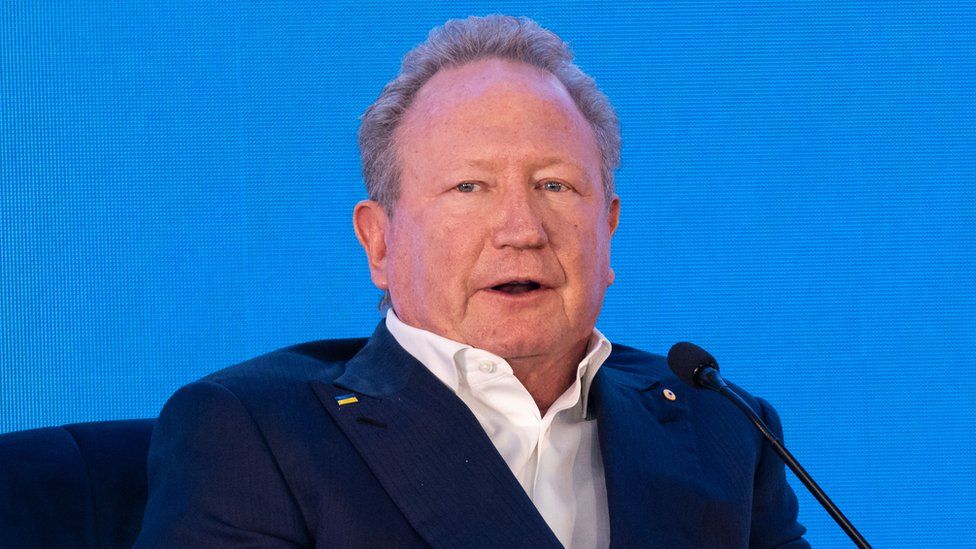
Andrew Forrest, an Australian mining billionaire, has launched an investment fund worthat least $25 billion (£21 billion) to help rebuild war-torn Ukraine.
Mr. Forrest and his wife have contributed $500 million to the fund, which organisers say could grow to $100 billion in the future.
The Ukraine Green Growth Initiative intends to invest in basic infrastructure such as energy and telecommunications networks.
The move was welcomed by President Zelensky.
“We will take advantage the fact that what the Russians have destroyed can readily be replaced with the most modern, green, and digital infrastructure,” Mr Zelensky said.
The fund said it had been working with Larry Fink, the chairman of investment giant BlackRock, and hopes to gain the support of sovereign wealth funds and other professional investors.
Since starting work on the investment fund in early March, Mr Forrest said he had discussed the plan with a number of world leaders including US President Joe Biden, then-UK Prime Minister Boris Johnson and European Commission President Ursula von der Leyen.
“The president [Zelensky] sees that as an opportunity to completely replace old coal-fired [and] nuclear power stations with brand new green energy,” Mr Forrest told the BBC.
“That capital would be available the instant that the Russian forces have been removed from the homelands of Ukraine,” he added.
In recent years he has turned his attention to sustainable technology, with initiatives to decarbonise his mining operations and become a major producer of green hydrogen.
Rebuilding Ukraine
The Russian invasion of Ukraine has seen large parts of the country’s infrastructure destroyed or damaged.
Recent Russian missile attacks have targeted Ukraine’s energy network including its electricity generation plants.
In July Ukrainian Prime Minister Denys Shmyhal said it would cost $750bn for the country to recover from the war, which had caused $100bn of direct damage to infrastructure.
IMAGE SOURCE,GETTY IMAGES Image caption, Australian mining tycoon Andrew Forrest
This week Russia angrily rejected international calls for it to pay for war damage it has inflicted in Ukraine.
It came after the UN General Assembly passed a resolution saying Russia should face the consequences of its actions, including paying reparations.
Rwandan President Paul Kagame has lamented the effects of the Ukraine conflict on Africa, declaring that the continent desires world peace.
On Tuesday, Kagame spoke at the G20 Summit in Bali, Indonesia, as chairperson of the African Union Development Agency’s (Nepad) Heads of State and Government Orientation Committee.
The setting was ideal for Kagame to say: “I commend the attention given to the priorities that matter to small and developing countries, including coping with the effects of the war in Ukraine and other crises.” The conference was held under the theme “Recover Together, Recover Stronger.”
Parts of Africa, particularly central and southern Africa, are currently experiencing or preparing for cropping seasons.
But the war in Ukraine has resulted in a shortage of fertiliser, which is mostly procured in Ukraine and Russia. This has led to a spike in the price.
One of the single most notable compromises to help alleviate this crisis this week was the release of a Russian fertiliser cargo which had been detained for months in the port of Rotterdam because of sanctions.
It’s now on its way to Malawi, one of southern Africa’s most food-insecure countries.
The 20 000 tons of fertiliser belong to a Russian who’s been on the United States sanctions list since the start of the war in Ukraine. However, he will not benefit from the cargo that’s now under the radar of the World Food Programme (WFP).
Since the start of the war, a number of African countries have been sitting on the fence, choosing not to vote against Russia or outright support the invasion.
It’s a diplomatic approach that seeks to please both sides of the divided world. But Kagame said Africa should not be blamed for allegedly taking sides.
He said:
What Africa wants to see is peace. We are confident that we cannot be accused of taking sides, simply by asking for peace. Africa is here for Africa and our productive relationship with the rest of the world.
Kagame also highlighted that Africa had specific challenges, made worse by external factors such as the war in Ukraine, and that “too often our people are left to pay the price”.
Climate change, the war in Ukraine, and conflicts in Africa are the major drivers of the widening gap between developing and developed countries. This has led to even more debt for the continent.
Kagame pleaded with the G20to reintroduce debt write-offs, and for more support from the International Monetary Fund through its Resilience and Sustainability Trust.
The United States has strongly condemned Russia’s latest missile attacks against Ukraine, which are reported to have struck residential buildings in Kyiv and additional sites across the country.
US National Security Advisor Jake Sullivan has said the strikes will serve to only deepen the concerns among the G20 about the “destabilising impact of [Russian President Vladimir] Putin’s war”.
“It is not lost on us that, as world leaders meet at the G20 in Bali to discuss the issues of significant importance to the lives and livelihoods of people around the world, Russia again threatens those lives and destroys Ukraine’s critical infrastructure,” Sullivan said.
“Our thoughts are with the brave Ukrainian people, who continue to demonstrate resilience and courage in their defence of their sovereignty and democracy.”
He said the US, its allies and its partners would continue to provide Ukraine with what it needed to defend itself, including air defence systems, adding the US would stand with Ukraine “for as long as it takes”.
We are getting a bit more on President Volodymyr Zelenskyy’s speech at the G20 summit in Bali.
During his virtual address, the Ukrainian leader presented a 10-point plan for peace with Russia.
He also said there would be no “Minsk 3” deal to end the fighting in Ukraine.
The Minsk agreements were a series of international agreements which sought to end the Donbas war and his statement refers to two failed ceasefire deals between Kyiv and Moscow over the status of the region.
“We will not allow Russia to wait, build up its forces, and then start a new series of terror and global destabilisation. There will be no Minsk 3, which Russia will violate immediately after the agreement,” Mr Zelenskyy said.
Mr Zelenskyy’s 10-point plan for peace are:
Radiation safety and nuclear weapons;
Food safety
Energy security
Release of prisoners and internees
Implementation of the UN Charter
Withdrawal of Russian troops and cessation of hostilities
Ukraine has put forward “unrealistic” conditions for peace, Russia’s foreign minister, Sergei Lavrov has said.
Speaking to reporters in Bali, Indonesia, Mr Lavrov said he had been in talks with the leaders of France and Germany on the conflict in Ukraine before going on to accuse Kyiv of dragging out any possible resolution.
He claimed Ukraine was refusing to talk to Moscow and had put forward unrealistic conditions for peace.
The Kremlin official also said that the UN had promised to move obstacles to the export of Russian grain and fertilisers.
Russia has long complained of barriers to its farm exports, even though they are not directly targeted by Western sanctions.
In spite of the problems, Mr Lavrov said Russia had already exported 10.5 million tonnes of grain, mainly wheat, of which 60% had gone to Asia and 40% to Africa.
“I hope these promises will be fulfilled. At least the UN secretary general gave me his sworn assurance that this is a priority issue for him,” he added.
Yesterday, the Indonesian authorities said Mr Lavrov had been taken to hospital after his arrival in Bali for the G20 summit.
Wayan Koster, the governor of Bali, said he had been taken in for a “check-up” at the Sanglah Hospital in the provincial capital, Denpasar, and was “immediately returned”.
Three other Indonesian government and medical officials also said he was being treated on the resort island.
However, the Russian foreign ministry dismissed claims that he had been in hospital as “fake news”.
Zelenskyy triumphantly walked the streets of Kherson, hailing Russia’s withdrawal as the “beginning of the end of the war,” but also acknowledging the high cost Ukrainian troops are paying in their grinding effort to push back the Russians.
Zelenskyy awarded medals to soldiers and posed for selfies with them in Kherson, striking a defiant tone.
“This is the beginning of the end of the war,” he said. “We are step by step coming to all the temporarily occupied territories.”
But he also grimly noted that the fighting “took the best heroes of our country”.
Zelenskyy’s trip to Kherson was another is a series of unexpected visits to front-line areas at crucial moments of the war. This one was laden with both symbolism and the common touch — clearly aimed at boosting morale of soldiers and civilians alike.
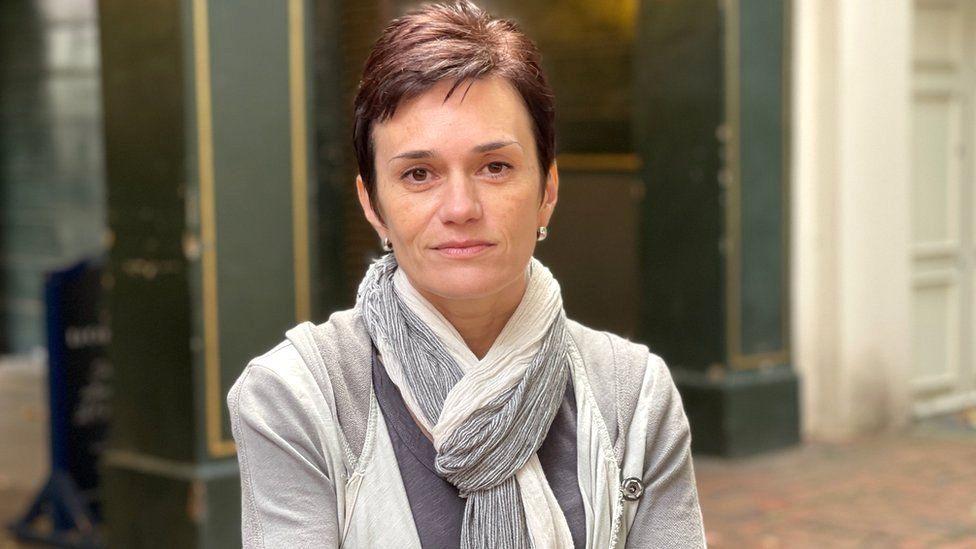
When Vladimir Kara-Murza announced he was returning to Moscowearlier this year, his wife Evgenia knew the risk but did not try to stop him.
Russia had invaded Ukraine and made it a crime to call it a war. Thousands of protesters had been arrested. Vladimir himself was a sworn opponent of President Vladimir Putin and an outspoken critic of atrocities committed by his military.
Still, the opposition activist insisted on being in Russia.
Now he has been locked up and charged with treason and Evgenia has not been allowed to speak to him since April.
But in a series of letters to me from Detention Centre No. 5, Vladimir – who has twice been the victim of a mysterious poisoning – says he has no regrets, because the “price of silence is unacceptable”.
Opposing President Putin was dangerous even before the invasion, but since then the repression of dissent has intensified. Almost all prominent critics have either been arrested or left the country. Even so, the treatment of Vladimir is especially harsh.
All the charges against him are for speaking out against the war and against President Putin and yet his lawyer calculates he could spend 24 years behind bars.
“We all understand the risk of opposition activity in Russia. But I couldn’t stay silent in the face of what’s happening, because silence is a form of complicity,” Vladimir explains in a letter from his cell.
The first Evgenia heard of her husband’s arrest was a call from his lawyer, who had been tracking the activist’s phone as he always did when his client and friend was in town. On 11 April, the phone had come to a stop at a Moscow police station.
Vladimir was eventually allowed to call his wife, who lives in the US with their children for safety. There was just time to say: “Don’t worry!”
Evgenia smiles at the absurdity of that instruction.
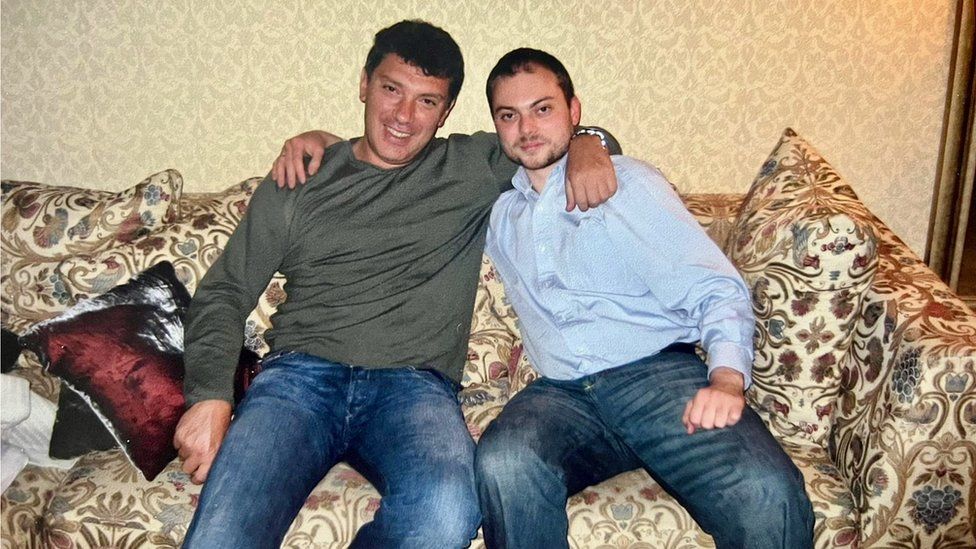
The couple were children of perestroika, growing up during Russia’s democratic awakening after the Soviet collapse. Vladimir then studied history at Cambridge, and simultaneously began a career in Russian politics as an adviser to the young reformer Boris Nemtsov.
This is the longest the pair have been apart since their marriage on Valentine’s Day in 2004 and the activist says not seeing his family is the hardest thing. “I think about them every minute of every day and cannot imagine what they’re going through,” he says.
“I love and hate this man for his incredible integrity,” Evgenia told me on a recent trip to London.
“He had to be there with those people who went out on the streets and were arrested,” she said, referring to the many Russians detained for opposing the war. “He wanted to show that you shouldn’t be afraid in the face of that evil and I deeply respect and admire him for that. And I could kill him!”
Image caption, Evgenia has not been allowed to speak to her husband since he was jailed
Vladimir was initially detained for disobeying a police officer, but once in custody the serious charges began raining down.
The activist was first accused of “spreading false information” about Russia’s military and “higher leadership”.
The rights group OVD-Info has recorded more than 100 prosecutions under that so-called “fake news” law since the war began: a local councillor, Alexei Gorinov, was sentenced to seven years in July and activist Ilya Yashin will go on trial soon after referring to the murder of civilians in Bucha.
Vladimir’s case is based on a speech in Arizona where he said Russia was committing war crimes in Ukraine with cluster bombs in residential areas and “the bombing of maternity hospitals and schools”.
That has all been independently documented, but according to the charge sheet I have seen, Russian investigators deem his statements to be false because the defence ministry “does not permit the use of banned means… of conducting war” and insists that Ukraine’s civilian population “is not a target”.
The facts on the ground are ignored.
Another charge stems from an event for political prisoners at which the activist referred to what investigators term Russia’s “supposedly repressive policies”.
Then last month he was charged with state treason.
The activist responded to that in his latest letter: “The Kremlin wants to portray Putin’s opponents as traitors… the real traitors are those who are destroying the well-being, the reputation, and the future of our country for the sake of their personal power, not those who are speaking out against it.”
Political persecution
The treason charge is based on three speeches abroad, including one in which Vladimir said that in Russia political opponents were persecuted.
Investigators maintain that he was speaking on behalf of the US-based Free Russia Foundation, which is banned in Russia, where any “consultancy” or “assistance” to a foreign organisation considered a security threat can now be classed as treason.
No secrets have to be divulged.
“State treason for public speeches? That’s just absurd. It’s quite simply persecution for free speech. For opinion. Not for any real crime,” Vladimir’s lawyer, Vadim Prokhorov, argues by phone from Moscow.
He says the activist had no link to the foundation at the time.
“This is a political case. They’re trying to stigmatise the absolutely normal, civilised Russian opposition.”
IMAGE SOURCE,EVGENIA Image caption, Vladimir has written to the BBC from his jail cell
Vladimir himself points out that the last person accused of treason for political opposition was the Nobel Prize-winning writer Alexander Solzhenitsyn in 1974. “All I can say is that I am honoured to be in such company.”
Evgenia finds it harder to sound so calm.
This is not the first time she has been scared for her husband. He nearly died, twice, in Moscow, and the cause of his poisoning has never been identified.
When he first collapsed in 2015 and slipped into a coma, Evgenia was told he had a 5% chance of survival, but he defied the odds.
She nursed him back to health, helping him learn to function again, even to hold a spoon. He would then insist on working on his laptop on their couch, despite being sick every half hour.
“The moment he could walk, he packed his bags and went to Russia. That fight is bigger than his fears.”
For Evgenia, that has meant seven years sleeping with her phone, ”afraid I will get that call from him, or from someone else because he can’t talk anymore”.
She gave up persuading her husband not to go to Moscow long ago: her only protest was to refuse to help pack his bags. But before his last visit, after the war started, Evgenia accompanied him first to France.
“I wanted to make the trip beautiful,” she remembers, forcing back tears as she recalls long strolls through the streets of Paris, talking endlessly. “Deep inside, I knew what was coming.”
Nemtsov’s Place
Since Vladimir’s arrest, Evgenia has taken on his advocacy work: speaking out about the war in Ukraine and political repression in Russia, as well as her husband’s case.
On Monday she will unveil the Boris Nemtsov Place in London, the result of a long campaign by Vladimir to honour his mentor and friend. The prominent opposition politician was shot beside the Kremlin in 2015 in a contract killing for which the contractor has never been caught.
The renamed London street, actually a roundabout, is close to the Russian trade delegation in Highgate.
IMAGE SOURCE,EVGENIA KARA-MURZA Image caption, Boris Nemtsov (left) was a friend and mentor to Vladimir (right)
“The idea was that every car that comes to the big gate will see the Boris Nemtsov plaque,” Evgenia explains. Her husband hopes a different Russia will one day be proud of that name.
For several years, the politician worked closely with Vladimir to lobby Western governments to sanction senior Russian officials for human rights violations. Their success infuriated a political elite that had enjoyed travelling abroad and channelling funds there.
In Moscow once, Vladimir told me he had concluded that those “Magnitsky” sanctions are why both he and Mr Nemtsov were targeted.
Standing-in for her husband is taking a heavy toll on Evgenia, but it is also kept her going.
“I am doing what I need to do so that he can be brought back to the kids and this hideous war stops and this murderous regime can be brought to justice.”
Vladimir is not staying silent, either.
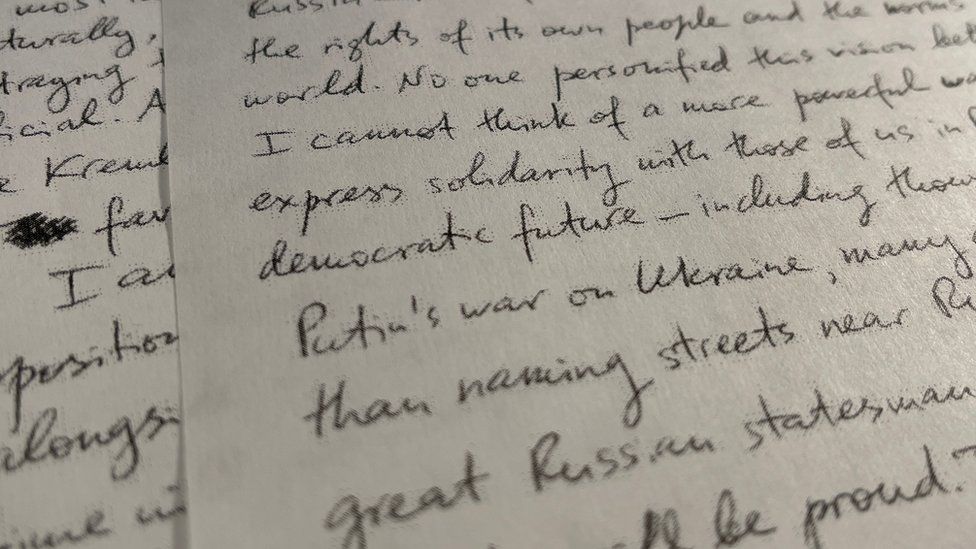
His long, handwritten prison letters set out his convictions that Russia is not doomed to autocracy and its people are not all brainwashed Putin devotees.
He points to the large number of letters he gets from supporters who openly criticise the Ukraine invasion and the Kremlin, and to those who still protest publicly, despite the risk. He urges the West not to isolate that part of Russian society that “wants a different future for our country”.
“For Putin, compromise is a sign of weakness and an invitation to further aggression,” he says. “If he’s allowed a face-saving exit from the war, then in a year or two we will have another one.”
Vladimir tells me he is coping with imprisonment with a mixture of exercise and prayer, books and letters. As a historian, he has a particular interest in Soviet-era dissidents and has been reading more about them as he awaits trial.
“Their favourite toast back then was ‘To the success of our hopeless cause!’” he writes. “But as we know, it wasn’t so hopeless after all.”
All Russian forces and equipment have been relocated to the Dnieper River’s eastern bank, according to the Russian defence ministry
Russia has completed its troop withdrawal from the western bank of the Dnieper River in Ukraine’s southern Kherson region, a major setback for Moscow in its nearly nine-month war in Ukraine.
According to Russian news agencies, the withdrawal was completed by 5 a.m. Moscow time (02:00 GMT) on Friday, and not a single military unit was left behind.
According to the ministry, all Russian forces and equipment have been transferred to the Dnieper’s eastern bank.
It was also stated that no personnel or equipment were lost during the withdrawal from the strategic city of Kherson.
Serhiy Khlan, a deputy for Kherson Regional Council, told a briefing many Russian soldiers had been unable to leave Kherson city after months of occupation, and had changed into civilian clothing.
Ukrainian officials were wary of the Russian pullback announced this week, fearing their soldiers could get drawn into an ambush in Kherson city, which had a pre-war population of 280,000. Military analysts also predicted it would take Russia’s military at least a week to complete the troop withdrawal.
Serhii Tamara removes debris from her son’s house, which was destroyed during a Russian attack [Valentyn Ogirenko/Reuters]
‘No regrets’
The Kremlin remained defiant on Friday, insisting the development in no way represented an embarrassment for President Vladimir Putin. Moscow continues to view the entire Kherson region as part of Russia, Kremlin spokesman Dmitry Peskov told reporters.
“This is a subject of the Russian Federation. There are no changes in this and there cannot be changes,” said Peskov, adding Moscow had “no regrets” about the move.
He added the Kremlin did not regret holding festivities just a month ago to celebrate the annexation of Kherson and three other occupied or partially occupied regions of Ukraine.
Russia ordered the withdrawal on Wednesday after it said attempts to maintain its position and supply troops were “futile” in the face of a mounting Ukrainian counteroffensive.
Putin proclaimed Kherson and three other regions of Ukraine as part of Russia in a triumphal ceremony at the Kremlin on September 30. Ukraine, its Western allies, and an overwhelming majority of countries at the United Nations General Assembly condemned the annexations as illegal.
Ukrainian troops reclaimed dozens of landmine-littered settlements abandoned by Russian forces in southern Ukraine and were advancing on Kherson on Friday. President Volodymyr Zelenskyy said in an overnight video address that Ukrainian forces had liberated 41 settlements.
Counteroffensive
Ukraine’s general staff said it was keeping its latest movements under wraps but listed 12 settlements it said had been freed as of Wednesday: one of them, Blagodatne, lies 30km (20 miles) from the centre of Kherson, a port at the mouth of the Dnieper River.
“Offensive actions in the specified direction continue,” it said. “Due to the safety of the operation, the official announcement of the results will be made later.”
Russia still has 40,000 soldiers in the region and intelligence showed its forces remained in and around the city, Ukraine’s Defence Minister Oleksii Reznikov said on Thursday.
Having previously warned the Russian retreat might be a trap, some quarters of the Ukrainian government barely disguised their glee at the pace of the withdrawal.
“The Russian army leaves the battlefields in a triathlon mode: steeplechase, broad jumping, swimming,” Andriy Yermak, a senior presidential adviser, tweeted.
Social media videos apparently filmed by soldiers on routes towards Kherson showed villagers hugging the Ukrainian troops.
Recapturing the city could provide Ukraine with a strong position from which to expand its southern counteroffensive to other Russian-occupied areas, potentially including Crimea, which Moscow seized in 2014.
From its forces’ new positions on the eastern bank, however, the Kremlin could try to escalate the war.
The state of the key Antonovsky Bridge that links the western and eastern banks of the Dnieper remained unclear.
Russian media reports suggested the bridge was blown up following the Russian withdrawal. Pro-Kremlin reporters posted footage of the bridge missing a large section.
But Sergey Yeliseyev, a Russian-installed official in Kherson, told the Interfax news agency “the Antonovsky Bridge hasn’t been blown up, it’s in the same condition”.
US National Security Adviser Jake Sullivan says, communication channels between Washington and Moscow remain open.
The announcement comes as the White House refuses to deny reports that Mr. Sullivan has been leading talks with Russia to avoid a nuclear escalation in Ukraine.
Mr Sullivan stated in New York that maintaining contact with the Kremlin was “in the interests” of the US.
He insisted, however, that officials were “clear-eyed about who we are dealing with.”
The Wall Street Journal reports that Mr Sullivan has held confidential discussions with his Russian counterpart, Security Council secretary Nikolai Patrushev, and senior Kremlin foreign policy aide Yuri Ushakov, over the past several months.
Senior officials told the paper the men had discussed ways to guard against the risk of nuclear escalation in the war in Ukraine, but had not engaged in any negotiations around ways to end the conflict.
Last month, Mr Sullivan said any use of nuclear weapons would have “catastrophic consequences for Russia”. He told the US broadcaster NBC that senior officials had “spelled out” the scope of the potential US response in private discussions with Russian officials.
US National Security Council spokeswoman Adrienne Watson refused to confirm the story, telling the paper that “people claim a lot of things”, while Kremlin spokesperson Dmitry Peskov accused Western newspapers of “publishing numerous hoaxes”.
But White House press secretary Karin Jean-Pierre said on Monday that the United States reserved the right to hold talks with Russia.
And Mr Sullivan – who is said to be one of the most senior advisers to US President Joe Biden still pushing for discussions with Russia – said maintaining contact with Moscow was in the “interests of every country who is affected by this conflict”.
Last week, the Washington Post reported that senior US officials were urging Kyivto signal an openness to hold negotiations with Russia and drop their public refusal to discuss an end to the war while President Vladimir Putin remained in power.
But Mr Sullivan told a public event in New York that the Biden administration had “an obligation to pursue accountability” and pledged to work with international partners to “hold the perpetrators of grave and grotesque war crimes in Ukraine responsible for what they have done”.
“I was just in Kyiv on Friday. and I had the opportunity to meet with President [Volodymyr] Zelensky and my counterpart Andriy Yermak, with the military leadership and also to get a briefing on just what level of death and devastation has been erupted by Putin’s war on that country,” Mr Sullivan said.
Concerns have been heightened in recent months that Russia could resort to using nuclear weapons in a desperate attempt to defend four regions of eastern and southern Ukraine that it illegally annexed.
Meanwhile, Ukraine has invoked its war-time martial laws to take control of the assets of five strategically important companies.
Some of the companies – which include two energy companies and firms that make engines, vehicles and transformers – are linked to oligarch Vyacheslav Bohuslayev, who was arrested on suspicion of collaborating with Russia.
Koku Anyidoho, a one-time presidential spokesperson has reacted to the ‘Kume preko‘ reloaded protest that took place over the weekend.
The protest which saw hundreds of Ghanaians clad in red and black and holding placards critical of the government was called by a private legal practitioner, Martin Kpebu.
The lawyer decried the spate of economic mismanagement as a core plank for his call for the president and his vice to resign and hand over power to the Speaker of Parliament.
It is that demand that Anyidoho built his views around in a tweet dated November 6, 2022.
It read: “When a lawyer goes on demonstration to ask that the President and Vice President should resign; is he asking for a coup?”
Kpebu speaks at protest
Kpebu led hundreds of demonstrators who marched through the capital on Saturday demanding the immediate resignation of President Akufo-Addo over Ghana’s current economic woes.
Addressing protesters during the march, he said: “We are dying; citizens are dying; citizens can’t afford food; citizens are starving all because of misgovernance by President Akufo-Addo.
“It never happened that you have a president in office and every time that the country borrows, the president’s family becomes richer; how? This can’t continue.
“We can’t borrow all the time and have Databank becoming richer all the time. Citizens have a duty as stated in Article 41 [of the Constitution] to ask the president to resign and this is not the first time that a president of Ghana is going to resign,” Martin Kpebu said.
What Akufo-Addo said about Ghana being in a crisis
Amid an economic downturn, calls for Akufo-Addo to resign has heightened with a November 5, 2022 protest dubbed ‘Kume Preko Reloaded’ making the loudest call as activists and politicians marched in Accra to press home that demand.
The government is meanwhile, grappling with an economic crisis, which along with the galamsey scourge and corruption are the major drivers for the call on Akufo-Addo to resign along with his Vice President, Mahamadu Bawumia.
Akufo-Addo in his October 30 address on the economy blamed the Covid-19 pandemic and the ongoing Russia-Ukraine war as causes for the country’s economic woes.
While admitting that the country was in crisis and rallying support for various government interventions to stem the tide, he said the situation was not peculiar to the country as many nations across the world were also experiencing difficulties.
“We are in a crisis, I do not exaggerate when I say so. I cannot find an example in history when so many malevolent forces have come together at the same time.
“But, as we have shown in other circumstances, we shall turn this crisis into an opportunity to resolve not just the short-term, urgent problems, but the long-term structural problems that have bedevilled our economy,” he said.
But like before, President Akufo-Addo blamed the Covid-19 pandemic and the ongoing Russia-Ukraine war as causative factors for the economic woes.
When a lawyer goes on demonstration to ask that the President and Vice President should resign; is he asking for a coup?
The Kremlin has refused to comment on media reports that high-level US-Russia talks have occurred.
The Kremlin has refused to comment on a Wall Street Journal report that the US held secret talks with top Russian officials about avoiding further escalation in the Ukraine war.
According to the report, US National Security Adviser Jake Sullivan met with President Vladimir Putin’saides in an attempt to reduce the risk of a larger war or nuclear conflict.
“We have nothing to say about this publication,” Kremlin spokesman Dmitry Peskov told reporters on Monday.
The newspaper reported that US officials said Sullivan has been in contact with Yuri Ushakov, a foreign policy adviser to Putin, and Security Council Secretary Nikolai Patrushev.
Peskov also declined to comment on a Washington Post report over the weekend that said the US had privately encouraged Ukraine to negotiate with Russia.
“We have nothing to say about this publication,” Peskov said.
“Once again, I repeat that there are some truthful reports, but for the most part, there are reports that are pure speculation,” he said, directing journalists to contact the White House or the newspaper itself.
Meanwhile, Ukrainian President Volodymyr Zelenskyy said he sees no room for negotiations with Russia, an option he officially ruled out after Russia held illegal referendums that resulted in the “annexation” of four Ukrainian regions in September.
Zelenskyy has said he may negotiate with a new Russian president, whenever one emerges.
The Ukrainian public, having suffered enormously over the past eight months of war, are often outraged whenever foreign figures suggest they accept the conflict’s current state and give in to Russia’s demands.
Recently, tech billionaire Elon Musk tweeted a plan to end the war that would give Crimea to Russia and hold United Nations-organised referendums in the four regions Moscow has annexed about whether Russia stays or goes.
Musk was blasted for it, but a lack of negotiations is causing concern among international powers.
“Ukraine fatigue is a real thing for some of our partners,” an anonymous US official reportedly told the Washington Post.
According to a Wall Street Journal poll, 48 percent of Republicans said the US was doing “too much” to support Ukraine.
With global inflation rates rising, new questions have been raised about the future of the US assistance, which has already reached $18.2bn.
Other nations that were already reluctant to outwardly support Ukraine could also push for more peace talks if the war continues.
Zelenskyy has refused to speak to Russia unless Ukraine regains all its captured territory, but according to the Washington Post, US officials believe the Ukrainian leader will probably be open to negotiations in the winter.
More than 1,500 new graveshave been dug at a mass burial site near the southern Ukrainian city of Mariupol, according to an analysis of new satellite images carried out for the BBC.
The site north-west of the city consists of a large field of graves that Ukrainian officials and witnesses say contains thousands of bodies.
Mariupol, a port city close to the border with Russia, was a major strategic target for the Russians. From the start of the war it was pounded relentlessly from the air and from the ground. By the time it fell to the Russians in May, thousands of civilians had died and much of the city had been destroyed.
Recent satellite images from Maxar show that three mass burial sites near Mariupol located at Staryi Krym, Manhush and Vynohradne, have been steadily growing since the Spring.
The Centre for Information Resilience analysed the images of Staryi Krym for the BBC’s Panorama programme and concluded that 1,500 new graves had been dug there since it last analysed images at the site in June. It now estimates that more than 4,600 graves have been dug there since the beginning of the war, although it says it cannot know how many bodies are buried at the site.
Ukrainian officials now believe that at least 25,000 people were killed in the fighting in Mariupol, and that 5,000-7,000 of them died under the rubble after their homes were bombed.
Witnesses in Mariupol have told the BBC that they have seen the Russian authorities removing bodies from the rubble of destroyed buildings in the city over recent months and taking them away for burial.
IMAGE SOURCE,MAXAR/CIR Image caption, Analysis of the mass burial site shows how it has grown since May
Olga Sagirova’s harrowing story is a glimpse into what so many in Mariupol went through. She was the only person inside her house to survive when it was bombed by the Russians. Her husband and parents were killed, and like many who have now escaped the city, she doesn’t know where their bodies are.
The 48-year-old accountant lived with her husband Valery in a two-storey house with a landscaped garden, in a residential neighbourhood of Mariupol. Her two adult children lived elsewhere.
It had been fairly quiet in her area in early March, despite the intense shelling in other parts of the city. Nonetheless, each night she and her husband would sleep in the cellar. “I used to cry all the time, my husband tried to reassure me,” said Olga. “He said I shouldn’t worry, that we’d get through this.”
On the evening of 10 March, the 15th day of the Russian bombardment, there was a knock at the door. Olga’s parents, who were in their 80s, were standing there looking very shaken.
Image caption, Olga Sagirova (L) with her mother and sister, whose bodies – like thousands in Mariupol – are unaccounted for
Their house had just been shelled and was on fire. Olga brought them in and urged them to sleep down in her cellar with her. But they didn’t want to, so she gave them a bedroom in the main house.
At about 22:30 Valery went upstairs from the cellar because the shelling had quietened down and he wanted to get some rest. But he reassured Olga, saying he would return if anything happened.
At 03:30 she woke up and heard the sound of a plane. Suddenly the entire house came down on top of her.
“It just all happened in a split second. Everything was falling down on me,” she said.
“My legs were half-buried, so I couldn’t even move. When my hearing slowly returned, I could hear my husband’s voice somewhere: ‘Olga, help me, dig me out,’ he said. ‘I’m near the stairs’.”
Olga could see Valery only six feet away but she could not reach him. He was buried more deeply than her.
All she could do was to keep talking with him. “After a while, I heard him wheezing,” she said. “Then he was silent.”
Alone in the darkness, Olga tried to scream but no-one heard her. Eventually, she saw a torch moving towards her. It was her neighbours, who tried to free her from the rubble. Unable to do so, they said they would return at sunrise.
Olga was alone again, with her husband, who had spoken his last words, buried in the rubble near her.
Hours under the rubble
As dawn broke, Olga began to make out her surroundings. When she looked up she saw a concrete slab – tilted and threatening to fall on her.
“I knew that nothing mattered any more. I was dying,” she says. At that point, she says, she tried to take her own life.
Eventually her neighbours came back with others and they tried to dig her out. They managed to dislodge one of Olga’s legs. But one of the concrete slabs was pressing down on the other one.
For six more agonising hours they tried to free her right leg. Finally they decided to wrap a cable around Olga’s leg and pull it hard.
“I was really scared that they couldn’t get my leg out and I would be left without a leg,” she says.
After three attempts, Olga was freed. Both of her legs were broken in multiple places and she was unable to walk for almost five months. “My right leg was totally smashed,” she said.
That night Olga lost not only her husband, but her parents, who had been sleeping in the main area of the house when it was pulverised.
But her ordeal was not over yet.
While Olga was being cared for in a nearby cellar in Mariupol she received more devastating news.
Image caption, An estimated 90% of the buildings destroyed were residential
Her sister and brother-in-law had also been killed in their home three days earlier.
“They were sitting in their garden drinking coffee when the bomb struck,” Olga said.
“I lost five of my closest people in a few days.”
When I met Olga, she was living in Huizen near Amsterdam, safe with her two grown-up children. She can now walk again, after months of needing to use a wheelchair.
She is learning English and loves to walk and look at the flowers and gardens that remind her of home.
She is a warm, elegant and softly spoken woman with a deeply friendly smile. Olga told me she is glad to be alive and believes she was fated to live.
When I texted her the other day to wish her a happy birthday, she replied: “No matter what, life goes on and I have an understanding that I must live!”
She had spent much of the day in tears.
Until mid-summer she had forced herself to stay awake until the early hours of the morning to stave off the nightmares in which she relived the horror. She scrolls endlessly through pictures of her former life and says she has not yet fully absorbed what has happened to her.
In her two adult children she sees her husband. She misses Valery so deeply that she can hardly bear it. They used to swim together, have parties once a week, and now Olga lives in a small flat in a foreign country.
Olga has been unable to get information about the bodies of her family, but suspects they are still buried beneath the rubble of her house.
Russians are in control of the city now, but Olga was told this summer that one body could be seen stuck in the ruins of her old home.
The gravedigger
Olga is just one of many people from Mariupol who cannot find the bodies of their missing relatives.
Some were buried in mass graves in the centre of Mariupol, dug by Ukrainians who braved the shelling to retrieve corpses that were lying in the streets and in homes.
In early March, Vaagn Mnatsakanian, a local ecologist, had been trying to find a place to bury his father who had been killed in the fighting. Vaagn found to his disgust that the mortuaries were full.
He went to the local authorities to ask where he could bury his father and – realising how many others were in the same situation – volunteered to start organising emergency burials.
He began to arrange teams of other locals to dig three mass grave sites in the centre of the city for the Ukrainian municipal authorities. For five days in March he and his team collected bodies from around Mariupol, under intense shelling.
Image caption, Vaagan’s team dug mass graves at a site known as Old Cemetery in March
The bodies were hurriedly slid into the trenches, often without body bags. “On some terrible days we were told there were over 100 bodies – sometimes 150 bodies – that needed collecting that day,” he said. “There were so many that we couldn’t collect them all.
“One day a shell flew towards me and I had to jump into the mass grave for cover. I found myself near the corpses, but I was glad to be alive,” said Vaagn.
Searching for my son
Tatyana, who lost her son in the fighting, had been desperate to find him and this summer visited a mass burial site at Vynohradne near Mariupol looking for him.
She says she doesn’t know what happened to 26-year-old Yaroslav, who loved cars and dreamed of owning his own business.
But she says she was told that he was killed by a sniper.
“If he is not alive, we want to bury him humanely,” she said.
“We counted over 800 fresh graves [at Vynohradne],” said Tatyana, who prefers not to use her surname. Many people from the Russian-controlled city do not want to speak openly about mass burials, for fear of reprisals by the new authorities.
She took a photograph of the site at Vynohradne. Many graves at the site are marked with small placards bearing numbers and gender, but not names. “Most of the bodies are unidentified,” she said.
Others the BBC spoke to visited makeshift mortuaries in Mariupol to try to find their loved ones this summer, and had to look through scores of bodies lying outside on the ground unrefrigerated.
“People should know the truth about these horrors,” said Tatyana, “so that it will never happen again”.
Vice President, Dr. Mahamadu Bawumia, says it is wrong to measure the government’s performance only by the current post-COVID-19 economic difficulties.
He said the country’s economic outlook before the onset of the pandemic was positive; thus the reason the government continued to attribute the current crises to factors emanating from the pandemic and the Russia-Ukraine war.
“Judging government by the development in the global space and not including the performance of the economy when we assumed office in 2017 to 2020 is an anti-climax. And we all know that period gave us a strong economy.”
Dr. Bawumia said this in an address at the 60th Anniversary celebration of Hogbetsotsoza at the Anloga park.
History was made when Otumfuo Osei-Tutu II, the Asantehene, and his entourage of chiefs, King Tackie Teiko Tsuru II, the Ga Mantse and his retinue of chiefs and Daasebre Akuamoah Agyapong II, the Kwahuhene’s delegation participated in the event.
He said the government had chalked many successes across all sectors, including school infrastructure, railways, fish landing sites, interoperability, restored teachers and nurses allowances as well as many transformational policies and programmes.
He said these successes were unequal to successive governments’ performance on all fronts.
Dr. Bawumia said the government was working assiduously to stem the high food and fuel prices and urged Ghanaians to be patient.
He identified with the strong cultural heritage of the Anlo people, which is a panacea for the development of the creative industry, an enabler, and a driver for sustainable national development.
He said Keta and Anloga continued to harness a chunk of the tourism traffic and urged the residents to maintain the peace at all times.
Togbi Sri III, the Awoamefia of Anlo, said COVID-19 denied them the organization and celebration of the festival for two years, the same way its effects were wreaking havoc on the economy.
He said the Russia-Ukraine war had added another dimension to the crisis with escalating fuel hikes, food shortages, and high inflation.
He appealed to the people to remain patient with the government for a permanent solution to the difficulties.
The Awoamefia bemoaned the increasing exodus of professionals from the Anlo enclave compared to their collective support for the development of the area.
He said the time had come for them to redirect their efforts at building a solid Anlo state to serve as motivation for the young ones.
Asantehene Otumfuo Osei-Tutu II said his forefathers and the Anlos forged a military pact, which he wanted to practicalize through development to benefit the two kingdoms on a win-win situation.
He said he had been yearning for an occasion like this to demonstrate to the whole world that Asantes and Anlos were inseparable and could only work to better the fortunes available to them.
He said it was time to maximize the human resources of the two kingdoms and improve the productivity and creativity of their people.
Daasebre Akuamoah Agyapong II, the Kwahuhene, said he agreed to particiate in the festival to forge stronger ties due to the mindset of the people towards work and peacebuilding.
King Tackie Teiko Tsuru II, the Ga Mantse, who presided, appealed to the Anlos to unite and forge a common front for development to thrive, adding close ranks and not allowing politicians to divide them.
The festival also known as Hogbeza, commemorates the legendary exodus of the Ewe-Dogbo folks from Notsie in present-day neighboring Togo.
The festival was held this year after its suspension in 2020 and 2021 in compliance with COVID-19 protocols and was attended by people from far and near, diplomats, politicians, and the clergy.
Minister of Information, Kojo Oppong-Nkrumah, has warned of a possible “third problem” that can worsen the country’s economy despite the dire effect of the Russia-Ukraine war which the government has identified as a prime cause of Ghana’s economic crisis.
Mr Oppong-Nkrumah expressed his disappointment in the Ghanaian media over the lack of attention on China’s possible takeover of Taiwan which is a matter of concern to other countries.
Instead, there are calls for the president, Nana Addo Dankwa Akufo-Addo to accept the blame and apologize to Ghanaians for the economic crisis under his government.
Key personalities in the country including Broadcaster Nana Aba Anamoah called on Akufo-Addo to apologize to the good people of Ghana during his State address on the economy on October 30 but reacting to these calls on Asempa FM, Mr Oppong Nkrumah explained that the ‘mess’ was not created by the government. He was quick to once again cite the effect of the Russia-Ukraine war on the global economy.
“The president admitted that we are in crisis. There was a part in his speech where he noted that we can’t take lightly the situation despite the global crisis…some people were expecting something different and let’s not reduce the conversation to that. They wanted to hear the president take the blame and apologise.
“There is a third problem coming, do you know that China has extended the tenure of office for president Xi Jinping? They have extended it by an extra five years…his attempt to annex Taiwan. If indeed China carries on with its plans, its case will be similar to Russia-Ukraine. Can you imagine the damage, especially with the increase in crude oil prices? If indeed China attacks Taiwan, what will be the implication?” he quizzed.
The Minister sounding the alarm added: “News outlets in other countries are analyzing the implication this possible attack will have on them but in our case, we haven’t taken a look at it but when it happens and we spell out the implications they will say it is pure fabrications but these are the realities in the world we live in. It is therefore not a matter of the president accepting blame because that’s not the matter of fact.”
The Chinese are seeking full control of the Taiwan island which was historically under their control back in the 17th Century.
China’s president, Xi Jinping is seeking a “reunification” with Taiwan. The use of force in fulfilling this takeover has not been ruled out according to reports.
Pope Francis told an interfaith summit that religion should never be used to justify violence and urged faith leaders to oppose war leaders’ “childish” whims.
Speaking at an East-West dialogue conference in Bahrain, the head of the Catholic Church warned that the world was on the “brink of a delicate precipice” and warned of a new race to rearm that was redesigning Cold War-era spheres of influence.
Apparently referring to Ukraine, Francis condemned a situation where “a few potentates are caught up in a resolute struggle for partisan interests, reviving obsolete rhetoric, redesigning spheres of influence and opposing blocs”.
“We appear to be witnessing a dramatic and childlike scenario: In the garden of humanity, instead of cultivating our surroundings, we are playing instead with fire, missiles and bombs, weapons that bring sorrow and death, covering our common home with ashes and hatred,” he said.
The Russian Orthodox Church, which sent an envoy to the conference, has strongly supported the Kremlin in its war and justified it on religious grounds.
“The nuclear war cannot be won and it should never be fought. And we stick strongly to thisstatement,” Moscow’s ambassador to the UK, Andrey Kelin, told Sky News.
The Russian ambassador to the UK has claimed Britain played a role in an attack on its warships – warning the country is “too deep” in the Ukraine war.
In an interview with Sky’s Mark Austin, diplomat Andrei Kelin claimed he had ‘proof’ that UK special forces were involved in a Ukrainian drone assault on Russia’s Black Sea fleet in Crimea and had handed evidence to the British ambassador.
Asked to provide evidence of Russia’s claims, Mr Kelin said: “We perfectly know about [the] participation of British specialists in [the] training, preparation and execution of violence against the Russian infrastructure and the Russian fleet in the Black Sea. We know that it has been done.”
Image:Russia’s ambassador to the UK, Andrei Kelin
Pressed to give evidence to the public on Moscow’s accusation the attack on the Russian fleet in the Black Sea was carried out under the guidance and leadership of British Navy specialists, Mr Kelin said it had been handed to the British ambassador and added that “it will become public pretty soon,” perhaps today, perhaps tomorrow.
He added: “It is dangerous because it escalates the situation. It can bring us up to the line of I would say no return, return is always possible. But anyway, we should avoid escalation.
“And this is a warning actually that Britain is too deep in this conflict. It means the situation is becoming more and more dangerous.”
The UK government has said such claims are false and are designed to distract from Russia’s military failures in Ukraine.
A spokesperson said: “In recent days, Russia has made a range of allegations against the UK, clearly designed to distract attention from Russia’s illegal invasion of Ukraine; Russia’s losses on the battlefield and its bombing of civilian populations and energy infrastructure without any regard for international law and the loss of innocent life.
“We do not plan to give a running commentary on these allegations; it is no secret that the United Kingdom has taken a public lead in our support to Ukraine – this has been enduring since Russia’s illegal annexation of Crimea in 2014.”
Moscow has cast Britain as a particularly insidious Western foil to Russia. President Vladimir Putin has said the UK is plotting to destroy Russia and carve up its vast natural resources.
Image: A Russian Yars intercontinental ballistic missile launched during nuclear exercises
Ambassador denies Moscow would use nuclear weapons
Speaking after Russia accused the West of “encouraging provocations with weapons of mass destruction”, Mr Kelin denied Moscow would use nuclear weapons in Ukraine.
Mr Kelin said: “The nuclear war cannot be won and it should never be fought. And we stick strongly to this statement.”
Image: A Russian Tu-95MS strategic bomber landing during exercises held by the country’s strategic nuclear forces
Asked if Moscow could use a tactical nuclear weapon in the conflict, Mr Kelin replied: “No. The world has every assurance that Russia is not going to use [a] tactical nuclear weapon in [the] Ukrainian conflict.”
Moscow has been ramping up its nuclear rhetoric since it invaded Ukraine, most recently by accusing Kyiv of planning to use a “dirty bomb,” though it did not offer evidence. Kyiv has denied it has any such plan.
The Russian Foreign Ministry said it feared the five declared nuclear powers were teetering “on the brink of a direct armed conflict”.
It added: “We are strongly convinced that in the current complicated and turbulent situation, caused by irresponsible and impudent actions aimed at undermining our national security, the most immediate task is to avoid any military clash of nuclear powers.”
Disclaimer: A number of claims and counterclaims are being made on the Ukraine-Russia conflict on the ground and online. While WION takes utmost care to accurately report this developing news story, we cannot independently verify the authenticity of all statements, photos and videos.
Is Russian President Vladimir Putinseriously unwell? In the past few months, several claims and counterclaims have been made over the alleged deteriorating health of Putin.
Now, a recent report suggests that the Russian president is apparently battling Parkinson’s disease and pancreatic cancer. Citing leaked Kremlin documents, the British tabloid newspaper The Sun reported that Putin is currently under medication.
The report, which has also been published by several media outlets, states that the Russian president is “regularly stuffed with all kinds of heavy steroids” in order to ease his battle with his disease.
The report also attached videos and photos of the 70-year-old Russian leader, who has been routinely seen twitching and unsteady during several public appearances.
Putin’s health has been a matter of speculation, especially, during the ongoing Russia-Ukraine war, which led to massive food and fuel crisis across the world.
The Sun claimed it has seen emails from a Russian intelligence source, which can reveal that Putin is suffering from both early-stage Parkinson’s besides pancreatic cancer. The report also mentioned that the cancer is now spreading to other parts of his body.
The bombshell email from an insider claimed: “I can confirm he has been diagnosed with early stage Parkinson’s disease, but it’s already progressing.
The source said that “this fact will be denied in every possible way and hidden.”
It further added: “Putin is regularly stuffed with all kinds of heavy steroids and innovative painkilling injections to stop the spread of pancreatic cancer he was recently diagnosed with.”
“It not only causes a lot of pain, Putin has a state of puffiness of the face and other side effects – including memory lapses. In his close circle, there are rumours that in addition to pancreatic cancer, which is gradually spreading, Putin also has prostate cancer,” the intelligence source added.
Videos released by 🇷🇺 Government news show what could be track marks, from IVs, on the hand of Putin.
For the same event, the Kremlin released two videos: One with tons of watermarks (making the hand harder to see), the other without any shot of his hand. pic.twitter.com/a1mfs6hOud
These reports emerged after some pictures went viral on social media platforms recently showing the Russian leader’s hand with track marks from possible IV treatment.
Recently, reports also claimed that Putin’s relatives were concerned about his “coughing fits, constant nausea and a lack of appetite”. This happened after he underwent an undisclosed medical examination.
Ukraine’s defence ministry has announced, Iran intends to send over 200 drones to Russia at the start of this month.
The ministry said the drones include the Iranian-made Shahed-136, dubbed “kamikaze drones” because they fly at a target and detonate, plus the Mohajer-6 and Arash-2s.
It added: “It is known that the UAVs will be delivered via the Caspian Sea to the port of Astrakhan. Drones will arrive in a disassembled state. In the future, on the territory of the Russian Federation, they will be collected, repainted, and applied with Russian markings, in particular.”
Shahed-136 drone
Ukraine claims Russia has already used more than 400 “kamikaze drones” for its war in Ukraine, despite initially denying this was the case.
It is thought Vladimir Putin may have ordered as many as 2,400.
He may be a former British prime minister, but any comment made by Boris Johnson on the war in Ukraine still carries weight, especially when it comes to nuclear weapons.
His uniquely close relationship with Ukrainian President Volodymyr Zelenskyy and his decision to be a leading voice amongst western allies in supporting Ukraine from the outset of the invasion has made London one of Kyiv’s most trusted and valued partners.
It also gave Mr Johnson privileged access during his time in office to the private thoughts of Mr Zelenskyy, as well as a deep understanding of Ukraine’s need to defeat Russia’s invasion and the threats it could face – all the way up to Vladimir Putin launching a nuclear strike.
Having been the leader of a nuclear power, Mr Johnson would have been carefully briefed by officials about the risk of nuclear escalation by Russia and how western allies, led by the United States, might respond.
NATO allies have a deliberate policy of “strategic ambiguity” when it comes to anything nuclear – refusing to set out in public how they might retaliate should the Kremlin choose to break the nuclear taboo and use an atomic weapon against Ukraine.
However, Mr Johnson made clear there would have to be a western response, noting in his interview with Sky News’s Mark Austin that there “are all sorts of options”.
A decision by the UK to send anti-tank weapons to Ukraine, the first of any European nation, in the run-up to the war – followed by a steady flow of increasingly lethal munitions – has made Mr Johnson a legendary figure amongst the Ukrainian public and leadership.
It will be interesting to see how or if the former prime minister will choose to use this special relationship, especially with President Zelenskyy, going forwards.
It is a status his latest successor, Rishi Sunak, will find almost impossible to fill given the personal chemistry that the two men enjoyed.
Mr Johnson was the first foreign leader who Mr Zelenskyy called early on the morning of 24 February, when Russia launched its all-out war.
Britain’s then prime minister then became one of the first western allies to venture to Kyiv as the war raged and even chose a trip to see Mr Zelenskyy as his swansong on the international stage before stepping down from office.
Boris Johnson has told Sky News that he does not think Vladimir Putin will use a tactical nuclear weapon in his war in Ukraine.
There have been suggestions that the Russian president could carry out such a military strike as his forces continue to lose territory which they captured earlier in the invasion.
But in his first interview since leaving Number 10 for Sky News’ Ukraine: A Modern War programme, the ex-prime minister told Sky’s Mark Austin: “I don’t think he will, he’d be crazy to do so.”
Mr Johnson also said he will be traveling to the COP27 climate summit in Egypt next week, as question marks remain over whether Rishi Sunak will join him.
Mr Johnson said using a nuclear weapon would mean Mr Putin “would immediately tender Russia’s resignation from the club of civilised nations”.
The former UK leader said it would be a “total disaster” for Russia, which would be put into a “cryogenic economic freeze” and Mr Putin would “lose a lot of the middle ground of global tacit acquiescence that he’s had”.
Mentioning sub-Saharan Africa, Latin America, and South Asia, Mr Johnson said: “There’s a lot of willingness to give Putin the benefit of the doubt. That will go, the minute he does anything like that.
“He would also crucially lose the patronage of the Chinese. And in his own country, I think he would trigger an absolutely hysterical reaction.”
Mr Johnson said if there was such a military action from Mr Putin, there would have to be a response of some kind.
“There are all sorts of options” both in NATO and the P3 nations (US, UK, and France), he said.
He also said it was a “critical” and “pivotal moment” for the world.
Looking ahead to how the conflict could be resolved, the former PM warned about the danger of trying “to comprise and find some sort of deal, some grubby bargain with Putin”, trying to encourage the Ukrainians to trade some of their territory, which Mr Johnson said, “will only encourage Putin to make further aggression”.
Putin’s only aim is to ‘spread terror’
He said that it is going to be very difficult for the Ukrainians to accept any deal that stops short of a full return of all the areas taken by Russia since the invasion began on 24 February.
Mr Johnson also said it was “absolutely inevitable” that the Ukrainians will eventually win the war.
“We have to show strategic patience and continue to support them,” he added.
He said that many Ghanaians, who are currently struggling because of rising prices and their meager earnings, were disappointed by the president’s speech.
“While many citizens were expecting expectantly for the president to tell us the measures that the administration is putting in place immediately to curb the hardships, he rather disappointed us and again pressed the blame on Covid-19 and the Russia-Ukraine war,” claims Dr. Iddrisu.
He added: “It’s unfortunate the president hasn’t yet recognised that his government’s mismanagement, reckless borrowing and corruption may be contributing factors to the current hardships Ghanaians are facing.
‘’Available data and analysis done by both local and foreign economists, including the IMF, point to the fact that the country’s rising prices of goods and services can’t be blamed on Covid-19 and Russia-Ukraine war”. “Rather, domestic factors are the major drivers of the current rising inflation in Ghana.”
Dr Iddrisu also believes the president did not offer immediate solutions in his Sunday speech.
“The president, instead of offering solutions to our current hardships, is, unfortunately, proposing new taxes on the Ghanaian people.
“The president mentioned in his speech that, ‘We have decided to review the reforms in the energy sector, capping of statutory funds, implementation of the exemptions Act and a new property rate regime’”.
He further questioned, “how do you introduce new property tax rates on the already suffering Ghanaians in these hard times?
“Why not cuts on your luxury presidential travels and jet rentals, the 50 V8-presidential convoy, the ballooning presidential staffers at the Jubilee House, and the excess ministries and agencies?”
“Again, many Ghanaians were expecting to hear an immediate solution from the president that tonight would lead to a 10 – 20 per cent reduction in the cooking oil price from the current GHS1,000 by tomorrow, or at least something drastic that would drive down prices of goods and services in the coming days.
“Unfortunately, there was no solution of such offered by the President,” Dr Iddrisu bemoaned.
He also gave examples of how some countries have offered immediate solutions to mitigate hardships on their citizens.
“Other leaders around the world have shown concern [about] rising prices in their countries and have implemented immediate solutions to address them.
“For example, in January 2022, Malaysia announced it will set aside 680 million Malaysian ringgit ($162 million) to ensure the price stabilisation for essential goods.
“Hungary also placed a price stabilisation on food items such as milk, sugar, flour, sunflower oil, and chicken in February 2022.
“Panama established food price stabilisation in August 2022.
“In October 2022, the Bahamas outlined the details of temporary price stabilisation measures on 38 key staples, such as eggs, bread and sanitary towels, with the aim of helping families survive rising prices.
“All of these are immediate solutions such countries are putting in place to reduce hardships faced by their citizens, whilst embarking on the needed fiscal and monetary policies to address the problems in the long run,” the economist cited.
To this end, he is “calling on the president to offer the Ghanaian people immediate solutions to address the current rising prices, review his new property tax statement in his speech and also abolish existing nuisance taxes, so as to cushion Ghanaians in these hard times. Any introduction of new taxes on the Ghanaian people at this very excruciating moment may ‘kill’ many in hunger and destitution.”
Dr Sa-ad Iddrisu is a Ghanaian-born economist based in the United States of America.
He has over the years been extremely vocal on the state of the Ghanaian economy and has made several policy recommendations in the past.
The Russianmayor of Labytnangi has shared photos of local schoolchildren who appear to be sewing clothes for soldiers fighting in Ukraine.
Marina Treskova said on the Russian social network VK: “Our compatriots continue to demonstrate their readiness to help not in words, but in reality”.
She added that the school students were sewing clothes for “military personnel who are in the special operations zone” – the term Russia uses to describe its invasion of Ukraine.
The Wagner Group – dubbed by some as Putin’s private army – is apparently lowering its standards and recruiting Russian convicts suffering from serious diseases including HIV and hepatitis C for the Ukraine war, according to UK intelligence, citing the organisation’s head, Yevgeny Prigozhin.
The Ministry of Defence says that in earlier conflicts the Wagner Group has maintained “relatively high recruitment standards” with many of its operators previously serving as professional soldiers.
But the MoD added on Twitter that the admission of prisoners with serious medical concerns highlights “an approach which now priorities numbers over experience or quality”.
Latest Defence Intelligence update on the situation in Ukraine – 30 October 2022
He went on to say that Moscow had carried out 4,500 missile strikes and over 8,000 air raids in total.
Mr Zelensky, speaking from Kyiv and standing next to what appeared to be a downed Iranian Shahed drone, pledged to “clip the wings” of Moscow’s air power.
Western officials believe Iran has supplied a large number of drones to Russia, but Moscow and Tehran deny it.
It comes as US Secretary of State Antony Blinken called Russia’s aggressive use of drones “appalling”.
The top US diplomat accused Russian commanders of using the devices to “kill Ukrainian civilians and destroy the infrastructure they rely on for electricity, for water, for heat” during a visit to the Canadian capital Ottawa.
“Canada and the United States will keep working with our allies and partners to expose, to deter, and to counter Iran’s provision of these weapons,” Mr Blinken said.
In recent weeks, Russian attacks have targeted Ukraine’s civilian infrastructure, damaging the country’s electricity and water supply just as temperatures begin to drop.
Western countries say Iran is supplying its domestically developed drones to Moscow and that Iranian military experts are on the ground in Russian-occupied Crimea to provide technical support to pilots.
Kyiv has identified the drones used in some attacks on its infrastructure as Iranian Shahed-136 drones. They are known as “kamikaze” drones because they are destroyed in the attack – named after the Japanese fighter pilots who flew suicide missions in World War Two.
But Tehran has repeatedly denied that it has struck any arms deal with the Kremlin, and Moscow also denies using Iranian drones.
On Wednesday, Iran’s Foreign Minister Hossein Amir-Abdollahian called the accusations “baseless” and urged Ukraine to “present any evidence supporting the accusations”.
“If… it becomes clear to us that Russia has used Iranian drones in the war against Ukraine, we will definitely not be indifferent about this issue,” he added.
Tehran’s regional adversary, Israel, has also attacked Iran over the alleged exports. During a meeting with US President Joe Biden at the White House on Thursday, President Isaac Herzog slammed the regime’s activities.
“The fact that Iran, following its activities in killing its own citizens, in working towards nuclear weapons endlessly, endangering the entire world and the region — and now killing innocent civilians in Ukraine, clearly that gives you a picture of what Iran is all about,” Mr Herzog said.
Prior to the visit, he had pledged to share “proof” with Mr Biden that Iran was supplying the weapons.
Meanwhile, US officials have said they will supply Ukraine with an additional $275m (£237m) of military aid, according to the Associated Press.
The assistance is expected to be used to restock ammunition for Ukrainian artillery systems,including the HIMARS launchers that Kyiv’s forces have used to great effect.
On the ground, fighting has slowed in recent days, with a much anticipated Ukrainian advance on the southern city of Kherson stalled due to poor weather.
He claims that the minister has performed his duties admirably and is not to be held responsible for the current economic difficulties caused by outside sources.
“It is obvious that the finance minister did a great job controlling the economy when you look at Ghana’s economic track before 2020. The COVID-19 pandemic’s arrival and the Russia-Ukraine war, however, have reversed the achievements,” Domfe added.
“Cast your mind back to 2017 when he took over as finance minister,” Domfe told Accra-based Peace FM. “He managed to stabilise the dollar for a very long time. The dollar until this year was selling at GHC6. This shows the kind of work he did to stabilise it.”
“Unfortunately, the US decided to hike their prime rates which is forcing our cedi to fall rapidly. So, I don’t understand the call for his dismissal,” he added.
Ofori-Atta has come under immense pressure to resign from his post with the most recent coming from a section of the governing New Patriotic Party MPs. The lawmakers, numbering about 80 called for his dismissal to boost government’s chances of restoring confidence in Ghana’s economy.
However, Domfe dismissed their request insisting that there is no basis for President Nana Akufo-Addo to relieve him of his duties, citing the instrumental role Ofori-Atta played in steering the country towards sound economic footing prior to 2020.
Notably, he said, the minister was able to keep the country’s inflation at a single digit, supervised the implementation of the Fiscal Responsibility Act and managed to achieve a 7% growth in the economy in 2019.
After surviving drone attacks and bombing in their first few months of life, four lion cubs and a black leopard cub from war-torn Ukraine have found refuge in a Polish zoo, according to the International Fund for Animal Welfare (IFAW).
The cubs were transferred to animal rescue organisations in Kyiv and Odesa after a crackdown on the exotic pet trade in Ukraine, and are now in Poznan zoo in western Poland awaiting onward travel.
IFAW said it had partnered with a sanctuary in the United States and one in Europe to care for the cubs, who were bred in captivity and cannot be released into the wild.
RIA news agency reports that Putinobserved exercises by Russia’s strategic nuclear forces.
“Under the leadership of the Supreme Commander-in-Chief of the Armed Forces Vladimir Putin, a training session was held with the ground, sea, and air strategic deterrence forces, during which practical launches of ballistic and cruise missiles took place,” the Kremlin said in a statement.
State television showed Putin overseeing the drills from a control room.
The claims were made by Russia’s defence minister, Sergei Shoigu, and were later repeated by Russia’s UN ambassador, Vassily Nebenzia.
But the West has rejected the claims as false and said they are part of a disinformation campaign.
Now, Ukraine’s foreign minister Dmytro Kulebahas said that experts from the International Atomic Energy Agency (IAEA) are expected to arrive in Ukraine “shortly” amid the claims.
He said the experts will “prove Ukraine has neither any dirty bombs nor plans to develop them”.
In order to protect Ghanaians from the tough economic conditions, the finance minister announced in April of this year a 30% reduction in the wages and expenses of government appointees.
Bright Simons claimed that the act has not produced much, despite the fact that the Minister has not fully explained the effects of this action.
He said “in the first 9 months of this year, the government earned 51.5 billion GHS in income. Despite pledges to cut 30% of discretionary expenditures, it ended up spending nearly 90 billion GHS. This is despite escalating arrears (that is to say refusal to pay many overdue bills).”
He also noted that due to the country’s inability to borrow from the international market, “it has resorted to borrowing 41.2 billion GHS to plug the gap (fiscal deficit) and pay interest and principal due on debt.”
Bright Simons further reiterated that the government’s statement that the Russia-Ukraine war is to blame for the country’s crisis is ill-founded since Ghana is not directly related to these countries in terms of trade.
“Blaming the Russia-Ukraine conflict would only add up if Ghana were exceptionally exposed to that region. Fortunately, on many indicators such as trade and investment, Ghana is not even among the top 20 African countries with high levels of exposure. How then is inflation in Ghana the fastest rising in Africa behind only Sudan and Zimbabwe?” he asked.
The Government, International Monetary Fund (IMF), and World Bank have mostly blamed the COVID-19 pandemic and the Russia-Ukraine war for Ghana’s economic difficulty.
In a Saturday conversation on a local television channel, Mr. Martin Kpebu, a private legal practitioner, Mr. Jacob Osei Yeboah, and Dr. Abu Sakara Foster, the Convention People’s Party (CPP) Presidential Candidate for the 2012 elections, argued the nation required a consensus to overcome the difficulties.
He said: “Drastic situation requires drastic measures, and we need to call for a national meeting to build consensus on, which way to go. We must accept and admit that no one group of people in Ghana can solve the problems.”
“We have a crisis, and we must first contain it by accepting that it’s a collective work to solve the situation. We must come together, build consensus, face reality and come up with long term plan,” Dr Abu Sakara, emphasised.
He called for a fundamental reform to the constitution to bind Governments to go by the country’s long-term national development plan for inclusive and sustainable growth.
On governance, he called for a shift from the attitude of “borrowing to spend” to having a prudent and fiscally disciplined economy that invested in agriculture and manufacturing.
“We must grow the economy through agriculture and manufacturing and adjust trade and investment policies into these areas. There must be an underlying conveyor belt to transition small-scale farms and agribusinesses into medium-scale and large-scale in the long term,” the Agronomist said.
Also speaking on reforms, Mr Yeboah said the time had come for Ghana to make changes to the 1992 constitution, which he noted had some defects that Government in power exploited to their advantage.
“We need to change the constitution, until the constitution is changed, we can’t develop. The NDC (National Democratic Congress) and the NPP (New Patriotic Party) are benefiting from the defects in the Constitution,” he said.
Mr Kpebu called for a constitutional process to remove both President Nana Addo Dankwa Akufo-Addo and his Vice, Dr Mahamudu Bawumia, from office, stressing that they had failed to fulfil the Article 36 requirement of the constitution.
Article 36 (1) states that: “The State shall take all necessary action to ensure that the national economy is managed in such a manner as to maximize the rate of economic development and to secure the maximum welfare, freedom and happiness of every person in Ghana and to provide adequate means of livelihood and suitable employment and public assistance to the needy.”
Mr Kpebu said: “The President and the Vice President should go, and there should be a buffer of experts constituted to support the Speaker of Parliament who will then take over as President because he is from the other side of the political divide.”
“We need a Kumepreko demonstration and then Parliament takes up from there. One third of MPs (Member of Parliament), let’s make the efforts to remove Akufo-Addo from office otherwise it will be an indictment on all of us,” the private legal practitioner said.
The Government has admitted to the economic hardship and confident that measures taken and the ongoing negotiations with the IMF for a loan support programme would help alleviate the sufferings of Ghanaians in the shortest time possible.
Western governmentshave expressed worry about the scale of nuclear bluster from senior Russian officials, including President Putin, over Ukraine, particularly in the aftermath of the February incursion.
How does Moscow react to charges it is engaging in such rhetoric and threats?
I asked one of Russia’s most powerful officials, Sergei Naryshkin, head of the SVR Foreign Intelligence Service, to respond to international criticism.
He denied any Russian nuclear rhetoric, even though there’s been plenty.
Mr Naryshkin pointed the finger back at the West.
“Will you state categorically that Russia will not use nuclear weapons in Ukraine or engage in other provocative actions, such as exploding a dirty bomb, or blowing up a dam?” I asked Mr Naryshkin.
Russia’s spy chief didn’t answer the question directly. “We are, of course, very concerned about Western rhetoric about the possibility of using nuclear weapons,” Sergei Naryshkin responded.
“Yesterday Russia’s defence minister talked by phone with his colleagues from Turkey, the US, and France. He told them about the possible plans of the Ukrainian leadership to use a so-called ‘dirty nuclear bomb’,” Mr Naryshkin continued.
“But there is no evidence to back up that claim,” I pointed out.
On Sunday the UK, US, and French governments issued a joint statement on the Russian government’s claims. They rejected what they called “Russia’s transparently false allegations” against Kyiv, adding: “The world would see through any attempt to use this allegation as a pretext for escalation. We further reject any pretext for escalation by Russia.”
I was speaking to Sergei Naryshkin at the opening of an exhibition at the Russian Army Museum.
It is a sobering experience – an exhibition that transports you back to a time when the world was on the edge of nuclear Armageddon.
It marks the 60th anniversary of the Cuban Missile Crisis. On the wall,there is a giant photograph of Soviet leader Nikita Khrushchev and US President John F Kennedy. There are images of the Soviet missiles Moscow sent to Cuba, which the Kennedy White House demanded the Kremlin remove.
In the eyes of Vladimir Putin’s Russia, what are the lessons of the Cuban Missile Crisis?
“The lesson of the Cuban Missile Crisis is that political leaders must find the inner strength to reach compromises to resolve global problems,” Sergei Naryshkin told me.
It’s true that Kennedy and Khrushchev compromised to end a potentially devastating crisis. Khrushchev removed nuclear missiles from Cuba; Kennedy promised to remove American missiles from Turkey.
But six decades on, there is no sign that Russia’s current leader, Vladimir Putin, is prepared to compromise. Once more there is concern about a possible nuclear conflict.
And yet the war in Ukraine is very different from the Cuban Missile Crisis.
Back in February the Kremlin leader invaded a neighbouring country, a sovereign state; the war has been raging for eight months. Despite major setbacks on the battlefield, President Putin still seems determined to secure some kind of victory, both over Ukraine and against the West.
Due to the high cost of production, some farmers have given up on their operations, and those who are still in operation worry that because they cannot afford enough fertilizers for their farms, harvests will be of low quality.
So that they can restart their businesses, they are pleading for help and support.
The Ukrainian government delegation is on a fact-finding mission to ascertain the plight of the farmers as a result of the Russia-Ukraine war.
Ukraine is a major exporter of fertilizer to Ghana.
The Volta Region is thus noted for its high rice production rate in Ghana. The region thus contributes huge tonnes of paddy rice to the country’s rice production capacity.
According to the farmers even though the rainfall pattern has been favourable this year, their major challenges are the high prices of fertilizer and other agricultural inputs.
He noted that previous years saw them producing huge tonnes of rice, due to government subsidies on fertilizers, but such incentives have been scrapped.
“Most of the farmers quit the business because they don’t have capital or money to buy the inputs. So few farmers try their best to still be in the business. As you can see the rice on this field needs fertilizer and now the fertilizer Uriah one bag costs 500 Ghana cedis and unfortunately that 500 Ghana cedis too the fertilizer itself is not in the system to buy,” he added.
The Ukrainian government delegation has been in the country to engage the Ghanaian government on the effects of the Russian-Ukraine War on key sectors of the economy and the way forward.
After a tour of some rice farms in the district, a member of the delegation, Oleg Nivievskyi said fertilizer production levels have dropped significantly in Ukraine, and export channels have been blocked due to the Russia invasion.
“The war in Ukraine challenges International rules of trade. Trade is what is needed to bring fertilizers from other countries to Ghana and this is not happening right now because Russia challenges that. Things have to be restored so that the trade can also begin smoothly between Ghana and her partners and respect for trade rules and not by uncertain behaviour of Russia as we are seeing.”
Another member of the delegation, Olexiy Haran thanked the Ghanaian government for their support and empathy for the people of Ukraine who have been devastated by the war.
An IMF team met with Ukrainian officials in Vienna this week and will continue to work on Ukraine’s request for additional programme monitoring in the coming weeks, according to IMF mission leader Gavin Gray.
Gray said IMF staff met Ukrainian authorities and discussed its findings with Finance Minister Serhiy Marchenko and Governor of the National Bank of Ukraine Andriy Pyshnyi.
He added that Russia’s invasion had caused tremendous human suffering and had a severe economic impact, with the fiscal deficit rising to unprecedented levels.
But IMF officials were encouraging Ukraine to refrain from measures that erode tax revenues.
The Estonian Prime Minister has called for a special tribunal to investigate Moscow.
“We have agreed sanctions in Iran because they are participating in the war … we are going to discuss Iran today, and we are going to discuss China and developments there,” Kallas said on her way to the second day of an EU summit.
“We definitely have to discuss the legal response to the crimes of aggression that have been committed in Ukraine … that can only be addressed by a separate tribunal,” she added.
To protest the worsening economic condition, members of the Ghana Union of Traders Association (GUTA) will close their businesses in Accra on Wednesday, October 19.
The group termed the strike as a “pinch” on the government to immediately address the falling cedi, high interest rate, and inflation. The strike will finish on Monday, October 24.
After a three-hour discussion with some Council of State members, GUTA made their decision public.
In a press briefing after the meeting, the President of GUTA, Dr Joseph Obeng, said the resolve to close shops was a distress call to the nation.
“Our immediate neighbours in this global village are Cote d’Ivoire, Togo, and Burkina Faso. If they have not been consumed by these global phenomena, then, there is something fundamentally wrong with our economy,” he said.
The Association has among other things called on government to ascertain the factors leading to excessive demand for the forex while reviewing investment laws to retain forex and push foreign investors into productive sectors of the economy.
“Government should adopt other alternative currencies like the Chinese Yuan to reduce the pressure on the Dollar, especially. There should be the immediate implementation of the road map set out to flush out all illegal foreigners in the retail trade sector,” said Dr Obeng.
Sharing his thought on the outcome of the meeting, Mr Samson Asaki Awingobit, the Executive Secretary of the Importers and Exporters Association-a member of GUTA, explained that the Council of State indicated that it could not help with exchange rate and inflation.
“This means our problems cannot be solved; hence, we’re asking any businessperson, anyone who clears goods at the port, anybody who operates a shop, including cold stores to close down their shops tomorrow.
“The District Assemblies who will be coming to our shops for tickets (tax) will be denied, then the consumer who’ll also come to buy will be denied, and the end of the day, the Government will be losing some revenue,” Mr Awingobit said.
Madam Pearl Poku, a trader, told the Ghana News Agency that businesses were collapsing due to high-interest rate and exchange rate pressures as debtors chased them.
“We give thumbs up to the Council of State, they’ve done well, but we want more improvement in the economy, ” she said.
The Council of State on August 25, this year, impressed upon GUTA to put an earlier decision to close shops on hold for a one-month period following assurances to address the Association’s concern.
A joint committee was set up and tasked to find solutions to the issues.
Unsatisfied with the output of the joint committee, the Association announced the closure of shops this week.
Ghana currently has an interbank exchange rate of GH¢11.5 to US$1, inflation rate of 37.2 percent, and a monetary policy rate of 24.5 percent.