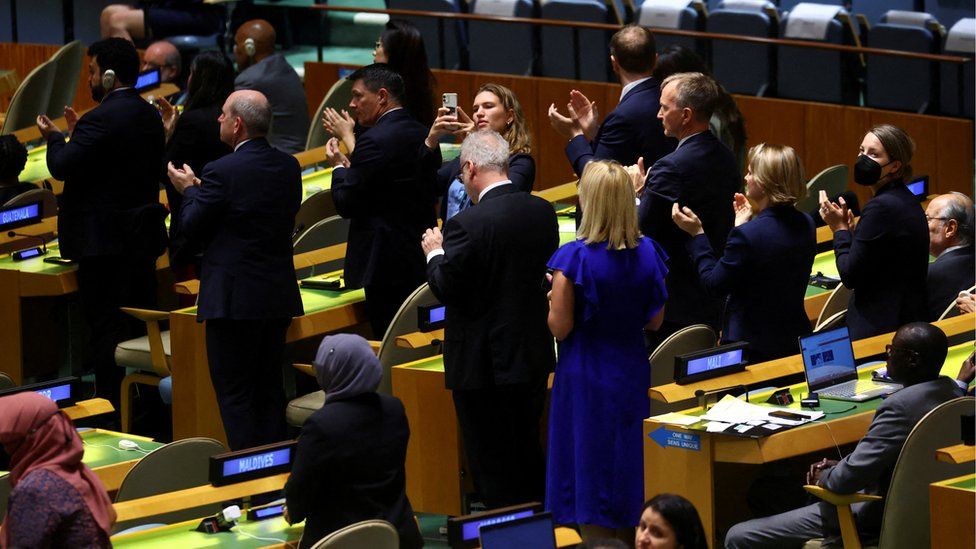
Oleg Nivievskyi, a professor at the Kyiv School of Economics where he serves as vice-president of economics education, is encouraging Ghana and other African countries to support Ukraine in the fight against Russia.
On 24 February 2022, Russia invaded Ukraine in an unprovoked act of aggression.
The aftershocks of the war are being felt by people around the world, including Africa.
Speaking on The Big Bulletin on Monday (17 October 2022), Nivievskyi said: “At the moment we have to find a way to win [over] Russia, otherwise it’s going to be difficult; it’s going to last for God knows how long.
“So, Russia has to be defeated, otherwise the world will be insecure. Because what I would like to stress is we, as a civilised world, we need trustful partners, secured partners that we can trust.
“Russia at the moment is not a trustful partner and it really undermines the world order.”
Rallying behind Ukraine
Nivievskyi said that African countries need a “unified voice” to back Ukraine in the fight against Russia.
“I think African countries can have a stronger voice,” Nivievskyi told Asaase 99.5’s Beatrice Adu. “There was a summit recently in UN in terms of recognising the ‘fake referendum’ which was recently done in Ukraine by Russians, and in that vote there were a couple of African countries that were kind of voting against although the majority were supporting Ukraine.”
According to him, Russia has to be defeated for the world to get back to normal.
“So, I will like for the African countries to be more united so that everybody understands the consequences and who is to blame. So, that’s the purpose of this visit. And by establishing platforms for discussions, we really hope the message is getting through and everybody is on the same page.”
Russia’s war in Ukraine has disrupted the promise of Africa’s recovery from the COVID-19 pandemic by raising food and fuel prices, disrupting trade in goods and services, tightening the fiscal space, constraining green transitions and reducing the flow of development finance around the continent, said United Nations Assistant Secretary General Ahunna Eziakonwa.
Eziakonwa, who serves as the UN Development Programme’s assistant administrator and regional director for Africa, said the war has put households, communities and countries across Africa in a “very precarious situation”.
While the level of trade between the African continent as a whole and Russia/Ukraine is insignificant, some African countries rely heavily on these two countries for critical imports, particularly wheat, fertilisers and steel. Disruptions to supplies of these imports has adversely affected African countries.
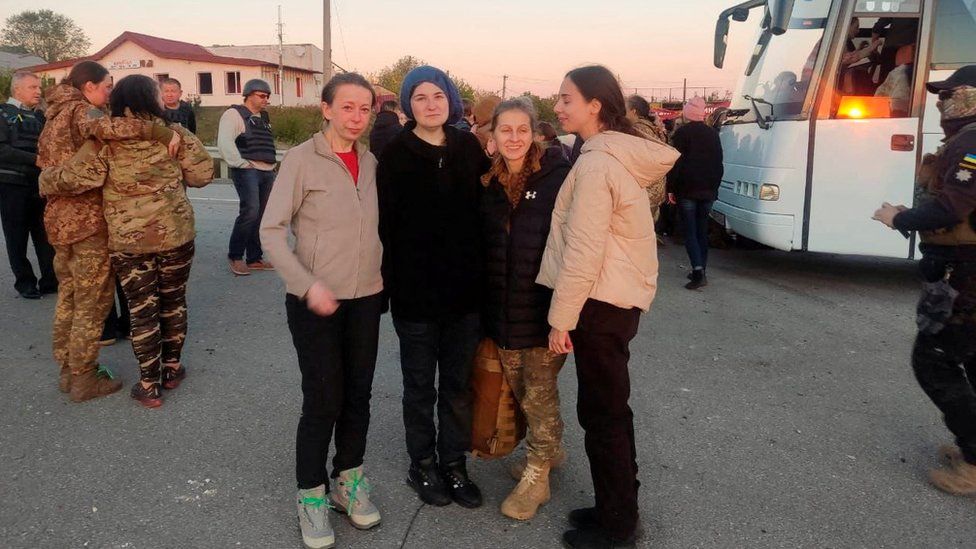
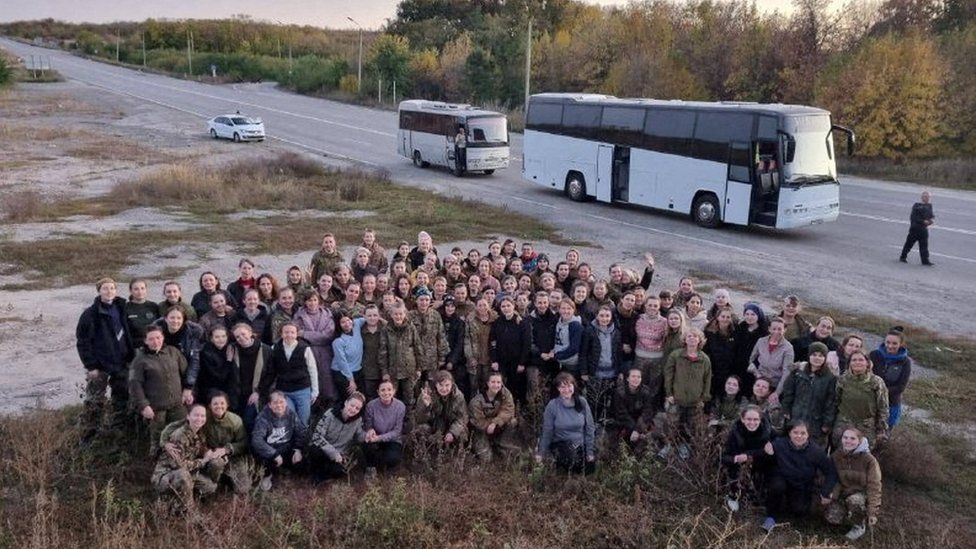
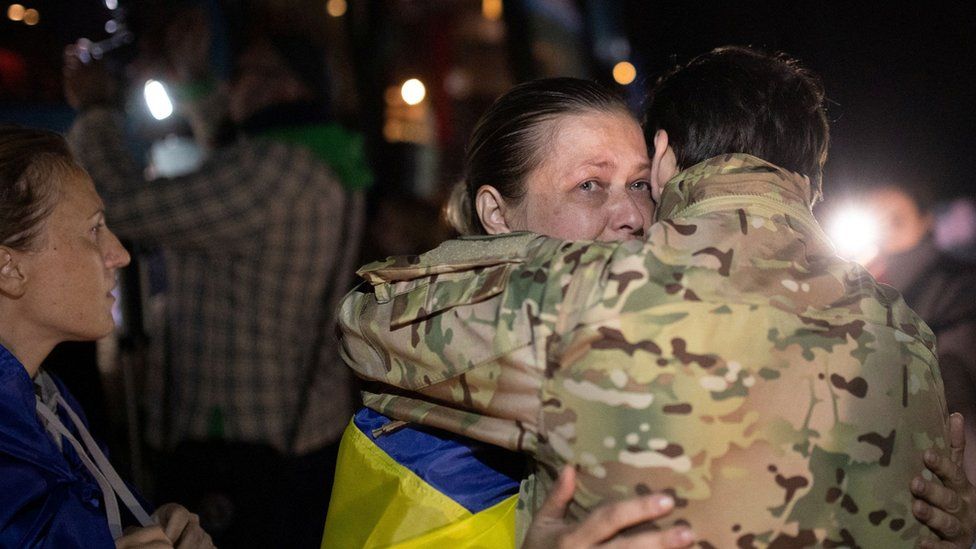
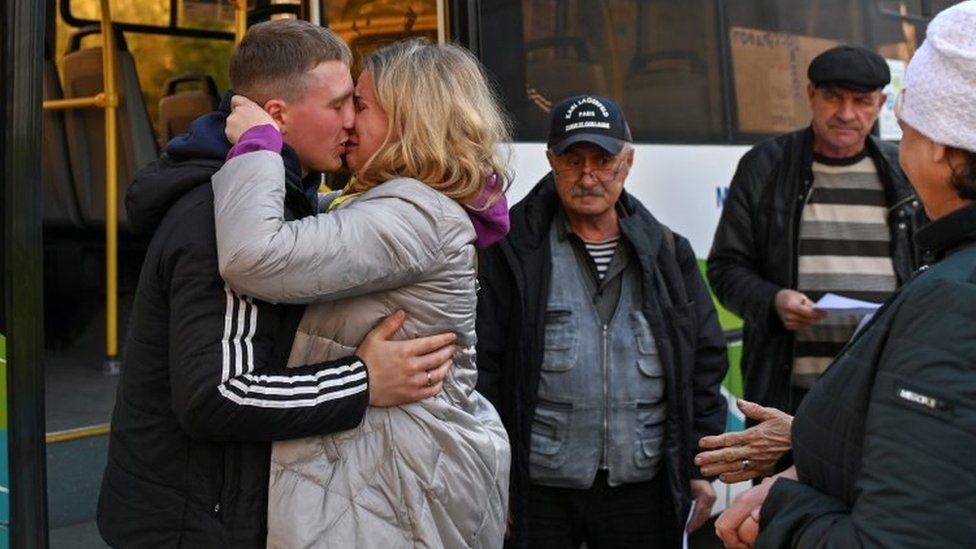
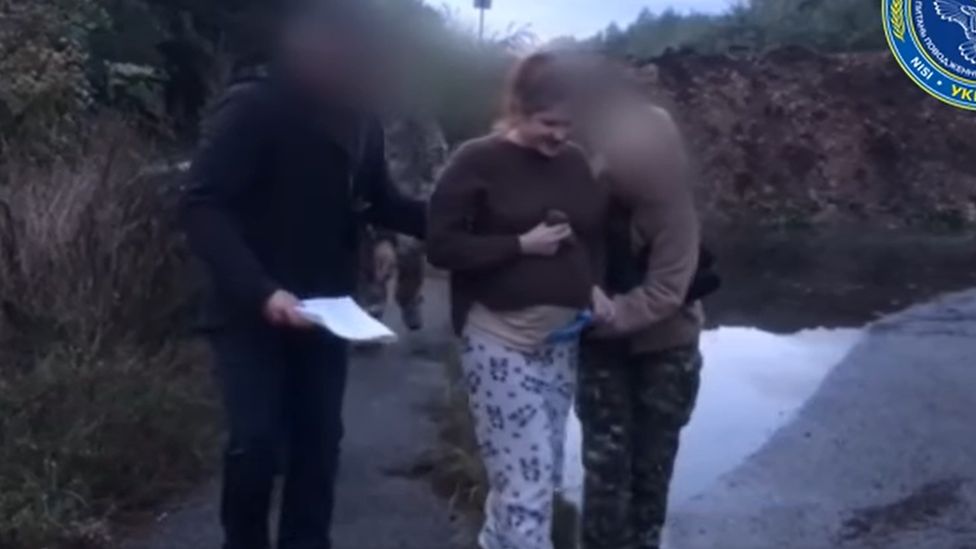
Russia has swapped 108 Ukrainianwomen detained as prisoners of war for 110 Russian hostages held by Ukraine according to officials on both sides,
As per reports, 37 of the women were caught after surrendering during the siege of the Azovstal steel factory in Mariupol, which ended in May.
Most of the Russians freed are sailors from merchant ships held in Ukraine.
They also include members of pro-Russian separatist military units from the Donbas in eastern Ukraine.
Daylight photos were released of the Ukrainian women boarding coaches in an unspecified area and later of them arriving after dark in government-held territory in the southern region of Zaporizhzhia.
IMAGE SOURCE, REUTERS Image caption, The freed Ukrainians were taken to safety in coaches
IMAGE SOURCE, REUTERS
IMAGE SOURCE, REUTERS
The Ukrainian presidency’s chief of staff, Andriy Yermak,confirmed on social media that 108 women had been released in the “first all-female exchange”.
He said they included mothers and daughters who had been held captive together. All but 12 of them are servicewomen, he said.
Denis Pushilin, the top Russian-backed official in the breakaway part of Ukraine’s Donetsk region, confirmed the swap but said two detainees had decided to remain in Russia. Kyiv has not commented on this.
According to Mr Pushilin, the prisoners freed by Ukraine are 80 sailorsand 30 service personnel.
After Russia’s invasion of Ukraine, the International Committee of the Red Cross (ICRC) has asked for immediate access to all prisoners of war.
In an apparent response to comments made by Ukrainian President Volodymyr Zelenksyy, the committee also stated that it has been “ready for months” to visit the Olenivka penal facility.
Speaking in his nightly video address on Thursday, Mr Zelenskyy accused the ICRC of inaction in upholding the rights of Ukrainian prisoners of war.
In the latest in a series of Ukrainian criticisms of the ICRC, Mr Zelenskyy also said no one had yet visited Olenivka – a notorious camp in eastern Ukraine where dozens of Ukrainian POWs died in an explosion and fire in July.
The ICRC should be granted the right to visit prisoners wherever they are held under the Third Geneva Convention.
“We share the frustration regarding our lack of access to all prisoners of war (POWs) held in the international armed conflict between Russia and Ukraine,” the ICRC said in a statement.
“We have been working since February to obtain access to check on the conditions and treatment of POWs and keep their families informed about their loved ones.
“We have been able to visit hundreds of POWs but there are thousands more who we have not been able to see.
“We want to stress that our teams are ready on the ground—and have been ready for months—to visit the Olenivka penal facility and any other locationwhere POWs are held. Which Zelenksyy called for overnight.
“However, beyond being granted access by high levels of authority, this requires practical arrangements to materialize on the ground.
“We cannot access by force a place of detention or internment where we have not been admitted.”
A total of USD 250 million has been granted by the board of directors of the ECOWAS Bank for Investment and Development (EBID) for Ghana and four other member states to help the oil and gas, energy, road infrastructure, and agricultural sectors of West Africa.
Burkina Faso, Nigeria, Senegal, and Sierra Leone are the other recipients.
The approvals are a part of EBID’s stepped-up efforts to invest in important industries to boost recovery from the COVID-19 epidemic and lessen the effects of the Russia-Ukraine war on ECOWAS member states.
This was disclosed by the President and Chairman of the Board of Directors of EBID, Dr George Agyekum Donkor at the just ended 79th session of the Board of Directors of the Bank.
In his opening statement, Dr Donkor observed that the impact of the COVID pandemic and ongoing Russian – Ukraine war have left many economies in tatters. He indicated that the current market conditions have compelled investors to seek premium on investments in sub-Saharan Africa thereby increasing the cost of capital.
According to the President of EBID, this has resulted in dampening economic growth, wide-spread balance of payments deficits, unfavourable terms of trade, depletion of central bank international reserves, fiscal deficits, and debt distress. Therefore, Dr Donkor stressed the need for EBID, as the financial arm of ECOWAS, to deepen its financial intermediation in all the critical sectors of the Member States to assist them to recover from the economic challenges.
Present at the session was the Vice-President of the ECOWAS Commission, Her Excellency Damtien L. Tchintchibidja, who lauded the tremendous impact of EBID’s interventions in the sub-region and assured the Bank of the commitment of the new administration of the ECOWAS Commission to collaborate and support EBID in its multifarious activities especially in the area of resource mobilization to transform the ECOWAS Communities.
The Board of Directors of the ECOWAS Bank for Investment and Development (EBID) has approved $250 million for five member states to boost the oil and gas, energy, road infrastructure and agricultural sectors in those countries.
The beneficiary countries are Ghana, Burkina Faso, Nigeria, Senegal and Sierra Leone.
The approval is part of the intensified efforts by EBID to invest in key sectors to spur post-COVID-19 pandemic recovery.
The investment is also to mitigate the impact of the Russia-Ukraine war on ECOWAS member states.
The President and Chairman of the Board of Directors of EBID, Dr George Agyekum Donkor, disclosed this at the 79th Session of the Board of Directors of the bank in Lome last Wednesday.
Impact
Dr Donkor said the impact of the COVID-19 pandemic and the ongoing Russia-Ukraine war had left many economies in tatters.
He indicated that current market conditions had compelled investors to seek premium on investments in sub-Saharan Africa, thereby increasing the cost of capital.
That had resulted in dampening economic growth, widespread balance of payment deficits, unfavourable terms of trade, depletion of central bank international reserves, fiscal deficits and debt distress, the President of EBID stated.
He, therefore, stressed the need for EBID, as the financial arm of ECOWAS, to deepen its financial intermediation in all the critical sectors of member states to assist them to recover from the economic challenges.
Present at the session was the Vice-President of the ECOWAS Commission, Damtien L. Tchintchibidja, who lauded the tremendous impact of EBID’s interventions in the sub-region.
She assured the bank of the commitment of the new administration of the ECOWAS Commission to collaborate and support EBID in its activities, especially in the area of resource mobilisation, to transform the community.
Context
EBID is a leading regional investment and development bank, owned by the 15 ECOWAS member states.
Based in the Togolese capital, Lome, the bank is committed to financing developmental projects and programmes.
These range from infrastructure and basic amenities, rural development and environment, industry and social services sectors through to its private and public sector windows.
EBID intervenes through long, medium, and short-term loans, equity participation, lines of credit, refinancing, financial engineering operations and related services.
Rich people in Nairobi are less affected by increased prices for products and services at a time when the rest of Kenyans are struggling with inflation.
Due to their higher discretionary earnings, those in the social class who spend more than Sh184,395 monthly have a stronger ability to withstand price increases.
However, the figure is a rise from 4.15 percent in 12 months to June 2021, pointing to a rise in the cost of living affecting all Kenyan households. President William Ruto campaigned on the platform of bringing down the cost of living in his first 100 days in office and reiterated his commitment to doing so when he took power last month.
But his administration is finding it difficult to fulfil the promise. Already the government has failed to subsidise food items like maize flour, leading to a rise in the price of a 2kg packet of the commodity to around Sh200 from Sh100 under a subsidy introduced by his predecessor, Uhuru Kenyatta.
Inflation soared to a 63-month high in September at 9.2 percent from 8.5 percent in August on higher fuel prices, shocks from food shortages and a depreciating shilling.
The inflation surge occurred against the backdrop of the Russia- Ukraine war and Covid-19 pandemic in 2020. The difference in inflation levels among Nairobi’s income segments is linked to their different consumption habits. The rich spend most of their income on transport and the middle class on utilities and rent.
Food takes the bulk of the poor’s budget. The increase in the prices of food items surpassed that of fuel in January this year, with food inflation hitting 15.5 percent in September compared to fuel inflation at 11.7 percent.
The prices of a three-bedroom house rose by 5.6 percent in 12 months to September compared to a similar period in 2021 while those of furnishing and household equipment rose 10.7 percent.
Middle-class homes spend the bulk of their monthly income — over 23.6 percent — on housing and utilities, followed by food at 22 percent, exposing them to rising costs.
The lower-income residents in Nairobi and in rural areas will be hit hardest by inflationary pressures that eroded the country’s real wage by negative 3.83 percent last year, down from negative 0.59 percent in 2020.
People in rural areas are hurting the most from the jump in food and non-alcoholic beverages inflation —whose weight in the shopping basket is nearly a third
at 32.9 percent — which rose to 15.25 percent in July.
As the Russia-Ukraine war enters its 233rd day, we take a look at the main developments.
Civilians in the southern Kherson region have started to flee to Russia amid Ukrainian advances, and evacuees were expected to begin arriving there on Friday. A Russian-installed official suggested residents should leave for safety, a sign of Moscow’s weakening hold on territory it claims to have annexed.
A Russian region adjoining Ukraine said it was preparing to receive refugees from the Russian-held part of Kherson.
Ukraine’s armed forces have retaken more than 600 settlements in the past month, including 75 in the strategic Kherson region, the government said.
The governor of a Russian border region accused Ukraine of shelling an apartment block, but a Kyiv official said a stray Russian missile was to blame – one of a series of apparent attacks on Russian towns.
Russian missiles hit the Ukrainian port of Mykolaiv. A five-storey residential building was hit, the two upper floors completely destroyed, the mayor said.
Three drones attacked the small town of Makariv, west of the capital Kyiv, with officials saying critical infrastructure facilities were hit by Iran-made drones.
NATO said it will closely monitor an expected Russian nuclear exercise but will not be cowed into dropping support for Ukraine.
Zelenskyy accused the International Committee of the Red Cross of inaction in upholding the rights of Ukrainian prisoners of war and urged it to undertake a mission to Olenivka – a notorious camp in eastern Ukraine.
Kremlin spokesman Dmitry Peskov was quoted as saying in Izvestia newspaper that the goals of Russia’s “special military operation” could be achieved through negotiations.
The leaders of Commonwealth of Independent States (CIS) countries, including Russian President Vladimir Putin, are meeting for the CIS summit in Astana.
Putin is scheduledto take part in the first Russia-Central Asia summit later on Friday.
Economy
Russia has submitted concerns to the United Nations about an agreement on Black Sea grain exports and is prepared to reject renewing a deal next month unless its demands are addressed, Russia’s UN ambassador in Geneva told Reuters.
Putin courted Turkish President Recep Tayyip Erdogan with a plan to pump more Russian gas via Turkey, turning it into a new supply “hub”, bidding to preserve Russia’s energy leverage over Europe.
The International Monetary Fund expects 2023 to be a challenging year for the banking industry in emerging nations like Ghana.
If strict steps are not taken to address the global fiscal situation, some economies could experience a recession, according to the Fund’s Global Financial Stability Report.
According to the research, the development will raise the risks to financial stability, and the balance of those risks is expected to lean downward.
It further pointed out that despite the global banking sector being able to withstand certain pressures for a period, a global bank test undertaken by the IMF shows that the reserve buffers of some banks may not be enough heading into 2023.
The IMF report explained this can be attributed to an abrupt and sharp tightening of global financial conditions which may force several economies into recession coupled with soaring inflationary pressures which could significantly impact capital requirements.
Meanwhile, in Ghana, the central bank has embarked on a number of policy rate hikes to deal with inflationary pressures which has been soaring in months.
The Bank of Ghana, BoG, on October 7, 2022 hiked the policy rate by 250 basis points from 22 percent to 24.5 percent – a move that is likely to impact the cost of lending.
The country in September also recorded an inflation rate of 37.2 percent, making it the highest in about 20 years.
Ghana has since July 2022 engaged the IMF for economic support programme to address the current economic challenges which have impacted the performance of the local currency, rising inflation figures and among others.
In order to jointly acquire air defence systems that shield allied territory from missiles, Germany and more than a dozen NATO allies have their sights set on the Israeli Arrow 3 system, the US Patriot, and German IRIS-T units, among other options.
“With this initiative, we are living up to our joint responsibility for security in Europe – by bundling our resources,” Christine Lambrecht, Germany’s defence minister, said during a ceremony at NATO’s Brussels headquarters where 14 countries signed a letter of intent.
Estonia wasn’t present at the event but will also be part of the initiative, dubbed “European Sky Shield”. In total it comprises half of NATO’s members – including Germany, the United Kingdom, Slovakia, Norway, Latvia, Hungary, Bulgaria, Belgium, Czechia, Finland, Lithuania, the Netherlands, Romania, and Slovenia.
Ground-based air defence systems such as Raytheon’s Patriot units or the more recently developed IRIS-T are in short supply in many Western nations, which were reluctant to invest too much money in military capabilities after the end of the Cold War.
Erdoganhas stated that despite the challenges on the ground, Turkey will continue to advocate for peace between Russia and Ukraine.
“Our goal is to continue the momentum that has been achieved and bring an end to the bloodshed as soon as possible,” the Turkish leader said in his address to the summit of the Conference on Interaction and Confidence-Building Measures in Asia. The summit is being held in Kazakhstan’s capital, Astana.
Erdogan was referring to agreements that Turkey helped broker which allowed Ukrainians to resume grain exports and led to a prisoner swap between Ukraine and Russia.
“We are all closely experiencing the effects of the crisis in Ukraine on a regional and global scale,” he said. “I always say that a just peace can be established with diplomacy, that there are no winners in war and no losers in equitable peace.”
Turkey has retained close tieswith both Moscow and Kyiv during the war and has repeatedly offered to organise peace talks between the two sides.
After thousands of people spent Monday night in bomb shelters while explosions erupted, the President of Ukrainedeclared that air defence was the “number one priority.”
After another devastating day of rocket attacks on Ukraine, Volodymyr Zelenskyy remained belligerent and pledged to make the battlefield “more painful” for Russian troops.
The Ukrainian president said air defence was the “number one priority” after thousands of people spent Monday in bomb shelters as explosions erupted in cities across the country.
At least 14 people were killed and 97 injured in attacks on Kyiv, Kharkiv, Dnipro, Lviv, Sumy, Zaporizhzhia, Zhytomyr, and elsewhere.
Vladimir Putin said the strikes were in retaliation for its “terrorist action” against Russian territory – the attack on the Kerch Strait Bridge in Crimea – but Ukraine has rejected this claim of “provocation”.
“We will do everything to strengthen our armed forces,” President Zelenskyy said in his nightly address. “We will make the battlefield more painful for the enemy.”
“Now the occupiers are not capable of opposing us on the battlefield already, that is why they resort to this terror,” he said on Telegram.
Meanwhile, in his nightly address, which he delivered from the streets of Kyiv, Mr Zelenskyy said Ukraine “cannot be intimidated” following the strikes.
He continued: “Only united even more. Ukraine cannot be stopped. Only convinced even more that terrorists must be neutralized.
“The Russian army specifically struck these blows precisely during the morning rush hour. This is a typical terrorist tactic. They wanted to instill more fear and affect more people. They did. The whole world took notice.
In a call with the Ukrainian leader, Joe Biden reiterated that the US will provide advanced air defence systems.
It comes after the Pentagon said on 27 September that it would start delivering the National Advanced Surface-to-Air Missile System (NASAMS) over the next two months or so.
Former Ukrainian prime minister, Arseniy Yatsenyuk, told Sky News that “critical infrastructure” were among Russia’s key targets in Monday’s strikes and that Ukraine is expecting some blackouts as a result, putting hospitals in “jeopardy”.
President Putin has said the strikes were retaliation for the attack on the Kerch Strait Bridge, which links occupied Crimea to Russia.
The Russian leader has blamed the damage on Ukrainian special forces, but Kyiv has not claimed responsibility for the blast.
Whoever was responsible, the attack is set to further squeeze Russian logistics and supply lines amid speculation that Kremlin forces will soon be down to their last supplies of fuel and unable to transport their troops.
The strike on the bridge came after months of Ukrainian forces using HIMARS rocket attacks to degrade Russian logistics, hitting ammunition stores and transport networks.
Sir Jeremy Fleming, the head of GCHQ, is set to deliver a speech saying that Russia is running out of weapons for its war against Ukraine and the costs to the Kremlin are “staggering” in terms of soldiers and equipment lost.
He will say that Ukrainian armed forces are “turning the tide” on the physical battlefield as well as in cyberspace.
The UN General Assembly (UNGA) overwhelmingly approved a resolution on Wednesday telling Russia its annexation of four Ukrainian zones is illegal and not valid.
Ghana was among the 143 countries that voted in favour of the resolution, 15 abstained from the exercise and 5 rejected the resolution including Russia.
Ukrainian President Volodymyr Zelenskycalled the resolution “historic” in a tweet and thanked the states that voted in favor.
Grateful to 143 states that supported historic #UNGA resolution “Territorial integrity of Ukraine: defending the principles of the UN Charter”. The world had its say – RF’s attempt at annexation is worthless & will never be recognized by free nations. 🇺🇦 will return all its lands pic.twitter.com/FupYPfZz8M
During the assembly’s emergency special session on Ukraine, US ambassador to the UN Linda Thomas-Greenfield said the vote “is important not just to the future of Ukraine and the future of Europe, but to the very foundations of this institution.”
“After all, the UN was built on an idea: that never again would one country be allowed to take another’s territory by force,” Thomas-Greenfield added.
The US diplomat said the resolution calls for peace and de-escalation, and “makes clear that we reject Russia’s attempted annexations. That we reject this affront to territorial integrity, to national sovereignty, to peace and security.”
She noted that “today it is Russia invading Ukraine. But tomorrow it could be another nation whose territory is violated. You could be next. What would you expect from this chamber?”
“So let us send a clear message today: these United Nations will not tolerate attempts at illegal annexation. We will never recognize it. These United Nations will not tolerate seizing a neighbor’s land by force. We will stand up to it. These United Nations will not tolerate the destruction of the UN Charter. We will defend it,” she told the assembly.
“Our message Today is loud and clear: It does not matter if you, as a nation, are big or small, rich or poor, old or new. If you are a UN Member State, your borders are your own and are protected by international law. They cannot be redrawn by anyone else by force.” Thomas-Greenfield added.
It’s the question we’ve been asking for months now, even before Russia invaded Ukraine.
What is Vladimir Putin thinking and planning?
Let me get the disclaimer in early. I have no Kremlin crystal ball. Neither do I have Putin on direct dial.
Former US President George W Bush once said he’d looked Vladimir Putin in the eye and “got a sense of his soul”. Look how well that ended for relations between Russia and the West.
So, getting inside the mind of the Kremlin leader is a pretty thankless task. But it’s important to try. Perhaps more than ever now, in light of recent nuclear sabre-rattling by Moscow.
There’s little doubt that the Russian president is under pressure. His so-called “special military operation” in Ukraine has gone badly wrong for him.
It was supposed to last a few days. But we’re nearly eight months in and there’s no end in sight.
The Kremlin admits “significant” troop losses; in recent weeks the Russian military has been losing territory in Ukraine which it had previously occupied.
To boost troop numbers, last month President Putin declared partial mobilisation, something he’d insisted he wouldn’t do. Meanwhile, sanctions continue to degrade the Russian economy.
So, back to Putin’s state of mind. Will he be thinking he got it all wrong, that his decision to invade was a fundamental error?
Don’t assume so.
“Putin’s perceptions drive the entire situation in this conflict,” believes Konstantin Remchukov, owner and editor-in-chief of the Russian newspaper Nezavisimaya Gazeta.
“He is the authoritarian leader of nuclear power. He’s the unchallenged leader in this country. He has some strong beliefs and perceptions which drive him crazy. He’s started to believe that this is existential from the point of view of importance. Not only for him. But for the future of Russia.”
If this conflict is existential, how far is President Putin prepared to go to win it?
In recent months senior Russian officials (including Putin himself) have been dropping unsubtle hints that the Kremlin leaderwould be prepared to use nuclear weapons in this conflict.
“I don’t think he will,” US President Joe Biden told CNN. “But I think that it’s irresponsible for him to talk about it.”
IMAGE SOURCE,EPA Image caption, Russian troops were forced to make a humiliating retreat from nearly all of Ukraine’s north-eastern Kharkiv region in September
This week’s intense Russian bombardment of Ukraine suggests the Kremlin is, at the very least, determined to escalate things with Kyiv.
With the West, too?
“He’s trying to avoid direct confrontation with the West, but at the same time he’s prepared for it,” believes veteran liberal politician Grigory Yavlinsky. “I fear most the possibility of nuclear conflict. And, on the second place, I fear endless war”.
But “endless war” requires endless resources. That’s something Russia doesn’t seem to have. The wave of missile strikes on Ukrainian cities is a dramatic demonstration of force, but how long can Moscow sustain that?
“Could you continue this missile flow for days, weeks, months? Many experts doubt that we have enough missiles,” says Mr Remchukov.
“Also, from the military point of view, no one has ever said what would be the sign of ultimate [Russian] victory? What is the symbol of victory? In 1945 it was the banner over Berlin. What is the criteria for success now? [A banner] over Kyiv? Over Kherson? Over Kharkiv? I don’t know. Nobody knows.”
It’s not even clear that Vladimir Putin knows.
Back in February, the Kremlin’s objective appears to have been the rapid defeat of Ukraine, forcing Russia’s neighbour back into Moscow’s orbit without a prolonged war. He miscalculated. He underestimated not only the determination of the Ukrainian army and people to defend their land but the capabilities of his own military.
What’s he thinking now? Is Vladimir Putin’s current plan to cement control over Ukrainian territory he claims to have annexed and then freeze the conflict? Or is he determined to push on until the whole of Ukraine is back in the Kremlin’s sphere of influence?
This week former Russian president Dmitry Medvedev wrote: “The Ukrainian state in its current configuration… will be a constant, direct, and clear threat to Russia. I believe the aim of our future actions should be the complete dismantling of Ukraine’s political regime.”
If Mr Medvedev’s words reflect President Putin’s thinking, expect a protracted and bloody conflict.
IMAGE SOURCE,REUTERS Image caption, Russia’s military says it wants to mobilise 300,000 reservists – but there appears to be growing opposition to the move across the country
But, inevitably, Mr Putin’s actions abroad are having consequences at home. Over years the Kremlin painstakingly cultivated Putin’s image of “Mr Stability”, encouraging the Russian public to believe that as long as he was in charge they would be safe.
That’s a hard sell now.
“The previous contract between Putin and society was that ‘I protect you,” says Mr Remchukov.
“For many years the main slogan was ‘predictability’. What kind of predictability is there today? The concept is over. Nothing is predictable. My journalists don’t know whether they will receive call-up papers when they get home today.”
Vladimir Putin‘s decision to invade Ukraine surprised many. But not Mr Yavlinsky.
“I think that [Putin] had been moving in that direction – year by year he was constructing the way to what we have now,” Mr Yavlinsky says.
“For example, destroying independent media. He stated that in 2001. Destroying independent business. He stated that in 2003. Then 2014 and what happened with Crimea and Donbas? You’d have to be blind not to see it.
“Russia’s problem is our system. A system was created here that created such a person [as Putin]. The question of the West’s role in creating this system is a very serious one.
“The problem is that this system didn’t create a society. There are a lot of very nice people in Russia. But there is no civil society. That’s why Russia can’t resist.”
DISCLAIMER: Independentghana.com will not be liable for any inaccuracies contained in this article. The views expressed in the article are solely those of the author’s and do not reflect those of The Independent Ghana
After the attacks on Ukraine on Monday, President Zelenskyencouraged nations to impose additional sanctions on Russia in response to “a new wave of terror.”
As Russian missiles struck various parts of the nation, at least 19 people were killed and numerous others were injured.
Defiant, he said the attacks will only “delay our recovery a little”.
Following more strikes on Tuesday, Mr Zelensky called on the West to find new ways to apply political pressure to Russia and support Ukraine.
The calls came after he met the G7 group of nations for emergency virtual talks on Tuesday.
The bloc – which consists of Canada, France, Germany, Italy, Japan, the UK, and the US – promised to continue providing “financial, humanitarian, military, diplomatic and legal” support to his country “for as long as it takes”.
Mr Zelensky said: “For such a new wave of terror there must be a new wave of responsibility for Russia – new sanctions, new forms of political pressure, and new forms of support for Ukraine.”
“The terrorist state must be deprived of even the thought that any wave of terror can bring it anything.”
Russian President Vladimir Putin said the attacks were retaliation for Saturday’s explosion on a key bridge linking Russia to Crimea.
Western countries have already placed widespread sanctions against Russian businesses as well as allies of President Putin since the invasion of Ukraine in February.
This includes removing major Russian banks from the international financial messaging system Swift and sanctioning more than 1,000 Russian individuals and businesses – including oligarchs.
While the US has banned all Russian oil and gas imports, the EU has been reluctant to do so because it relies on Russia for about 40% of its gas needs.
Monday’s barrage of missile strikes was the heaviest bombardment Ukraine has seen since the early days of the war. Several strikes hit Kyiv – the first time the capital city has been targeted in months, and previous attacks have not hit the city center.
Civilian areas including a popular park and children’s playground were hit during the morning rush hour. Infrastructure was destroyed, causing a power blackout in many neighbourhoods.
On Tuesday, President Zelensky said 28 more missiles were fired, 20 of which were shot down. These included Iranian combat drones, he said. The BBC has not been able to verify this.
“If it wasn’t for today’s strikes, we would have already restored the energy supply, water supply, and communications that the terrorists damaged yesterday,” the president said in his nightly address on Tuesday evening.
“Today, Russia will achieve only one additional thing: it will delay our recovery a little.”
He added that restoration works were taking place “quickly and efficiently” throughout the country and that electricity and communication had been restored to most cities and villages targeted in Monday’s attacks.
“Where there was destruction, the infrastructure will be renewed everywhere. Where there were losses, there is already or will be construction,” he said.
On Tuesday, reports also emerged of a mass grave being found in recently liberated Lyman, in the eastern Donetsk region.
Pavlo Kyrylenko, head of the Donetsk region’s military administration, was quoted by Associated Press as saying that more than 50 bodies of soldiers and civilians had been found in a series of graves. They included Ukrainian soldiers buried together in a mass grave, as well as individual graves holding the bodies of civilians.
“We are finding bodies and parts of bodies here,” Mr Kyrylenko said.
Lyman was liberated by Ukrainian troops last month, as part of a rapid counteroffensive that recaptured large parts of the east of the country from Russian forces.
Meanwhile, in Washington, US President Joe Biden told CNN he believed Vladimir Putin was a “rational actor” who misjudged his ability to successfully invade Ukraine.
“I think he thought he’d be welcomed with open arms – that this was the home of mother Russia in Kyivand he was going to be welcomed – and I think he totally miscalculated,” Mr Biden said.
Asked about the prospects of meeting President Putin at next month’s Group of 20 summits in Indonesia, Mr Biden said he did not currently see a reason to do so.
“It would depend on specifically what he wanted to talk about,” the US president said, adding that he would be open to discussing Brittney Griner, the American basketball star currently serving a nine-year prison sentence in Russia on drug charges.
“But look, he’s acted brutally. I think he’s committed war crimes, so I don’t see any rationale to meet with him now,” Mr Biden told CNN’s, Jake Tapper.
President Biden also said he didn’t believe Mr Putin would resort to nuclear warfare, despite apparent threats to do so.
“I think it’s irresponsible for him to talk about it, the idea that a world leader of one of the largest nuclear powers in the world says he may use a tactical nuclear weapon in Ukraine,” Joe Biden said.
An alleged Russian missile strike on a new power plant in the area has been reported, according to Ukrainian MP Volodymyr Ariev, who is in Kyiv this morning.
He said: “We know that yesterday’s strike was preplanned since Russian policy is still in effect. Although the perpetrator of the explosion in Crimea hasn’t been identified, [Vladimir] Putin would like to respond to it.”
Mr Ariev added that the reason for this escalation is “pretty understandable”.
“In one month, Putin is going to the meeting of G20 countries on Bali Island in Indonesia,” he said. “So he would like to present himself not as a weak leader after the defeat of Russian army in conventional battlegrounds.
“He would like to speak to the world from a position of strength. So that’s why he changed the commander… and his first day was an air strike to scare Ukraine.
Russia’s missile attacks on Ukraine this morning have been “seriously criticised” by US President Joe Biden.
In a statement, Mr Biden said: “These attacks killed and injured civilians and destroyed targets with no military purpose.
“They once again demonstrate the utter brutality of Mr Putin’s illegal war on the Ukrainian people.”
The US leader went on to offer his condolences to the families and loved ones of those who were “senselessly killed”.
“These attacks only further reinforce our commitment to stand with the people of Ukraine for as long as it takes,” he added.
“Alongside our allies and partners, we will continue to impose costs on Russia for its aggression, hold Putin and Russiaaccountable for its atrocities and war crimes, and provide the support necessary for Ukrainian forces to defend their country and their freedom.
“We again call on Russia to end this unprovoked aggression immediately and remove its troops from Ukraine.”
The UShas vowed to keep supporting Ukraine “unwaveringly” and has denounced Russia’s “horrific” attacks this morning, during which it launched several missiles.
“We will continue to provide unwavering economic, humanitarian, and security assistance so Ukraine can defend itself and take care of its people,” US Secretary of State Antony Blinken tweeted.
Blinken said he had spoken to his Ukrainian counterpart Dmytro Kuleba “to reiterate US support for Ukraine”.
Meanwhile, Ukrainian President Volodymyr Zelensky says he has spoken to Bridget Brink, the US ambassador to Ukraine, following this morning’s air strikes.
“The United States condemns Russia’s attacks on the infrastructure facilities of Ukraine and is committed to holding Russia accountable for war crimes and atrocities committed in our country. Thank you for your support!” he wrote on the Telegram messaging app.
Oleksii tells me: “I feel safe here because we are on our land and even the ground will bring me help.” That’s despite the nearby sound of small-arms fire, exploding artillery shells landing within sight, and the roar of Russian jets overhead.
The ground he and the small team of Ukrainian troops now occupy is on the border of the Donetsk and Luhansk regions. The same ground that Russian President Vladimir Putin recently declared as being Russian forever.
Over the past week, the men of Ukraine’s D1 National Guard Unit have advanced more than 20km (12 miles) east of the recently liberated city of Lyman in the Donetsk region. They now occupy a former Russian position in a wood – still within range of the retreating Russian army. Part of “forever Russia” is already back in Ukrainian hands. Russia’s now the defending army.
The reversal in fortunes has been a shot in the arm for Ukrainian troops. There’s a palpable sense of confidence among them, even though they’re still within range. Ilya, another member of the unit, tells me: “We can retake territory, but the Russians cannot.” I ask why? “Because they are weak now, they’re scared of us, they’re running from us.”
This position also tells a story about the difference between Ukrainian and Russiandiscipline and morale. Strewn across the ground and hanging in trees are remnants of the retreating Russian forces – empty cans, ration packs, boots, bottles, and clothes.
Ilya picks up a discarded Russian helmet and compares it with his own. “Army of the future,” jokes Ilya as he taps the Russian helmet. “A very bad future,” adds a comrade, laughing.
It’s not that dissimilar to what Russian troops would have worn in World War Two. They hold up a Russian winter glove and read the label. It says it was made in 2005. “New for Russians,” they joke. Another soldier called Duke says Russia treats its soldiers like meat.
Oleksii says discarded Russian trash often gives away their positions when they fly their small drone. They rely on one of Elon Musk’s Starlink satellite kits for communication. They say it’s been working all week.
As you drive around the Donbas there are more signs of Russia’s depleted army. We witnessed Ukrainian forces towing away a troop carrier and a large self-propelled gun – both still marked with the Russian “Z”.
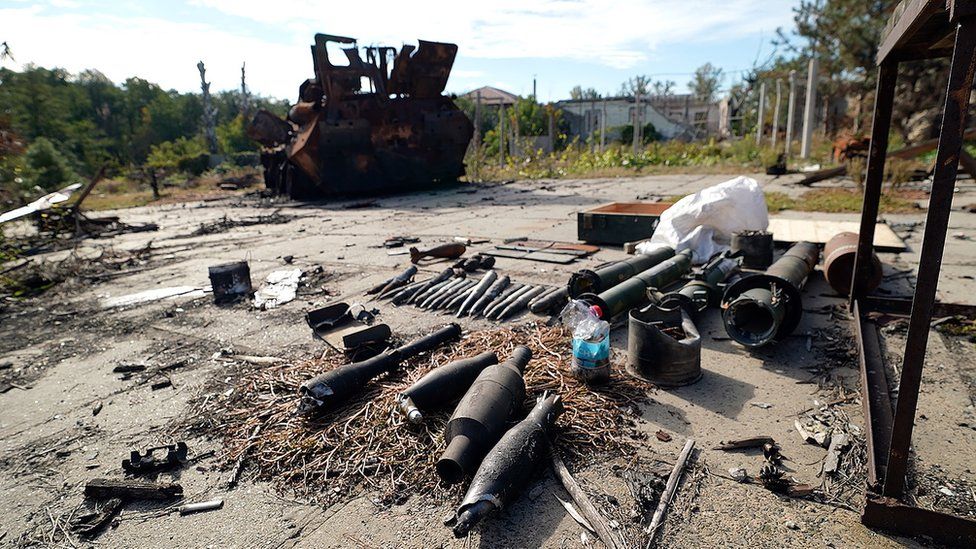
Image caption, Some of the collected, discarded materiel the Russian leave behind
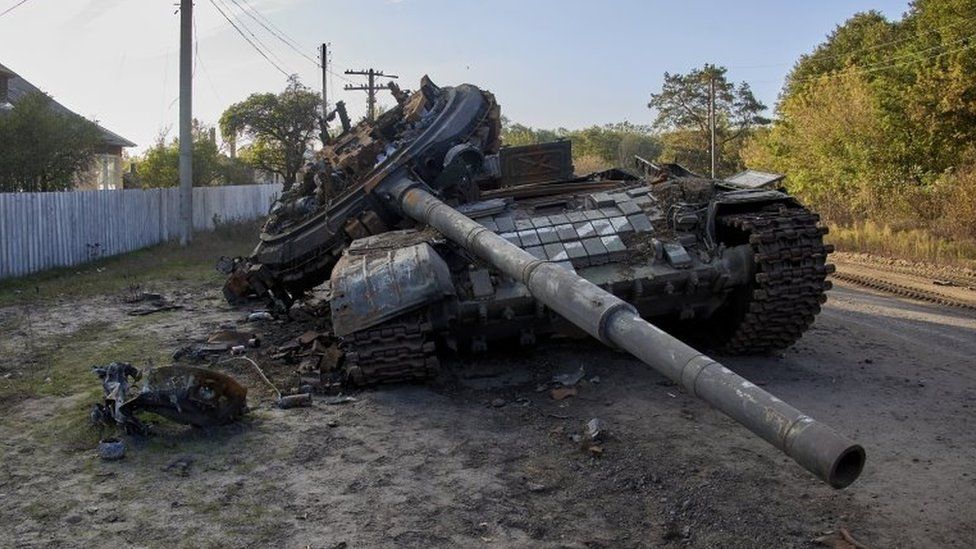
Ukraine’s now captured more Russian armour than it’s been supplied by the West. Dozens more burnt-out military vehicles, too damaged to salvage, have been left rusting on the sides of roads. Boxes of unused ammunition are collected to be used against their former owners. The Donbas is also still littered with lethal mines – which will take years to clear.
Any sense of euphoria among Ukrainian troops is not always shared among the people they’ve freed from Russian control. Liberation comes with a costly legacy.
Those who survived the shelling are wondering how they’ll make it through the winter. Tens of thousands of people are without power and running water.
In Lyman we come across Natalia and Vitali, searching in the rubble of abombed-out house for the wood they can burn. Their fire is now the only way they can stay warm. An estimated 80% of their city has been destroyed or damaged. They narrowly survived a Russian rocket landing on their home – waking them up at 05:30.
Image caption, Natalia and Vitali speaking to the BBC’s Jonathan Beale
Natalia describes life now as “hard and simply unbearable”.
“We are like ants. We were trampled on and those who survived now carry firewood. And those who did not are buried,” she says. Like many here, she tries to avoid blaming either side for her woes.
When we arrive at the centre of Lyman there’s already a long queue for bread. Many of them appear to be hedging their bets on the future.
Image caption, The queue for bread in Lyman
Kataryna, a mum with two young children, tries to explain her dilemma: Russia, she says, still “has a lot of power, which is why it is scary that they might return. Because the city has already suffered very badly, and if the city will be passed back and forth from hand to hand, then nothing will remain including people”.
At the moment she says all she wants is electricity and peace.This winter she’s unlikely to get either.
DISCLAIMER: Independentghana.com will not be liable for any inaccuracies contained in this article. The views expressed in the article are solely those of the author’s and do not reflect those of The Independent Ghana
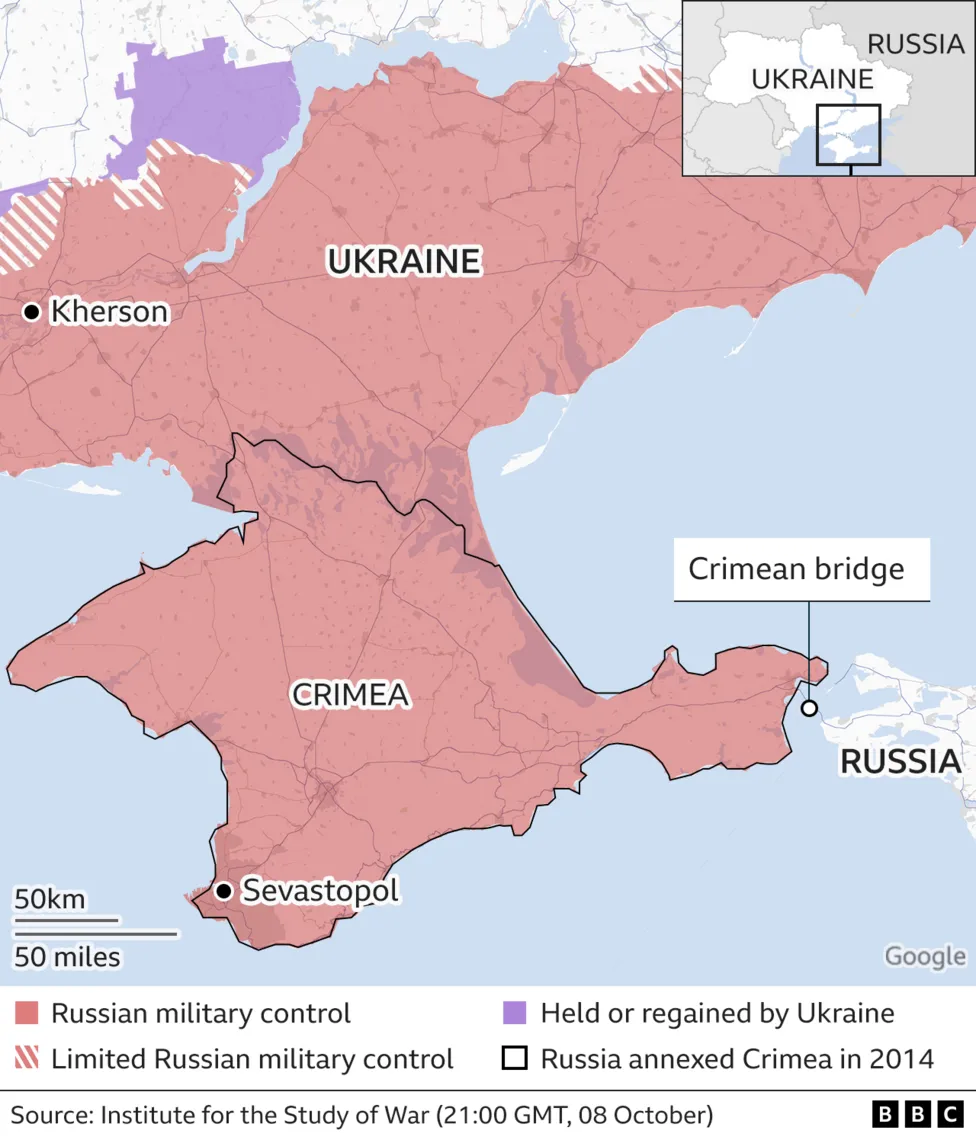
Vladimir Putin, the president of Russia, has described the attack on the bridge leading to Crimea, which Russia has annexed act as an “act of terrorism”.
President Putin said Ukraine’s intelligence forces had aimed to destroy a critically important piece of Russia’s civil infrastructure.
He was speaking at a meeting with the head of the Investigative Committee of Russia, Alexander Bastrykin.
Officials say three people were killed in the blast on the bridge.
The victims were in a nearby car when a lorry blew up, Russian officials say.
“There is no doubt, this is an act of terrorism aimed at destroying Russia’s critical civilian infrastructure,” Mr Putin said.
“Its authors, perpetrators, and beneficiaries are the security services of Ukraine.”
Mr Bastrykin said that citizens of Russia and some foreign states had aided preparations for the attack.
According to Mr Bastrykin, investigators have established that the truck which they say blew up travelled through Bulgaria, Georgia, Armenia, North Ossetia and Krasnodar Territory.
He has ordered an investigation into the incident which brought down sections of the roadway.
Ukrainian officials have not indicated that their forces were behind the attack.
But an adviser to Ukraine’s President Volodymyr Zelensky, Mykhailo Podolyak, denied Mr Putin’s accusation.
He wrote that there is “only one terrorist state here” and that the “whole world knows who it is”.
“Does Putin accuse Ukraine of terrorism? It looks too cynical even for Russia,” he said.
On Saturday, President Volodymyr Zelenskyacknowledged the incident in his nightly address: “Today was not a bad day and mostly sunny on our state’s territory.”
“Unfortunately, it was cloudy in Crimea. Although it was also warm,” he added.
Russian authorities partially re-opened the roadway part of the bridge hours after the attack but for light traffic only.
The railway part of the bridge – where oil tankers caught fire – has also reopened.
The 19km (12-mile) bridge, the longest in Europe, is an important supply route for Russian forces fighting in Ukraine.
Russia has used the bridge to move military equipment, ammunition, and personnel from Russia to battlefields in southern Ukraine.
It was opened by Mr Putin in 2018, four years after Russia’s annexation of Crimea.
Security camera footage released on social media showed a truck – allegedly from the Russian city of Krasnodar, an hour’s drive from the crossing – moving west across the bridge at the time of the explosion.
The footage shows a huge fireball erupting just behind – and to one side – of the truck as it begins to climb an elevated section of the bridge.
The speed with which the truck bomb theory started to spread in Russian circles was suspicious. It suggested the Kremlin preferred an act of terrorism to a more alarming possibility: that this was an audacious act of sabotage carried out by Ukraine.
“I’ve seen plenty of large vehicle-borne IEDs [improvised explosive devices] in my time,” a British army explosives expert told me. “This does not look like one.”
A more plausible explanation, he said, is a massive explosion below the bridge – probably delivered using some kind of clandestine maritime drone.
“Bridges are generally designed to resist loads on the deck and a certain amount of side loading from the wind downwards,” he said. “They are not generally engineered to resist upward loads. I think this fact was exploited in the Ukrainianattack.”
Some observers have noted that in one of the other security camera videos, something that looks like the bow wave of a small boat appears next to one of the bridge supports, a split second before the explosion.
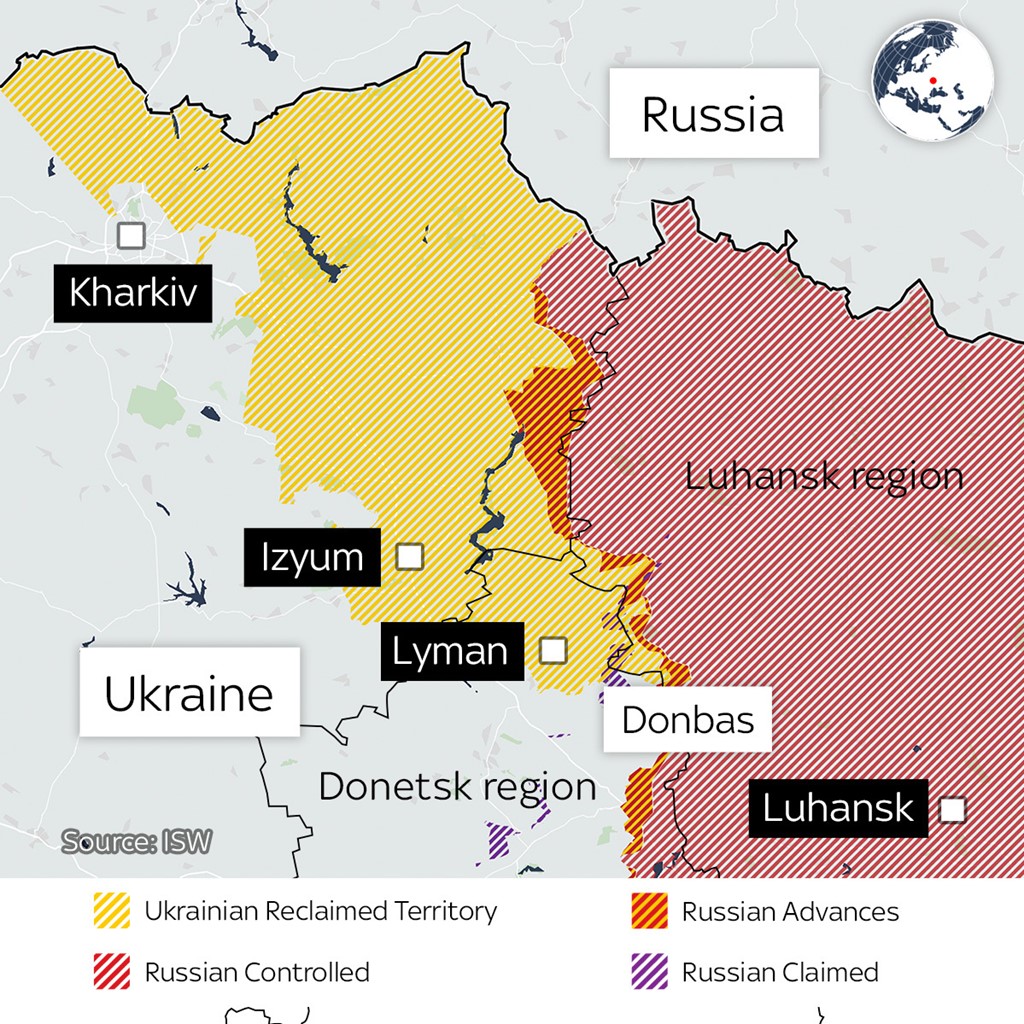
Brigadier General Oleksiy Gromov told a briefing that Ukraine had taken back 93 settlements and liberated over 2,400 square km (926 square miles) in the region since 21 September.
Sky News could not verify these claims.
Ukrainian forces have been advancing in the east and south of the country under a counteroffensive that has seen the country take back key cities like Lyman in eastern Ukraine.
Mr Gromov said Russian troops were fighting to slow a Ukrainian advance outof Kupiansk, a recently liberated railway hub town.
This map shows the areas controlled by each side in the east according to the latest Sky News analysis.
Good morning, Ladies and Gentlemen of the Media, and welcome to the press conference following this week’s 108th Monetary Policy Committee (MPC) sessions.
The Committee discussed current macroeconomic trends and evaluated the outlook’s risks for inflation and growth.
Below is a summary of the evaluation and major factors that influenced the committee’s choice of monetary policy stance.
Global economic conditions remain challenging. Global growth is slowing more than anticipated, and financing conditions have tightened some more since the August MPC Emergency Meeting, reflecting further synchronous tightening of monetary policy rates across Advanced Economies and Emerging Markets.
The Russia-Ukraine war has persisted, dragging down growth and putting additional upward pressure on prices, especially for food and energy with economic and social spillovers. Against the backdrop of these headwinds, the IMF World Economic Outlook update in July 2022 projected global growth at 3.2 percent in 2022, almost half of the 6.1 percent outturn recorded in 2021.
The wave of inflationary pressures spreading across several economies remain elevated and have now become broad-based across all items in the consumer basket. However, there are signs that global price pressures may be peaking as the major drivers of inflation ease somewhat, alongside the synchronized tightening of monetary policy across countries. The Fed’s initial estimates which showed that global supply chain disruptions have eased steadily since May 2022, the fifth consecutive monthly decline in the Food and Agricultural Organisation’s food price index for August 2022, and the recent dip in crude oil prices on the back of weakened global growth prospects, are all suggestive of peaking of global inflation.
Global financing conditions remain tight as central banks in Advanced Economies raise policy rates significantly to decisively contain inflationary pressures. The Fed’s continued hike in interest rates has strengthened the US dollar, instigating a sharp rise in long term bond yields, along with a sharp decline in stock prices. The monetary policy tightening trend, has resulted in widening sovereign bond spreads across Emerging Market and Developing Economies, leading to higher currency depreciation, currency risks, and elevated debt profiles.
On the domestic front, economic growth appeared strong in the second quarter. The latest data released by the Ghana Statistical Service estimated real GDP growth for the second quarter of 2022 at 4.8 percent, compared with 4.2 percent recorded in the second quarter of 2021.
Non-oil GDP grew slower at 6.2 percent against 6.6 percent growth in the same comparative period. The relatively strong growth recorded in the second quarter was largely driven by the service and industry sectors, the latter bolstered by the manufacturing sub-sector.
The latest Bank of Ghana high frequency indicators signalled some moderation in economic activity. The Composite Index of Economic Activity (CIEA) recorded an annual growth of 0.5 percent in July 2022, compared to 1.6 percent in June 2022, and 5.0 percent in December 2021. The sources of the slowdown were from construction and port activities.
Reserve money, for the period under review, increased at a slower pace relative to a year ago. Annual growth in reserve money was 33.1 percent in August 2022, compared with 36.1 percent in August 2021. Broad money supply (M2+) increased marginally due to a sharp fall in Net Foreign Assets which moderated the expansion in the Net Domestic Assets (NDA) of the depository corporations sector. M2+ grew by 23.4 percent year-on-year in August 2022, compared with 20.2 percent in the same period of 2021.
The latest credit conditions survey conducted in August 2022 indicated an overall net tightening of credit stance to corporates and households by the commercial banks. This was reflected in the steady increase in average lending rates. This notwithstanding, new advances increased by 56.1 percent year-on-year to GH¢33.8 billion in August 2022, relative to a 4.9 percent increase in August 2021. Annual growth in private sector credit was 35.8 percent in August 2022, compared with 9.6 percent a year ago. In real terms, private sector credit increased, albeit marginally, to 1.4 percent due to sustained price pressures. This compares with a contraction of 0.2 percent over the same period in 2021.
Results from the Bank’s August 2022 confidence surveys showed further softening of Business and Consumer sentiments. While consumer confidence dipped on account of rising inflation, business sentiments softened on the back of concerns about price pressures, currency depreciation, and weakening consumer demand. The survey findings were broadly in line with an observed downturn in Ghana’s Purchasing Managers’ Index (PMI) in August 2022.
Banking sector performance however remained resilient as at end-August 2022. Total assets increased by 22.9 percent on year-on-year basis to GH¢204.6 billion in August 2022 due to sustained growth in deposits, compared to a 16.7 percent annual growth in the previous year. Total deposits increased by 22.5 percent to GH¢136.7 billion, relative to 21.8 percent growth in August 2021.
The key Financial Soundness Indicators (FSIs) of the banking industry have remained positive in the year, with Capital Adequacy Ratio at 18.1 percent, well above the regulatory minimum of 13.0 percent. The sector was also liquid, reflected by an increase in the core liquid assets to short-term liabilities to 31.1 percent in August 2022 from 24.7 percent in the previous year. Asset quality also improved as the Non-Performing Loans ratio declined to 14.3 percent at end-August 2022, from 17.3 percent in August 2021, reflecting partly, the higher level of outstanding loans.
Profit before tax for banks stood at GH¢6.1 billion in August 2022, representing an annual growth of 25.2 percent, compared to 27.4 percent in the previous year.
Net interest income grew by 17.3 percent, compared to 17.9 percent. Net fees and commissions also increased by 26.9 percent to GH¢2.3 billion, compared with 21.8 percent growth in the previous year, reflecting the rebound in credit growth as well as an increase in trade finance-related business.
Other income of banks grew by 85.6 percent to GH¢2.0 billion, compared with a contraction of 5.4 percent a year ago. These developments resulted in a 25.5 percent growth in operating income to GH¢14.2 billion, relative to a growth of 15.7 percent in the previous year.
Operating expenses, however, increased sharply by 24.3 percent in August 2022, compared to 9.0 percent growth in August 2021, partly reflecting the impact of inflation on banks’ operations.
Price pressures have remained elevated. The latest reading indicated that headline inflation accelerated to 33.9 percent in August 2022, from 31.7 percent in July and 29.8 percent in June. The rise in the August inflation was broad-based, driven by both food and non-food prices.
Food inflation rose to 34.4 percent from 32.3 percent in July, whereas non-food inflation jumped to 33.6 percent from 31.3 percent, over the same comparative period. The upturn in food and non-food inflation was influenced by prices of both local and imported components in the consumer price basket.
In line with these trends, underlying inflation pressures remained heightened. The Bank’s core inflation measure, which excludes energy and utility, increased further to 32.6 percent in August, from 30.2 percent in July 2022. Similarly, all the other core measures of inflation rose, reflecting the generalised increase in price levels.
The Bank’s latest surveys showed increased inflation expectations across consumers, businesses, and the financial sectors. Notwithstanding the above trends, monthly inflation has declined for four consecutive months, reflecting a slowdown in the rate of increase in inflation.
Short term interest rates on the money market have reflected recent developments, while medium-term to long-term rates have remained relatively behind the yield curve. For example, while the discount rate on the 91-day instrument has increased to 29.7 percent in September 2022 from 12.5 percent in September 2021, the coupon rates on the 7-year, 10-year, 15-year, and 20-year have remain unchanged at 18.1 percent, 19.8 percent, 20.0 percent, and 20.2 percent respectively.
The interbank market weighted average rate has increased to 22.05 percent in September 2022 from 12.61 percent in September 2021, consistent with the rise in the policy rate. Average lending rates of banks have also adjusted upwards to 29.81 percent in September 2022 from 20.20 percent recorded in the corresponding period of 2021.
Budget implementation, using banking sector data, for the first 9-months of the year recorded an elevated overall cash deficit of 6.4 percent of GDP, against the revised programmed target of 5.0 percent of GDP. Total receipts of GH¢51.49 billion (8.7 percent of GDP) over the review period, fell short of projected target of GH¢60.08 billion (10.2 percent of GDP), and represented 85.7 percent of the budgeted estimate.
Total payments of GH¢89.04 billion (15.0 percent of GDP) was almost on target, representing 99.5 percent of GH¢89.46 billion (15.1 percent of GDP). The deficit of GH¢37.56 billion, together with net foreign loan repayments of GH¢3.54 billion, created a resource gap of GH¢41.1 billion, which was financed from domestic sources and use of resources from the stabilization fund.
Ghana’s main export commodities saw mixed developments on the international markets. The strong rally in Brent crude oil prices since the start of 2022 slowed somewhat to settle at US$97.74 per barrel, representing a 30.7 percent year-to-date gain on the back of global recession concerns. On cocoa, prices have eased to US$2,385.96 per tonne, representing a contraction of 3.9 percent on year-to-date basis.
Gold price also fell by 1.5 percent to settle at US$1,763.71 per fine ounce due to higher bond yields and a strong US dollar, as the US Fed reaffirmed its commitment to bring inflation under control.
At the end of August 2022, the trade surplus was US$1.7 billion, far exceeding the surplus of US$892.4 million recorded in August 2021. This was driven by higher receipts from gold, crude oil and non-traditional exports, notwithstanding increased demand for oil and gas imports. Total exports went up by 19.5 percent year-on-year to US$11.8 billion. Crude oil exports totalled U$3.8 billion, 56.5 percent higher than observed in 2021, mainly due to price effects.
Gold export earnings also went up by 23.9 percent to US$4.2 billion, supported by increased production volumes triggered by the positive response from small scale gold exporters to the downward revision of the withholding tax regime from 3 percent to 1.5 percent.
However, on account of lower prices and low cocoa purchases, cocoa receipts declined by 22.8 percent to US$1.7 billion from US$2.1 billion. Total merchandise imports grew by 12.9 percent on a year-on-year basis to US$10.2 billion, mainly driven by higher oil and gas import bill of US$3.1 billion at end-August 2022, relative to US$1.7 billion in the same period of 2021. Non-oil imports, however, dipped by 3.8 percent year-on-year to US$7.1 billion in the review period.
The stock of Gross International Reserves declined to US$6.6 billion, equivalent to 2.9 months of import cover for goods and services in September 2022. This compares with the December 2021 position of US$9.7 billion, equivalent to 4.3 months of import cover. Net International Reserves, which excludes encumbered assets and petroleum funds, is estimated at US$2.7 billion as at September 2022.
In the year to September 2022, the Ghana Cedi has depreciated by 37.5 percent, 24.1 percent, and 27.5 percent against the US dollar, the pound, and Euro, respectively. In comparison with the same period of last year, the Ghana Cedi fared better, depreciating by 1.8 percent and 0.5 percent against the US dollar and the pound, respectively, and appreciated by 4.0 percent against Euro.
The depreciation of the currency was driven by higher crude oil product import bill on the back of rising prices, non-roll over of maturing bonds by non-resident investors, portfolio reversals and sudden exit of non-resident investors in the bond market, as well as loss of market access to Eurobond resources. The effect of these factors has been exacerbated by the strength of the US dollar, resulting in depreciation of the local currency from the beginning of the year-to-date.
Summary and Outlook
Recent global developments reflect among others, heightened economic and policy uncertainties, fostered by the strong commitment on the part of advanced economies to decisively tackle inflation.
This has triggered a wave of monetary policy tightening stance by most central banks across advanced economies and strengthening of the US dollar. Against other major international currencies, the US Dollar has appreciated by some 15 percent.
Consequently, global financing conditions have tightened further since the start of 2022, with spillovers in the financial markets of emerging markets and developing economies.
Driven in large part by these factors, several currencies have weakened against the US dollar, resulting in faster-paced capital flow reversals from emerging and developing economies, including Ghana.
On the fiscal situation, while expenditures have been broadly on target, revenue performance has been below expectations, complicating fiscal policy implementation.
Financing of the budget so far has predominantly been from the banking sector with the central bank absorbing a larger share. Persistent uncovered auctions and portfolio reversals by non-resident investors continue to pose risks to financing of the budget, resulting in monetization of the budget deficit by the central bank.
The Monetary Policy Committee recognizes the fact that the current condition is sub-optimal and will be interim until agreements are reached on an IMF-supported programme. The Committee assesses that the engagement with IMF has been positive and early conclusion of the programme discussions will help re-anchor stability.
The outlook for the Ghana Cedi has improved, aided by the recent disbursement of the loan from Afreximbank of US$750 million, the signing of the syndicated Cocoa Loan of US$1.13 billion and the agreement with gold and oil companies to purchase the repatriated foreign exchange earnings of about US$83.9 million so far, will help stabilise the exchange rate.
Inflation remains elevated and the balance of risks is on the upside. Although the forecasts are for monthly inflation to continue to slow down, the risks are on the upside, emanating largely from pass-through effects of the currency depreciation, the recent upward adjustment in utility tariffs, and rising inflation expectations. The Committee remains committed to re-anchoring inflation expectations and returning to a disinflation path.
Under the circumstances, the MPC decided to increase the Monetary Policy Rate by 250 basis points to 24.5 percent.
Four-year-old Teona sits in a room filled with purple beanbags and other sensory toys, patting an inflated balloon vigorously with both her hands. She seems cheerful and vivacious, occasionally crying out in joy. Speaking to her in a kindly, the measured tone is a play therapist, Sofia. Her job is to help Teona improve her social skills. Watching the two interact, it’s hard to imagine that the last few months have been intenselytraumatic for Teona in ways that she cannot articulate.
For now, she is safe at the Dzherelo Children’s Rehabilitation Centre, an NGO offering rehabilitation services and treatment for young people with disabilities in the western Ukrainian city of Lviv. The journey was not easy, though. She and her mother, Viktoria Plyush, 33, fled by train, waiting fearfully at dangerous checkpoints before arriving on July 9, just over four months after Russian forces captured their hometown of Hola Prystan in the southern region of Kherson.
Teona has non-verbal autism, and before the Russians overran Hola Prystan she had been attending a kindergarten that provided play and speech therapy. For months, her mother clung to the hope that Ukrainian forces would liberate the area. Teona had been confined to their home for several months, unable to go to school or see any of her classmates, who had all gone to Poland or Romania with their families. She grew agitated, covering her ears and screaming constantly.
“All the facilities for children with developmental disabilities shut down because they refused to cooperate with the Russian occupiers, which we think is the honourable thing to do,” Plyush says. A mild-mannered woman with a determined gaze, she sits ramrod straight in her chair as she speaks, occasionally glancing at Teona as she plays with Sofia.
The family lived in fear. “Rockets were flying everywhere and there were no air raid sirens to warn us,” she recalls. The only times she left the housewere to dash out to the market to buy food. The last straw came when she heard about the Russian army kidnapping civilians or fighters with Ukrainian loyalties.
Teona wailed throughout the arduous two-day journey from Hola Prystan into Lviv.
Now, Plyush, her husband and Teona live with her sister in Lviv. Plyush is relieved that Teona can resume the therapy she needs, and not be isolated any longer.
Despite her sunny disposition and the friends she’s made at Dzherelo, Teona is still on edge following her ordeal. After months at home with Plyush in Hola Prystan, she also has separation anxiety, screaming if her mother is out of sight for more than a few minutes.
But it’s not just Teona who has needed extra care after all the stress she has endured. Yaroslava Nikashin, 35, an easy-going and warm social worker at Dzherelo, says that her work in recent months has focused on supporting parents and ramping up psychological help and counseling for caregivers. “Some of the parents like her [Plyush] seem calm, but on the inside, they’re also really scared and sad,” she says.
Despite worries that financing for NGOs like Dzherelo will dwindle as the war drags on and most financialaid is diverted to the armed services, Nikashin has made up her mind to continue her work. “We have to try and maintain both the quality and quantity of the services we offer and give as much as we can,” she says.
The Dzherelo centre, in a suburb of Lviv, offers treatment and rehabilitation services for disabled young people [Amandas Ong/Al Jazeera]
Challenges accessing support
As the Russian invasion grinds into its eighth month, Ukrainians with intellectual and physical disabilities – as well as their carers – continue to encounter huge challenges in accessing the support they need.
According to two Brussels-based NGOs, the European Disability Forum and Inclusion Europe, some 2.7 million people with disabilities are registered in Ukraine. Of these, an estimated 261,000 have intellectual disabilities. Both organisations have documented a drastic deterioration in the quality of life for Ukrainians with disabilities.
Some are unable to access medication or food, while those with developmental disabilities have seizures or become aggressive while frightened by shelling. In addition, wheelchair users or those with mobility issues are not able to access bomb shelters, so people with physical disabilities have no choice but to remain at home, leaving them at a disproportionate risk of death. Thousands more are believed to be trapped in care homes or poorly-maintained institutions, cut off from their communities and languishing in neglect.
Since the end of June, Dzherelo has been working with UNICEF and the Ukrainian government on an emergency intervention, dispatching mobile teams of medical experts to seven regions of western Ukraine, focusing on remote areas where children with physical impediments and developmental difficulties might struggle to receive the assistance they need. In total, Dzherelo has supported more than 750 families through this scheme and their Lviv facility.
Zoreslava Liulchak, the director of Dzherelo, says that in the early days of the war, the centre met people at the train station in Lviv who had carried their children for the entire journey from the east to western Ukraine, as they were not able to bring wheelchairs from home. “There’s also a big problem with leaving itself,” she adds. “The Russians often do not release people from the occupied territory.”
She cites the example of a rehabilitation specialist from Kherson who is nowworking at Dzherelo. Along with his two nephews who have cerebral palsy, he had to escape through Russian-controlled Crimea, as they were not permitted to leave via any other route. These stories are commonplace, Liulchak says, and such stressful journeys can “provoke complications in physical and psychological conditions” already experienced by children with disabilities.
A trampoline at the Dzherelo centre, which has helped more than 750 families through a joint emergency programme focusing on remote areas which started in late June [Amandas Ong/Al Jazeera]
Grueling, expensive work
Some 735km (575 miles) away in Galway, Ireland, 40-year-old Ukrainian disability rights activist Yuliia Sachuk is all too familiar with the frustrations faced by people with disabilities who are trying to evacuate to safety – whether to western Ukraine or abroad. As the chair and co-founder of Fight for Right, a female-led Ukrainian NGO for disability rights, Sachuk and her team of nearly 30 have been overworked arranging the delivery of essential medications, financial support and legal advice for more than 4,100 individuals in the disabled community since the end of February.
Sachuk was studying for a master’s in disability law in Galway when she returned home in early 2022 as tensions were rising in eastern Ukraine. She fled the country in the late hours of February 24, following the invasion, with her 17-year-old son and sister after hearing about a bombing near a medical facility for people with disabilities. Their train from Kyiv kept stopping amid explosions and she frantically texted other activists in neighbouring countries for help. One of her contacts helped the family get to Romania, and eventually to Ireland. Her husband has remained in Ukraine and is volunteering with the Territorial Defence Forces.
Sachuk says her work has been non-stop, gruelling and expensive. Arranging a medical evacuation for a person with disabilities, especially from the worst-affected cities, can cost the equivalent of $5,100 to $10,300 – in part due to the equipment needed.
The group started a GoFundMe online crowdfunding campaign to help with evacuations and support those who cannot leave with food and medicine. As of late September, it has raised 481,096 euros ($464,188) of its 700,000-euro ($675,390) goal. According to Sachuk, requests for help from people with disabilities continue to stream in.
Aside from receiving initial guidance from two US-based organisations – the Partnership for Inclusive Disaster Strategies and the World Institute on Disability – on how to set up Fight For Right’s response strategy, Sachuk says they were let down by other international disability charities.
“In the first months of the war, all these organisations were not helpful at all when it comes to direct support. Nobody worked with us,” Sachuk says. “If [we’re talking about] getting a person here and now to help a disabled person to their car, or to buy some food or medicine, all of these organisations have failed.” Ukrainian disability organisations were left on their own to save people, she says.
With sadness, she recalls the first few months of the war when she received goodbye calls and messages from people with disabilities in occupied regions. “They were stuck in their houses and they didn’t have the possibility of evacuation,” she says.
Sachuk knows intimately what it means to live with a disability. Born in the western Ukrainian city of Lutsk with severe congenital visual impairment, she was in and out of hospital throughout her childhood as she underwent multiple eye surgeries. Her sight is still poor today but she says she manages to get by with the aid of magnifying glasses and enlarged letters on computer screens. “When you have lived with this for all your life, you get used to it, and stop thinking of it as a problem,” she says.
She credits her parents for fighting for her to attend a state-run school, instead of one of the boarding schools for children with disabilities that are infamous for rampant abuse and mistreatment. At school, she was bullied by classmates.
She remembers hearing stories about children with disabilities who were confined to their homes as some parents were ashamed of them. “It was just not talked about so much in the past,” she says.
Sachuk is proud of how Fight for Right has brought people with disabilities safety and comfort. She recalls how, in June, her team helped organise the delivery of a prosthetic breast from Germany to a woman in the northeastern city of Kharkiv in Ukraine. The woman had had a mastectomy following a breast cancer diagnosis and was also suffering from mobility problems. “She was just so, so happy. She couldn’t believe it was possible,” Sachuk remembers.
Routine is critical
One formidable task for NGOs working with people with developmental disabilities is the pressure to provide stability amidst the turmoil of war. Routine is especially important for children with autism; disarray can jeopardise any progress that comes with therapy.
Anna Perekatiy, founder of the Start Centre in Lviv, an NGO that supports children with developmental disabilities, says 35 displaced families from regions in eastern Ukraine that were shelled intensely by the Russians, such as Kherson, Donetsk and Mykolaiv, have come to her for help since the start of the war. They have children with a range of physical, developmental and learning disabilities. Some 90 percent of them have autism.
“These children need stability, they need permanent therapy to help them develop crucial skills,” says Perekatiy, who has a 12-year-old son with autism. She stresses that children’s development deteriorates quickly when pedagogical therapy is put on pause.
Olha Chermayina, left, and her daughter Alisa, who has non-verbal autism, play at the Start Centre. When their city of Berdyansk was occupied in late February, Alisa’s speech therapy was disrupted [Amandas Ong/Al Jazeera]
Two-year-old Alisa has non-verbal autism – a diagnosis that she only formally received upon arriving in Lviv from her home in Berdyansk in southeastern Ukraine. Her mother, 37-year-old Olha Chermayina, cries as she describes how Alisa’s behavior changed when the Russian occupation began. “She stopped making eye contact and shut down completely,” Chermayina recalls. As doctors fled the city, there was no proper medical care for children, and Alisa had no access to speech therapy.
When the family began to feel the impact of food shortages, they decided to flee. Upon arriving in Lviv, Chermayina and her husband Shota took Alisa to a children’s hospital, where a doctor confirmed she had autism. “He said we would have to start her treatment right from the beginning,” Chermayina says. “We’re taking a risk in staying here, but … we don’t know if she’ll get the care she needs if we go abroad, and there’s no guarantee that she can get used to it there.” Today, Alisa goes to the Start Centre five times a week.
Many children with disabilities were deprived of educational opportunities once the war started, as they could not partake in the online learning offered in mainstream schools. Perekatiy is also frustrated by the lack of governmental support, with the majority of rehabilitative services provided by NGOs like hers. She says the “old Soviet education system”, where the learning needs of people with disabilities were largely ignored, has meant that those who need support still feel stigmatized. Though she is optimistic that attitudes are changing, she worries that recognition of these needs won’t come quite fast enough for those most affected by the war.
Nine-year-old Milena, her hair in braids, who is from Bilytske in Donetsk, enjoys a play session at the Dzherelo centre [Amandas Ong/Al Jazeera]
Structured environment
Even for children with intellectual disabilities who may not have outwardly shown signs of trauma, a structured environment is just as important for their development. In Dzherelo’s spacious garden, with its trampoline and playground, Olena Filippova watches her daughter, nine-year-old Milena, play with other children.
At the beginning of April, Filippova travelled with Milena, who has Down’s Syndrome, westward from their home city of Bilytske in Donetsk. Unable to get on a bus to Poland, she decided to stay in Lviv and enrol Milena at Dzherelo for play therapy five days a week. For the time being, the pair lives in an overcrowded dormitory for internally displaced people where the conditions are dismal. But Filippova, 49, a secondary school teacher, hopes to secure a teaching job in the autumn.
Milena, who has limited speech and communicates predominantly with gestures, is curious and observant, having picked up new words in Ukrainian simply by listening to other people. Since she grew up speaking Russian, the linguistic switch is particularly remarkable. “But she’s very mischievous,” Filippova laughs. “Once she knows a new word, she’ll say it once but refuse to repeat it. It’s like she’s making fun of me.”
For Milena, it was only after the war started that she began receiving specialist care. In Bilytske, Milena attended a regular kindergarten where Filippova says the teachers “made sure to be very inclusive” and had similar play therapy but for only two hours a week, which her mother felt wasn’t sufficient.
“My daughter was born at a time when rehabilitation centres [for children with learning disabilities] were just starting to open,” she says. As the field opens up and improves, she hopes that “with this change of circumstances, Milena will start talking to me”.
From left to right, Volodymyr, Ivanka, and Danylo, long-term residents of the Emmaus Centre, are shown with two of the centre’s assistants, including Tetiana, standing, in the building’s lounge [Amandas Ong/Al Jazeera]
A glimmer of hope
At the Emmaus Centre, a home for adults with intellectual disabilities on the grounds of the Ukrainian Catholic University in Lviv, residents offer fellow members of the disabled community a glimmer of hope by showing how stability and opportunities can facilitate social integration.
Emmaus provides individualised care – its four assistants live on site and support its five permanent residents – aged between 25 and 45 – with all aspects of their lives, from vocational training to employment to daily tasks such as shopping for groceries. At Emmaus’s request, the residents interviewed are referred to by their first names only.
The atmosphere in the home is relaxed and inviting, with the residents chatting and laughing with each other. Sitting at the dining table in a cosy room lit by the afternoon sun, 32-year-old Ivanka speaks enthusiastically about her experiences with the 500-odd displaced people with disabilities who have over six months sought refuge at Emmaus and its surrounding dormitories for a few days at a time. Emmaus supported their subsequent evacuation to other countries in Europe.
Ivanka, who has a developmental disability, attended a boarding school for years, only coming to live in Emmaus in September 2017. “It was good when the refugees came because I was able to volunteer as a nanny for some of their children,” she says. In particular, she misses a pair of twin boys who were five months old and had mobility issues. Prior to the war, she had been regularly attending a workshop where she learned to craft origami and artwork for sale. “I stopped going because it was not safe. There was no bomb shelter near the place where the workshop was held. But I hope to go back soon,” she says with a smile.
Ivanka and Danylo are among the five permanent residents at the Emmaus Centre [Amandas Ong/Al Jazeera]
Two of her other housemates found their lives severely disrupted when the war began. One, 33-year-old Volodymyr, who has Down’s Syndrome, lost his job as a cleaner in a tech company several months ago. Having immensely enjoyed it, it was he who first suggested that other residents of the house would benefit from working.
“We are hoping to find him something else in the meantime,” says Tetiana Chul, one of the assistants at Emmaus.
“But it is still important to help out,” Volodymyr interjects. With not much on his plate at the moment, he spends his days cooking and cleaning for his roommates, and often volunteers to do chores on behalf of the staff. In his free time, he watches TV programmes from the 1990s and dreams of visiting Turkey, where one of his favourite soap operas is set.
Another resident, 25-year-old Danylo, who also has Down’s Syndrome, was taken by his family to Poland at the start of the war. “They felt I would be safer there. It was fun and I enjoyed going to school in Poland, but the language barrier was difficult for me,” he confesses. He ended up missing his friends in Lviv so much that his family agreed that he should return – and now he is back at Emmaus.
Danylo thumbs through a photo album to show Al Jazeera photosof his time in Poland. Suddenly, he recalls his mother, who died a few years ago and whom he calls his best friend. “Her lifelong dream was for me to live in a place like this, where I could be independent, and loved. I miss her very much,” he says, choking up with tears.
As Ivanka pats him on the shoulder, Chul holds out her hand to comfort him, and he kisses it. “Because of you, I am happy now,” he tells them.
DISCLAIMER: Independentghana.com will not be liable for any inaccuracies contained in this article. The views expressed in the article are solely those of the author(s) and do not reflect those of The Independent Ghana
In September, the inflation rate in Germany reached a new high of 10%. The announcement follows economic forecasts that the GDP will contract in 2019.
High energy and food prices pushed inflation in Germany to 10% in September. In August, the figure was 7.9%.
Rising energy costs, which have skyrocketed since Russia’s invasion of Ukraine, were fueling inflation.
According to the federal statistical office, Destatis, energy prices were 43.9% higher in September 2022 this year than in the same month last year.
Destatis said the end of a fuel subsidy and the €9 public transport ticket “presumably had an impact on the inflation rate in September.”
German Chancellor Olaf Scholz announced on Thursday plans for an energy relief package worth €150-200 billion ($145-194 billion).
“The German government will do everything so that prices sink,” Scholz said in a press conference.
Germany expected to enter a recession
The inflation announcement follows a forecast by a leading group of think tanks earlier on Thursday that painted a bleak picture for Germany’s future economic prospects.
According to the think tanks’ projections, the crisis in the gas markets, spiraling energy prices, and a massive drop in purchasing power would push the German economy into recession.
The high cost of energy was the leading factor “driving Germany toward recession,” said Torsten Schmidt, head of economic research at the RWI think tank.
Schmidt told a media briefing that Europe’s largest economy would shrink over the second half of 2022.
Incomplete recovery from the global pandemic wasamong the factors contributing to Germany’s economic future.
Munich’s ifo Institute said in a statement earlier on Thursday that inflation would likely average at 8.8% in the coming year.
Inflation is expected to settle down in 2024 — “to be only slightly above the ECB’s target rate of 2%.”
German GDP is also expected to shrink by 0.4% in 2023, down from April’s estimate of 3.1% growth, before rebounding back to a state of growth in 2024.
The forecasts came Thursday as part of the so-called Joint Economic Forecast, which is prepared twice a year by the Ifo Institute in Munich, the Kiel Institute for the World Economy, the Halle Institute for Economic Research (IWH), and the RWI — Leibniz Institute for Economic Research.
Germany is not alone in the economic challenges it is facing. According to the joint statement, the global economy is in a downturn, with Russia’s war against Ukraine and subsequent Western sanctions against Moscow fueling the level of inflation for energy commodities.
The high levels of inflation have prompted the US Federal Reserve, along with many other central banks, to tighten monetary policy.
The joint report also pointed to China’s zero-COVID strategy,which prohibits economic activity during periods of lockdown, and a bubbling real estate crisis as having impacts on the economy.
“Overall, our growth outturn of 3.4% and 4.8% in Q1 and Q2 of 2022 respectively, coupled with modest improvements in our fiscal position, suggests our economy is gradually on the upswing despite the numerous shocks we have faced over the past two years,” he said at a press briefing on Wednesday.
“These figures demonstrate that in spite of recent challenges, there has been economic growth, modest as the gains so far may be,” the Finance Minister added.
Mr. Ofori-Atta said this progress gives Ghana a solid foundation to confront its economic challenges head-on.
“Undoubtedly, global risks remain on the horizon, including a strengthening US dollar and higher interest rates which negatively affect external borrowing. This development is exerting enormous pressure on our Balance of Payment position, and thus the need for us to expedite our engagement with the IMF.”
Ghana is currently seeking a $3 billion bailout programme from the International Monetary Fund (IMF).
Ghana was compelled to seek IMF support because of the worsening debt stock, fiscal challenges, depreciation of the cedi, upsurge in inflation, as well as shocks from COVID-19 and the Russia-Ukraine war.
Mr. Ofori-Atta told the press that the Ghana Revenue Authority has intensified its efforts to shore up domestic revenue mobilization, particularly in relation to the enforcement of compliance measures, in a bid to resolve the country’s fiscal challenges.
“The increased visibility of GRA officials at shopping malls and various commercial establishments and at our borders across the country is in pursuit of meeting our revenue objectives.”
Cedi depreciation
With regard to the cedi which has depreciated by 37.1% against the US Dollar as of Tuesday, September 27, 2022, Ofori-Atta said the government has put efforts in place to arrest the free fall of the currency.
He further indicated that the Bank of Ghana has introduced enhanced measures such as a Special Foreign exchange auction for bulk distribution companies and a Gold Purchase Programme to contain the depreciation of the cedi.
“As part of measures to shore up our reserves, improve exchange rate stability and address some of the funding needs, the Ministry successfully worked on a US$750 million Afreximbank loan facility which was received in August 2022. The traditional Cocoa Syndication Loan, expected in the last quarter of 2022 which will promote the cocoa sector, will further help us build our FX reserves and provide a strong buffer for the cedi in the last quarter of the year.”
“Additionally, the Bank of Ghana has introduced enhanced measures such as a Special Foreign exchange auction for bulk distribution companies and a Gold Purchase Programme to contain the depreciation of the cedi, which is now slowing down,” he added.
“There are cases when the decree is violated,” Russian President Vladimir Putin’s spokesman said, adding that “all the errors will be corrected”.
Multiple reports say people with no military experience – or who are too old or disabled – are being called up.
Last week’s mobilization decree has already triggered widespread protests.
President Putin announced what he described as partial mobilization on 21 September, with Defence Minister Sergei Shoigu later saying 300,000 reservists would be called up.
However, reports in opposition Russian media suggested that up to one million people could be called up, pointing out that one paragraph believed to be about the exact number of the required reservists was omitted (classified) in the published version of Mr Putin’s decree on the official Kremlin website.
A number of military experts in the West and Ukraine say Mr Putin’s decision to call up reservists shows that Russian troops are failing badly on the battlefield in Ukraine – more than seven months after Moscow launched its invasion.
Since the mobilization announcement, more than 2,000 people have been detained at protests across Russia.
At a briefing on Monday, Mr Putin’s spokesman, Dmitry Peskov, conceded that mistakes were being made.
He said that in some regions, “governors are actively working to rectify the situation”.
Mr Peskov also said he was unaware of any decisions to shut Russia’s borders and impose martial law in the country.
Media reports earlier suggested this could be done to stop potential recruits from escaping abroad.
Footage has emerged on social media apparently showing the attacker approaching the officer and then shooting him. People in the building are then seen screaming and running in panic after the gunman shouted to them to flee.
Over the weekend, people in Russia’s Dagestan republic in the North Caucasus clashed with police over the mobilisation drive. More than 100 people were arrested during protests in the regional capital, Makhachkala, said OVD-Info, an independent Russian human rights monitor.
There have also been reports of a number of arson attacks on recruitment centres and other administrative buildings across Russia.
In his last week’s mobilisation announcement, Mr Putin did not specify how many reservists would be called up.
But speaking immediately after the president, Mr Shoigu said 300,000 reservists – people who have had military experience and required specialist skills – would be enlisted.
The minister said this was just over 1% of Russia’s 25 million military reserve potential. The process would be spread over several months.
Certain age and disability limits would apply, the mobilisation decree said. It provided no further details. It is believed that males aged 18-60 – and in some cases even older – could be mobilised.
Russian commentators have cast serious doubts on the promises of the president and his defence minister that the call-up will be limited.
They also point out that the decree says nothing about exceptions, such as not recruiting students or conscripts.
It is believed to have been left to regional heads to decide who to call in order to meet quotas.
Before launching its invasion on 24 February, Russia had amassed about 190,000 troops along Ukraine’s borders.
In an effort to fortify its eastern defenses against Russia’s offensive in Ukraine, a group of NATO member states have started two days of training exercises in the Baltic Sea region.
Air forces from Hungary, Germany, the Czech Republic, Italy, Turkey, Estonia, Latvia, Lithuania, and the United Kingdom are taking part in the exercises. NATO candidate Finland is also involved in the drills.
“The exercise series integrates more than two dozen fighter and support aircraft and NATO airborne early warning aircraft with NATO and national command and control centres,” NATO said in a statement.
“The realistic drills train Allied forces to deter and – if needed – defend against any aggression,” it added.
British intelligence has reported that, as men called up for the country’s partial mobilization began arriving at military camps, a man shot a recruiter and set a conscription office on fire in Russia.
In Ust-Ilimsk, Irkutsk, a conscription office was shot at by theassailant, severely injuring a military recruitment officer.
Sky News has confirmed a video purportedly taken by a would-be recruit of the shooting.
It shows the gunman shooting the recruiter who falls to the ground, as others at the draft office start running out to the sounds of a woman screaming.
He was detained by police and identified himself as 25-year-old Ruslan Zinin in a separate video posted on social media.
Irkutsk region Governor Igor Kobzev wrote on the Telegram messaging app that the recruitment officer was in hospital in a critical condition, adding the detained gunman “will absolutely be punished”.
It comes after Russian President Vladimir Putin – faced with a series of defeats in Ukraine – announced a partial mobilization last week that could see 300,000 reserves called up to fight.
Elsewhere, a man was seen throwing Molotov cocktails at a military registration and enlistment office in Uryupinsk, in footage circulating on social media.
It shows the man driving a car up to the entrance of the local government building in the center of the town.
He can then be seen lighting several Molotov cocktails, throwing them one by one at the entrance to the building.
Town officials confirmed the building was set on fire early on Monday morning, and a man was detained. Damage was minimal and no one was injured, they added.
The threat of mass conscription has sparked protests around the country, and military-aged men have been fleeing in droves.
“Everyone who is of conscription age should be banned from traveling abroad in the current situation,” Sergei Tsekov, a member of Russia’s upper house of parliament, the Federation Council, told RIA news agency on Monday.
Russia faces an administrative and logistical challenge to provide training for the new recruits, the UK Ministry of Defense said in its latest intelligence update.
Many tens of thousands of call-up papers have already been issued.
“Many of the drafted troops will not have had any military experience for some years,” the MoD said.
“The lack of military trainers, and the haste with which Russia has started the mobilization, suggests that many of the drafted troops will deploy to the front line with minimal relevant preparation.
“They are likely to suffer a high attrition rate.”
Videos have emerged showing men being forced onto buses as many citizens refused to take part in the war.
Protests over mobilization have taken place in more than a dozen cities across Russia, with girls as young as 14 years old detained.
Hundreds of people were arrested over the weekend, and there were major protests in the Dagestan region yesterday.
Sky correspondent Alex Rossi in Moscow said: “Russia is a very heavily securitized police state. Dissent isn’t tolerated, but there have been sporadic protests all over the country. Thousands of people have been arrested, protesting against what the Kremlin is calling a partial mobilization, but really, what to you and I, looks like mass conscription.”
The call-up of 300,000 reserves is almost double the initial invasion force, “so is a reflection really of how badly things are going on the battlefield, and shows that they have a very significant manpower problem”, he said.
General Sir Richard Barrons, a former head of the Joint Forces Command, told Sky News some individuals who are mobilized may find themselves on the front line in Ukraine very quickly.
“Of course, they wouldn’t necessarily be very enthusiastic about that,” he said. “And they won’t be very well trained and are probably not very well equipped for this kind of mobilization to make a difference.
“Russia would have to invest in training and equipping these large numbers of people that would take them well into next year. And it just doesn’t look like they have the training machinery, the logistics, or the weapons to make this really work any time soon.”
As Russia steps up its conscription of citizens, Ukrainian President Volodymyr Zelenskyy has urged opposition troops to surrender to his country’s forces.
It comes as “sham” referendums continue in contested territory, which could lead to the formal annexation of Ukraine’s land.
They are being held in the self-declared Donetsk (DPR) and Luhansk People’s Republics (LPR), and in Russian-occupied parts of the Kherson and Zaporizhzhia regions.
The move comes eight years after a similar process in Russian-occupied Crimea, which Moscow said was justification for annexing the peninsula.
Sky’s security and defense editorDeborah Haynes in Dnipro, Ukraine, said the move was “a further escalation of the war”.
“There is no sign on the Ukraine side that they are backing down, but they are clearly going to have to counter an ever-increasing Russian force as they try to defend their territory and win back their land,” she added.
The EU must take Vladimir Putin’s threats he could use nuclear weapons in the conflict in Ukraine seriously, the bloc’s foreign policy chief has said.
Josep Borrell told the BBC’s Lyse Doucet that the war had reached a “dangerous moment”.
His remarks come as Russia begins a partial mobilisation and moves to annex four regions of Ukraine.
Mr Putin has faced setbacks on the battlefield, with his forces pushed back by a Ukrainian counter-offensive.
“Certainly it’s a dangerous moment because the Russian army has been pushed into a corner, and Putin’s reaction – threatening using nuclear arms – it’s very bad,” Mr Borrell said.
Seven months since Russia’s invasion of Ukraine began, analysts agree that President Putin’s forces are on the back foot, but he said a “diplomatic solution” must be reached, one that “preserves the sovereignty and territorial integrity of Ukraine”.
“Otherwise, we can finish the war, but we will not have peace, and we will have another war,” he said.
In a rare address to the nation earlier this week, Mr Putin said his country had “various weapons of destruction” and would “use all the means available to us”, adding: “I’m not bluffing”.
“When people say it is not a bluff, you have to take them seriously,” Mr Borrell said.
In the same speech President Putin announced the call-up of 300,000 Russians who have done compulsory military service, sparking protests and reports of people fleeing the country to avoid being sent to the front line.
It comes after a rapid counter-offensive in which Ukraine says it took more than 8,000 sq km (3,088 sq miles) back from Russian forces.
Now self-styled referendums on joining Russia are being held in four occupied regions. Ukraine has denounced these as annexation attempts, and reported that armed Russian soldiers are going door-to-door collecting votes.
Due to the lack of electricity and running water, a small group of drained locals lined up to draw water from a nearby well. Each person was holding a number of plastic bottles.
They hardly moved as the crack of an incoming round striking deeper in the city was followed by the boom of outgoing fire from the Ukrainian side.
Vira, a 72-year-old woman, stated, “It’s disturbing.” “We are terrified, of course.”
Putin’s mobilisation order sparks fury in Moscow – Ukraine live updates
Image:Ukrainian forces are trying to retake Kupiansk
Ukrainian forces are trying to retake this city as part of a major counter-offensive in the northeastern Kharkiv region that has recaptured swathes of land from Russian control.
But unlike other newly liberated areas such as the city of Izyum and the large town of Balakliya, Russian forces are not giving up Kupiansk without a fight.
It has turned the city into a frontline, with Russia shelling Ukrainian positions, seemingly from outside the eastern perimeter, and Ukraine using return fire to push them further back.
Image:Villagers queue for water in Kupiansk, Ukraine
The centre of Kupiansk looks and sounds like a war zone, with buildings burnt and smashed, twisted metal and chunks of concrete littering the streets and the few local people wandering around having to contend with the fairly regular thud of incoming and outgoing fire.
Two women emerged from the basement of one building onto a shattered street.
One of them agreed to speak. She was visibly angry and blamed the Ukrainian side for the destruction, without a mention of the role Russian forces played – an indication perhaps of how not everyone in the city opposed Russia’s months-long occupation.
Image:Investigators gather DNA evidence in the police station’s interrogation room
“How are we living? Just take a look. No jobs, no money, nothing,” she said, waving her arms at the devastation.
“Nothing to eat, no electricity, no water, no gas. I haven’t washed my hair for two weeks.”
The woman, sarcastically, added: “How are we living? We used to dream about this life all our lives… It sucks.”
Image:Not everyone in this area backs the Ukrainian forces
Ukraine’s operation to reclaim all parts of the Kharkiv region under Russian control officially began on 6 September, targeting Russian positions in occupied areas.
Kupiansk is a railway hub, with tracks leading southeast to the Donbas – a core focus of the Russian invasion – and also into Russia.
Spreaker Due to your consent preferences, you’re not able to view this. Open Privacy Options
Control of the city had given Russian forces the ability to resupply more easily frontline forces in Donetsk and Luhansk regions, which comprise the Donbas.
It made reclaiming the place all the more important, strategically, for the Ukrainians.
Residents in Kupiansk talked about the 9 to 12 September period being particularly “loud and scary” in their city as the Ukrainians attacked.
Image:This woman is cut off from her family by the fighting
“There was a lot of shelling from the Ukrainian side, jets were flying,” said Olena Dmitrieva, 55, who lives in an apartment block on a grassy, raised area on the edge of the city, but with a view of the centre.
“I live on the fourth floor and these jets, explosions, it was like hell. Our building was shaking… We thought it might collapse now.”
She said her children and grandchildren live on the eastern side of Kupiansk, closer to the Russian lines, and it was not possible for her to visit them.
“God, why are we being punished like this?” she asked, weeping.
Image:Homes and buildings have been destroyed by the shelling
The governor of the Kharkiv region said Russian shelling in Kupiansk on Wednesday had injured five people, including a 13-year-old boy.
Despite the active combat, Ukrainian police and prosecutors are already on the ground in the city, gathering evidence of suspected Russian war crimes during the occupation.
Oleksandr Sirenko, Kupiansk’s deputy prosecutor, visited the main police station on Wednesday.
A Russian flag was strewn on the ground by the entrance, along with a shattered Russian police sign – indicators of who had been using the building.
Inside, there was a sinister-looking painting on a wall of a letter “Z” – an emblem of the occupation.
Image:A torn Russian flag outside the central police station
Investigators were picking through a number of grimy cells where people appeared to have been detained in cramped, dirty conditions. There was also a room thought to have been used for interrogations where forensic experts were gathering DNA samples.
All the while, they had to be alert to the threat of Russian attacks.
We were told to seek cover if we heard the buzz of a drone as it could well be a Russian one, looking for targets on the ground for artillery guns to strike.
“It is hard,” the deputy prosecutor said, about having to work in a war zone.
“But harder than being near the frontline is being without electricity and lights. It complicates our investigation. But we are collecting evidence about how Russia treated people. This is where there used to be aggression.”
A top White House source told the BBC that Vladimir Putin’s veiled threats to use nuclear weapons to defend territory in Ukraine are being taken “seriously” by the US.
John Kirby said the US was not changing its “strategic deterrent posture”, but that Mr Putin spoke irresponsibly.
On Wednesday Russia’s leader warned his country would use all the means at its disposal to protect its territory.
It came as four Ukrainian regions part-occupied by Russian forces are about to stage snap votes on joining Russia.
Ukraine and its allies call these votes a sham exercise, designed to give spurious legitimacy to an illegal annexation.
“It is a dangerous precedent for Mr Putin to be using this kind of rhetoric in the context of a war clearly that he’s losing inside Ukraine,” National Security Council spokesman Mr Kirby told the BBC.
“We have to take these threats seriously and we do… We’ve been monitoring, as best we can, his nuclear capabilities, I can tell you that we don’t see any indication that we need to change our strategic deterrent posture at this point.”
“But it’s not going to work,” he said. “No one’s going to recognise it. And what needs to happen is Mr Putin needs to leave Ukraine. He needs to stop this war.”
Russia’s conduct in Ukraine was strongly condemned at a special meeting of the UN Security Council in New York on Thursday.
“This week, President Putin said Russia wouldn’t hesitate to use ‘all weapon systems available’ in response to a threat to its territorial integrity – a threat all the more menacing given Russia’s intention to annex large swaths of Ukraine in the days ahead…” said US Secretary of State Anthony Blinken.
“This from a country that in January of this year joined the other permanent members of the Security Council in signing a statement affirming that ‘nuclear war can never be won and must never be fought.”
But Russian Foreign Minister Sergei Lavrov accused some Security Council members of trying to impose a false narrative on Moscow’s operations in Ukraine and restating allegations that ethnic Russians had been persecuted by Ukrainian government forces.
“There’s an attempt today to impose on us a completely different narrative to show Russian aggression as the origin of all the tragedy,” Mr Lavrov said.
“This ignores the fact that for over eight years the Ukrainian army and fighters from the nationalist formations killed and continue to kill inhabitants of [the east Ukrainian region of] Donbas with impunity simply because they refused to recognise the results of the coup d’etat in Kyiv. They decided to uphold their rights, which were guaranteed by the Ukrainian Constitution, including the right to freely use Russian, their mother tongue.”
Russia attempts to justify its invasion by saying it is fighting neo-Nazis, a claim widely dismissed by the international community, as well as resisting Nato expansion.
In his speech on Wednesday, President Putin also announced a call-up for reservists in a move analysts say is a sign that Russia’s forces in Ukraine are struggling to hold on to the strip of the territory they occupy in the east and south.
The Ukrainian president demanded the establishment of a special war tribunal and described alleged war crimes committed by Russia in a pre-recorded video.
He also set out a “formula”, including more military support and punishing Russia on the world stage.
During his address to the UN General Assembly in New York, President Volodymyr Zelensky said that Russia must receive “just punishment” for its invasion of Ukraine.
The Ukrainian president demanded the establishment of a special war tribunal and described alleged war crimes committed by Russia in a pre-recorded video.
r called up 300,000 reservists for duty.
The move prompted rare protests in dozens of Russian cities and Mr Zelensky said the partial mobilization showed his enemy was not serious about peace talks. Monitoring group OVD-Info said 1,315 Russians had been arrested.
The Kremlin said the call-up would be limited to those who had completed military service and had important skills and combat experience. But some of those arrested during protests in Moscow were also told they would have to sign up, reports say.
The Ukrainian leader said creating a special tribunal would help hold Moscow to account for stealing territory and murdering thousands of people. His address on Wednesday received a standing ovation from many of the session’s attendees.
Despite Russia’s decision to bolster its military campaign, the two sides took part in the biggest exchange of prisoners since the start of the war.
In a deal brokered by Saudi Arabia, 215 fighters were returned to the Ukrainian side, including 10 foreigners – while Russia took back 55 soldiers. Pro-Russian politician Viktor Medvechuk was also part of the swap. He has been seen as President Putin’s closest ally in Ukraine and faced treason charges.
Ukraine said that among those released were 108 members of the Azov battalion whofor weeks defied Russia’s bombardment of Mariupol and the city’s steel plant.
Battalion commander Denys Prokopenko and his deputy were among five senior officers freed. So too was Ukrainian military medic Mariana Mamonova, who is more than eight months pregnant and was being held in the notorious Olenivka prison in an area of eastern Ukraine held by Russian-backed separatists.
IMAGE SOURCE, UKRAINIAN GOVERNMENT Image caption, A heavily pregnant Mariana Mamonova was seen in a video of the exchange released by Ukrainian authorities
A fellow prisoner, who was released in July, told the BBC how the medic was forced to live in a cell with several other people, sleeping on the floor and going outside only once a day. Her husband had feared their baby would be taken away.
Ten foreign prisoners held by Russian-backed forces were also released, including five British nationals and two Americans.
In his UN address, Mr Zelensky condemned Russian plans to stage so-called referendums on joining Russia in occupied areas of Ukraine. The vote which is due to start on Friday has been widely condemned as a sham by Western leaders.
He addressed the discovery of 445 new graves in Izyum, a northeastern city recently retaken from Russian forces during a sweeping Ukrainian counter-offensive.
Mr Zelensky detailed allegations of war crimes in the city, including against one man said to have been castrated and murdered.
“Why are the Russian military so obsessed with castration?” he asked.
IMAGE SOURCE, REUTERSImage caption, Zelensky’s words received a standing ovation from some quarters
The word “punishment” cropped up some 15 times in Mr Zelensky’s speech and was the first of his five non-negotiable conditions for peace.
Russia must face consequences for its aggression, he said, through further sanctions and by the UN stripping Moscow of its powerful role as a permanent Security Council member.
He also called for Ukrainian lives to be protected, and for the country’s internationally-recognized borders to be respected.
As his fourth and fifth conditions, he called for new security guarantees for Kyiv, and for the world to unite in calling out Moscow’s armed aggression.
Later on Wednesday, the European Union’s foreign policy chief said EU countries had agreed to hit Russia with new sanctions.
Sporting his signature green T-shirt in his video, Mr Zelensky thanked the 101 countries at the UN which voted to allow him to address the assembly in a video rather than in person.
He blasted the seven countries including Russia which voted against his video appearance and criticized those which have remained neutral during the conflict.
After Russia’s foreign minister delivered a speech, James Cleverly, the foreign secretary, said that we have since heard additional “distortions, dishonesty, and disinformation” from Russia.
At a UN Security Council meeting, Mr. Cleverly said: “President Putin invaded Ukraine illegally and without justification. He ignored the resounding pleas for peace I heard in this council on 17 February”.
He adds that Russia has tried to “lay the blame on those imposing sanctions” for Vladimir Putin’s invasion.
“Every day, the devastating consequences of Russia’s invasion become more clear,” he added.
“We see the mounting evidence of Russian atrocities against civilians, including indiscriminate shelling and targeted attacks on more than 200 medical facilities and 40 educational institutions – and horrific acts of sexual violence.”
Mr Cleverly then went on to talk about food security.
On Wednesday, President Vladimir Putin announced a partial military mobilization that may call up to 300,000 individuals to fight.
The Kremlin says reports of fighting-age men fleeing are exaggerated.
But on the border with Georgia, miles-long queues of vehicles have formed including men trying to escape the war.
One man, who did not want to be named, told the BBC’s Rayhan Demytrie he had grabbed his passport and headed to the border, without packing anything else, immediately after President Putin’s announcement – because he fell into the group that could potentially be sent to the war.
Some witnesses estimated the queue of cars at the Upper Lars checkpoint to be some 5km (3 miles) long, while another group said it had taken seven hours to get across the border. Video from the scene showed some drivers leaving their cars or trucks temporarily in standstill traffic.
Georgia is one of the few neighboring countries that Russians can enter without needing a apply for a visa. Finland, which shares a 1,300km (800 miles) border with Russia, does require a visa for travel, and also reported an increase in traffic overnight – but said it was at a manageable level.
Other destinations reachable by air – such as Istanbul, Belgrade, or Dubai – have seen ticket prices skyrocket immediately after the military call-up was announced, with some destinations sold out completely. Turkish mediahave reported a largespike in one-way ticket sales while remaining flights to non-visa destinations can cost thousands of euros.
According to a statement from the ministry, the liberated inmates included citizens of the United States, the United Kingdom, Croatia, Morocco, and Sweden. It further stated that a plane transporting the convicts had landed in the kingdom.
“The relevant Saudi authorities received and transferred them from Russia to the kingdom and are facilitating procedures for their respective countries,” the statement said.
The ministry did not identify the prisoners. A Saudi official said they were five Britons, two Americans, a Croatian, a Moroccan, and a Swedish national.
British Prime Minister Liz Truss hailed the release of the British nationals on Twitter as “hugely welcome news” after “months of uncertainty and suffering for them and their families.”
British lawmaker Robert Jenrick said Aiden Aslin was among those released. He was captured earlier this year and then sentenced to death by a court in the self-proclaimed Donetsk People’s Republic (DPR), one of Russia’s proxies in eastern Ukraine.
Russia also released U.S. citizens Alexander Drueke, 39, and Andy Huynh, 27, a family representative told Reuters on Wednesday.
The pair, both from Alabama, were captured in June while fighting in eastern Ukraine where they went to support Ukrainian troops resisting Russia’s invasion.
Large numbers of foreigners have traveled to Ukraine to fight since Russia’s Feb. 24 invasion. Some of them have been caught by Russian forces, along with other foreigners in the country who say they were not fighters.
Reuters could not immediately establish if the released group included Britons Shaun Pinner and Morocco-born Brahim Saadoun who were also captured and sentenced to death in Donetsk.
A Swedish citizen, captured at the port city of Mariupol and facing a possible death sentence under the laws of the DPR, was among those released, Swedish Foreign Minister Ann Linde confirmed.
“I can confirm that the Swede who in May was taken into custody by Russian forces is free and on his way to Sweden,” Linde told Swedish news agency TT on the sidelines of the United Nations General Assembly in New York.
Prince Mohammed has maintained close ties with Russian President Vladimir Putin, including within the framework of the OPEC+ oil producers group, despite heavy pressure from Washington, Riyadh’s traditional ally, to isolate Russia.
Both Ukrainian and Russian forces have captured hundreds of enemy fighters since thestart of the conflict, with a handful of prisoner exchanges having taken place.
The head of the U.N. human rights mission in Ukraine said earlier this month that Russia was not allowing access to prisoners of war, adding that the U.N. had evidence that some had been subjected to torture and ill-treatment that could amount to war crimes.
Russia denies torture or other forms of maltreatment of POWs.
In her first public address as prime ministeron a world platform, Ms. Truss called the Russian president’s threat to use “all means at our disposal” to defend his nation “sabre rattling.”
Vladimir Putin’s nuclear threats are part of a desperate attempt to justify his “catastrophic” failure in Ukraine, Liz Truss has said.
In her first speech on the world stage as prime minister, Ms Truss accused the Russian president of “sabre rattling” after he said that his country would use “all the means at our disposal” to protect itself.
The comments appeared to suggest the conflict in Ukraine could spiral into a nuclear crisis.
Ms Truss said Mr Putin was “desperately trying to justify his catastrophic failures” in her address to the United Nations General Assembly (Unga) in New York.
“He is doubling down by sending even more reservists to a terrible fate,” she said.
“He is desperately trying to claim the mantle of democracy for a regime without human rights or freedoms.
“And he is making yet more bogus claims and saber-rattling threats.”
Ms Truss praised the “strength of collective purpose” in response to Mr Putin’s invasion so far, but said that aid for Ukraine must not wane.
And she told other world leaders that the UK will spend 3% of GDP on defence by 2030, repeating a promise she made when she campaigned to become Tory leader.
She added: “In the face of rising aggression we have shown we have the power to act and the resolve to see it through. But this must not be a one-off.
“This must be a new era in which we commit to ourselves, our citizens, and this institution that we will do whatever it takes – whatever it takes to deliver for our people and defend our values.”
According to the president, the conflict, which broke out in February 2022, made an already bad position even worse for African economies, which were just beginning to recover from the COVID-19 pandemic’s consequences.
Akufo-Addo claimed that the conflict directly affected Africa, particularly in the field of food supplies, which in turn, significantly, caused inflation.
“Two years ago, a pandemic of disease caused by an unidentified, hostile virus and a catastrophic worldwide economic pandemic brought our world to a crashing halt.
No longer were only underdeveloped countries concerned about large budget deficits.
“By 2021, COVID-19 had pushed Africa into the worst recession for half a century. A slump in productivity and revenues, increased pressures on spending and spiralling public debts confronted us without relent,” he submitted.
On the specific case of the Russian invasion, even though Moscow insists it was a military operation, Akufo-Addo stated: “As we grappled with these economic challenges, Russia’s invasion of Ukraine burst upon us, aggravating an already difficult situation.
“It is not just the dismay that we feel at seeing such deliberate devastation of cities and towns in Europe in the year 2022, we are feeling this war directly in our lives in Africa.
“Every bullet, every bomb, every shell that hits a target in Ukraine, hits our pockets and our economies in Africa. The economic turmoil is global with inflation as the number one enemy this year,” he added.
Goverment has routinely explained that recent economic headwinds are attributable largely to the ravages of the COVID-19 pandemic, the ongoing Russia-Ukraine war and the banking sector clean-up.
The rippling effect has been an increase in the cost of living, record high inflation rates and downgrades of the economy by rating agencies such as S&P and Fitch – a situation which has dealt a heavy blow to government’s ability to access the international capital market.
The Cedi has also been on a free fall compelling the Bank of Ghana to resort to hiking its monetary policy rate to deal with the situation.
The worsening economic situation compelled the government in July to initiate contact with International Monetary Fund for an economic support programme.
Ghana is said to be targeting an amount of US$3 billion over three years from the International Monetary Fund once an agreement on a programme is reached. The new amount requested as a loan was double the government’s initial target of $1.5 billion.
Government hopes to complete negotiations by end of the year in order to receive the funds in the first quarter of next year.
The current rate of inflation for the month of August is 33.9%.
A statement by the IEA on September 19, 2022, said: “Countries around the world, including major economies, where inflation tends to be mostly demand-driven, and where demand-management approaches, such as IT, may be more appropriate tools, have resorted to interventions directed to the supply factors attendant to Covid-19 and the Russia-Ukraine war. The US has passed the Inflation Reduction Act.
“The new UK Prime Minister has imposed caps on energy prices for two years. France has capped fuel prices and limited electricity tariff increases to 4%. If these countries are taking these unorthodox and innovative measures to cushion their citizens, who are far richer than us, why can’t our policymakers be equally proactive?” he queried.
The IEA also noted that the Bank of Ghana’s IT framework for dealing with inflation has not been able to properly deal with the situation.
“We have repeatedly pointed out the inadequacy of the IT framework in dealing with these supply and cost drivers of inflation, especially at the primary level, although, we acknowledge its potential role in stemming second-round effects of these factors. The supply and cost factors should be directly targeted with appropriate policy interventions,” it mentioned.
He claims that the argument over whether or not the nation’s economy is strong enough to support aid from abroad is pointless and should not be promoted.
Kweku Kwarteng’s remarks are in response to the Minority’s worries on the IMF’s assertion that the Russia-Ukraine war and the COVID-19 pandemic have severely harmed Ghana’s economy.
“Is this a point worth responding to? This whole discussion about Ghana subscribing to the IMF for the 17th time because of COVID-19 and Russia-Ukraine war – do we genuinely believe that for the sake of our country, this is a question we should be addressing? Won’t it be brilliant to be debating who has a better strategy to make this 17th appearance at the IMF the last for the country”, he quizzed on Eyewitness News.
Responding to criticisms of the IMF’s assessment of Ghana’s economy, Director of the Communications Department at the IMF, Mr. Gerry Rice re-emphasized that Ghana’s plight has been worsened by the Russia-Ukraine war as it had already injected a lot of fiscal power into the pandemic.
This is a point Kweku Kwarteng corroborates, and called for a rather more healthy discussion on the development to find a lasting solution to the country’s heavy dependence on the IMF.
“Why are we preoccupied with this? What kind of discussions do we want to have about the economy right now? I believe that our economy has been challenged but as we grow, we should learn and begin to have discussions that will make this 17th appearance, the last one. Why can’t we put those fundamental issues taking us to the IMF on the table? Why turn the debate into a blame game? Let’s correct things and focus on having helpful debates”.
Ghana is before the IMF to help the country navigate the economic crisis it finds itself in, which was worsened by the coronavirus pandemic and the ongoing conflict between Russia and Ukraine.
The country is seeking a $3 billion package from the fund.
The Russian military is recruiting new members to fight in Ukraine and is presenting this as “the decision of a true man” by offering at least £2,300 a month as an incentive.
To recruit “contract soldiers” for the “special military operation,” as the Kremlin’s invasion of the neighbouring nation is known, the army has set up mobile offices.
At one location in Rostov, a city in southern Russia, soldiers in camouflage and black masks displayed their firearms to onlookers and distributed colour booklets with the heading “Military service on a contract – the option of a true man.”
Neither Russia nor Ukraine discloses their military losses, which western intelligence agencies estimate at tens of thousands on both sides.
Moscow has not updated the official death toll since 25 March, when it said 1,351 Russian soldiers had been killed and 3,825 wounded.
The Kremlin said last week there was no discussion of a nationwide mobilization to bolster its forces.
But the recruitment drive signals Moscow needs more men, coming in the wake of frontline setbacks.
The officer in charge of the Rostov truck said Russians and foreigners aged from18 to 60 with at least a secondary school education would be eligible.
“Patriotically-minded citizens are choosing to sign contracts for three or six months to take part in the special military operation,” major Sergei Ardashev said, promising training for everyone.
The minimum monthly wage on offer is 160,000 roubles (£2,292), which is almost three times the national average.
One potential recruit was musician Viktor Yakunin, who said: “I would love to serve in the airborne troops,” he said. “My parents brought me up since childhood to love my homeland, to protect the Russian world. I believe the power is with us.”
According to Kyei-Mensah-Bonsu, Ghana was directly impacted by the Russia-Ukraine war by the drop in exports from Ukraine and indirectly by the war’s impact on the price of petroleum products.
“The increase in the price of things we don’t export from Ukraine is because the price of petroleum products has increased due to the war. Because of the increase in the prices of petroleum products, the cost of transportation has also increased, which is affecting the prices of all other goods.
“So, it is shocking to hear the former president say he does not see how the Russia-Ukraine war affects Ghana’s economy,” he said in Twi, in an interview with Hello FM, monitored by GhanaWeb.
The remark made by the IMF chief, in Mr. Mahama’s opinion, ignores the fundamental truths underlying Ghana’s economic difficulties, which he attributes to poor management on the side of the Akufo-Addo-led administration.
“While observing the custom in international diplomacy of speaking quietly is welcomed, statements made by high-ranking officials must be supported by evidence and take into account local circumstances and opinions.
The former president stated, in a Facebook post seen by GhanaWeb, “The indisputable fact is that Ghana is in a shambles due to the terrible policies of this government, which have contributed immensely to the dire condition of affairs.”
The appeal came from the Czech Republic, which is presently in charge of rotating the bloc’s presidency. It was made in response to the discovery of hundreds of graves in Izyum, a town that Ukrainian forces had just recaptured.
It is said that many of them are civilians, including women and children.
“We stand for the punishment of all war criminals,” Czech Foreign Minister Jan Lipavsky said.
Ukraine says it believes war crimes have been committed in Izyum, where 59 bodies have been exhumed so far – with more expected from the graves in a forest at the edge of the city.
“In the 21st Century, such attacks against the civilian population are unthinkable and abhorrent,” Mr Lipavsky said.
“We must not overlook it. We stand for the punishment of all war criminals,” he said.
“I call for the speedy establishment of a special international tribunal that will prosecute the crime of aggression.”
In his regular address on Saturday evening, Ukrainian President Volodymyr Zelensky said investigators had discovered new evidence of torture used against the people buried in Izyum, in Kharkiv region.
He said the Russians would have to answer “both on the battlefield and in courtrooms”.
On Thursday, EU Commission President chief Ursula von der Leyen said she wanted Mr Putin to face the International Criminal Court over war crimes in Ukraine.
Russia claims it is fighting to de-Nazify Ukraine, in a conflict it still refers to as a “special military operation” rather than a war.
It has not commented on the burial sites at Izyum. Moscow has previously denied targeting civilians.
It, however, remains unlikely that it intends to use such weapons.
Tactical nuclear weapons are those which can be used at relatively short distances, as opposed to “strategic” nuclear weapons which can be launched over much longer distances and raise the spectre of all-out nuclear war.
In an interview with CBS’ 60 Minutes correspondent Scott Pelley in the White House, President Biden was asked what he would say to President Putin if he was considering using weapons of mass destruction in Ukraine.
“Don’t, don’t, don’t,” was President Biden’s response.
Mr Biden was then asked what the consequences would be for Mr Putin if such a line was crossed.
“You think I would tell you if I knew exactly what it would be? Of course, I’m not gonna tell you. It’ll be consequential,” Mr Biden responded.
“They’ll become more of a pariah in the world than they ever have been. And depending on the extent of what they do will determine what response would occur.”
The war in Ukraine has not gone as well as the Kremlin had hoped.
In recent days, Ukraine says it has recaptured more than 8,000 sq km (3,088 sq miles) of territory in the northeastern Kharkiv region.
Despite the apparent setback, President Putin has insisted that Ukraine’s successful counter-offensive will not stop Russia’s plans of continuing its operations in the east of the country.
Vladimir Putin has stated in his first public remarks on the subject that Russia’s plans will not be altered by the current counteroffensive by Ukraine.
In a quick counterattack, Ukrainian forces claim to have taken over 8,000 square kilometres (3,000 square miles) in the northeastern Kharkiv region in just six days.
However, Mr. Putin claimed he wasn’t in a rush, and the attack in the Donbass region of Ukraine is still on schedule.
Additionally, he pointed out that Russia has not yet sent out all of its forces.
“Our offensive operation in the Donbas is not stopping. They’re moving forward – not at a very fast pace – but they are gradually taking more and more territory,” he said after a summit in Uzbekistan.
The industrial Donbas region in east Ukraine is the focus of Russia’s invasion, which Mr Putin falsely claims is necessary to save Russian speakers from genocide.
Parts of the Donbas have been occupied by Russian-backed separatists since 2014. The Kharkiv region, where Ukraine’s recent counter-attack was launched, is not part of the Donbas.
“I remind you that the Russian army isn’t fighting in its entirety… Only the professional army is fighting.”
Russia initially denied sending conscript soldiers to Ukraine, but several officers were disciplined after cases came to light of conscripts being forced to sign contracts and in some instances being taken, prisoner.
So far, Russia has not officially declared war on Ukraine and only refers to its invasion as a “special military operation”.
But after Russia’s recent losses, some pro-Kremlin commentators have called for more forces to be mobilised. A recently leaked video that appears to show an attempt to recruit convicts to a private military company suggests Russia is struggling to find enough men willing to fight.
Later on Friday, US President Joe Biden reiterated his call on Russia to refrain from using chemical or tactical nuclear weapons.
Speaking during an interview with CBS News, Mr Biden said such action would “change the face of war unlike anything since World War Two”.
President Putin put the country’s nuclear forces on a “special” alert following its invasion of Ukraine in February.
This week’s visit to the Shanghai Co-operation Organisation summit in Uzbekistan – where he met the Chinese leader Xi Jinping – highlights his need to foster ties with Asian countries after being sidelined by the West.
But even there, leaders have expressed concern over the invasion.
“Today’s time is not a time for war,” Indian Prime Minister Narendra Modi told Mr Putin.
And on the previous day, Mr Putin hinted that Xi Jinping also disapproved.
A few days after the town was retaken from Russia, Ukraine claims hundreds of burials have been discovered outside of Izyum.
In a woodland outside of the town, advancing Ukrainian forcesfound wooden crosses, the majority of them bearing numbers.
Authorities announced that some of the tombs would be opened for exhumation on Friday.
Early reports indicate that some of the fatalities may have perished from shelling and a lack of access to healthcare, while it is yet unclear what happened to them.
There are also signs that some of the graves could belong to Ukrainian soldiers.
Regional police head Volodymyr Tymoshko told the BBC more than 400 bodies were thought to have been buried at the site.
Izyum, invaded in the early days of the war, was used by Russia as a key military hub to supply its forces from the east.
In his nightly address, President Volodymyr Zelensky said the “necessary procedural actions” had begun in the area.
“We want the world to know what is really happening and what the Russian occupation has led to. Bucha, Mariupol, now, unfortunately, Izyum… Russia leaves death everywhere,” he said. “And it must be held accountable for that.”
The Ukrainian leader was referring to alleged mass graves found this spring in Bucha, near the capital Kyiv, and also near Mariupol – the key south-eastern Ukrainian port now occupied by Russian troops.
Andriy Yermak, the head of President Zelensky’s office, tweeted a photo of the alleged mass burial site, also saying that more information was expected on Friday.
Much of Izyum lies in ruins, with one local politician telling reporters that up to 80% of the town’s infrastructure has been destroyed, and bodies are still being discovered in the rubble.
A mass burial was found in Izyum, Kharkiv region. Necessary procedures have already begun. All bodies will be exhumed and sent for forensic examination. Expect more information tomorrow.
Izyum and a number of other cities in the Kharkiv region were liberated earlier this month during a swift Ukrainian counter-offensive that appeared to have surprised Russian troops and left them unprepared to defend their positions.
Ukraine says it has identified more than 21,000 possible war crimes – including killing civilians and rape – committed by Russian troops since President Vladimir Putin ordered a full-scale invasion of the country on 24 February.
Investigators and journalists found what appeared to be evidence of the deliberate killing of civilians in Bucha and other nearby areas.
Ukrainian forces said they found mass graves and evidence that civilians had been killed after their feet and hands were bound.
The International Criminal Court has already sent a team of investigators and forensics experts to Ukraine to investigate this.
US President Joe Biden and former UK Prime Minister Boris Johnsonhave both accused Russia of carrying out war crimes in Ukraine.
The Russian government has repeatedly denied targeting civilians, accusing Ukraine and the West of fabricating evidence.
Vice president, Dr. Mahamudu Bawumia, has said government’s Free Senior High School (Free SHS) initiative has improved the lives of families despite the economic crisis.
He claims that the initiative has “lessened the burden on families as the nation goes through one of its biggest economic meltdowns.
In an interview with KTN News, Kenyan private TV channel, Bawumia emphasized that the cost of living has increased dramatically over the world, with Ghana being no exception, and blamed the country’s economic difficulties on the negative effects of theCovid-19 outbreak and the Russia-Ukrainewar.
“Ghana has been no exception and I’m sure Kenya has not been an exception, either because food prices and energy prices have gone up and they have inflationary consequences and exchange rate consequences and they have really squeezed budgets in that respect.
“In Ghana, we are trying to deal with it in this context of the very squeezed and tight budget on the monetary policy side. The Central Bank is trying to contain inflation through their monetary policy.
“There have been a number of interest rate increases to try to contain the situation. Government continues to offer free senior secondary school education to our citizens which has also continued to lessen the burden on families in terms of cost of living. Otherwise, without it, it would have been much worse,” Bawumia contended.
The Vice President indicated that the way to resolve crises when they plague a country is to increase production.
“Ultimately, you deal with this crisis by expanding your production. If it is a food crisis, then we need to increase food production and that is how we want to tackle it in Ghana. The energy side is a little bit more difficult since we are net importers of oil and we are taking things at the dictates of the international market.
“So we hope that sooner or later, the Ukraine crisis will abate and bring down energy prices for all of us. But I think that government is continuously looking at ways to deal with it [economic crunch]” he said.
The government implemented the Free SHS programme in 2017 to eradicate financial barriers in accessing second cycle level education.
Amid an economic crunch, there have been growing calls for government to review the programme to allow some cost to be borne by parents.
A teen who suffered significant injuries in a horrific Russian attack on a train station has spoken about her experience.
Anastasiia Shestopal, 19, lost her leg after being injured in the rocket strike on the Kramatorsk train station on April 8’s morning.
The strike left 61 people dead and 121 injured, according to the Security Service of Ukraine.
Speaking to the Kyiv Independent, Ms Shestopal said she had traveled from her native city of Druzhkivka to get away from attacks there.
While waiting for a driver to pick her up and take her to a safer part of the country, she decided to find an empty bench at the train station and do some reading.
A rescue worker spotted her and a team began treating her before she was taken to a nearby hospital. Ms Shestopal later found out she could have died from her injury if she had not received medical assistance quickly.
The teenager later had to have her leg amputated and is recovering in Germany, where a couple has kindly rented an apartment for her and her mother.
Several towns in Donetsk were shelled on Monday, including Bakhmut and Avdiivka, and four civilians were wounded. No information was provided on Ukrainian military casualties.
The regional administration said that a mandatory evacuation in much of Donetsk was still in force.
Despite daily bombardments by Russian artillery, air strikes, and tank fire, there has been virtually no change on the front lines in Donetsk for several weeks. Analysts say that after a string of losses in June on the border of Luhansk and Donetsk, Ukrainian forces have largely held their positions — and almost daily Russian assaults have been rebuffed. In recent days, Ukrainian units even advanced in one area across the Siverskiy Donets river, but it’s unclear how much resistance they met.
Ukrainian officials say the latest Russian assault was towards Bakhmut overnight Monday.
“The occupiers launched two rocket strikes, eight artillery shells, and 17 mortar shells. The Russians used MLRS three times, a tank — twice, and an infantry fighting vehicle.”
Further south in Zaporizhzhia and Dnipropetrovsk, the Russians shelled the Nikopol district across the river from the Zaporizhzhia nuclear power plant, according to the regional administration. Regional administrators said 11 homes and 20 high-rise buildings were damaged.