Tag: Russia-Ukraine war

  • Ukraine war: North Korea arming Russia – US reports

    As a result of Western sanctions, Russia apparently has been obliged to purchase weapons from North Korea in order to maintain its invading force in Ukraine.

    Russian media reports that it has purchased millions of rockets and artillery ammunition from Pyongyang.

    Last week it received the first order of new Iranian drones, US reports said.

    New Russian missile strikes have been reported across Ukraine, with a fuel depot set on fire in the Kryvyi Rih area and deadly attacks on Kharkiv.

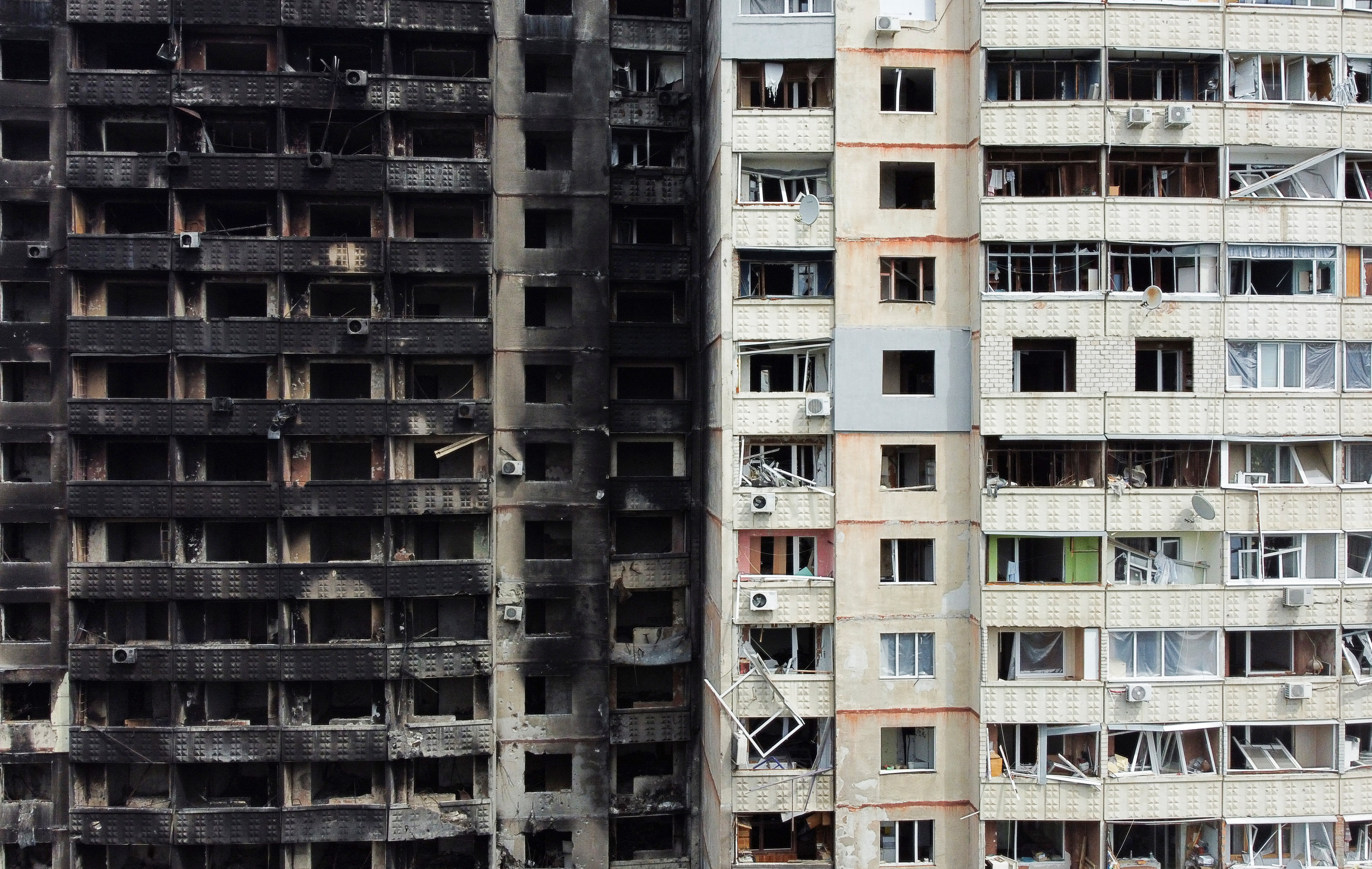
    In the north-eastern city of Kharkiv, a woman’s body was found after a strike destroyed the upper part of a block of flats, local authorities said.
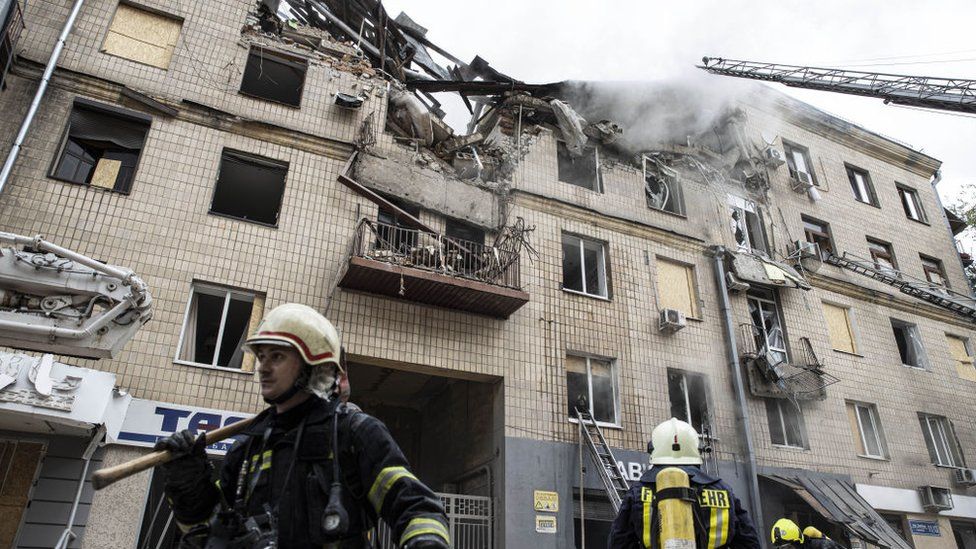
    Firefighters near a damaged building in Kharkiv, 6 September
    IMAGE SOURCE, GETTY IMAGES
    Image caption,

    Flats were destroyed in Kharkiv

    In Kryvyi Rih, in central Ukraine, thick black smoke billowed from the depot in a photo posted by the governor of the Dnipropetrovsk region.

    It was attacked with two missiles on Monday evening, Valentyn Reznichenko said, adding that there was no immediate information about casualties.

    In another development, Russian-backed separatists controlling Donetsk said parts of the eastern city had been shelled by Ukrainian government forces on Tuesday, with one civilian wounded.

    A US official said Russia would be forced to buy additional North Korean weaponry as the war dragged on.

    Iran and North Korea, themselves both the targets of significant Western sanctions, have sought to deepen ties with Russia since President Vladimir Putin launched his invasion of Ukraine in February.

    Kim Jong-un’s government has blamed the US for the conflict and accused the West of pursuing a “hegemonic policy” that justified Russia’s use of force.

    Last month, North Korea recognized the independence of two Russian-backed breakaway regions in eastern Ukraine – the Donetsk and Luhansk people’s republics – and vowed to deepen its “comradely friendship” with Moscow. Mr Putin said the two countries would expand their “comprehensive and constructive bilateral relations”, according to North Korean state media.

    The exact size and scale of the new weapons deliveries reported by the New York Times and Associated Press news agency remain unclear.

    But a US official said turning to North Korea for support demonstrated that “the Russian military continues to suffer from severe supply shortages in Ukraine, due in part to export controls and sanctions”.

    Broad economic sanctions have done little to damage Russia’s income from energy exports, according to a Finnish think tank the Centre for Research on Energy and Clean Air. It estimates Russia has made €158bn (£136bn) from surging fossil fuel prices during the six-month invasion, with EU imports accounting for more than half of that.

    However, the US and EU believe that Moscow’s ability to resupply its military has been impaired.

    Last week, officials in the Biden administration told US media that the first shipments of Iranian-made drones had also been delivered to Russia.

    US intelligence officers believe that Russian operators have travelled to Iran to receive training on the Mohajer-6 and Shahed series weapons.

    But they told reporters recently that many of the drones had been beset by mechanical and technical problems since delivery.

    Iran has officially denied delivering weapons to either side of the conflict, but in July US National Security Advisor Jake Sullivan said Tehran was planning to supply Moscow with potentially hundreds of drones for its war in Ukraine, some with combat capabilities.

    On Tuesday, UK defence officials said in a daily update that Russia was struggling to maintain its supply of battlefield drones in the face of significant “combat losses”.

    “It is likely that Russia is struggling to maintain stocks of UAVs [unmanned aerial vehicles], exacerbated by component shortages resulting from international sanctions,” the update said.

    “The limited availability of reconnaissance UAVs is likely degrading commanders’ tactical situational awareness and increasingly hampering Russian operations,” the officials added.
  • Ukraine war: Zelensky warns that Russia intends to disrupt Westerners’ normal way of life

    Ukrainian President Volodymyr Zelensky, says Russia intends to ruin every European citizen’s ability to live a normal life.

    In his regular address on Saturday, Mr. Zelensky stated that “it is trying to attack with poverty and political disarray where it cannot yet attack with missiles.”

    A few hours earlier, Russia had announced that its main gas pipeline to Europe would not reopen as scheduled.

    Europe accused Russia of using its gas supplies to blackmail Europe amid the Ukraine conflict, which Moscow denies.

    Energy prices have soared since Russia invaded Ukraine on 24 February and scarce supplies could push up costs even further.

    There are growing fears families in the EU will be unable to afford the cost of heating this winter.

    Governments across the continent are contemplating what measures to take to alleviate the crisis.

    Germany – one of the countries worst affected by the Russian supply disruption – announced a €65bn (£56bn) package of help on Saturday.

    Chancellor Olaf Scholtz said Russia was no longer a reliable energy partner.

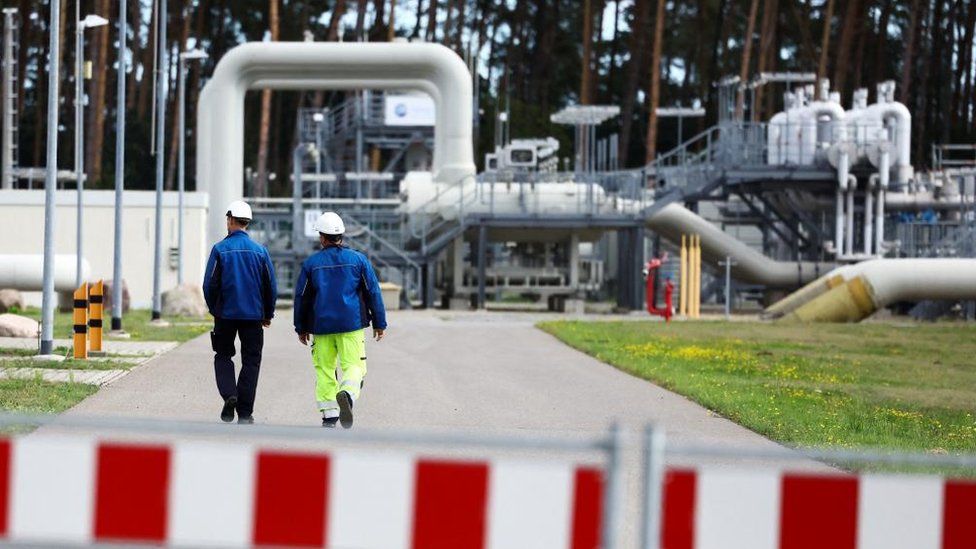
    The Nord Stream 1 pipeline in Lubmin, Germany
    IMAGE SOURCE,REUTERS
    Image caption,

    The Nord Stream 1 pipeline in Lubmin, Germany

    The stand-off with Russia has forced countries to fill their own gas supplies, with Germany’s stores increasing from less than half in June to 84% full today.

    Europe is attempting to wean itself off Russian energy in an effort to reduce Moscow’s ability to finance the war.

    Russia’s state energy firm Gazprom announced on Saturday the Nord Stream 1 pipeline could be closed indefinitely.

    The pipeline, which runs to Germany, had been shut for three days for what Gazprom described as maintenance work and had been due to reopen.

    The interruption of the service was “sadly no surprise”, EU Council President Charles Michel said.

    “Use of gas as a weapon will not change the resolve of the EU. We will accelerate our path towards energy independence. Our duty is to protect our citizens and support the freedom of Ukraine,” he tweeted in response to Gazprom’s announcement.

    Moscow denies using energy supplies as an economic weapon against Western countries supporting Ukraine.

    It has blamed the sanctions for holding up routine maintenance of Nord Stream 1, but the EU says this is a pretext.

    Gazprom’s announcement came shortly after the G7 nations agreed to cap the price of Russian oil in support of Ukraine.

    The G7 (Group of Seven) consists of the UK, US, Canada, France, Germany, Italy, and Japan.

    Their introduction of a price cap means countries that sign up to the policy will be permitted to purchase only Russian oil and petroleum products transported via sea that are sold at or below the price cap.

    However, Russia says it will not export to countries that participate in the cap.

    The gas pipeline stretches from the Russian coast near St Petersburg to north-eastern Germany and can carry up to 170 million cubic metres of gas a day.

    This is not the first time since the invasion that the Nord Stream 1 pipeline has been closed.

    In July, Gazprom cut off supplies completely for 10 days, citing “a maintenance break”. It restarted again 10 days later, but at a much-reduced level.

    In his address, President Zelensky said: “This winter, Russia is preparing for a decisive energy attack on all Europeans.”

    He said only unity amongst European countries would offer protection.

  • Russian oil chief Maganov dies in ‘fall from hospital window’

    The chairman of Russia‘s Lukoil oil giant, Ravil Maganov, has died after falling from a hospital window in Moscow, reports say.

    Maganov, 67, was being treated at the city’s Central Clinical Hospital and died from his injuries, sources told Russian media.

    He is the latest of a number of high-profile business executives to die in mysterious circumstances.

    Shortly after Russia invaded Ukraine, Lukoil called for the war to end.

    Early in March, the Lukoil board called for the conflict in Ukraine to end as soon as possible, expressing its sympathy to victims of “this tragedy”.

    Ravil Maganov took over as chairman of Lukoil’s board two years ago. He began working for the private oil company in 1993.

    In May a former senior manager at Lukoil, Alexander Subbotin, reportedly died also under unusual circumstances.

    Source: BBC

  • Zaporizhzhia nuclear plant: UN nuclear inspectors depart regardless of ‘significant’ risks

    Despite the “severe” dangers of their mission, a group of international experts is headed to Ukraine’s Zaporizhzhia nuclear plant for a scheduled inspection of the facility on Thursday, according to Rafael Grossi, the head of the International Atomic Energy Agency (IAEA).

    Upon arrival at the plant, the team will start an immediate “assessment of the security and safety situation,” Grossi told reporters, with the ultimate goal of “establishing a continued presence of the IAEA at the plant.”

    The plant is near the front line of the war in southeastern Ukraine and was captured by Russian troops in March. Both sides have accused each other of shelling it.

    “I have been briefed by the Ukrainian regional military commander about the inherent risks but weighing the pros and cons and having come so far, we are not stopping, we are moving now,” Grossi said. “We know that there is a so-called ‘gray zone’ where the last line of Ukrainian defense [ends] and the first line of Russian occupying forces begin; where the risks are significant.
    “At the same time, we consider that we have the minimum conditions to move, accepting that the risks are very high. Still, myself and the team feel we can proceed with this, we have a very important mission to accomplish.”

    It is uncertain how long the IAEA visit will last.

  • Top market prices on oil, gold and natural gas as at 17th August 2022

    Markets

    UK markets
    UK markets % change Value
    Change
    +0.36%
    7536.06
    +26.91
    -0.23%
    20336.41
    -46.35
    Europe markets
    Europe markets % change Value
    Change
    -0.11%
    728.11
    -0.77
    +0.34%
    6592.58
    +22.63
    +0.68%
    13910.12
    +93.51
    +0.41%
    3805.22
    +15.60
    +1.01%
    8511.90
    +84.90
    US markets
    US markets % change Value
    Change
    +0.71%
    34152.01
    +239.57
    -0.19%
    13102.55
    -25.50
    +0.19%
    4305.20
    +8.06
    Asia markets
    Asia markets % change Value
    Change
    +0.58%
    60190.14
    +347.93
    +0.72%
    19974.04
    +143.52
    +1.23%
    29222.77
    +353.86
    As of 07:01 17 Aug 2022

    Currencies

    GBP
    % change One £ buys
    Change
    +0.06%
    $1.2102
    +0.0007
    GBP against Euro
    +0.14%
    €1.1909
    +0.0017
    GBP against Yen
    +0.17%
    ¥162.7010
    +0.2780
    USD
    % change One $ buys
    Change
    -0.03%
    £0.8263
    -0.0002
    +0.08%
    €0.9840
    +0.0008
    USD against Yen
    +0.11%
    ¥134.4370
    +0.1530
    Euro
    % change One € buys
    Change
    -0.11%
    £0.8397
    -0.0009
    -0.08%
    $1.0162
    -0.0008
    Euro against Yen
    +0.04%
    ¥136.6235
    +0.0535
    Yen
    % change One ¥ buys
    Change
    +0.13%
    £0.0061
    0.0000
    -0.10%
    $0.0074
    -0.0000
    Yen against Euro
    -0.03%
    €0.0073
    -0.0000
    As of 07:01 17 Aug 2022

    Commodities

    Oil
    Commodity % change dollars per barrel
    Change
    +0.69%
    92.98
    +0.64
    WTI Crude Oil Futures
    +1.06%
    87.45
    +0.92
    Gold
    Commodity % change dollars per ounce
    Change
    No value
    1776.15
    No value
    Gold (Forex Index pm fix)
    No value
    1774.85
    No value
    Natural Gas
    Commodity % change pence per therm
    Change
    +4.63%
    436.00
    +19.59


    Source: BBC

  • New START treaty : Russia suspends US inspections of nuclear arsenal

    In accordance with the New START arms limitation deal, Russia has informed the US that it has “temporarily” stopped on-site inspections of its strategic nuclear weapons.

    The Russian foreign ministry claims that the US seeks to take advantage and had deprived Russia of the right to undertake inspections on US territory.

    It said US sanctions imposed on Russia over Ukraine had changed conditions between the countries.

    The treaty came into force in 2011.

    It is the last remaining arms reduction agreement between the former Cold War rivals. It caps at 1,550 the number of long-range nuclear warheads that each country can deploy.

    The ministry said the suspension was allowed under the treaty terms “in exceptional circumstances”.

    The suspension comes a week after US President Joe Biden said he was ready to work on a new nuclear arms deal with President Vladimir Putin. The current one will expire in 2026.

    The ministry accused the US of ignoring “existing realities” such as “the suspension of normal” air links.

    New START followed years of arms reduction talks between the US and the former USSR, aimed at preventing nuclear war.

    Russia’s invasion of Ukraine in February sparked hostile rhetoric on both sides, including warnings that the conflict could escalate into a third world war.

    Some commentators on Russian state media have boasted about Moscow’s nuclear arsenal in the context of current tensions with Nato.

  • EP Church has made monumental contributions to nation-building-Veep

    Vice President Mahamudu Bawumia Sunday launched the 175th Anniversary Celebration of the Evangelical Presbyterian Church Ghana, acknowledging its enormous contributions toward national development.

    He said the Church had been a reliable, trusted, and formidable agent of the transformation, civilisation and progress of society.

    The year-long celebration is on the theme: “A journey of 175 years in ministry: Achievements, Challenges and the Way Forward.”

    Vice President Bawumia believed that the celebration would strengthen their faith in the Lord and reposition the church as a great contributor to the moral, spiritual and socio-economic wellbeing of the people and humanity in general.

    “The gains we have made as a nation pre- and post-independence in moral, spiritual and socio-economic development could not have been entirely possible without the keen involvement of the church,” Dr Bawumia stated.

    “Indeed, we cannot mention any monumental contributions of the church to nation-building without recognising the role of the Evangelical Presbyterian Church Ghana. Before Ghana attained independence in 1957, the church had already been birthed on Sunday, November 14, 1847, through the missionary effort of the North German Mission Society (Bremen Mission),” he added.

    The Vice President noted that the Church had played a vital role in the emergence and development of formal education in the country.

    He said, for instance, the pioneer missionaries rolled out several socio-economic initiatives such as clinics, hospitals, schools and agricultural stations, and many others that complemented the work of the Colonial Administrations in developing the nation.

    Dr Bawumia observed that the 175 years in the life of the EP Church Ghana were worth celebrating, especially considering the huge sacrifices that the pioneer missionaries like Rev. Lorenz Wolf, Quinuius, Daeuble and Pleasing, had had to make to bring the light of the gospel to Africa and Ghana.

    The Vice President acknowledged the numerous educational establishments undertaken by the church, including over 500 basic and tertiary institutions such as Mawuli, Mawuko, EP Senior High Schools in Hohoe, Saboba, Tatale, plus Vocational and Technical Schools, as well as Colleges of Education.

    “You have also earned the enviable reputation of establishing the first university in the entire Volta and Oti Regions-the Evangelical Presbyterian University College.

    “Your health centres in Wapuli, Ho, Dambai, Blajai, inter alia, coupled with your numerous relief and development projects in the areas of agricultural development, climate change advocacy, HIV/AIDS & TB Programmes, among several others, have added to your endless list of achievements over the past seventeen and half decades of your existence,” Dr Bawumia stated.

    The Vice President lauded the church for dedicating parts of the celebration to reflect on its challenges and thus, underscored the need for all well-meaning Ghanaians to pool their resources together to rebuild the economy, ravaged by the Coronavirus pandemic and the Russia-Ukraine war.

    “The challenges that have bedevilled our world in the past decades and the present such as COVID-19 and the Russian-Ukraine War with their concomitant effects have spared no institution, and the EP Church Ghana is no exception.

    “As you, therefore, reflect on the strategies to surmounting your challenges and strategising for the way forward in the decades ahead, may we all pool together our collective and nationalistic efforts to rebuild our nation and recover from the internal and external devastations that have hit our economy very hard,” Dr Bawumia advised.

    He entreated the Church to roll out more socio-economic interventions like its water production business, which would be commissioned on Thursday, August 18, 2022, to create jobs and contribute to the overall gross domestic product (GDP) of the nation.

    “The EP Church should also consider rolling out interventions that would create opportunities to develop the human capital of the nation, especially the teeming youth who have benefitted from free education, and thus are in urgent need of work opportunities to contribute their quota to our nation-building quests,” the Vice President pointed out.

    In addition to economic and development issues, Dr Bawumia urged the Church to be concerned about building a peaceful nation, noting that, the recent Global Peace Index placed Ghana as the second most peaceful country in Sub-Saharan Africa.

    He said such a remarkable feat must be guarded jealously without any compromises since both the Bible and the Quran placed much emphasis on peace.

    The Reverend Dr Setri Nyomi, Council Chair, the Evangelical Presbyterian University College at Ho, said the EP Church had impacted the nation in so many ways including providing educational facilities, potable water and resolving ethnic conflicts.

    He said the Church had been a voice for the marginalised and vulnerable persons in society and urged the members to continue upholding discipline, hard work and responsibility as the hallmark of the Church and refrain from any acts of mediocrity in both public and private life.

    Source: GNA

  • Ukraine war: UN and Red Cross invited to investigate deaths of prisoners of war, Russia says

    Ukraine war: UN and Red Cross invited to investigate deaths of prisoners of war, Russia says.

    Russia has invited the United Nations and the Red Cross to investigate the deaths of dozens of Ukrainian prisoners of war.

    The prisoners were being held by Moscow-backed separatists at a jail in the town of Olenivka, in eastern Donetsk, when it was hit by rockets early on Friday.

    Russia’s defense ministry said 50 prisoners were killed and another 73 were injured, adding that it wanted to act “in the interest of conducting an objective investigation” into the attack.

    It claims Ukrainian soldiers had used a US-made high mobility artillery rocket system (HIMARS) to target the prison.

    Ministry spokesman Lieutenant-General Igor Konashenkov said “all political, criminal and moral responsibility” rested with Ukrainian President Volodymyr Zelenskyy, “his criminal regime and Washington who supports them”.

    But Ukraine said Russian artillery had been behind the attack, using it to hide the mistreatment of prisoners.

    Mr. Zelenskyy said: “It was a deliberate Russian war crime, a deliberate mass murder of Ukrainian prisoners of war.

    Source: bbc.com


  • Ukraine war: First grain ship leaves under Russia deal

    The first ship carrying grain has left a Ukrainian port under a landmark deal with Russia.

    Turkish and Ukrainian officials say the ship left the southern port of Odesa early on Monday morning.

    Russia has been blockading Ukrainian ports since February, but the two sides agreed on a deal to resume shipments.

    It is hoped the deal will ease the global food crisis and lower the price of grain.

    In a statement issued ahead of the ship’s departure, Turkey said the Sierra Leone-flagged vessel would dock in Lebanon, adding that further shipments were planned over the coming weeks.

    The Joint Coordination Centre (JCC) in Istanbul set up under the deal said the ship was carrying some 26,000 tonnes of corn and was expected to arrive in Turkish waters for inspection on Tuesday.

    “Today Ukraine, together with partners, takes another step to prevent world hunger,” Ukraine’s Infrastructure Minister Alexander Kubrakov wrote on Facebook.

    “Unlocking ports will provide at least $1 billion in foreign exchange revenue to the economy and an opportunity for the agricultural sector to plan for next year.”

    Mr. Kubrakov added that 16 other ships were waiting to depart in the ports of the Odesa Region in the coming weeks.

    Last month’s deal – brokered by the UN and Turkey – took two months to reach and is set to last for 120 days. It can be renewed if both parties agree.

    The blockade of Ukraine’s grain has caused a global food crisis with wheat-based products like bread and pasta becoming more expensive and cooking oils and fertilizer also increasing in price.

    Under the terms of the deal, Russia has agreed not to target ports while shipments are in transit and Ukraine has agreed that its naval vessels will guide cargo ships through waters that have been mined.

    Turkey – supported by the United Nations – will inspect ships, to allay Russian fears of weapons smuggling.

    Three ports in southern Ukraine – Odesa, Chornomorsk, and Pivdenny – are expected to be the focal point of the exports.

    But the deal was thrown into chaos less than 24 hours after it was announced that Russia had launched two missiles at Odesa port.

    Ukraine’s President Volodymyr Zelensky said the strike showed that Moscow could not be trusted to stick to the deal.

    Source: bbc.com

  • Outrage as footage appears to show Ukrainian prisoner of war being castrated by Russian soldiers

    The video, which was taken off Twitter after being shared by a Ukrainian MP, shows men in Russian camouflage outfits pinning a man down before using a box cutter to remove his genitals.

    Pic: AP

    Footage that appears to show Russian soldiers pinning a Ukrainian prisoner of war to the ground before cutting off his genitals has sparked outrage in Ukraine.

    Ukrainian MP Inna Sovsun tweeted to say she was banned by Twitter after posting the clip on the social media platform.

    Once she had regained access to her account, Ms. Sovsun shared a screenshot of her original post with the video blurred.

    Sky News has decided not to show any footage or images.

    She had written in her original tweet: “Russian soldier from Chechen battalion Ahmat cut off the genitals of Ukrainian POW (prisoner of war).

    “This is what Nazis are doing to Ukrainians.

    “Russia has to pay for it!

    “Give Ukraine the weapons we need to stop this nightmare once and for all. The world can’t pretend like this isn’t happening!”

    Ms. Sovsun wrote in a follow-up tweet on Friday: “Twitter banned my profile today. Because I posted a video where a Russian soldier castrates a Ukrainian POW.

    “@Twitter decided it was too cruel. But this is what happens. And deleting the video won’t change that.

    “People should know what #Russia is doing!”

    The video shows a group of men in Russian camouflage outfits pinning a Ukrainian prisoner of war to the ground.

    They are then said to use a box cutter to remove his genitals before showing them to the camera.

    ‘Brutal war crimes’ must be investigated

    In further footage seen by Sky News, the same prisoner is videoed getting tied up and shot in the head at the same location.

    It is not clear when or where the video was filmed.

    Ukraine’s Ministry of Foreign Affairs condemned the “brutal war crimes”, calling on the International Criminal Court to investigate.

    “Ukraine strongly condemns the brutal war crimes committed by the servicemen of the Russian Federation against Ukrainian prisoners of war, particularly horrible cases of torture, physical abuse, inhuman treatment, wilfully causing great suffering or serious injury to body or health and wilful killing of Ukrainian prisoners of war,” the department said in a statement.

    “Minister of Foreign Affairs Dmytro Kuleba calls on the international community to condemn the brutal violation of international law by the Russian Federation and to immediately recognize Russia as a terrorist state

    “He emphasized that any delay in this decision will only encourage Russia to commit further crimes and inhumane acts.

    War crimes allegations against Russia continue to mount

    Since the invasion of Ukraine began in February, Russia has been accused of committing thousands of war crimes.

    The International Criminal Court has described Ukraine as a “crime scene”, sending its largest ever team to investigate.

    In April, Ukraine’s prosecutor accused 10 Russian soldiers of atrocities in the town of Bucha, where evidence of mass killings was uncovered.

    Meanwhile, Russian soldier Vadim Shishimarin, 21, admitted to shooting unarmed Oleksandr Shelipov, 62, dead in the early days of the war.

    Shishimarin asked Mr. Shelipov’s widow to forgive him when he faced her in court in May.

    Source: sky. news

  • Cold showers as the German city of Hanover reacts to Russian gas crisis

    The German city of Hanover has turned off the heating and switched to cold showers in all public buildings because of the Russian gas crisis.

    It’s the first big city to turn off the hot water after Russia dramatically reduced Germany‘s gas supply.

    Germans have been told to expect sweeping gas reduction measures and extra charges on their energy bills.

    And the EU has agreed to lower the demand for Russian gas this winter by 15%.

    In a bid to save energy, Germany’s northern city of Hanover has decided hot water will no longer be available for hand washing in public buildings, or in showers at swimming pools, sports halls, and gyms.

    Public fountains are also being switched off to save energy, and there will be no night-time lights on major buildings such as the town hall and museums.

    Mayor Belit Onay said the goal was to reduce the city’s energy consumption by 15% in reaction to an “imminent gas shortage” which posed a significant challenge for big cities.

    The rules apply to heating, too. Public buildings will not have any heating from April to the end of September each year, with room temperatures limited to a maximum of 20C for the rest of the year – with some exemptions.

    The city is also banning portable air conditioners, heaters, and radiators.

    The policy is in line with announcements from Berlin last week, as Germany races to build up its reserves ahead of the winter. Other cities - such as Augsburg in Bavaria – have already introduced their own measures such as turning off public fountains.

    The 15% reduction target in Hanover matches the EU-wide goal to reduce reliance on Russian gas.

    And on Thursday, Germany confirmed that a planned gas surcharge on customers could be much higher than previously expected, to try to ensure energy companies do not go bankrupt in the coming months. “We can’t say yet how much gas will cost in November, but the bitter news is it’s definitely a few hundred euros per household,” said Economy Minister Robert Habeck.

    Some reports said the levy could cost families an extra €500 (£420) a year.

    Germany has long relied on Russian gas for its energy needs but has recently accused Russia of restricting the flow in retaliation for EU sanctions over the war in Ukraine – something Russia denies.

    Russian gas supplies now account for about a quarter of the nation’s needs, compared with more than half before the war.

  • ‘Ukraine is under constant stress’ – First Lady Olena Zelenska

    Ukraine’s First Lady Olena Zelenska has told the BBC that the whole of the country is “under constant stress”.

    Her comments come hours after a number of rocket attacks were reported in the country, including in the Kyiv region.

    “We have been under constant stress from 24 February and that does not relent,” she said.

    Ms. Zelenska says the government is implementing support to help Ukrainians get help for their mental health and is being assisted by the WHO.

    “We need expert help and that’s why we’ve approached the WHO who are helping us with psychological help.”

    Ms. Zelenska, who is known for being quite private, also discussed her recent appearance in Vogue. She said it was a massive opportunity to speak about Ukraine.

    “Millions read Vogue and speaking to them directly was my duty. And that was an interesting experience,” she said.

    “In peaceful life, I’m not used to the attention. Everyone is fighting on a front line and it’s work and I have to do that work,” she added.

    Last week Ms. Zelenska hosted a First Lady summit, attended by the spouses of a number of world leaders. During the meeting, they discussed the Ukraine war and the assistance needed.

    “First ladies have no opportunities to influence politics but we have an emotional influence. We understand each other, we feel each other,” she said.

    Ms. Zelenska also said that the need for the country to keep working and for people to keep going is very important.

    “The country has to survive, the country has to preserve some form of normality. Even soldiers are saying to their friends to go and have a coffee, see a film, enjoy the peace that you have. We are here on the front line to give that peace for you.

    “It’s a very delicate balance. So if someone might say Kyiv is a completely peaceful city, that would be an illusion. We had several rocket attacks but the country has to keep working. Businesses have to keep working. The country is working and it shouldn’t stop. There is no life without development – we have to keep developing.”

    Source: bbc.com

  • President Zelenskyy sacks security chief, cites hundreds of treason cases

    Ukraine’s President Volodymyr Zelenskyy sacked the head of the country’s domestic security service and state prosecutor, citing hundreds of cases of alleged treason and collaboration with Russia, as Moscow appeared set to step up military operations.

    Zelenskiy said more than 60 officials from the SBU security service and prosecutor’s office were working against Ukraine in Russian-occupied territories, and 651 treason and collaboration cases had been opened against law enforcement officials.

    The sackings on Sunday of Ivan Bakanov, head of the security service, and Prosecutor General Iryna Venediktova, who led efforts to prosecute Russian war crimes, and the sheer number of treason cases reveals the huge challenge of Russian infiltration as Kyiv battles Moscow in what it says is a fight for survival.

    “Such an array of crimes against the foundations of the national security of the state … pose very serious questions to the relevant leaders,” Zelenskiy said. “Each of these questions will receive a proper answer.

    In his nightly speech to the nation, Zelenskyy noted the recent arrest on suspicion of treason of the SBU’s former head overseeing the region of Crimea, the peninsula annexed by Russia in 2014 that Kyiv and the West still view as Ukrainian land.

    Zelenskiy said he had fired the top security official at the start of the invasion, a decision he said had now been shown to be justified.

    “Sufficient evidence has been collected to report this person on suspicion of treason. All his criminal activities are documented,” he said.

    3,000 CRUISE MISSILES

    After failing to capture the capital Kyiv early in the invasion, Russian forces using a campaign of devastating bombing now control large swaths of Ukraine’s south and east, where pro-Russian separatists already control territory.

    Advertisement · Scroll to continue

    Zelenskiy said Russia had used more than 3,000 cruise missiles to date, and it was “impossible to count” the number of artillery and other strikes so far.

    Dozens of relatives and local residents on Sunday attended the funeral of 4-year-old Liza Dmytrieva, one of 24 people killed in a Russian missile strike in the city of Vinnytsia last week.

    Western deliveries of long-range arms are beginning to help Ukraine on the battlefield, with Kyiv citing a string of successful strikes carried out on 30 Russian logistics and ammunitions hubs, using several multiple launch rocket systems recently supplied by the West.

    The strikes are causing havoc with Russian supply lines and have significantly reduced Russia’s offensive capability, according to Ukraine’s defence ministry.

    Ukraine's President Zelenskiy attends a joint news briefing with Dutch Prime Minister Rutte in Kyiv
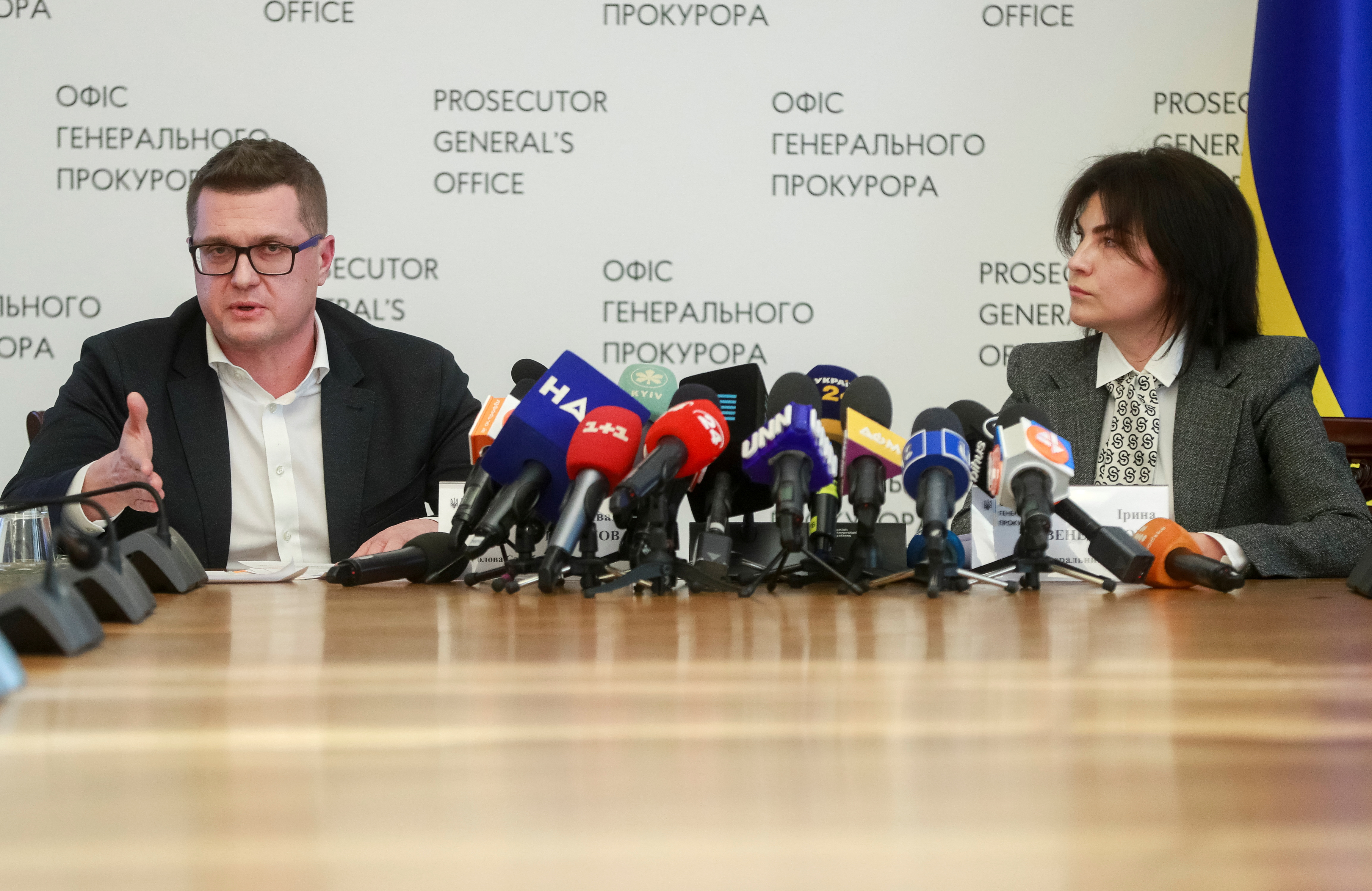
    Head of the Security Service of Ukraine (SBU) Bakanov and Ukraine's Prosecutor General Venediktova attend a news briefing in Kyiv
    Head of the Security Service of Ukraine (SBU) Ivan Bakanov and Ukraine’s Prosecutor General Iryna Venediktova attend a news briefing in Kyiv, Ukraine May 11, 2021. REUTERS/Valentyn Ogirenko
    Russia's attack on Ukraine continues, in Kharkiv

    Ukraine’s southern Operational Command reported that in the Kherson region, it had destroyed two Russian Pantsir missile systems, three strategic communication systems, one radar station, two ammunition depots, and 11 armoured and military vehicles on Sunday.

    The Russian military are also using radio-electronic warfare to suppress satellite communication channels, the Ukrainian General Staff said in a statement early on Monday.

    RUSSIA INTENSIFIES OPERATIONS

    Russia has ordered military units to intensify operations to prevent Ukrainian strikes on areas held by Russia, according to Ukraine which on the weekend reported shelling along the frontline in what it said was preparation for a fresh assault.

    Ukraine’s general staff said its forces had repelled Russian attacks in several towns in the Donetsk region.

    “Fighting is currently ongoing near Hryhorivka near the administrative between Luhansk and Donetsk regions,” it said.

    Overnight at least 10 explosions were reported in the southern city of Mykolaiv, but there was no information on casualties, while two people were killed and 10 wounded in Avdiivka and Novy Donbas, said Ukraine’s general staff, citing local officials.

    Reuters could not immediately verify the reports.

    The British defence ministry said on Sunday that Russia was reinforcing defences across areas it occupies in southern Ukraine after pressure from Ukrainian forces and pledges from Ukrainian leaders to drive Russia out. read more

    Russian President Vladimir Putin launched his invasion on Feb. 24 calling it a “special military operation” to demilitarise its neighbour and rid it of dangerous nationalists.

    Kyiv and the West say it was an imperialist land grab and attempt to reconquer a country that broke free of Moscow’s rule with the break-up of the Soviet Union in 1991.

    The biggest conflict in Europe since World War Two has killed more than 5,000 people, forced more than 6 million to flee Ukraine and left 8 million internally displaced, says the United Nations.

    Ukraine and the West say Russian forces are targeting civilians and been involved in war crimes, charges Moscow rejects.

    Source: Reuters

  • Ukraine war: 21,000 alleged war crimes being investigated, prosecutor says

    Ukraine says it is investigating more than 21,000 war crimes and crimes of aggression allegedly committed by Russia since the start of its invasion.

    Prosecutor General Iryna Venediktova told the BBC she was receiving reports of between 200 to 300 war crimes a day.

    She admitted that many trials would be held in absentia, but stressed that it was “a question of justice” to continue with the prosecutions.

    Russia invaded Ukraine on 24 February. It denies all war crimes allegations.

    Speaking to the BBC’s World Service Outside Source programme, Ms Venediktova warned that Russian soldiers who killed, tortured or raped civilians “should understand that it’s only a question of time when they all will be in court”.

    She said that although her team was working in regions across Ukraine, it was unable to investigate all cases “properly and effectively” because of a lack of access to some people and areas. This was an apparent reference to Ukraine’s territories occupied by Russian troops.

    In May, Ms Venediktova said that about 600 suspects had already been identified and 80 prosecutions had begun.

    The first Russian soldier to be put on trial in Ukraine, Sgt Vadim Shishimarin, was sentenced to life in prison for killing a civilian in May.

    Ukraine says it has uncovered multiple mass graves in Bucha, Borodyanka and other towns near the capital Kyiv that were briefly seized by Russian troops.

    The International Criminal Court has described Ukraine as a “crime scene”, dispatching its largest team of detectives ever to the country to assist in multiple investigations.

    Moscow has repeatedly denied targeting civilians.

    On the ground, Ukraine’s military said Russian troops were preparing for an offensive in the eastern Donetsk region, shelling several towns.

    Russia captured nearly all of the neighbouring Luhansk region over the weekend, part of its attempts to seize the wider Donbas area.

    In its update, Ukraine’s military said its forces were under intense pressure but had so far held off Russian forces.

    Residents of Slovyansk, a key city in Ukrainian hands, were earlier urged to evacuate further west – a day after a deadly Russian attack on a local market.

    Ukrainian President Volodymyr Zelensky, meanwhile, said “artillery from our Western partners had started working very powerfully, so the losses of the occupiers will only increase”.

    Source: BBCJohnson term in office chart

  • Ukraine needs strong signal from EU, Macron says ahead of possible visit

    President Emmanuel Macron voiced a tougher line on Russia on Wednesday and said Europe needed to send a strong signal to Ukraine as he sought to assuage concerns in Kyiv and among some European allies over his previous stance towards Moscow.

    Macron arrived in Romania on Tuesday for a three-day trip to Ukraine’s eastern neighbors including Moldova, before possibly heading to Kyiv on Thursday on a visit with German Chancellor Olaf Scholz, Italian Prime Minister Mario Draghi and Romanian President Klaus Iohannis, two diplomatic sources said

    • Macron insists Paris will do everything to stop Russia
    • Macron sees NATO troops in Romania, supports Moldova
    • Scholz, Draghi, Iohannis may join Macron in Kyiv visit

    CONSTANTA, Romania, June 15 (Reuters) – President Emmanuel Macron voiced a tougher line on Russia on Wednesday and said Europe needed to send a strong signal to Ukraine as he sought to assuage concerns in Kyiv and among some European allies over his previous stance towards Moscow.

    Macron arrived in Romania on Tuesday for a three-day trip to Ukraine’s eastern neighbors including Moldova, before possibly heading to Kyiv on Thursday on a visit with German Chancellor Olaf Scholz, Italian Prime Minister Mario Draghi and Romanian President Klaus Iohannis, two diplomatic sources said.

    The symbolic visit would come a day before the European Commission makes a recommendation on Ukraine’s status as an EU candidate, something the biggest European nations have been lukewarm about and are set to discuss at a leaders’ summit on June 23-24.

    We are at a point when we (Europeans) need to send clear political signals, us Europeans, towards Ukraine and its people when it is resisting heroically,” Macron said, without giving details.

    The French leader has been criticized by Ukraine and eastern European allies for what they perceive as his ambiguous backing for Ukraine in the war against Russia.

    French officials have in recent days sought to strengthen the public messaging, while Macron appeared to take a tougher line on Tuesday evening when he was with his troops.

    “We will do everything to stop Russia’s war forces, to help the Ukrainians and their army and continue to negotiate,” he told French and NATO troops at a military base in Romania.

    Macron has in recent weeks repeatedly said it was vital not to “humiliate” Russia so a diplomatic solution could be found when fighting ended and he has continued to keep communication channels open with the Kremlin open, riling more hawkish allies.

    We share a continent. Geography is stubborn and at the end of it, Russia is there. It was there yesterday, it’s there today and will be there tomorrow,” he told reporters.

    France leads a NATO battle group in Romania of about 800 troops, including 500 French troops alongside others from the Netherlands and Belgium. Paris has also deployed a surface-to air missile system.

    Macron heads to Moldova later on Wednesday to support a country many fear could be drawn into the conflict in neighboring Ukraine.

    The focus may turn to Kyiv on Thursday, with diplomatic sources saying the European leaders may head to Ukraine’s capital.

    Macron declined to comment on “logistical matters”, but said it was important to hold new talks with Ukraine on military, financial matters and issues related to exporting grains from the country.

    Romania’s Iohannis said support should include offering Ukraine candidate status in the European Union.

    Source: www.reuters.com

  • Ukraine needs strong signal from EU, Macron says ahead of possible visit

    President Emmanuel Macron voiced a tougher line on Russia on Wednesday and said Europe needed to send a strong signal to Ukraine as he sought to assuage concerns in Kyiv and among some European allies over his previous stance towards Moscow.

    Macron arrived in Romania on Tuesday for a three-day trip to Ukraine’s eastern neighbors including Moldova, before possibly heading to Kyiv on Thursday on a visit with German Chancellor Olaf Scholz, Italian Prime Minister Mario Draghi and Romanian President Klaus Iohannis, two diplomatic sources said.

    The symbolic visit would come a day before the European Commission makes a recommendation on Ukraine’s status as an EU candidate, something the biggest European nations have been lukewarm about and are set to discuss at a leaders’ summit on June 23-24.

    “We are at a point when we (Europeans) need to send clear political signals, us Europeans, towards Ukraine and its people when it is resisting heroically,” Macron said, without giving details.

    The French leader has been criticized by Ukraine and eastern European allies for what they perceive as his ambiguous backing for Ukraine in the war against Russia.

    French officials have in recent days sought to strengthen the public messaging, while Macron appeared to take a tougher line on Tuesday evening when he was with his troops. read more

    “We will do everything to stop Russia’s war forces, to help the Ukrainians and their army and continue to negotiate,” he told French and NATO troops at a military base in Romania.

    Speaking alongside Iohannis, Macron downplayed those comments, but insisted that Ukraine, which he hoped would win the war, would eventually have to negotiate with Russia.

    CONSTANTA, Romania, June 15 (Reuters) – President Emmanuel Macron voiced a tougher line on Russia on Wednesday and said Europe needed to send a strong signal to Ukraine as he sought to assuage concerns in Kyiv and among some European allies over his previous stance towards Moscow.

    Macron arrived in Romania on Tuesday for a three-day trip to Ukraine’s eastern neighbors including Moldova, before possibly heading to Kyiv on Thursday on a visit with German Chancellor Olaf Scholz, Italian Prime Minister Mario Draghi and Romanian President Klaus Iohannis, two diplomatic sources said.

    Advertisement · Scroll to continue

    The symbolic visit would come a day before the European Commission makes a recommendation on Ukraine’s status as an EU candidate, something the biggest European nations have been lukewarm about and are set to discuss at a leaders’ summit on June 23-24.

    Register now for FREE unlimited access to Reuters.com

    “We are at a point when we (Europeans) need to send clear political signals, us Europeans, towards Ukraine and its people when it is resisting heroically,” Macron said, without giving details.

    Advertisement · Scroll to continue

    The French leader has been criticised by Ukraine and eastern European allies for what they perceive as his ambiguous backing for Ukraine in the war against Russia.

    French officials have in recent days sought to strengthen the public messaging, while Macron appeared to take a tougher line on Tuesday evening when he was with his troops. read more

    “We will do everything to stop Russia’s war forces, to help the Ukrainians and their army and continue to negotiate,” he told French and NATO troops at a military base in Romania.

    Macron has in recent weeks repeatedly said it was vital not to “humiliate” Russia so a diplomatic solution could be found when fighting ended and he has continued to keep communication channels open with the Kremlin open, riling more hawkish allies. read more

    Speaking alongside Iohannis, Macron downplayed those comments, but insisted that Ukraine, which he hoped would win the war, would eventually have to negotiate with Russia.

    “We share a continent. Geography is stubborn and at the end of it, Russia is there. It was there yesterday, it’s there today and will be there tomorrow,” he told reporters.

    France leads a NATO battle group in Romania of about 800 troops, including 500 French troops alongside others from the Netherlands and Belgium. Paris has also deployed a surface-to air missile system.

    Macron heads to Moldova later on Wednesday to support a country many fear could be drawn into the conflict in neighboring Ukraine.

    Source: www.reuters.com

  • Africa risks stagflation due to COVID, Russia – Ukraine war – AfDB

    Africa risks sliding into stagflation – a cycle of slow growth and high inflation – as it battles the lingering effects of the pandemic and rising fuel and food prices caused by the Ukraine conflict, the African Development Bank (AfDB) said on Wednesday.

    Despite experiencing relatively low death rates compared to more developed regions, Africa was dealt a heavy economic blow by the COVID-19 pandemic.

    While 2021 saw a continent-wide rebound, with gross domestic product (GDP) growth estimated at 6.9% after a pandemic-induced contraction of 1.6% the previous year, the Bank projects real GDP growth to slow to 4.1% this year.

    “The deceleration in growth highlights the severity of the impact of the RussiaUkraine conflict on Africa’s economy,” the AfDB wrote in its 2022 African Economic Outlook.

    “If the conflict persists, Africa’s growth is likely to stagnate at around 4 percent in 2023.”

    Inflation is meanwhile expected to accelerate to 13.5% this year, from 13% in 2021, due to a sharp rise in energy and food prices linked to the war in Ukraine.

    The AfDB estimates around 30 million Africans were pushed into extreme poverty and 22 million lost their jobs last year alone as a result of the pandemic.

    Vulnerable populations, particularly in urban areas, will bear the brunt of rising prices, the report said, adding that economic disruptions stemming from the war could tip nearly 4 million more into extreme poverty this year and next.

    “In the absence of measures to cushion the impact, this could stoke social tension across the continent,” the report stated. “But in many African countries, fiscal space remains constrained by the effects of the pandemic.”

    The AfDB forecasts Africa’s debt-to-GDP ratio to stabilise at around 70%, down slightly from 71.4% in 2020, due to last year’s growth recovery and debt relief measures, but will remain above pre-pandemic levels.

  • Ukraine war: Bodies of dead Russian soldiers abandoned near Kyiv

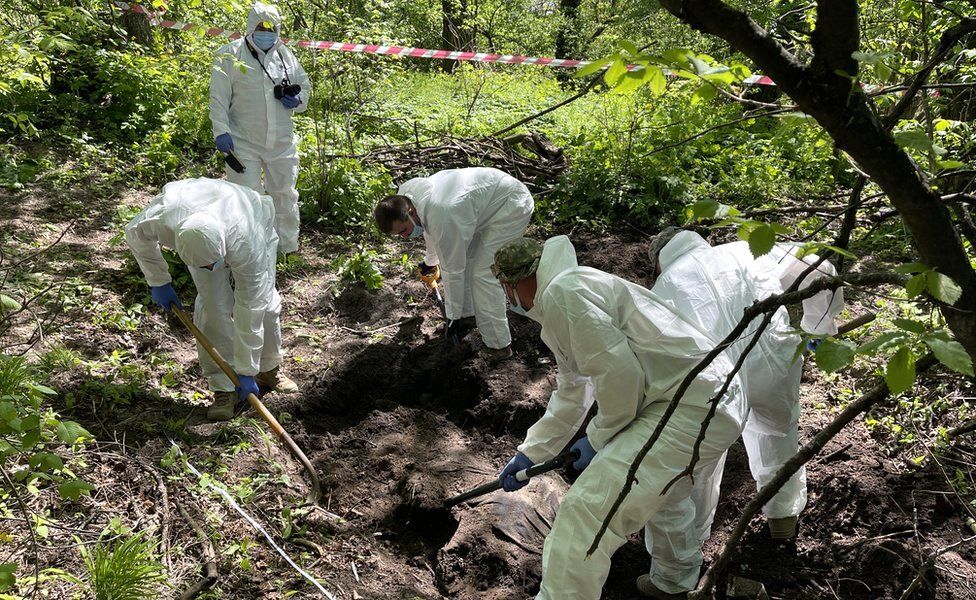
    When their dogs started digging insistently at a spot in the woods, villagers in Zavalivka called in the authorities.

    A Ukrainian military team were soon at the scene in white protective suits, carefully removing the topsoil.

    They uncovered a man’s body, face down with his legs oddly twisted beneath him. It was clear from his uniform that he was a Russian soldier.

    Weeks after they failed to seize Ukraine’s capital, the remains of Russian troops are still being discovered in and around the villages they passed through or occupied near the capital, Kyiv. But Ukraine says Russia shows little interest in getting them back.

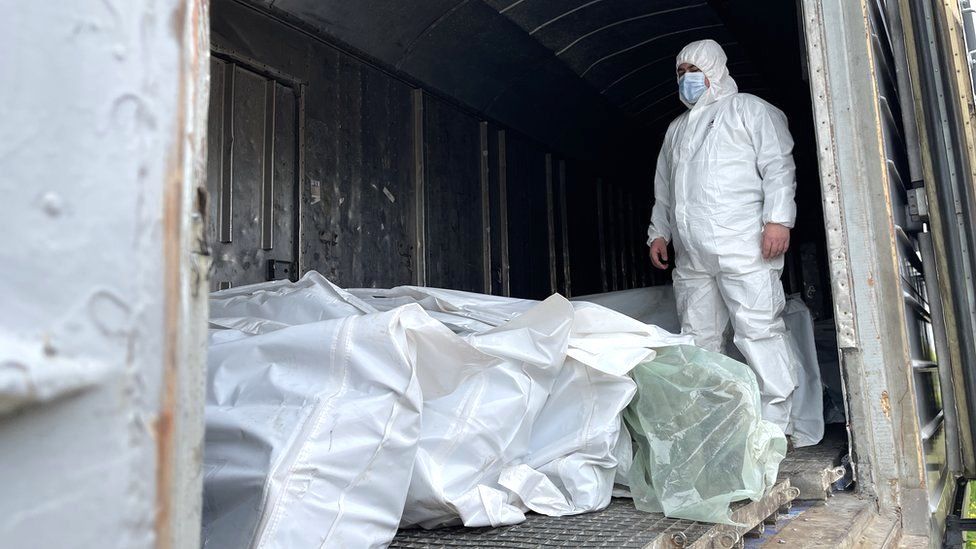
    From the grave in the woods, the body was removed to a refrigerated train on the outskirts of Kyiv that now operates as a mobile morgue for the Russian dead.

    The white plastic sacks are marked with numbers rather than names and there were at least 137 stacked inside two carriages on the day we visited.

    The dead Russian bodies are placed in refrigerated train carriages
    Image caption,

    The bodies of dozens of dead Russian soldiers discovered near Kyiv have been placed in refrigerated train carriages

    The Ukrainians attempt to identify the dead: on the body just brought in, the forensics team turned up two bank cards, as well as badges for a Russian motorised rifle brigade.

    “At least this one has a chance of getting home,” the man in charge announced, displaying the finds, including a soiled fragment of T-shirt printed with the Army of Russia logo.

    Moments later, I confirmed that the man I had just seen exhumed had been a young, married soldier from Siberia. Next to his body bag, a carefully posed black-and-white photograph from his social media profile stared out from my phone.

    Russia has a proud slogan: “We don’t abandon our own.” It’s a big part of President Vladimir Putin’s supposed justification for invading Ukraine, where he falsely claimed Russian-speakers needed protection.

    That pledge appears not to apply so much to Russia’s own soldiers.

    “The bodies we’ve found show they treat people as rubbish, as cannon fodder,” Col Volodymyr Liamzin told the BBC. “They don’t need their soldiers. They throw them here, retreat – and leave the bodies.”

    A Ukrainian forensic team remove a Russian soldier from a shallow grave on the outskirts of Kyiv
    Image caption,

    A Ukrainian forensic team remove the body of a young Russian soldier from a shallow grave on the outskirts of Kyiv

    We don’t actually know how the young soldier in the woods came to be abandoned. The villagers in Zavalivka say they were mostly hiding in their cellars from shelling at the time – they assume he was injured and got lost as his unit was forced to retreat.

    From what we’ve learned of the Russian troops fighting around Kyiv, many were young and inexperienced. It’s likely they were fleeing under fire.

    “We did do one swap,” Col Liamzin says, explaining that the Russian side provided a shortlist of the dead soldiers it wanted returned.

    “We’re ready to give them all back, we want our own dead returned too. We knock on every door there is, but there is no response, no dialogue,” the colonel says.

    The delay in collecting bodies isn’t unique to Russia.

    Neither side in this war is open about the number of casualties suffered. We’ve spoken to several Ukrainian families who say their own government has been less than helpful in recovering the remains of Ukrainian soldiers from the battlefield.

    One woman, who was told of her husband’s death by the men in his unit, said she had been trying to recover his body for almost three months.

    But the Russian dead are being discovered here all the time.

    Russian forces met fierce resistance from Ukrainian troops when they tried to advance on the capital Kyiv
    Image caption,

    Russian forces met fierce resistance from Ukrainian troops when they tried to advance on the capital

    Just up the road from Zavalivka in Sytnyaky, the village elder told us at least 10 Russian soldiers were killed and left behind in March, probably more.

    Their column was ambushed after they lost their way: the locals had removed and switched the traffic signs.

    The battle was fierce. What was once a roadside restaurant at the spot is now a heap of rubble, a bit of wall and a giant aquarium that somehow survived the assault.

    Leaflets in the ruins call on Russian soldiers to surrender and save their lives, and spare the blood of Ukrainian children.

    The village elder says he and others buried the Russians after the battle “for sanitary reasons”. When I look quizzical, he says most were blown to pieces.

    He wasn’t allowed to show us the graves: they constitute a crime scene until Col Liamzin’s team can get round to visiting and exhuming the site. But his dig-list is already long.

    line

    War in Ukraine: More coverage

    line

    A local man planting beetroot confirms that the Russians were killed along the main road.

    “It’s not humane to abandon a soldier, not to bury them,” Mikola says, leaning on his spade. His own son is in Ukraine’s army.

    “My wife felt sorry for the Russians at first, but then we found out what they did here,” he adds, referring to the shooting of unarmed civilians in places like Bucha and Irpin.

    “No-one feels sorry for the Russians after that.”

    The burned wrecks of Russian tanks still line all the main roads into Kyiv. Every few seconds, cars stop and families spill out to take photographs, children clambering over the top.

    It seems somehow cathartic. The other day, I watched a man working out by lifting a tank barrel up and down, over his head, as though he was doing weights.

    But that same day, just a few steps across the road, we spotted human remains on a scorched patch of verge – a charred piece of spine and a fragment of foot – and a sweet, deathly smell when the wind dropped. It was most likely one of the men killed in one of the nearby tanks.

    So the refrigerated train in Kyiv is still filling up, and there are more in other cities close to the fighting. For the Ukrainian military who recover and store the bodies, there is little sympathy: the dead are enemy soldiers – invaders.

    But in Russia, someone, somewhere must be looking for each one of them.

    Source: BBC News

  • A 1-year-old boy died after being raped by 2 Russian soldiers, Ukraine says

    A one-year-old boy died after being raped by two Russian soldiers, the Ukrainian Parliament’s Commissioner for Human Rights said on Thursday.

    The accusation is one of the most horrific from Russia’s invasion of Ukraine, but is not unique.

    Denisova Liudmyla Leontiivna said in the statement that it gets reports of sexual violence against Ukrainians every day, including against children.

    Leontiivna did not give further details of what is alleged to have happened, but said that the report had been received in the previous 24 hours. Insider could find no independent evidence for the claim.

    The majority of new reports were coming from around Kharkiv, she said, though did not give a specific location for the allegation about the one-year-old. Most reports were made by relatives or, for those who did not die, by the victims themselves, she said.

    Russian forces have this week been withdrawing from the area around Kharkiv, Ukraine’s second-largest city, which had long been subject to heavy attacks.

    The commissioner said on Thursday that her office recieved 10 reports of sexual violence in one hour on Thursday, including eight cases of minors being raped.

    “I appeal to the UN Commission for Investigation Human Rights Violations during the Russian military invasion of Ukraine to take into account these facts of genocide of the Ukrainian people,” Leontiivna said.

    Russia’s invasion of Ukraine has repeatedly been described as a genocide by Ukrainian officials, including President Volodymyr Zelenskyy, and reports of rape have been widespread.

  • Bush condemns Putin’s invasion of ‘Iraq’ instead of Ukraine

    Former US president George W Bush accidently condemned Vladimir Putin’s invasion of “Iraq”, before correcting himself by saying he was talking about Ukraine.

    Mr Bush made the gaffe during a speech at an event in Dallas, Texas, where he was talking about the importance of fair elections.

    He said, “the decision of one man to launch a wholly unjustified and brutal invasion of Iraq… I mean of Ukraine“.

    Mr Bush was president during the US-led invasion of Iraq in 2003 over weapons of mass destruction that were never found.

    Source: BBC

  • Russia says airstrikes on Ukraine hit armoured vehicles, 40 soldiers

    Russian airstrikes hit 73 military targets in Ukraine overnight, according to Russian Defence Ministry spokesperson Igor Konashenkov.

    “As a result of the impact of high-precision missiles in the Novovorontsovka and Kyselivka areas, up to 40 soldiers of the Ukrainian troops, as well as seven armoured vehicles, were destroyed.” This information could not be confirmed by independent sources.

    According to Konashenkov, the attacks were mainly directed against tactical targets. In addition to the air force attacks, Russian missile forces and artillery also shelled 1,053 military objects, he said in his daily morning briefing.

    He did not give any details on the Russian ground offensive. He also left open whether Ukrainian localities were captured.

    Source: GNA

  • Norway equips Ukraine with air defence weapons

    Norway has donated further defence weapons to Ukraine: almost 100 Mistral air defence missiles from military stocks, the Defence Ministry says.

    The air defence system was effective and needed by Ukraine’s navy, Defence Minister Bjørn Arild Gram explained.

    It was a system that the Norwegian armed forces wanted to replace, which meant that the delivery of weapons to Ukraine would not have a major impact on its own operational capabilities, his ministry wrote. The weapons have already been taken out of the country.

    In the past few weeks, the Scandinavian country had already decided to send Ukraine 4,000 anti-tank missiles and protective equipment, among other things.

    Former foreign minister Ine Eriksen Søreide of the opposition Conservative Party told Norwegian Radio that the government had her party’s support if it also wanted to deliver heavier defensive weapons to Ukraine as it fights off Russia’s attack.

    Source: GNA

  • Ukraine war: Russia denies it plans to declare war on 9 May

    Russia has dismissed speculation that it will declare all-out war in Ukraine in the coming days as “nonsense”.

    Moscow has up until now denied it is at war, instead referring to the invasion as a “special military operation”.

    But Western officials have speculated that President Vladimir Putin could use the 9 May Victory Parade to announce an escalation of military action.

    Kremlin spokesman Dmitry Peskov, however, said there was no truth to the rumours “at all”.

    UK Defence Secretary Ben Wallace said last week that the Moscow parade – commemorating the defeat of the Nazis and World War Two – might be used to drum up support for a mass mobilisation of troops and renewed push into Ukraine.

    “I would not be surprised, and I don’t have any information about this, that he is probably going to declare on this May Day that ‘we are now at war with the world’s Nazis and we need to mass mobilise the Russian people’,” he told LBC radio.

    Russian officials only refer to the invasion as a “special military operation” to “demilitarise” or “de-Nazify” the country, referencing a baseless claim about Nazis in the Ukrainian government which Moscow used to justify the invasion.

    As well as the annual parade in Moscow, there are also long-standing reports that the Kremlin is planning some sort of additional parade in the city of Mariupol in southern Ukraine, almost all of which is now under Russian control. Ukrainian forces remain in one area of the city – a vast industrial steelworks called Azovstal.

    Latest reports suggest that after the recent successful evacuation of some civilians, attacks on the steelworks have resumedand contact has been lost with the last remaining soldiers inside.

    Ukrainian officials say the streets of the city centre are being cleared of debris, bodies, and unexploded bombs. Large parts of the city lie in ruins, after Russian forces bombarded it relentlessly for weeks under siege.

    Ukrainian politician Alyona Shkrum told the BBC she was expecting things to become more difficult alongside Russia’s victory day celebrations.

    “For Putin and for the empire he’s trying to build, basically this is a symbolic day, right?” she said.

    “So he takes some kind of victory day and he turns it into a big fight right now against Nazis, which is obviously Russian propaganda and completely ridiculous.

    “We are expecting that there will be quite tough times here in Kyiv and in Odesa and in Mariupol, and in other cities for 9 May.”

    Source: bbc.com

  • Ukraine war to cause biggest price shock in 50 years – World Bank

    The war in Ukraine is set to cause the “largest commodity shock” since the 1970s, the World Bank has warned.

    In a new forecast, it said disruption caused by the conflict would contribute to huge price rises for goods ranging from natural gas to wheat and cotton.

    The increase in prices “is starting to have very large economic and humanitarian effects”, Peter Nagle, a co-author of the report, told the BBC.

    He said “households across the world are feeling the cost of living crisis”.

    “We’re particularly worried about the poorest households since they spend a larger share of income on food and energy, so they’re particularly vulnerable to this price spike,” the senior economist at the World Bank added.

    Energy prices are set to increase more than 50%, pushing up bills for households and businesses, the World Bank says.

    The biggest rise will be in the price of natural gas in Europe, which is set to more than double in cost. Prices are forecast to fall next year and in 2024, but even then will remain 15% higher than they were last year.

    The World Bank said this means that from the lows of April 2020 until the highs of March this year we have seen “the largest 23-month increase in energy prices since the 1973 oil price hike”, when tensions in the Middle East sent prices soaring.

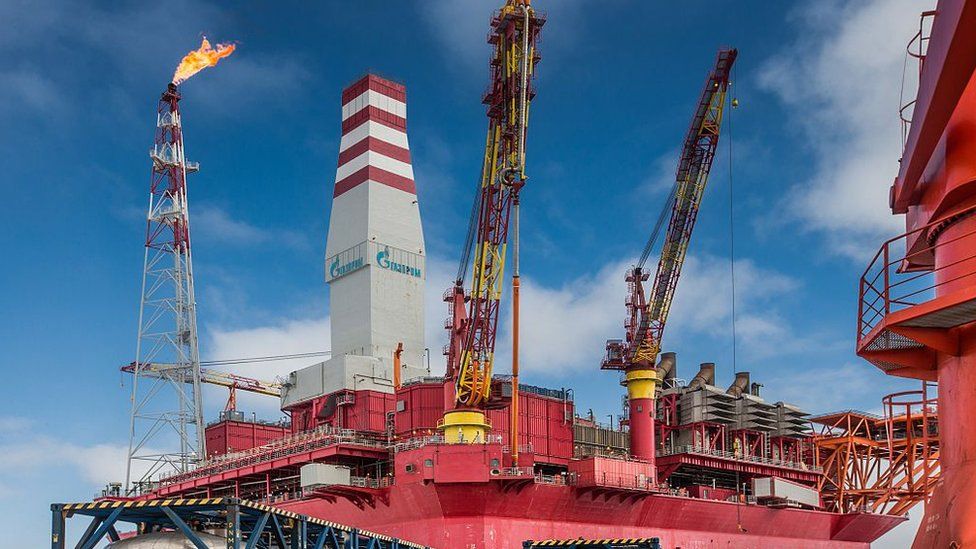
    oil-producing platform is seen at Pechora Sea, Russia
    Image source, Anadolu / Getty Image caption, Energy prices are soaring because of Russia’s invasion of Ukraine and set to remain high into 2024
     

    Similarly oil prices are expected to remain elevated into 2024 with a barrel of the benchmark measure, Brent Crude, projected to average $100 this year, something which will lead to widespread inflation.

    Russia produces about 11% of the world’s oil, the third biggest share, but the report said “disruptions resulting from the war are expected to having a lasting negative effect” as sanctions mean that foreign companies leave and access to technology is reduced.

    Russia currently provides 40% of the EU’s gas and 27% of its oil, but European governments are moving to wean their countries off of supplies from Russia . That has helped push up global prices by creating more demand for supplies from elsewhere.

    Wheat set for record highs

    The World Bank commodity outlook also warned many foods are set to see steep rises in their costs. The UN food prices index already shows they are at their highest since records began 60 years ago.

    Wheat is forecast to increase 42.7% and reach new record highs in dollar terms. Other notable increases will be 33.3% for barley, 20% for soybeans and 29.8% for oils and 41.8% for chicken. These increases reflect the fact that exports from Ukraine and Russia have fallen drastically.

    Before the war the two countries accounted for 28.9% of global wheat exports according to JP Morgan, and 60% of global sunflower supplies – a key ingredient in many processed foods – according to S&P Global.

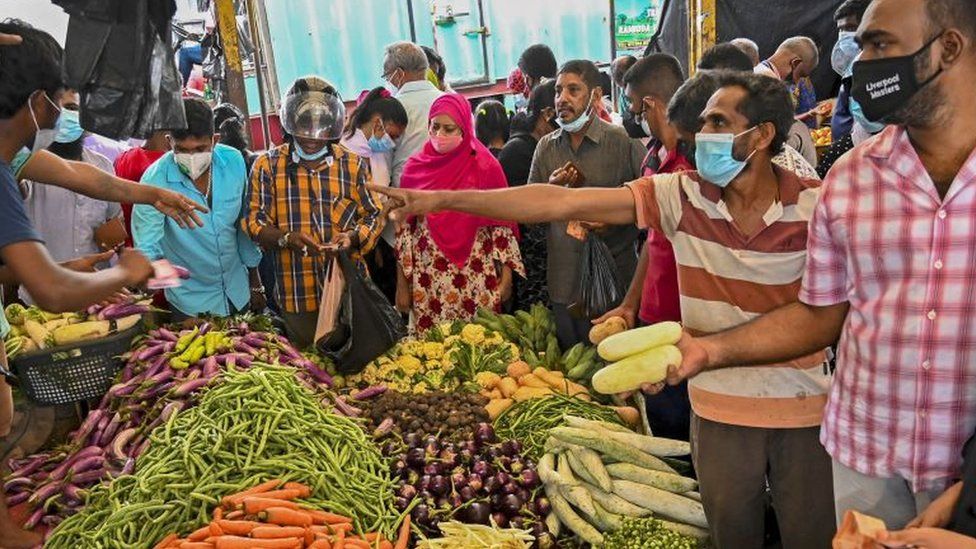
    food market in Colombo
    Image source, AFP Image caption, The rising cost of food has contributed to protests against the government in Sri Lanka
     

    Prices for other raw materials including fertilisers, metals and minerals are also predicted to go up. The costs of timber, tea and rice are amongst the few expected to fall.

    “Wheat is one of the hardest agriculture exports to replace,” according to a research note from the Bank of America. It points out that poor weather conditions in North America and China are likely to exacerbate the impact of Ukrainian supplies being reduced, something which will continue because the war has disrupted the spring planting season.

    The note also suggests grain and oilseed shipments from Ukraine have fallen more than 80% because of the fighting and these lost exports, over the course of a year, “equate to about 10 days of world food supply”.

    The chief executive of Archer Daniels Midland, one of the world’s four big food commodity traders, said he does not expect prices to come down soon.

    As the US firm announced a 53% increase in net earnings for the first three month of this year, to $1.05bn, Juan Luciano said: “We expect reduced crop supplies – caused by the weak Canadian canola crop, the short South American crops, and now the disruptions in the Black Sea region – to drive continued tightness in global grain markets for the next few years”.

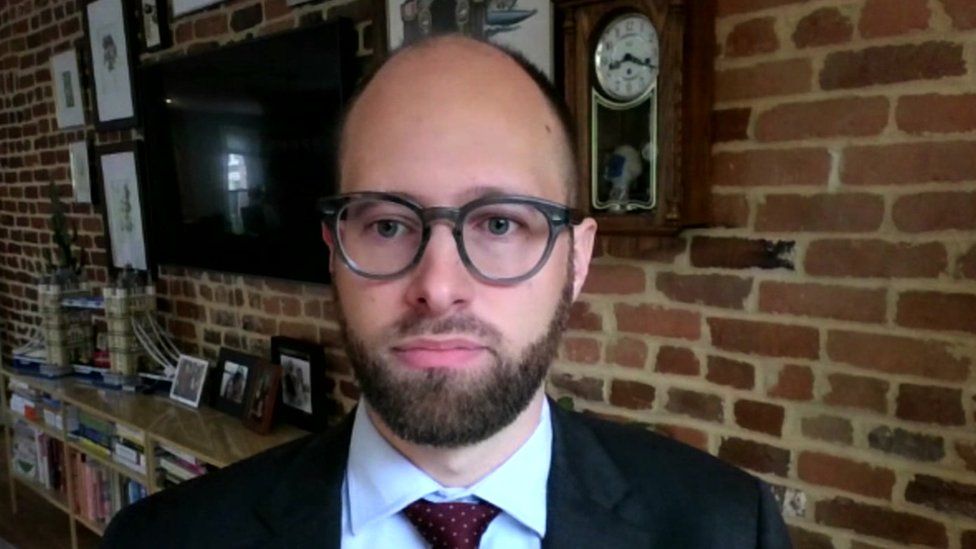
    Peter Nagle
    Image caption, The World Bank’s Peter Nagle says rising food prices are having “very large economic and humanitarian effects”

    Mr Nagle, from the World Bank, said other countries can help solve the supply shortage caused by Ukraine’s war in the medium term. However a forecast 69% increase in fertiliser prices this year means “there’s a real risk that as farmers start to use fewer fertilisers, agricultural yields will decline”.

    For commodities overall, the World Bank report said: “While prices generally are expected to peak in 2022, they are to remain much higher than previously forecast.”

    It added that “the outlook for commodity markets depends heavily on the duration of the war in Ukraine” and the disruption it causes to supply chains.

  • Gazprom halts gas supply to Poland and Bulgaria as Russia accused of blackmail

    Poland and Bulgaria have accused Moscow of “blackmail” after the Russian energy giant Gazprom said it had cut off gas exports to the countries.

    Poland’s deputy foreign minister, Marcin Przydacz, told the BBC that Russia was seeking to “foster divisions” between Western allies.

    EU Commission President Ursula von der Leyen said the move showed Russia’s “unreliability” as an energy supplier.

    It follows Poland and Bulgaria’s refusal to pay for gas in roubles.

    Last month, Russian President Vladimir Putin decreed that all energy payments must be made in the Russian currency.

    The move, which was designed to shore up the faltering currency which has been battered by Western sanctions, has been fiercely resisted by European nations.

    In a statement issued on Wednesday, Gazprom said it had “completely suspended gas supplies” to Poland and Bulgaria in line with the decree issued by Mr Putin.

    The company also warned the countries – which are transit states for Russian gas – that any unauthorised withdrawal of gas intended for other European nations would see supplies reduced by an equivalent amount.

    Polish state gas company PGNiG confirmed that Gazprom’s supplies to the country had been halted and warned that it reserved “the right to seek compensation” and would use “all available contractual and legal means to do so”.

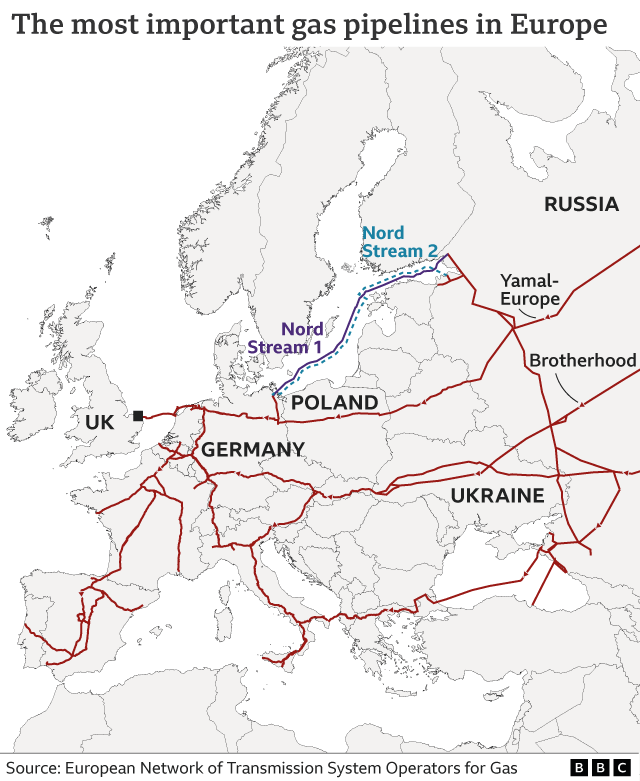
    A map of gas pipelines across Europe

    PGNiG bought 53% of its gas imports from Gazprom in the first quarter of this year, but Warsaw has said it can get gas from other sources. It described the suspension as a breach of contract, adding that the company would take steps to reinstate the gas supply.

    Bulgarian Prime Minister Kiril Petkov said the country was reviewing all of its contracts with Gazprom, including for transit of Russian gas to Serbia and Hungary, emphasising that “one-sided blackmail was not acceptable”.

    Bulgarian Energy Minister Alexander Nikolov said Russia was using gas as a “political and economic weapon in the current war”.

    Sofia, which relies on Gazprom for more than 90% of its gas supply, said overnight it had taken steps to find alternative sources but no restrictions on gas consumption were currently required.

    A host of Western leaders condemned Gazprom’s move on Wednesday morning.

    UK Deputy Prime Minister Dominic Raab told Sky News the decision to cut off gas supplies would have “a very damaging effect on Russia”.

    He added that the decision would further isolate Russia and lead to it becoming “an economic pariah”.

    In a statement, EU Commission President Ursula von der Leyen said Gazprom’s move was “unjustified and unacceptable”, and argued that the decision showed “once again the unreliability of Russia as a gas supplier”.

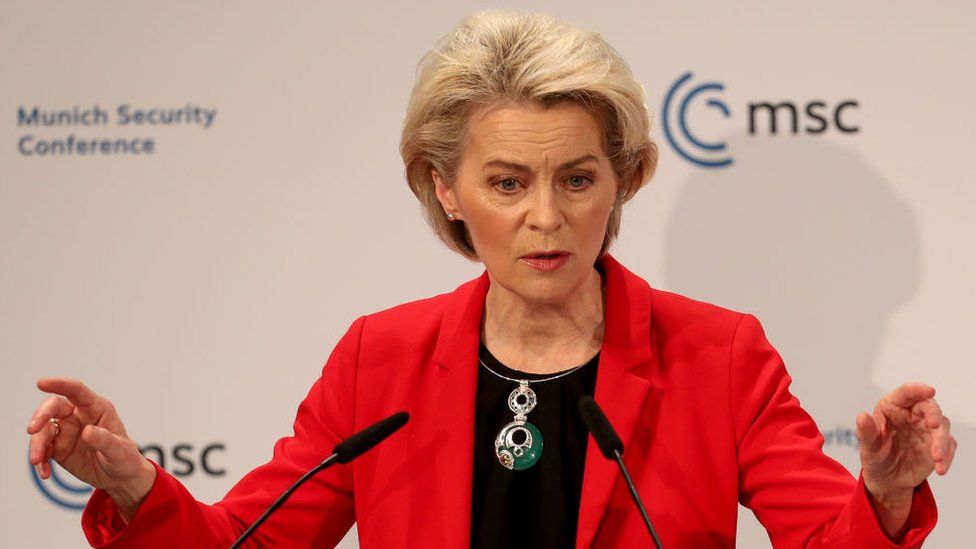
    EU Commission President Ursula von der Leyen
    Image source, Getty Images Image caption, Ursula von der Leyen said the EU will support member states impacted by the gas freeze

    She added that the bloc was “prepared for this scenario” and that European leaders have been working to “ensure alternative deliveries and the best possible storage levels across the EU”.

    Ahead of Gazprom’s move, Ukrainian President Volodymyr Zelensky’s chief of staff accused Russia of “beginning the gas blackmail of Europe”.

    Andriy Yermak said that Moscow was seeking to use energy resources as a “weapon” and called on the EU to “impose an embargo on energy resources, depriving the Russians of their energy weapons”.

    But Vyacheslav Volodin, speaker of the Duma – the lower house of Russia’s parliament – praised Gazprom’s move and urged it to take similar action against other “unfriendly” countries.

    Warsaw said it had “taken some decisions many years ago to prepare for such a situation” and PGNiG said its underground gas storage was almost 80% full and, with summer approaching, demand was lower.

    Europe depends on Russia for more than a third of its gas needs and Gazprom holds a monopoly on pipeline supplies in Russia.

    While the EU has been firm that it will not comply with Mr Putin’s demands that payments be made in roubles, several European nations, including Slovakia and Hungary have reached workaround deals with Gazprom.

    The countries will pay into a euro-denominated account with Gazprombank, a subsidiary of the energy giant, which in turn will deposit the amount in roubles.

  • Ghana abstains from vote to suspend Russia from the UN Human Rights Council

    Ghana abstained from a vote that would have seen the suspension of Vladimir Putin’s Russia from the U.N. Human Rights Council.

    The United Nations (UN) General Assembly voted on Thursday, April 7, to suspend Russia from the U.N. Human Rights Council over reports of “gross and systematic violations and abuses of human rights” in Ukraine.

    The resolution which took place on Thursday, April 7, 2022, received a two-thirds majority of members voting, minus abstentions, in the 193-member Assembly, with 93 nations voting in favour and 24 against.

    Fifty-eight abstained from the process.

    Russia, China, Cuba, North Korea, Iran, Syria, and Vietnam, were among those who voted against.

    Those abstaining, included India, Brazil, South Africa, Mexico, Egypt, Saudi Arabia, United Arab Emirates, Jordan, Qatar, Kuwait, Iraq, Pakistan, Singapore, Thailand, Malaysia, Indonesia and Cambodia.

    The meeting marked the resumption of a special emergency session on the war in Ukraine and followed reports of violations committed by Russian forces.

    Following the outcome of the resolution, Moscow, according to a Reuters news report sighted by GhanaWeb, has announced it was quitting the body.

    Speaking after the vote, Russia’s deputy U.N. Ambassador Gennady Kuzmin described the move as an “illegitimate and politically motivated step” and then announced that Russia had decided to quit the Human Rights Council altogether.

    “You do not submit your resignation after you are fired,” Ukraine’s U.N. Ambassador Sergiy Kyslytsya told reporters.

    Russia was in its second year of a three-year term. Under the resolution on Thursday, the General Assembly could have later agreed to end the suspension. But that cannot happen because Russia has quit the council, just as the United States did in 2018 over what it called chronic bias against Israel and a lack of reform.

    The General Assembly text on Thursday expresses “grave concern at the ongoing human rights and humanitarian crisis in Ukraine,” particularly at reports of rights abuses by Russia.

    Russia says it is carrying out a “special military operation” that aims to destroy Ukraine’s military infrastructure and denies attacking civilians. Ukraine and allies say Moscow invaded without provocation.

    Source: www.ghanaweb.com

  • Ukrainian peacekeepers to return home to join war

    Ukraine has asked its peacekeepers to return home and join the ongoing war against Russia.

    “The President urges Ukrainian soldiers to withdraw from peacekeeping operations together with the equipment to strengthen the Ukrainian army standing against Russian aggression,” wrote Verkhovna Rada of Ukraine, the Ukrainian parliament. 

    The UN, which has been notified of Ukraine’s request, has responded positively, according to several sources. 

    250 peacekeepers are set to withdraw from Monusco, the UN mission for the stabilisation of the DRC, which is the largest Ukrainian contingent in the peacekeeping missions.

    The withdrawal will also include the helicopters and equipment used in the UN peacekeeping mission in the Democratic Republic of Congo.

    According to the UN, Ukraine also has a military presence in other peace missions around the world, including 16 troops in South Sudan, 12 in Mali, 5 in Cyprus, 4 in Abyei in Sudan, and 3 in Kosovo.

    Source: theeastafrican.co.ke

  • Coach leaves Ghanaian team to join Ukraine soldiers to fight against Russia

    Four Ghanaian footballers in Moldova are recovering from trauma after their much-loved coach Yuriy Vernydub quit giant club Sheriff Tiraspol to join his country Ukraine as a soldier to fight Russian forces in the ongoing war, Ghanasoccernet.com can exclusively reveal.

    The Ghanaian quartet at the club are goalkeeper Razak Abalora, defender Patrick Kpozo, midfielder Edmund Addo and striker Khalid Basit who were stunned when the coach announced his decision to leave the club to join the frontlines of the Ukrainian army in their war against their bigger neighbours.

    All four Ghanaian players have a close relationship with coach Vernydub who personally supervised their signing by the club and his decision to leave the club to fight left his African players emotional.

    Fearing the uncertainty of war and the potential that their coach could lose his life or could be maimed left Abalora, Kpozo, Addo and Basit praying and wishing their coach a safe return from the deadly battle field.

    Sheriff Tiraspol’s manager of the Moldovan side, Yuriy Vernydub, has cut a father figure at the club where he has made history by bringing down big teams in the UEFA Champions League.

    He stunned his players when he left his managerial position at the club to return to his native Ukraine amid the Russian invasion and has even sent pictures to the players about the progress as a soldier.

    The coach chose to join the Ukrainian territorial army and help in the war against Russia, as citizens are encouraged to help defend the country.

    Veryndub was recently seen in a picture wearing army camouflage while helping them fight the Russian army.

    Yuriy helped Sheriff write an incredible Champions League story earlier this season when they defeated Real Madrid at the Santiago Bernabéu.

    Now, months after that part of the story, Vernydub aims to help Ukraine emerge victorious from this war.

    Source: ghanasoccernet.com

  • Russia-Ukraine conflict: Ablakwa meets Ghanaian students in Romania

    Samuel Okudzeto Ablakwa, Ranking Member on the Foreign Affairs Committee of Parliament, is currently in Bucharest, Romania to visit Ghanaian students who escaped from the Russia-Ukraine conflict.

    According to him, the visit will allow him to closely assess the conditions of the students and understand better their unique perspective of how Ghana can be more helpful to them.

    Sharing pictures with the students on his Facebook timeline on Wednesday evening, Ablakwa wrote:

    “This morning I arrived in Bucharest, Romania which shares a southern border with Ukraine to visit our Ghanaian students who escaped from the conflict in Ukraine.

    “The visit affords me the opportunity to closely assess their conditions and to better understand from their unique perspective how our nation can be more helpful to them as I engage them directly.”

    The North Tongu MP explained further, “I do this not merely because it is a constitutional imperative of oversight imposed on parliamentarians; there is a higher obligation of our common humanity and nationhood.

    “Romania now hosts the largest number of Ghanaian students — an estimated 200, expected to be evacuated to Ghana,” he said. “I have been greatly inspired by the amazing stories of survival and resilience as narrated by our heroic compatriots.”

    He lauded Ahmed Tijani Abubakr of Ghana’s diplomatic mission in Prague “for his impressive consular services which have been praised by the students.”

    The NDC MP continued: “the Romanians have been awesome with their exceptional kindness. Our nation owes them a debt of gratitude.

    “It gave me great pleasure to host our courageous compatriots to lunch, convey messages of hope for a brighter future, and to make a modest donation into the NUGS-Ukraine welfare account.

    “I assured our much-cherished compatriots that the entire nation led by the government is with them in prayers and solidarity. Evacuations shall continue and we would also never forget their colleagues who remain trapped in Ukraine, particularly those in the city of Sumy.

    “Together, as one nation with a common humanity, we shall ensure the complete protection and rehabilitation of our beloved citizens,” Samuel Okudzeto Ablakwa’s post concluded.

    Source: www.ghanaweb.com

  • ‘Save cancer children in Ukraine’- Ghanaian child cancer survivor appeals

    A nine-year-old Ghanaian child cancer survivor, Brenna Fosua Addai, has appealed to the international organisations and donors, to go to the aid of cancer children in Ukraine.

    According to her, because of the war in Ukraine there could be shortage of cancer drugs in the country.

    This is because there had been cancellation of international flights to the country and medical supplies could not made to the country.

    Reports from international media indicates that, children suffering from cancer have had their treatments interrupted after Russia invaded Ukraine.

    The report states that, doctors fear a lack of treatment would mean the children would get sicker or even die if they were not evacuated.

    In a solidarity message to the two countries and world leaders, she called for cease fire and negotiation to end the conflict in Ukraine and bring peace in the region.

    “They’re vulnerable and this is not the fault of theirs. I plead with world leaders to have mercy on them so that they could have their treatment to save their lives,” she stated.

    Little Breana who has been advocating for childhood cancers and hoped to become an ambassador for children with cancer also called on the President, Nana Addo Dankwa Akufo-Addo to intervene by using his international reputation to influence Putin to end the war in Ukraine.

    “I know the president is a listening father and will hear our cry, I plead with him and his wife to intervene to ensure these kids survive,” she added.

    Source: ghanaweb.com

  • Apple pauses sales in Russia

    We’ve news of more action being taken by Apple. The tech giant has paused sales of its products in Russia, the company has announced.

    The company has also limited its payments system, Apple Pay, and other services including live-traffic tracking, according to the Reuters news agency.

    The BBC’s Ukrainian service reports that consumers in Russia attempting to buy an iPhone, watch or MacBook on the company’s website are greeted with a message saying that delivery of the goods is impossible.

    The move by Apple comes after Ukrainian Vice Prime Minister Mykhailo Fedorov disclosed earlier this week that he had sent a letter to the company’s chairman Tim Cook asking that Apple be blocked from Russia.

    Source: bbc.com

  • How to deal with news of the war

    If you woke up this morning, looked at the news, and felt increasingly worried about the war in Ukraine, you are not alone. After a two-year pandemic, it’s a lot to absorb, and experts agree that feeling overwhelmed is normal.

    While it’s right to think first and foremost about the impact on those caught up in the conflict, it’s also completely normal to feel upset from afar by what we’re seeing in Ukraine, says Alex Bushill, from the mental health charity Mind.

    “It’s very natural to be distressed by what we’re seeing, you wouldn’t be human if you didn’t,” he says.

    This doesn’t always lead to anxiety, but the NHS and Anxiety UK agree on some key ways to avoid it: eat well, get outside, put your phone down, connect with people, rest. 

    These are all pretty basic pieces of advice, but when you’re stressed, they can be difficult to do consistently.

    Source: bbc.com

  • World Bank prepares $3bn in aid for Ukraine

    The World Bank Group and International Monetary Fund are preparing financing support for Ukraine.

    In a joint statement, leaders of the two agencies said they were worried by the potential spillover effects of the Russian invasion.

    They cited rising commodity prices, disruptions in financial markets and the risk of further fuelling global inflation.

    The World Bank said it would pledge $3bn (£2.3bn) in the coming months, including at least $350m in the next week.

    The IMF meanwhile said it will swiftly consider Ukraine’s request for emergency financing. It also hopes to make $2.2bn in funding available up to June.

    Source: bbc.com

  • Russia envoy says Kyiv has ‘no desire’ to compromise

    Moscow has seen “no desire on the part of Ukraine” to reach a legitimate and balanced solution to the problems between the two countries, says a Russian diplomat. 

    Gennady Gatilov, Russia’s ambassador to the United Nations in Geneva, made these comments in an interview with a Lebanese TV station that aired on Tuesday.

    Russia “supports diplomacy based on respect for the positions of all countries and equality, but for now we don’t see that”, he said, according to Russian news agency RIA.

    Russia and Ukraine held peace talks on Monday, but no agreements were reached other than a commitment to meet again at an unspecified date.

    Source: bbc.com

  • Russian aircraft to be banned from US airspace

    The BBC’s US partner CBS News reports that the US will soon close its airspace to Russian aircraft.

    European nations and Canada have already shut their own airspace to air traffic from Russia.

    An order that bars Russian owned and operated aircraft from the US is expected within the next 24 hours.

    Some flights from Russia to the US have already been cancelled.

    Source: bbc.com

  • Ghana is first African country to safely evacuate its nationals from Ukraine Government

    Deputy Minister of Foreign Affairs and Regional Integration, Kwaku AmpratwumSarpong, has revealed that Ghana is first African country to evacuate its citizens from Ukraine following the conflict with Russia.

    This makes the government of President Akufo-Addo the first among all African governments in the effort to rescue their nationals, he stressed.

    Mr Ampratwum-Sarpong said this when he welcomed the first batch of Ghanaian nationals who arrived from Ukraine at the Kotoka International Airport (KIA) on Tuesday, March 1.

    He said “The Government is determined to continue to make sure that your colleagues who are still in transit to be evacuated will eventually be evacuated. There is one important thing that we need to know, information coming in indicates that Ghana is the first African country to have been able to evacuate some of their compatriots and some of their students from Ukraine. So at least, if not for anything at all, the government of Nana Akufo-Addo has scored first,” he said

    He added “My fellow compatriots, on behalf of the President, His Excellency Nana Addo Dankwa Akufo-Addo and the Government and People of Ghana, I heartily welcome you all back home. We thank the Almighty God for keeping you safe and for granting you traveling mercies.

    “My dear students, we are proud of you for the bravery and perseverance you exhibited in the face of the dire situation you found yourselves in. You have had to halt your studies and other activities in order to escape the conflict between Russia and Ukraine. Some of your colleagues are yet to be evacuated from Ukraine. Let me assure you that the Government of Ghana will continue to work to ensure their safety and return to Ghana. Government will also continue to work with its International Partners to ensure that and urge for dialogue between Russia and Ukraine for a peaceful and quick resolution of this conflict.

    “I would like to commend your various Student leaders for cooperating with Government to ensure a smooth and successful evacuation exercise thus far.

    “You are the first batch of Ghanaians to have arrived from Ukraine. As at 28th February 2022, 527 Ghanaians had crossed the Ukrainian border into neighbouring countries of Poland, Romania, the Czech Republic, Moldova, Hungary and Slovakia. In the coming days, we are expecting more of your colleagues to be evacuated from these countries. We are working with the International Organisation for Migration (IOM) Organization and we are confident that this will enhance the success of the evacuation exercise.

    “The Hon. Minister for Foreign Affairs and Regional integration is scheduled to meet parents and guardians of affected students later this morning to discuss issues concerning the evacuation and return of their loved ones.

    “I wish to reiterate that Government has put in place the necessary package to facilitate the transportation, accommodation, feeding, medical support, etc to ease any burden on our compatriots who are still waiting to be evacuated and we urge all of them to take advantage of this exercise to come home. On this note, I will like to welcome you once again. Enjoy your time with your families.”

    Source: 3news.com

  • Ukraine crisis: Biden threatens to punish Putin over invasion

    US President Joe Biden has told Congress that Vladimir Putin badly misjudged how the West would hit back once he invaded Ukraine.

    In a primetime speech, Mr Biden vowed “an unwavering resolve that freedom will always triumph over tyranny”.

    Democrats and Republicans reacted to Mr Biden’s appeal to show support for Ukraine by rising in unison to applaud.

    His State of the Union address came as pandemic-weary Americans grapple with galloping inflation.

    In an hour-long address to lawmakers on Tuesday night, the Democratic president said: “Putin’s war was premeditated and unprovoked. He rejected repeated efforts at diplomacy. 

    “He thought the West and Nato wouldn’t respond. And he thought he could divide us here at home.”

    Mr Biden – whose chaotic withdrawal last year from Afghanistan damaged his popularity among Americans – added: “Putin was wrong. We were ready.”

    He announced that the US would ban Russian aircraft from American airspace, following similar bans by Canadian and European authorities.

    The US and it allies have launched a barrage of sanctions against Russia’s economy and financial system and Mr Putin himself. In his speech Mr Biden deviated from his prepared remarks by vowing further economic retaliation, warning Mr Putin: “He has no idea what’s coming.”

    The US president also welcomed Ukrainian Ambassador Oksana Markarova, who received a standing ovation as she sat in US First Lady Jill Biden’s VIP box.

    More coverage of Ukraine crisis

    Hours before his address, Mr Biden spoke to Ukrainian President Volodymyr Zelensky to discuss what help the US could give his country after six days of the Russian assault.

    “Let each of us… stand and send an unmistakable signal to Ukraine and to the world,” Mr Biden told his audience in the chamber of the House of Representatives.

    It was one of the few moments in the speech where members of both deeply polarised parties rose together to clap and cheer for Ukraine, many of them waving Ukrainian flags that had been passed out before the president arrived.

    Mr Biden’s first formal State of the Union speech, an annual event pushing a president’s agenda, came as his approval rating languishes.

    Just 40.6% of Americans are happy with his job performance, according to the RealClearPolitics polling average. 

    After addressing his biggest foreign policy crisis, the invasion of Ukraine, Mr Biden confronted a host of domestic troubles dogging his presidency, from the enduring pandemic, to soaring consumer prices, to a wave of violent crime.

    Republicans wearing Ukraine colours
    Ukraine flags and badges were in evidence

    Although the US jobless rate has sunk to 4%, inflation has hit a 40-year high.

    The president sought on Tuesday night to empathise with hard-pressed working families, saying: “I get it.”

    He promised a plan for “building a better America”.

    Mr Biden argued the best way to counter rocketing consumer prices was to boost domestic production of cars and semiconductors and rebuild the nation’s roads and bridges.

    Opinion polls show Americans are also unhappy with Mr Biden’s handling of the coronavirus pandemic.

    But on Tuesday, members of Congress who attended the speech were not required to wear masks for the first time in months.

    Mr Biden said: “Last year Covid-19 kept us apart. This year we are finally together again.” 

    More than 2,000 Americans are still dying daily of Covid, according to the latest figures, the highest official tally of any country in the world.

    With the nation’s homicide rate having hit a 25-year high, Mr Biden rejected calls to defund the police that were taken up by a wide spectrum of his fellow Democrats.

    “The answer is not to defund the police,” said the president. “The answer is to fund them.”

    Iowa Governor Kim Reynolds delivered the Republican response to Mr Biden’s speech.

    She sought to portray a presidency that had sent America back to the late ’70s “when runaway inflation was hammering families, a violent crime wave was crashing on our cities, and the Soviet army was trying to redraw the world map”.

    Source: bbc.com

  • Ukraine conflict: How Russia forged closer ties with Africa

    Russia has been expanding its influence in Africa in recent years and after the invasion of Ukraine, it will be expecting its new-found allies to provide support, or at least remain neutral, in international bodies such as the UN.

    From Libya to Mali, Sudan, the Central African Republic (CAR), Mozambique and elsewhere, Russia has been getting more involved – often militarily with help fighting rebels or jihadist militants.

    At the UN Security Council, Kenya, currently a non-permanent member, made its opposition to Russian action in Ukraine very clear.

    But there has not yet been a loud chorus from other countries backing Kenya’s position. The continental body, the African Union, expressed “extreme concern” about what was going on, but was muted in its criticism of Russia.

    South Africa, which is a partner of Russia in the Brics group, has called on the country to withdraw its forces from Ukraine but said it still held out hope for a negotiated solution.

    On the other hand, CAR President Faustin-Archange Touadéra has been reported as backing Russia’s decision to recognise the Ukrainian regions of Donetsk and Luhansk as independent states.

    And on Wednesday the deputy leader of the Sudanese junta, Mohamed Hamdan “Hemeti” Dagolo, led a delegation to Moscow in a sign of closer ties between the two countries.

    A statue of soldiers
    A monument to the Russian military has been put up in the capital of the Central African Republic

    One of the clearest examples of how alliances have been shifting in Africa came just a week before Russia’s attack on Ukraine with the ending of French involvement in fighting jihadists in Mali.

    Mali’s Prime Minister Choguel Maiga confirmed, in an interview with France24, that his country has signed military co-operation agreements with Russia. But he denied that the controversial Russian private military company, the Wagner Group, was involved.

    This Russian help in Mali, along with a reported offer to the military government in Burkina Faso, fits a pattern over the past five years where Russia has intensified steps to increase its influence in Africa, both official and informal.

    As the renewed Russia-Africa engagement gained momentum, a 2019 summit in the southern Russian city of Sochi was attended by delegates from more than 50 African countries, including 43 heads of state. 

    President Vladimir Putin addressed the leaders, appealing to a history of backing liberation movements and pledging to boost trade and investment.

    Vladimir Putin among African heads of state
    The 2019 Sochi summit drew almost all of Africa’s heads of state

    But there has also been another kind of presence: the opaque provision of security to governments in a number of African countries, in the form of training, intelligence and equipment, as well as involvement of Russian mercenaries in local conflicts.

    As Mr Putin indicated, there are historic ties stretching back to the days of the USSR, Russia’s predecessor, when Africa was one of several spheres of competition between it and the US.

    But from the collapse of the USSR in 1991 to the early part of the last decade, as Russia went through a period of transition, relations with Africa were not top of the agenda. 

    Then, regaining superpower status became a foreign policy priority for the Russian president. 

    New export markets

    In 2014, following Russia’s annexation of the Ukrainian peninsula of Crimea and the international sanctions which followed, there came a sharp deterioration in relations with the US and the European Union. 

    Faced with the threat of international isolation, Moscow started the search for new allies.

    “As a result of sanctions, Russia needed to look for new markets for its exports,” said Irina Abramova, director of the Africa Institute at the Russian National Academy of Sciences.

    But it was more than markets that Russia was after – it also wanted increased global influence. 

    In 2014 it got involved in Syria’s civil war, backing President Bashar al-Assad in part to highlight the mess the West was making and show how Russia could fix it. 

    From Syria it later moved on to the African continent.

    Irina Filatova, an honorary professor of the University of KwaZulu-Natal in South Africa, says Russia’s key task in Africa was to discredit Western influence, in much the same way as in Syria.

    It wanted to show that the Europeans, for example, had failed to contain the jihadist threat in the Sahel.

    It did this through a dual policy in Africa, combining official military instructors working in some countries, and informal agencies, such as the Wagner Group, fighting in a number of others. 

    Mercenaries

    The CAR was the first African country where Russian mercenaries from the Wagner Group appeared in 2017. 

    Later they were followed by an official contingent of Russian military consultants. Their aim was to help President Touadéra stay in control.

    Allegations of atrocities carried out by the mercenaries have become common, but Russia has consistently denied that any of its citizens were involved in war crimes or violence against civilians.

    Russian mercenaries have also been active in Libya, Sudan, Mozambique and Mali, with varied levels of success.

    In another sign of the growing significance of the continent, Africa has become a key market for Russia’s arms industry. Almost half of all the arms coming into Africa come from Russia, according to the country’s state arms export agency.

    The main importers are Algeria and Egypt, but there have been new markets in Nigeria, Tanzania and Cameroon.

    UN votes

    But there is also a prize for closer ties on the diplomatic front. 

    Africa, in total, has more than a quarter of the votes at the UN General Assembly, and can be a powerful collective voice in other international bodies.

    A 2021 report on perspectives of Africa-Russia co-operation, published by Moscow’s Higher School of Economics, pointed out that African countries have tended to be neutral when it comes to Russia’s actions in the past. 

    “None of the African countries introduced any sanctions against Russia [after 2014]. In the voting in the UN on Ukraine-related issues, most countries of the continent express a neutral position,” the report said.

    With the invasion of Ukraine, if that neutral stance continues, or if it is translated into more vocal support, then Russia’s efforts over the past few years could be seen to have paid off.

    Map outlining ties between Africa and Russia

    Source: bbc.com

  • AU condemns reports of ill-treatment of Africans trying to flee Ukraine

    The African Union has condemned disturbing reports of ill-treatment of African citizens in Ukraine trying to flee the country but are being refused the right to cross borders safely. 

    Thousands of Africans and other foreign nationals, particularly students, have been scrambling to leave Ukraine following Russia’s invasion.

    But as hundreds of thousands throng to Ukraine’s various land borders, overwhelming authorities in neighbouring countries, reports have emerged that Africans are being treated differently and sometimes prevented from leaving.

    Several people have shared videos and testimonies on social media, denouncing discrimination at train stations and border posts.

    “Reports that Africans are singled out for unacceptable dissimilar treatment would be shockingly racist and in breach international law,” AU Chair, Senegal’s President Macky Sall, and Moussa Faki Mahamat, head of AU Commission said in a joint statement.

    The statement added that all people have the right to cross international borders during conflict, and should enjoy the same rights to cross to safety from the conflict in Ukraine, notwithstanding their nationality or racial identity.

    “The Chairpersons commend the efforts by African Union Member State countries and their embassies in neighbouring countries to receive and orientate African citizens and their families trying to cross the border from Ukraine to safety,” the statement concluded. 

    Find below the full statement:

    Source: www.ghanaweb.com

  • Ukraine conflict: Russia bombs Kharkiv’s Freedom Square and opera house

    Russian missiles and rockets have hit the the cultural heart of Ukraine’s second city in what officials said was a deadly and “barbaric” attack.

    An opera house, concert hall and government offices were hit in Freedom Square, in the centre of the north-eastern city, Kharkiv.

    At least 20 people, including a child were injured, but authorities are still trying to clarify if anyone was killed.

    The attack came as Ukraine’s president said Russia was committing war crimes.

    “Russian forces have today cruelly targeted Kharkiv with artillery fire,” Mr Zelensky said. “This is a peaceful place, peaceful suburbs… The Russians knew where they were shooting…,” he said.

    Video footage showed a missile hitting the local government building and exploding, causing a massive fireball.

    Kharkiv has been bombed heavily for days now. Ukraine’s government accuses Russia of trying to lay siege to Kharkiv and other cities, including the capital Kyiv, where a huge Russian armoured convoy is approaching.

    Ukraine’s Foreign Minister Dmytro Kuleba said the world must do more to punish Russia for the “barbaric” attack on Freedom Square and residential neighbourhoods, accusing the Russian President Vladimir Putin of committing “more war crimes out of fury, murders innocent civilians”.

    The sixth day of Russia’s invasion of Ukraine has seen continued attacks on several fronts, but the Russian advance has reportedly been slowed by Ukrainian resistance.

    People in the southern city of Kherson say it is now surrounded, and the mayor of Mariupol, a port city also in the south of Ukraine said it had been fired upon overnight.

    Meanwhile new satellite images showed a 40-mile (64km) long Russian military convoy snaking its way toward the capital, Kyiv, where air raid sirens were again ringing out on Tuesday morning.

    The convoy – which has appeared to slow in the last 24 hours – includes armoured vehicles, tanks, artillery and logistical vehicles, and is said to be less than 18 miles (30km) from Kyiv.

    Kherson surrounded

    The mayor of Kherson said Russian forces had set up checkpoints surrounding the city, which has a population of some 300,000 people, and is located in the south, near to Moscow-controlled Crimea.

    But Mayor Igor Kolykhayev said defiantly on Facebook that the city “has been and will stay Ukrainian”.

    A journalist in the city, Alena Panina told broadcaster Ukraine 24 that “the city is actually surrounded, there are a lot of Russian soldiers and military equipment on all sides, they set up checkpoints at the exits.”

    There was still electricity, water, and heating in Kherson but said it was getting difficult to bring food into the city because it is stored in warehouses on Kherson’s outskirts, she added.

    Mariupol

    Also in the south, there were strong words from the mayor of the strategically located port city of Mariupol, who said the city had been under constant shelling.

    “Russian Nazis seek the genocide of the Ukrainian nation,” Vadym Boychenko told Ukrainian 24 News. “We will fight until the last bullet… If they run out, we will use our teeth against the enemy that is moving towards Mariupol.”

    Russian-backed separatist leader, Denis Pushilin, has said his forces will aim to encircle Mariupol on Tuesday, the Russian state-owned RIA Novosti news agency reported.

    Investigation into war crimes

    Claims that Russia is committing war crimes are mounting, with Ukraine’s president, local government officials, and Amnesty International saying the attacks on residential districts need to be investigated.

    “A state that commits war crimes against civilians can’t be a member of the UN Security Council,” Mr Zelensky said, referring to the end of Russia’s month-long term as the UN Security Council’s president.

    Russia has previously denied targeting residential areas, but the International Criminal Court (ICC) – which examines war crimes – is looking to open an investigation.

    Chief prosecutor Karim Khan still needs the approval of ICC judges to begin work, but for now has asked his team to start collecting evidence of abuses, such as attacks on civilians.

    Mr Khan said his investigation would look into alleged crimes arising from the fighting, as well as violations dating back to the initial Russian invasion in 2014. However any Russian nationals accused of committing war crimes, crimes against humanity or genocide in Ukraine, would have to be extradited by the Kremlin before standing trial in The Hague.

    More than half a million people across Ukraine have fled their homes to escape the fighting, according to the United Nations, and more than 130 civilians have been killed in Ukraine since Thursday, including 13 children.

    On Monday, envoys for Russia and Ukraine held talks at the Belarus border on Monday, but they reached no agreements other than a commitment to meet again in the next few days.

    Mr Zelensky has also called for the West to consider a no-fly zone over Ukraine – something Washington has so far ruled out over fears it could draw the US into a direct conflict with Russia.

    Source: bbc.com

  • Ukraine-Russia brouhaha: Ghana to receive 24 students Monday, Feb 28

    The government of Ghana will receive the first batch of twenty-four (24) Ghanaian evacuees from Ukraine later on Monday, February 28, 2022. 

    The Ghanaians, who are fleeing Ukraine at a time when the country is coming under heavy military attacks from Russia, will arrive via Qatar Airways, the Minister of Foreign Affairs and Regional Integration, Shirley Ayorkor Botchwey, has said. 

    According to a graphic.com.gh report, this first batch will be followed by 220 others within the week. 

    It further said that the 24, who are part of about 460 students who have managed to leave Ukraine to neighbouring countries such as Poland, Hungary, Slovenia and Czech Republic, have already arrived in Bucharest, the capital of Romania.

    The minister is also said to have denied reports that students aboard a train that was carrying some Ghanaian students had been attacked while on its way out of beleaguered Ukraine.

    Source: www.ghanaweb.com

  • No Ghanaian casualty recorded in Ukraine Deputy foreign affairs minister

    Deputy Foreign Affairs Minister, Kwaku Ampratwum-Sarpong has disclosed that no Ghanaian casualty has been recorded in the ongoing war between Ukraine and Russia.

    According to him, all Ghanaians in Ukraine were safe and will be evacuated at the opportune time. 

    “Currently all Ghanaians are well, nothing has happened to any Ghanaian… but we do not know what would happen tomorrow. 

    “…most Ghanaians have moved to safety, close to the Ukraine border with Poland. If the opportunity comes we will immediately evacuate all Ghanaians from Ukraine,” he said in Twi during an interview with Neat FM, on February 25, 2022, monitored by GhanaWeb. 

    The deputy minister indicated that the government had not started the evacuation because all the borders of Ukraine are closed and Ukraine was currently a no-flight zone.

    He said he understands the cries of Ghanaians for their relations to be moved out of Ukraine for their safety.

    Ampratwum-Sarpong noted that the government has not neglected its responsibility to Ghanaians in Ukraine.

    “The government is actively monitoring the situation and it is receiving briefings on the condition of Ghanaians on a daily basis. We are making contacts, we are doing whatever we have to do to see what is going on and what the government can do to save the lives of Ghanaians,” he added.

    Meanwhile, the National Union of Ghanaian Students (NUGS) has revealed that some Ghanaian students studying in Ukraine are currently stranded and in distress following the conflict between the country and Russia.

    According to NUGS, some of these students who recently returned to Ghana from Ukraine have reached out to them to detail the situation and to seek that they advocate for the evacuation of these students.

    They are, therefore, urging the government to, as soon as possible, put in measures for the evacuation of all Ghanaian students close to the areas of the conflict between Russia and Ukraine.

    Source: www.ghanaweb.com

  • The Ukraine crisis is a major challenge for China

    Hours before Russian President Vladimir Putin announced a military operation in eastern Ukraine, the US accused Moscow and Beijing of combining to create a “profoundly illiberal” world order. 

    Yet State Department spokesman Ned Price also said that this was an opportunity for China to use its leverage with Russia to pull back Vladimir Putin, given the new “no limits” pact he signed with China’s leader Xi Jinping on the same day as the Winter Olympic opening ceremony.

    “You will have to ask the PRC whether they have used their own considerable influence with the Russian Federation to that end,” Mr Price said at a press briefing. 

    The Ukraine-Russia crisis is posing a major challenge for China on many fronts. 

    The ever-closer diplomatic relationship between Russia and China could be seen at the Winter Games with Mr Putin coming to Beijing as one of only a handful of known world leaders to attend. 

    Significantly, Mr Putin waited until just after the Games were over to recognise the two breakaway regions of Ukraine and send in troops to back them. 

    In its public pronouncements, the Chinese government has urged all sides to de-escalate tensions in Ukraine. 

    More recently, China’s Foreign Minister Wang Yi discussed the situation with US Secretary of State Anthony Blinken, acknowledging that things were “getting worse” and repeating calls for “all parties to exercise restraint”. 

    But now that Russia has dispensed with all such restraint, where does that leave China’s official position as clashes escalate?

    The Chinese government thinks it cannot be seen to support war in Europe but also wants to strengthen military and strategic ties with Moscow. 

    Ukraine’s number one trading partner is China and Beijing would ideally like to maintain good relations with Kyiv but this could be difficult to sustain when it is clearly so closely aligned with the government which is sending its troops into Ukrainian territory. 

    Mariko Oi explains why China is in a delicate position in the Ukraine conflict

    There is also the potential for trade blowback on China from Western Europe if it is judged to be backing Russia’s aggression. 

    Furthermore, a constant refrain from China’s leaders is that it does not interfere in the internal affairs of others and that other countries should not interfere in its internal affairs. 

    But as former US intelligence officer John Culver has posted on Twitter: “Russian annexation of portions of Ukraine, or invasion and seizure of Kiev, violate China’s position that sovereignty is sacrosanct.” 

    Joining the dots

    For the Communist Party, what will worry it most is where that may leave its own people and their world view.

    For this reason, it is manipulating and controlling talk about the Ukraine situation in the press and social media.

    It wasn’t going to be long before Taiwan was dragged into the mix.

    The self-governing island is seen by the Party as essentially a rogue province that must be unified with the mainland. 

    On Weibo, China’s version of Twitter, Chinese nationalists have used Russia’s invasion of Ukraine to call on their own nation to follow suit with comments like: “It’s the best chance to take Taiwan back now!”

    When the Chinese government rejected the imposition of sanctions on Russia in recent days it knew it could face similar treatment if it moves to seize Taiwan by force, in what would be a bloody, costly exercise. 

    Foreign Ministry spokeswoman Hua Chunying told a regular press briefing in Beijing that China has never thought that sanctions were the best way to solve problems. 

    A constant refrain from China’s leaders is that it does not interfere in the internal affairs of others

    But if Chinese citizens start joining the dots with Russia’s justification for invading Ukraine and applying it to their own country, this could upend the Chinese government’s entire explanation for its current borders.

    Vladimir Putin says he’s liberating Russian speakers inside Ukraine. What of the ethnic Mongolians, Koreans, Kyrgyz and the like who are now part of China? More potentially explosive for Beijing, what if Tibetans or Uyghurs renew calls for greater autonomy or even independence?

    That this does not happen is more important to Xi Jinping’s administration than anything. 

    Given that, you only have to look at the remarks on Chinese social media to see the direction the Party’s media is driving the population in terms of the way it should view Mr Putin’s moves in Eastern Europe. 

    The state press has its own accounts on Weibo and controls the responses to its posts about Russia and Ukraine. 

    Here is a flavour of the comments: 

    “I support Russia, oppose US. That’s all I wanna say.” 

    “America always wants to create mess in the world!” 

    While there are also a lot of people calling for peace, posts attacking the US are being heavily promoted. 

    In terms of Chinese people actually questioning Russia’s ambitions in Ukraine, you have to seek out individual Weibo accounts not connected to the Party media threads. 

    One writes: “I don’t understand why so many people support Russia and Putin. Is invasion to be seen as justice? We should oppose any form of war!” 

    According to another: “Putin recognises the independence of Ukraine separatist regions, which is obviously interfering in the domestic affairs of another country.” 

    And there you have it. That last post is expressing precisely the conclusion which Beijing does not want its people coming to.

    It is the essence of the minefield the Chinese government is walking through.

    Inside Ukraine, China’s embassy has sent out a message to Chinese citizens living in the country now locked in a major war.

    It has recommended that people post a Chinese flag on their car and “help one another out” while showing “China’s strength”.

    Asked if what is occurring right now in Ukraine amounts to an invasion, Foreign Ministry spokeswoman Hua Chunying told a press conference that the “historical context is complicated” and that the current situation is “caused by all kinds of factors”.

    There is a major upheaval unfolding in Europe. Xi Jinping has some big choices to make in terms of how his country will deal with it. 

    Source: bbc.com

  • Ukrainian men banned from leaving country

    All Ukrainian men aged between 18 to 60 are now banned from leaving the country, Ukraine’s state border guard service (DPSA) says.

    It adds the measure is aimed at “guaranteeing Ukraine’s defence and the organisation of timely mobilisation”.

    The temporary ban will remain in force for the duration of martial law declared on Thursday morning.

    Source:bbc.com

  • What would Swift sanctions mean for Russia?

    President Joe Biden and German Chancellor Olaf Scholz have both said that cutting Russia off from the global banking system, Swift, is not being proposed right now.

    But what would happen if it was? 

    Excluding Russia from Swift would risk severe repercussions for banks that are owed money – either now or in the longer term.

    This is particularly true in Germany, which has deep financial ties with Russia and feels it has done its share of economic sacrifice by suspending certification of the Nord Stream 2 pipeline. 

    Although being de-Swifted would be disruptive for Russia, there is an alternate system – called CFPS – that Russia set up after it annexed Crimea in 2014. Similarly, China has also set up a secondary system, CIPS. 

    Expelling Russia would probably only push it closer to China and play into the hands of the Xi administration, which is keen to “de-dollarise” the world’s financial architecture. This would accelerate that trend and ambition.

    Source:bbc.com