In March 2022, former President of Ghana, H.E Nana Addo Dankwa Akufo-Addo blamed the country’s stagnant economy on the global pandemic, Covid-19 and the Russia-Ukraine war.
At the 77th UN General Assembly, the former president argued that the Ghanaian economy was at the right timing before the unexpected shocks of COVID-19 and the Russia-Ukraine war.
“As we grappled with these economic challenges, Russia’s invasion of Ukraine burst upon us, aggravating an already difficult situation.It is not just the dismay that we feel at seeing such deliberate devastation of cities and towns in Europe in the year 2022, we are feeling this war directly in our lives in Africa.Every bullet, every bomb, every shell that hits a target in Ukraine, hits our pockets and our economies in Africa. It is not just the dismay that we feel at seeing such deliberate devastation of cities and towns in Europe in the year 2022, we are feeling this war directly in our lives in Africa,” he added.
However, that assertion has been shot down by the World Bank in a recent report released in September, 2025 titled Transforming Ghana in a Generation. The Bretton Woods institution’s report indicated that the global challenges didn’t influence the crisis at the time but rather exposed “ an economy already beset with deep structural vulnerabilities and precarious macroeconomic conditions.”
According to the World Bank, prior to the global shocks, Ghana was already under pressure existing pressures with spending more than it earned and structural inefficiencies. It added that the situation pushed the country into seeking support from the International Monetary Fund (IMF), making Ghana the first African country to run to IMF.
The World Bank has further cautioned Ghana against repeating previous actions and move for a stable economy. “The deterioration of global conditions due to the COVID-19 pandemic and the Russian Federation’s invasion of Ukraine was not the cause of the 2022 macroeconomic crisis”, the policy note mentioned.
Following Akufo-Addo’s assertions, opposition figures like a member of the National Democratic Congress (NDC), Elvis Afriyie-Ankrah pointed to ignored warnings from credit rating agencies and fiscal indiscipline as factors for Ghana’s crisis.
In a recent address, at the 80th United Assembly, President John Dramani Mahama, noted that the global pandemic, COVID-1,9, which plagued the world five years ago, foiled the hard-fought-for decades of poverty reduction policies which were implemented by African countries.
He was highlighting some of the challenges of global progress and the fragility of development gains, which, in a general sense, affect development.
President Mahama referred to the impact of the pandemic and how it led to a regression in progress made in bettering the livelihoods of citizens, particularly the less privileged.
“In 1990, 36 per cent of the world lived in extreme poverty. By 2019, that figure had fallen to eight per cent. Global life expectancy had risen by nearly a decade in just one generation. Maternal mortality had declined by a third since the year 2000. And in global health since 2000 alone, more than 50 million lives had been saved through expanded access to vaccines, HIV treatment, and malaria prevention. The Global Fund and Gavi, born out of a new development consensus two decades ago, had provided life-saving tools to billions of the world’s population. This progress deserves recognition. It reminds us of what becomes possible when global solidarity rises to meet global challenges.”
COVID-19, first recorded in China, was declared a Global Health Emergency in January 2020. The World Health Organisation (WHO) declared it a Public Health Emergency of International Concern (PHEIC).
In early 2020, especially from March 2020 onward, as countries began enforcing lockdowns, travel bans, and social distancing measures, these affected work and production globally, affecting vulnerable countries like Africa, which were already struggling with healthcare, limited financial resources, inadequate infrastructure, and other constraints, the most from these health and safety-imposed restrictions.
The unprecedented pandemic devastated global economies, leading to widespread job losses and a sharp rise in the cost of living.
While the erstwhile Akufo-Addo government consistently attributed Ghana’s economic downturn between 2020 and 2022 to the pandemic, then-opposition leader Mahama and the National Democratic Congress (NDC) rejected that explanation.
However, speaking at the United Nations General Assembly during a side event dubbed Accra Reset, President Mahama acknowledged that the pandemic had indeed negatively impacted Ghana, particularly its fight against poverty.
“And yet, even as we celebrate these gains, the cracks in the global order are growing deeper… The COVID-19 pandemic erased two decades of poverty reduction in less than two years”, state broadcaster Ghana Television quoted the President as saying on its official Facebook page.
Meanwhile, Also, President Mahama made calls for a permanent representation of Africa on the United Nations General Assembly, granting the continent the right to veto power.
In his speech at the 80th United Nations General Assembly (UNGA) on Thursday, September 25, President Mahama explained that the long-standing tradition in which veto power is reserved for just five nations is outdated.
The current arrangement, rooted in the post-World War II order, the President stressed, concentrates power in the hands of a few countries.
He said, “Veto power should not be restricted to five nations, nor should it be absolute. There must be a mechanism for the General Assembly to challenge a veto. No single nation should be able to exercise an absolute veto to serve its own interests in a conflict.”
Currently, five countries hold permanent seats on the United Nations Security Council (UNSC), which automatically grants them veto power. This allows any one of them to block substantive resolutions, even if all other members agree. Named the P5, they include the United States, the United Kingdom, France, Russia, and China.
These countries were granted permanent status and veto rights in 1945, at the end of World War II, as part of the founding structure of the UN. Eight decades later, nothing has changed despite the shifting global order, President Mahama highlighted.
He referred to Africa’s growing and youthful population, citing demographic projections that by 2050, Africa will be home to over a quarter of the world’s population and a third of its youth, hence, “the future is African.”
He emphasised that it is time for the UN to grant Africa permanent representation on its council. He believes that just as Ghana is making adjustments, the UN must “reset” itself in light of the dramatic changes since 1945; however, the UN’s structures have not kept pace.
“A continent as large as Africa, with its numerous UN member states, would have at least one permanent seat on the Security Council. Madame President, I believe that in honour of this milestone celebration, the United Nations should also embark on a process of serious recalibration and establish its own reset agenda. Since the organisation’s founding, the number of UN member nations has nearly quadrupled, and quite frankly, it is not the same world that it was back then when the UN was formed,” he stressed.
He reiterated that if equality were truly upheld, Africa, with its 54 member states, would have at least one permanent seat on the Security Council.
“The most powerful post-World War II nations are still being rewarded with an almost totalitarian guardianship over the rest of the world. And yet, the first sentence in Chapter 2, Article 1 of the UN Charter declares that ‘The Organisation is based on the principle of the sovereign equality of all its members,’” he said.
Drawing on the words of Nelson Mandela, who in 1995 urged the UN to “reassess its role, redefine its profile, and reshape its structures,” President Mahama noted that little progress had been made three decades later.
“Today, we African leaders are still making the same request: for a permanent seat on the Security Council, with the power of veto. So, I ask again: if not now, then when?” he declared.
Another reform President Mahama urged the UN to pursue was gender equality, particularly empowering women and girls. He emphasised that women are indispensable in the world’s pursuit of development.
He said the future must be one of inclusion and fairness. “Allow me to echo the Indian-American writer, Arundhati Roy, who wrote: ‘Another world is not only possible, she is on her way. On a quiet day, I can hear her breathing.’ I want to add that for the sake of Africa, and quite selfishly, for the sake of my 18-year-old daughter, I hope this new world that is arriving is a place of safety and equality for women and girls. To succeed, we must empower everyone, including women and girls, to reach their full potential,” he stated.
He added that empowering women is not optional but essential for progress. “To succeed, we must empower everyone, including women and girls, to reach their full potential,” President Mahama said.
President Mahama then congratulated Vice-President Naana Jane Opoku-Agyemang on becoming Ghana’s first female Vice-President, describing her rise as a milestone for women. “Now every Ghanaian girl knows the heights to which she can ascend,” he said.
Founder and Leader of #TheNewForce Movement, Nana Kwame Bediako, popularly known as Cheddar, has provided a nuanced perspective on President Akufo-Addo’s performance, attributing certain challenges to the impact of the COVID-19 pandemic.
In an interview on Asempa FM, Cheddar contended that the current administration could have performed better but for the COVID-19 pandemic that struck in 2020, and the Russia-Ukraine war which affected Ghana’s economy.
“Looking at Akufo-Addo it’s not like we are saying the economy under his tenure is bad. But I also think he’s a president that’s really good at promotion. He’s really promoted Ghana but it’s just that certain things did not go well during his regime,” he said.
Cheddar further commended the government on its initiatives like ‘The Year of Return’ and ‘Beyond the Return’ which he said has helped in promoting the country.
“My favorite President in the 4th Republic is John Kufuor. Nana Akufo-Addo has also done well in terms of promoting Ghana. He would have done more but for COVID”. — Nana Kwame Bediako (Cheddar) pic.twitter.com/EXJoI6MrlW
“During his time, there was COVID, there was the lockdown, the wars but when you look at the Beyond the Return project, it brought the diaspora into the country. December is a good year for Ghana since the NPP came to power,” he stated.
Member of Parliament for Buem Constituency, Kofi Adams, has called the government’s $2.6 million investment in developing a sky railway in Accra a swindle.
According to Mr Adams, the project’s contracting company lacks a license, and there is no feasibility report for the deal.
He feels that such a disastrous contract, along with many others under the Akufo-Addo administration, is to blame for the current economic crisis, rather than the Russia-Ukraine war or the covid-19 pandemic.
“It’s one of the scams. It’s a scam because there has not been any feasibility study, there’s nothing, the company has no license, we don’t know it from anywhere and you just give away $2 million dollars and nothing has happened,” he told the media.
He further said that the project is a sham because of inconsistencies in information provided by authorities.
“The current Minister for Railway Development is saying that we can’t have any sky train now. The CEO is saying it’s a project that is still alive. Who’s telling us the truth?” he quizzed.
In 2019, an agreement for a 194 km train track above ground, transporting nearly 400,000 passengers annually across five routes in Greater Accra, was signed at the Africa Investment Forum in Johannesburg.
However, due to its high cost, the Minister of Railway Development, John Peter Amewu, reveals the project’s delay, citing other pressing needs in the country.
“I don’t see a sky train being done in the next three to four years, let’s be very frank to ourselves.”
“A kilometre of a railway line is about four to five times the cost of building concrete infrastructure in terms of building an asphaltic road,” Mr Amewu said.
NDC MPs condemn government’s payment of US$2 million to African Investor Holding Limited, located in Mauritius, for a train project that seems unlikely to proceed. They argue that the deal lacked parliamentary approval.
The Caucus urges the government to ensure a refund for the payment made to the company, which, according to the Minister, was made even before the project’s feasibility study had commenced.
“What was the reason for the government to act in a way to give out two million dollars? Who actually took the decision to pay this entity in Mauritius?
“Who authorised the payment of the two million dollars in terms of the feasibility studies and which normal decision maker pays out two million dollars as feasibility; before as they put it to determine whether the project is bankable?” the NDC MP for Adaklu Constituency, Kwame Governs Agbodza, said.
During a conversation withFrench President Emmanuel Macron, Ukrainian President Volodymyr Zelensky raised concerns about Russia’s alleged plans for “dangerous provocations” at the Zaporizhzhia nuclear power plant, which is currently under Moscow’s control.
This exchange of statements followed mutual accusations between Kyiv and Moscow regarding preparations for an incident at the plant, which happens to be the largest in Europe.
The ongoing conflict has raised fears about the potential safety risks faced by the nuclear facility as a result of Russia’s invasion.
“I warned Emmanuel Macron that the occupation troops are preparing dangerous provocations at the Zaporizhzhia plant,” Zelensky said in a statement after a phone call with his French counterpart.
“We agreed to keep the situation under maximum control together with the IAEA (International Atomic Energy Agency),” he added.
In his evening address, Zelensky said Russia had “installed objects similar to explosives” on the plant, according to Ukrainian intelligence.
“Perhaps to simulate the hit on the plant. Maybe they have some other scenario. But in any case, the world sees it,” the Ukrainian leader said.
“Radiation is a threat to everyone in the world.”
The claim about the explosives was earlier made by the Ukrainian army, which warned of the “possible preparation of a provocation on the territory of the Zaporizhzhia power plant in the near future”.
It claimed that “external objects similar to explosive devices were placed on the outer roof of the third and fourth reactors” at the site.
“Their detonation should not damage power units, but may create a picture of shelling from the Ukrainian side,” it said, alleging that Moscow would “misinform on this”.
In Moscow, an advisor to Russia’s Rosatom nuclear agency, Renat Karchaa, accused Kyiv of planning an attack on the plant.
“Today, we got information that I am authorised to announce… On July 5, literally at night, in the dark, the Ukrainian army will try to attack the Zaporizhzhia nuclear power plant,” Karchaa told Russian state television.
He claimed that Ukraine planned to use “high-precision, long-range weapons” as well as drones.
Russia and Ukraine have regularly accused each other of putting the plant’s safety at risk since the outbreak of the war in February 2022.
According to Richard Ahiagbah, the director of communications for the ruling New Patriotic Party (NPP), the effects of Covid-19 and the Russia-Ukraine war on the world economy are visible.
He told Ghanaians not to be deceived by the main opposition National Democratic Congress(NDC) to think otherwise.
Despite the effect of these two exogenous factors, he said, the government of Ghana continues to pay salaries and provide essential public services.
“Ghanaians, we are going through difficulties, but we continue to pay salaries and provide essential public services.
“The impact of Covid-19 and Russia-Ukraine war on the global economy is real. Let’s not be deceived by NDC to think otherwise,” he tweeted.
Ghanaians, we are going through difficulties, but we continue to pay salaries and provide essential public services. The impact of Covid-19 and Russia-Ukraine war on the global economy is real. Let's not be deceived by NDC to think otherwise. #CitiCBS #CitiNewsroom #JoyNews… pic.twitter.com/1krde4mSex

— Richard Ahiagbah (@RAahiagbah) April 13, 2023
The Managing Director of the International Monetary Fund (IMF) Kristalina Georgieva has also repeated her comment that Ghana’s economy has been negatively impacted by the Russia-Ukraine war.
She described Ghana as an innocent bystander that has been hit by the Covid pandemic and the war.
Speaking at the ongoing IMF/World Bank Spring Meetings in Washington, she said “we have been in constant contact with authorities in Ghana, we have worked very hard and very swiftly to have the programme, $3bn support programme, for Ghana in place.
“We have been urging Ghana’s creditors to act swiftly. My appreciation also for the proactive role of the Minister of Finance of Ghana in reaching out to the creditors. We are expecting that next week there will be discussions among creditors.”
She further indicated that the Fund has asked Ghana’s creditors to act swiftly to ensure that the deal that the country is seeking with the Fund is approved.
“I can tell you that I use every opportunity myself to urge them to act swiftly. Let us remember that Ghana for a long time has done really well to tap markets to finance its growth paths.
“It has been like all innocent bystanders hit by Covid, hit by the war in Ukraine. it caused complicated domestically, the ability to Finance the budget. So a country that has a long track record of sound macroeconomic management.”
A Belarusian court sentenced Ales Bialiatski, who was awarded the Nobel Peace Prize in October for his decades of defending human rights in Belarus, to 10 years in prison on Friday, according to Viasna, the group that he helped found.
Mr. Bialiatski has been a pillar of the human rights movement in Eastern Europe since the late 1980s, when Belarus was part of the Soviet Union. Most members of Viasna are now in prison or living in exile from the country’s authoritarian government, which is one of Russia’s closest allies and a key supporter of its war in Ukraine.
Mr. Bialiatski was arrested in 2021 on charges of tax evasion, an accusation that rights groups denounced as fraudulent. A sweeping and brutal crackdown on dissent unfolded across the country after huge street protests erupted in 2020, including the arrest of an opposition journalist the following year after the Belarusian authorities forced a commercial plane on which he was a passenger to land in Minsk, the capital.
The country’s authoritarian leader, President Aleksandr G. Lukashenko, repaid the Kremlin for its support in helping quash those protests by allowing Russian forces to use Belarusian territory as a staging ground for their invasion of Ukraine a year ago.
Mr. Bialiatski’s wife, Natalia Pinchuk, said in October that she had sent a telegram to her husband in jail to inform him of the Nobel Peace Prize, and that she had not seen him since a few days before his arrest in July 2021.
When the award was announced, Natalia Satsunkevich, a Viasna activist living in exile, told Dozhd, an online Russian television channel that has been shut down in Russia and now operates from abroad, that giving Mr. Bialiatski the accolade, along with recipients from Ukraine and Russia, was “very symbolic.”
She said it highlighted “how closely these countries are now connected by war,” although that concept met with criticism from some in Ukraine.
Ukrainian soldiers near Bakhmut on Thursday.Credit…Daniel Berehulak/The New York Times
BAKHMUT, Ukraine — As Russian forces launched assaults from multiple directions aimed at encircling Ukrainian soldiers in the eastern city of Bakhmut, the information campaign around the battle was also intensifying.
Signs are mounting that Ukraine might be forced to retreat from the decimated city. But on Friday, Ukraine’s deputy defense minister, Hanna Maliar, accused “Russian propagandists” of “spreading the narratives that are intended to demoralize the Ukrainian military and society.”
As if on cue, Yevgeny Prigozhin, the founder of the Wagner mercenary force that has helped lead Russia’s assault on Bakhmut, released a video saying that the Ukrainians only had one road left to escape the city and urged President Volodymyr Zelensky to order a withdrawal.
“The pincers are closing,” he said.
It is not the first time Mr. Prigozhin has made bold proclamations, many of which have proven false. But the precariousness of the Ukrainian grip on Bakhmut has been evident for weeks. While President Volodymyr Zelensky of Ukraine at one point vowed that “fortress” Bakhmut would not fall, in recent days Ukrainian officials have been preparing the public for a possible retreat even as they rush reinforcements to the area.
Col. Serhiy Cherevaty, a spokesman for Ukraine Eastern command, told reporters on Thursday that Ukrainian forces would conduct a tactical retreat from Bakhmut if necessary.
Bakhmut has taken on a deep symbolic resonance for both sides, which have incurred staggering numbers of casualties. The main question for Ukraine at the moment is ensuring that if a withdrawal was deemed necessary how they would do so in a way that minimizes losses.
The gravest risk for Ukrainian forces is that they would be encircled, trapped and killed in large numbers. But the more immediate risk is that Russia makes it impossible to resupply the Ukrainian fighters in and around Bakhmut.
The road from Bakhmut to Chasiv Yar — three miles to the west — is the last major supply line for Ukrainian soldiers in and around Bakhmut. Volodymyr Nazarenko, a deputy commander in Ukraine’s national guard, often travels that road and said on Friday that the route is coming under regular shelling.
“The enemy tries to advance and conducts assaults not even every day, but almost every hour,” Mr. Nazarenko said, but added that Ukraine has continued to defend the supply line.
If that changes — which it could any day — then the calculations of Ukraine’s military and political leaders would also likely shift.
The commander of a Ukrainian drone unit who has offered frequent updates on the situation from inside Bakhmut said on Thursday that Kyiv still controlled the city but warned that the situation was growing more difficult by the day.
“It is getting harder and harder to hold it,” the commander, who goes by the call sign Magyar, said in a video message, noting Russian efforts to cut the last supply lines to the city.
On Friday, he posted a video saying his unit had been ordered to withdraw from the city to another position. He offered no other details.
— Marc Santora and Natalia Yermak
A factory producing HIMARS rocket launchers in Arkansas.Credit…Kevin Lamarque/Reuters
The United States is set to send more aid to Ukraine, most of it ammunition for equipment such as HIMARS rocket launchers, ahead of an anticipated Russian assault this spring.
At a press briefing in Washington on Thursday, John F. Kirby, the National Security Council spokesman, declined to give details on the size of the new aid package and did not offer a timeline for when it would be delivered. More information is expected to be released on Friday, he said.
Ukraine is running low on ammunition after a year of fighting Russia. The world’s biggest producers of ammunition can’t keep up with the pace of fighting, which is straining global arms production. Ukraine’s allies, including members of the North Atlantic Treaty Organization, are moving billions of dollars of equipment to Ukraine but are hampered by a patchwork of rules and the need to replenish their own stockpiles.
Last week, the Pentagon said it would spend $2 billion on equipment for the Ukrainian military so the country could sustain its long-term needs. The United States will buy that equipment, which includes ammunition for artillery and long-range rocket systems, from manufacturers instead of drawing from its own stockpile. That will delay the delivery by months or years.
With last week’s offering, Washington has provided $32 billion in military aid to Ukraine since February 2022.
President Biden and Chancellor Olaf Scholz of Germany meeting during a Group of 7 session in Germany in June.Credit…Kenny Holston for The New York Times
There will be no state dinners, no press entourage and little fanfare. On a two-day visit to Washington to see President Biden, Germany’s chancellor, Olaf Scholz, wants to get straight to business. The question many in Berlin are asking is what that business is.
“What is the purpose of your trip to Washington today? Why are you traveling there? You should have actually explained that here,” Friedrich Merz, the leader of Germany’s main opposition party, the Christian Democrats, said to Mr. Scholz in a speech at the German Parliament on Thursday.
The chancellor’s press office published a one-line statement announcing the visit to Washington in advance of the trip: The two leaders will discuss the Russian invasion of Ukraine one year on, and support for Kyiv.
The quiet nature of the visit — with no traveling press invited, and no news conferences, and not even an outline of his plans in his speech to German Parliament before his journey — has led some within Berlin’s foreign policy circles to wonder whether it is a reflection of a growing sense of urgency, on both sides of the Atlantic, to find a new road map for ending the conflict in Ukraine.
“I think we are at a difficult moment, because the question about the endgame is becoming louder, bigger and more important in the U.S., but also in Europe,” said Ulrich Speck, a German foreign policy analyst. “So I think it is one year on and looking back, it’s also looking forward, and to the question: How will this end?”
Mr. Scholz’s representatives say the muted nature of the trip is an “exception” but have stressed that it is not a reflection of any grave situation, merely the “work focus” of the visit.
Speculation has been growing in Europe and Washington that despite vocal public statements that they would back Kyiv “as long as necessary,” as Mr. Scholz has put it, some Western leaders worry how long a strong, unified front can last.
European leaders are fretting over how support for Ukraine will fare during a U.S. presidential election next year, with parts of the Republican Party skeptical of military support for Kyiv. The White House said on Thursday that it would announce more military aid to Ukraine on Friday.
Nearly all Western leaders have concerns over whether their populations may tire of sustained and costly backing of Ukraine, especially as the war exposes many shortcomings in their own countries — including military preparedness and energy supplies.
In Berlin, a protest over military backing for Ukraine last Saturday drew 13,000 people, the police said — underscoring that a notable portion of Germany’s population remains leery of Western involvement in the war.
Trying to balance between that domestic wariness and European allies’ calls for bolder military support for Ukraine from Germany, Mr. Scholz gave a measured statement reaffirming support for Ukraine before setting off for Washington.
“The majority of citizens want our country to continue to stand by Ukraine,” he said. “And to do so as we have since the beginning of the war: decisively, in a balanced way, closely coordinated with our friends and partners.”
The Biden administration said the Chinese company B.G.I. had contributed to Chinese government surveillance programs that were used to repress ethnic minorities.Credit…Carlos Garcia Rawlins/Reuters
The Biden administration has restricted sales of some U.S. technology to 37 companies and organizations, saying that their activity threatened national security.
Three-quarters of the companies included in the announcement, which was made on Thursday, are based in China. They include entities that the Commerce Department said had supported Beijing’s military modernization or produced technology that risked being diverted for military purposes. The Biden administration has warned in recent weeks that China could be gearing up to provide military support to Russia for its war in Ukraine.
Tensions have been brewing between the United States and China over the potential for Beijing to get involved in the war. Secretary of State Antony J. Blinken said last month that he had warned China of “serious consequences” if Beijing were to supply arms or ammunition to Russia.
China’s Foreign Ministry responded on Friday by accusing the United States of creating excuses to suppress Chinese businesses and discriminate against them. It also denied that China had provided weapons to Russia but did not address whether it was considering doing so in the future.
“China is strongly unsatisfied and opposes this action,” said Mao Ning, a spokeswoman for the ministry.
The companies on the list include units of the Chinese genetics company B.G.I. The Biden administration said that B.G.I. had contributed to Chinese government surveillance programs that were used to repress ethnic minorities by collecting and analyzing genetic data. The companies’ technology could also be used in China’s military programs, the Commerce Department said.
The Chinese cloud computing company Inspur was added to the list for trying to acquire American technology to support the modernization of China’s military.
The Biden administration added the companies to what is known as the entity list, which bars them from buying American parts and technology unless their suppliers obtain a special license.
Some of the Chinese companies were accused of supplying or trying to supply an Iranian electronics company that was previously punished for ties to Iran’s defense ministry. Other Chinese companies blacklisted on Thursday contributed to “ballistic missile programs of concern,” including Pakistan’s, the Commerce Department said.
Also added to the list were companies from Belarus, Russia and Taiwan that the administration said had significantly contributed to Russia’s military industry. The administration said it was increasing efforts to clamp down on intermediaries who help Russia evade sanctions meant to restrict its ability to fund the war.
The notice issued jointly by the Commerce, Treasury and Justice Departments said that transfer points in China, including Hong Kong and Macau, could be used to illegally redirect shipments to Russia and Belarus.
Olivia Wang contributed reporting.
Ales Bialiatski, a Belarusian rights activist, speaking at a Right Livelihood Award event in Stockholm in 2020.Credit…Anders Wiklund/EPA, via Shutterstock
Though not widely known in the West before he was honored with last year’s Nobel Peace Prize along with recipients from Ukraine and Russia, Ales Bialiatski has been a pillar of the human rights movement in Eastern Europe since the late 1980s, when Belarus was still part of the Soviet Union but, inspired by the reforms of Mikhail S. Gorbachev in Moscow, was slowly shaking off decades of paralyzing fear.
He was active in Tutajshyja, or “The Locals,” a dissident cultural organization that helped lay the groundwork in the late Soviet period for a movement calling for the independence of Belarus.
After the 1991 collapse of the Soviet Union and the 1994 election of Belarus’s authoritarian leader, President Aleksandr G. Lukashenko, Mr. Bialiatski helped found and lead Viasna, or Spring, a rights group whose members are now nearly all in prison or living in exile abroad.
He served for a time as the director of a museum honoring Maksim Bahdanovic, a poet who is considered a founder of modern Belarusian literature but was forced out of that post when Mr. Lukashenko, who has now been president for almost three decades, started cracking down on the Belarusian language and promoting Russian.
When Andrei Sannikov, a former deputy foreign minister who resigned his post in 1996 to protest Mr. Lukashenko’s increasingly repressive policies, was put on trial in 2011 for taking part in peaceful protests, Mr. Bialiatski testified on his behalf — and was arrested shortly afterward. Put on trial on trumped-up charges of tax evasion, Mr. Bialiatski was sentenced to four and a half years in jail. He was released on amnesty in 2014.
In October, Natalia Satsunkevich, a Viasna activist who now lives in exile, told Dozhd, an online Russian television channel that has been shut down in Russia and now operates from abroad, that Mr. Bialiatski was being held in “inhuman conditions” in a decrepit prison inside a 200-year-old Minsk fortress.
The supreme allied commander for Europe, Gen. Christopher G. Cavoli, in Brussels, in January.Credit…Omar Havana/Getty Images
WIESBADEN, Germany — With winter almost behind them, senior American generals hosted Ukrainian military officials this week for a set of “tabletop” exercises designed to help Kyiv map out the next stage of its battle to reclaim territory from dug-in Russian troops.
During a war-game session at the headquarters of U.S. Army Europe and Africa, the military officials rehearsed a range of options for an offensive that Ukraine’s leader, President Volodymyr Zelensky, has been telegraphing for some time.
The sessions, attended on Thursday by President Biden’s most senior generals responsible for American efforts to help Ukraine, were meant to strategize, officials said, mapping out the risks and benefits of a variety of moves that Ukraine might make against Russian positions in the coming months.
Ukrainian officials will ultimately decide which course to follow, with the American military officials described as serving like a sounding board.
After one session on Thursday, Gen. Christopher G. Cavoli, the supreme allied commander for Europe, praised the Ukrainian military’s “phenomenal” adaptability and said, “We’re going to help them adapt more.”
The United States and NATO, he said, “can keep going as long as necessary.”
A photo released by the office of President Luiz Inácio Lula da Silva of Brazil in a video call with Ukraine’s president, Volodymyr Zelensky.Credit…Ricardo Stuckert/Brazil Presidential Office
BRASÍLIA — President Luiz Inácio Lula da Silva of Brazil expressed his willingness to help bring about peace talks with Russia on Thursday in a video call with Ukraine’s president, Volodymyr Zelensky, in their first meeting since Mr. Lula’s inauguration in January, according to a statement released by his office.
Mr. Lula stressed that Brazil was willing to participate “in any effort to bring together a group of nations capable of talking with both sides of the conflict to promote peace,” while underscoring that Brazil defended Ukraine’s territorial integrity, the statement said.
Since taking office, the Brazilian leader has been presenting his nation as a potential mediator for peace talks. In meetings with foreign leaders, including President Biden and the German chancellor, Olaf Scholz, he has introduced the idea of a dialogue led by countries that are not involved in the conflict. Mr. Lula told the Ukrainian leader that he would discuss the idea with China and Russia.
In a Twitter message posted after their meeting, Mr. Zelensky said that the two leaders had “discussed diplomatic efforts to bring peace back to Ukraine and the world” and that he had invited Mr. Lula to visit Kyiv, the Ukrainian capital.
Mr. Lula did not immediately accept Mr. Zelensky’s invitation to visit Ukraine but expressed a willingness to do so “at an appropriate time,” the statement from his office said.
Prospects for negotiations to end the war remain dim. Mr. Zelensky has insisted that peace talks are not possible until Russia withdraws its forces from Ukraine and returns captured lands. The Kremlin has made it clear that any settlement would have to take into account territory Russia has occupied and now claims to have annexed.
On Wednesday, Brazil’s foreign minister, Mauro Vieira, held a meeting with his Russian counterpart, Sergey V. Lavrov, on the sidelines of a Group of 20 conference in India, to hear about the Russian perspective on the war and prospects for peace, the Brazilian foreign ministry said.
Last week, Brazil voted in favor of a resolution at the United Nations General Assembly laying down broad principles for a lasting peace in Ukraine, which included respecting the country’s “sovereignty, independence, unity and territorial integrity.” Brazil’s diplomats introduced language into the resolution calling for the “cessation of hostilities.” Russia opposed the resolution.
In January, Mr. Lula suggested that he was open to Russia’s point of view when he made remarks implying that both Russia and Ukraine held some responsibility for the conflict. “It takes two to begin a fight,” he said.
Credit…Andrew Kelly/Reuters
Two Kansas men were arrested on Thursday on federal charges that they broke U.S. export laws by selling aviation-related technology to Russia, the Justice Department said.
The men, Cyril Gregory Buyanovsky, 59, of Lawrence, Kan., and Douglas Edward Robertson, 55, of Olathe, Kan., owned and operated KanRus Trading Company, which supplied electronics installed in aircrafts to Russian companies and provided repair services for equipment used in Russian-manufactured aircrafts.
The scheme, which also included repairing equipment, was already illegal when it started in 2020, the Justice Department said in a statement. But it was uncovered as the United States has cracked down on illegal exports to Russia since it invaded Ukraine a year ago.
After the invasion in February 2022, the men continued exporting Wester avionics — the electronics that include communications, navigation, flight control and threat detection systems — without seeking or obtaining a license from the U.S. Commerce Department.
Mr. Buyanovsky, the company’s president, and Mr. Robertson, a commercial pilot who helped operate the company, each face 13 criminal counts, including conspiracy, exporting controlled goods without a license, falsifying and failing to file electronic export information, and smuggling goods contrary to U.S. law.
Maximum penalties for each count range from five to 20 years in prison. It was unclear whether the men had legal representation.
In one incident from November 2020 detailed in the indictment, Mr. Buyanovsky listed the value of a computer component at $100 on an invoice when the true value of the transaction was $10,950.
In January 2021, Mr. Robertson quoted a client $28,769 for repairs on a piece of equipment, but the shipping label and invoice undervalued the repaired equipment at $2,275.
Mr. Robertson told a client in 2022 that an invoice needed to state a transaction as less than $50,000 to avoid “more paperwork and visibility.”
“This is NOT the right time for either,” Mr. Robertson said in an email, according to the indictment.
Mr. Buyanovsky and Mr. Robertson arranged for goods to be shipped to “transshipment points” in Germany, the United Arab Emirates, Cyprus and Armenia to conceal Russia as their final destination, the indictment said.
The United States has imposed a wide range of sanctions against Russia since the invasion of Ukraine, including cutting off Russia’s largest banks, placing trade restrictions and reducing technology sales. The Justice Department’s KleptoCapture task force, which led the investigation into KanRus, has pushed for enforcing sanctions and export controls placed on Russia.
“The task force will continue to leverage all of the department’s tools and authorities to combat efforts to evade or undermine the collective actions taken by the U.S. government in response to Russian military aggression,” the Justice Department said.
Copenhagen’s Little Mermaid statue was vandalized with the colors of the Russian flag on Thursday.Credit…Ida Marie Odgaard/Ritzau Scanpix, via Reuters
COPENHAGEN — The Danish capital’s beloved and much vandalized statue of a fairy-tale Little Mermaid has once again come under assault, and this time the perpetrator painted its stone base in broad stripes of white, dark blue and red, in apparent imitation of the Russian flag.
It was not immediately clear who had painted the stone or why, though the act was widely interpreted as indicating support for Russia in its war in Ukraine. The paint appeared overnight, and the Danish police said that officers had been dispatched immediately when they were alerted to the vandalism on Thursday morning. Within hours, workers were washing the paint from the stone.
Neither the Russian nor Ukrainian Embassies in Denmark offered any information about the incident on their websites.
Denmark has been a supporter of Ukraine since Russia invaded a year ago. According to the Danish Ministry of Foreign Affairs, Denmark has given Ukraine about 659 million euros, or $697 million, in military support and €192 million in humanitarian aid. On Tuesday, the Danish Parliament voted 95 to 68 in favor of dropping Great Prayer Day, a religious holiday that dates back more than three centuries, a decision that allows the government to devote more of its spending to military purposes.
The bronze sculpture, a favorite among Copenhagen’s residents and tourists, was created by the artist Edvard Eriksen and erected on the Copenhagen waterfront in 1913. It was inspired the fairy tale “The Little Mermaid,” written by the Danish writer Hans Christian Andersen and published in 1837, which tells the tragic story of a mermaid who falls in love with a human prince.
The Little Mermaid statue has been vandalized and restored numerous times. In April 1964, the figure was decapitated, and decades later, an artist who had been part of a politically oriented movement admitted that he had been the culprit. The figure suffered another decapitation in January 1998, but the head was returned a few days later.
She also lost her right arm in 1984 (two teenage boys turned themselves in after a drunken night); has been splashed with red, pink, blue and white paint over the years for various reasons; and was once dressed in a burka. In January 2020, “Free Hong Kong” was painted on the stone base. An explosion damaged the work on Sept. 11, 2003.
— Jasmina Nielsen
For Kormotech and its 1,300 employees, Russia’s invasion disrupted everything. After nimble decision-making and good fortune, sales are up, providing Ukraine with much-needed tax revenue.
It was exactly a year ago, and the Ukrainian pet food maker Kormotech had concluded its annual meeting. The mood was buoyant. Business was booming, the factory was running 24/7, and sales were projected to grow by double digits. “We had a beautiful budget,” Rostyslav Vovk, the company’s chief executive and founder, recalled almost dreamily.
The next morning, air sirens sounded.
Russia had invaded. Mr. Vovk called his top managers to meet at a nearby hotel, avoiding the company’s windowed seventh-floor headquarters in Lviv. They had a plan for what had been considered a very unlikely risk — Russian aggression — but it soon proved wholly inadequate.
“We were not ready,” Mr. Vovk said. He closed the plant. Raw materials couldn’t get into the country, and deliveries headed abroad couldn’t get out. Staff from the besieged eastern part of the country needed to be evacuated. Employees were joining the military. And the company’s biggest export market, Belarus, was a close ally of Vladimir V. Putin, the Russian president.
“We would make decisions,” Mr. Vovk said of that first week after the invasion, “and then the next morning, we would change all the information.”
Like leaders at tens of thousands of companies throughout Ukraine, Mr. Vovk and his team were suddenly confronted with a new and bewildering responsibility: keeping a business going through the chaos and danger of war.
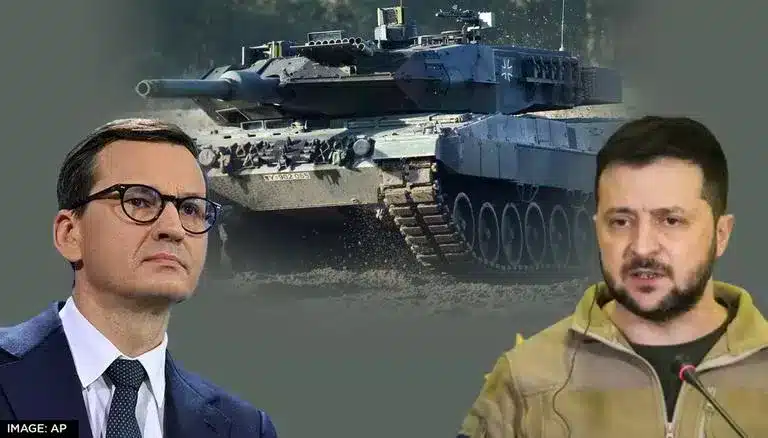
Poland will send an additional 60 tanks to Ukraine on top of the 14 German-made Leopard 2 tanks it has already pledged, the Polish prime minister said in an interview with Canadian television.
Warsaw, which has positioned itself as one of Kyiv’s staunchest allies, had pressed hard for Germany to send Leopard 2 tanks to Ukraine and to allow other countries to do so as well, a demand which Berlin agreed on Wednesday.
Zelenskyy thanked the Polish prime minister on Twitter; in Polish, he wrote, “Thank you, Andrzej Duda, Mateusz Morawiecki, Mariusz Blaszczak, Jacek Siewiera, and the nation of Poland for such important decisions to hand over 60 Polish tanks to Ukraine, 30 of which are the famous PT-91 Twardy and 14 Leopard-2 tanks. Like 160 years ago, we are together, but this time the enemy doesn’t stand a chance. Together, we will win!”
Elvis Afriyie Ankrah, General Secretary aspirant of the opposition NDC, has described the constant blame of Ghana’s collapsing economy on the war between Russia and Ukraine as “hogwash”.
According to him, Ghana’s economy started collapsing before the war in Russia-Ukraine started so it is not right for anybody to use that as an excuse to tell Ghanaians that things were going on well but the war brought about hardships.
He said, Ghana’s economy should have turned around when it received money from World Bank and IMF during the pandemic but those handling the affairs decided to share the money among themselves.
Afriyie Ankrah speaking on GhanaWeb’s Election Desk programme noted that, the over 23 billion that came into the country was used to buy the 2020 general elections to make sure that the NPP remains in power.
“When we had the energy crisis, was it not due to exogenous factors? Is John Mahama the one to rain into the Akosombo dam?… Was there Russia-Ukraine when this government realised that the cedi was collapsing, set up an economic advisory something with 30 people including Franklin Cudjoe and co…?” he questioned.
“So, the cedi started performing badly long before Russia-Ukraine. Now, look at the Auditor-General’s report, look at the infractions; at the time we were leaving office in 2016, the cumulative infractions for that year was about 957 million cedis – which for us was horrible – from that time [till now] what are the infractions according to Auditor-General’s report; was it Russia-Ukraine?
“Was it Russia-Ukraine that caused us to have these infractions? Was it Russia-Ukraine that came and made Ken Ofori-Atta that any time we go for Eurobond he…benefits from those transactions such that he goes to the Euro market with that thinking because his company benefits?
“This is complete hogwash. These Russia-Ukraine here and there is complete hogwash. Before Russia-Ukraine came, all the fundamentals started going down.” Elvis Afriyie Ankrah told Edward Smith Anamale.
He continued: “Indeed, the World Bank and IMF warned us that the way we were going about collecting loans was unsustainable and we will get here. Was it Russia-Ukraine that caused us to go and borrow 13 billion cedis… in any case, Ghana benefited from COVID-19…cumulatively over 23 billion came into this economy that should have been a turnaround for this economy.
“You know what they did, they chopped the money; they shared the money…the real root of the problem is that in 2020 these people poured the money and bought the election.”
Elvis Afriyie Ankrah alleged that the Akufo-Addo-led government wanted to win the election at all cost, therefore, they had to be paying people so that they win the elections.
“They paid people, they spent the money; that is the issue that we must face and confront and stop talking about Russia-Ukraine,” he said.
Information Minister Kojo Oppong-Nkrumah has warned Ghanaians of a possible war between China and Taiwan which he said has the possibility of having disastrous consequences on Ghana’s economy.
According to him, Ghanaians are not talking about the implication of this ensuing conflict but will say it is not affecting Ghana’s economy once it happens like some are doing for the COVID-19 pandemic and the Russia-Ukraine war.
“There is a 3rd problem coming, and if we fail to pay attention to it, it hits us, and people will deny it is one of the reasons for the challenges in the country.
“Do you know that China has extended the tenure of office for Xi Jinping by an extra five years? Read Xi Jipin’s inaugural speech. Somethings we fail to pay attention to these things. Xi Jinping said that he would not rule out taking over Taiwan.
“The issues between China and Taiwan are no different from the issues of Russia and Ukraine – where one country thinks the other country is part of his territory and attempt to use false to annex it. If China attacks Taiwan can you imagine the consequences, especially at this time that crude oil costs $94 per barrel and is set to rise again due to OPEC cutting supply,” he said in Twi.
Oppong Nkrumah, who made these remarks in an Asempa interview monitored by GhanaWeb, said that the media in other countries are seriously discussing the implication of the potential war, but the media in Ghana are silent about it.
“If indeed China attacks Taiwan, what will be the implications? So, if we are not seeing the implication of the Russia-Ukraine war on our economy, what are we saying about the implication of a potential war between China and Ukraine?
“If you turn in to other (foreign) media houses, they are discussing the implications of this issue, but we are not, and if it hits us, we will be saying it is not affecting our economy,” he reiterated.
The information minister made these remarks while answering a question on calls by some Ghanaians for President Nana Addo Dankwa Akufo-Addo to apologise to Ghanaians about the current hardships in the country.
He indicated that the president admitted that the country is facing an economic crisis, and calls for him to apologise for it are immaterial.
The New Patriotic Party (NPP) has reportedly suspended its polling station organizer in the Manhyia North Constituency of the Ashanti Region, named Andy, who begged former President John Dramani Mahama’s forgiveness for voting against him.
In a viral video sighted by GhanaWeb on October 20, Andy berated President Akufo-Addo for his poor handling of Ghana’s economy while expressing regret for his decision to vote against former President John Dramani Mahama.
“Honourable Mahama, please forgive me. Mahama, forgive me. I did not know that things were going to be like this. If I knew that this was what was going to happen, I would not have voted against you. Mahama, please forgive me.
“… As for you, Akufo-Addo, I am not going to say anything against you. After all these (difficulties), you are also insulting us by telling us that nobody held our hands to vote. 2024 will be here soon and you will see your stance.
“A dollar is almost GH¢15 and you’re telling us it is because of the Russia-Ukraine war. A gallon of petrol is now GH¢70. We can no longer buy cement. We have all packed our cars. Mahama please forgive, please forgive,” he said in Twi.
In another video sighted by GhanaWeb, Andy, who disclosed his suspension from the NPP, said that he has no regret for the comments he made.
He added that his suspension will not affect him in any way since the NPP has done nothing for him for the 12 years he has been serving the party.
“Yesterday, the dollar was GH¢14 plus. Today it is GH¢15, why? You have suspended me for speaking the truth.
“It has never been my intention to contest for a position in the NPP; it has never been my intention. Also, the NPP has never gotten me a job. I have been a member of the NPP for 12 years and you have not gotten me a job. And so, what is the essence of your suspension?
“… I will continue to seek Mahama’s forgiveness because I did not know this was how things were going to be. I have supported the NPP with my resources. I have used my money for posters, banners and other things. I don’t want to hold any position in the NPP and I will continue to beg Mahama for his forgiveness,” he said in Twi.
Rice farmers in the Akatsi South District of the Volta region are in distress as prices of farm inputs skyrocket.
Some of the farmers have abandoned their farms due to the high cost of production and those in business fear there would be poor yields during the harvest season because they cannot afford adequate fertilizers for their farms.
They are therefore appealing for support and assistance to be able to bounce back into business.
They made the point when a Ukrainian government delegation interacted with the farmers at Akatsi.
The Ukrainian government delegation is on a fact-finding mission to ascertain the plight of the farmers as a result of the Russia-Ukraine war.
Ukraine is a major exporter of fertilizer to Ghana.
The Volta Region is thus noted for its high rice production rate in Ghana. The region thus contributes huge tonnes of paddy rice to the country’s rice production capacity.
According to the farmers even though the rainfall pattern has been favourable this year, their major challenges are the high prices of fertilizer and other agricultural inputs.
The Chairman of the local rice farmers Association, Richard Odzor said most farmers cannot afford to buy fertilizers, a situation which will have negative impact on their yields.
He noted that previous years saw them producing huge tonnes of rice, due to government subsidies on fertilizers, but such incentives have been scrapped.
“Most of the farmers quit the business because they don’t have capital or money to buy the inputs. So few farmers try their best to still be in the business. As you can see the rice on this field needs fertilizer and now the fertilizer Uriah one bag costs 500 Ghana cedis and unfortunately that 500 Ghana cedis too the fertilizer itself is not in the system to buy,” he added.
The Ukrainian government delegation has been in the country to engage the Ghanaian government on the effects of the Russian-Ukraine War on key sectors of the economy and the way forward.
After a tour of some rice farms in the district, a member of the delegation, Oleg Nivievskyi said fertilizer production levels have dropped significantly in Ukraine, and export channels have been blocked due to the Russia invasion.
“The war in Ukraine challenges International rules of trade. Trade is what is needed to bring fertilizers from other countries to Ghana and this is not happening right now because Russia challenges that. Things have to be restored so that the trade can also begin smoothly between Ghana and her partners and respect for trade rules and not by uncertain behaviour of Russia as we are seeing.”
Another member of the delegation, Olexiy Haran thanked the Ghanaian government for their support and empathy for the people of Ukraine who have been devastated by the war.
Vladimir Saldo,the Russian-installed head of Ukraine’s southern Kherson region, has urged citizens to flee, alleging daily rocket assaults by advancing Ukrainian soldiers.
He advised them to “save themselves” by going to Russia for “leisure and study,” and he requested assistance from Moscow.
His call was later backed up by Russian Deputy Prime Minister Marat Khusnullin in a message on state television.
Ukraine rejects accusations that it targets its own civilians.
Its troops have recently retaken some areas of north-western Kherson, closing in on the regional capital, Kherson city.
“The government took the decision to organise assistance for the departure of residents of the [Kherson] region to other regions of the country,” said Mr Khusnullin, who has special responsibility for southern Russia and Crimea.
“We will provide everyone with free accommodation and everything necessary.”
The first group of people from Kherson would arrive on Friday in Russia’s Rostov region, said its governor Vasily Golubev, according to Russian state news agency Tass.
“The Rostov region will accept and accommodate everyone who wants to come to us from the Kherson region,” he added.
Kyiv has been using US-supplied Himars rocket systems Among other weaponry to great effect.
It has targeted key Russian-held military targets and threatened to cut off the bulk of the occupying forces on the west bank of the Dnieper river (known as Dnipro in Ukraine).
Kherson is the only regional capital seized by Russian forces since Moscow’s invasion began on 24 February.
Ukraine’s military has been tight-lipped about its troop advances in the key region that borders Crimea – the southern Ukrainian peninsulaannexed by Moscow in 2014.
In other major developments on Thursday:
All of Ukraine – with the exception of Crimea – was for some time under air raid alert, and Russian missile strikes were reported on energy and military targets in the Kyiv region and Lviv, in the west
Two people were killed in shelling in the southern city of Mykolaiv, and dramatic footage showed a young boy being rescued from the rubble of a destroyed house, although he later died, officials said
Both Kyiv and Moscow confirmed that 20 Ukrainian service personnel were exchanged for 20 Russian soldiers – in the latest such swap
Russia accused Ukraine of hitting a residential building in the Russian border city of Belgorod
Russian President Vladimir Putin met his Turkish counterpart Recep Tayyip Erdogan and proposed building a gas hub in Turkey as an alternative supply route to Europe following problems with the Nord Stream pipelines
Nato said it would provide Ukraine with dozens of jammers – transmitters used to disrupt signals – to counteract Russian and Iranian drones. The head of the military alliance, Jens Stoltenberg, also said members had agreed to increase the protection of critical infrastructure after what he called the “sabotage” of the Nord Stream pipelines
Speaking on Thursday, Mr Saldo said many towns in the region – including the two major cities of Kherson and Nova Kakhovka – were now under daily rocket attacks by Ukrainian troops.
“Such strikes are causing serious damage,” he said, urging residents across the whole region – and especially those on the west bank of the Dnieper river – to evacuate to Russia or Crimea.
And he appealed to the government in Moscow to help organise the process. “Russia is not abandoning its people,” he stressed, using a popular saying.
Earlier this month, President Putin declared the annexation of the Kherson and Zaporizhzhiaregions in Ukraine’s south, as well as Donetsk and Luhansk in the east.
Ukraine and its Western allies condemned the move, saying it had no legal power. The Kremlin does not fully control any of the four regions.
On Wednesday, the United Nations General Assembly voted overwhelmingly to condemn the Russian annexation attempt.
The assembly’s resolution was supported by 143 countries, while 35 states – including China and India – abstained. As well to Russia, four countries rejected the resolution – Belarus, North Korea, Syria, and Nicaragua.
Although symbolic, it was the highest number of votes against Russia since the invasion.
Former New Patriotic Party (NPP) Member of Parliament (MP) for Okaikwei North, Fuseini Issah, has refuted assertions by some factions in the public that the Akufo-Addo government said it was not going to borrow.
He intimated that neither President Akufo-Addo nor Vice President Dr. Mahamudu Bawumia categorically stated that Ghana was never going to borrow money under their watch.
Speaking in a TV3 interview monitored by GhanaWeb on Tuesday, the ex-MP added that there is nothing wrong with borrowing money for development and that even advanced countries, including the US, borrow.
“Nobody said that we were not going to borrow. At no point did we say we were not going to borrow. Aid and borrowing are different.
“Borrowing is part of normal government business. No government on earth does not borrow; it is part of normal governance and normal fiscal policy. Nobody said that we were never going to borrow. It is not written anywhere,” he said.
Also, he said that the current hardships in the country can not be blamed on the Akufo-Addo government.
According to him, the main reasons for the hardship are the COVID-19 pandemic, the Russia-Ukraine war and the mess created by the government of ex-president John Dramani Mahama, which the Akufo-Addo administration is still fixing.
Prior to the 2016 election, Vice President Bawumia said that there was no need for the Mahama government to borrow because Ghana had enough resources.
“I worked at the Bank of Ghana, and so I know that Ghana is rich. It is because the managers of the economy are incompetent, and so all they think of is borrowing. The NPP, if voted in, will harness resources to develop Ghana. I am telling you we can develop Ghana without borrowing, the money is here,” he said.
He has since stated that the statement he made is being misconstrued and that he meant that an NPP government will borrow responsibly.
President Akufo-Addo also, before he came to power, said that Ghana has an abundance of money needed to transform Ghana.
“God has not placed us on this rich land to be poor. Ghana is not a poor country. The money is there in abundance. It’s just a matter of priority,” Akufo-Addo said.
The Ranking Member of Parliament’s Mines and Energy Committee, John Jinapor, has refuted claims by the government that the Russia-Ukraine war and the COVID-19 pandemic are the cause of the challenges in Ghana.
According to him, data from the Ministry of Finance shows that these two events have been a blessing to the Nana Addo Dankwa Akufo-Addo government.
John Jinapor, who made these remarks in an XYY interview monitored by GhanaWeb, explained that because of the Russia-Ukraine war and the COVID-19 pandemic, the government had exceeded most of its revenue projections.
“If you look at the summary of the financial data of the country from January to June this year, which was published by the Ministry of Finance, you will notice that the government has benefited from these two things, particularly because of the rise in the prices of petroleum prices.
“The Summary of Central Government Operation, which was published by the ministry, shows that the country at the end of the 2nd quarter collected 127 percent of its projected tax revenue from oil products. When it comes to royalties from oil production, we have gotten 133 percent of projected revenue. For the financial sector levy, we have gotten 133 percent of projected revenue.
“For the COVID-19 levy, we have gotten 170 percent of what we budgeted for. We have gotten 150 percent of the oil revenue we budgeted for. So, one can observe that Ghana is rather benefiting from the Russia-Ukraine war in terms of revenue when it comes to the government side,” he said in Twi.
Jinapor, who is the Member of Parliament (MP) for Yapei-Kusawgu, further stated that Ghanaians are going through a lot of hardship because the government has refused to use the windfall in revenues to bring some reprieve to the citizenry.
Meanwhile, President Nana Addo Dankwa Akufo-Addo, during his speech at the United Nations (UN) General Assembly, said that the Russia-Ukraine War was having a devastating impact on Ghana and other African countries.
“As we grappled with these economic challenges, Russia’s invasion of Ukraine burst upon us, aggravating an already difficult situation. It is not just the dismay that we feel at seeing such deliberate devastation of cities and towns in Europe in the year 2022; we are feeling this war directly in our lives in Africa.
“Every bullet, every bomb, every shell that hits a target in Ukraine, hits our pockets and our economies in Africa. The economic turmoil is global with inflation as the number one enemy this year,” the president said.
President Akufo-Addo, during his speech at the United Nations (UN) General Assembly, said that the Russia-Ukraine War was having a devastating impact on Ghana and other African countries.
“As we grappled with these economic challenges, Russia’s invasion of Ukraine burst upon us, aggravating an already difficult situation. It is not just the dismay that we feel at seeing such deliberate devastation of cities and towns in Europe in the year 2022, we are feeling this war directly in our lives in Africa.
“Every bullet, every bomb, every shell that hits a target in Ukraine, hits our pockets and our economies in Africa. The economic turmoil is global with inflation as the number one enemy this year,” the president said.
But speaking at the 2022 Baah-Wiredu Lecture in Accra, Bright Simons argued that the president’s assertion is not backed by data.
He intimated that there is evidence that Ghana is performing worse than other Africa surrounding it which means that there is more to the country’s challenges than the Russian-Ukraine war.
“When we start to do the comparative analysis, you cannot use some other factor that has had a uniform effect. I tried my best to give you factors that could have shown that Ghana has been affected more, and as you saw I struggled with the data.
“I went to jobs, I went to growth, I went to how many people were killed and none of it bears out that we were affected worse. So, if you are the worse performing in terms of currency, you cannot complain and say it is because of some factor that has affected everybody uniformly. It is as simple as that,” he said.
Mohammad Eslami’s comments echo a similar recent statement by a senior adviser to Iran’s supreme leader.
Such public claims by top officials are rare and are likely to intensify concerns over the nature of Iran’s nuclear programme.
It has advanced its nuclear activities since a deal limiting them faltered.
The 2015 agreement began to unravel when the US pulled out and reinstated crippling economic sanctions.
Iran has repeatedly claimed its nuclear programme is for purely peaceful purposes but Western powers and the global nuclear watchdog say they are not convinced.
Western officials have warned time is running out to restore the deal before Iran’s programme reaches such a point where it cannot be reversed.
“As Mr Kharrazi mentioned, Iran has the technical ability to build an atomic bomb, but such a programme is not on the agenda,” Mr Eslami said.
In his own remarks made to Al Jazeera news channel on 17 July, Mr Kharrazi said: “Iran has the technical means to produce a nuclear bomb but there has been no decision by Iran to build one.”
There have been growing concerns over the so-called breakout time, or the amount of time it will take Iran to amass enough highly enriched uranium for a nuclear weapon.
Media caption, Iran’s nuclear programme: What’s been happening at its key nuclear sites?
In June, the head of the global atomic energy agency, Rafael Grossi, said Iran could acquire such a quantity in a matter of weeks. The US put the breakout time at about a year during the period in which the nuclear deal was intact.
However Mr Grossi said possessing enough material did not mean Iran could manufacture a nuclear bomb.
In its latest report in May, the IAEA said Iran had 43.1kg (95lb) of uranium enriched to 60% purity. About 25kg of uranium enriched to 90% is needed for a nuclear weapon.
The claims from Iran that it has the technical know-how to develop a bomb come at a time when Iran and world powers are at loggerheads over reviving the 2015 deal.
Months-long on-off-talks in Vienna have stalled, and rare indirect negotiations between the US and Iran on the issue which took place in Qatar in June ended without agreement.