Tag: Russian Defense Ministry

  • Ukrainian offensive takes place in multiple directions – Officials

    Ukrainian offensive takes place in multiple directions – Officials

    Hanna Maliar, Ukraine’s deputy defence minister, said on Ukrainian television on Monday that an operation is “taking place in several directions,” fueling rumours that Kyiv is preparing a big offensive to retake territory controlled by Russia’s occupying forces.

    It’s not only about Bakhmut, either. There are various fronts from which the onslaught is coming. We appreciate every metre. Our forces have had a successful day today, she declared.

    Recent weeks have seen Ukraine’s military stepping up shaping operations – attacks on Russian targets like fuel depots and weapons dumps far behind frontlines – which typically precede a major advance by ground forces. But government officials in Kyiv have been at pains to say the start of any counteroffensive would not be announced.

    Both Ukraine and Russia have engaged in intense information campaigns to sway public opinion and mislead their opponents about their battle plans.

    Maliar’s comments came after the Russian Defense Ministry claimed its troops resisted a “large-scale” attack from Ukrainian forces in the eastern Donetsk region. The Russian military claimed in a statement to have killed 250 Ukrainians and destroyed armored vehicles used in the assault, but provided scant evidence.

    Moscow is known to make inflated claims about Ukrainian losses. CNN has been unable to independently verify the claim.

    A spokesperson for the Ukraine Armed Forces, Bohdan Senyk, told CNN that Ukraine does “not have information” on a purported “large-scale offensive” in Donetsk.

    In a post on its official Telegram feed, the Russian Defense ministry said the assault took place at “five section of the front in the southern Donetsk direction.”

    The ministry claimed the goal of the Ukrainian operation was “to break through” Russian defenses in what it considered to be “the most vulnerable area of the front.”

    At the time of the attack, Russia’s top general Valery Gerasimov “was at one of the forward command and control posts,” the statement added.

    Gerasimov, who is chief of Russia’s General Staff, was put in overall command of Russian military operations in Ukraine early this year. He has come under public criticism from the head of the Russian private military company Wagner for supposedly running the war from a comfortable office.

    Further south, a Russian-appointed official in Zaporizhzhia said Ukrainian troops were attempting to break through a defense line to reach the coast of the Sea of Azov.

    “The goal of the [Ukraine Armed Forces] militants is to reach the Azov Sea coast and cut the land corridor,” Vladimir Rogov said, according to Russian state media outlet RIA Novosti.

    He claimed that Ukrainian troops have increased the intensity of their shelling, and fired Storm Shadow missiles. “They are launched in large quantities, which means Ukrainian militants and terrorists have ammunition in sufficient quantity.”

    Rogov said he did not think a full-scale counteroffensive had begun.

    In a Monday Telegram post, Maliar said the country’s troops were “carrying out offensive actions” on the eastern front and had “advanced in several directions” around the city of Bakhmut: near the settlements of Orikhovo-Vasylivka and Paraskoviivka to the north, and near Ivanivske and Klishchiivka to the southwest.

    Serhii Cherevatyi, spokesman for the Eastern Grouping of the Ukrainian Armed Forces, also spoke of “an offensive assault” by the Ukrainians “on the southern and northern flanks of Bakhmut” on national TV on Monday.

    “These actions were successful,” Cherevatyi said. “Despite the enemy’s fierce resistance, our airborne assault and mechanised units managed to advance along the Siverskyi Donets-Donbas Canal in the direction of Klishchiivka, Orikhovo-Vasylivka, Zaliznianske, and Bohdanivka to a distance of 300 meters to 1 km in various parts of the frontline.”

    CNN cannot verify the battlefield reports.

    It comes after Maliar and other officials posted a social media video urging silence over any potential news of a counteroffensive.

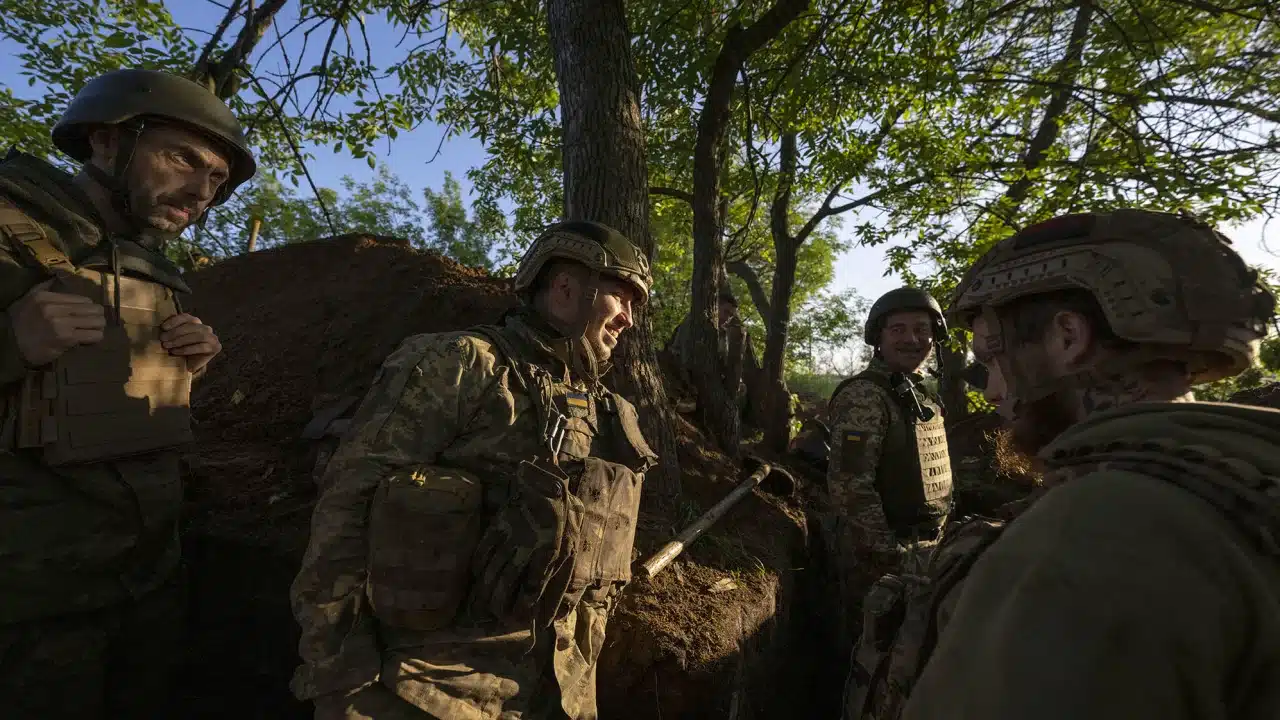
    The video shows several soldiers in full combat gear putting a finger to their lips and saying “shhh” followed by the text: “Plans love silence. The beginning [of the counteroffensive] will not be announced.”

    Ukrainian President Volodymyr Zelensky praised troops fighting around the embattled city of Bakhmut during his nightly address, saying: “I am grateful to every warrior, to all our defenders, who provided us today with the news we have all been waiting for in the Bakhmut direction. Well done, warriors!”

    Days before, Zelensky told the Wall Street Journal (WSJ) that Kyiv was “ready” to launch the long-awaited military maneuvers.

    “I think that, as of today, we are ready to do it. We would like to have certain things, but we can’t wait for it for months,” Zelensky said in an exclusive video interview published Saturday.

    The president said he believed the counteroffensive will be successful but was not sure how long it will take.

    “Everyone knows perfectly well that any counteroffensive in the world without control in the skies is very dangerous. Imagine what a military man feels, knowing he does not have a ‘roof’ and he can’t understand how neighboring countries have that,” Zelensky said about his dogged campaign for allies to supply Ukraine with F-16 fighter jets.

    According to the WSJ, Zelensky acknowledged Russia’s superiority in the skies, adding that a lack of protection against Moscow’s air power means “a large number of soldiers will die” during the counteroffensive.

    “If everybody knows we need the protection for our skies, then what’s the issue with [giving us] the modern jets? What is the issue?” he implored.

    The Ukrainian leader has spent months courting Western allies to provide Kyiv with fighter jets and weapons to help control the skies and help limit the number of casualties to Ukrainian fighters during any potential counteroffensive.

    Earlier this week, Jake Sullivan – US President Joe Biden’s national security adviser – said Washington believed the counteroffensive would help Kyiv retake “strategically significant territory.”

    “Exactly how much, in what places – that will be up to developments on the ground as the Ukrainians get this counteroffensive underway,” Sullivan told CNN’s Fareed Zakaria. “But we believe that the Ukrainians will meet with success in this counteroffensive.”
  • Russian combatants are approaching Bakhmut city

    Russian combatants are approaching Bakhmut city

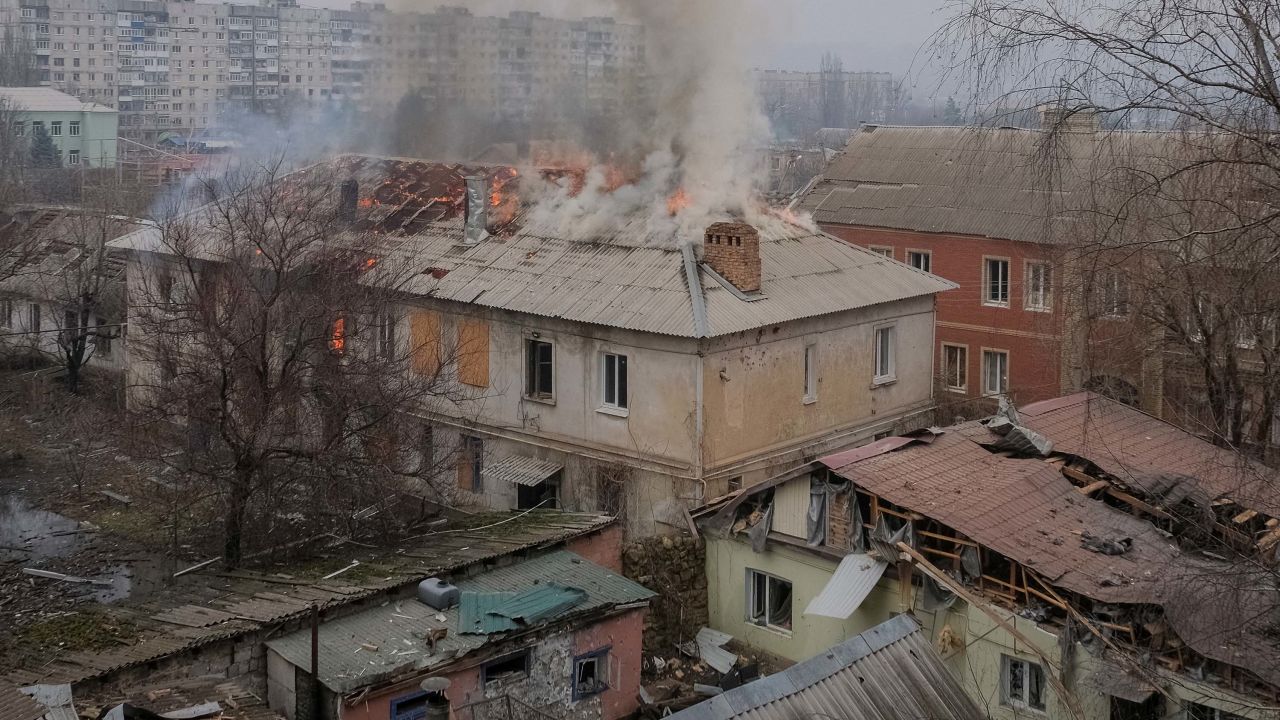
    After weeks of brutal battle steadily wore down an unyielding Ukrainian opposition, Russian soldiers are inching closer and closer to taking the city of Bakhmut.

    Bakhmut is a relatively small town in eastern Donetsk that has been out of reach of Russia’s plodding ground assault for many months, which is not the kind of city Moscow had hoped to be fighting for in the second year of its invasion.

    Yet, if it were taken, Russian President Vladimir Putin would have made some military progress and would have given his army the chance to conduct aerial assaults on more western major centers.

    Here’s what you need to know about the battle for Bakhmut.

    Ukraine’s biggest challenge at this moment is defending Bakhmut, President Volodymyr Zelensky said in his nightly video message Tuesday.

    Russian forces have been making incremental gains around the city, but Ukrainian forces are yet to retreat, creating a standoff that recalls drawn-out battles for other eastern cities such as Severodonetsk over the past year.

    On Saturday, Land Forces of Ukraine said on its Telegram channel that “the enemy keeps trying to break through the defenses and take Bakhmut” and that the commander of Ukraine’s Eastern Military Group, Colonel-General Oleksandr Syrskyi, had visited units that are defending the city and its approaches.

    Alexander Rodnyansky, an economic adviser to Zelenksy, told CNN on Tuesday that “the situation is difficult. There is no secret about that.”

    “Russia is trying to encircle it right now and they’re using their best Wagner troops, apparently, the most well trained and experienced,” the adviser added. “Our military is obviously going to weigh all of the options. So far, you know, they’ve held the city, but, if need be, they will strategically pull back because we’re not going to second guess all of our people just for nothing.”

    The Ukrainian military has also confirmed that Russian forces are employing more experienced fighters from the ranks of the Russian private military company Wagner as they attempt to capture the town.

    There are still around 4,500 civilians in Bakhmut, including 48 children, as Russian forces continue to advance on the city, the spokeswoman for the Ukrainian Donetsk regional military administration Tetiana Ignatchenko told CNN on Wednesday.

    She called on people to evacuate the city due to the danger but said they had enough supplies.

    “There is food, water and medicine in the city. People were provided with everything in advance,” Ignatchenko said. “Still, everyone has to leave. The situation is extremely dangerous for civilians.

    A soldier from Ukraine’s 93th Brigade says his country’s forces are still standing in Bakhmut, with no plans for a retreat.

    “We are standing in Bakhmut. No one is going to retreat yet,” the soldier said a video posted by the Ukrainian military on Wednesday. “We are standing. Bakhmut is Ukraine.”

    The soldier also claimed the situation in Bakhmut was a bit calmer than in previous days.

    “We have muffled the enemy down a little bit. It’s a little calmer, but there are still gunfights on the outskirts,” he said. “There are isolated explosions, bombs are flying.”

    But Ukrainian troops have acknowledged that it is becoming harder to hold onto the city as the routes in from the west are squeezed by Russian forces, who have advanced both to the north and south of Bakhmut.

    “The situation in Bakhmut is very difficult now. It is much worse than officially reported,” a soldier who didn’t want to be named told CNN on Tuesday. “In all directions. Especially in the northern direction, where the (Russians) have made the biggest advance between Berkhivka and Yahidne.”

    The city sits towards the northeast of the Donetsk region, about 13 miles from Luhansk region, and has been a target for Russian forces for months. Since last summer the city has been a stone’s throw from the front lines, so its capture would represent a long sought-after success for Moscow’s forces – and bring some limited strategic value.

    The city has important road connections to other parts of the Donetsk region; eastwards to the border with Luhansk, north-west to Sloviansk and south-west to Kostiantynivka.

    For several weeks the routes into Bakhmut have gradually come under the control of Russian forces. Rather than drive directly towards the city center, Wagner groups have sought to encircle the city in a wide arc from the north. In January they claimed the nearby town of Soledar, and have since taken a string of villages and hamlets north of Bakhmut.

    If the Russians can take the high ground to the west of the city, nearby industrial towns Kostiantynivka and Kramatorsk would be at the mercy of their artillery and even longer range mortars. And it is unclear where exactly Ukrainian forces would fall back to should they retreat from the city.

    But experts say capturing Bakhmut is unlikely to dramatically alter the overall picture of the war in eastern Ukraine, where little territory has changed hands in 2023. And it would in some ways signal the overriding failures of Russia’s invasion that, early in its second year, the capture of a relatively small city has required such a long and costly assault.

    While Bakhmut’s strategic importance should not be overstated, its capture could still carry a very welcome symbolic impact for Russian President Vladimir Putin.

    When Russian troops took the town of Soledar in mid-January, it marked a first gain in the Donbas for months. Six weeks on, the capture of Bakhmut would represent the completion of the next step.

    It matters too to oligarch Yevgeny Prigozhin, who runs the Wagner group and has frequently criticized the Russian Defense Ministry’s management of the “Special Military Operation” in Ukraine.

    His Wagner fighters, many of them former prison inmates, have taken heavy casualties in what has become a battlefield of trenches and mud, reminiscent of World War I. After months in which the Russian Ministry of Defense delivered nothing but retreat, Prigozhin has been keen to show his men can deliver with the seizure of Soledar and now Bakhmut.

    Nonetheless, urgent questions will remain for Putin even if his forces pull off a successful assault on Bakhmut.

    “The specter of limitless Russian manpower is a myth. Putin has already been forced to make difficult and suboptimal choices to offset the terrible losses his war has inflicted on the Russian military, and he will face similarly difficult choices in 2023 if he persists in his determination to use military force to impose his will on Ukraine and the West,” the Institute for the Study of War (ISW) think tank wrote on Sunday in an update on the state of Russian forces and firepower.

    “Russia can mobilize more manpower, and Putin will likely do so rather than give up. But the costs to Putin and Russia of the measures he will likely need to take at this point will begin to mount rapidly,” the ISW wrote.