Tag: Ruto

  • Kenya will work with Ghana to drive mutual development in oil, gas sectors – President William Ruto

    Kenya will work with Ghana to drive mutual development in oil, gas sectors – President William Ruto

    Kenyan President William Samoei Ruto has pledged to deepen Kenya’s partnership with Ghana, emphasizing the expansion of collaboration across various sectors, including trade, investment, agriculture, mining, tourism, and oil and gas.

    Ruto revealed this commitment in a post following a meeting with Ghana’s incoming president, John Dramani Mahama.

    He highlighted that the strengthened relationship would open up new avenues for both countries and foster shared prosperity.

    He said, “Kenya will enhance its relations with Ghana to include more sectors such as trade and investment, agriculture, mining, tourism, and oil and gas. This will broaden opportunities for the people of both countries and ensure our shared prosperity.”

    In their discussions, Ruto and Mahama explored opportunities to boost intra-African trade, particularly through the African Continental Free Trade Area (AfCFTA).

    Ruto also expressed his appreciation for Mahama’s endorsement of Hon. Raila Odinga’s bid for the African Union Commission chairperson and confirmed his attendance at Mahama’s swearing-in ceremony in Accra next month.

  • “I concede” – Ruto refuses to sign Finance bill into law after deadly protests in Kenya

    “I concede” – Ruto refuses to sign Finance bill into law after deadly protests in Kenya

    Kenya’s President William Ruto has declared his decision to withdraw the Finance Bill 2024 following widespread and deadly protests across the country.

    The bill, which included controversial tax hikes, sparked massive demonstrations culminating in violent clashes and the torching of parliament buildings on Tuesday.

    In a televised address to the nation, President Ruto acknowledged the vehement opposition from Kenyans towards the Finance Bill, stating, “Listening keenly to the people of Kenya who have said loudly that they want nothing to do with this Finance Bill 2024, I concede.”

    He announced that he will not sign the bill into law, effectively withdrawing it.

    The protests, which erupted nationwide, resulted in at least 22 deaths, according to the Kenya National Commission on Human Rights. Demonstrators, predominantly young people, expressed outrage over the proposed tax increases, which they argued would exacerbate the country’s already severe cost-of-living crisis.

    Initially responding with a military deployment and a stern warning against violence, President Ruto reversed course in the face of escalating public anger and condemnation. He pledged to engage in dialogue with the protesters, emphasizing their role in shaping national policy.

    The unrest saw protesters storming parliament, vandalizing its interior, and setting parts of the complex ablaze. The symbolic mace, representing legislative authority, was stolen during the chaos.

    Human rights organizations and international bodies condemned the use of live ammunition by security forces during the protests. Wanjeri Nderu of the International Society For Human Rights described the scene as akin to war, highlighting excessive force by police.

    Catholic bishops and the Law Society of Kenya also denounced the violent crackdown on protesters and called for restraint from security forces.

    In response to the escalating crisis, UN Secretary-General Antonio Guterres expressed deep sadness over the deaths and injuries, urging Kenyan authorities to exercise restraint and ensure peaceful demonstrations.

    The Finance Bill, which originally proposed taxes on essential commodities such as bread and cooking oil, as well as mobile money services and medical facilities, faced widespread opposition from various sectors of Kenyan society. With its withdrawal now confirmed, President Ruto aims to quell unrest and initiate a process of national reconciliation.

  • Kenya’s Ruto confirms mission to Haiti will take place despite court ruling

    Kenya’s Ruto confirms mission to Haiti will take place despite court ruling

    A leader in Kenya’s opposition has said that President William Ruto is planning to ignore a court decision that says police should not be sent to Haiti.

    Ekuru Aukot was able to successfully stop the army from being sent out by taking the case to court. He believes that only the president has the power to send out the army, not the police.

    The court said that the mission was not allowed by law.

    MrRuto said on Tuesday that the mission could happen “as soon as next week” if all the necessary paperwork is completed to meet the court’s requirements.

    In November, Kenya’s government approved sending 1,000 officers to lead a group of countries’ force in Haiti. This is because gangs in Haiti are trying to take over more areas.

    Last week, a judge said that the National Security Council in Kenya, which is led by the president, cannot send regular police to other countries.

    It said that the council can only send soldiers, not police, to keep peace in places like Haiti.

    The court said both countries need to agree before the soldiers can go there.

    Justice Chacha Mwita said Kenya’s plan to send police to Haiti is a good idea, but it must follow the law.

    Mr Ruto said at a meeting in Rome that he thinks a request will come soon to meet the Kenyan court’s demands.

    “The mission is going as planned. ” He said the mission is a big job for all people.

    When they asked if Haiti is trying to get what it needs, Mr. Ruto said “Yes, definitely. ”

    “Haiti wrote this formally, not recently, but several months ago,” he said.

    Korir Sing’oei, a high-ranking official in Kenya’s foreign ministry, said on X that sending police to another country would not break the law if it follows a mutual agreement between the two countries.

    ButAukot believes that the deployment needs more than just the agreement between two countries.

    Understand Justice Mwita’s thoughts on the differences between ‘service’ and ‘force’. According to the law and the constitution, you can’t send the police to work in another country, Mr. Aukot said on X. He accused the foreign affairs official of giving the president incorrect information.

    During the interview on Tuesday, Mr. Ruto emphasized that it was carried out by the police instead of the military.

    The Kenyan government said it would ask for another decision in court.

    Last week, the US said it backs Kenya’s plan to challenge the court’s decision.

    The Kenyan opposition told the US to stay out of Kenya’s business.

    It is not clear when the Kenyan government will go to court and if other countries who promised to send small forces to support the multinational mission will do it on their own.

    Some countries including the Bahamas and Antigua and Barbuda will send their military forces, and the US will give $200 million to help with the mission.

    An official from the United Nations said last week that the violence caused by gangs in Haiti has become very serious, with almost 5,000 deaths reported last year.

  • Ruto suffers as Kenyan housing tax blocked by court

    Ruto suffers as Kenyan housing tax blocked by court

    A court in Kenya has refused to let the government introduce a new tax on housing. This decision is a setback for the government.

    In November, the High Court said that the 1. 5% monthly charge was not fair to Kenyans who have regular jobs and told them to stop paying it.

    On Friday, the court said that people don’t have to pay the tax until the case is finished.

    The government wanted to start collecting the tax again for now.

    It started taking 1. 5% of the total wages of both local and foreign workers last July. This money is being used to build cheap houses for people with low incomes.

    The new tax upset the opposition and many Kenyans who already feel overwhelmed by the many taxes President William Ruto has introduced.

    The government said that if they stopped the tax, many people working on the housing program would lose their jobs and it would break the contracts that had already been made.

    Many people in Kenya feel better about the decision, even though the Court of Appeal has not made its final ruling.

    The decision was made just one week after the appeals court approved a new healthcare insurance fee. This fee will require people to give 2. 75% of their monthly salary to a social healthcare program.

    The housing levy case on Friday has caused a disagreement between the judges and the president. President Ruto said that some judges are working with the opposition to stop development projects and are corrupt.

  • Ruto wins as Kenyan court removes health levy ban

    Ruto wins as Kenyan court removes health levy ban

    The Kenyan Court of Appeal has approved a healthcare insurance levy that was previously banned.

    President William Ruto wants to make sure that every person in Kenya can get healthcare they can afford. This is called the Social Health Insurance Fund (SHIF).

    But a lot of people don’t like it because they think it’s a new tax.

    Critics say the fee will make the cost of living higher, which caused a lot of protests last year.

    The SHIF launch was stopped by the High Court last November because businessman Joseph Enock Aura filed a petition against parts of the program.

    This made President Ruto upset, along with the suspension of a controversial housing tax. He recently accused some judges of corruption in public. He said the courts were teaming up with the other party to stop his government’s plans, which made lawyers protest.

    The SHIF is replacing the old National Health Insurance Fund because a lot of money from taxpayers has been lost due to corruption.

    On Friday, a group of judges ended the ban because they thought it was a threat to the health rights of many people who were not involved in the case.

    However, the court stopped the parts that made it necessary for people to sign up for the program.

    All employees need to give 2. 75% of their pay to the new health fund.

    The new rule doesn’t say what happens if people can’t pay, but President Ruto promised that the government would cover the costs for them.

    People who don’t like the new health plan say that the 2. 75% deduction is a big increase from what they used to pay to the NHIF. This is in addition to the recent increase in fuel prices and living costs.

    Some people worry that the new healthcare organization will use most of the money it collects for things like paperwork and office expenses, instead of using it for actual healthcare.

    Last year in June, Mr. Ruto approved a new law called the Finance Act. This new law made both employers and employees pay a 1. 5% housing levy, which many people did not like.

    The government wants to offer housing that low-income people can afford. The levy is being disputed in court.

  • Kenyan attorneys demonstrate against Ruto’s threats against justice

    Kenyan attorneys demonstrate against Ruto’s threats against justice

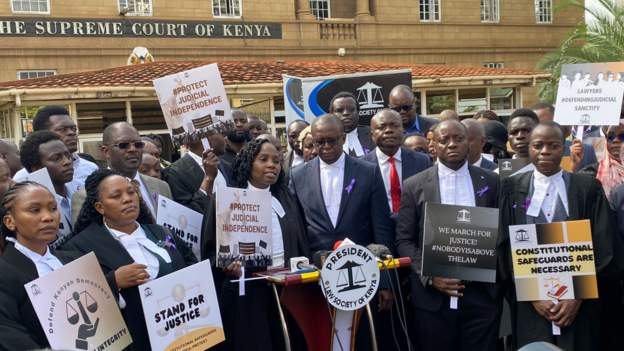
    Many lawyers in Nairobi, Kenya are protesting because President William Ruto is not following court orders.

    The lawyers are walking in a protest from the highest court to the president’s office. The protest was arranged by the Law Society of Kenya (LSK).

    President Ruto was strongly criticized last week for saying he might not follow court orders. He claimed that some judges were working with opposition politicians and other groups to stop his government’s plans.

    The leader of this country must follow the laws, just like everyone else. So we don’t think he should speak as if following court orders is a special thing he’s doing for the country. “It is a rule in the constitution,” said LSK president Eric Theuri during a press conference on Thursday.

    Mr Theuri said that LSK will think about starting the process to remove Mr Ruto from his position because he is not following the rules of the constitution if he keeps criticizing the judiciary.

    LSK has put together a group of lawyers to submit a request to the High Court to say that Mr. Ruto broke the rules of the constitution, Mr. Theuri told the privately-owned Standard newspaper.

    Many well-known Kenyan lawyers, like former Vice-President Kalonzo Musyoka and former minister Eugene Wamalwa, who are now opposition politicians, have joined the protest.

    The top judge and a political leader told Mr Ruto that not following the court’s decisions could cause chaos in the country.

  • Ruto promises to “eradicate crooked judges in Kenya”

    Ruto promises to “eradicate crooked judges in Kenya”

    Judges in Kenya have criticized the president for saying he might not follow court orders.

    President William Ruto has promised to get rid of people he thinks are causing problems for his government by using the courts to stop his plans. Even though people are saying to respect the courts, he still wants to do this.

    The president said that no money should be used to bribe any officer, even though some officers are honest.

    He said that he won’t allow anyone to bribe judges to stop Kenya from changing for the better.

    Chief Justice Martha Koome and opposition leader Raila Odinga said that Mr Ruto is trying to scare the judges, and a group of lawyers want to have demonstrations.

  • Kenya to become visa-free country begining January 2024

    Kenya to become visa-free country begining January 2024

    Effective January 2024, Kenya will eliminate visa requirements, opening its borders to all foreign nationals.

    Africans planning to visit Kenya will no longer need visas but will instead require advance electronic travel authorization.

    Kenyan President William Ruto, in his announcement on December 12, 2023, emphasized that the country is transitioning to a visa-free status, eliminating the need for individuals to go through the visa application process before visiting.

    Ruto stated, “This is to echo a message to humanity to welcome everyone home…this is why the government of Kenya has abolished the requirements of visas for all visitors,” he noted.

    “To implement this policy, we have developed a digital platform to ensure that all travellers to Kenya are identified in advance on an electronic platform.

    Consequently, all travellers will obtain electronic travel authorization as they come to Kenya,” President Ruto added.

    To implement this policy, a digital platform has been developed to identify all travelers in advance on an electronic platform.

    Consequently, travelers will obtain electronic travel authorization before coming to Kenya.

    President Ruto initially announced the visa-free initiative in October 2023, highlighting that visa requirements were hindering trade, tourism, and overall development.

    He emphasized the impact on business people and entrepreneurs when travel is restricted.

    “When people cannot travel, business people cannot travel, entrepreneurs cannot travel, we all become net losers,” President Ruto earlier said.

    Kenya’s move mirrors a recent visa waiver agreement between Ghana and South Africa.

    Both countries declared that Ghanaians and South Africans can travel to each other’s countries without a visa, effective from November 1, 2023.