Tag: Salaries

  • Salaries of more than 2k government workers suspended

    Salaries of more than 2k government workers suspended

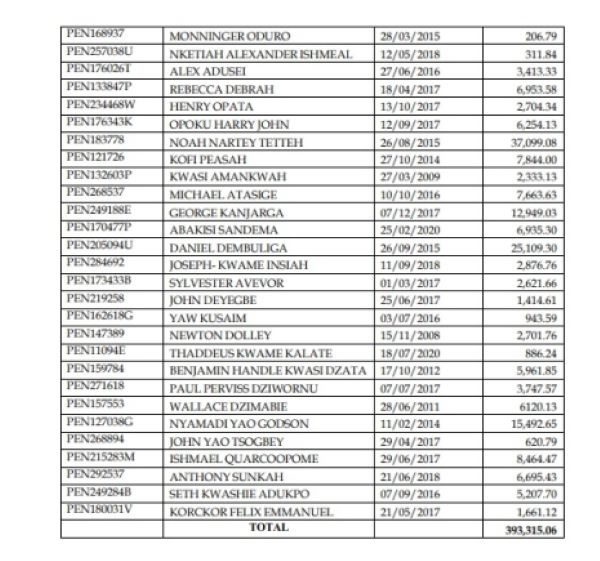
    Two thousand five hundred and sixty-three (2,563)government employees have had their salaries suspended over failure to participate in the nationwide headcount exercise conducted by the Ghana Audit Service in 2025 across various Ministries, Departments, and Agencies.

    The suspension of their salaries follows the recommendation of the Auditor-General (A-G). This was contained in a statement signed by Cephas Neosoo, Head of Public Relations for the CAGD on Friday, January 30, 2026.

    The statement directed affected individuals to complete necessary clearance processes to ensure they receive their salaries.

    Meanwhile, all public sector workers under the Single Spine Salary Structure (SSSS) is expected to have their salaries increased by nine percent.

    As part of the government’s review, the national daily minimum wage will also be increased from GH₵19.97 to GH₵21.77, effective January 1 to December 31, 2026.

    The review follows several deliberations by the National Tripartite Committee (NTC), which comprises representatives from the government, employers, and labour unions.

    It was made official on Sunday, November 9, after the government, represented by the Fair Wages and Salaries Commission (FWSC) and the Ministry of Finance (MoF), and Organised Labour, signed the agreement.

    During the signing ceremony, Finance Minister Dr. Ato Forson pledged the government’s commitment to upholding its side of the agreement while commending the efforts of Organised Labour.

    “The country has gone through difficult times with high inflation and interest rates, but today both indicators have declined. The government is working to further reduce inflation from the current 8 percent to ease the burden on Ghanaians,” he said.

    In July this year, Dr. Cassiel Ato Forson indicated that wages and salaries exceeded the budget by GH¢1.3 billion for the first six months of the year.

    Per the 2025 budget statement, compensation of employees, comprising wages and salaries, pensions, gratuities, and social security, has been programmed at GH¢76.2 billion for the entire year.

    Presenting the 2025 Mid-Year Budget in Parliament on Thursday, July 24, the Finance Minister revealed that the government has experienced some significant pressures on the compensation budget for the first half of 2025, mainly emanating from wages and salaries.

    The wage pressures, the minister said, were largely driven by last-minute recruitments undertaken by the previous government in the last quarter of 2024, especially in the education, health, and security sectors faced significant pressures on the compensation budget in the first half of 2025, mainly due to“In addition, ad-hoc reviews of conditions of service undertaken in previous years have distorted the Single Spine Pay Policy and further burdened the public wage bill,” the sector minister added.In 2024, compensation of employees amounted to GH¢67,189 million (5.7% of GDP), above the target of GH¢63,683 million (6.2% of GDP) by 5.5 percent.

    Wages and salaries constituted 89.8 percent of the total compensation and amounted to GH¢60,352 million (5.1% of GDP), 5.9 percent above the target of GH¢57,005 million (5.6% of GDP), per the 2025 budget statement.In February this year, Chief of Staff Julius Debrah issued a directive annulling all public service appointments and recruitments made after December 7, 2024 accounted for 89.8 percent.

    A letter was circulated to heads of government institutions, instructing them to comply with the directive and submit a report by February 17, 2025, detailing the actions taken in response.

    “Consistent with Government pronouncement in relation to near end of tenure appointments and recruitments, I wish to bring to your attention that all appointments and recruitments made in the Public Services of Ghana after 7th December, 2024 are not in compliance with established good governance practices and principles.”

    “Accordingly, all Heads of Government Institutions are hereby requested to take the necessary steps to annul any such appointments or recruitments and submit a comprehensive report on the actions taken to this Office by 17th February 2025.

    “Prior to the swearing-in of President-elect John Mahama, concerns were raised over last-minute appointments and financial transactions by the outgoing administration.The previous government defended these actions, stating, “these recruitment processes and payments have received the relevant statutory approvals and have not been proven to be illegal. It was decided that any specific allegation of illegality about any particular payment or recruitment should be brought to the attention of the Transition Team for a decision to be made.”

    Minority Leader Alexander Afenyo-Markin urged President Mahama to reconsider and overturn the cancellation of these appointments.

    In response, the Minister of State responsible for Government Communications and a spokesperson for President John Dramani Mahama, Felix Kwakye Ofosu, defended the administration’s move to invalidate appointments made after December 7, citing procedural flaws in the recruitment process.

    Speaking to the media in Accra on Wednesday, February 19, Kwakye Ofosu said, “Let me also put it on record that this action has been taken not because of a perception or a belief that they were NPP. It is because we know that the recruitment processes were attended by irregularities.”

    He pointed out cases where some individuals were issued retroactive appointment letters to falsely suggest they had been hired well before the elections, while others secured positions without going through interviews or even formally applying.Kwakye Ofosu stressed that such irregularities could not be overlooked and reaffirmed the government’s commitment to launching a fresh recruitment exercise that would be open to all qualified Ghanaians, regardless of their political backgrounds.“In due course, government will do recruitment and it will be open to all Ghanaians irrespective of political colouration.

    Indeed, your party identity will not be required. You will not be asked to show whether you’re NPP or NDC when that comes, but we will do it in a regular manner,” he explained.

    He also guaranteed that individuals whose appointments had been nullified would still have the chance to apply again and participate in a fair recruitment process.

    “So even those who have had their employment revoked will still have the opportunity to reapply and go through due process,” Kwakye Ofosu added.

    In his delivery to Parliament on Thursday, the Finance Minister revealed that more than 14,000 workers on the government’s payroll are unidentifiable and unverifiable by the Ghana Audit Service.

    The minister noted that as part of the government’s fiscal consolidation strategy, the government has taken measures to sanitize public sector payroll and rid it of ghost names.

    The government engaged the Ghana Audit Service to undertake a nationwide payroll audit across all 16 regions of the country. The Finance Minister revealed that the Ghana Audit Service has completed 91% of the payroll audit.

    The Service has identified 53,311 separated staff—these are staff who are either retired, resigned, terminated, on leave without pay, or deceased, and yet remain on government payroll.

    According to the sector minister, the Audit Services expects to recover GH¢150.4 million of unearned salaries from the separated staff over the 2023 and 2024 period.

    “Mr. Speaker, going forward, we will enforce the monthly payroll validation process and strictly apply sanctions to all who validate “ghosts” for payment of salaries. Rt. Hon. Speaker, let me use this opportunity to strongly caution those who validate “ghosts” across the public service that they will be personally liable for the loss of public funds,” Dr Cassiel Ato Forson said.

    He assured that the Ministry of Finance will continue to monitor the payroll and put in place measures to prevent “ghost names” on the payroll.By the end of August, the Ghana Audit Service, in partnership with EY and PWC, will complete the audit of arrears and payables as of the end of 2024.

    The Audit Service was tasked to audit and validate GH¢68.7 billion of arrears. The sector minister noted that about 87 percent of the audit has been completed.

    The preliminary results show that a total of GH¢28.3 billion has been validated for payment. Also, an amount of GH¢3.6 billion has been rejected because of errors, duplications, and non-compliance with PFM and procurement rules.

    An amount of GH¢562.6 million is without adequate supporting documents, and GH¢27.3 billion is pending validation.Dr Cassiel Ato Forson stated that “once finalized, we will update the House on the findings and outcomes.”

    In his delivery, Dr Cassiel Ato Forson noted that it has come to the attention of the Ministry of Finance that several contractors implementing some of these 55 stalled projects have drawn down on the loans with no work done to match the amounts drawn down.

    Again, some contractors have submitted additional costs in excess of what Parliament approved. In light of this, the Ministry of Finance has commissioned a forensic audit into these projects. “Mr. Speaker, we will apprise the House when this audit is completed,” the sector minister assured.

  • Govt increases daily minimum wage from GHS19.97 to GHS21.77

    Govt increases daily minimum wage from GHS19.97 to GHS21.77

    The government has approved an increase in the national daily minimum wage from GHS19.97 to GHS21.77, effective 2026, representing a 9 percent rise. In addition, all public sector workers under the Single Spine Salary Structure (SSSS) will have their salaries increased by nine percent during the same period.

    The review follows several deliberations by the National Tripartite Committee (NTC), which comprises representatives from the government, employers, and labour unions.

    It was made official on Sunday, November 9, after the government, represented by the Fair Wages and Salaries Commission (FWSC) and the Ministry of Finance (MoF), and Organised Labour, signed the agreement.

    During the signing ceremony, Finance Minister Dr. Ato Forson pledged the government’s commitment to upholding its side of the agreement while commending the efforts of Organised Labour.

    “The country has gone through difficult times with high inflation and interest rates, but today both indicators have declined. The government is working to further reduce inflation from the current 8 percent to ease the burden on Ghanaians,” he said.

    In July this year, Dr. Cassiel Ato Forson indicated that wages and salaries exceeded the budget by GH¢1.3 billion for the first six months of the year.

    Per the 2025 budget statement, compensation of employees, comprising wages and salaries, pensions, gratuities, and social security, has been programmed at GH¢76.2 billion for the entire year.

    Presenting the 2025 Mid-Year Budget in Parliament on Thursday, July 24, the Finance Minister revealed that the government has experienced some significant pressures on the compensation budget for the first half of 2025, mainly emanating from wages and salaries.

    The wage pressures, the minister said, were largely driven by last-minute recruitment undertaken by the previous government in the last quarter of 2024, especially in the education, health, and security sectors.faced significant pressures on the compensation budget in the first half of 2025, mainly due to

    “In addition, ad-hoc reviews of conditions of service undertaken in previous years have distorted the Single Spine Pay Policy and further burdened the public wage bill,” the sector minister added.

    In 2024, compensation of employees amounted to GH¢67,189 million (5.7% of GDP), above the target of GH¢63,683 million (6.2% of GDP) by 5.5 percent. Wages and salaries constituted 89.8 percent of the total compensation and amounted to GH¢60,352 million (5.1% of GDP), 5.9 percent above the target of GH¢57,005 million (5.6% of GDP), per the 2025 budget statement.

    In February this year, Chief of Staff Julius Debrah issued a directive annulling all public service appointments and recruitments made after December 7, 2024.accounted for 89.8 percent of A letter was circulated to heads of government institutions, instructing them to comply with the directive and submit a report by February 17, 2025, detailing the actions taken in response.

    “Consistent with Government pronouncement in relation to near end of tenure appointments and recruitments, I wish to bring to your attention that all appointments and recruitments made in the Public Services of Ghana after 7th December, 2024 are not in compliance with established good governance practices and principles.”

    “Accordingly, all Heads of Government Institutions are hereby requested to take the necessary steps to annul any such appointments or recruitments and submit a comprehensive report on the actions taken to this Office by 17th February 2025.”Prior to the swearing-in of President-elect John Mahama, concerns were raised over last-minute appointments and financial transactions by the outgoing administration.

    The previous government defended these actions, stating, “these recruitment processes and payments have received the relevant statutory approvals and have not been proven to be illegal. It was decided that any specific allegation of illegality about any particular payment or recruitment should be brought to the attention of the Transition Team for a decision to be made.”

    Minority Leader Alexander Afenyo-Markin urged President Mahama to reconsider and overturn the cancellation of these appointments. In response, the Minister of State responsible for Government Communications and a spokesperson for President John Dramani Mahama, Felix Kwakye Ofosu, defended the administration’s move to invalidate appointments made after December 7, citing procedural flaws in the recruitment process.

    Speaking to the media in Accra on Wednesday, February 19, Kwakye Ofosu said, “Let me also put it on record that this action has been taken not because of a perception or a belief that they were NPP. It is because we know that the recruitment processes were attended by irregularities.”

    He pointed out cases where some individuals were issued retroactive appointment letters to falsely suggest they had been hired well before the elections, while others secured positions without going through interviews or even formally applying.

    Kwakye Ofosu stressed that such irregularities could not be overlooked and reaffirmed the government’s commitment to launching a fresh recruitment exercise that would be open to all qualified Ghanaians, regardless of their political backgrounds.

    “In due course, government will do recruitment and it will be open to all Ghanaians irrespective of political colouration. Indeed, your party identity will not be required. You will not be asked to show whether you’re NPP or NDC when that comes, but we will do it in a regular manner,” he explained.

    He also guaranteed that individuals whose appointments had been nullified would still have the chance to apply again and participate in a fair recruitment process.

     “So even those who have had their employment revoked will still have the opportunity to reapply and go through due process,” Kwakye Ofosu added. 
    In his delivery to Parliament on Thursday, the Finance Minister revealed that more than 14,000 workers on the government’s payroll are unidentifiable and unverifiable by the Ghana Audit Service.

    The minister noted that as part of the government’s fiscal consolidation strategy, the government has taken measures to sanitize public sector payroll and rid it of ghost names.The government engaged the Ghana Audit Service to undertake a nationwide payroll audit across all 16 regions of the country. 

    The Finance Minister revealed that the Ghana Audit Service has completed 91% of the payroll audit.The Service has identified 53,311 separated staff—these are staff who are either retired, resigned, terminated, on leave without pay, or deceased, and yet remain on government payroll.

    According to the sector minister, the Audit Services expects to recover GH¢150.4 million of unearned salaries from the separated staff over the 2023 and 2024 period.“Mr. Speaker, going forward, we will enforce the monthly payroll validation process and strictly apply sanctions to all who validate “ghosts” for payment of salaries. 

    Rt. Hon. Speaker, let me use this opportunity to strongly caution those who validate “ghosts” across the public service that they will be personally liable for the loss of public funds,” Dr Cassiel Ato Forson said.

    He assured that the Ministry of Finance will continue to monitor the payroll and put in place measures to prevent “ghost names” on the payroll.By the end of August, the Ghana Audit Service, in partnership with EY and PWC, will complete the audit of arrears and payables as of the end of 2024.The Audit Service was tasked to audit and validate GH¢68.7 billion of arrears. 

    The sector minister noted that about 87 percent of the audit has been completed.The preliminary results show that a total of GH¢28.3 billion has been validated for payment. Also, an amount of GH¢3.6 billion has been rejected because of errors, duplications, and non-compliance with PFM and procurement rules.

     An amount of GH¢562.6 million is without adequate supporting documents, and GH¢27.3 billion is pending validation.Dr Cassiel Ato Forson stated that “once finalized, we will update the House on the findings and outcomes.”

     In his delivery, Dr Cassiel Ato Forson noted that it has come to the attention of the Ministry of Finance that several contractors implementing some of these 55 stalled projects have drawn down on the loans with no work done to match the amounts drawn down.

    Again, some contractors have submitted additional costs in excess of what Parliament approved. In light of this, the Ministry of Finance has commissioned a forensic audit into these projects.

    “Mr. Speaker, we will apprise the House when this audit is completed,” the sector minister assured.

  • Public sector salaries, minimum wage increased by 9%

    Public sector salaries, minimum wage increased by 9%

    Effective 2026, all public sector workers under the Single Spine Salary Structure (SSSS) will have their salaries increased by nine percent. As part of the government’s review, the national daily minimum wage will also be increased from GH₵19.97 to GH₵21.77, effective January 1 to December 31, 2026.

    The review follows several deliberations by the National Tripartite Committee (NTC), which comprises representatives from the government, employers, and labour unions.


    It was made official on Sunday, November 9, after the government, represented by the Fair Wages and Salaries Commission (FWSC) and the Ministry of Finance (MoF), and Organised Labour, signed the agreement.

    During the signing ceremony, Finance Minister Dr. Ato Forson pledged the government’s commitment to upholding its side of the agreement while commending the efforts of Organised Labour.

    “The country has gone through difficult times with high inflation and interest rates, but today both indicators have declined. The government is working to further reduce inflation from the current 8 percent to ease the burden on Ghanaians,” he said.

    In July this year, Dr. Cassiel Ato Forson indicated that wages and salaries exceeded the budget by GH¢1.3 billion for the first six months of the year.

    Per the 2025 budget statement, compensation of employees, comprising wages and salaries, pensions, gratuities, and social security, has been programmed at GH¢76.2 billion for the entire year.

    Presenting the 2025 Mid-Year Budget in Parliament on Thursday, July 24, the Finance Minister revealed that the government has experienced some significant pressures on the compensation budget for the first half of 2025, mainly emanating from wages and salaries.

    The wage pressures, the minister said, were largely driven by last-minute recruitments undertaken by the previous government in the last quarter of 2024, especially in the education, health, and security sectors.

    faced significant pressures on the compensation budget in the first half of 2025, mainly due to“In addition, ad-hoc reviews of conditions of service undertaken in previous years have distorted the Single Spine Pay Policy and further burdened the public wage bill,” the sector minister added.

    In 2024, compensation of employees amounted to GH¢67,189 million (5.7% of GDP), above the target of GH¢63,683 million (6.2% of GDP) by 5.5 percent.

    Wages and salaries constituted 89.8 percent of the total compensation and amounted to GH¢60,352 million (5.1% of GDP), 5.9 percent above the target of GH¢57,005 million (5.6% of GDP), per the 2025 budget statement.

    In February this year, Chief of Staff Julius Debrah issued a directive annulling all public service appointments and recruitments made after December 7, 2024.

    accounted for 89.8 percent of A letter was circulated to heads of government institutions, instructing them to comply with the directive and submit a report by February 17, 2025, detailing the actions taken in response.

    “Consistent with Government pronouncement in relation to near end of tenure appointments and recruitments, I wish to bring to your attention that all appointments and recruitments made in the Public Services of Ghana after 7th December, 2024 are not in compliance with established good governance practices and principles.”

    “Accordingly, all Heads of Government Institutions are hereby requested to take the necessary steps to annul any such appointments or recruitments and submit a comprehensive report on the actions taken to this Office by 17th February 2025.”

    Prior to the swearing-in of President-elect John Mahama, concerns were raised over last-minute appointments and financial transactions by the outgoing administration.

    The previous government defended these actions, stating, “these recruitment processes and payments have received the relevant statutory approvals and have not been proven to be illegal. It was decided that any specific allegation of illegality about any particular payment or recruitment should be brought to the attention of the Transition Team for a decision to be made.”

    Minority Leader Alexander Afenyo-Markin urged President Mahama to reconsider and overturn the cancellation of these appointments. In response, the Minister of State responsible for Government Communications and a spokesperson for President John Dramani Mahama, Felix Kwakye Ofosu, defended the administration’s move to invalidate appointments made after December 7, citing procedural flaws in the recruitment process.

    Speaking to the media in Accra on Wednesday, February 19, Kwakye Ofosu said, “Let me also put it on record that this action has been taken not because of a perception or a belief that they were NPP. It is because we know that the recruitment processes were attended by irregularities.”

    He pointed out cases where some individuals were issued retroactive appointment letters to falsely suggest they had been hired well before the elections, while others secured positions without going through interviews or even formally applying.

    Kwakye Ofosu stressed that such irregularities could not be overlooked and reaffirmed the government’s commitment to launching a fresh recruitment exercise that would be open to all qualified Ghanaians, regardless of their political backgrounds.

    “In due course, government will do recruitment and it will be open to all Ghanaians irrespective of political colouration. Indeed, your party identity will not be required. You will not be asked to show whether you’re NPP or NDC when that comes, but we will do it in a regular manner,” he explained.

    He also guaranteed that individuals whose appointments had been nullified would still have the chance to apply again and participate in a fair recruitment process. “So even those who have had their employment revoked will still have the opportunity to reapply and go through due process,” Kwakye Ofosu added.
    In his delivery to Parliament on Thursday, the Finance Minister revealed that more than 14,000 workers on the government’s payroll are unidentifiable and unverifiable by the Ghana Audit Service.

    The minister noted that as part of the government’s fiscal consolidation strategy, the government has taken measures to sanitize public sector payroll and rid it of ghost names.

    The government engaged the Ghana Audit Service to undertake a nationwide payroll audit across all 16 regions of the country. The Finance Minister revealed that the Ghana Audit Service has completed 91% of the payroll audit.

    The Service has identified 53,311 separated staff—these are staff who are either retired, resigned, terminated, on leave without pay, or deceased, and yet remain on government payroll.

    According to the sector minister, the Audit Services expects to recover GH¢150.4 million of unearned salaries from the separated staff over the 2023 and 2024 period.

    “Mr. Speaker, going forward, we will enforce the monthly payroll validation process and strictly apply sanctions to all who validate “ghosts” for payment of salaries. Rt. Hon. Speaker, let me use this opportunity to strongly caution those who validate “ghosts” across the public service that they will be personally liable for the loss of public funds,” Dr Cassiel Ato Forson said.

    He assured that the Ministry of Finance will continue to monitor the payroll and put in place measures to prevent “ghost names” on the payroll.

    By the end of August, the Ghana Audit Service, in partnership with EY and PWC, will complete the audit of arrears and payables as of the end of 2024.

    The Audit Service was tasked to audit and validate GH¢68.7 billion of arrears. The sector minister noted that about 87 percent of the audit has been completed.

    The preliminary results show that a total of GH¢28.3 billion has been validated for payment. Also, an amount of GH¢3.6 billion has been rejected because of errors, duplications, and non-compliance with PFM and procurement rules. An amount of GH¢562.6 million is without adequate supporting documents, and GH¢27.3 billion is pending validation.

    Dr Cassiel Ato Forson stated that “once finalized, we will update the House on the findings and outcomes.” In his delivery, Dr Cassiel Ato Forson noted that it has come to the attention of the Ministry of Finance that several contractors implementing some of these 55 stalled projects have drawn down on the loans with no work done to match the amounts drawn down.


    Again, some contractors have submitted additional costs in excess of what Parliament approved. In light of this, the Ministry of Finance has commissioned a forensic audit into these projects. “Mr. Speaker, we will apprise the House when this audit is completed,” the sector minister assured.

  • Deceased staff at Tamale Teaching Hospital received GHS1.449m salaries for 26 months – PAC

    Deceased staff at Tamale Teaching Hospital received GHS1.449m salaries for 26 months – PAC

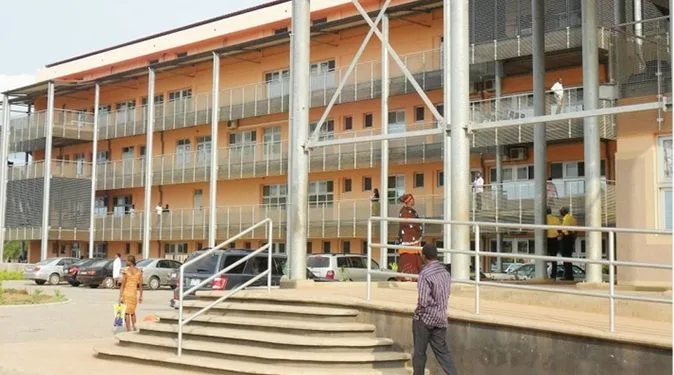
    The Tamale Teaching Hospital (TTH) has come under scrutiny following a recent claim by the Auditor-General’s (A-G) report, revealing financial irregularities at the hospital.

    The report suggests that the hospital paid salaries amounting to GHS 1,449,000 to a deceased staff member for a period of 26 months.

    Appearing before the Public Accounts Committee (PAC) in Accra on Monday, September 29, the hospital’s Director of Administration, Dr. Emmanuel Sena Kwasi Donkor, affirmed the report, adding that the hospital has so far recovered GHS303,558.68 of the total amount.

    He explained that the banks previously handling the transactions had, through a letter, indicated that they have ceased processing them.

    “We were able to recover some amounts. Before we got here, we had received letters from some banks stating that they had stopped transferring the funds to the government chest,” Dr. Donkor told the Committee.

    He further urged Parliament to intervene and help the hospital recover the remaining funds.

    “Maybe at the end of this session, we will make a prayer to this House for the House to make an order directing those banks to transfer,” he said.

    Dr. Donkor revealed that his outfit has submitted the names of the individuals implicated in the act to the Economic and Organised Crime Office (EOCO)for recovery.

    “EOCO has written back requesting the files of the people involved, and we have submitted them,” he added.

    Meanwhile, Ranking Member Samuel Atta-Mills has raised serious concerns regarding the issue.

    “Habib Napare – date of separation was 2022. This guy had died. Didn’t you go to the funeral? And you validated this dead person for 26 months? And now you are coming to tell Parliament to do what?” Atta-Mills asked sharply,” he added.
    In the meantime, the Office of the Special Prosecutor (OSP) has released a fifty-page report covering investigations and prosecutions carried out between January 1 and July 31 this year.

    The OSP’s Seventh Half-yearly Report is pursuant to Section 3(3) of the Office of the Special Prosecutor Act, 2017 (Act 959). The document also outlines key developments in the Office’s operations.

    According to the OSP, despite resistance from powerful interests, it stayed focused on executing its mandate during this period. As such, the Office successfully progressed significant corruption-related investigations to the stage of court proceedings, while also initiating new inquiries into suspected acts of corruption.

    “Then again, the Office, as one of three implementing partners of the new National Ethics and Anti-Corruption Strategy and Implementing Plan, is fashioning and moulding anti-corruption structures that would stand the test of time. The task ahead remains formidable. Much more so is our resolve to perform.

    “This reporting period was characterised by intensification of the Office’s prosecutorial mandate. We advanced high-profile investigations to court and initiated bold inquiries into suspected corruption, often in the face of deep-seated resistance from entrenched interests.

    “Notwithstanding these expected challenges, the Office remains resolute and guided by the rule of law, fairness, firmness, evidence-based action, and the interest of the public. We recognise that the fight against corruption cannot be waged and won only through punitive action and incarceration,” parts of the report read.

    The legislative framework of the Office of the Special Prosecutor mandates the Authority to crack down on corruption, recover assets, and confiscate illicit property.

    “Indeed, the legislative set-up of the Office leans heavily on corruption-prevention and asset recovery and disgorgement of tainted property. Consequently, we proceed on sustainable anti-corruption outcomes by pairing enforcement with robust prevention and asset recovery, especially founded on our unique plea bargaining regime.

    In this spirit, the Office scaled up its preventive mandate through active engagement with public institutions, private sector actors, civil society- and secured convictions and asset recovery through impactful plea bargaining. We also reckon that the nation’s anti-corruption legal framework requires re-imagination, modernisation and retooling to address the immense scale and complexity of modern corruption in the context of our social, economic and political constructs.

    “On this score, the Office has proposed the inclusion of a new chapter in the Constitution dedicated to the fight against corruption through definitive constitutional expression by the institution of proposed concrete measures to effectively and comprehensively suppress and repress corruption in public life as well as in the private sector chief among which include lifestyle audit non-conviction-based asset recovery, enhanced asset declaration and verification regime, and reverse onus presumption of corruption as the foundation of both anti-corruption criminal proceedings and civil asset recovery proceedings,” parts of the report added.

    The Office is also leading the charge in respect of the passage of a comprehensive Corrupt Practices Act and Conduct of Public Officers Act.

    Currently, sixty-seven(67) cases are being handled by the Office, all of which are undergoing comprehensive review.

    The corruption cases being investigated by OSP include: Minerals Income Investment Fund, Ghana Airports Company Limited, Ghana Education Service, National Commission on Culture, Ghana Revenue Authority/Tata Consulting Services, National Service Authority, Ministry of Health/Service Ghana Auto Group Limited, National Cathedral.

    The others are: Tema oil refinery and Tema Energy and Processing Limited and the Electricity Company of Ghana Limited, State lands, Stool lands, and other Vested lands, Illegal Mining, National Sports Authority, Customs Division of Ghana Revenue Authority, Bank of Ghana and Estate of Kwadwo Owusu-Afriyie, alias Sir John.

  • Payment of public sector salaries likely to be affected by Parliamentary impasse – Akim Swedru MP

    Payment of public sector salaries likely to be affected by Parliamentary impasse – Akim Swedru MP

    Akim Swedru Member of Parliament, Kennedy Nyarko Osei, has warned that the payment of public sector salaries could be disrupted in the coming months due to an ongoing impasse in Parliament.

    He expressed concerns that, without consensus on a budgetary allocation for the upcoming quarter, essential workers, including those in security services, may face delayed or unpaid salaries as the festive season approaches.

    “If you are a public sector worker and expecting to receive your salary for Christmas, be aware that the NDC caucus in Parliament has taken a decision to obstruct and prevent the Government from submitting the three months’ salary appropriations,” Mr. Osei noted, pointing to a partisan deadlock that threatens the country’s financial stability.

    Mr. Osei criticized what he termed “partisan posturing” in Parliament, suggesting it undermines effective governance. He argued that the situation might have been avoided if the speakership position had not been awarded to an opposition member, calling it “a hard lesson” for the ruling party. “We have caused this ourselves by giving the speakership position on a silver platter to an opposition member. Hard lessons must be learned from these unfortunate events,” he stated.

    The government’s spending on compensation and wages has risen significantly, with a 21.79% increase in the second quarter of 2024, reaching GHC16.09 billion, up from GHC13.21 billion in the first quarter. This surge reflects the government’s commitment to meeting wage obligations amid rising fiscal pressures but also underscores the strain on the national budget.

    Spending Patterns in Q1 and Q2

    In Q1, total compensation expenditure amounted to GHC13.21 billion, with March marking the highest monthly expense at GHC4.74 billion. Spending increased in Q2 to GHC16.09 billion, with June recording the peak at GHC5.39 billion, indicating potential adjustments in wage settlements or an expanded payroll.

    Wages and Social Contributions

    Wages and salaries made up the bulk of compensation expenses. Q1 saw GHC11.53 billion allocated, with a notable increase to GHC14.74 billion in Q2, a 27.84% rise. Expenditure on social contributions, however, fell by 19.8% from Q1 to Q2, driven by reduced allocations in June.

    Pension and Gratuity Trends

    Pension payments remained stable, totaling GHC568.63 million in Q1 and GHC571.82 million in Q2. Gratuity spending, meanwhile, saw a minor reduction in Q2, dropping from GHC132.12 million to GHC126.24 million.

    Six-Month Financial Summary

    Overall, the government has spent GHC29.30 billion on employee compensation in the first half of 2024, roughly 46% of the annual budget allocated for this category. While current spending patterns suggest the government is on track to stay within budget, the potential for unexpected expenditures or continued parliamentary gridlock could jeopardize this goal, leaving public sector workers uncertain about future payments.

  • We have not been paid our GHC250 monthly salaries for almost a year – Zoomlion workers lament

    We have not been paid our GHC250 monthly salaries for almost a year – Zoomlion workers lament

    A group of employees from Zoomlion Ghana Limited are demanding their unpaid salaries, which have been in arrears for nine months. 

    One worker expressed frustration, revealing that they receive a meager salary of GH¢250 per month, equating to around GH¢8 per day.

    She described the hardships they face, including the tragic deaths of two colleagues due to a lack of access to quality healthcare. 

    “Two people are dead as I speak, and we buried one last Saturday. We don’t have money for medication. The salary is GH¢250 a month, which means about GH¢8 per day. Now, as we enter October, it becomes ten months without pay. How do we take care of our children in school? How do we get medication when we are sick?” she lamented.

    She further highlighted the lack of support from the company for deceased workers, with no financial contribution to their funerals or benefits for their families. 

    “When someone dies in service, the company doesn’t contribute anything towards the funeral. We, the leaders, have to push for the arrears to be given to the children of the deceased. There are no allowances or health insurance. Some of us have worked for 15 to 17 years without any pension or designated healthcare facilities,” she added.

    Management has attributed the delayed payments to contractors, who in turn claim they have fulfilled their financial obligations. The worker shared their frustration, stating, “Contractors say they don’t owe any money, but our leaders say the government has to pay them before they can pay us. So, who is holding our money?”

    The group is appealing to relevant authorities to intervene, seeking both the overdue payments and a reconsideration of their wages to help manage their debts and restore their dignity.

    In line with Section 113 (1) (a) of the Labour Act, 2003 (Act 651), the National Tripartite Committee increased the national daily minimum wage from GH¢14.88 to GH¢18.15 effective from January 1, 2024. This highlights a contradiction, as the waste management company appears to be non-compliant with the approved minimum wage.

    Watch video below:

  • You can have our August salaries, we will still strike – CETAG members to govt

    You can have our August salaries, we will still strike – CETAG members to govt

    Members and leaders of the Colleges of Education Teachers Association of Ghana (CETAG) remain steadfast despite their employers threatening to freeze their salaries.

    In an interview with JoyNews, a member of CETAG’s national communications team, Fedilis Kamaayi, confirmed their determination to continue the strike, which has now lasted over six weeks, demanding improved conditions of service.

    Mr Kamaayi noted that CETAG members anticipated that salary freezes might be used as a tactic to end the strike.

    He emphasized that this threat has only strengthened their resolve.

    “When the directive was issued, it has even motivated and gingered most of our tutors and they are saying that they should even take the August salary in addition because until all the arbitrary awards are implemented, they can go ahead and continue to freeze the salaries,” he said.

    Mr. Kamaayi mentioned that the members are mentally prepared for the challenges ahead.

    This comes after the Minister of Education instructed Principals and the Controller and Accountant General to withhold the July 2024 salaries of teaching staff from the 46 public colleges of education due to the ongoing strike.

    The strike, which started on June 14, has significantly disrupted academic activities, leading to many students leaving campus.

    When asked about the strike’s continuation, Mr. Kamaayi expressed optimism that the situation would be resolved soon.

    “We have students in final year who have one more semester for them to complete and we have also started selling admission forms for new level 100s to be admitted. So, if you look at all these things, it will not augur well for the educational system in the country so our employer will not go there.”

    Meanwhile, Professor Samuel Atintono, President of the Conference of Principals of the Colleges of Education, has stated that the salary freeze cannot be reversed.

    “It was GTEC that wrote the letter not to validate the July salaries so not until GTEC writes again, we cannot reverse,” he said.

  • Don’t pay July salaries of Colleges of Education Teachers – Govt

    Don’t pay July salaries of Colleges of Education Teachers – Govt

    Government has collaborated with Ghana Tertiary Education Commission (GTEC), to instructed the Controller and Accountant General’s Department to halt the salaries of all instructional staff at Colleges of Education for July.

    In a letter dated July 22, 2024, the Commission indicated that this order, prompted by the Minister for Education, Dr. Yaw Osei Adutwum, is due to the Colleges of Education Teachers Association Ghana (CETAG) not ending their current strike, which began in June.

    “At the instance of the Minister for Education on the non-adherence of CETAG members to call off an illegal strike from June 2024, you are by this letter requested to stop the salaries of all teaching staff of the Colleges of Education (CETAG) except for the College Principals for July 2024. By this letter, the College Principals are not to validate the July 2024 salaries of all teaching staff,” the letter signed by the Head of IPP at GTEC, Prof. Ahmed Jinapor Abdulai, stated.

    Meanwhile, CETAG, which has maintained that its strike action over the non-implementation of the outstanding arbitration award by the National Labour Commission (NLC) is legal, has warned of legal action against any attempt by the government to freeze their salaries.

  • Govt should divert salaries of irresponsible parents to their children – Okyenhene

    Govt should divert salaries of irresponsible parents to their children – Okyenhene

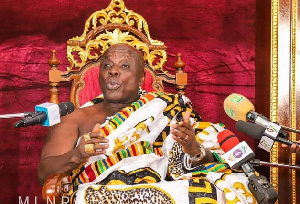
    Okyenhene Osagyefuo Amoatia Ofori Panin is calling for legislation that would halt the salaries of parents who have abandoned their children and neglected their parental duties.

    He proposed that the withheld salaries be utilized by the government to support the education and maintenance of these children.

    Osagyefuo Amoatia Ofori Panin believes that if the government imposes a freeze on the salaries of parents who abandon their children, it would encourage responsible parenting nationwide, diminish the issue of streetism, and safeguard the welfare of these innocent children.

    Addressing the 2024 Ohum Kan Festival durbar in Kyebi, Okyenhene voiced his concern about parents who neglect their offspring after birth.

    “You give birth in your community and abscond to a different town to work without providing for your children. That is irresponsible. The state should be able to freeze your salary or whatever you earn, and use it to take care of the child. You will work but your salary will go to the children you have deserted”, Osagyefuo Amoatia Ofori Panin stressed.

    Okyenhene urged parents to take responsibility for their children’s well-being and safety to foster a safer and more harmonious community.

    He warned that children abandoned and left to fend for themselves on the streets could eventually become a source of trouble for the affluent if their situation is not addressed.

    Discussing the importance of patriotism and responsibility, Osagyefuo Amoatia Ofori Panin alluded to reports that some teaching and non-teaching staff at various Senior High Schools are intentionally undermining the Free SHS policy.

    He noted that some staff members have developed a habit of pilfering food supplies intended for the students.

    He referenced an incident in Kyebi where a staff member stole food meant for the students and emphasized that such individuals should be publicly identified and condemned.

    “The state is struggling to ensure that every Ghanaian child gets some basic education for free. You steal food items meant for these innocent children and create shortage of food in the schools then you have the gust to video food being served in the school and make mockery of its quality to the world. Have you forgotten you stole the stuff ? You don’t have shame ?” Osagyefuo stressed.

    He urged Ghanaians to revive their sense of patriotism and love for their country.

    Osagyefuo Amoatia Ofori Panin advised the youth to avoid all forms of drug abuse and lead a respectable lifestyle.

    “They say there is one called tramadol or something, they take it and become sober. It’s not good, you must desist from drug abuse in all forms. The nation needs you,” Okyenhene added.

    He advocates for the Police to vigorously pursue drug traffickers and bring them to justice, as their actions have serious repercussions on both the youth and the elderly.

    This year’s Ohum festival coincides with Osagyefuo Amoatia Ofori Panin’s 25th anniversary of ascending to the Ofori Panin Stool.

    The Ohum festival embodies the fundamental Akan belief in the interconnectedness of the deceased, the living, and the yet-to-be-born.

  • Salaries of civil servants increased by 25% and 35% in Nigeria

    Salaries of civil servants increased by 25% and 35% in Nigeria

    Civil servants in Nigeria will see their salaries boosted by 25% to 35% in a bid to address the challenges posed by the escalating cost of living, as reported by Reuters news agency.

    According to the report, the least-paid government employee will now earn $324 (£258) annually.

    Police and military personnel are among the state workers slated to benefit from these salary increments, effective from January and retroactively applied.

    This announcement coincided with the eve of Wednesday’s Workers’ Day holiday.

    However, Nigeria’s inflation rate has surged to over 30%, the highest in nearly thirty years.

    Moreover, food prices have soared by 35%, according to the latest data from the National Bureau of Statistics. As a result, the salary increases for civil servants effectively maintain their purchasing power at existing levels.

    The National Salaries, Incomes, and Wages Commission (NSIWC) disclosed that pensions for eligible workers would also witness a boost of 20% to 28%.

    These adjustments follow recent salary increases for academic and healthcare professionals.

    Despite these measures, the monthly minimum wage, mandated by the government for all employers, remains stagnant since 2019, standing at 30,000 naira. With the currency’s sharp depreciation, this amounts to just $19 (£15).

    Furthermore, the government has hiked electricity tariffs for high-consuming consumers, aiming to reduce the financial burden on public finances.

    While the Nigeria Labour Congress (NLC) appreciated the salary increments, it urged the government to ensure they reflect the country’s challenging economic conditions.

    “These categories of workers are already in the privileged sector but we expect it to be extended also to other categories of civil servants who are in lower cadre and are vulnerable,” NLC spokesman Comrade Benson Upah told local media.

  • Unemployed, children will receive monthly allowances from me if elected president – Akpaloo


    The Presidential Candidate of the Liberal Party of Ghana (LPG), Percival Kofi Akpaloo, has pledged to provide every Ghanaian child with a monthly allowance if elected as President.

    Mr Akpaloo envisions significant economic transformation for Ghana should he assume office.

    Speaking to Kwadwo Oppong Kyeremeh, Akpaloo emphasized his commitment to distributing monthly allowances to every Ghanaian child, drawing inspiration from similar initiatives benefiting his own children abroad. He believes this measure will stabilize the economy, fostering prosperity by enabling citizens to actively participate in economic activities.

    Akpaloo asserts that this initiative isn’t limited to children but extends to unemployed individuals, providing them with financial support until they secure employment. He reiterated his longstanding promise to implement these measures during an interview on the Angel Morning Show (AMS), emphasizing their alignment with the LPG’s manifesto, “A Better Tomorrow, A New Plan for Jobs and Wealth Creation.”

    Akpaloo’s vision reflects a holistic approach to social welfare, aiming to improve the lives of Ghanaians across various demographics. If elected, he intends to prioritize these initiatives to pave the way for a brighter future for all citizens.

    “In the first place, if elected as President as revealed to me by God, I will pay every Ghanaian child monthly allowance as my six children are benefiting elsewhere in the diaspora.

    “Every child will be paid monthly, and this will make the economy stable so that businesses can flourish because once there is money for every citizen they can as equally patronize goods and items from traders,” he told Kwadwo Oppong Kyeremeh.

    “Again, as done in abroad, I will pay every Ghanaian who is unemployed and is 18 years and above including the aged who cannot work in their capacity will be paid monthly,” he added.

  • Workers at ATL launch sit-down strike demanding unpaid salaries and allowances

    Workers at ATL launch sit-down strike demanding unpaid salaries and allowances

    Employees at Akosombo Textile Limited (ATL) have initiated a sit-down strike, citing unpaid salaries and outstanding allowances dating back to 2021 as the primary reasons for their actions.

    The striking workers allege that the company’s machinery has been dismantled and sold as scrap, painting a grim picture of its operational capacity.

    Expressing concerns over inadequate compensation, they highlight instances where some employees reportedly earn less than GH¢500.

    This independent strike, launched on Friday morning, was not endorsed by the local textile workers union’s leadership, whom they accuse of neglecting their interests and aligning with management.

    Wary of potential repercussions from management, workers have refrained from granting interviews.

    Nevertheless, they convey their discontent with the prevailing situation, blaming the government for portraying ATL as stable despite its deteriorating condition.

    ATL’s financial challenges and operational sustainability have been recurring themes in recent news coverage. In various reports, workers have appealed to the government to urgently intervene, addressing their grievances to alleviate the hardships faced by employees and ensure ATL’s viability.

  • Defreeze our salaries by Friday or blame yourself for what comes next – NAGRAT warns Special Prosecutor

    Defreeze our salaries by Friday or blame yourself for what comes next – NAGRAT warns Special Prosecutor

    The National Association of Graduate Teachers (NAGRAT) has issued a two-day ultimatum to the Office of the Special Prosecutor (OSP) to release the salaries of some teachers by Friday or face their wrath.

    The Association claimed that the OSP had withheld the salaries of over 400 teachers.

    The OSP stated that they are investigating ghost names on the government’s payroll, which is their justification for withholding the salaries.

    However, NAGRAT President Angel Karbonu argued that this is not sufficient justification for withholding their salaries.

    “When you’re auditing somebody, until the audit is completed and you have conclusively arrived indicating that A, B and C are not qualified to earn a salary, you don’t go ahead to inflict purgery.”

    Speaking on NewsNite on Wednesday, NAGRAT President Angel Karbonu warned that the association would be forced to resort to other measures if the Office of the Special Prosecutor fails to release the withheld salaries by Friday, February 16, 2024.

    “He [Special Prosecutor] has not finished prosecuting people who have been given bribes in elections and things like that, it is not poor teachers that he is coming to zero in on,” he said.

    “If he does not defreeze the salaries by Friday, he will have to be blamed for whatever happens after Friday.”

  • Rotational nurses to hit streets over unpaid salaries

    Rotational nurses to hit streets over unpaid salaries

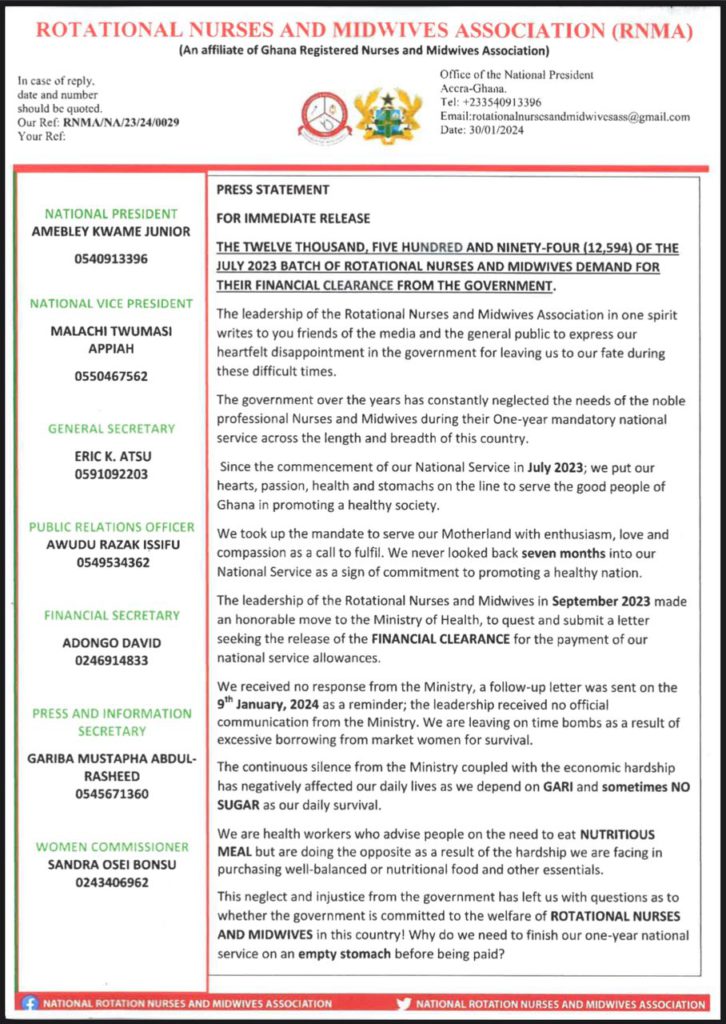
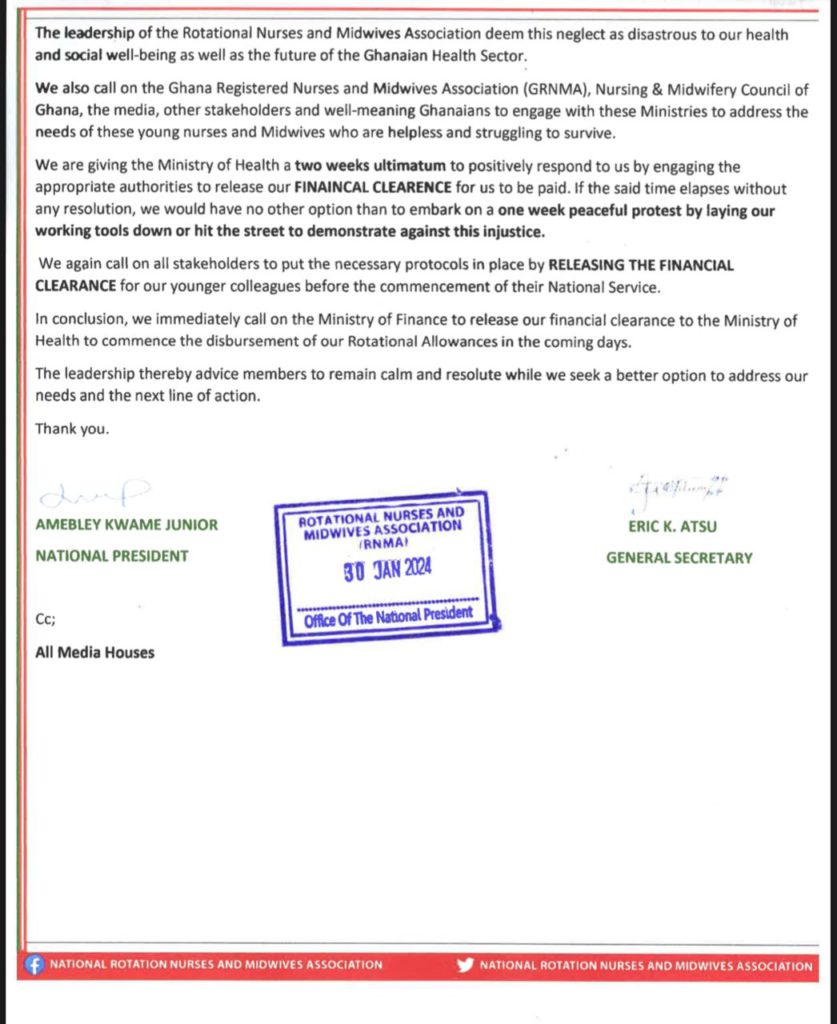
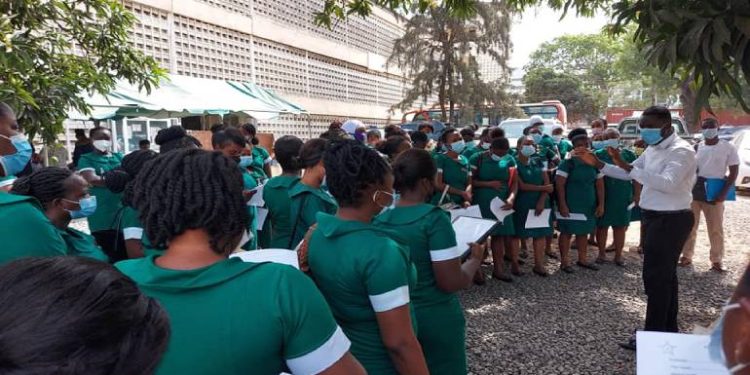
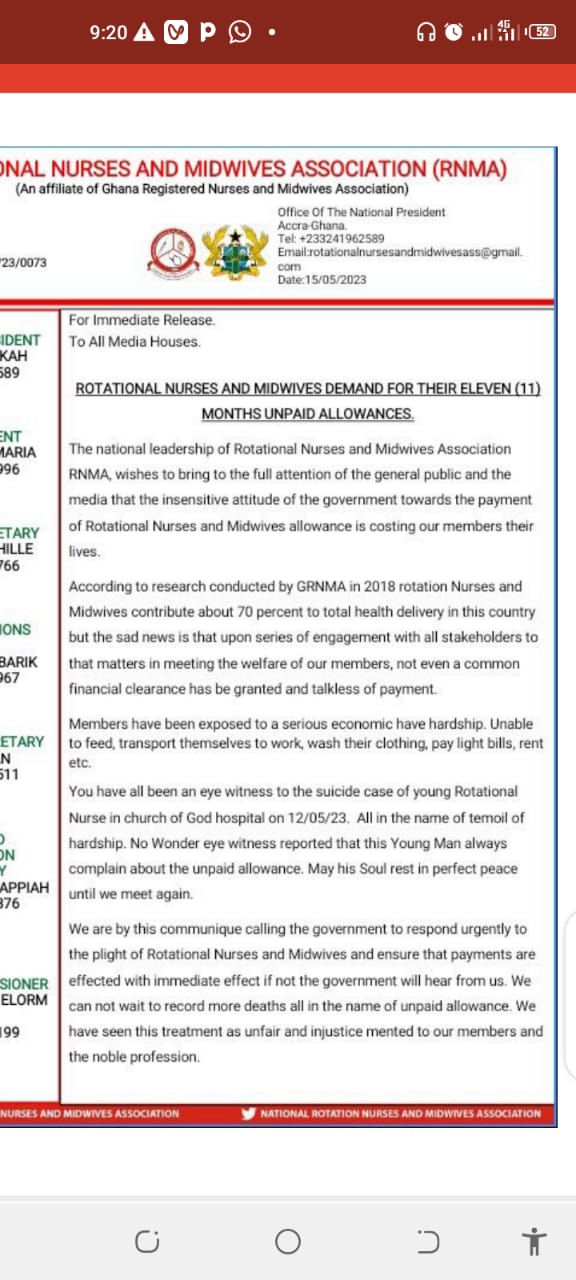
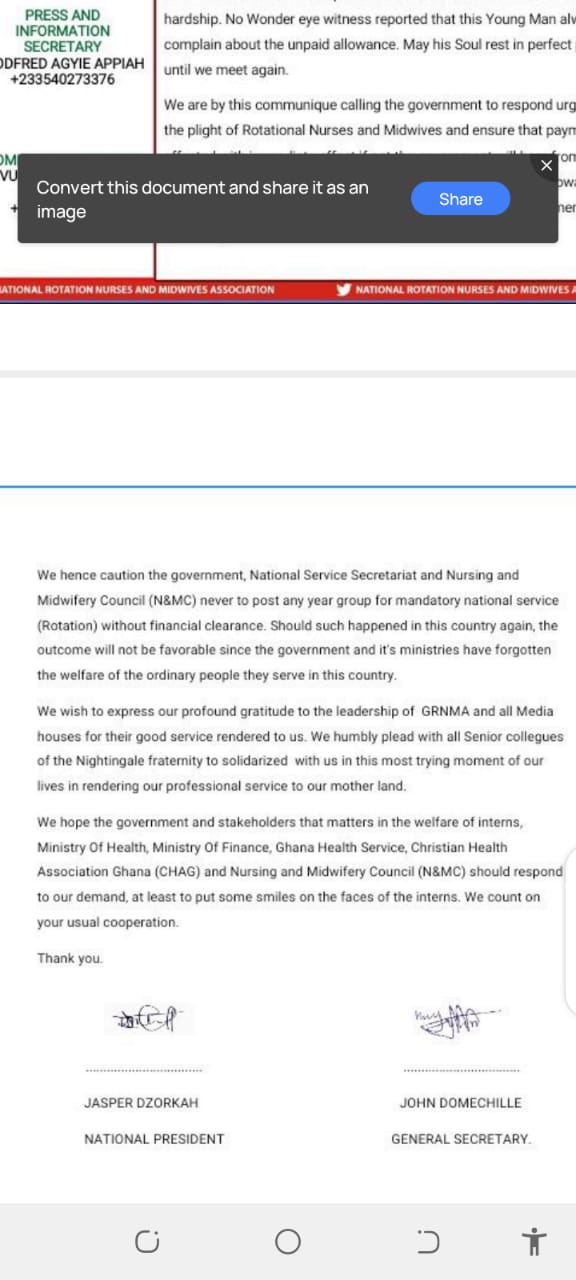
    The Rotational Nurses and Midwives Association (RNMA) is poised to initiate a one-week peaceful protest in response to the government’s delay in providing financial clearance.

    The 12,594 members of the July 2023 RNMA batch are prepared to embark on a strike if their demands are not addressed within the stipulated two-week timeframe.

    Claiming negligence of their needs during the one-year mandatory national service since July 2023, the Association emphasized that the government has failed to fulfill its obligations.

    In a press statement signed by the National President, Ambley Kwame Junior, the group revealed that their plea for financial clearance was submitted to the Ministry of Health in September 2023 but has gone unanswered.

    The RNMA is urging all stakeholders involved, including the government and the Ministry of Health, to take prompt action and ensure that their rightful entitlements are granted.

    Read full statement below:

  • Sex workers faced reduced income during COVID-19 but Akufo-Addo did not reduce salaries – Bishop

    Sex workers faced reduced income during COVID-19 but Akufo-Addo did not reduce salaries – Bishop

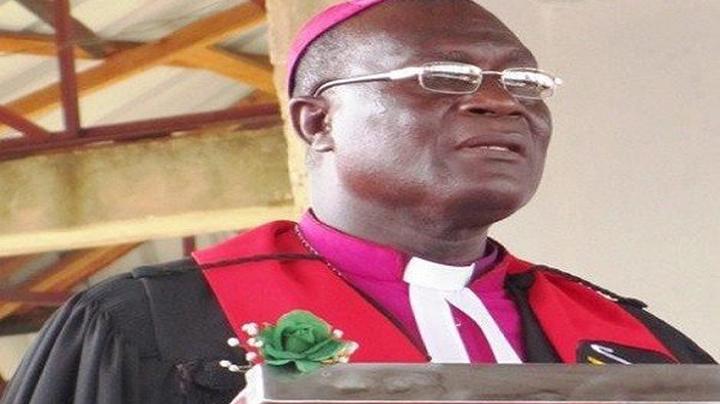
    Former Methodist Bishop of Obuasi Diocese, Bishop Stephen Bosomtwe Ayensu, responded to questions regarding his and other religious leaders’ reluctance to criticize the Nana Addo-led administration for its shortcomings, as they did during the tenure of former President John Mahama.

    He stated that President Akufo-Addo’s government has been doing its best to manage the country despite the challenges and that global factors, including the COVID-19 pandemic, have contributed to the difficulties.

    Bishop Ayensu also defended his previous criticisms of former President Mahama, citing economic challenges during that time, and expressed his view that the current administration has performed better compared to the previous NDC government.

    “Thank you for making reference to such stories where I gave it to Mahama. It is good to reference such records. It helps by giving us an opportunity to recollect the past.

    “When you go into an examination hall, you answer the questions with the expected answers and not different answers. When journalists call me for an interview, I provide answers based on the questions they ask me. If you have good intentions or bad ones and you ask your questions, I will respond with my answers.”

    Under Mahama, I responded by providing answers to the kinds of questions I was asked. Those who conduct the interviews also have their agenda.”

    In regard to the Akufo-Addo administration’s performance, Bishop Ayensu pointed out that the indicators and government’s overall performance should be assessed truthfully. He acknowledged that the outbreak of COVID-19 was devastating and had severe repercussions, emphasizing the importance of focusing on the handling and impact of such crises. Bishop Ayensu noted that, when examining the records, it becomes evident that President Akufo-Addo’s government had performed well until the onset of COVID-19.

    He also highlighted that even sex workers experienced reduced income during this challenging period, yet the Akufo-Addo government maintained worker salaries without reductions.

    “Things became so difficult that even commercial sex workers had their payments reduced. But the government did not reduce the salaries and wages of workers. Those who did not even go to work were paid their salaries. We were provided with free water and electricity. From the perspective I am speaking from, I believe things were going well until the global crisis came in,” he said

    He continued by saying that the president has told us that he is working to fix the issues and has openly acknowledged that things were challenging.

  • How govt blew GHS5.7bn on salaries and subsidies in 2022 – Auditor-General report reveals

    How govt blew GHS5.7bn on salaries and subsidies in 2022 – Auditor-General report reveals

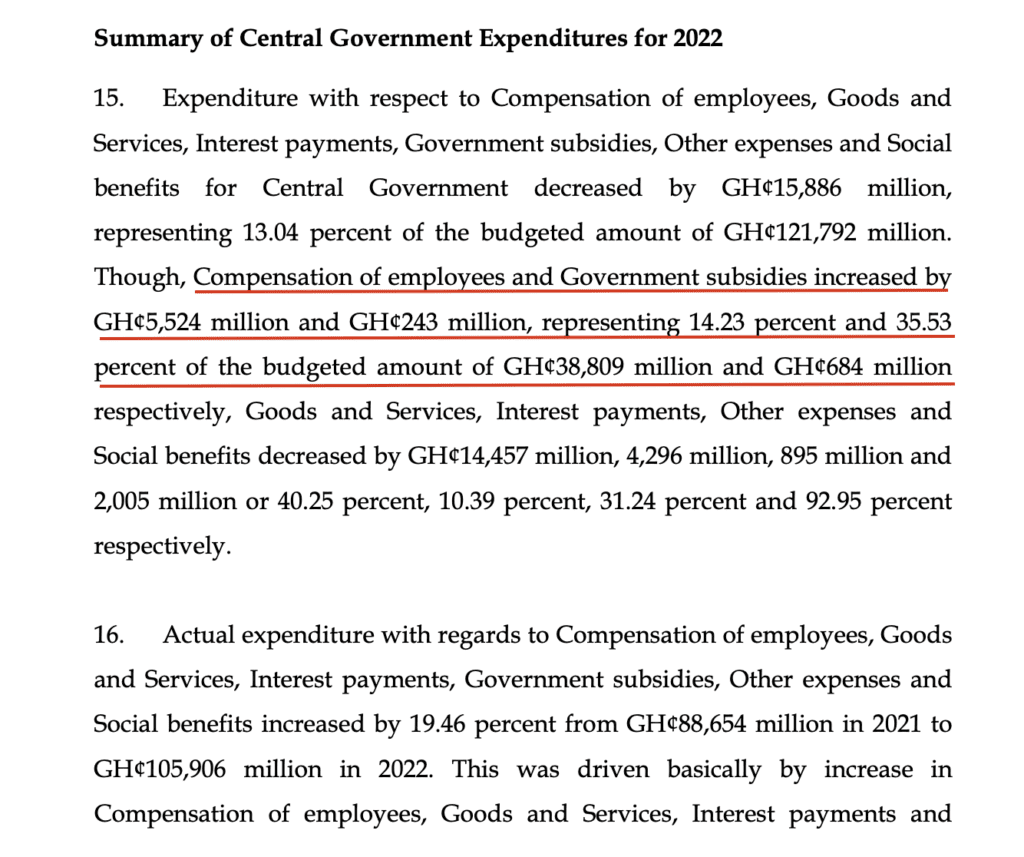
    The 2022 Auditor-Generals report has revealed that the government spent more money on paying salaries and subsidies to its employees and institutions in 2022 than it had planned. 

    The report stated that the government had budgeted GH¢38,809 million for salaries and GH¢684 million for subsidies in 2022, but ended up spending GH¢44,333 million and GH¢927.25 million respectively. 

    This means that the government overspent by GH¢5,524 million on salaries and GH¢243 million on subsidies, representing 14.23 percent and 35.53 percent of the budgeted amounts respectively.

    The report explained that salaries are the payments made to public servants for their work, while subsidies are the financial support given by the government to some institutions or sectors to reduce their costs or prices.

    The report did not specify which institutions or sectors received the subsidies, but they could include education, health, agriculture, energy, transport, or others.

    The report also showed that the government spent less money on other items such as goods and services, interest payments, other expenses and social benefits in 2022 than it had planned.

    The report stated that the government had budgeted GH¢121,792 million for these items in 2022, but ended up spending GH¢105,906 million. This means that the government underspent by GH¢15,886 million on these items, representing 13.04 percent of the budgeted amount.

    The report attributed the decrease in spending on these items to various factors such as improved debt management, enhanced internal controls, reduced wastage and corruption, and better allocation of resources. The report also noted that some of these items increased in actual terms compared to 2021, but they were still lower than the budgeted amounts for 2022.

    The report commended the government for its efforts to control its expenditure and achieve fiscal consolidation in 2022. Fiscal consolidation is the process of reducing the government’s budget deficit and debt levels. The report also urged the government to implement its recommendations to ensure fiscal discipline and accountability.

    Report of the Auditor-Gener… by The Independent Ghana

  • Salaries of nurses appalling – GRNMA

    Salaries of nurses appalling – GRNMA

    The nature of the pay that health workers in Ghana get, according to the Ghana Registered Nurses and Midwives Association (GRNMA), is another factor contributing to their emigration.

    Nurses don’t make enough money, says association president Perpetual Ofori Ampofo, which is a sad reality.

    With over 4,000 nurses leaving the country between January and July for Europe, she claimed that the exodus has grown alarming.

    She quickly clarified, though, that other nations have the same problems as Ghana.

    The reality is that nurses and midwives in Ghana do not receive the highest pay. I am aware that it is not limited to Ghana, though. The problem exists both inside the subregion and throughout all of Africa.

    Therefore, the issue of nurses leaving Ghana is not limited to that country; it also affects Nigeria, the Ivory Coast, and other nations. Because of the poor pay and terrible working circumstances, she was quoted by citinewsroom.com as saying, “They are leaving.

  • Salaries and wages experienced an increase as against what 2023 budget stated

    Salaries and wages experienced an increase as against what 2023 budget stated

    Leader of the opposition in the House, Cassiel Ato Forson, l has stated that the Finance Minister cannot make certain expenditure decisions without getting parliamentary consent.

    He claims that the minister went against his word, despite it being stated in the 2023 budget that there would be no pay or salary increases.

    When the minister pretended to give the statement for the mid-year budget review, Ato Forson presented the argument on the floor of the legislature.

    He said: “I am of the view that if the minister of Finance is varying any expenditure line downwards there is the need for parliament to approve it. We know for a fact that the budget was prepared with the note that the government was not going to increase wages and salaries.

    “Mr. Speaker, subsequently, government increased salaries and wages. It means that the mid-year review the minister is presenting today will include an increase in the compensation line. He can’t do it unilaterally; parliament will need to give him permission,” he noted.

    On Monday, July 31, 2023, the mid-year budget review for 2023 will be presented to Parliament by Finance Minister Ken Ofori-Atta.

    The Budget Statement on the Economic Policy of the Government of Ghana for the Fiscal Year is being presented in compliance with the Public Financial Management Act 2016’s provisions, which require the Minister of Finance to do so.

    It aims to give the administration a platform to inform the House and the public of its economic progress and to lay out any modifications to the budgetary allocations and policies that may be required.

  • NLC directs FWSC to reinstate GBC staff allowances

    NLC directs FWSC to reinstate GBC staff allowances

    The Fair Wages and Salaries Commission (FWSC) has been ordered by the National Labour Commission (NLC) to overturn a decision to block the allowances of certain GBC employees.

    This follows weeks of protests and threats of industrial strike action by the workers.

    According to Sam Nat Kevor, the Divisional Union Chairman of GBC, the affected allowances which include rent, housing, utility, vehicle maintenance and transportation, must be restored since inflation keeps rising and therefore the withdrawal of such allowances will worsen the cost of living.

    However, the FWSC Boss, Ben Arthur insists the initiative forms part of its nationwide payroll monitoring exercise with the Internal Audit Agency.

    He explained that as part of the payroll monitoring exercise, it had been discovered that some staff of GBC are currently enjoying allowances that they are not entitled to.

    Mr Arthur said the commission exists to ensure better working conditions for workers and will not compromise.

    But during a hearing of a complaint tabled before it by the FWSC over the pending strike by the staff of GBC, the NLC described the FWSC’s directive as unlawful.

    Subsequently, the Commission has given the FWSC a 14-day ultimatum to reverse its decision to strike out the allowances in question and restore all deductions made from the salaries of GBC staff.

    Background 

    The FWSC began payroll auditing in April this year. Two weeks ago, the FWSC audited the payroll of the staff of GBC over some allowances which, it said, some staff did not deserve.

    It, therefore, wrote to the CAGD to stop the payment of the allowances and allow the affected staff to refund the money. The GBC unionised staff cautioned against the directive, but the CAGD carried it through. 

    Recounting the genesis of what led to the deductions by the FWSC, the divisional union chairman said these allowances were negotiated as “per our collective agreement and senior management staff condition of service.”

    He said the last negotiation by the Public Services Joint Standing Negotiation Committee (PSJNC) occurred on August 26, 2019, with the effective payment date being January 1, 2020.

    He said, “The disposition of the CEO of the FWSC began with the negotiation for our category two and three non-core allowances which started smoothly in 2021 with the then CEO, Dr Edward Kwapong until Mr Arthur took over in the latter part of 2022.”

    The posture of Mr Arthur, according to Mr Kevor, was clearly manifested in the number of times negotiations had to be adjourned. 

    Negotiations

    Mr Kevor alleged that Mr Arthur deliberately delayed forwarding the outcome of the negotiations to the Ministry of Finance for onward transfer to the CAGD.

    He said in spite of the intervention from the Minister of Employment and Labour Relations, Mr Arthur still delayed for four months until he finally forwarded the signed agreement to the Ministry of Finance.

    Mr Kevor, who wore red headgear and was flanked by the Chairman of the Senior Management Union, Alhaji Abdul Razak Tahiru, and a member of the Local Trustee, Mr Abraham Osekre, said a meeting convened by the Minister of Information and the CEO of FWSC to seek a resolution to the impasse could not yield any result as Mr Arthur claimed that the collective agreement of GBC had expired and also the allowances had been revised under the Single Spine Salary Scheme.

    He said in spite of efforts to prevent the deductions and to meet him, Mr Arthur went ahead and directed the CAGD to remove the allowances of GBC workers. 

  • Pay us or face our wrath – Rotational nurses to govt

    Pay us or face our wrath – Rotational nurses to govt

    The Rotational Nurses and Midwives Association has asked the government to pay allowances due them or face their wrath.

    The group says the failure of the government to pay their allowances is causing severe hardship for its members.

    According to the group, the hardship has led to the demise of one of its members Paul Dodzi.

    The deceased Rotational Nurse is reported to have allegedly taken his own life at Asankragua in the Western Region because of hardship.

    According to the association, its members are yet to receive their allowances since they began serving in July 2022, after being posted by the National Service Secretariat (NSS) in June 2022.

    In a statement, the group called on the government to immediately pay the rotational nurses their due allowances or face their wrath.

  • UK Nurses’ make “u-turn” on decision to hold out for double-digit pay rise – Cabinet minister laments

    UK Nurses’ make “u-turn” on decision to hold out for double-digit pay rise – Cabinet minister laments

    Despite previously advising a lower offer, the head of the UK nursing union wants to resume negotiations in pursuit of a double-digit salary increase.

    Pat Cullen, the general secretary of the Royal College of Nursing (RCN), had advised members to accept an offer of 5%, but they voted to reject it.

    Speaking to the international media, Sophy Ridge On Sunday programme, cabinet minister Grant Shapps said: “I find this a very curious story indeed because Pat Cullen just recently was encouraging her members to settle for the pay rise that was put on the table.

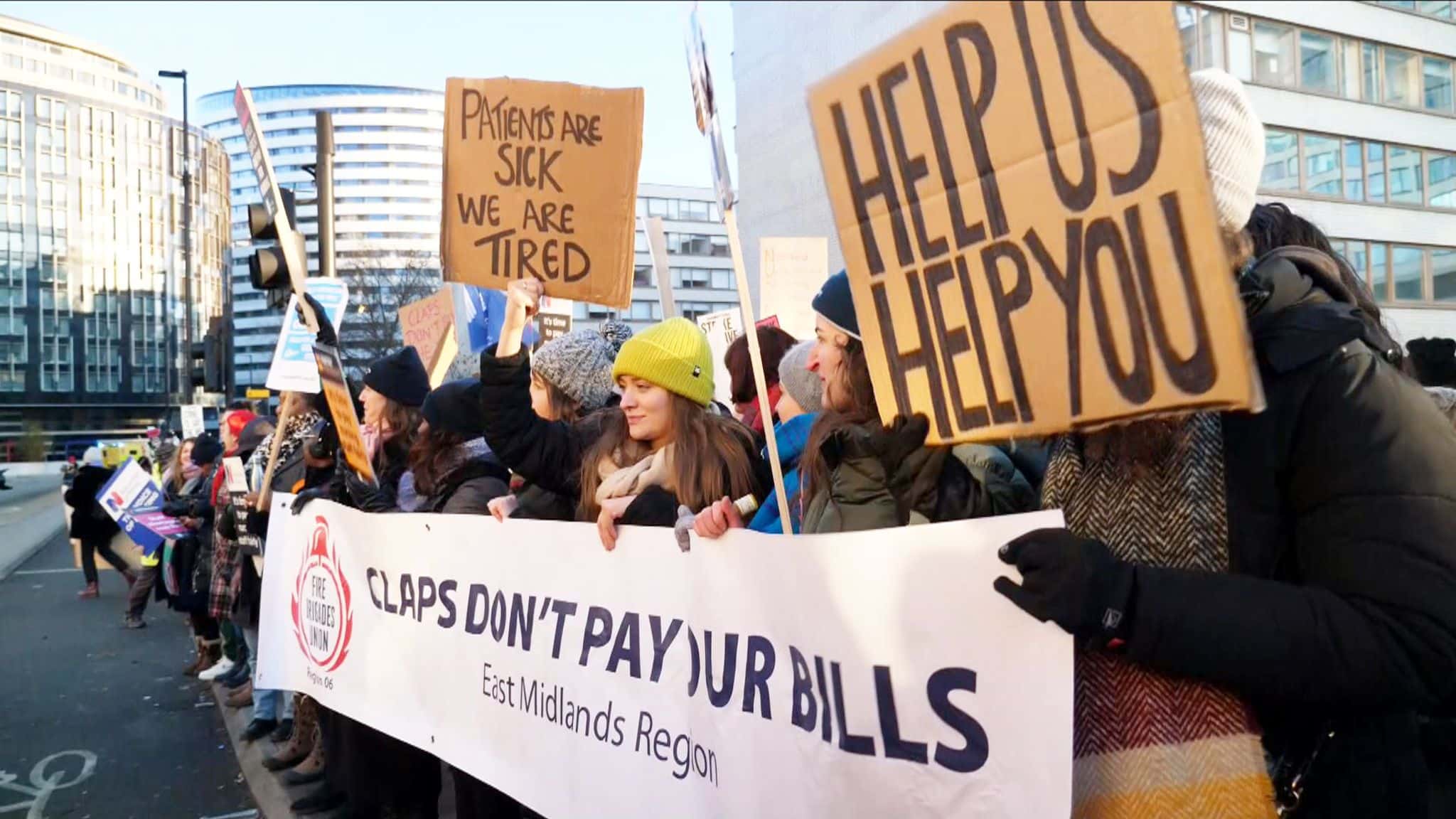
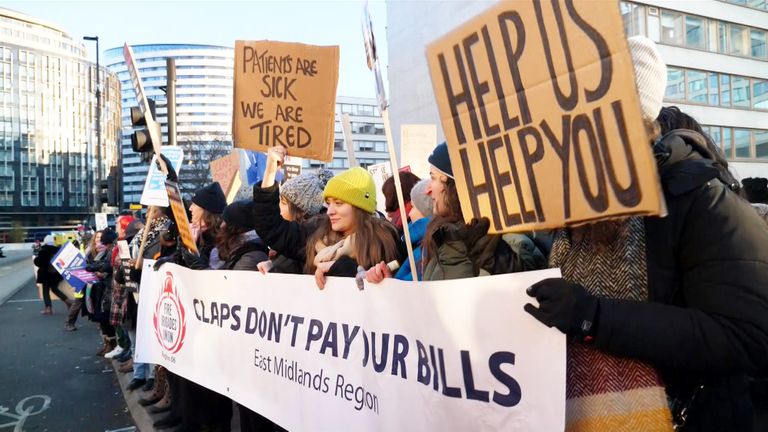
    Nurses on strike outside of St Thomas' Hospital in London in April
    Image: Nurses on strike outside St Thomas’ Hospital in London in April

    “I thought this was a great settlement.

    “It’s frankly rather confusing having encouraged her members to accept that deal, she seems to now be coming back and saying the opposite.

    “You have got to balance that with the rest of the public purse.”

    RCN members will be balloted again for strike action on 23 May after the existing six-month mandate ran out at the start of the month.

    Ms Cullen described striking as one of the “hardest decisions”, and told The Sunday Times that fresh negotiations were needed to prevent six more months of action.

    “They [ministers] owe that to nursing staff not to push them to have to do another six months of industrial action right up to Christmas,” she said ahead of Sunday’s RCN congress in Brighton, telling Health Secretary Steve Barclay talks needed to “start off in double figures”.

    “It’s just not right for the profession,” she said.

    “It’s not right for patients. But whose responsibility is it to resolve it? It is this government.”

    The nurses’ strikes: A timeline

    25 November 2022 -The Royal College of Nursing announces it will hold strike action for the first time since its creation more than a century ago in a dispute over pay and working conditions.

    15 December – Nurses hold their biggest nationwide strike in history with a 12-hour walkout, leading to thousands of appointments, procedures and surgeries being cancelled.

    18 and 19 January – Thousands of nurses hold a further strike over two days

    21 January – The head of NHS England warns repeated walkouts by health staff are making workloads ‘more challenging’.

    2 February – A petition signed by 100,000 people is delivered to Downing Street demanding fair pay for nursing.

    6 February – Tens of thousands of nurses and ambulance staff walkout together in the biggest strike in NHS history.

    21 February – Nurses agree to pause a major 48-hour strike planned on 1 March for pay talks.

    16 March – Unions, including the RCN, suspend further strikes and recommend a new pay offer involving a 5% pay rise for staff this year and a cash sum for last year.

    20 March – NHS strikes in Scotland are called off after unions representing midwives and nurses voted to accept the Scottish government’s pay offer.

    28 March – Up to 280,000 RCN members vote on whether to accept the government’s pay offer.

    14 April – RCN members reject the deal and announce a 48-hour walkout on 30 April.

    16 April – RCN leader Pat Cullen warns nurses could strike until Christmas and calls for the government to improve its pay offer.

    21 April – The government takes legal action over the planned bank holiday walkout as the strike mandate runs out during the action on 1 May.

    27 April – Strike action planned by the RCN on 2 May is called off after a judge ruled it would be unlawful.

    29 April – The RCN agrees to supply some staff during the curtailed strike following patient safety concerns.

    30 April – Nurses stage 28-hour strike.

    2 May – Most health unions back the new pay deal, although both the RCN and Unite vote against it. The RCN says it will ballot members on further strikes between June and December.

    9 May – It is announced nurses will vote between 23 May and 23 June on whether to stage more walkouts.

    10 May – Nurses in Wales vote to strike again this summer after rejecting the Welsh government’s latest pay offer.

    14 May – Ms Cullen calls for Health Secretary Steve Barclay to restart pay talks with a proposed rise in double digits – a move described as “curious and confusing” by cabinet minister Grant Shapps given she had recommended the previous offer to her members.

    An RCN spokesperson said: “The negotiations covered two financial years which resulted in a consolidated NHS pay increase of 9%. When our members rejected that, it is clear they expect an offer into double figures.”

    Fourteen other unions have accepted the government’s 5% offer, including Unison, the NHS’s biggest union. Others like Unite continue to seek a better offer.

    Please use Chrome browser for a more accessible video playerEarlier this month: Nurse strikes could go ‘right up to Christmas’

    A health department source added: “It is strange how quickly the RCN leader has changed her tune from recommending this pay deal, which she now refers to as an insult to nurses.”

    The comments come after Ms Cullen told The Sunday Times: “It’s not so long ago since the prime minister went on the media and very publicly said nurses are an exception,” she said when asked why nurses warrant a larger increase than other healthcare workers.

    “I would totally agree with him… they should be made an exception because they are exceptional people.”

    The mental health nurse, 58, from Co Tyrone, said patient safety was “at the centre of everything that we do”.

    “We will do nothing that will add further risk to the patients that we look after,” she said, saying increased pay would see nurses return to the profession and ease a staffing crisis.

    “The truth is that patient safety cannot be guaranteed on any day of the week. How could you guarantee patient safety when you have 47,000 nurses from your workforce every single day and night?”

    She also warned Prime Minister Rishi Sunak not to take her members lightly.

    “Looking back on this pay offer, I may personally have underestimated the members and their sheer determination,” she said.

    “I think what I would be saying to the prime minister, Rishi Sunak, is ‘Don’t – don’t make that same mistake, don’t underestimate them’.

    “Nurses believe it’s their duty and their responsibility because this government is not listening to them on how to bring it [the NHS] back from the brink and the message to the prime minister is that they are absolutely not going to blink first in these negotiations.”

  • Judicial Service Staff Association to strike due to unpaid salaries

    Judicial Service Staff Association to strike due to unpaid salaries

    The Judicial Service Staff Association of Ghana (JUSAG) has vowed to go on an indefinite strike should government fail to ensure a wage raise and back pay from January 2023 are granted. 

    This information was provided in a letter written to the executive secretary of the National Labor Commission (NLC).

    According to the letter from Abdulai Yakubu, general secretary of JUSAG, the government has until Friday, May 12, 2023, to accept and implement reviewed salaries with all back pay from January 2023; otherwise, the association will go on strike.

    The letter referred to a previous letter dated May 5, 2023, addressed to the President, which requested approval of the recommendation of the Judicial Council on the review of salaries and related allowances for staff of the Judicial Service in line with Article 149 of the 1992 Constitution of Ghana. 

    The letter also acknowledged the economic challenges in the country and the withdrawal of the Cost of Living Allowance in December 2022, but noted that members of JUSAG had shown patience for the past four months.

    Judicial staff

    JUSAG has reiterated its notice to the National Labour Commission, stating that if the approval is not received by the stated date, members will wear red armbands to work from May 15, 2023, for one week.

    The letter further states that if no approval is received by May 19, 2023, JUSAG will embark on an indefinite strike. The association’s leadership urged the President to act swiftly to prevent adverse consequences to justice delivery.

    At the National May Day parade in Bolgatanga, Mr Yakubu, speaking through the Ghana News Agency, the JUSAG General Secretary called on the government to urgently review their salaries.

    He pointed out that members of the Judicial Service, the third arm of government that provided critical services, were dissatisfied with their salaries, which had not been reviewed for two years and four months. 

    He emphasized that they had exercised enough patience and that the President needed to approve the new salary recommendation.

  • Sanwo-Olu begins payment of 20% increment in workers’ salaries

    Sanwo-Olu begins payment of 20% increment in workers’ salaries

    Lagos State Governor, Babajide Sanwo-Olu, has given his approval for the implementation of a 20% pay increment for state employees.

     This comes after a pledge he made during an interactive session with civil servants at the local government level on Monday, March 6, 2023, at the Adeyemi Bayero Auditorium within the Alausa Secretariat, in Ikeja.

    He approved that the payment process begin immediately through a circular dated MondayMarch 20 2023 and signed by the Head of Service, Hakeem Muri-Okunola.

    Commencing on January 1st, 2023, the new pay system will be in place, the arrears for January 2023 will be paid along with the payments for March 2023, while the arrears for February 2023 will be paid along with the salaries for April 2023.

  • COCOBOD workers calls on Parliament to intervene over unpaid benefits

    COCOBOD workers calls on Parliament to intervene over unpaid benefits

    On Wednesday, March 15, a group calling itself the 1993/1994 retrenched Ghana Cocoa Board (COCOBOD) Officers Association has petitioned parliament alleging COCOBOD had underpaid its employees’ benefits.

    The group bemoans that members were laid off in the years 1993 and 1994 without due diligence by COCOBOD.

    However, following legal action against the dismissal, the court directed COCOBOD to pay the required benefits to the former workers.

    Speaking to journalists, the spokesperson of the group,William Boafo said the funds paid by COCOBOD do not correspond to their entitlements hence the need for the Speaker of Parliament and the Office of the Special Prosecutor to probe the matter.

    “We were at various departments, and various divisions working in various areas throughout the country and we were laid off in 1993 and some in 1994.  It became a court issue and in 2019 the court gave a ruling that COCOBOD should pay us our benefits but in 2020 COCOBOD started issuing cheques to us, and it was nothing to write home about.”

    Mr Boafo added that some of the former workers received as low as GH¢400 which was woefully inadequate. He added that several pleas and meeting with officials of COCOBOD to rectify the anomaly has proved futile.

    He revealed that over 14, 000 workers were affected by the retrenchment by COCOBOD.

  • Women in public sector earn less salaries than men – GSS report

    Women in public sector earn less salaries than men – GSS report

    Males who work in the public sector are paid more than women who work in the same field.

    This was contained in a report released by the Ghana Statistical Service (GSS) themed “Ghana 2022 earnings: Inequality in the public sector”.

    GSS in the report disclosed that men have a higher average monthly net salary of GH₵2,669 as against women’s salary of GH₵2,504.

    “The difference between the average net salary of men and women is GH₵165. This means that the gender pay gap is 6.0 percent. Men have a higher average monthly net salary, of GH₵2,669, while women have an average of GH₵2,504. The average monthly net salary of women is lower than that of men in all 16 regions,” GSS stated in its report.

    According to the GSS’ report, this situation is prevalent in all 16 regions of the country.

    The GSS in its report further disclosed that the difference is highest in the public sector in the Upper West Region as men earn an average of GH₵348 more than women.

    GSS emphasised, “the difference is highest for employees in the Upper West Region, with men earning on average GH₵348 more than women. This is a gender pay gap of 13 percent”.

    In the Central Region, the GSS in its report added that women earn less than men with a gender pay gap of 5.0 percent.

    “In the Central Region, the difference between men and women is the least, with women earning GH₵124 less than men. This means the gender pay gap of 5.0 percent,” the GSS stated in its report.

    The GSS’ report hinted that the average income for males above 60 is more than four times that of those within the ages of 51 to 60, whereas that of females who fall within that bracket age earn more than five times.

    “For women and men, there is a very similar relation between age and the average monthly net salary, where the average steadily increases with age. Average income steadily increases with age until age is above 60. Average income for males above 60 is more than four times that of those within the ages of 51 to 60. In the case of females, the difference between the two groups is more than five times,” the GSS said in its report.

    Based on the GSS’ report, males in the public sector constitute 54.4 percent of the total number of employees.

  • Kenya ministers to forgo a month’s pay in drought aid


    In solidarity with those who have been impacted by the continuing drought in some regions of the country, Kenyan ministers will forgo their salaries for one month.

    A statement from the presidency said the cabinet agreed that the funds collected from all members of the cabinet would contribute to the state interventions to support the affected Kenyans.

    It also noted the “unacceptably high” prices of the staple food maize, and pledged market support for farmers who were harvesting their crop.

    A minister had earlier indicated that the country would be importing millions of tonnes of maize, but the cabinet noted that this would now be done in February in order to give the farmers a priority to sell their produce to the market.

    Millions of Kenyans are currently facing hunger amid the ongoing drought and are in dire need of food aid.

    Last week, the government announced a funds drive for Kenyans to donate to victims of the drought including through a mobile money platform.

    Source: BBC

  • Our qualified doctors of pharmacy have not been paid for 7 months

    The Doctor of Pharmacy Programme or PharmD as it is popularly called is a professional doctorate pharmacy programme that involves 6 years of training in an accredited institution which enables one to become a licensed pharmacist by the Pharmacy Council of Ghana (in this case) or an approved body (which is country specific) in order to work in the clinical space.

    The PharmD students who graduate go on to write a licensure exam before being qualified to be posted for housemanship that usually lasts one year which is mandatory in order to work as a licensed pharmacist in Ghana.

    However, the already arduous training journey has been fraught with extra hurdles such as lack of appointment letters and lack of remuneration for the past 7 months (thus for the current batch who started work on 24th January, 2022).

    In fact, that has allegedly been the order of the day since the first graduating batch of 2018 PharmD house officers started work and both their appointment letters and salaries were delayed.

    Speaking to Dr. Mizero Hope Florence and another PharmD house officer who chooses to remain anonymous, the following information below was gathered about the alleged situation on the ground –

    1. The current Doctor of Pharmacy House officers were issued a letter from the Pharmacy Council concerning mandatory housemanship for newly qualified pharmacists in accordance with Section 85 and 86 of the Health Professionals Regulatory Bodies Act, 2013 (Act 857) that talks about the mandatory 12-month housemanship at accredited hospitals in Ghana for those who have completed their 6-year Doctor of Pharmacy Programme and passed the Ghana Pharmacy Professional Qualifying Examination. The letter further states that the registered pharmacists have been posted to do their housemanship from the 24th of January, 2022 to the 24th of January, 2023.

    2. Assurances were allegedly given by the Pharmacy Council that the appointment letters of the qualified pharmacists would be available soon but this has not materialized. Hence there does not seem to be any hope that the salaries would arrive soon since the appointment letters have not even been issued.

    3. According to my sources, there have not been interventions to provide stipends for the houseofficers in order to support them in their daily activities. The director of one institution allegedly says it is not possible for stipends to be given out because that would mean singling that group out which is not justifiable. Some institutions also started giving allowances but withdrew due to the lack of appointment letters meaning that the PharmD hosueofficers are technically not recognized by the institution they work for without these appointment letters.

    4.The previous batch of PharmD houseofficers also allegedly struggled to get their appointment letters and also get paid but their appointment letters arrived before 7 months.

    5. PharmD house officers get appointment letters from Ministry of health with financial clearance from Ministry of Finance and are allegedly remunerated by the Controller and Accountants General’s Department (CAGD). It is alleged that some PharmD students were made to pay some amounts of money to ensure that their names appear on the Ministry of Health payroll.

    6. There has not been a strike by the houseofficers yet. The group has tried engaging bodies governing the pharmacy practice – Pharmacy council, Pharmaceutical society of Ghana and the young Pharmacists group. The pharmacy director in Ministry of Health was allegedly in attendance of previous meetings but not much has been done to alleviate their plight. The houseofficers were told that the situation was being worked on but no results have been seen so far.

    7. For foreign students/houseofficers, the PharmD houseofficers that belong to this group were allegedly informed by the Pharmacy council that they would receive no remuneration for the housemanship period since they are not Ghanaians. The foreign houseofficers were allegedly told that it is either they forget about being allowed to write their licensure exam alongside their housemanship training or they do their housemanship without pay.

    8. The job description of the PharmD houseofficer is the same as that of the clinical Pharmacist and the average PharmD houseofficer works for about 40hours per week with weekend and night shifts inclusive depending on the department in which one belongs to.

    In my opinion, it is not only inhumane to force an individual to work without pay but it is also against the labour laws of Ghana.

    Furthermore, the practice of allegedly forcing foreign PharmD hosueofficers to work without pay is unfair since foreign houseofficers (Medical Doctors) qualified to work in Ghana get paid for their work and this practice seems xenophobic. This practice is also against the labour laws of Ghana since Section 68 specifies that “Every worker shall receive equal pay for equal work without distinction of any kind and the law prohibits discrimination on the basis of race, sex, ethnic origin, creed, colour, religion, social, or economic status.”

    Our pharmacists are torn between the devil and the deep blue sea when it comes to matters of them going on strike (aside being part of the essential workforce) because that would most likely extend their housemanship period for over a year which also has financial implications and there is also a possibility of being victimized and blackballed for those who would want to lead this fight.

    As a concerned Medical Doctor, I empathize with our colleagues in the PharmD field because I know how it feels to have a 6-month salary delay and still being expected to show up every day for your patients.

    I call on the Pharmacy Council of Ghana, Pharmaceutical Society of Ghana, Ministry of Health, Ministry of Finance, Controller and Accountants General’s Department, Civil Society Organizations, Media Organizations and other authorities not mentioned but responsible for their remuneration or who could help with sharing their stories to listen to the plight of our pharmacists and ensure that they are paid their due because this all contributes to people in the health sector wanting to emigrate and once again, working without pay is inhumane.


    Source: Ghanaweb


    DISCLAIMER: Independentghana.com will not be liable for any inaccuracies contained in this article. The views expressed in the article are solely those of the author(s) and do not reflect those of The Independent Ghana