Tag: Salman Rushdie

  • Andrew Wylie: Salman Rushdie has lost sight in one eye

    Author Salman Rushdie lost vision in one eye and uses one hand as a result of his stabbing in New York in August as reported by his agency.

    “He has about 15 more wounds in his chest,” Andrew Wylie, a New York-based agent, also told Spain’s El País newspaper. “It was a brutal attack.

    Mr Wylie said he could not disclose the novelist’s whereabouts. The assault occurred at an event in New York state.

    Mr Rushdie has long faced death threats for his 1988 novel The Satanic Verses.

    Some Muslims regard the book as blasphemous. The man charged over the attack, US-born Hadi Matar, 24, has pleaded not guilty to attempted murder.

    “He’s lost the sight of one eye,” Mr Wylie said in his interview with El País. “He had three serious wounds in his neck. One hand is incapacitated because the nerves in his arm were cut.”

    Asked if the author was still in hospital, Mr Wylie replied: “I can’t give any information about his whereabouts. He’s going to live… That’s the more important thing.”

    The attack took place at the Chautauqua Institution in New York State on 12 August. Mr Rushdie was about to give a speech about how the US has served as a haven for writers.

    The novelist was forced into hiding for nearly 10 years after The Satanic Verses was published. Many Muslims reacted with fury to it, arguing that the portrayal of the Prophet Muhammad insulted their faith.
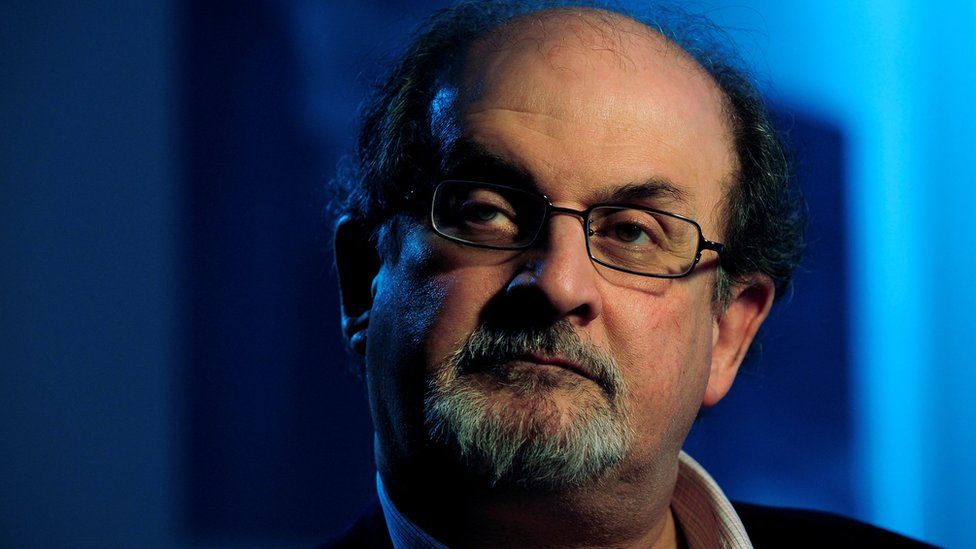
    Sir Salman Rushdie pictured onstage
    IMAGE SOURCE, REUTERS

    He faced death threats and the then-Iranian leader, Ayatollah Ruhollah Khomeini, issued a fatwa – or decree – calling for Mr Rushdie’s assassination, placing a $3m (£2.5m) bounty on the author’s head.

    The fatwa remains active, and although Iran’s government has distanced itself from Mr Khomeini’s decree, a quasi-official Iranian religious foundation added a further $500,000 to the reward in 2012.

    Mr Wylie told El País that he had discussed such threats with Mr Rushdie over the years. “The principal danger that he faced so many years after the fatwa was imposed is from a random person coming out of nowhere and attacking.

    “So you can’t protect against that, because it’s totally unexpected and illogical. It was like John Lennon’s murder.”

    Mr Rushdie was born in India in 1947. He was sent to boarding school in England before studying at the University of Cambridge. In 2007, he was knighted for services to literature.

    There has been an outpouring of support for him, with the attack widely condemned as an assault on freedom of expression.
  • Salman Rushdie’s attack :Suspect claims has read only two pages’ of Satanic Verses

    Hadi Matar,  the man accused of stabbing Sir Salman Rushdie has reportedly said he has only read two pages of the author’s controversial novel The Satanic Verses.

    In relation to the assault that happened at a gathering in New York last week, Hadi Matar, 24, has entered a not guilty plea.
    Mr. Matar described Sir Salman as “someone who attacked Islam” in a prison interview with the New York Post.
    He did not, however, affirm that a 1980s-era Iranian fatwa was the motivation behind his purported conduct.
    The Chautauqua County Jail in New York is where Mr. Matar is now detained.
    Sir Salman published his famous and controversial novel The Satanic Verses in 1988, sparking outrage among some Muslims, who considered its content to be blasphemous.
    The book’s release prompted the Iranian leader Ayatollah Ruhollah Khomeini to issue a fatwa, or edict, calling for the writer’s death in 1989.

    Mr. Matar told the New York Post he had only read “a couple of pages” of the book and did not say whether the fatwa had inspired him.

    “I respect the Ayatollah. I think he’s a great person. That’s as far as I will say about that,” he said.

    Mr. Matar also told the newspaper he was “surprised” to hear that Sir Salman had survived the attack.

    “I don’t like the person. I don’t think he’s a very good person. I don’t like him very much,” Mr. Matar said, according to the paper. “He’s someone who attacked Islam, he attacked their beliefs, the belief systems.”

    Earlier this week, Mr. Matar’s mother said she had disowned her son after his alleged behavior. “I’m done with him,” Silvana Fardos said on Monday, adding: “I have nothing to say to him.”

    Sir Salman suffered a damaged liver as well as severed nerves in an arm and eye injuries in the attack but was taken off a ventilator on Saturday.

    Despite his “life-changing” injuries, the Booker Prize-winning author has retained his “usual feisty and defiant sense of humour”, his family said earlier this week.

    On Friday, a number of literary figures will read from his works on the steps of New York’s public library to show solidarity with the novelist.

    Tina Brown, Paul Auster, Kiran Desai, Andrea Elliott, Hari Kunzru, and Gay Talese will be among those taking part in Stand With Salman: Defend the Freedom to Write.

  • Salman Rushdie: Iran blames writer and supporters for stabbing

    Instead of placing the blame on the author Salman Rushdie, Iran has “categorically” rejected any connection with the assailant.

    During a performance in New York, Mr. Rushdie, 75, was stabbed on stage and suffered serious injuries. He can now breathe on his own.

    Because of his 1988 book The Satanic Verses, he has endured years of death threats.

    Earlier, US Secretary of State Anthony Blinken accused Iran’s state media of gloating about the attack, calling its behavior “despicable”.

    Iranian media have extensively commented on the attack, calling it “divine retribution”.

    Iran’s state broadcaster daily Jaam-e Jam highlighted the news that Rushdie might lose an eye following the attack, saying “an eye of the Satan has been blinded”.

    As news emerged of Friday’s attack, eyes turned to Tehran where the fatwa – religious edict – calling for the writer’s assassination was first issued more than three decades ago.

    But on Monday, Iran’s foreign ministry spokesperson Nasser Kanaani Tehran “categorically” denied any link, adding “no one has the right to accuse the Islamic Republic of Iran”.

    However, he said freedom of speech did not justify Mr. Rushdie’s insulting religion in his writing.

    “In this attack, we do not consider anyone other than Salman Rushdie and his supporters worthy of blame and even condemnation,” the spokesman said during his weekly press conference in Tehran.

    “By insulting the sacred matters of Islam and crossing the red lines of more than 1.5 billion Muslims and all followers of the divine religions, Salman Rushdie has exposed himself to the anger and rage of the people.”

    Iran had no other information about Rushdie’s assailant except what has appeared in the media, he added.

    Mr. Blinken had earlier denounced Iran’s state institutions for inciting violence against the author.

    He said in a statement that Mr. Rushdie had “consistently stood up for the universal rights of freedom of expression, freedom of religion or belief, and freedom of the press”.

    “While law enforcement officials continue to investigate the attack, I am reminded of the pernicious forces that seek to undermine these rights, including through hate speech and incitement to violence.

    “Specifically, Iranian state institutions have incited violence against Rushdie for generations, and state-affiliated media recently gloated about the attempt on his life. This is despicable.”

    Mr. Blinken added the US and its partners would use “every appropriate tool” at their disposal to stand up to what he called “these threats”.

    On Sunday, Mr. Rushdie’s son said the author was still in a critical condition: “Though his life-changing injuries are severe, his usual feisty and defiant sense of humor remains intact,” he said.

    The family was “extremely relieved” when Mr. Rushdie was taken off a ventilator on Saturday, he said, adding that his father was able to “say a few words”.

    The author’s agent Andrew Wylie said the celebrated novelist suffered severed nerves in one arm, damage to his liver, and would likely lose an eye.

    The man charged over Friday’s attack – named Hadi Matar, aged 24 – has pleaded not guilty to charges of attempted murder and assault. He is accused of running onto the stage and stabbing Mr. Rushdie at least 10 times in the face, neck, and abdomen.

    The novelist was forced into hiding for nearly 10 years after The Satanic Verses was published in 1988. Many Muslims reacted with fury to it, arguing that the portrayal of the Prophet Muhammad was a grave insult to their faith.

    Mr. Rushdie faced death threats and the then-Iranian leader, Ayatollah Ruhollah Khomeini, issued a fatwa – or decree – calling for Mr. Rushdie’s assassination, placing a $3m (£2.5m) bounty on the author’s head.

    The fatwa remains active, and although Iran’s government has distanced itself from Mr. Khomeini’s decree, a quasi-official Iranian religious foundation added a further $500,000 to the reward in 2012.

  • Who is Salman Rushdie? The writer who emerged from hiding

    Over a literary career spanning five decades, Sir Salman Rushdie has been no stranger to death threats arising due to the nature of his work.

    The novelist is one of the most celebrated and successful British authors of all time, with his second novel, Midnight’s Children, winning the illustrious Booker Prize in 1981.

    But it was his fourth novel, The Satanic Verses, published in 1988, which became his most controversial work – bringing about international turmoil unprecedented in its scale.

    In the Islamic world, many Muslims reacted with fury to the book’s publication, arguing that the portrayal of the Prophet Muhammad was a grave insult to their faith.

    Death threats were made against Rushdie, 75, who was forced to go into hiding, and the British government placed him under police protection.

    Iran quickly broke off relations with the UK in protest and the country’s supreme leader, Ayatollah Ruhollah Khomeini, issued a fatwa – or decree – calling for the novelist’s assassination in 1989 – the year after the book’s publication.

    But in the West, authors and intellectuals denounced the threat to freedom of expression posed by the violent reaction to the book.

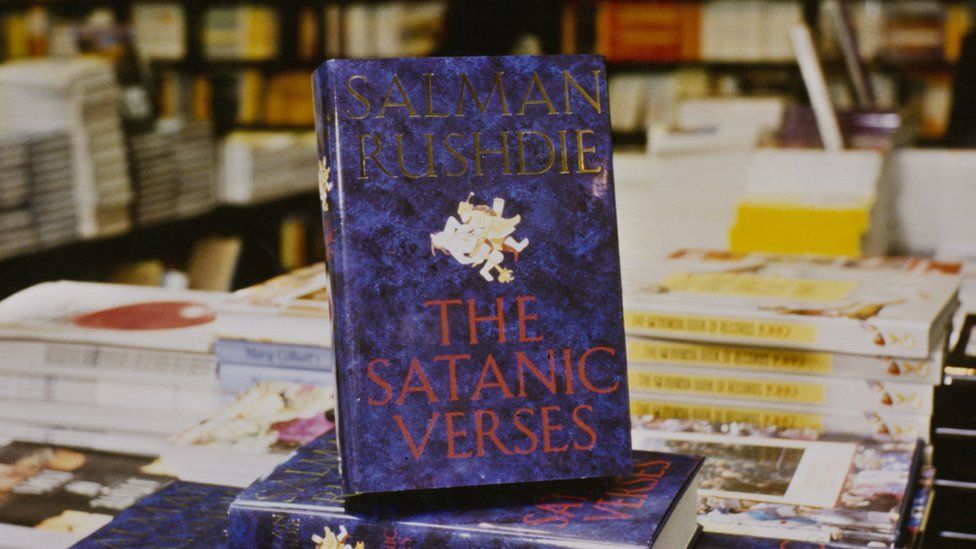
    Copies of Salman Rushdie's novel The Satanic Verses on sale in the UK, circa 1988.

    The Satanic Verses, published in 1988, brought about an international turmoil unprecedented in its scale

    Salman Rushdie was born in Bombay – now known as Mumbai – two months before Indian independence from Britain.

    Aged 14, he was sent to England and to school in the town of Rugby, later gaining an honours degree in history at the prestigious Kings College in Cambridge.

    He became a British citizen, and allowed his Muslim faith to lapse. He worked briefly as an actor and then as an advertising copywriter, while writing novels.

    His first published book, Grimus, did not achieve huge success, but some critics saw him as an author with significant potential.

    Rushdie took five years to write his second book, Midnight’s Children, which won the 1981 Booker Prize. It was widely acclaimed and sold half a million copies.

    Where Midnight’s Children had been about India, Rushdie’s third novel Shame – released in 1983 – was about a scarcely disguised Pakistan. Four years later, he wrote The Jaguar Smile, an account of a journey in Nicaragua.

    In September 1988, the work that would endanger his life, The Satanic Verses, was published. The surrealist, post-modern novel sparked outrage among some Muslims, who considered its content to be blasphemous.

    India was the first country to ban it. Pakistan followed suit, as did various other Muslim countries and South Africa.

    The novel was praised in many quarters and won the Whitbread Prize for novels. But the backlash to the book grew, and two months later, street protests gathered momentum.

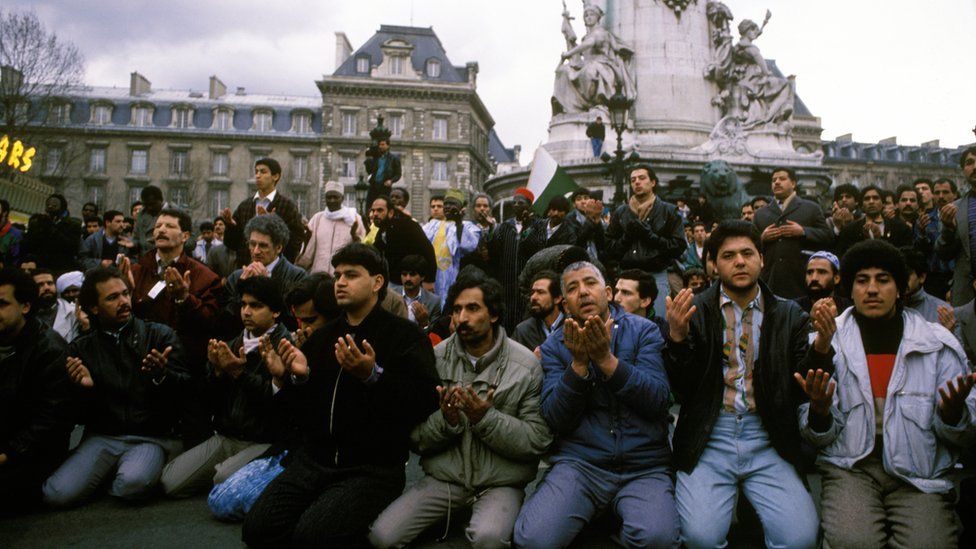
    Demonstration Against Salman Rushdie's book The Satanic Verses in Paris, February 26, 1989

    Demonstrators were seen protesting against The Satanic Verses in Paris in February 1989

    Some Muslims considered it an insult to Islam. They objected – among other things – to two prostitutes in the book being given names of wives of the Prophet Muhammad.

    The book’s title referred to two verses removed by the Prophet Muhammad from the Quran, because he believed they were inspired by the devil.

    In January 1989, Muslims in Bradford in the UK ritually burnt a copy of the book, and newsagents WHSmith stopped displaying it there. Rushdie rejected charges of blasphemy.

    In Mumbai, Rushdie’s hometown, 12 people were killed during intense Muslim rioting, the British embassy in Tehran was stoned, and a $3m (£2.5m) bounty was put on the author’s head.

    Meanwhile, in the UK, some Muslim leaders urged moderation, others supported the ayatollah. The US, France and other Western countries condemned the death threat.

    Rushdie – by now in hiding with his wife under police guard – expressed his profound regret for the distress he had caused Muslims, but the ayatollah renewed his call for the author’s death.

    The London offices of Viking Penguin, the publishers, were picketed, and death threats were received at the New York office.

    But the book became a best-seller on both sides of the Atlantic. Protests against the extreme Muslim reaction were backed by the EU countries, all of which temporarily recalled their ambassadors from Tehran.

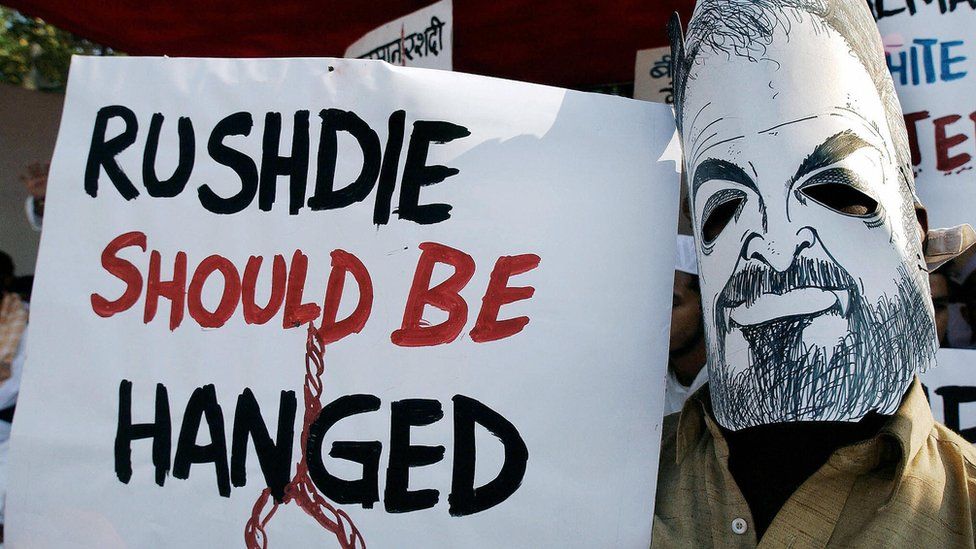
    An Indian Muslim wears a mask of Indian writer Salman Rushdie as he displays a placard condemning Rushdie during a protest in Bombay, 12 January 2004. During the protest against Rushdie's presence in the city, organised by several Muslim organisations, a reward of Rs.100,000 (2,199 USD) to anyone who blackens the face of Rushdie,who in his book The Satanic Verses allegedly made remarks against Islam's holy prophet Mohammed.An Indian Muslin wearing a mask of Rushdie was one of many protesting the author’s presence in Bombay in January 2004
    But the author was not the only person to be threatened over the book’s content.

    The Japanese translator of The Satanic Verses was found slain at a university north-east of Tokyo in July 1991.

    Police said the translator, Hitoshi Igarashi, who worked an assistant professor of comparative culture, was stabbed several times and left in the hallway outside his office at Tsukuba University. His killer has never been found.

    Earlier that same month, the Italian translator, Ettore Capriolo, was stabbed in his apartment in Milan, though he survived the attack.

    And the book’s Norwegian translator, William Nygaard, was shot in 1993 outside his home in Oslo – he also survived.

    Salman Rushdie

    Rushdie had to go into hiding and received police protection due to the backlash to The Satanic Verses

    A prolific writer, Rushdie’s later books include a novel for children, Haroun and the Sea of Stories (1990), a book of essays, Imaginary Homelands (1991), and the novels East, West (1994), The Moor’s Last Sigh (1995), The Ground Beneath Her Feet (1999), and Fury (2001).

    He was involved in the stage adaptation of Midnight’s Children which premiered in London in 2003.

    In the last two decades he has published Shalimar the Clown, The Enchantress of Florence, Two Years Eight Months and Twenty-Eight Nights, The Golden House and Quichotte.

    Rushdie has been married four times, and has two children. He now lives in the US, and was knighted in 2007 by the Queen for his services to literature.

    In 2012, he published a memoir of his life in the wake of the controversy over The Satanic Verses.

    The death sentence against Rushdie stopped being formally backed by Iran’s government in 1998 and in recent years the author has enjoyed a new level of freedom.

    But threats to his life always lingered under the surface, and Iran’s current supreme leader – Ayatollah Ali Khamenei – once said the fatwa against Rushdie was “fired like a bullet that won’t rest until it hits its target”.

    Source: BBC

    Â