Tag: Same sex marriage

  • Cuba Family Code: Country votes to approve same-sex marriage

    In a national referendum, Cubans decided to legalise same-sex marriages.

    A new Family Code that will also permit surrogate pregnancies and grant gay couples the ability to adopt children was approved by around two-thirds of the electorate.

    It marks a big moment for Cuba, which saw gay people persecuted and sent to work camps in the 1960s and 70s.

    However, there was significant opposition to the reforms among religious groups and conservatives.

    The referendum on Sunday was for a new Family Code – a 100-page document that went through more than two dozen drafts and hours of debate in community-level meetings.

    Cuba’s government had backed the law change and ran a nationwide campaign urging people to approve it.

    Speaking as he voted on Sunday, the country’s President, Miguel Díaz-Canel, said he expected most of the population would vote yes and that the new code reflected the diversity of people, families, and beliefs.

    On Monday, preliminary results indicated an “irreversible trend”, with 66% of votes counted so far in favour of the reform, electoral council president Alina Balseiro said on state television, according to AFP news agency. The law required 50% of voters’ approval to be adopted.

    The reforms were the culmination of efforts by gay rights activists in Cuba.

    Official attitudes towards homosexuality on the Communist-run island have changed over the past decades, partly thanks to the efforts of former leader Raúl Castro’s daughter Mariela.

    In the early part of communist leader Fidel Castro’s rule after the 1959 revolution, homosexual men and women were sent to work camps for supposed “re-education”.

    However, many in Cuba still oppose the step, including evangelical churches and other non-religious conservatives.

    Parts of the opposition also campaigned for a “no” vote, urging Cubans to seize a unique opportunity to hand the country’s communist government a defeat in the polls.

    Some anti-government activists consider the referendum an effort by the state to improve its human rights image following a brutal crackdown on all forms of dissent in recent years.

    The referendum also comes during a serious energy crisis, which has led to daily power cuts affecting millions of people across the island.
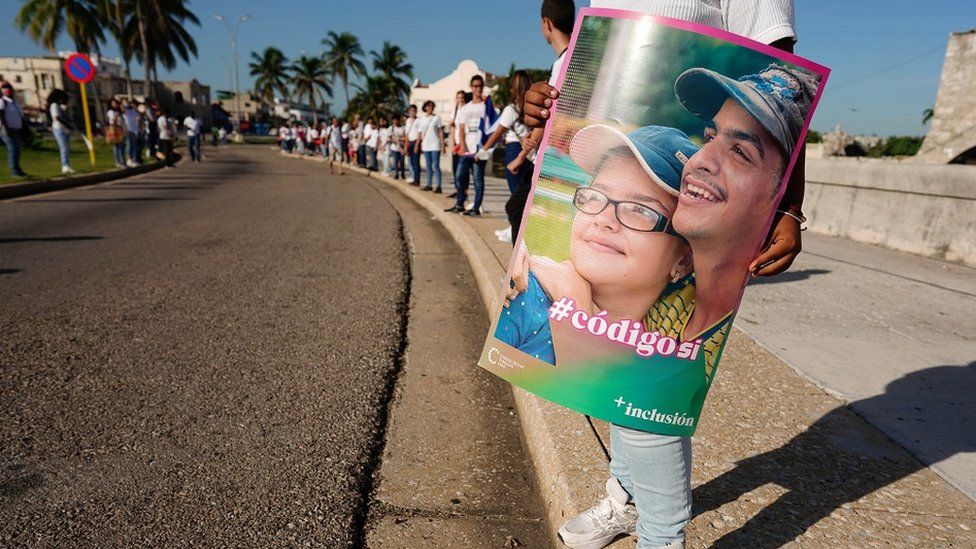
    A child holds a banner which reads "Code Yes" referring to a family code referendum to take place on September 25, during a state organized pro-referendum demonstration in Havana, Cuba, September 17, 2022. REUTERS/Alexandre Meneghini
    A child holds a banner that reads “code yes”
  • Desmond Tutu’s daughter prohibited by Church of England from leading funeral

    The Church of England has forbidden Desmond Tutu’s daughter from officiating at a funeral because she is married to a woman.

    Mpho Tutu van Furth, an Anglican priest in the Diocese of Washington, DC, was requested to preside at Thursday’s burial in Shropshire for her late godfather, Martin Kenyon.

    Ms Tutu van Furth told BBC News it “seemed really churlish and hurtful”.

    The Diocese of Hereford said it was “a difficult situation”.

    The Church of England does not permit its clergy to be in a same-sex marriage because its official teaching is that marriage is only between one man and one woman.

    However, its sister Anglican church in the US, The Episcopal Church, does allow clergy to enter into gay marriages.

    “Advice was given in line with the House of Bishop’s current guidance on same-sex marriage,” a statement from the Diocese of Hereford said.

    The former Bishop of Liverpool, the Right Reverend Paul Bayes, who is a campaigner for the church to change its position on sexuality, said to “plead that things are difficult is not good enough”.

    “We urgently need to make space for conscience, space for pastoral care, and space for love,” he said.

    After Mr Kenyon’s family was told of the Church’s decision, they moved the funeral service from St Michael and All Angels in Wentnor, near Bishops Castle, to a marquee in the vicarage next door so Ms Tutu van Furth could officiate and preach.

    “It’s incredibly sad,” Ms Tutu van Furth told BBC News. “It feels like a bureaucratic response with maybe a lack of compassion.

    “It seemed really churlish and hurtful. But as sad as that was, there was the joy of having a celebration of a person who could throw open the door to people who are sometimes excluded.”

    Martin Kenyon, then 91, became an internet sensation in December 2020 with his frank answers during a CNN interview after receiving the Covid-19 vaccine.

    Asked how it felt to be one of the first people in the world to receive the jab, he said: “I don’t think I feel much at all”. But added he hoped not to have the “bug” now because he had granddaughters.

    “There’s no point in dying when I’ve lived this long, is there?” he said.

    Mr Kenyon was close friends with the late South African Archbishop, Desmond Tutu.

    Ms Tutu van Furth was forced to give her upright to officiate as a priest in South Africa after she married Marceline van Furth, a Dutch academic, in 2015.

    Her father Desmond Tutu, who died in December 2021, won the Nobel Peace Prize in 1984 for his struggle against apartheid in South Africa. He also campaigned in favour of gay rights and backed same-sex marriage.

    “I would refuse to go to a homophobic heaven. No, I would say sorry, I mean I would much rather go to the other place,” he said in 2013. “I would not worship a God who is homophobic and that is how deeply I feel about this.”

    He added: “I am as passionate about this campaign as I ever was about apartheid. For me, it is at the same level.”

  • Drobo residents against legalization of same sex marriage

    Some residents of Drobo in the Jaman South Municipality of the Bono region have expressed concern over the legalisation of homosexuality and lesbianism in the country.

    Sharing their views on whether same-sex marriage should be legalised or not, the residents in unison have declared the issue as an abomination that should not be entertained.

    According to them, the government should not consider that option at all as it is not good for the image of the country.

    Mr. Emmanuel Gyamfi believes now is the time for the government to clamp down on gayism and lesbianism once and for all. Gyamfi disclosed that the call against the practice should be louder than before as it is against our cultural values.

    “ I think we should not entertain the practice at all as it is not good for our image as a people. I think the time has come for us to clamp down on the practice with some seriousness”, he urged.

    Afful Stephen, a tutor in one of the Senior High Schools told Ghanaweb that it is ethically wrong for a group of persons to engage in lesbianism and gayism in the name of enjoying their rights.

    Quoting the book of Leviticus to back his argument, he averred that it is an abomination for people of the same sex to engage in sexual activities. He warned that any attempt to give it legal backing in the country will incur the wrath of God and warned authorities not to entertain such thoughts at all.

    Source: www.ghanaweb.com