Tag: Samsung

  • Samsung’s earnings decline as the demand for gadgets dwindles

    Samsung’s earnings decline as the demand for gadgets dwindles

    The final three months of 2022 are projected to see Samsung’s profits decline by 69% to their lowest level in eight years.

    The largest manufacturer of memory chips, smartphones, and TVs in the world anticipated that its operating profit would drop to about 4.3tn won ($3.4bn; £2.8bn) for the time period.

    It occurs as the slowdown in the world economy affects the cost of memory chips and the demand for electronic devices.

    As consumers tighten their belts, global technology giants have recently taken a hit.

    It was Samsung’s lowest quarterly profit since 2014 and missed investor expectations of around 5.9 trillion won.

    The South Korean company said it saw a bigger-than-expected fall in demand for computer chips as customers cut their stocks of the key components for digital devices.

    “For the memory business, the decline in fourth-quarter demand was greater than expected as customers adjusted inventories in their effort to further tighten finances,” Samsung said in the statement.

    “Smartphone sales and revenue decreased due to weak demand resulting from prolonged macro issues,” it added.

    Samsung is scheduled to publish its full financial statement on 31 January.E

    It is the latest major technology company to reveal how weakness in the global economy is impacting its business.

    Sales have also slowed after demand boomed during the pandemic when customers at home spent a lot online.

    Tens of thousands of jobs are being shed across the global technology industry, amid slowing sales and growing concerns about an economic downturn.

    This week Amazon said it planned to axe more than 18,000 jobs, the largest number in the firm’s history, as it cuts costs.

    In November, Meta announced that it would cut 13% of its workforce.

    The first mass lay-offs in the social media firm’s history will result in 11,000 employees, from a worldwide headcount of 87,000, losing their jobs.

    Meta chief executive Mark Zuckerberg said the cuts were “the most difficult changes we’ve made in Meta’s history”.

    The news followed major layoffs at Twitter, which cut about half its staff after multi-billionaire Elon Musk took control of the firm in October.
    Source: BBC.com
  • Lee Jae-yong: Samsung names convicted heir to top position

    Samsung has appointed convicted heir and de facto CEO Lee Jae-yong to the position of executive chairman.

    The symbolic move means that the world’s largest smartphone manufacturer will now be led by the third generation of its founding family.

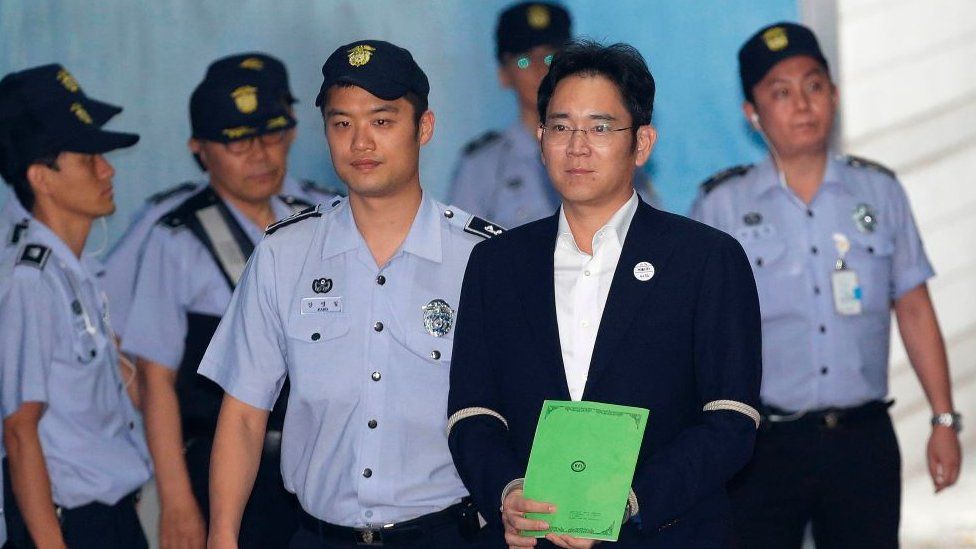
    Mr Lee was granted a special presidential pardon in August after being convicted of bribery and embezzlement in 2017.

    He was imprisoned twice for bribing a former president.

    “The Board cited the current uncertain global business environment and the pressing need for stronger accountability and business stability in approving the recommendation,” the company said in a statement.

    The announcement formalises the role Mr Lee – who is also known as Jay Y Lee – has held since 2014. He took over after his father, the late Samsung Group chairman Lee Kun-hee, was hospitalised. He died in 2020.

    The 54-year-old has been vice chairman of Samsung Electronics, the crown jewel of South Korea’s biggest business conglomerate, since 2012.

    In August last year, Mr Lee was released from a South Korean prison on parole after serving 207 days in jail.

    It was just over half the sentence he received after being convicted in January.

    In a statement, then-President Moon Jae-in’s office said his release was made in the national interest and asked for understanding.

    “We are well aware that there are supporting and opposing views on Vice-Chairman Jay Y Lee’s parole. The views of the people who are opposed are also right,” it said.

    At the time, the country’s Justice Ministry said it made the decision to release Mr Lee after considering the effects of the pandemic on South Korea’s economy and global markets.

    A year later, he was pardoned by new President Yoon Suk-yeol.

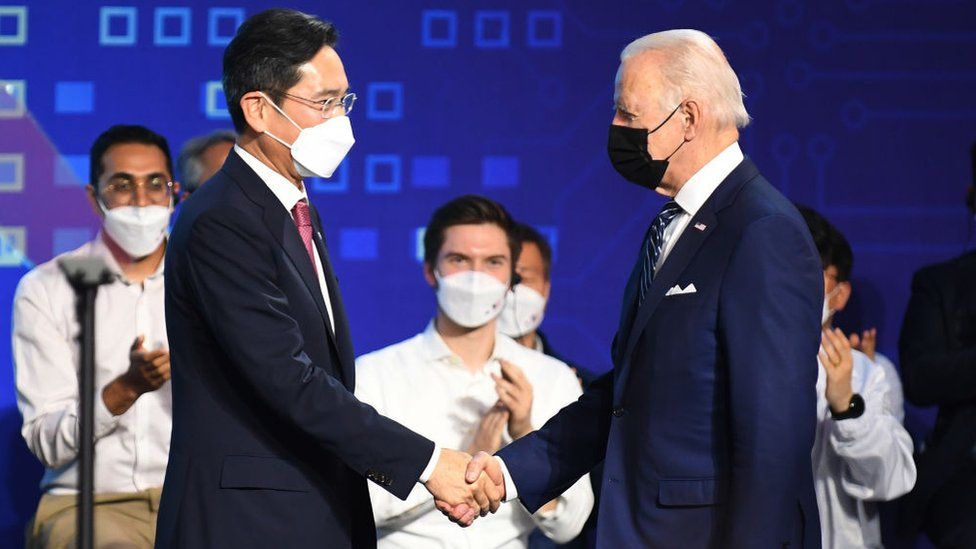
    Mr Lee has largely resumed his public duties as a Samsung executive, meeting with the US leader in Seoul in May.
    IMAGE SOURCE,GETTY IMAGES Image caption, Mr Lee has largely resumed his public duties as a Samsung executive, meeting with the US leader in Seoul in May

    Mr Lee was found guilty of bribery, embezzlement, and concealment of criminal proceeds worth about 8.6 billion won ($6m; £5.2m).

    The case involved the country’s former President Park Guen-hye, who was also jailed for bribery and corruption.

    Samsung Electronics was founded by Mr Lee’s grandfather and he has been the de facto head of the company since 2014.

    Global headwinds

    Today’s announcement came as Samsung Electronics faces mounting problems as demand for its products falls due to soaring inflation, rising interest rates, and the gloomy economic outlook.

    On Thursday, the world’s top maker of memory chips and smartphones reported a 31% drop in its third-quarter profit.

    It also warned that uncertainties around the world are likely to dampen demand until early next year, as the global economic downturn hits the market for electronic devices.


  • Why South Korea just pardoned the Samsung ‘prince’ Lee Jae-yong

    Samsung heir Lee Jae-yong – convicted of bribery and embezzlement in 2017 – has been granted a special presidential pardon.

    One of South Korea’s most powerful white collar criminals, Lee was twice imprisoned for bribing a former president.

    South Korea’s government justified the move, saying the de-facto leader of the country’s biggest company was needed back at the helm to spearhead economic recovery post-pandemic.

    This marks another swing in a struggle over how the country is run that has raged since mass protests took over Seoul six years ago and ousted a president from office.

    Lee’s crimes were directly tied up in the corruption scandal that led to the imprisonment of former president Park Geun-Hye, in office from 2013-2017.

    The “Crown Prince of Samsung” – as he was dubbed by protesters – paid $8 million (£6.6m) in bribes to President Park and her associate to secure support for a merger opposed by shareholders that would shore up his control of his family’s empire.

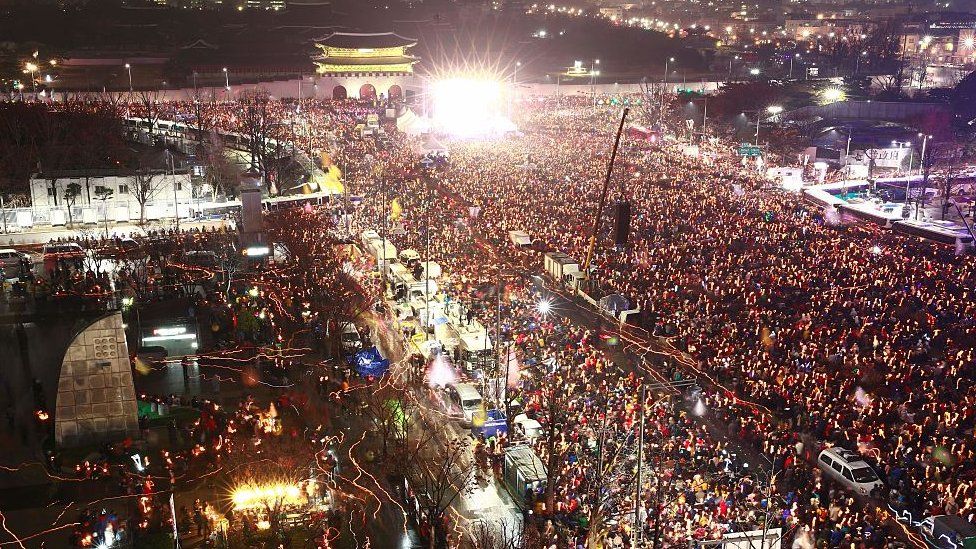
    When it was revealed, millions of South Koreans turned out at candlelit protests every weekend in the 2016/2017 winter, demanding an end to Park’s government and the stitch-up between politics and business.

    Protesters pack the forecourt outside the Presidential Palace in Seoul during the 2016/2017 anti-corruption protests
    IMAGE SOURCE,GETTY IMAGES Image caption, Millions of people attended the protests against President Park and her corruption

    Korea’s parliament impeached Park and she was imprisoned in 2017 for 25 years.

    Lee, who is also known as Jay Y Lee in the West, was jailed a year later for offences including embezzling company funds to buy a $800,000 (£650,000) horse for the president’s friend’s daughter.

    A new president, Moon Jae-in swept into office with a mandate to clean up the mess. But he failed to make much headway. In his last days as president, he granted a pardon to his predecessor.

    Now eight months later, under another new president, Samsung’s chief has also received the same clemency.

    For those who have been fighting against corruption, it’s a dispiriting blow.

    “It is a setback. And it means Korea retreats to the time before the candlelit demonstrations,” said Sangin Park, an economics and industrial policy professor at Seoul National University.

    ‘Octopus’ influence

    Lee’s case reaffirms popular conception that business leaders are untouchable and above the law.

    In Korea, giant conglomerates dominate the economy, with the top 10 accounting for about 80% of GDP. Known as chaebols, they are family-controlled empires which provide a span of services. LG, Hyundai, Lotte, and SK are among them.

    But Samsung is the biggest and most powerful of them all.

    Lee Jae-yong
    IMAGE SOURCE,GETTY IMAGES Image caption, Lee was first jailed for bribery and corruption in 2017 – but then was later released from jail twice.

    As the world’s largest smartphone maker, it’s a global electronics brand. But at home it does much more – hospitals, hotels, insurance plans, billboards, shipyards and even theme parks.

    Samsung and other chaebols are so omnipresent they’re known as “octopus” firms, says Prof YoonKyung Lee, a political sociologist at the University of Toronto.

    And those tentacles have long wormed their way into the highest levels of Korean politics. Prof Lee was at the 2016 protests and says most of the anger was directed at President Park’s personal actions. But she said labour activists and others strove to highlight the chaebols’ outsize influence on government.

    Chaebols were heavily supported by the government after the Korean War. They were given cheaper electricity and tax incentives, there was a “Buy-Korea” policy and even help in suppressing union movements.

    But the resulting monopolies also crushed competition, stifled labour movements and their practices spawned decades of bribery and corruption cases.

    In many cases, Prof Lee said, executives were given light or suspended sentences. In some cases judges said the economy might suffer if a chaebol leader was taken out of action.

    Mr Lee’s own father, Lee Kun-hee was convicted of bribery and fraud in the 1990s when he was Samsung chairman. But he didn’t serve a single day of jail time.

    So in 2017, when his son was hauled away to a cell on a five-year sentence, activists hoped the case would mark a turning point.

    In and out of jail

    Celebration however was short lived. Lee’s court battle dragged on for years with twists and turns worthy of the most dramatic Korean serials.

    An appeals court released him, a higher court then ordered a retrial at which he was again found guilty and jailed.

    But just a few months into his second jail term, the Moon government released him on parole, saying it was in the national interest.

    Since then, he has returned as the public face of Samsung – in May greeting US President Joe Biden on a trade visit to South Korea.

    Lee
    IMAGE SOURCE,GETTY IMAGES Image caption, Lee has largely resumed his public duties as a Samsung executive, meeting with the US leader in Seoul in May

    Lee still faces criminal allegations – of rigging company valuations, accounting fraud and making Samsung business decisions in breach of his sentence conditions. Clemency means he will be able to fully resume his executive responsibilities.

    It follows a pattern of convicted chaebol leaders having their slates wiped clean.

    “When it comes to formal power, there’s the president’s office and the National Assembly – they’re making the laws,” Prof Lee said.

    “But when it comes to political influence or cultural influence or even how people think about the importance of chaebol in Korean society, it’s really down to a coalition of conservative political and business elites who all have interests with each other.”

    Divided reaction

    The government’s pardon of Lee rests on the argument that chaebol leaders are needed for the economy. But numerous economists have pointed out this isn’t backed up by hard proof.

    “The pardoning of chaebol controllers has not contributed to economic growth or turnaround historically,” said Prof Park.

    Analysts say Samsung has fared perfectly well while Lee has been in and out of prison. Reform advocates say South Korea, where growth has been slowing for years, also needs to end its dependence on chaebols.

    “Several studies have shown that it’s getting harder to get the ‘trickle-down effect’ – it’s time to move away from the old notion that any illegal acts done by chaebols are ‘forgivable’ if they do their jobs,” says Roh Jong-Hwa, a lawyer from an advocacy group Solidarity for Economic Reform.

    Still the dismay among critics over Lee’s pardoning is not shared among the broader South Korean public. A recent public poll recorded 70% support for the pardon.

    How to explain that support?

    The desire to tackle corruption and chaebol influence remains, experts say. But it is mingled with fear and concerns over a looming recession – and residual pride over Samsung representing Korea on the world stage.

    “There’s a core belief that if Samsung does well, Korea does well. And Koreans have lived with this myth for so many decades, it’s really hard for ordinary citizens to break out of it,” says Prof Lee.

    “Right now, amid an economic downturn, people want to see some concrete sign that we are moving forward and Lee’s release is a sign of that.”

    Source: BBC

  • LIVESTREAMING: Galaxy Unpacked August 2020

    Samsung today is launching it’s new Galaxy Note 20 series dubbed the ‘Galaxy Unpacked 2020’.

    The launch is taking place inside the Samsung Digital City in Suwon, South Korea.

    In addition, the South Korean smartphone manufacturer is also expected to launch some more products including Galaxy Tab S7, Galaxy Watch 3, Galaxy Buds Live and Galaxy Z Fold 2.

    This time along Samsung will host the Galaxy Unpacked via a pre-recorded video, instead of a physical event due to the ongoing Covid-19 pandemic.

    Watch the video below:

    Source: www.ghanaweb.com

  • Samsung heir apologises over corruption scandal

    The heir to the Samsung empire bowed in apology Wednesday for company misconduct including a controversial plan for him to ascend to the leadership of the world’s largest smartphone maker.

    Lee Jae-yong is vice-chairman of Samsung Electronics and was jailed for five years in 2017 for bribery, embezzlement and other offences in connection with the scandal that brought down South Korean president Park Geun-hye.

    The 51-year-old was released a year later on appeal but is currently undergoing a retrial.

    “Our technology and products are being hailed as first-class but the public gaze towards Samsung still remains harsh,” Lee said. “This is my fault. I apologise.”

    Lee bowed three times before flashing cameras at a Samsung Electronics office in Seoul, where reporters sat apart under coronavirus distancing rules.

    He will not allow his children to succeed him at the firm, he said in steady tones, swallowing occasionally.

    Wednesday’s apology came at the request of Samsung’s compliance committee, which oversees the firm’s transparency in its corporate dealings.

    Lee has effectively been at the helm of the sprawling Samsung group since his father and group chairman Lee Kun-hee was left bedridden by a heart attack in 2014.

    The court case centred on millions of dollars the Samsung group paid Park’s secret confidante Choi Soon-sil, allegedly for government favours including ensuring a smooth transition for Lee to succeed his ailing father.

    The scandal highlighted shady connections between big business and politics in South Korea, with the ousted president and her friend accused of taking bribes from corporate bigwigs in exchange for preferential treatment.

    Samsung Electronics is the flagship subsidiary of the group, which is by far the biggest of the family-controlled conglomerates, or chaebols, that dominate business in the world’s 12th-largest economy.

    Its overall turnover is equivalent to a fifth of the national gross domestic product and it is crucial to South Korea’s economic health.

    Chairman Lee Kun-hee is listed as South Korea’s richest man — and the world’s 65th — by Bloomberg Billionaires, with a fortune estimated at $15.7 billion, while Lee Jae-yong has a separate listing of his own, and a net worth of $5.7 billion.

    Source: france24.com

  • Samsung Galaxy Fold to be launched on 6 September

    Samsung’s first foldable phone will go on sale on Friday after problems delayed its initial release.

    The Galaxy Fold will be available on 6 September in South Korea, followed by select countries including the US, the UK and Singapore.

    The release of the nearly $2,000 (£1,634) device in April was postponed after early reviewers reported broken screens.

    Samsung has been rushing to launch the folding smartphone before its rivals.

    Read:Samsung introduces a new line of premium smartphones: Galaxy S10

    The firm said in July it had made “improvements” to the device and planned for the phone to go on sale in September.

    It comes as the firm has seen profits tumble amid a broader industry slowdown, weighed down by the US-China trade war.

    Samsung, the world’s biggest smartphone and memory chip maker, is facing growing competition from rivals like Chinese tech firm Huawei.

    Read:Huawei launches new $2,600 foldable 5G phone to rival Samsung

    It is also navigating possible disruption to its chip business from a trade row between South Korea and Japan.

    Huawei became the second-largest smartphone seller in the world last year and plans to launch its folding smartphone in September.

    Earlier this year, Chinese technology firm Xiaomi unveiled a prototype of a folding smartphone that transforms into a tablet.

    Source: bbc.com