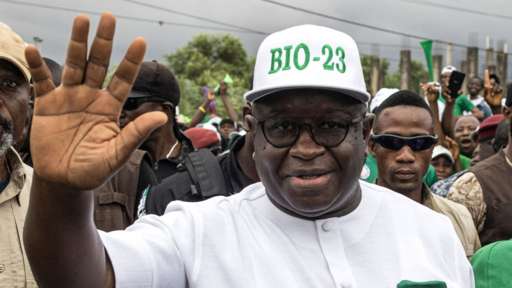
Opposition MPs in Sierra Leone have skipped their parliamentary swearing-in ceremony following elections last month.
According to the electoral commission’s results, which the opposition contests, the All People’s Congress (APC) won 54 of 149 seats.
The head of the election commission’s resignation and a new election within six months have been demanded by the APC.
According to David Reimer, the US ambassador to Sierra Leone, “those who voted for the opposition need to have their voices heard” and “a vibrant democracy needs a strong opposition.”
But APC leader Samura Kamara, the losing presidential contender, tweeted: “Under normal circumstances, each day forward means progress. In our political journey however in Sierra Leone, a new day now means going backwards.”
The electoral commission has noted that with 60% of polling stations counted, the incumbent Julius Maada Bio currently holds a 56% share of the votes.
Samura Kamara, from the All People’s Congress (APC), trails behind with 42%. To secure victory in the first round, a candidate needs more than 55% of the votes.
The main opposition candidate has denounced the early results of Sierra Leone’s presidential election as “daylight robbery.” He claims that his electoral agents were denied the opportunity to verify the ballot counting process.
Bio’s success can be attributed to strategic electoral alliances he formed during the campaign, even in opposition strongholds. However, European Union observers have criticized the electoral commission for a lack of transparency and have reported incidents of violence in some regions during the voting on Saturday.
The APC had previously raised concerns about the election’s conduct and the electoral commission. Kamara reported that live ammunition was fired into his party’s headquarters during a press conference, resulting in the injury of a woman whose life is now in danger.
Furthermore, the APC alleged that one of its supporters was shot dead by the police, although the police have denied these claims. Supporters of both major parties have been accused of attacking their opponents.
Accusations of election irregularities, including ballot stuffing and voter suppression, have been made by Kamara, intensifying the controversy surrounding the election.
However, the electoral body had insisted, in a press conference, that it had mechanisms in place to ensure a fair vote. Local media reports that arrests were made.
Saturday’s vote saw a high turnout, with voters telling the BBC the process was smooth despite polling stations opening hours late in many areas.
The election took place against the background of a troubled economy, the rising cost of living, and concerns about national unity.
The voters were choosing a president, MPs and councillors in the West African country’s fifth election since the civil war ended in 2002.
The 11-year conflict cost an estimated 50,000 lives, but since then the country has a tradition of largely peaceful, free and credible elections, according to Marcella Samba Sesay, chairperson of the NGO National Elections Watch.
With strong party loyalty among the 3.3 million registered voters, the campaigns have focused on shoring up their parties’ bases rather than articulating and debating policy issues.
However, voters have told the BBC they want to see concrete change in the country.
“I want a responsible government that will provide jobs, education, improve healthcare and also ensure food security. I expect the new president to work for the nation,” Solomon Beckley from Freetown said.
In the midst of rising unhappiness and demands for change from its citizenry, Sierra Leone is preparing for Saturday’s vital presidential elections.
Since the horrific civil war that raged through the nation’s history concluded 21 years ago, there have been five elections.
Devastating illnesses like the Covid pandemic and Ebola in 2014 have also hit Sierra Leone.
Samura Kamara, the leader of the opposition “All People Congress” (APC) party, is one of the twelve candidates running against Maada Bio, 59, in the general election.
Kamara, a former cabinet minister, 72, is facing trial on corruption charges which he denies. The case has been adjourned until after the general election.
The mood in the country is tense as the country prepares for the high-stakes elections.
Earlier in the week, police officers fired rubber bullets and teargas at supporters of the opposition party, All People’s Congress (APC), during a protest in the capital Freetown calling for the Chief electoral Commissioner, Mohamed Konneh, to step down after allegations of electoral fraud.
The United Kingdom, the United States, Ireland, Germany, France, and the European Union issued a joint statement urging all parties to remain peaceful.
Sierra Leoneans are concerned about several issues, including economic management, food shortages, healthcare services, infrastructure development, and education.
Many citizens say they are frustrated with high inflation rates and unemployment levels, as well as political violence and corruption.
” …We are not seeing any prospect that the prices are coming down because the dollar inflation is very high. Everything is very high,” said Aminata Fanta Koroma, an APC party member.
While Samura supporter Kadira Rodhe Kamara said: “We are tired with the austerity, we’re tired with the problems, the killings, the brutality, tribalism, nepotism, all kinds of things. You know, no democracy, no freedom of speech. The people are tired.”
President Bio has promised to tackle these problems by feeding the nation and creating half a million jobs for young people if re-elected.
However, Sierra Leoneans remain uncertain about their future as the country remains one of the poorest in the world despite its abundant diamond resources and other minerals.
The illicit trade in these gems, commonly referred to as “blood diamonds” due to their association with conflict financing, exacerbated the civil war.
Sierra Leone has a population of around 8.8 million, but less than half (3.3 million) are registered to vote in this election.
The country has been facing a number of issues, including a soaring cost of living and massive unemployment.
Inflation rates in April were recorded at around 37% according to the International Monetary Fund (IMF).
The outcome of the elections is expected to depend largely on the younger demographic as people under the age of 35 make up around 60% of the voting-age population.
A significant proportion of this group belongs to the post-war generation, who have grown up in a country grappling with poverty, unemployment, and political instability.
However, Ishmael Beah, a former child soldier and author, turned human rights activist told CNN the youth are not hopeful of change.
“The general mood of the country is it’s not hopeful at all because… the security situation has gotten tense in the way that you have more presence of armed police, armed military that are basically patrolling the streets as if going to an election is also going to war.”
Beah added that the two political parties have not “presented any policies or any ideas of what they are going to do and that are credible. There was no presidential debate to talk about policy,” he said.
There have been concerns of unrest in the run-up to the poll, similar to deadly anti-government protests that broke out last August, over the rising cost of living.
Following August’s protests, President Bio ordered a crackdown as he believed the protests were part of an attempt to overthrow his government.
“This was not a protest against the high cost of living occasioned by the ongoing global economic crisis. The chant of the insurrectionists was for a violent overthrow of the democratically elected government,” he said at the time.
To be declared winner, a presidential candidate must secure 55 percent of the total votes. If this is not achieved in the first round of voting, a run-off election will be held between the two candidates with the highest votes — as was the case in the 2018 election.