Tag: sanitary pad

  • Free sanitary pads initiative to spur growth of Ghana’s private sector – Trade Minister

    Free sanitary pads initiative to spur growth of Ghana’s private sector – Trade Minister

    Minister for Trade and Agro Business, Elizabeth Ofosu-Agyare, has highlighted the economic benefits of the government’s decision to distribute free sanitary pads to female students in primary and secondary schools.

    As part of the 2025 budget presented in Parliament on Tuesday, Finance Minister Dr. Cassiel Ato Forson announced that GH¢292.4 million has been allocated to support this initiative.

    Reacting to this development in an interview with The Independent Ghana, Minister Ofosu-Agyare described the budget as inclusive, emphasizing that the policy goes beyond addressing menstrual health challenges.

    “This is a good budget,” she said. “It is good in the sense that there is something in it for everybody. And let me tell you one thing—free pads are not just for the benefit of the girl child. No. This policy is also beneficial to the industry because His Excellency John Dramani Mahama has made it clear that the government will use its purchasing power to support locally made products. That means nearly GH¢300 million will remain in the economy to benefit the private sector since we will source all the pads from Ghana.”

    She further explained that producing sanitary pads locally will boost job creation and stabilize the cedi by reducing the need to import such products.

    “We are going to create more jobs. It means we will stabilize our cedi because we won’t have to exchange money to import pads. And when local manufacturers profit, they will expand and even export more,” she stated.

    The minister also pointed out that the budget includes measures to enhance collaboration between the government and private businesses.

    “One of the challenges industries have raised is access to the Finance Ministry and GRA,” she noted. “Now, the minister has stated that there will be quarterly meetings between the GRA, the Finance Ministry, and the private sector. Guess what? I will always be there to champion the cause of the private sector.”

    She assured that these engagements would foster a business-friendly environment where tax-related concerns are addressed promptly.

    “This will give a lot of confidence to businesses operating in Ghana. They will have direct access to the Ministry of Finance and GRA so that tax issues affecting their sectors can be resolved quickly,” she added.

    The government’s commitment to industrial growth, she said, extends beyond sanitary pad production. “We have set the tone well, and the resetting agenda has begun. Ghana is ready for business,” she concluded.

    The free sanitary pad initiative comes amid longstanding calls for tax relief on menstrual hygiene products. In September 2023, a private member’s bill was submitted to Parliament seeking an amendment to the VAT (Amendment) Act, 2022 (Act 1082), to remove the 15% Value Added Tax (VAT) on sanitary pads and tampons.
  • Govt to implement zero rate VAT on locally produced sanitary pads

    Govt to implement zero rate VAT on locally produced sanitary pads

    Government has failed to totally scrap the taxes on sanitary pads in its 2024 budget statement presented by Finance Minister, Ken Ofori-Atta today.

    According to the Finance Minister, this is because, in the short term, fiscal sustainability requires that the country improve its tax ratios significantly; otherwise, its long-term competitiveness will be eroded despite believing in lower taxes for industry.

    In the interim, government says there are some reliefs that have been prioritised for implementation.

    Among these reliefs is a zero-rate VAT (value-added tax) on locally produced sanitary pads.

    Also, the government is looking at granting import duty waivers for raw materials for the local manufacture of sanitary pads.

    This implies that the cost of local sanitary products will decline when implemented. However, imported sanitary pads will continue to see the current taxation measure.

    Sanitary products are currently enlisted in Chapter 96 of the Harmonized System, and that attracts a 32.5% tax on imported sanitary pads, which comprises a 20% import duty and a 12.5% Value Added Tax.

    Prior to the 2024 budget presentation, many called on the government to remove the taxes on sanitary pads which has stalled the education of several girls in rural communities. Aggrieved individuals lamented the high cost of sanitary pads due to the high taxes.

    The other relief measures are as follows:

    • Extend zero rate of VAT on locally manufactured african prints for two (2) more years.
    • Waive import duties on import of electric vehicles for public transportation for a period of 8 years.
    • Waive import duties on semi-knocked down and completely knocked down Electric vehicles imported by registered EV assembly companies in Ghana for a period of 8 years;
    • Extend zero rate of VAT on locally assembled vehicles for 2 more years;
    • Grant exemptions on the importation of agricultural machinery equipment and inputs and medical consumables, raw materials for the pharmaceutical industry;
    • A VAT flat rate of 5 percent to replace the 15 percent standard VAT rate on all commercial properties will be introduced to simplify administration.
  • Madina MP presents bill to scrap off 15% sanitary pad tax

    Madina MP presents bill to scrap off 15% sanitary pad tax

    A private member of Parliament has introduced a bill aimed at amending the Value Added Tax (VAT) regulations to eliminate the 15 percent VAT imposed on menstrual hygiene products.

    This proposed bill seeks to make modifications to the VAT (Amendment) Act of 2022 (Act 1082) to exempt sanitary pads and tampons from VAT.

    Additionally, the bill aims to advocate for the reclassification of the existing 20 percent import tax on final consumer goods, designating them as zero-rated essential social goods. It also seeks to prohibit any future taxation of such essential social goods.

    Francis-Xavier Sosu, a Member of Parliament representing the National Democratic Congress (NDC) for Madina, formally presented this bill to the Clerk of Parliament last Thursday. In the accompanying memorandum, which provides the rationale for introducing the bill, Mr. Sosu, a human rights lawyer, emphasized the global challenges faced by many women and girls in managing menstruation.

    He clarified that menstrual hygiene management (MHM) involves the use of clean materials to absorb menstrual blood, with the ability to change them privately, safely, hygienically, and as often as necessary throughout the menstrual cycle. Mr. Sosu argued that the failure to address the menstrual hygiene needs of women and girls could have significant repercussions for basic hygiene, sanitation, and reproductive health, ultimately impacting the country’s progress toward achieving Sustainable Development Goals one, three, four, five, six, and ten.

    These Sustainable Development Goals encompass various critical areas, including eradicating poverty, promoting good health and well-being, ensuring quality education, advancing gender equality, enhancing access to clean water and sanitation, and reducing inequalities.

    “Despite the fact that about a quarter of the world’s population menstruates, 500 million people have been left without access to menstrual hygiene products, leading to period poverty”.

    “Period poverty, thus refers to the struggle to afford menstrual products, and the increased economic vulnerability menstruating people face due to the financial burden posed by menstrual supplies,” the MP, who is also one of the legislators who sponsored the Criminal Offences (Amendment) Bill, 2022 which was passed to scrap the death penalty and criminalised accusation of anyone as  witchcraft. 

    Citing reputable global sources, Mr. Sosu highlighted several significant factors that hinder effective menstrual management among schoolgirls in low- and middle-income countries. These factors include a lack of adequate knowledge about menstrual issues among schoolgirls, insufficient access to suitable water, sanitation, and hygiene (WASH) facilities, limited availability of sanitary kits, and the presence of cultural barriers.

    Furthermore, Mr. Sosu pointed out that on a global scale, women were twice as likely as men to report instances of discrimination based on their gender.

    Given that women constitute the majority of Ghana’s population, accounting for 15.6 million people or 50.7 percent of the population according to the 2021 Population and Housing Census, and with approximately 85 percent of women relying on sanitary pads as their primary menstrual hygiene management (MHM) material, Mr. Sosu argued that the imposition of taxes on sanitary products did not align with the best interests of this demographic.

    “Imposing taxes on sanitation pads which is as a result of their menstrual cycle which is a natural phenomenon is unfair, discriminatory and violates both national law (Article 17 of the 1992 Constitution) and various international laws and treaties such as Article 2 of the African Charter on Human and Peoples’ Rights, Articles 24(1) and 26 of the International Covenant on Civil and Political Rights (ICCPR), the Convention on Rights of Children, and the Convention on the Elimination of All forms of Discrimination against Women, among others,” Mr Sosu said. 

    The MP highlighted examples from various countries that have taken progressive steps to eliminate taxes on menstrual products, underscoring the feasibility of such actions.

    Mr. Sosu pointed out that Scotland made history in 2020 by becoming the first country worldwide to provide free sanitary products to all women. Additionally, he noted that Kenya took a pioneering step in 2004 by becoming the first country to abolish import taxes on sanitary products.

    Moreover, Mr. Sosu mentioned several other countries, including Canada, Australia, India, Jamaica, Nicaragua, Nigeria, Lebanon, Malaysia, Colombia, South Africa, Namibia, and Rwanda, as nations that have implemented measures to remove taxes on “period products.”

    On June 23 of the current year, the Speaker of Parliament, Alban Sumana Kingsford Bagbin, expressed strong disapproval of the imposition of taxes on sanitary pads in Ghana.

    He described the passage of laws by Parliament to impose the tax on sanitary pads as “unconscionable and a cardinal sin.”

    “This House should not have allowed it at all. You know the impact of that law on human resource development and the development of this country is immeasurable. Why should we pass a law imposing tax on sanitary pads? We have to take immediate action to prevent whoever is the minister and is proposing it to take it off,” Mr Bagbin said.

  • Gov’t revenue unlikely to be significantly affected by tax on sanitary pad – Tax Analyst

    Gov’t revenue unlikely to be significantly affected by tax on sanitary pad – Tax Analyst

    Tax analyst and lawyer, Fred Awutey has stated that taxing sanitary pads will not have any significant impact on the government revenue target.

    This comes on the heels of the latest legal action initiated by a private legal practitioner, James Kofi Afedo suing the Attorney General, Speaker of Parliament, and the Commissioner General of the Ghana Revenue Authority (GRA) over the continuous collection of taxes on sanitary pads.

    He argues that the trio had breached portions of Ghana’s constitution regarding the treatment of all persons as equal before the law.

    However, speaking on Starr Today with Joshua Kodjo Mensah, lawyer Awutey stated that Sanitary Pads can be classified as items under Value Added Tax that are not to be taxed.

    “So if you look at all these in whole you will notice this taxing of sanitary pads or products will not really have any much impact on revenue. This is basically because if you look at the sanitary pads per se you will notice that it is one way or the other a necessity product.

    “If you take for instance the Value Added Tax some of the items they have which are exempted are basically items which are basic necessities. Things like food, salt, and these items are basic necessities and most often they are exempted from tax. And I don’t see why sanitary pads could not be classified as a social product or item of necessity,” lawyer Awutey stated.

  • Women’s group renews calls for taxes on sanitary pad to be scrapped

    Women’s group renews calls for taxes on sanitary pad to be scrapped

    In efforts to eliminate school absenteeism and other challenges associated with girls not being able to afford sanitary pads during menstruation, the Women’s Wing of Socialist Forum Ghana has presented a petition to Parliament to expedite actions on scrapping 20 per cent import tax on sanitary pads.

    “This is to eliminate school absenteeism associated with the inability to afford sanitary pads among schoolgirls…’’

    It also demanded “the allocation of funding for public education and information on the nature of menstruation and its role in female health and fertility and the reproduction of humanity.”

    The petition was presented to the Speaker of Parliament, Mr Algban Babgin, after a closed-door meeting with him.

    Ms Loretta Naa Dei Ashi, the Women’s Organizer, Socialist Movement Ghana, speaking to the media, said they expected the abolishment of the tax to reflect in the 2024 budget and financial statement.

    “The outcome we are looking for is that taxes should be scrapped, all taxes on sanitary pads should be removed, we are close to November and we expect the Finance Mnister to include it in the budget, ‘’ she stated.

    Mrs Mildred Asante, a member of the group, told the Ghana News Agency (GNA) that she was compelled to spend 10 per cent of her monthly income on sanitary pads.

    The situation, she complained, was a major constraint on her and her three daughters.

    Ms. Nyarkoa Annobell, a student at the University of Education Winneba, lamented how she had to sacrifice her money for feeding on campus to buy sanitary pads.

    She said some of her colleagues had resorted to the use of rugs and textiles due to their inability to afford sanitary pads.

    The Speaker of Parliament assured the Group that plans were far advanced to address the situation.

    He indicated that he had already engaged the relevant committees, particularly the committee of Finance and Gender on the subject.

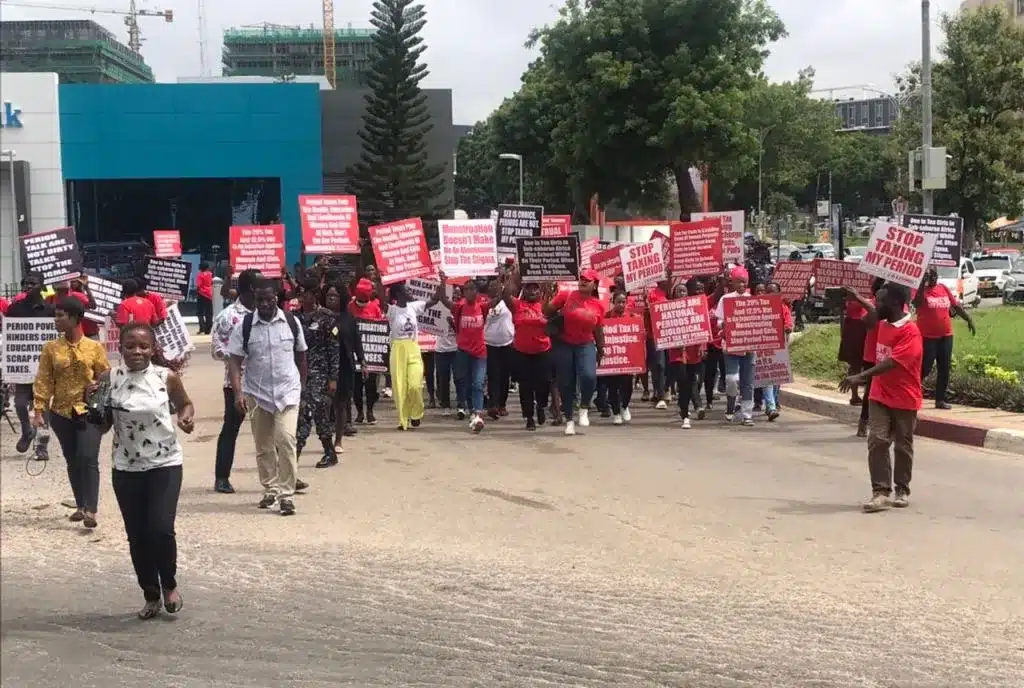
    The Group, before presenting the petition to Parliament, marched from the Ridge Roundabout with placards calling for the scrapping of the tax.

  • GNAD donates to Volta School for the Deaf and Blind

    GNAD donates to Volta School for the Deaf and Blind

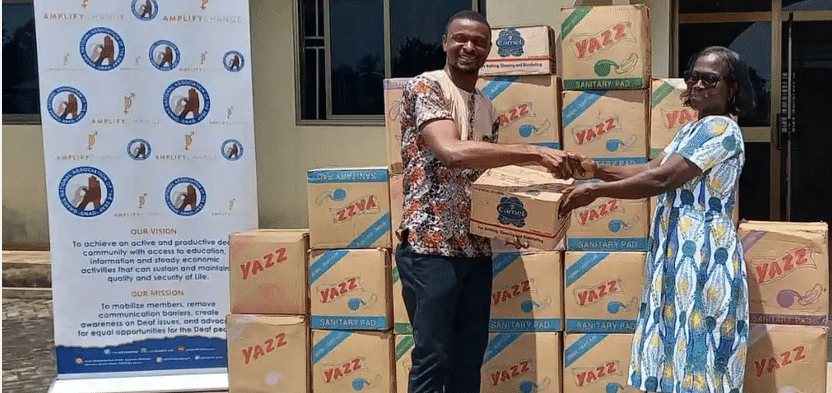
    The Ghana National Association of the Deaf (GNAD), a non-profit making organisation, has presented 24 boxes of sanitary pads and two boxes of Dettol to the Volta School for the Deaf and Blind in Hohoe.  

    The gesture is to address issues of absenteeism among adolescent girls while they are on their menstrual period due to lack of sanitary pads. 

    Mr Eric Sapey Jnr, Project lead, noted that the donation would go a long way to support the beneficiaries to actively participate in learning during their menstrual periods.  

    He said the donation was part of a project on Comprehensive Sexual Reproductive Health (SRH) whose aim is to improve access to SRH information and services for Deaf people in Ghana with financial support from AmplifyChange. 

    Mr Sapey said the core objectives of the project were to increase access to comprehensive SRH information and service for hearing-impaired women and girls in three regions, enhance knowledge of 1,000 adolescent girls with the ability to manage their menses in a dignifying manner. 

    He noted that as the Project with its partners is coming to an end, it was important that stakeholders such as Social Welfare Departments, devised means to ensure its sustainability in curbing absenteeism among the adolescent girls while on their menstrual periods.  

    Madam Kushigbor Ophelia, Headmistress, Volta School for the Deaf and Blind, expressed gratitude to the GNAD for its kind gestures.  

    She said since the presentation of similar support to the school in 2022 by GNAD, there had been a major improvement in the adolescent girl’s participation in learning in terms of menstrual periods.  

    Madam Kushigbor said most parents were unable to provide sanitary pads for their wards and the supply by GNAD came was appropriate.  

    She appealed to individuals and organisations to help support the girls. 

    Mrs Janet Valerie Datsa Agbotse, Hohoe Municipal Director of Education, described the support as the “hope for the future of our girls” and noted that the support would go a long way to help parents who could not provide pads for their wards.  

    Mrs Agbotse said there was the need for collaboration with other individuals and stakeholders to ensure continuous support through the supply of sanitary pads for the adolescent girls in the schools. 

    Mr Henry Yanpalleh, Hohoe Municipal Social Welfare Officer, commended GNAD and AmplifyChange for supporting the adolescent girls with sanitary pads to stay in school. 

    He said the Department was also working hard to support the students and the school in ensuring that students received holistic education, one of which was the supply and availability of sanitary pads. 

    Mr Raymond Agbadi, Volta Regional President, GNAD, said the project had positively affected the education of adolescent girls in beneficiary schools. 

  • Young girls exchanging sex for sanitary pad – Eco-Me Africa

    CEO of Eco-me Africa Amdiya Abdul-Latiff has revealed that some young girls in rural areas are being forced to have sex with men in order to get money for sanitary pads.

    According to her, many of the girls are from deprived homes and are unable to afford decent sanitary towels for the monthly menstrual cycle.

    Speaking with Prime Morning host, Asieduwaa Akumia, on Monday, Mrs. Amadiya Abdul-Latiff indicated the ordeals the teenagers go through to obtain common sanitary pads.

    “They were resulting in unhygienic means like using socks – which are very popular by the way, newspapers, dirty rags, and then dried leaves. They are easily available in the rural communities, so anything at all that can absorb and hold blood, that’s what they use,” Mrs. Abdul-Latiff said.

    The Eco-me Africa CEO further said that she was posted to a school in a rural community as a pupil’s teacher.

    It was there that she witnessed the difficulties that girls in primary schools are forced to face.

    This situation, she said, accounts for girls dropping out of school.

    Those who remained in school resorted to unorthodox materials in place of sanitary towels. The majority of these are exposed to infections.

    According to her, some girls are even pushed to the extent of sleeping with men in exchange for pads.

    She said, “Some of them too had no option but were pushed to exchange sex for pads. It is a common trade in the poorest areas of Ghana, where young girls are pushed to sleep with men, mostly older men, just so they can have money to purchase a sanitary pad.”

    Madam Abdul-Latiff also mentioned that this plight can result in teenage pregnancies, thus leading girls to drop out of school.

    She also added that there has been new research that states that in Ghana, many girls sometimes miss school when menstruating.

    Eco-me Africa CEO fears the phenomenon if not checked will affect the health and education of these young girls.

    Source: – MyJoyOnline.com


  • 53% of adolescent girls cannot afford sanitary pads – Report

    A research from the University of Education, Winneba proves that 53% of adolescent girls cannot afford themselves sanitary pads thereby lacking access to adequate menstrual protection.

    The study sought to assess the knowledge and practices of menstrual hygiene among adolescent schools in the Mampong municipality of Ghana.

    According to the lead investigator, Mr Huda Abdallah Kusi, the survey was used to assess how abreast adolescent girls are with menstrual hygiene and its practices.

    “The descriptive cross-sectional study was used to assess the knowledge and practices of menstrual hygiene among adolescent school girls with at least 4 months of menstrual experiences,” he stated.

    The report also contained that seventy per cent of adolescent school girls believe menstruation is a disease.

    However, the researchers concluded that menstrual hygiene practices for adolescent school girls in Mampong municipality were largely influenced by socioeconomic capacities of their parents.

    For that matter, they recommend knowledge about menstrual hygiene practices among girls for additional education and enlightenment.

    84 participants within the ages of 14 to 18 were interviewed face-to-face using questionnaires.

    59 of them representing 70.2 per cent indicated menstruation is a disease.

    Sociodemographic characteristics, economic factors, menstrual hygiene practices were captured.

    Source: www.ghanaweb.com

  • Ghana needs a local sanitary product factory NGO tells government

    Women in Ghana have lauded the governments for its promise to scrap the 20% luxury tax on imported sanitary products in the country.

    Bridge for Equity, a non-governmental organization has called on the government to factor in a local sanitary manufacturing company in the One District One Factory policy to help cut down the cost of sanitary products.

    For years, various organizations and bodies have been calling on the government to remove the tax on sanitary products to make it affordable for all, especially young girls in deprived communities.

    Reports indicate that most girls in rural Ghana are prevented from going to school during their monthly menstrual cycle as a result of not being able to purchase sanitary pads.

    But, speaking on Saturday, August 22, 2020, at the launch of the New Patriotic Partys (NPP) manifesto at Cape Coast, Vice president, Dr. Mahamudu Bawumia assured Ghanaians that they will scrap the tax on imported sanitary products in their next administration.

    He indicated that “We (NPP government) will eliminate import duties on sanitary pads to improve health conditions, particularly for girls. It is very important. What we intend doing is to make sure we produce sanitary pads in Ghana until that happens in their numbers, we are going to eliminate import duties to bring down their cost.”

    Speaking on the back of locally produced sanitary pad, the founder of ‘Bridge for Equity’, Lilipearl Baaba Otoo, in an interview with GhanaWeb, advocated that the country goes into the production of reusable sanitary pad which “can last for 4 years”, this she believes will drastically cut down on the prices of the product and also save the environment.

    She stated that “the government can introduce the reusable sanitary pads…we are trying to fit this agenda into governments policies especially the 1 District One Factory, it is possible. We are trying to eradicate plastic; we consider that a reusable one will be more sustainable and efficient…they are healthier,” she added.

    Source: www.ghanaweb.com

  • Abolish import tax on sanitary pads Government urged

    A Consortium of Non Profit Organisations in the Upper West Region has renewed calls on the government to abolish tax on the importation of sanitary pads into the country.

    The consortium made up of Ideapath Consult, Wype the Tears of African Girl Child, Get Back to School Foundation, Toilet Engineers and Sanitation Services Limited, noted that prices of sanitary pads in the country continued to increase to the detriment of the vulnerable girls in society due to heavy taxes imposed on its importation into the country.

    In a statement signed by the Chief Executive Officer (CEO) for the lead organisation, Ideapath Consult, Mr Lukeman Tahiru and released to the Ghanaian Times, the consortium appealed to the government to prescribe tax holidays for importers of sanitary pad.

    It also encouraged government to invest in the manufacturing of sanitary pads locally as well as promote local entrepreneurs who would venture into such production in order to reduce cost.

    The statement noted with concern, the spate at which some young girls had fallen victim to unscrupulous men in their bid to secure money to purchase basic items such as sanitary pads.

    “Menstruation is not an option. It is a normal biological process for women yet low-income families are heavily hit as parents and guardians are unable to afford sanitary pads for their wards” it stated, adding that the situation was more pronounced in the Upper West Region where poverty was widespread.

    The consortium opined that if taxes on sanitary pads were slashed it would make the product affordable for females and would go a long way to reduce social vices such as child prostitution with its resultant problem of teenage pregnancy and school dropout cases

    “Many girls in this region, particularly in the rural areas, according to our preliminary survey stay out of school when they are menstruating and that is because they do not have sanitary pads to keep them safe and confident,” it noted.

    The statement further lamented that the problem was compounded by the colour of the school uniforms being used by a particular school, indicating that girls with bright coloured uniforms would opt out of school for a whole week during their menstrual period for fear of soiling themselves in public.

    “The impact of this on the girl child is enormous as it affects her academic performance and kills her confidence as well,” the statement expressed and added a plea to government to abolish the taxes as soon as possible.


    Source: ghanaiantimes.com.gh