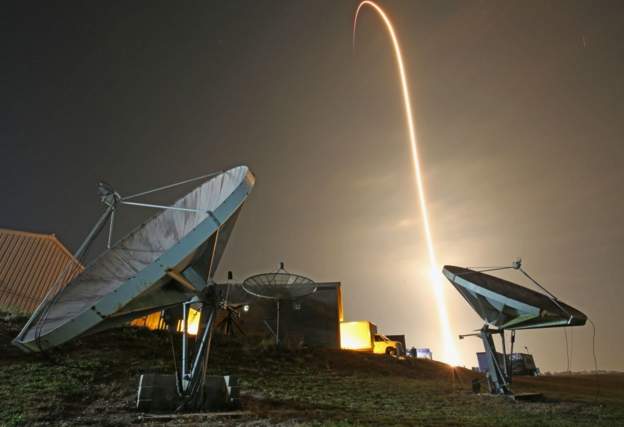
Senegal hasmade a groundbreaking step into space exploration with the successful deployment of its first satellite, Gaindesat.
The satellite was launched from California’s Vandenberg Air Force Base at 6:46 p.m. GMT on Friday, with the support of SpaceX.
“After five years of hard work by our engineers and technicians, this achievement marks a significant step toward our technological sovereignty.
I wish to express my pride and gratitude to all those who made this project possible,” President Bassirou Diomaye Faye wrote on X following the launch.
Senegal’s latest achievement in space technology, the Gaindesat satellite, marks a significant milestone for the nation and the broader African space industry.
Developed by a team of Senegalese engineers in partnership with the Montpelier University Space Center (CSUM), Gaindesat is poised to enhance various sectors including water management, weather prediction, aviation safety, and climate monitoring.
This satellite will support key organizations such as the Directorate of Water Resource Management and Planning (DGPRE) and the National Agency for Civil Aviation and Meteorology (ANACIM).
Gaindesat’s launch positions Senegal as the second Francophone country in sub-Saharan Africa to deploy a satellite, following Djibouti’s precedent.
Senegal’s advancement in space technology highlights the nation’s readiness to lead in scientific innovation and explore new frontiers.
This initiative not only represents a leap forward for Senegal but also serves as an inspiration for other African nations, showcasing the potential for progress in the space sector across the continent.
The global space industry, currently valued at approximately $469 billion, sees Africa’s contribution growing. With the African space sector valued at $19.49 billion in 2021, projections suggest it will reach $22.64 billion by 2026.
As of 2022, Africa has launched 52 satellites, with ambitious plans to significantly increase this number in the coming years, as reported by Space Hubs Africa.
A new kind of satellite that will show us celestial objects in a different way was launched on Wednesday night, along with a spacecraft called the “Moon Sniper” that will land on the moon.
The Japanese Space Agency had to change the launch many times because of bad weather. Finally, they launched a rocket called H-IIA from the Tanegashima Space Center at 7:42 p. mOn Wednesday at 8:42 a. mIt is currently Thursday in Japan, according to the local time.
The event was shown live on JAXA’s YouTube channel, with broadcasts in English and Japanese.
The XRISM satellite, or X-Ray Imaging and Spectroscopy Mission, is a project involving JAXA and NASA, as well as the European Space Agency and Canadian Space Agency.
JAXA’s SLIM, which stands for Smart Lander for Investigating Moon, is also coming along for the journey. This small exploration lander is made to show how it can land very accurately in a specific spot within 100 meters (328 feet), rather than within a kilometer. It uses advanced landing technology to achieve this. The accuracy of the mission made it be called Moon Sniper.
According to NASA, the satellite and its two instruments will study the hottest parts of the universe, the largest structures, and objects with very strong gravity. XRISM is a machine that can sense X-ray light, which is a type of light that humans cannot see because its wavelength is too short. Learning about stars that explode and mysterious black holes. Richard Kelley, who is in charge of XRISM at NASA’s Goddard Space Flight Center, said that they aim to research the results of star explosions and the fast particle streams from massive black holes in galaxies. “But, of course, we are most thrilled about all the surprising things XRISM will find as it watches our universe. ”
With this in mind, XRISM has many curved mirrors that are arranged in a way that helps them detect X-rays more effectively. The satellite will need to adjust and test itself for a couple of months after it gets to space. The goal is to work for three years.
The satellite can see X-rays that are much more powerful than visible light, according to NASA. Visible light has energy levels of only 2 to 3 electron volts, while the X-rays detected by the satellite have energies ranging from 400 to 12,000 electron volts. This detection range will let us study very extreme things in space.
The satellite has two tools called Resolve and Xtend. Resolve is a system that can detect very small changes in temperature. It uses these changes to figure out where X-rays come from, what they are made of, how they move, and what form they are in. Resolve is really, really cold – about 50 times colder than deep space. It gets this cold by using a big container of liquid helium. At that temperature, it is minus 459. 58 degrees Fahrenheit or minus 273. 10 degrees Celsius
This tool will help scientists who study space learn more about the chemicals in hot gas found in groups of stars called galactic clusters.
“According to Kelley, XRISM’s Resolve tool will allow us to look closely at the composition of cosmic X-ray sources in a way that we have never done before. ” We expect to learn a lot about the hottest things in the universe like stars that explode, black holes, galaxies that are powered by them, and groups of galaxies.
In simpler terms, Xtend will allow XRISM to see a very wide area in space using X-rays, which is one of the biggest on any X-ray satellite.
Brian Williams, who is in charge of NASA’s XRISM project, said that the information collected by XRISM will be the most detailed ever seen for certain events that we will be studying. The mission will help us understand more about things that are hard to study, like what’s inside neutron stars and how fast particles move near black holes in active galaxies.
At the same time, SLIM will use its own method of moving forward to go towards the moon. The spaceship will reach the moon’s orbit around three to four months after it takes off. It will stay in orbit around the moon for about one month, and then it will start to slowly come down and try to land softly on the moon’s surface, which will happen around four to six months after it took off. If the lander works well, it will also briefly study the surface of the moon to demonstrate the technology.
SLIM is a mission that will land on the moon near a small crater called Shioli. It will explore the rocks there to learn more about how the moon was formed. The place where Apollo 11 landed is located in the south of the Sea of Tranquility, near the moon’s middle part, in the year 1969.
India successfully landed on the moon on August 23, joining the United States, former Soviet Union, and China as the fourth country to do so. The landing was part of the Chandrayaan-3 mission and took place near the southern part of the moon. Before, the lunar lander made by the Japanese company Ispace called Hakuto-R fell down 3 miles (4. 8 kilometers) and crashed into the moon when trying to land in April.
The SLIM probe uses technology that helps it navigate using its vision or eyes.
Areas that have a lot of resources, like the south pole of the moon which has water ice in the shadowed parts, can also be dangerous because there are many craters and rocks. In order to avoid these things, future missions will have to be able to land in a small space.
SLIM is designed to be very light, which can be helpful for agencies to go on missions more often and explore moons on other planets like Mars. If SLIM is successful, JAXA says it will change missions from landing in random places to landing in specific locations of our choosing.
State-run Korean Central News Agency (KCNA) said that the second stage of the rocket malfunctioned during North Korea‘s effort to launch a military reconnaissance satellite into space on Wednesday. Pyongyang claimed it wanted to conduct a second launch as soon as possible.
As a result of an anomalous activation of the engine on the second stage after the first stage was detached during normal flight, the new satellite vehicle rocket Chollima-1 lost propulsion and crashed into the West Sea, according to KCNA.
According to the study, the mission failed because “the reliability and stability of the new engine system” were “low” and the fuel utilised was “unstable.”
The South Korean Joint Chiefs of Staff said it identified an object presumed to be part of what North Korea claims to be its space launch vehicle in the sea about 200 kilometers (125 miles) west of Eocheong Island at around 8:05 a.m. and is in the process of obtaining it.
Earlier, South Korea’s military said Pyongyang fired a “space projectile,” triggering emergency alerts in Seoul and Japan, weeks after North Korean leader Kim Jong Un ordered officials to prepare to launch the country’s first military reconnaissance satellite.
Both countries later canceled those alerts when it became clear there was no danger to civilian areas from the North Korean launch.
Analysts said Wednesday morning’s events illustrated problems for both North and South Korea, for Pyongyang in its space program and for Seoul in its public alert process.
“North Korean space efforts have consistently failed, indicating that whereas its military ballistic capabilities are being developed, its space launch capabilities are not proceeding at the same pace of development,” said Malcolm Davis, a senior analyst at The Australian Strategic Policy Institute.
“That is curious because space launch capabilities and ballistic missile systems are essentially similar technologies in many respects, and North Korean testing of ballistic missile systems have been more successful,” Davis said.
North Korea has performed dozens of ballistic missile tests over the past two years, which analysts have said have shown a maturation in the program.
The test of a new solid-fueled intercontinental ballistic missile (ICBM) in April showed that Pyongyang could launch the missiles more quickly in the event of any nuclear confrontation, analysts said.
The North Korean launch sparked air raid sirens around Seoul about 6:30 a.m., causing confusion among residents who are used to pre-announced tests of the warning system in the middle of the day.
The sirens were followed by a text sent to cell phones, telling people to prepare to seek shelter.
The alert was canceled about 20 minutes after it was issued.
Who implemented the alert remains uncertain. The Interior Ministry said it was issued by the Seoul city government in error.
Seoul Mayor Oh Se-hoon apologized to the citizens for “causing confusion” over sending a citywide alert, adding that efforts will be made to refine the system to avoid similar situations.
Leif-Eric Easley, a professor at Ewha Womans University in Seoul, said any criticism of government leaders for the alert may be unwarranted.
“The government would receive more criticism if it did not make every effort for public safety,” Easley said.
In fact, he said the alert could help shake South Korean residents from complacency about the dangers posed by Pyongyang’s missile programs.
“The Yoon administration will likely promise improvements to the alert system but may also expect that greater awareness of the North Korean threat will increase support for the government’s military deterrence policies,” Easley said.
Both the South Korean and Japanese governments condemned the North Korean launch as a violation of United Nations Security Council resolutions.
“Whether it was a success or not (it was) a serious provocation that threatens peace and security on the Korean Peninsula and the international community,” according to a statement from Yoon’s office.
In Japan, Chief Cabinet Secretary Hirokazu Matsuno said Tokyo “vehemently protested” to North Korea. He promised continued “vigilance and surveillance” from the Japanese government.
Japan’s Defense Ministry had warned on Monday it would destroy any North Korean missile that entered its territory after Pyongyang notified the country of plans to launch a “satellite.”
An Earth-sized planet that is entirely unlike Earth has been discovered by astronomers.
Instead, the exoplanet, known as LP 791-18 d, is most likely covered with volcanoes and may have eruptions as frequently as Jupiter’s moon Io, our solar system’s most volcanically active location.
The exoplanet was discovered using information from ground-based telescopes, the decommissioned Spitzer Space Telescope, and NASA’s planet-hunting Transiting Exoplanet Survey Satellite. The results of a study were released in the journal Nature on Wednesday.
LP 791-18 d circles a tiny red dwarf star in the Crater constellation, about 90 light-years from Earth.
Two other known planets also orbit the star, including LP 791-18 b, which is estimated to be 20% bigger than Earth, and LP 971-18 c, about 2.5 times Earth’s size and more than seven times its mass. And astronomers believe the massive planet LP 971-18 c might be contributing to the newly detected exoplanet’s possible volcanism.
As the two objects orbit their star, LP 971-18 c and the newfound exoplanet LP 791-18 d closely pass each other, allowing the gravitational pull of the larger planet LP 971-18 c to tug on planet d and reshape its orbit. With each trip around the star, planet d’s path shifts, becoming slightly more oval-shaped. The elliptical revolutions cause the interior of the planet to heat up, driving volcanic activity.
This phenomenon is similar to what occurs on Io, caught in a gravitational crossfire between Jupiter and its larger moons.
But there is no direct evidence yet to prove that volcanoes exist across LP 971-18 d.
“We don’t know that there are any volcanoes here,” said study coauthor Ian Crossfield, associate professor of physics and astronomy at the University of Kansas in Lawrence, in a statement. “All we know is that this is a small planet that’s experiencing a straight-up periodic stretching due to its orbit around its star and near the other planets. That might cause lots of volcanoes like on Jupiter’s moon Io, which is the most volcanically active thing in our solar system. We know about that because we’ve sent things nearby and taken pictures. There’s not yet that kind of clear evidence yet with LP 791-18 d.”
Future observations of the planet could provide more data as astronomers continue the search for potentially habitable Earth-size planets.
Volcanic activity and planetary atmospheres
Astronomers estimate that LP 791-18 d falls within the inner edge of the habitable zone, the distance from a star where a planet is warm enough to support liquid water on its surface.
“LP 791-18 d is tidally locked, which means the same side constantly faces its star,” said study coauthor Björn Benneke, professor of astronomy at the Trottier Institute for Research on Exoplanets at the University of Montreal, in a statement. “The day side would probably be too hot for liquid water to exist on the surface. But the amount of volcanic activity we suspect occurs all over the planet could sustain an atmosphere, which may allow water to condense on the night side.”
Although volcanic activity sounds like an impediment to water and potential life, it may actually help the planet maintain an atmosphere. Volcanoes can drive interactions between the interior and exterior of a planet.
“A big question in astrobiology, the field that broadly studies the origins of life on Earth and beyond, is if tectonic or volcanic activity is necessary for life,” said study coauthor Jessie Christiansen, a research scientist at NASA’s Exoplanet Science Institute at the California Institute of Technology in Pasadena, in a statement. “In addition to potentially providing an atmosphere, these processes could churn up materials that would otherwise sink down and get trapped in the crust, including those we think are important for life, like carbon.”
Astronomers are intrigued by how volcanic activity can drive changes on planets. Venus, similar enough in size to Earth to be called its twin, may have once been more like our world.
“On Venus, volcanic carbon dioxide stayed in the atmosphere, pushing the planet into a runaway greenhouse state,” said study coauthor Stephen Kane, professor of planetary astrophysics at the University of California Riverside, in a statement. “Today, surface temperatures on Venus are more than 850 degrees Fahrenheit (454.4 degrees Celsius) — as hot as a wood-fired pizza oven — and odds of life there are slim. But it may not always have been that way. Volcanoes might be a big piece of the puzzle about what actually happened on Venus. Planets like LP 791-18d can shed important insights into how volcanoes shape planetary environments with time, including those of Venus and Earth.”
The larger planet LP 971-18 c is already on the list of targets that the James Webb Space Telescope will observe in the future, and now the study team believes that the newly spotted planet d is also a prime candidate. Astronomers are using the Webb telescope to search for signs of atmospheres around exoplanets and peer into them to determine the chemicals that make up these extraterrestrial atmospheres.
The discovery of LP 971-18 d points to the importance of data collected by space telescopes. The planetary system was one of the last observation targets of the Spitzer Space Telescope before the observatory was retired in January 2020.
“It is incredible to read about the continuation of discoveries and publications years beyond Spitzer’s end of mission,” said Joseph Hunt, Spitzer project manager at NASA’s Jet Propulsion Laboratory in Pasadena, California, in a statement. “That really shows the success of our first-class engineers and scientists. Together they built not only a spacecraft but also a data set that continues to be an asset for the astrophysics community.”
Kenya is getting ready to launch its first ever earth observation satellite, marking a significant milestone in the nation’s space research endeavors.
Next week, the SpaceX Falcon 9 rocket carrying Nation-1, also known as Taifa-1 in Swahili, is set to blast out from the Californian Vandenberg Space Force Base.
According to a joint announcement from the Kenya Space Agency and the Ministry of Defense, the satellite is intended to deliver earth observation data for use in agricultural, food security, and environmental management.
It was “fully designed and developed” by Kenyan engineers in collaboration with a Bulgarian aerospace manufacturer, the statement added.
A delegation from Kenya is expected to travel to the US for the launch.
The mission is seen as a significant milestone for Kenyan scientific innovation. The country is suffering its worst drought in decades after five failed rain seasons.
In 2018, Kenya launched its first experimental nano-satellite from the International Space Station.