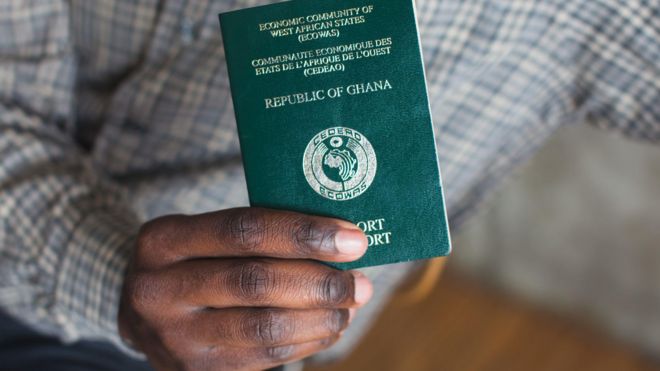
A forensic audit by the Auditor-General (A-G) has disclosed that Ghana’s Embassy in the United States collected $19.3 million from visa and passport applicants over six years.
According to the report, the applicants paid the money to the Embassy to circumvent the standard application process. The process involved redirecting applicants who accessed the Embassy’s official website to privately controlled platforms, where they were required to pay $29.75 per application before their passports or visas could be returned.
Part of the report read, “These arrangements enabled the collection of dispatch/mailing fees and application support service charges from applicants. The forensic analysis of visa and passport processing activities at the Embassy of Ghana in Washington, D.C., identified irregular financial transactions related to dispatch/mailing charges between 2019 and 2025; application support services between 2021 and 2025; extra merchant fees for online payments between 2020 and 2025; as well as transactions involving Fred Kwarteng & STEFRANN LLC between 2019 and 2020″.
Additionally, the report noted that “the dispatch fees previously collected from applicants were not utilised for their intended purpose, exposing the Embassy to avoidable financial loss”.
This development comes at a time when the Authority has revealed that Ghana incurred in excess of $40 million in avoidable costs, highlighting millions of dollars and cedis in questionable claims, inflated rates, omitted works, and avoidable costs across several projects in hosting and organisation of the 2023 13th African Games that began late February 2024.
The audit discovered possible financial irregularities in several African Games projects, including contract changes that may not have followed proper procedures, discrepancies in project cost estimates, and cases where the final work delivered appeared to be less than what was originally planned. These issues were identified at the Borteyman Sports Complex, University of Ghana Stadium, Games Village hostels, cricket facilities and access roads.
One of the major highlights of the report is the Borteyman Sports Complex project, which was supposed to be Ghana’s flagship facility for the 2023 African Games.
The report found that parts of the original Borteyman Sports Complex project were either omitted or scaled back, including a warm-up football field valued at $3.213 million, the conversion of a multipurpose hall into lecture halls valued at $3.06 million, single- and double-lane access roads valued at $11.22 million each, drainage works worth $3.366 million, an electrical substation valued at $850,000, while concrete sidewalks and a children’s playground were reduced by $2.014 million and equipment installations such as CCTV, irrigation and security systems were reduced by $1.6 million.
Despite the scope reductions, auditors noted that consultant supervision fees increased from 3 per cent to 3.83 per cent after the rescoping exercise.
At the University of Ghana Stadium project, the Audit Service flagged claims amounting to $2.814 million as opportunity costs arising from variations and delays, citing a $388,856.78 in interest on delayed payments, $1.136 million in prolongation costs due to a 10-month extension, $769,490.72 for adjustment in cost changes, $519,899.88 in outstanding statutory payments, $62,745.25 variation for extension of the warm-up track
While contractors claimed they delivered more work than originally planned at some facilities, auditors found inconsistencies in payment records and questioned the validity of some claims. They also concluded that portions of the University of Ghana hostel refurbishment were scaled back or omitted, resulting in an estimated loss of value of $1.717 million.
One of the most contentious claims involved $1.176 million for repainting works. The Audit Service said the “computation of justification for this claim is questionable” because painting had already been captured as a lump sum item in the original contract.
The auditors also cast doubt on the justification for repainting the hostel facilities, questioning whether the buildings could have deteriorated significantly enough within a matter of months to warrant such expenditure.
The review further highlighted several additional payments that raised concerns, including $555,668.01 claimed for an extension of time with associated costs, $219,167.59 for extra canteen works, and $888,642.96 covering bedsheets, pillows, pedestrian walkways, transportation bay canopies and mattress replacements.
According to the Audit Service, supporting documentation for some of these expenditures was insufficient, making it difficult to determine whether the costs were reasonable and justified.
Attention also turned to the construction of the access road to the Achimota Cricket Oval, where auditors estimated that GH¢4.376 million could have been saved if pricing rates used by the Department of Urban Roads had been adopted.
The audit identified substantial differences between the rates charged by contractor Mawums Limited and those assessed by auditors. These included variances of GH¢966,537.16 for excavation works, GH¢755,824.37 for imported fill material, GH¢1.094 million for road surfacing, GH¢791,340.20 for pavement works and GH¢252,189.80 for drainage construction.
Investigators further challenged claims that swampy terrain around the project site had contributed to higher costs, noting that evidence of some drainage structures cited in the project documents could not be verified during physical inspections.
Similar concerns were raised over the Achimota Cricket Pavilions project, where a comparison with rates provided by Architectural and Engineering Services Limited (AESL) suggested potential savings of GH¢346,793.21.
The report also criticised the project’s BoQ structure, describing it as “quite unconventional” with considerable variations in rates for similar works across building units. Auditors added that “several arithmetic errors made assessment and valuation a challenge,” creating “a false sense that saving was minimal.”
In addition, auditors noted that testing costs were lumped together with consultancy fees on multiple projects, yet no supporting test results or data were made available for verification.
Overall, the Audit Service estimated avoidable costs of more than $38.96 million and GH¢6.33 million across reviewed African Games infrastructure projects.