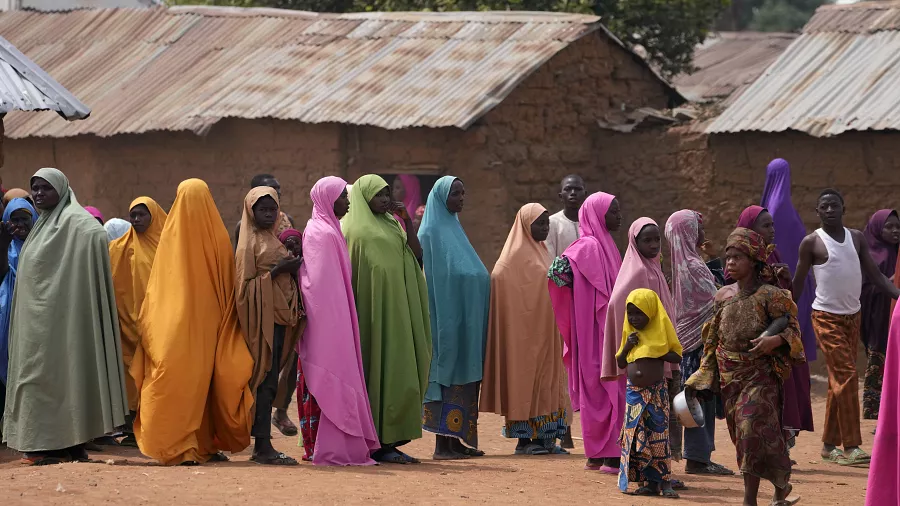
Local officials announced on Sunday that nearly 300 Nigerian schoolchildren who were kidnapped in the northwestern state of Kaduna have been released, over two weeks after they were abducted from their school and taken into the forests.
Since 2014, over 1,400 students have been abducted from Nigerian schools, following the infamous kidnapping of hundreds of schoolgirls by Boko Haram militants in Borno state’s Chibok village. Recent years have seen a concentration of abductions in the northwestern and central regions, where numerous armed groups target villagers and travelers for ransom.
Kaduna state Gov. Uba Sani did not provide specific details regarding the release of the 287 students abducted from their school in the remote town of Kuriga on March 7, with at least 100 of them aged 12 or younger. In his statement, he expressed gratitude to Nigerian President Bola Tinubu, particularly for ensuring the safe release of the abducted school children.
President Tinubu had pledged to rescue the children without paying any ransom, though it is common for families to arrange ransom payments for kidnappings. Official acknowledgment of such payments is rare in Nigeria.
No group has claimed responsibility for the Kaduna kidnapping, which locals attribute to bandit groups notorious for mass killings and ransom kidnappings in the conflict-affected northern region. Many of these groups comprise former herders engaged in conflicts with settled communities.
According to sources familiar with the security situation in Nigeria’s northwest, the identity of the abductors is known. Murtala Ahmed Rufa’i, a professor of peace and conflict studies at Usmanu Danfodiyo University, and Sheikh Ahmad Gumi, a cleric involved in negotiations with the bandits, stated that the abductors are hiding in the vast and ungoverned forests of the region.
Arrests are infrequent in Nigeria’s mass kidnappings, as victims are typically released only after families pay ransoms or through negotiations with government and security officials.
The Kaduna governor expressed gratitude to Nigerian security forces and officials for their efforts leading to the release of the students.
“I spent sleepless nights with the National Security Adviser, Mal. Nuhu Ribadu … fine-tuning strategies and coordinating the operations of the security agencies, which eventually resulted in this successful outcome,” he said.