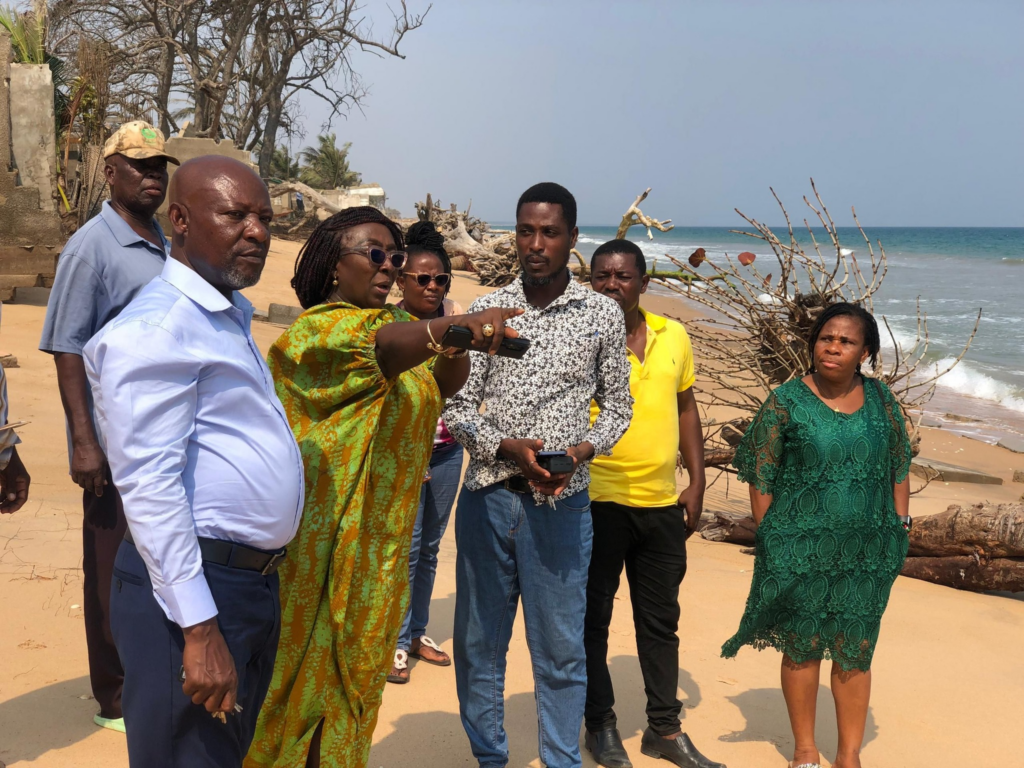
Communities in Ketu South are once again bearing the brunt of relentless coastal erosion, as tidal waves continue to wash away homes and farmlands, leaving scores of residents displaced and in dire need of support.
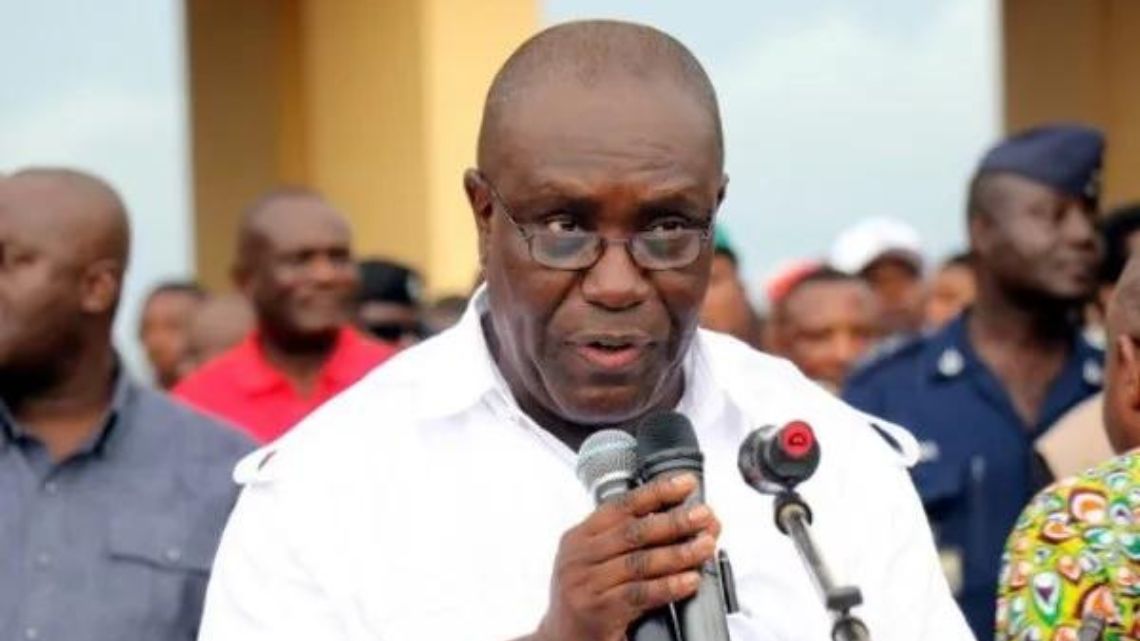
Member of Parliament for Ketu South and Minister for Tourism, Dzifa Abla Gomashie, has voiced deep concern over the worsening crisis, describing it as a grave threat to the survival of her constituents.
“The sea is swallowing our land,” she lamented in a Facebook post, highlighting that the recent destruction caused by tidal waves has been even more devastating than past occurrences.
Determined to address the crisis, Ms. Gomashie, alongside the Municipal Coordinating Director, visited the hardest-hit communities to assess the extent of the damage. She has since engaged key government officials, including the Volta Regional Minister, the Minister for Interior, the Minister for Works and Housing, the Minister for Environment, Science, Technology and Innovation (MESTI), and the National Security Advisor, urging swift action to mitigate the disaster.
In response, a high-level delegation consisting of the Volta Regional Minister, the Environmental Protection Agency (EPA), and the National Disaster Management Organisation (NADMO) visited the affected areas to evaluate the situation firsthand.
So far, relief supplies have been distributed on three separate occasions to support affected families, but with the risk of further destruction looming, authorities are now focusing on relocating those most vulnerable.
To provide immediate shelter, the Chief of Agavedzi, Togbe Sewor, has stepped forward to accommodate displaced families as officials work towards a long-term solution.
Expressing frustration over the stalled Coastal Protection Project, Ms. Gomashie stressed the need for urgent action to revive the initiative, which was launched under former President John Mahama but has since been left incomplete. She confirmed that both the Minister for Works and Housing and the Minister for MESTI are working to expedite the West Africa Coastal Areas (WACA) initiative, which aims to curb coastal erosion and protect affected communities.
Calling for national solidarity, the MP urged Ghanaians to support Ketu South and offer prayers as residents struggle to rebuild their lives amidst the crisis.
Organized Labour has urged Ghanaians to reconsider the proposed flagship policy of the New Force Movement, which aims to dredge the sea to Kumasi in the Ashanti region.
They emphasized that the policy, presented by the leader of the New Force Movement, has been misunderstood and should be viewed in terms of its practicality and potential benefits.
Speaking at a meeting between the New Force Movement and the Trade Union Congress (TUC) of Ghana to present the Movement’s 16 industrial policies, the Secretary-General of the TUC, Dr. Anthony Yaw Baah, expressed support for political leaders whose policies can bring about transformative change in the country.
He highlighted that Organized Labour is ready to support initiatives that promise significant developmental impacts.
“If you look at the river systems, when you dredge the Pra, Tano, Bia and the rest, it easily links to Cape Coast. And his point was that why should we use our roads to cut things? We can actually use our river systems, once we dredge properly, the vessels can use it, and they can transport it from Accra to the North.
“God has given us a huge river that we are not using because many people don’t really understand that policy.”
The leader and founder of the New Force Movement, outlined the key points of the Movement’s sixteen industrial policies plan to the Trade Union Congress (TUC).
Addressing issues such as Corruption, Agriculture, Education, Health, and climate change, Nana Kwame Bediako emphasized the need for a robust partnership with the TUC to ensure the effective implementation of these initiatives. He stressed the significance of collaboration in driving substantial economic and social advancement for Ghana.
"The way he(@OsagyefoNKB ) explained to us, I realized that it is doable" – Dr Anthony Yaw Baah, Secretary General – TUC calls on Ghanaians to reassess the Sea Dredging Policy by The New Force Leader #CitiNewsroompic.twitter.com/IuAz6h5EZ3
Leader of political movement, The New Force, Nana Kwame Bediako, popularly known as Cheddar, has clarified his earlier comments about dredging the sea to Kumasi in the Ashanti Region.
During a recent interview while touring the Ashanti Region, Mr. Bediako sparked controversy by suggesting intentions to extend the sea from the coast to the inland city.
However, in an interview on Joy FM’s Super Morning Show on April 10, he explained that his plan was not to extend the sea but to dredge a canal.
He clarified that dredging a canal would enhance industrialization and improve transportation at the port, ultimately aiming to enhance port accessibility for the efficient transportation of goods as part of a broader economic industrialization policy. Additionally, he noted that this initiative would reduce pressure on land transport by heavy-duty vehicles.
“I want Ghanaians to understand that I’m here to build a country. My vision is very clear. That’s how clear my vision is. I can see that development is going to happen this way because you need to connect your water bodies.
“Why do you think your colonial master is hiding that secret from you? But when you go to his country, he’s connected all his waters. He calls them Thames, Canals, Ferry, Woolwich, and secretly he’s transporting things on there,” he said.
Cheddar clarified that when he mentioned dredging to Kumasi, he was referring to a canal and not extending the sea. He further pointed out that if there had already been industrialization in areas like Ada, some development would have taken place.
“If you drill and connect a sea to any river, the name for it, which will be in development, will be a canal.
“Yes, canal. Now, a canal can have any sort of river, lagoon, sea, whatever that it is. And look, when you go to Ada, the water in Ada shares border right with the sea, right there. The opportunity is we could have created a harbor there if there was already industrialisation in those areas,” he added.
The businessman dismissed claims that it was impossible.
“I mean you guys make it look like it’s unaffordable, it’s unacceptable and it cannot be done. [It’s a long time.] No, it’s not. Actually, I’ll tell you. Look, a vision without action is a mere dream.
“You and the dreamer, there’s no difference. That’s what a visionary is, if you have a vision and you can’t find a way to activate the vision, if you don’t apply action, it’s a useless vision. It can be done.
“Once you decide to do it, it gets done. Now, why do I have the confidence to say so? Because I’ve done things. I have raised the first 16th-floor building in a place where they started building one floor, two floors, one floor, and two floors.
“I came and I went, and I put two floors underneath it. On one and a half plots, I put 108 apartments,” he added.
Singer Efya Nokturnal has responded to the suggestion made by New Force Movement leader Nana Kwame Bediako, also known as Cheddar, regarding the dredging of a sea in Kumasi, the capital of the Ashanti Region.
On her official X account on March 19, 2024, she posed a question, asking whether Cheddar had received a specific request from the people before announcing his proposal publicly.
“Did the people in Kumasi say they want a beach?” her post read. Her question elicited comical responses largely.
“Lowkey they want it but they’re pretending,” one user responded, while another tweeted: “Question for the gods.”
Another had a lengthy take about why Cheddar had a good point and needed not be ridiculed: “And did Cheddar say he is bringing the sea because of a beach?
Did the people in Kumasi say they want a beach ??👀👀
“Despite the fact the we feel what Cheddar said it’s impossible in our country, we shouldn’t make mockery of it, man made some good point citing Dubai as an example. We don’t just have the money to do that here,” he submitted.
What Cheddar said:
During an interview with Abusua FM in Kumasi, Cheddar expressed that the “sea to Kumasi” vision is integral to his goal of enhancing trade by connecting Ghana’s Eastern and Western corridors.
“I have travelled far and wide. I have seen many countries do that. Even Dubai which was a typical desert now has the sea. That is the kind of vision I have for the Ashanti Region. When we dredge the sea to the region, ships can dock in Kumasi,” he stated.
Recently, people who live in Kinmen have said they are seeing more Chinese boats that dig up sand and mud near the island. The group of islands has around 180,000 people and is 187km away from Taiwan’s main island.
The coastguard said two out of the four people on the Chinese boat were declared dead at the hospital after attempts to revive them didn’t work.
“The other two people are okay and have been taken to Kinmen for more investigation by the prosecutors,” the statement said.
Wednesday’s incident happened when things were already getting tense between the two groups. In January, Taiwan chose a new leader that China sees as wanting to split from China.
China’s office that deals with Taiwan has asked the Taiwanese government to look into the situation and help the families of the victims.
Zhu Fenglian, a person who speaks for the government, said that the ruling party in Taiwan is taking Chinese fishing boats without permission and hurting the fishermen in a violent way.
She said they have worked hard to make things easier for fishermen on both sides.
The Taiwan government supported the coastguard’s actions on Thursday and asked China to stop doing the same things in their waters.
“Taiwan’s Mainland Affairs Council said that many Chinese fishing boats have been coming into our off-limits waters and catching valuable fish, especially during the Lunar New Year. ”
“We feel very sorry that the Chinese crew did not work with our law enforcement and this bad thing happened,” it said.
On Sunday, December 23, 2023, an elderly man exhibited exceptional bravery near Independence Square, Accra, as he dived into the sea to rescue a young man in distress.
The incident, shared by user @eddie_wrt, highlighted the selfless act of the unnamed elderly man, averting a potential tragedy.
The footage captures moments of confusion and concern among onlookers as they express distress over the struggling young man in the water.
Witnesses in the video urgently call for help, underscoring the severity of the situation.
Suddenly, the unidentified elderly man, without hesitation, abandons everything he’s holding and swiftly dives into the sea to save the drowning individual.
The observer who recorded the scene remarked, “the guy dey die oo, you no dey see. Only his head is up.”
As the elderly man reaches the struggling individual, he skillfully lends assistance, preventing what could have unfolded into a tragic incident.
Yesterday, an old man plunged into the sea near Independence Square, Accra without hesitation to rescue a drowning young man. pic.twitter.com/f0CQe6Ny8S
In a devastating incident on Saturday, 23 December 2023, three school children lost their lives, while 12 others were fortunate to be rescued after drowning at Gomoa Nyanyano sea while swimming.
The victims, hailing from Kasoa, had ventured to Gomoa Nyanyano to enjoy a day of swimming during the ongoing Christmas vacation.
Upon receiving a distress call from concerned community members, the police promptly responded to the scene and successfully rescued 12 children from the water.
Unfortunately, despite extensive search efforts, the bodies of two children, aged between 10 and 15, were recovered, while one child remains missing.
Expressing her condolences, the Municipal Chief Executive for Awutu Senya East, Anita Love Obo Amissah, remarked on the unfortunate nature of the incident, emphasizing the tragedy of school children losing their lives during the Christmas holidays.
She also mentioned that officials from the Ghana Education Service (GES) have visited the parents and the school owner affected by this heart-wrenching event.
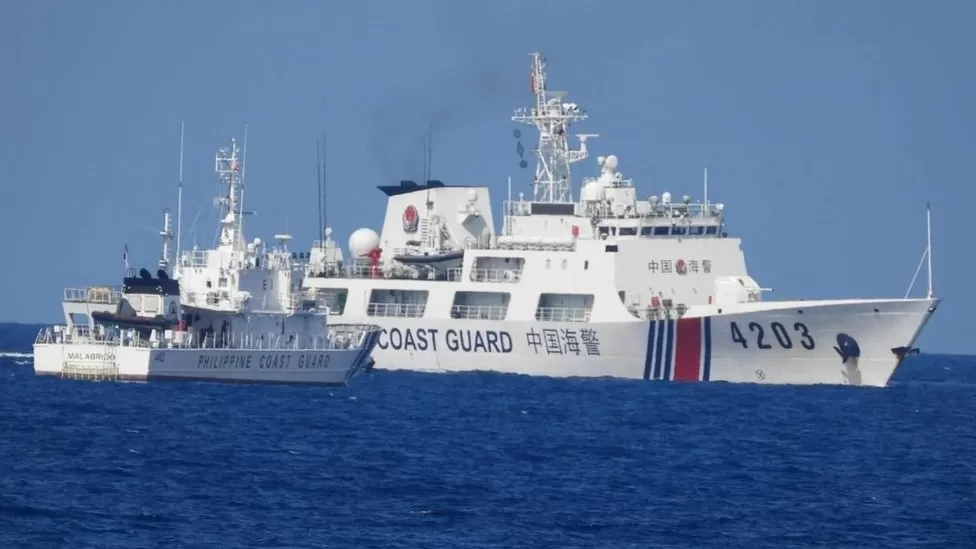
The Philippine Coast Guard has accused its Chinese counterpart of stopping its ships in the disputed South China Sea and firing water cannons at them.
It said that this incident occurred as its ship escorted boats carrying supplies for Filipino military stationed on a disputed Spratly Island.
The US condemned Beijing’s “dangerous actions”, also blaming Chinese “maritime militia” for the incident.
Regarding the alleged incident, China has not made any public comments.
The Spratly Islands, which are also partially claimed by the Philippines, are included in Beijing’s almost total claim to the South China Sea.
Additionally, Malaysia, Vietnam, Brunei, and Taiwan have countervailing claims.
The incident took place on Saturday while PCG vessels were traveling to Second Thomas Shoal in the Spratly Islands, according to a statement.
It added that the actions taken by China were “excessive and unlawful” and that they also broke international law.
The US Department of State has stated that “our Philippine allies” have its support.
“Firing water cannons and employing unsafe blocking manoeuvres, PRC [China’s] ships interfered with the Philippines’ lawful exercise of high seas freedom of navigation and jeopardised the safety of the Philippine vessels and crew,” the department said in a statement.
China has disregarded the ruling of an international arbitration court, which declared its claim to almost the entire South China Sea as unfounded.
In April, a BBC team aboard a PCG (Philippine Coast Guard) ship witnessed firsthand instances of Chinese harassment.
The South China Sea has become a major global hotspot, particularly amid escalating tensions between the United States and China in recent years.
The strategic access to these waters plays a crucial role in defending Taiwan, especially as China’s claims over the self-governed island have become more assertive.
Moreover, the waterways facilitate approximately $5tn (£4tn) of global trade each year, leading to concerns that China’s expanding presence in the region could potentially impede commerce.
Three Coastal communities in the Keta Municipality of Volta Region have been submerged by the roaring sea.
The once thriving hub for fishing activities years ago have now been completely washed away.
Consequently, the inhabitants have relocated to other parts of the country and neighboring West Africa countries in search of jobs and livelihoods.
Agorkedzi, Atiteti, Dzita, Kedzikope, Horvi, Blekusu, Adina and Agavedzi appear to be the next in line to submit to the roar of the Atlantic Ocean.
A colonial relic, Prinzenstein, built in 1784 by the Danes in Keta, which served as a prison, is in ruins on the stretch.
It had served as a transit point for slaves from Accra, Northern Volta, Togo and Dahomey in Benin.
The roof is almost gone, the wooden structures are weak, while portions of the walls have fallen.
Few meters away from the forts is the Saint Michael Cathedral, described as a magnificent worship centre built in 1982 by the Catholic Church.
At high tide, sea water hits the fence walls of the church.
A kilometer from the Cathedral is the residence of Joana Adiku, 60, who has lived in the area all her life.
“For those of us here, we sit on tenterhooks, especially from July onwards. Our situation is like being notified of a pending war but all border exits are closed,” she says in a still voice.
Growing up, she says going to the seashore was quite a distance, but now it is just three feet away.
Mr Joel Degue, 58, a development worker, and an indigene of the area, says the beautiful sandbar between the Atlantic Ocean and the Lagoon Complex is sinking.
Two thirds of Keta have been taken by the sea. It used to be the capital of Volta Region but lost that status in 1986 due to land loss.
“In the 1980’s, Keta used to be one of the most thriving business towns where traders from Togo, Nigeria, Cape Verde, Benin, Niger visited. The sea invasion, which damaged market centres robbed the area of such a mega business status leading to the exile of most talented and exuberant people,” he says.
Mr Deng recalls that although the area had a history of coastal erosion, the rate of intrusion has been rapid in the last four decades.
“I grew up in Keta, specifically Dzelukope and Abutsiakope. I remember crossing a very wide sandy beach before reaching another one, especially around Ghanakpedzi and Lokpodzi beach towards Zomayi beach, Tettekope beach,” he recounts.
“Vividly, I remember seeing a very wide beach around Tegbi-Kpota, Woe Lighthouse, Whuti, Srogbe, Adakordzi, Akplorwotokor as recently as the 1990s. Today, greater portions of those beaches are gone into sea and the communities are precariously exposed.”
He says erosion along the coastland, especially between the Volta Estuary and Aflao is the greatest environmental threat in Ghana besides illegal mining popularly known as “galamsey”.
Causes Multiple factors contribute to the vulnerability of Keta, particularly extraction of sand at the beach, geographical location, depletion of vegetative cover and rising sea level caused by climate change, says Dr Andrews Agyekumhene, Lecturer at the Department of Marine And Fisheries Sciences University of Ghana.
In Ghana, the waves normally move from west to east and Keta, which already is below sea level, is hit by high waves making that section vulnerable.
He explains that naturally, the sea tides flow to the shore with a quantity of sand and takes a quantity back when retreating.
“Once the sand deposit is extracted by the people, the tide has no choice than to take the sand available back, and that causes the shore to erode.”
Dr Agyekumhene says the world is experiencing increase temperature as observed by the Intergovernmental Panel on Climate Change (IPCC), a UN scientific body that provides regular assessments of the scientific basis of climate change, its impacts and future risks, and options for adaptation and mitigation.
This is causing the sea to warm, while the ice cape (glacier) is also melting due to the warming.
The results are an increase in volumes of sea water.
He tells the GNA that Keta may be far from the glacier, but the seas are connected, so happenings elsewhere impact on all.
The quest for a lasting solution
Successive governments have attempted solutions by building defense walls at some sections but the threats still linger.
Mr Emmanuel Gamegah, the Metropolitan Chief Executive of Keta, expresses optimism that the development of the commercial port will help mitigate the effects of the waves.
“From where I sit, I have been part of the process leading to the completion of the port. When that happens, this tidal wave problem will be solved. I am aware that the project will reclaim one kilometer of the land taken by the sea,” he says.
Aside from that, Keta will be benefiting from the second phase of the West Africa Coastal Areas Resilience Investment Project 2 (WACA ResIP 2).
The World Bank in 2022 announced the approval of a $150 million in finance for Ghana to improve ecosystem health and protect communities from erosion, which includes the Volta Delta and Keta Lagoon.
This will be done through the protection and restoration of mangrove forests; nourishment of sandy barriers; dune revegetation; and building of protective infrastructure such as groynes.
For Dr Agyekumhene, building of infrastructure like sea defense helps but the best approach is to use nature-based solutions- planting more mangroves, coconuts and other vegetative plants to solve coastal erosion.
“The structures will fall apart with time like in the case of Ada. The defense wall often shifts the problem from one location to the other…”
The mangrove expert explains that best practice has demonstrated that vegetation holds the soil together preventing sea water from easily taking the soil.
With nature-based solutions, Keta’s frontline communities, including Atiteti, Dzita, and others on the coast of Ghana and those around the world threatened by coastal erosion will be protected.