Tag: Sergei Lavrov

  • Russia applauds unexpected G20 ‘milestone’ , Ukraine fumes

    Russia applauds unexpected G20 ‘milestone’ , Ukraine fumes

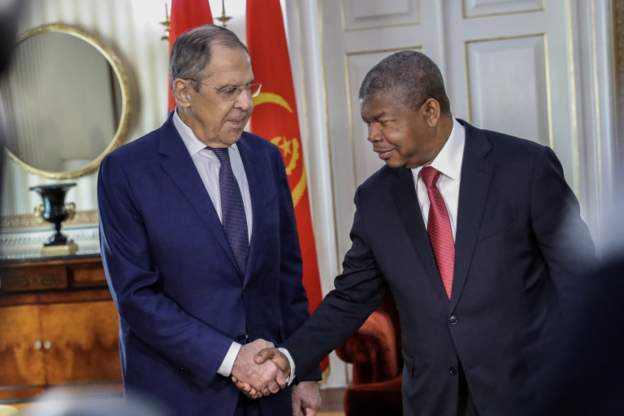
    Russia’s Foreign Minister Sergei Lavrov has said he is happy with a statement made by G20 leaders in Delhi. The statement does not criticize Russia for its conflict with Ukraine.

    Mr Lavrov said that Russia was not expecting everyone to agree, but they saw the agreement on the wording as a positive step.

    The G20 statement said it is wrong to use force to take over land, but did not mention Russia’s aggressive actions. Ukraine criticized this.

    The meeting that lasted for two days also welcomed the African Union as a new permanent member.

    The group of 55 countries is invited by India to join. India wants to include more countries from the Global South in the G20.

    The largest economies in the world made important agreements in Delhi. They agreed on issues like climate change and using biofuels. However, some people were upset because they did not agree to stop using fossil fuels.

    For the second year in a row, there was no official G20 “family photo”. (Simple words) No explanation was given, but there are reports that many leaders did not want to take pictures, because they were upset about Russia being at the meeting.

    Only a small number of people had expected all the countries in the G20 to make a statement together, especially on the first day of the summit. The group is strongly split over Russia’s attack on Ukraine last year. Neither Russia’s Vladimir Putin nor China’s Xi Jinping came to Delhi. Instead, they sent representatives of lower rank.

    There was a surprise when, only a few hours after the summit began, Indian Prime Minister Narendra Modi said that they had agreed on how to word the part about Ukraine in the statement. This part had criticized Russia last year, but now it was made less strong.

    Mr Lavrov said at a press conference on Sunday that an important point had been reached.

    To put it simply, we were really surprised. We were prepared to protect our choice of words in the text. He responded to a question from the BBC’s Yogita Limaye by saying that the Global South is no longer interested in being told what to do.

    The UK and US also mentioned the joint statement positively, but Ukraine, who participated in last year’s Bali summit but was not included this year, expressed that they were not proud of it.
    Last year in Bali, most members strongly criticized Russia’s aggressive behavior towards Ukraine. In contrast, the Delhi declaration discusses the harm and negative effects of the war in Ukraine on worldwide food and energy security.

    It asks countries to not use violence to try to take land from other countries. This might be talking about Russia, but it says that different people have different opinions about what is going on.

    Experts say that the way money and influence are shared among the top 20 economies in the world is changing. It is no longer just the wealthy countries in the Western world that have the most control, but also the big developing countries in Asia.

    There were also important events at the summit that focused on making plans to address climate change.

    The G20 countries have agreed to work together to increase renewable energy capacity by three times using their current goals and policies. The group represents over 75% of the greenhouse gases discharged worldwide.

    India, the United States, and Brazil have come together to create a global alliance for biofuels. The purpose of this alliance is to increase the use of cleaner fuels. The grouping aims to help speed up worldwide efforts to reach the goal of no net emissions by promoting the trading of biofuels made from things like leftover plant and animal materials.

    There was also a big agreement between countries in the Middle East and South Asia about building railways and ports, which happened during the summit. The pact is seen as a way to oppose China’s efforts to expand global infrastructure through their Belt and Road project.

    On Sunday afternoon, Mr. Modi ended the summit, which had been hyped up and waited for for months. He gave President Luiz Inacio Lula da Silva of Brazil a special hammer, as he is becoming the president.

    President Lula focused on the difficulties that developing countries experience in his speech.

    “We live in a world where there is a lot of wealth in the hands of a few, while millions of people still don’t have enough to eat. Our efforts towards sustainable development are constantly at risk, and the institutions that govern the world still operate based on outdated ideas from the middle of the previous century,” he said.

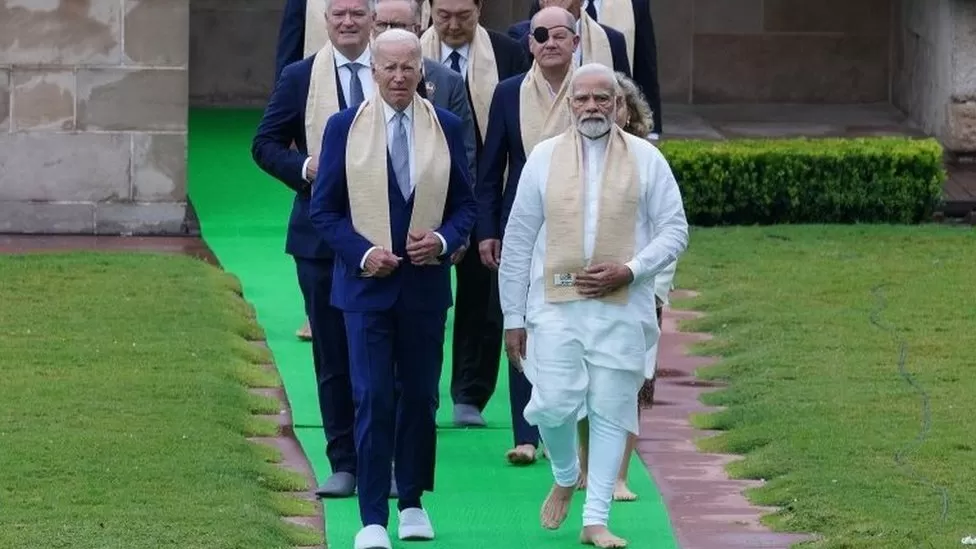
    Heavy rain during the monsoon spoiled some events that were supposed to happen earlier in the day. Despite the rain, leaders walked in the rain to honor Mahatma Gandhi, who fought for India’s independence, at the place where he was cremated. A ceremony where trees were planted was changed to become a symbolic action where G20 presidents traded young trees among themselves.

    Mr Modi’s government has organized a fancy event, where delegates are enjoying cultural performances, a big dinner party, and excellent Indian hospitality.

    However, some disagreements arose, particularly when Mr. Modi held up a sign at the beginning of the summit that said “Bharat” (which is the Hindi word for India). This caused some people to wonder if there might be a potential name change for India.

    Mr Modi and his ministers said that the event was a big success and showed that India is a strong global leader.

    “We have tried our best to include as many people as possible in this G20,” said Foreign Minister S Jaishankar.

    Finance Minister Nirmala Sitharaman said that India has successfully made sure that disagreements on certain matters do not take away attention from the important developmental issues that are of concern to the global community.

    “She said that India’s G20 Presidency has successfully followed through with its actions”.

  • US calls for release of detained journalist, Evan Gershkovich in call with Russia

    US calls for release of detained journalist, Evan Gershkovich in call with Russia

    In a rare phone call with his Russian counterpart, US Secretary of State Antony Blinken requested for the release of a detained Wall Street Journal reporter.

    In response, Sergei Lavrov, the foreign minister of Russia, said that the US shouldn’t try to “make a fuss” or politicise the arrest.

    On Friday, Evan Gershkovich was taken into custody on spying-related charges.

    The espionage accusation has been vehemently refuted by The Wall Street Journal.

    On Sunday, the Russian Foreign Ministry confirmed that Mr. Lavrov and Mr. Blinken spoke on the phone about Mr. Gershkovich’s arrest at the US’s request.

    A readout of the call released by the US Department of State said that Mr Blinken conveyed “great concern over Russia’s unacceptable detention of a US citizen journalist”.

    Mr Lavrov responded by repeating Russia’s claims that Mr Gershkovich was caught “red-handed attempting to obtain classified information” and that his case will be handled by Russian courts, a statement by Russia’s foreign ministry said.

    Mr Lavrov also cautioned US officials and media not to fan “hysteria” around the journalist’s arrest.

    “It was stressed that it is inadmissible for Washington officials and Western mass media to stir up hysteria with an obvious aim of giving a political overtone to this case,” the ministry said.

    The White House has previously condemned Mr Gershkovich’s arrest “in the strongest terms”, and Mr Blinken said he was “deeply concerned” by his detainment.

    During the call, Mr Blinken also urged the release of other US citizens detained in Russia, including former US Marine Paul Whelan, who has also been held on espionage charges for over five years.

    Mr Gershkovich, 31, is a well-known correspondent in Moscow.

    The Wall Street Journal lost all contact with him on Wednesday afternoon, after which it was revealed that he was arrested by Russia’s FSB security service.

    The FSB claimed that it had halted “illegal activities” and that the journalist had been detained “acting on US instructions”.

    They alleged that Mr Gershkovich had “collected information classified as a state secret about the activities of a Russian defence enterprise”. He was ordered to remain in detention until 29 May.

    Espionage in Russia carries a maximum jail term of 20 years.

    Mr Gershkovich’s arrest has been strongly condemned by journalists around the world.

    In a letter to Russia’s US ambassador Anatoly Antenov, the Committee to Protect Journalists called Mr Gershkovich’s arrest “unwarranted and unjust”, and accused the Russian government of being anti-press.

  • Uproar over Germany’s dig at Russian envoy Africa tour

    Uproar over Germany’s dig at Russian envoy Africa tour

    Germany’s foreign office has come under fire after taking aim at Russian Foreign Minister Sergei Lavrov’s tour of Africa using an unpopular generalisation about the continent.

    In a tweet, Germany’s foreign office had said: “The Russian Foreign Minister Lavrov is in Africa, not to see [leopard emoji], but to bluntly claim that Ukraine’s partners “want to destroy everything Russian”.”

    Many were angered by the suggestion that Africa’s wildlife was the only thing worth bringing the Russian envoy to the continent.

    Ebba Kalondo, the spokesperson to the African Union chairperson, wondered whether “the continent of Africa, its people and wildlife is a joke to you?”

    Ms Kalondo noted that German Foreign Minister Annalena Baerbock recently visited the African Union headquarters in Ethiopia. “Did she come to see animals?” she posed.

    “How many times should we tell you that Africa is more than seeing wild animals?” Kofi Yeboah tweeted.

    “Using terrible stereotypes of Africa (“Africa is a vast landscape of wild animals in the bush”) to score a geopolitical upper cut to an adversary in a European war will not win you any African friends,” added Zainab Usman.

    Source: BBC

  • Ukraine war: Kyiv is not to blame for the Poland missile, according to Zelensky

    President Volodymyr Zelensky has stated that he has “no doubts” that Ukraine was not to blame for the Tuesday missile strike in Poland that killed two people.

    Mr Zelensky stated that he had been assured by his top commanders that “it wasn’t our missile.”

    He also demanded that Ukrainian officials be allowed to visit the blast site and participate in the investigation.

    His remarks came as Nato Secretary-General Jens Stoltenberg stated that Kyiv’s air defence missiles were “most likely” to blame.

    US Vice President Joe Biden questioned Mr Zelensky’s claim that the missile was not of Ukrainian origin, telling reporters that “that’s not the evidence.”

    The missile blast occurred on a farm in Przewodow, just 6km (4 miles) from Poland’s border with Ukraine.

    Ukrainian air defence systems were activated on Tuesday when Russia launched what is believed to be its biggest wave of missile strikes since its February invasion.

    The attack, which occurred during the G20 summit in Indonesia, caused an international outcry, while news of a missile blast inside Nato member Poland’s territory raised fears of a dangerous escalation in the war.

    But Polish President Andrzej Duda said it was “highly probable” that the missile was launched by Ukrainian anti-aircraft defence.

    “From the information that we and our allies have, it was an S-300 rocket made in the Soviet Union, an old rocket and there is no evidence that it was launched by the Russian side,” he said.

    Mr Stoltenberg told the BBC that he agreed with Poland’s assessment that the incident was probably caused by a Ukrainian air defence missile.

    “But the main message is that Russia bears the ultimate responsibility, because this would not have happened hadn’t Russia waged a brutal war of aggression against Ukraine,” he said.

    He added that Nato had pledged to supply a “more advanced air defence system” to Ukraine, which is not a member of the alliance but receives extensive military aid.

    And Linda Thomas-Greenfield, the US ambassador to the UN, said Russia bore ultimate responsibility for the incident.

    “While we still don’t know all the facts, we do know one thing – this tragedy would never have happened but for Russia’s needless invasion of Ukraine and its recent missile assaults against Ukraine’s civilian infrastructure. The UN Charter is clear. Ukraine has every right to defend itself against this barrage,” she said at a meeting of the UN Security Council.

    Meanwhile, the top US general has warned that an early military victory for Ukraine remains unlikely, despite a series of successful Ukrainian counter-offensives in the east and south.

    Last week, Ukraine recaptured Kherson, the only major city to fall to Russia since it started its invasion in February. And in the east, a Ukrainian offensive launched in September has seen Kyiv’s forces advance into Donestsk and Luhansk.

    “The probability of a Ukrainian military victory – defined as kicking the Russians out of all of Ukraine to include what they claim as Crimea – the probability of that happening any time soon is not high, militarily,” Gen Mark Milley – the Chairman of the Joint Chiefs of Staff – told reporters at the Pentagon.

    But he said recent Russian losses meant a “political solution” was possible.

    Gen Milley, who serves as President Biden’s top military adviser, said the Ukrainian gains had left Russia “on its back” and observed that its losses could see Moscow agree to some sort of a political withdrawal.

    But the top US general did not elaborate as to what that agreement would look like.

    Speaking to attendees of the G20 summit in Bali earlier this week, President Zelensky laid out a 10-point peace plan that includes nuclear safety guarantees, the withdrawal of Russian troops from Ukraine’s territory, and reparations and justice for “Russia’s aggression against Ukraine”.

    But Moscow’s Foreign Minister Sergei Lavrov said Kyiv’s demands were “unrealistic and inadequate”. He added that Ukraine “categorically refuses” negotiations with Russia.

    Elsewhere, the eastern Donetsk region has seen heavy fighting in recent days, according to Ukrainian presidential adviser Oleksiy Arestovych.

    He said Russian troops from Kherson region had now been “redirected” towards Donetsk and Luhansk.

  • Ukraine put forward ‘unrealistic’ conditions for peace, Lavrov says

    Ukraine has put forward “unrealistic” conditions for peace, Russia’s foreign minister, Sergei Lavrov has said.

    Speaking to reporters in Bali, Indonesia, Mr Lavrov said he had been in talks with the leaders of France and Germany on the conflict in Ukraine before going on to accuse Kyiv of dragging out any possible resolution.

    He claimed Ukraine was refusing to talk to Moscow and had put forward unrealistic conditions for peace.

    The Kremlin official also said that the UN had promised to move obstacles to the export of Russian grain and fertilisers.

    Russia has long complained of barriers to its farm exports, even though they are not directly targeted by Western sanctions.

    In spite of the problems, Mr Lavrov said Russia had already exported 10.5 million tonnes of grain, mainly wheat, of which 60% had gone to Asia and 40% to Africa.

    “I hope these promises will be fulfilled. At least the UN secretary general gave me his sworn assurance that this is a priority issue for him,” he added.

    Yesterday, the Indonesian authorities said Mr Lavrov had been taken to hospital after his arrival in Bali for the G20 summit.

    Wayan Koster, the governor of Bali, said he had been taken in for a “check-up” at the Sanglah Hospital in the provincial capital, Denpasar, and was “immediately returned”.

    Three other Indonesian government and medical officials also said he was being treated on the resort island.

    However, the Russian foreign ministry dismissed claims that he had been in hospital as “fake news”.

  • Lavrov says, Zelenskyy remarks confirm need for ‘special operation’ in Ukraine

    Russia’s foreign minister, Sergei Lavrov, says remarks by Ukrainian President Volodymyr Zelenskyy recommending that  NATO undertake preventative strikes on Russia validate the need for a “special operation” in Ukraine.

    “By doing so, (he) essentially presented the world with further evidence of the threats posed by the Kyiv regime,” Mr Lavrov said.

    “This is why a special military operation was launched to neutralise them.”

    For context: During an Australian think tank last night, Mr Zelenskyy said he believed strikes were necessary to preclude any use of nuclear weapons.

    He did not go into detail about what kind of strikes he meant and made no reference to any need for nuclear strikes.

    The Ukrainian leader also urged the world to “show strength” following the annexation of four Ukrainian regions.

    He told the think tank: “The head of Russia is now carefully analysing the world’s reaction to the sham referenda he organised on Ukrainian soil and to the announcement of the annexation of our territory.

    “He is interested in whether he still has the potential for escalation. If the world’s reaction is weak now, Russia will come up with some new escalation.”

    Kremlin spokesman Dmitry Peskov denounced Mr Zelenskyy’s comments as “an appeal to start yet another world war with unpredictable, monstrous consequences”, according to RIA news agency.


  • UN Security meeting: Sergei Lavrov walks out after speech

    After giving his speech, Sergei Lavrov, the foreign minister of Russia, left the UN Security Council meeting.

    He began by saying: “There is an attempt today to impose on us a completely different narrative, about Russian aggression as the origin of all the tragedy”.

    He continued by talking about the historical relationship between Ukraine and Russia and described Ukraine as “totalitarian”.

    He added that he is “concerned about the fate of Russian soldiers taken prisoners by Ukraine”.

    Mr Lavrov said he has “no confidence” in the work of the International Criminal Court.