Tag: Seychelles

  • Seychelles abandons witchcraft case against opposition figure Patrick Herminie

    Seychelles abandons witchcraft case against opposition figure Patrick Herminie

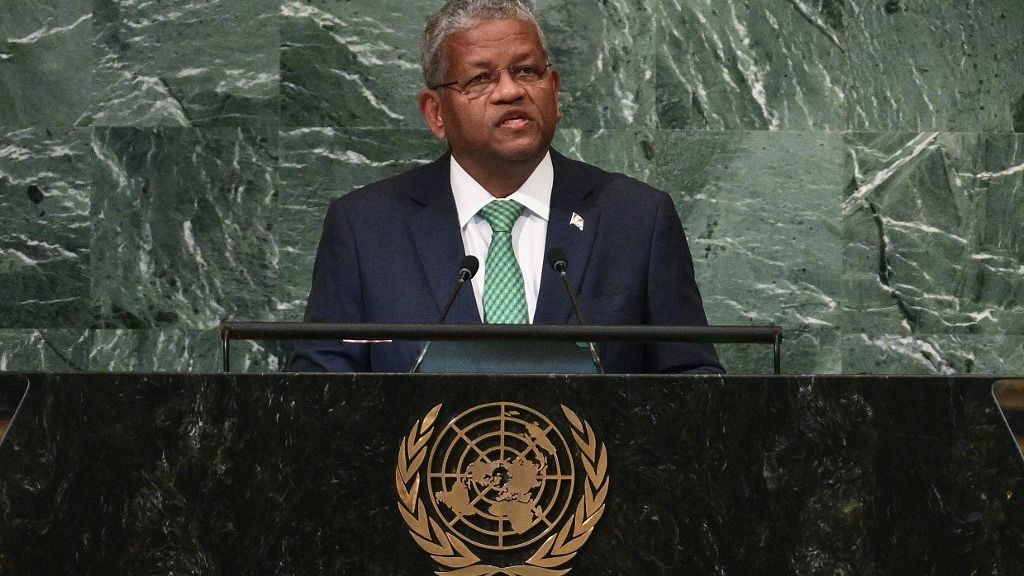
    Seychelles’ principal opposition figure, Patrick Herminie, has been relieved of witchcraft allegations as prosecutors opted to dismiss the case against him.

    Consistently denying the accusations, Herminie denounced them as “malicious actions” following a court appearance on Thursday.

    The charges stemmed from the uncovering of two bodies exhumed from a cemetery on Mahé Island, as stated by the police.

    Looking ahead, Mr. Herminie intends to contest the 2025 presidential election representing the United Seychelles Party.

    “We do not have the right to arrest someone and put them in prison for nothing at all,” he said.

    The president has not commented on the case.

    Mr Herminie served as the Speaker of Seychelles’ parliament between 2007 and 2016.

    The prosecutor told a magistrates’ court in the capital, Victoria, that he was withdrawing all charges against him.

    No reasons were given for the decision.


    The president has remained silent on the matter.

    Mr. Herminie previously held the position of Speaker in Seychelles’ parliament from 2007 to 2016.

    During a session at the magistrates’ court in Victoria, the prosecutor declared the withdrawal of all charges against him.

    No explanations were provided for this decision.

    Last October, Mr. Herminie and six Seychellois co-accused were released on bail.

    They had been accused of possessing items intended for witchcraft use, conspiring to practice witchcraft, and engaging in services related to witchcraft, as reported by local media.

    Originally, prosecutors alleged that Mr. Herminie’s name surfaced in a WhatsApp exchange between a Seychellois individual and a Tanzanian suspect apprehended at the main international airport last September.

    Seychelles abandons witchcraft case against opposition figure Patrick Herminie

    The Tanzanian was found with items allegedly related to witchcraft, including stones, black wooden artefacts, small bottles of brownish liquid, a collection of powders and documents with strange language and “demonic and satanic” symbols, they said.


    According to prosecutors, the documents resembled those discovered in vandalized Catholic churches and other locations on Mahé, Seychelles’ largest island.

    Apart from Mr. Herminie, four others involved in the initial case are no longer being prosecuted.

    As reported by the Seychelles News Agency, a fresh case has been initiated against the Tanzanian individual and two others.

    Last year, Mr. Herminie informed local media that over 40 police officers had conducted a raid on his party’s offices in Victoria.

    He added that the officers searched for items related to witchcraft, including “bones, body parts, and objects associated with Christianity” but did not find any.

    “In Seychelles’ history, there has never been until now, a political party leader arrested for superstition and witchcraft. This is something new and it is shameful for Seychelles,” he was quoted as saying at the time.
  • Leader of Seychelles opposition accused of witchcraft

    The leader of the opposition in Seychelles, Patrick Herminie, has been accused of practicing witchcraft, along with seven other people.

    The police say that the case is connected to finding two bodies that were dug up from a cemetery on the island of Mahé.

    He said that the accusations against him are not true and that they are just trying to make him look bad for political reasons.

    Mr Herminie wants to be a candidate in the 2025 presidential election for the United Seychelles Party.

    On Monday, a court released him and six others from Seychelles on bail. They had to pay 30,000 Seychelles rupees ($2,100; £1,745) to be free. However, a Tanzanian suspect was not released and will remain in custody until the next court date in November.

    Mr Herminie and his co-accused are facing charges, as reported by the local media. These charges include having things meant for witchcraft, planning to do witchcraft, and getting services for witchcraft.

    The prosecutors say that they have evidence that the name of the opposition leader was mentioned in a message on WhatsApp. The message was exchanged between a person from Seychelles and a suspect from Tanzania, who was arrested on September 21 at the main international airport.

    The Tanzanian person was discovered with things linked to witchcraft. These things included stones, black wooden objects, small bottles filled with a dark brown liquid, a mixture of powders, and papers with strange language and symbols that seemed “evil and satanic,” according to the people who found them.

    The papers were like the ones found in Catholic churches and other places that were damaged in Mahé, which is the biggest island in Seychelles. The prosecutors also claimed this.

    Mr Herminie, who was the leader of Seychelles’ parliament from 2007 to 2016, said to local media that over 40 police officers had searched his party’s offices in the capital city of Victoria on Friday.

    He said the police looked for things related to witchcraft like bones, body parts, and things connected to Christianity but didn’t find any.

    According to the Seychelles News Agency, Mr. Herminie said that his arrest was like a political performance by President Wavel Ramkalawan. He believes that the president is trying to get rid of people who can challenge him in the 2025 elections.

    President Ramkalawan has not said anything about the situation.

    Mr Herminie says he doesn’t think witchcraft is real.

    In the history of Seychelles, no political party leader has ever been arrested for believing in superstition and witchcraft, and this still remains true today. “He said this is a new thing and it brings shame to Seychelles. ”

  • African Development Bank hosts maiden edition of Civil Society Open Day in Seychelles

    African Development Bank hosts maiden edition of Civil Society Open Day in Seychelles

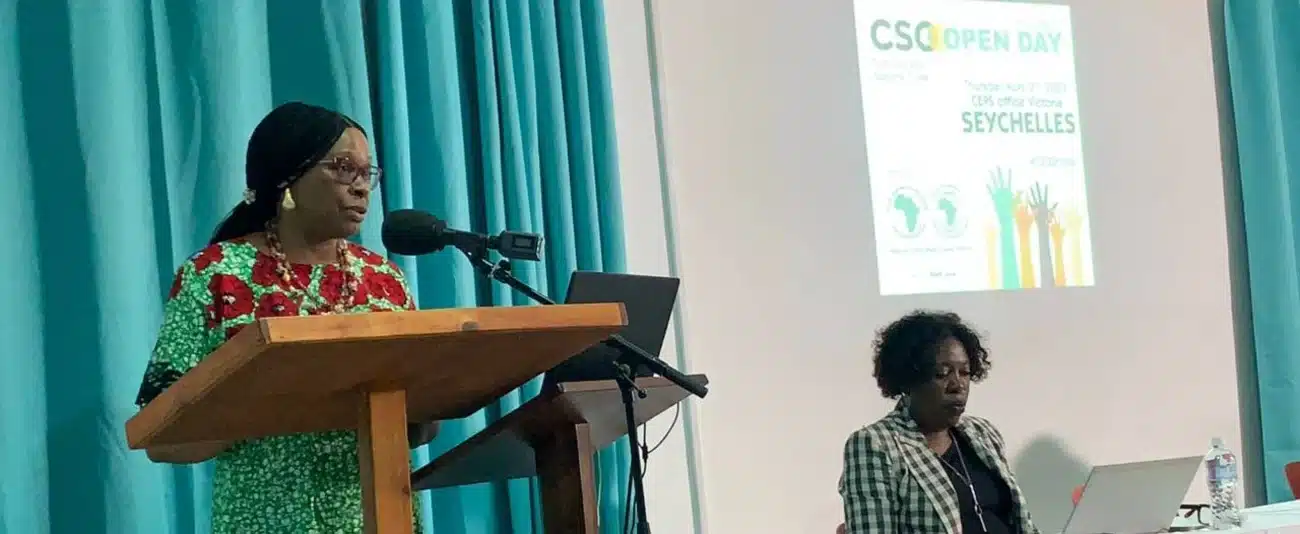
    On Thursday, April 27, 2023, the African Development Bank’s Seychelles Country Team organized its inaugural Open Day for Civil Society Organizations (CSOs) in Seychelles.

    The event was attended by 25 representatives from various CSOs, including the umbrella body, Citizens Engagement Platform Seychelles (CEPS).

    The purpose of the gathering was to discuss the bank’s country strategy and portfolio and explore possibilities for collaboration in achieving sustainable and inclusive development in Seychelles.

    Among the topics addressed were energy transition and youth development.

    Attendees include the African Development Bank’s Director General for East Africa, Mrs. Nnenna Nwabufo, the Principal Secretary for National Planning in Seychelles, Ms. Elizabeth Charles Agathine, the Director for Special Programs at the Office of the President, Ms. Maria Mulindi, and the CEO of CEPS, Mr. Alvin Laurence.

    Mrs. Nwabufo reiterated the Bank’s commitment to engaging civil society organizations in implementing the Bank’s High 5s for inclusive, sustainable growth and development in Seychelles. 

    The bank instituted CSO Open Day as a platform for sharing information on its portfolio, shared learning, and an opportunity for civil society bodies to provide feedback on the Bank’s country engagement.

    Ms. Agathine reaffirmed the government’s commitment to working with CSOs and other stakeholders to solve the country’s development challenges.  “We believe working together can create a more just, inclusive, and sustainable society.”

    Recognizing the role of CSOs in the development process, Ms. Mulindi encouraged the participants to develop a keen interest in the Bank’s development projects.

    This would ensure the realization of the intended social benefits for the people while strengthening the Bank’s impact on livelihoods.

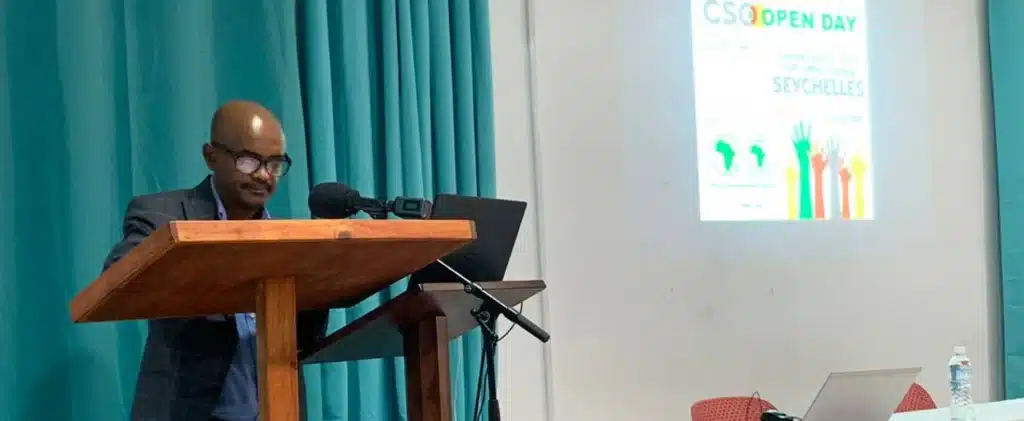
    The Bank presented its strategy and results achieved since 2021. The presentation made by Mr. Tilahun Temesgen, Chief Regional Economist, highlighted the key challenges, including cross-cutting issues.

    Alvin Laurence, Executive Director of the Citizens Engagement Platform Seychelles, an umbrella organization of civil society organizations in Seychelles.

    CEPS CEO Laurence gave an overview of civil society engagement in Seychelles, challenges and possible opportunities for collaboration.

    Some of the critical recommendations raised at the event were:

    1.Request for a more participatory development process. The CSOs recommended a platform for multistakeholder dialogue, which includes government, private sector and civil society with a particular focus on the energy transition and solutions for renewables.

    2. Build capacity on the Bank’s procurement processes, including for AFAWA and ACCF.

    3.Education curricula should match the respective industry, especially in the tourism and renewable energy sectors. They emphasized the need for a transition plan from fossil fuel to clean energy.

    1. Seychelles classified as Africa’s least corrupt country by the 2022 CPI

      Seychelles classified as Africa’s least corrupt country by the 2022 CPI

      The Transparency International Corruption Perceptions Index (CPI), has classified Seychelles as Africa’s least corrupt country, keeping sub-Saharan Africa.

      The island nation retained the position for the 5th consecutive year and 23rd ranking globally attained in 2022 with 70 points once again.

      Denmark outperformed Finland and took first place with 90 points. Finland and New Zealand are second and third with 87 points each.

      The CPI report rates the perception of corruption in the public sector using a scale of 0 to 100, where 0 is highly corrupt and 100 is clean. Seychelles stayed in 23rd place globally like in 2021 with a score of 70 points. 

      The island state again outperformed major Western democracies like the United States, which did better than last year and climbed to 24th position with a score of 69 points.

      The commissioner of the Anti-Corruption Commission of Seychelles, (ACCS), May De Silva, said in a press statement that this is good news for the islands.

      “We are therefore delighted that this positive action and our tireless efforts to root out corruption by our committed staff and the supportive public has been recognised and that we are able to maintain our global position as the 23rd least corrupt country in the world and remain the least corrupt country in Africa,” said de Silva in a report by seychellesnewsagency.

      Source: Africa News

    2. Prempeh I: The 26-year King who protected the Ashanti sovereignty

      After giving up the throne and being taken into custody in 1896, Asantehene Prempeh I spent 24 years in exile in the Seychelles.

      Prempeh I, who was born Prince Kwaku Dua III in 1870, became the 13th ruler to sit on the Golden Stool when he was 18 years old. After taking the throne, he launched a vigorous effort to protect Ashanti sovereignty.

      At the time, the British led by Queen Victoria had offered to take the Kingdom of Ashanti under their protection, but Prempeh I refused to grant their request.

      He told the British as quoted in a Ghanaian museum reportage, “my Kingdom of Asante will never commit itself to any such policy of protection; Ashanti people and the Kingdom of Ashanti must remain an independent sovereign state as of old, and at the same time be friends with all white men.”

      Offended by the response of Prempeh, the British Governor is reported to have demanded reparations (fines of 50,000 ounces of gold levied on the Asantehene, the Ashanti emperor, by the Treaty of Fomena) which was agreed by Otumfuo Nana Kofi Karikari in the third Anglo-Ashanti War which occurred from 1873 to 1874 which the Asantes lost to the British for the first time.

      Prempeh I, then sent a delegation to London to negotiate the demands with Queen Victoria. The delegates from the Kingdom included its military commander.

      The negotiations from the delegation did not yield any result, therefore, the British decided to capture and annex the entire Empire. The war started on the pretext of failure to pay the reparations. Colonel Sir Francis Scott left Cape Coast along with the British and Indian Troops in December 1895 and arrived in Kumasi in January 1896. Major Robert Baden-Powell led an army of African allies who had opposed Ashanti rule.

      Prempeh I, who wanted peace, agreed to be captured and exiled to prevent an unprepared war and to protect the Golden Stool.

      Prempeh I, the Queen Mother, and other important members of the Asante elite were taken prisoner and marched to the coast. On arrival, they were kept for a year at Elmina Castle but were eventually exiled firstly to Sierra Leone and then later to the Seychelles Islands.

      Prempeh I was kept at a suite of apartments in the castle. On his door, however, he had an inscription boldly written “Prempeh Room”.

      In a tweet on August 11, The Asante Nation wrote: “the British and their African allies were doing everything possible to break the Asante Kingdom into pieces by exiling our King. Little did the Queen of Britain, Victoria, know that she was fighting a 26-year-old King. Out of embarrassment, they wrote that he was 40 years.”

      Prempeh I arrived in Seychelles Islands on Tuesday, September 11, 1900; accompanied by 52 other prisoners, among them were his mother, his father, his brother and his three wives.

      He stayed in exile in Seychelles for 24 years before the British allowed him to return to Kumasi as a private citizen.

      On September 13, 1924, Prempeh and 49 others were reported to have left Seychelles, SS Karoa for Bombay. The oldest among them was the ex-chief, James Asafu Boachie. He was 96-years-old. The youngest was a three months old baby girl, Rose Amah Apia, daughter of Kojo Apia (1831-1911) ex-chief of Kumasi.

      There were also some 13 original deportees, who were with Prempeh. On September 22, 1924, they left Bombay and travelled to Liverpool. The party left Liverpool on October 29, 1924. On Tuesday, November 11, 1924, Prempeh and his delegation arrived in Ghana [Gold Coast] without James Prempeh, his son and his Seychellois wife, Marie-Francoise Auguste. The couple remained in Seychelles.

      Prempeh I died on May 12, 1931, and was succeeded by his heir apparent Prempeh II.


      Source: Ghanaweb


    3. Why the British sent Prempeh I to exile in Seychelles – Otumfuo explains

      Asantehene Otumfuo Osei Tutu II has revealed why the British eventually sent King Agyemang Prempeh I to exile in Seychelles.

      According to Otumfuo, the British authorities at the time were struggling to keep him close to his subjects who thronged places they knew he had been detained at.

      He linked that state of affairs to the absolute loyalty that the subjects had for King Prempeh even in detention.

      He said: “Wherever he was kept within the Gold Coast or West Africa, his people were prepared to walk to try and rescue him. Eventually they had to send him across the oceans to the Island of Seychelles.

      “Even then, the people waited for all the 25 years he was in exile until the British allowed him to return to Kumasi before they committed their loyalty to the Gold Coast,” Otumfuo added.

      The revered monarch was speaking during a lecture at the University of Memphis, in the United States of America on May 5, 2022.

      He also addressed the historic financial, military and territorial strength of the kingdom he leads today and how it had defended itself robustly against invaders.

      According to him, the British bid to control the kingdom was fiercely resisted for years before it took place: “we successfully fought off attempts at colonial conquest and remained fiercely independent until the beginning of the last century when King Prempeh I was taken into exile and Asanteman agreed to be integrated into the Gold Coast under British rule.

      “We have been resolute and true to our integration into the new nation state which is now the Republic of Ghana and have been unflinching in our determination to ensure its continuing prosperity,” he stated.

      The lecture was under the theme: “Contemporary challenges in US and Africa relations” and took place at the Rose Theatre of the University.

      Some of the participants included academics, students, university administrators, and some members of the Ghana Community in Memphis.

      In 1896 the British arrested and deported the Asantehene, Agyeman Prempeh I, to Seychelles in their efforts to colonize the Asante kingdom.

      This photo shows Asantehene Agyeman Prempeh when he arrived in the Seychelles from Sierra Leone to begin his exile

      Following this, and for a brief time, the Asantehene was exiled to Elmina, and then subsequently to Sierra Leone, before he finally settled in Seychelles.

      It must be noted that he however returned to Ghana in 1924, but only under the official designation of a “private citizen.”

      Two years later, Agyeman Prempeh was re-enstooled as “Kumasihene,” only a king over the Kumasi, rather than of all of the Asante kingdom, a status he retained until he died in 1931.

      Source: www.ghanaweb.com