In the Egyptian resort of Sharm el-Sheikh, where the COP27 United Nations Climate Conference is taking place, activists from all over the world flocked to the streets on Monday November 14 2022.
They were calling on industrialised nations to pay for global warming’s impact on the most vulnerable nations. And there was a strong contingent from the Democratic Republic of Congo (DRC).
‘We wanted to organise this march to show the whole world that it is time to react. It is not normal to be here without any significant progress, especially since we, the DRC, are a climate change solution country,’ said Héritier Mpiana, deputy director, cabinet of the vice-prime minister in charge of environment.
Call for help
The group, gathering outside the conference centre where the talks are taking place, sang songs calling for help for African countries.
Africa is responsible for less than four per cent of global gas emissions, but countries on the continent are the most vulnerable to climate changes. However, experts say they are the least equipped to respond to them.
African negotiators have been calling for the delivery of promised financing for adaptation and mitigation efforts. With the summit concluding on Friday, talks are expected to intensify over the next few days in a bid to reach a final declaration that is acceptable to all delegates.
Ghanaian environmental activist Gideon Commey has taken the fight against illegal mining, also known as “galamsey”, to the climate change conference (COP27) at Sharm el-Sheikh in Egypt.
The founder of Ghana Youth Environmental Movement staged a one-man protest at the ongoing COP27 to draw the attention of the international community on what he describes as the government’s failure to tackle the galamsey menace.
“I staged the one-man protest at #COP27 yesterday as an activist who deeply cares about the climate, and a concerned Ghanaian citizen frustrated and angry at the current state of our water bodies and forests because of galamsey (illegal small-scale mining).
“The attention the video has received and overall support for the campaign has been overwhelming. This shows I spoke the minds of thousands of Ghanaians who are exhausted and feeling hopeless about the lack of conviction, leadership and action from our political leaders,” Commey posted on Facebook.
“This in turn gives me hope about what our youth can do if we rise, speak truth to power and hold leaders accountable. Thank you everyone! I’m also grateful to Collins Gameli Hodoli for providing me with direct support without which I wouldn’t have been successful yesterday,” he added.
Small-scale farmers from developing countries produce one-third of the world’s food, yet they only receive 1.7% of climate finance even as they are forced to cope with droughts, floods, cyclones and other disasters.
This sentiment echoed through dozens of pavilions and conference rooms in Sharm el-Sheikh on Saturday (12 November) as COP27 turned its attention to the vital issues of adaptation, agriculture and food systems in the context of climate change.
“We need to help rural populations build their resilience to extreme weather events and adapt to a changing climate. If not, we only go from one crisis to the next. Small scale farmers work hard to grow food for us in tough conditions,” Sabrina Dhowre Elba, Goodwill Ambassador for the UN International Fund for Agricultural Development (IFAD), said during a press conference.
As a Somali woman, Dhowre Elba said this issue was personal: as COP27 got underway her country had experienced four consecutive failed rainy seasons, a climatic event not seen in 40 years.
“I can’t stand idly by while mothers, families and farmers are suffering across the Horn of Africa as it experiences its most severe drought in recent history,” she explained, urging developed countries to mobilize political will and investments.
“Trillions of dollars were made available to tackle the COVID-19 pandemic and its economic consequences. The same is needed for climate change. The same is needed for sustainable agricultural support. It’s crucial to the well-being and the food security of us all,” she added.
Funds for adaptation must be delivered
Dina Saleh, the Regional Director of IFAD, explained that failure to help rural populations to adapt could have dangerous consequences, leading to longer poverty, migrations and conflict.
“This is why today we are calling on world leaders from developed nations to honour their pledge to provide the US$100 billion a year in climate finance to developing nations and to channel half of that to have that amount to climate adaptation,” she underscored.
Thirteen years ago, at COP15 Copenhagen, developed nations made a significant pledge. They promised to channel US$100 billion a year to less wealthy nations by 2020, to help them adapt to climate change and mitigate further rises in temperature. That promise, however, was not kept.
Saleh cautioned that there is a “narrow window” to help rural poor people to survive and protect their communities, and that crop yields could reduce by as much as 50 per cent by the end of the century.
“The choice is between adapting or starving,” she warned, urging COP27 to be about action, credibility and justice for the invisible and the silent.
A new initiative
Precisely to address these issues, the COP27 Egyptian Presidency launched on Friday the new initiative Food and Agriculture for Sustainable Transformation or FAST, to improve the quantity and quality of climate finance contributions to transform agriculture and food systems by 2030.
The cooperation programme will have concrete deliverables for helping countries access climate finance and investment, increase knowledge, and provide policy support and dialogue.
The UN Food and Agriculture Organization (FAO), along with other UN agencies, will be the facilitator of this initiative, which, according to Zitouni Ould-Dada, deputy director of the agency’s Climate and Environment Division, puts agriculture at the heart of efforts to tackle climate change.
“The message really is to recognize that agriculture must be an integral part of the solution to the climate crisis,” he told UN News.
The importance of investing in innovation
At the same time, while the agricultural and food sector is profoundly impacted by climate change, it also contributes around a third of global greenhouse emissions, from production to consumption, Ould-Dada explains, saying that there must be a transformation of the agri-food systems.
“We can’t continue with the current model of producing food and then degrading the soil, declining biodiversity, affecting the environment. No. It must be sustainable,” he notes.
The expert highlights that if the right choices are made, agriculture can be an important part of the solution to fight the climate crisis by sequestering carbon in soil and plants and promoting adaptation and resilience.
“We can’t produce the food to feed and nourish a growing population with the current model, with the threat of climate change. We can’t.”
The first thing the world should be tackling, he says, is addressing food waste, which is responsible for 8 per cent of global gas emissions.
The importance of investing in innovation
At the same time, while the agricultural and food sector is profoundly impacted by climate change, it also contributes around a third of global greenhouse emissions, from production to consumption, Ould-Dada explains, saying that there must be a transformation of the agri-food systems.
“We can’t continue with the current model of producing food and then degrading the soil, declining biodiversity, affecting the environment. No. It must be sustainable,” he notes.
The expert highlights that if the right choices are made, agriculture can be an important part of the solution to fight the climate crisis by sequestering carbon in soil and plants and promoting adaptation and resilience.
“We can’t produce the food to feed and nourish a growing population with the current model, with the threat of climate change. We can’t.”
The first thing the world should be tackling, he says, is addressing food waste, which is responsible for 8% of global gas emissions.
Civil society calls for finance, economy transformation
UN representatives were not the only ones underscoring the need for countries to invest in transformation and deliver their climate finance promise.
A massive protest led by a coalition of environmental, women, indigenous, youth and trade union organizations took over the roads and pathways between the pavilions at COP27.
“Right to territories, rights to resources, human rights, indigenous people rights, loss and damage must be in all the negotiation texts…. 1.5 is not negotiable that is what we are here standing for,” said Hindou Oumarou Ibrahim, Chadian environmentalist and SDG advocate.
The activist stated that her people are dying because of floods, droughts, while some indigenous communities in the Pacific are losing their homelands.
“We want to have justice. Justice for our people, for our economies for loss and damage. We are losing our culture, our identity, our life, and these are not payable, but climate finance needs to be delivered,” she shouted amid hundreds of protesters.
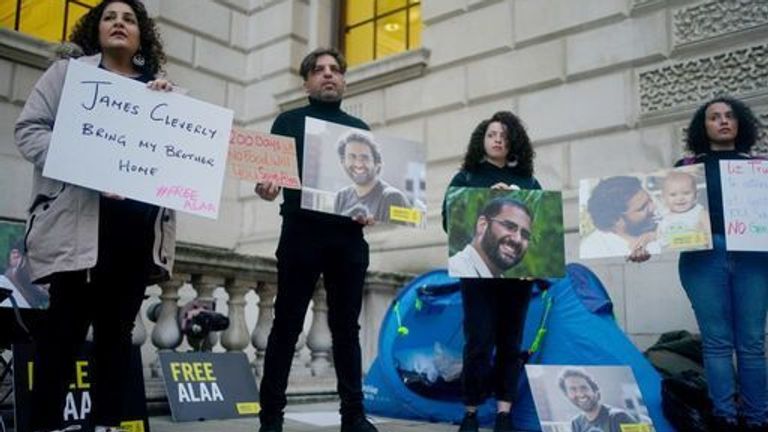
On Sunday, the first day of the COP27 climate summit in Sharm el-Sheikh, Egypt, Alaa Abd El-Fattah stopped eating and began refusing water.
According to his mother, Egyptian prison authorities intervened medically days after jailed British-Egyptian pro-democracy activist Alaa Abd El-Fattah escalated his hunger strike.
The nature of the intervention is unknown, but Mr Abd El-family Fattah’s is concerned that prison officials will force-feed him.
According to the family, this would be torture.
She told the Associated Press news agency she asked “if it was by force, and they said no” and told her “Alaa is good”.
Mr Abd El-Fattah had been on a partial hunger strike of 100 calories a day for the past six months.
He stopped all calorie intake and began refusing water on Sunday – the first day of the COP27 climate summit held in Sharm el-Sheikh in Egypt.
His hope was to get the attention of British Prime Minister Rishi Sunak, who attended the UN-led summit this week, and persuade him to take immediate action for his release.
Mr Abd El-Fattah is now in a prison hospital following the escalation in his hunger strike.
The activist said in an earlier letter that he was prepared to die in prison if not freed.
Ms Soueif has called for her son to be transferred to a civilian hospital rather than a prison facility.
“I need proof for this. I don’t trust them,” she said.
She has been waiting outside the prison every day this week, asking for proof her son is alive.
Mr Abd El-Fattah’s sister Mona Seif has said she has now been informed by prison officials that he is undergoing “medical intervention”.
The activist’s family have been increasingly worried for his health and continuously campaigned for his release ahead of COP27.
Image:Mona Seif (left), the sister of writer Alaa Abd el-Fattah, outside the Foreign Office in October
Mr Abd El-Fattah’s younger sister Sanaa Seif said last week in a public address to world leaders at COP27: “You are going to be in the same land as a British citizen dying.
“And if you don’t show that you care, it will be interpreted as a green light to kill him. My brother can be saved.”
“If you don’t save him, you have blood on your hands.”
Mr Abd El-Fattah rose to prominence during the pro-democracy uprisings in 2011 which took place throughout the Middle East and played a role in dismounting Egypt’s long-time president Hosni Mubarak.
World leaders and activists have repeatedly called for Egyptian authorities to release him.
At COP27, UK Prime Minister Rishi Sunak, French President Emmanuel Macron and German Chancellor Olaf Scholz raised the activist’s case in their talks with Mr el-Sissi.
Celebrities who have spoken out in support of Mr Abd El-Fattah include Dame Judi Dench, Dame Emma Thompson, Mark Ruffalo, Carey Mulligan andKhalid Abdalla.
Ghana’s framework on energy transition has been out doored by President Nana Addo Dankwa Akufo-Addo.
This was done on the sidelines of the ongoing COP27 in Sharm el-Sheikh, Egypt.
While outdooring the document, President Nana Addo Dankwa Akufo-Addo said that it has become imperative for Ghana to develop plans and strategies toward the creation of a net-zero energy sector, whilst aggressively pursuing the nation’s economic development.
In preparing the framework, all existing policies and the programmes that are being implemented towards achieving Ghana’s Nationally Determined Contributions were considered.
The transition will mitigate 200 million tons of carbon dioxide of greenhouse gas emissions, minimising energy-related indoor air pollution and associated diseases. It is estimated that forty-eight thousand, two hundred and eighteen (48,218) premature deaths will be avoided annually due to the improvement in air quality, resulting from the impact of the transition.
The National Energy Transition Plan is the major component of a Climate Action Plan (CAP). They both seek to reduce energy usage through energy efficiency measures because that is the most cost-effective way of reducing carbon emissions.
Read Dr. Mathew Opoku Prempeh’s Statement Below:
On the sidelines of the ongoing COP27 in Sharm el-Sheikh, Egypt, President Nana Addo Dankwa Akufo-Addo presented Ghana’s framework on energy transition at a High-Level Event organised by Bloomberg Philanthropies on Sustainable Energy for All.
In December 2021, I inaugurated the National Energy Transition Committee and tasked them to engage all relevant and related stakeholders across the length and breadth of our country.
My team and I were all delighted to witness the outdooring of the framework yesterday.
With Ghana being a signatory to the Paris Agreement and other international conventions, which require the country to reduce her carbon dioxide emission levels, President Akufo-Addo indicated that it has become imperative for Ghana to develop plans and strategies toward the creation of a net-zero energy sector, whilst aggressively pursuing the nation’s economic development.
In preparing this framework, all existing policies and the programmes that are being implemented towards achieving Ghana’s Nationally Determined Contributions were considered.
The transition will mitigate 200 million tons of carbon dioxide of greenhouse gas emissions, minimising energy-related indoor air pollution and associated diseases. It is estimated that forty-eight thousand, two hundred and eighteen (48,218) premature deaths will be avoided annually due to the improvement in air quality, resulting from the impact of the transition.
My ministry will continue to work hand-in-hand with other stakeholders to ensure that we are able to meet our energy transition targets and help improve the quality of life of Ghanaians.
Boris Johnson referred to himself as “the spirit of Glasgow COP26,” calling for the legacy of last year’s climate summit, which was held in the UK, to be “taken forward” as a “joint global endeavor.”
In his first appearance at the COP27 climate summit in Egypt, BorisJohnson slammed net zero “naysayers” who want to “frack the hell out of the British countryside.”
On the first day of the summit in Sharm el-Sheikh, the former prime minister said the fight against climate change had become a “collateral victim” of the Ukraine war, causing “naysayers to adopt a corrosive cynicism about net zero.”
In a swipe at other Conservatives – including his successor Liz Truss who had planned to lift the ban on fracking in England – Mr Johnson declared that it is “not the moment to ban the campaign for net zero” despite the ongoing energy crisis.
Returning to the international stage, he also warned that countries “should not be lurching back to an addiction or a dependence on hydrocarbons” if they wish to keep global warming to 1.5C, adding: “The solution is to move ahead with a green approach.”
Mr Johnson said nations must join together to “tackle this nonsense head on”.
“This is not the moment to give in to Putin’s energy blackmail,” the former PM told the audience.
“Yes, of course, we do need to use hydrocarbons in the transitional period and, yes, in the UK there is more that we can do with our own domestic resources.
“However, this is not the moment to abandon the campaign for net zero, this is not the moment to turn our backs on renewable technology.”
Mr Johnson also seemed to reject calls for climate reparations – sometimes referred to as “loss and damage” payments – which is a policy widely expected to dominate talks in Egypt.
“Let’s look to the future, to trigger private sector involvement, I’d much rather look at what we can do now to help countries going forward,” he said.
‘I am here as a footsoldier’
Describing himself as “the spirit of Glasgow COP26”, the former prime minister called for the legacy of last year’s climate summit hosted in the UK to be “taken forward” as a “joint global endeavour”.
“Glasgow was a big moment, I want to see that legacy, it’s crucial the steering wheel is yanked back a bit to tackling climate change, clean green solutions to achieve net zero, that’s what I’m here to do,” he said.
“We have got to end the defeatism, end Putin’s energy blackmail, keep up our campaign to end global dependence on hydrocarbons and keep 1.5C alive.”
Probed on why he confirmed his attendance at COP27 before Prime Minister Rishi Sunak had, Mr Johnson replied: “I am here as a footsoldier and a spear carrier of the Conservatives… I am here in a purely supportive role and to remind people of the work we did in Glasgow which I think was fantastic.”
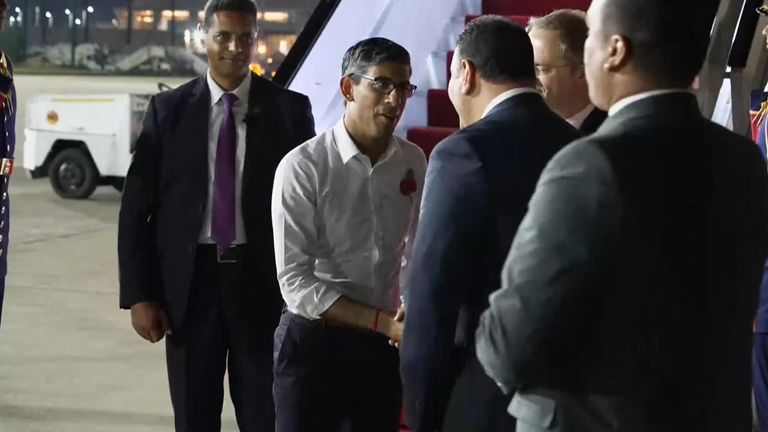
Last week, Mr Sunak reversed his decision to skip the COP27 climate, bowing to pressure from environmental campaigners and MPs.
PM arrives for COP27 in Egypt
‘Glad PM is here’
Having originally said he would not attend due to “other pressing domestic commitments” back home – including preparing for the autumn statement on November 17 – Mr Sunak changed his position on Thursday, saying there is “no long-term prosperity without action on climate change”.
Asked if he was concerned when Mr Sunak’s position was not to attend the climate conference, Mr Johnson added: “Look, the PM is here and I am glad he is here. He has made an outstanding speech the other day and I think he is on the right line.”
Mr Johnson added that he supports what the government is doing back in the UK to help people facing rising bills.
“In the short term of course you have to abate the cost, the impact for those who are feeling it – and that is why I support what the government is doing, what Rishi is doing, to help people through tough times,” he said.
“People are struggling, people are hurting, they can feel the impact of the spike in energy prices. The answer is not to renew our addition to hydrocarbons, it’s to accelerate the adoption of green solutions,” Mr Johnson said.
Ahead of the US midterm elections this week, Mr Johnson also noted that “it is very important for the rest of the world that America stays with the programme on climate change”.
ather around the world, the former PM suggested that soaring temperatures back in July in the UK may have influenced the “unexpected political turmoil” in Westminster which saw him being ousted from Number 10.
“Temperatures in London reached 40 degrees, which is unprecedented and unbearable, perhaps even contributing who knows to unexpected political turmoil that we saw in Westminster at that time,” he said.
World leaders are attending the latest UN climate talks in Egypt amid tensions over who will pay for the damage caused by global warming.
US President Joe Biden and French President Emmanuel Macron are among those others at the event.
The climate summit will end on Friday 18 November.
Ministry of Environment, Science, Technology and Innovation in Accra, Dr Kwaku Afriyie, confirmed to pressmen last week that Ghana will be sending a delegation of over 320 persons to the ongoing 27th Conference of Parties to the UNFCCC (COP 27) in Egypt.
He explained that out of a total of 322 people attending, attendees are pooled from both state and non-state institutions having duly registered on the government’s portal to attend and participate in COP27.
Dr Afriyie, according to a Ghana News Agency, GNA; report explained that of the total, participants from government institutions account for 226, while those from non-state actors are 72 and those belonging to the Climate Vulnerable Forum (CVF) are 24.
“Half of the number on the government platform are NGOs and partner institutions who decided to go through some institutions to be registered,” he clarified.
“Therefore, the actual government staff attending the COP is about 150…People attending this will be participating in diverse programming including negotiations, workshops, side events and bilateral meetings. Sponsorships is also form diverse sources,” he stressed.
2021 edition attracts public scrutiny
There was a huge public outcry when it emerged that Ghana sent over 330 delegates to the COP 26, which took place between 31st October and November 12, 2021, in Glasgow, Scotland.
A provisional list published on the website of the United Nations Framework Convention on Climate Change indicated that Ghana’s contingent was led by President Nana Addo Dankwa Akufo-Addo.
Some sector ministers who made the trip included Kwaku Afriyie, Minister of Environment, Science, Technology and Innovation; Shirley Ayorkor Botchwey of Foreign Affairs, Samuel Abu Jinapor, Minister for Land and Natural Resources and Matthew Opoku Prempeh, Minister of Energy.
The list also includes representatives from Parliament, Environmental Protection Agency, Office of the President, the media, among others.
It was later explained that not all persons registered under Ghana traveled on state largess and that the presidential team was much smaller.
Akufo-Addo leads COP 27 delegation
President Nana Addo Dankwa Akufo-Addo arrived in Egypt on Sunday as leader of Ghana’s delegation of climate negotiators to COP 27.
COP 27, scheduled for November 7 to 18, is being hosted in the Egyptian city of Sharm El-Sheikh.
It will provide the platform for climate activists and negotiators to discuss, propose actions and make decisions towards facilitating the implementation of the various Articles of the Paris Agreement and the Glasgow Climate Pact.
At a Pre-COP media briefing organised by Ministry of Environment, Science, Technology and Innovation in Accra, Dr Kwaku Afriyie, sector Minister, said Ghana’s team was ready to present the real needs of the African people at the conference.
“Ghana will participate actively at the negotiations, and the Presidency implementation summit and also host a number of events at the Ghana Pavilion.
“We will launch the Article six framework and sign some additional bilateral agreements with Sweden and Singapore. Other sectors will host events relating to their mandate, i.e., energy, forestry, transport, finance etc,” Dr Afriyie stated.
President Nana Addo Dankwa Akufo-Addo will lead Ghana’s delegation of climate negotiators to this year’s 27th Conference of Parties to the UNFCCC (COP27) in Egypt.
COP27, scheduled for 7 to 18 November, would be hosted in the Egyptian city of Sharm El-Sheikh and will provide the platform for climate activists and negotiators to discuss, propose actions and make decisions towards facilitating the implementation of the various Articles of the Paris Agreement and the Glasgow Climate Pact.
At a pre-COP media briefing organised by the Ministry of Environment, Science, Technology and Innovation in Accra, Dr Kwaku Afriyie, the sector minister, said Ghana’s team was ready to present the real needs of the African people at the conference.
“Ghana will participate actively at the negotiations, and the Presidency implementation summit and also host a number of events at the Ghana Pavilion.
“We will launch the Article six framework and sign some additional bilateral agreements with Sweden and Singapore. Other sectors will host events relating to their mandate, i.e., energy, forestry, transport, finance etc,” Dr Afriyie said.
He said Ghana, which host the Presidency of the Climate Vulnerable Forum (CVF), would also demand as a moral right, funds from the developed world to address issues of loss and damage being experienced by Africa due to greenhouse emissions from the big polluters.
He argued that Africa, which continues to feel the highest impact of the climate change phenomenon but contributes just less than 5% of such emissions needed to be helped to mitigate and adapt to such impacts.
The minister said the Inter-governmental Panel on Climate Change report released in February this year, projected the likelihood of some 118 million vulnerable people in Africa being affected by the impact of climate change by the year 2030 if nothing is done to curb climate issues.
“With regard to loss and damage, Ghana recognises the impact of loss and damage on women, youth, children and other vulnerable groups and calls for the integration of these groups.
“Finance for loss and damage is key…We expect delivery of new climate finance under the New Collective Quantifies Goal on climate Finance… We will follow up with our CVF colleagues and push to ensure that is achieved.”
Meanwhile, altogether, 322 Ghanaian activists from both state and non-state institutions have registered on the government’s portal to attend and participate in COP27.
Dr Afriyie explained that of the total, participants from government institutions account for 226, while those from non-state actors are 72 and those belonging to the Climate Vulnerable Forum (CVF) 24.
“Half of the number on the government platform are NGOs and partner institutions who decided to go through some institutions to be registered.
“Therefore, the actual government staff attending the COP is about 150…People attending this will be participating in diverse programming including negotiations, workshops, side events and bilateral meetings. Sponsorships are also from diverse sources.”
Before hosting the COP27 summit,Egyptian human rights organizations demand that their nation release political prisoners and open civic space.
It comes in response to a study by Amnesty International that claimed Egypt was experiencing a “human rights catastrophe.”
According to Human Rights Watch (HRW), Egypt has severely restricted the activities of environmental organizations. Cairo authorities deemed the information to be “misleading.”
The UN Climate Change Conference takes place in Sharm el-Sheikh in November.
More than 100 international non-governmental organizations (NGOs) have already signed a petition organized by the Egyptian Human Rights Coalition, which consists of 12 groups.
“We emphasize that effective climate action is not possible without open civic space,” a petition launched by the coalition says. “As host of COP27, Egypt risks compromising the success of the summit if it does not urgently address ongoing arbitrary restrictions on civil society.
“Moreover, we stress the importance of the right to freedom of expression and independent reporting to foster efforts to address the climate crisis.”
In a joint statement in July, three dozen groups expressed concern that Egypt would largely maintain its prohibition on protests during the conference aimed at slowing climate change.
Under Egypt’s President Abdul Fattah al-Sissi, there has been a widespread crackdown on dissent. Rights groups estimate the country has had as many as 60,000 political prisoners, many detained without trial.
They say that activists are routinely intimidated and that new laws make it practically impossible for many civil society groups to function.
“You will have activists from everywhere in the world coming to COP, but Egyptian activists are either blocked from going or they’re in jail,” a leading human rights campaigner in Cairo told the BBC, asking not to be named for fear of reprisal.
“Basically, nobody is safe in Egypt,” the campaigner said.
The Egyptian authorities say they hope to use their presidency of COP27 to urge the international community to act on pledges of support for developing countries to cope with the devastating impacts of climate change.
“They are the most deserving of our support,” Foreign Minister Sameh Shoukry told the UN General Assembly this month.
After a tumultuous decade since the 2011 uprising that overthrew then-President Hosni Mubarak, the country is also looking to boost its standing on the world stage.
‘PR tool’
However, critics, such as the Egyptian human rights campaigner, said the government sees the event as a way of “whitewashing its reputation”.
A few hundred less high-profile prisoners have been released in recent months since Mr Sisi unveiled a new pardon committee, in a move that many link to Egypt’s hosting of COP.
Amnesty’s new report focused on how Egyptian authorities have used a National Human Rights strategy launched a year ago “as a PR tool to deflect attention from its real human rights record”.
Meanwhile, HRW researched instances of repression against environmental groups.
Following interviews with academics, scientists and activists, it said that government restrictions amounted to human rights violations and left in doubt Egypt’s ability to meet basic climate commitments.
A spokesperson for the Egyptian foreign ministry dismissed the report as “deplorable and counterproductive” saying it contained “inaccuracies”, and questioned the use of unnamed sources.
This week, Ambassador Wael Abul-Magd, assisting him, told journalists that civil society and environmental groups would be represented at the talks.
“We don’t believe in tokenism,” he said in a virtual briefing. “We are involving these stakeholders across the board in every step of the way.”
However, Egyptian activists told the BBC that many local groups had been unable to register for the conference.
They questioned the independence of those who had been given access in a special process overseen by the government and facilitated by the UN. One called the lack of transparency “a scandal”.