Minister OJ has noted that many strong communicators struggle with stammering.
Reflecting on his personal experience, the acclaimed singer-songwriter explained that his speech disorder pushed him toward extensive reading and writing, which in turn sharpened his thinking and writing skills.
“You end up reading widely and writing more, and soon you become a very good writer and sharp at thinking”. My difficulty with speaking made me focus more on reading and writing.”
Addressing the potential for improvement, the “Obi Nya Wo Aye” hitmaker remarked that stammering can lessen with time, and he suggested looking to YouTube for practical techniques to manage it, such as “relaxing and taking slow breaths.”
OJ also offered advice, saying, “With the small amount of air you can gather, try to speak more quickly, as dragging out words can cause the air to get stuck.” He emphasized that impatience can aggravate stammering, sometimes leading to frustrated hand gestures.
He encouraged those who interact with people who stammer to be patient and let them finish their sentences without interruption, as cutting them off can further frustrate them.
OJ also offered a hopeful perspective, suggesting that stammering might be a way for God to slow individuals down and encourage them to focus on reading and gaining knowledge. He mentioned that once stammering diminishes, these individuals might find themselves stronger mentally.
He pointed to former President John Agyekum Kufuor as an example, noting that despite his stammer, Kufuor became widely read and knowledgeable.
Downing Street’s unprecedented action will prevent the new law, which lowers the legal age at which someone can apply to change their gender to 16, from becoming a part of the statutes.
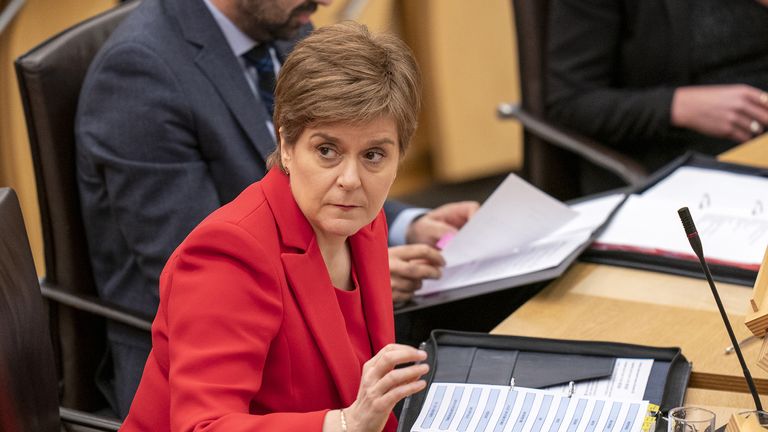
Nicola Sturgeon has referred to the UK government’s unprecedented intervention as a “full-frontal attack” on the Scottish parliament for blocking Scotland’s gender reform bill.
If Downing Street thinks a piece of legislation will have a negative effect on UK-wide law, it has the authority to prevent it from receiving Royal Assent from Holyrood, the last step in any new bill.
Scotland Secretary Alister Jack has confirmed he will lay a section 35 order at Westminster tomorrow to prevent the legislation being sent to the King for Royal Assent.
In a statement, he said: “I have not taken this decision lightly.”
In the 25 years since devolution, no British government has taken this step – until now.
In a tweet posted in response to Mr Jack’s announcement, the first minister said: “This is a full-frontal attack on our democratically-elected Scottish parliament and its ability to make its own decisions on devolved matters.
“The Scottish government will defend the legislation and stand up for Scotland’s parliament.
“If this Westminster veto succeeds, it will be first of many.”
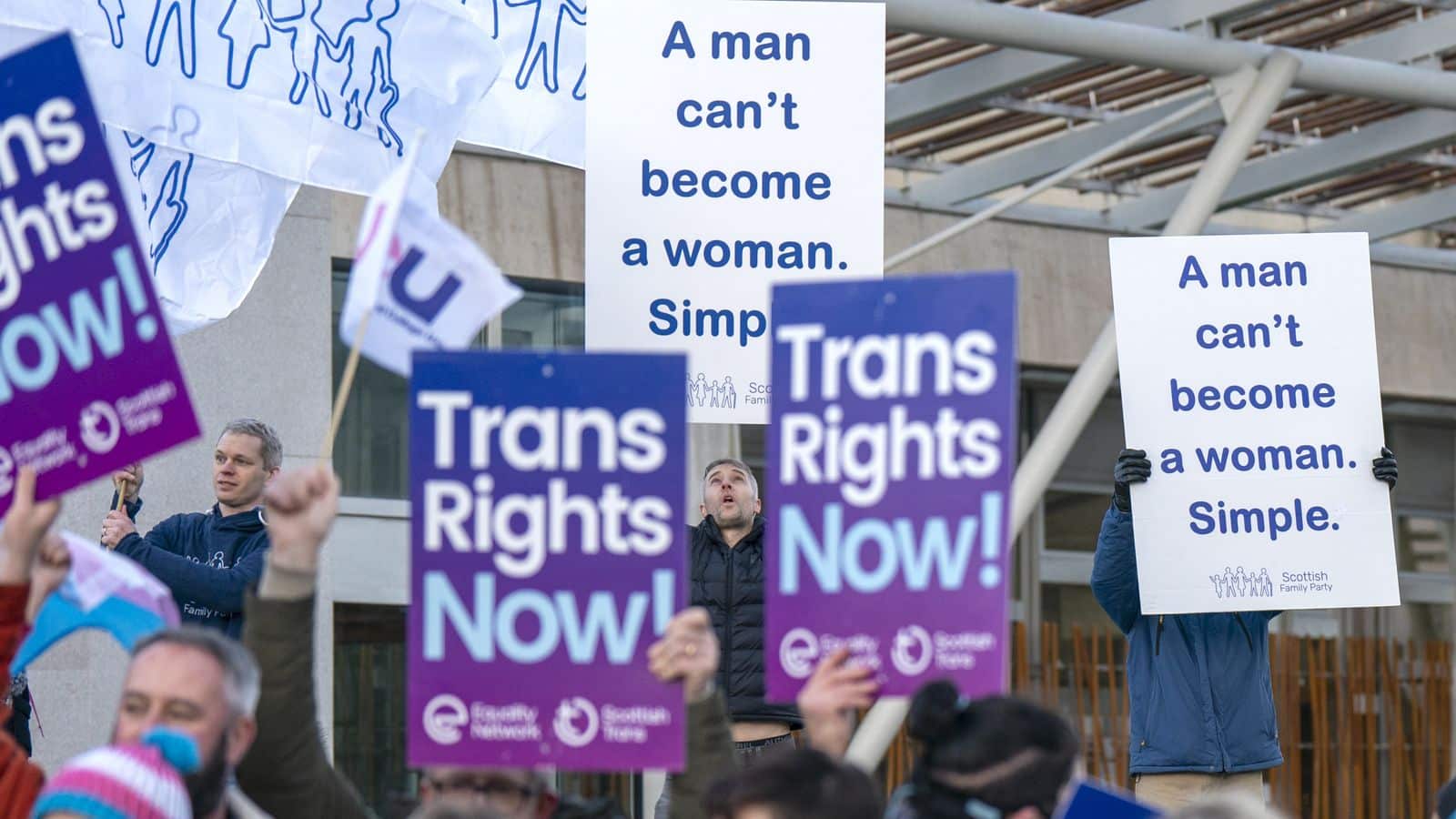
The Gender Recognition Reform (Scotland) Bill was passed by a majority of MSPs last month, with MsSturgeon hailing at as a “historic day for equality”.
The new legislation would lower the age people can apply to change their gender to 16, remove the need for a medical diagnosis of gender dysphoria for a gender recognition certificate (GRC), and reduce the time an applicant needs to live in their acquired gender.
But while the bill has been welcomed by equality campaigners, UK ministers fear it may lead to gender tourism and that people who change gender in Scotland would have a different legal gender when they are in the rest of the UK.
Critics of the legislation are also concerned organisations offering single-sex spaces would have to adopt different policies.
Announcing the move the block the gender reform bill, Mr Jack said: “I have decided to make an order under section 35 of the Scotland Act 1998, preventing the Scottish parliament’s Gender Recognition Reform (Scotland) Bill from proceeding to Royal Assent.
“After thorough and careful consideration of all the relevant advice and the policy implications, I am concerned that this legislation would have an adverse impact on the operation of Great Britain-wide equalities legislation.
“Transgender people who are going through the process to change their legal sex deserve our respect, support and understanding. My decision today is about the legislation’s consequences for the operation of GB-wide equalities protections and other reserved matters.
“I have not taken this decision lightly.
“The bill would have a significant impact on, amongst other things, GB-wide equalities matters in Scotland, England and Wales. I have concluded, therefore, that this is the necessary and correct course of action.
“If the Scottish government chooses to bring an amended Bill back for reconsideration in the Scottish parliament, I hope we can work together to find a constructive way forward that both respects devolution and the operation of UK parliament legislation.
“I have written today to the first minister and the Scottish parliament’s presiding officer informing them of my decision.”
Earlier today, Ms Sturgeon said “it would be an outrage” if the UK government were to block the bill.
In a briefing on NHS pressures, she accused UK ministers of “using trans people as a political weapon”.
“In my view there are no grounds to challenge this legislation,” she told reporters.
“It is within the competence of the Scottish parliament, it doesn’t affect the operation of the Equality Act and it was passed by an overwhelming majority of the Scottish parliament after very lengthy and very intense scrutiny by MSPs of all parties represented in the parliament.
“So if there is a decision to challenge, in my view, it will be quite simply a political decision and I think it will be using trans people – already one of the most vulnerable, stigmatised groups in our society – as a political weapon.
“And I think that will be unconscionable and indefensible and really quite disgraceful.”
The first minister said the move to block the legislation would create a “very, very slippery slope indeed”, adding that it could “normalise” and “embolden” the UK government to do the same in other areas.
“I think it is that serious. I think the import and significance of this would go beyond the particular subject matter of the legislation”, she added.
Ms Sturgeon said the Scottish government would “robustly and rigorously and with a very, very high degree of confidence” defend the bill.
Prime Minister Rishi Sunak has previously said it was “completely reasonable”for the UK government to consider blocking the reforms.
At the weekend, Labour leader Sir Keir Starmer voiced his concerns with the legislation, saying 16 was too young for such a decision to be made.
The bill was backed by the Scottish Labour Party, with the exception of two MSPs who resigned their frontbench positions to vote against it.