Tag: Smoke

  • Passenger’s luggage emits smoke at KIA

    Passenger’s luggage emits smoke at KIA

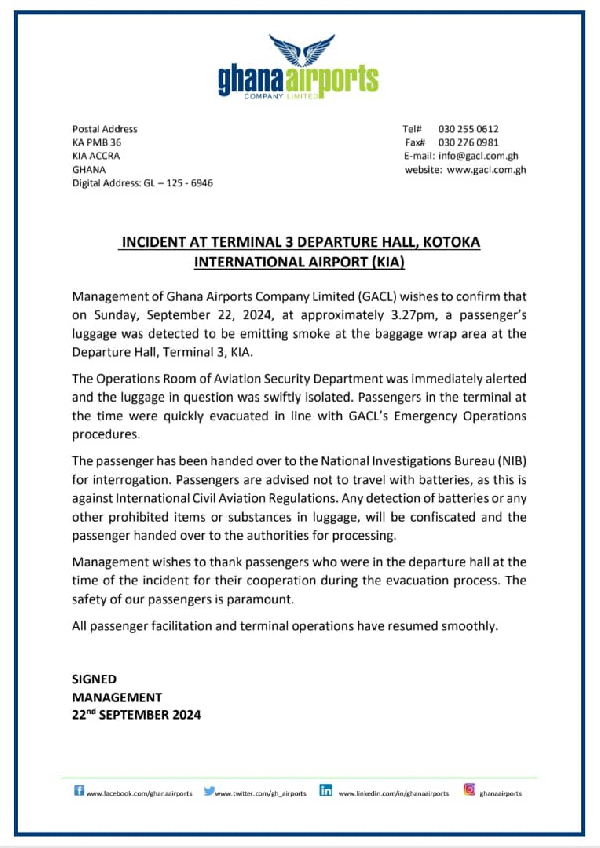
    The Ghana Airports Company Limited (GACL) has confirmed an incident at Kotoka International Airport’s Terminal 3 involving a passenger’s luggage emitting smoke in the baggage wrap area of the Departure Hall.

    The incident took place on Sunday, September 22, 2024, when smoke was observed coming from the luggage in question.

    “Management of Ghana Airports Company Limited (GACL) wishes to confirm that on Sunday, September 22, 2024, at approximately 3.27 pm, a passenger’s luggage was detected to be emitting smoke at the baggage wrap area at the Departure Hall, Terminal 3, KIA.

    “The Operations Room of Aviation Security Department was immediately alerted, and the luggage in question was swiftly isolated. Passengers in the terminal at the time were quickly evacuated in line with GACL’s Emergency Operations procedures,” a press statement from the GACL said on September 22, 2024.

    The statement continued, “The passenger has been handed over to the National Investigations Bureau (NIB) for interrogation. Passengers are advised not to travel with batteries, as this is against International Civil Aviation Regulations.

    “Any detection of batteries or any other prohibited items or substances in luggage, will be confiscated and the passenger handed over to the authorities for processing.

    GACL has once again advised passengers to avoid traveling with batteries or other prohibited items, warning that any detection will lead to confiscation and further investigation by the authorities.

    GACL thanked the passengers for their cooperation during the evacuation and emphasized, “Management wishes to thank passengers who were in the departure hall at the time of the incident for their cooperation during the evacuation process.

    “The safety of our passengers is paramount,” the statement added.
  • Smoking fish is hell for us – Fishmongers

    Smoking fish is hell for us – Fishmongers

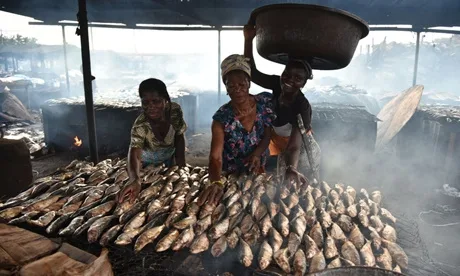
    Ga women in Ghana, particularly those at Chorkor, have long thrived in the age-old trade of fishmongering, a traditional business tied to their coastal access.

    Passed down through generations, this livelihood, while vital for income, is now under the spotlight due to its concerning health impact.

    Using firewood in rustic structures, these resilient fishmongers smoke catch made by fishermen, but the resulting smoke poses health risks, from respiratory issues to more severe conditions like lung cancer and stroke.

    In a JoyNews report monitored by The Independent Ghana, a number of fishmongers engaged noted that their occupation is hazardous, but in order to earn a living, they have to compromise and make the best out of their current situation.

    According to one of the fishmongers, she has already begun noticing a drastic change in her sight. She noted that she struggles to see at night as she sees objects in shades of red, gold, and green.

    “The firewood we use emits smoke that affects our eyes. I see things in shades of red, gold and green at night. It is a constant struggle.”

    Another noted that smoking fish is bearable when it is cloudy compared to when it scorches. She noted that she and her colleagues get dehydrated and have to take in a significant amount of water to quench their thirst.

    “When the sun sets, it’s much comfortable smoking fish than when the sun is high. We drink a lot of water when the sun is high,” she said.

    Fishmongering is an essential part of the seafood supply chain, ensuring that consumers have access to a variety of fresh and high-quality fish products; however, the priority remains preserving lives.

    As such, energy experts have admonished fishmongers to use smoke-free stoves to reduce the health effect.

    Smoke-free stoves, also known as clean cookstoves, are designed to reduce or eliminate the emissions of smoke and harmful indoor air pollutants generated during cooking.

    Energy Minister, Dr. Matthew Opoku Prempeh has stated that Ghana is actively pursuing a transition from fossil fuels to clean, renewable energy sources.

    The country is already engaged in significant initiatives aimed at achieving this transition, which include a target of integrating 10 percent of renewable energy into its energy mix by 2030 and the development of an energy transition framework.

    Dr. Prempeh also noted that, at present, 63 percent of the population has access to clean cooking methods, with 35 percent having access to liquified petroleum gas, 27 percent using improved biomass cookstoves, and one percent utilizing electric cooking.

  • Crew members jump off burning ship carrying 3,000 automobiles to land in Ameland

    Crew members jump off burning ship carrying 3,000 automobiles to land in Ameland

    Off the shore of the Dutch island of Ameland, a cargo ship carrying nearly 3,000 automobiles caught fire, killing one crew member and injuring 22 others.

    In order to escape the fire, some of the crew made a 30 m (100 ft) leap into the water.

    Rescue workers worry that the fire could burn for days as a massive recovery operation is underway in the North Sea.

    Initial attempts by crew members to put out the fires by themselves failed due to being overpowered, and they were ultimately forced to leave.

    Willard Molenaar, the skipper of the Ameland lifeboat, reported that seven of them dove into the water.

    “One by one, they jumped and we had to fish them out of the water,” he told public broadcaster NOS. “They were really desperate so they had to jump – you don’t just do that for the sake of it.”

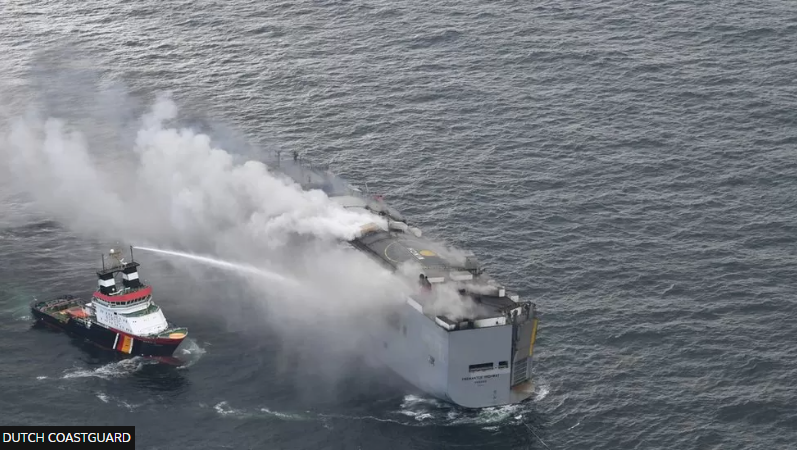
    In the North Sea, distressing images shared by the coastguard depicted the Panamanian-flagged Fremantle Highway shrouded in smoke, its deck ablaze.

    According to the Dutch news agency ANP, the coastguard stated that the fire was expected to persist for several days. In an effort to cool down the vessel, water was being sprayed on the ship’s sides.

    However, rescue boats exercised caution in their water usage, as excessive pouring could pose a risk of sinking the ship.

    The cargo ship embarked from the port of Bremerhaven in northern Germany, en route to Port Said in Egypt, departing on Tuesday around 15:00 local time.

    Unfortunately, it encountered difficulties overnight, approximately 27km (17 miles) north of Ameland in the Wadden Sea, an area within the North Sea designated as a World Heritage site.

    The exact cause of the fire remained unknown, although earlier suggestions by the coastguard had indicated the possibility of an electric car being involved, as around 25 of the vehicles onboard were electric.

    About 25 of the vehicles on the ship were electric.

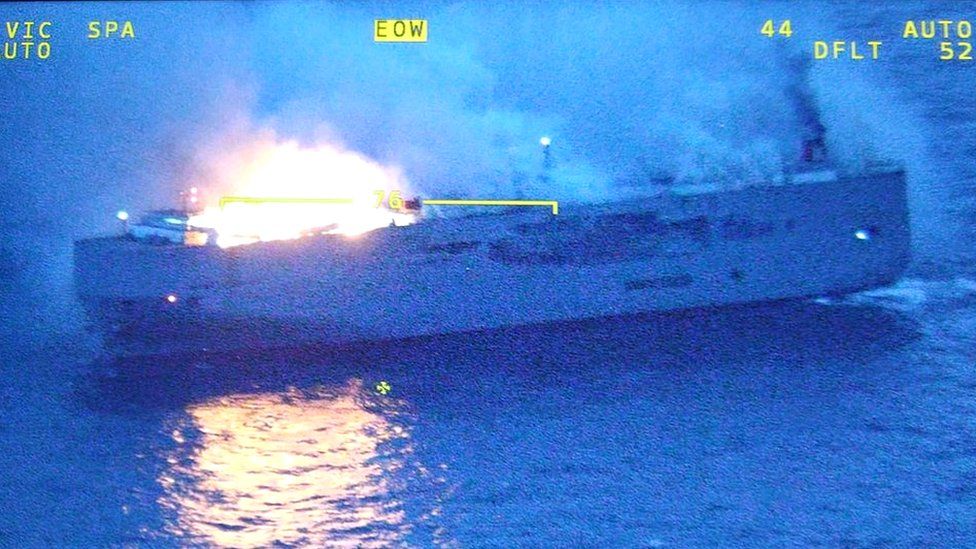
    Ship burning
    Image caption,The cause of the fire has not yet been established

    To move the cargo ship away from major shipping routes to and from Germany, a tugboat was deployed for the task.

    The freighter, operated by K-Line but owned by a subsidiary of the Japanese shipbuilding firm Imabari Shipbuilding, is presently stationary. However, there are concerns that it might be listing, adding to the challenges faced by emergency crews at the scene.

    The primary focus for the responders is to extinguish the fire and prevent the cargo ship from sinking. Salvage boats are strategically positioned around the vessel, ready for any potential scenarios, while an oil-recovery vessel has been dispatched to the area in case of a leak. As a precautionary measure, air traffic officials have restricted planes from flying near the ship.

    Environmental group North Sea Foundation has expressed concern over the increased vulnerability of the Wadden Sea due to the high volume of larger ships utilizing the busy shipping route.

    In the past, the area has experienced incidents involving cargo ships. Four years ago, another Panamanian-registered cargo ship lost 270 shipping containers, some of which contained chemicals, during a storm, with some containers washing up on Dutch beaches.

    Similarly, in a separate incident last year, a cargo ship carrying 4,000 luxury cars caught fire and sank off the Azores. The blaze was attributed to lithium-ion batteries in the cars, and although water initially proved ineffective, firefighters managed to bring the situation under control before the ship eventually sank during towing.