
Tag: smoking

  • “I don’t think womanizing is a problem if you are honest about it” – Samini

    “I don’t think womanizing is a problem if you are honest about it” – Samini

    Award-winning singer Emmanuel Andrews Samini, popularly known as Samini, has dismissed the notion that a man involved with multiple women is immoral

    He holds the view that the culture is nothing for society to frown upon if the man is honest about it to his partners.

    “I don’t think womanizing is a problem,” Samini said on the Health Quarters podcast monitored by MyNewsGh while he stirred laughter on the podcast. “What matters is honesty. If you’re in multiple relationships, be open. Don’t deceive anyone.”

    The musician also clearly explained that his stance does not equate to forcing polygamy on anyone.

    “You can’t force polygamy down anyone’s throat,” he added. “But if a man is open and a woman knows what she’s agreeing to, then there’s mutual respect,” he said.

    For those who strongly believe that all creatives are womanizers or engage in smoking, Samini debunked the perception and declared it untrue.

    “It’s a perception. There are a lot of doctors and teachers who smoke. So you can’t just say it’s a creative person thing,” ,” Samini stated.

    He further acknowledged that there are young people who are negatively influenced by their peers at a naive sttae in their carrer

    “We enter the space quite young,” he noted. “You’re a teenager, you see what others are doing, and you think it’s part of the culture. If you’re not careful, it becomes a habit before you even realize it.”

    Meanwhile, womanizing and rapid unplanned child birth have been cited as part of the reasons the majority of Ghanaian businesses fail, according to the founder of the A&C mall Andrew Asamoah.

    He claims that because business owners typically don’t plan well, their companies don’t survive their deaths.

    Mr. Asamoah asserted that having children with numerous women frequently jeopardizes the viability of businesses.

    Speaking in an interview on Odana TV, he said: “Because we don’t plan, you must have a vision, you must have a plan. You go some places, someone is a top-class tailor in England, and he makes sure that his son who went to a top-class school comes in, it’s planning.”

    “We don’t plan. And then you are doing business, and you start making money then you start doing women, too many women, having too many children then when you die it becomes a contention. I’ve seen it so much.”

    Business owners should make sure that their families or other relatives are actively involved in their companies, advised Dr. Asamoah.

    Adding that, this will keep businesses should they pass away or become physically unable to manage the affairs of the organization.

    Nollywood actor Daniel Etim-Effiong shared that although he briefly engaged in womanizing – an act not accepted by many due to morality—he considers it part of his personal growth.

    The actor who doubles as an engineer said he eventually realized that toeing the path of womanizing was not going to bring him the fulfillment he desired.

    Etim-Effiong explained that, while it may seem fun to be a “player,” the habit can negatively affect one’s ability to commit in the future.

    “Maybe there was a period in my life that I was,” he admitted. “I wouldn’t say for long, but they were periods of learning.”

    “If you develop that lifestyle, it won’t automatically change overnight,” he said. “When you get married, that muscle hasn’t been developed. So when you face challenges, you may feel like walking away instead of working through it.”

    He now uses his experience to advise philanderers, emphasizing the importance of building healthy relationship habits early.

    Another celebrity in Ghana’s entertainment industry, Incredible Zigi, who is a dancer, also revealed that he used to date numerous women in the early days of his dancing career.

    During an interview with the media, he admitted to his past as a Casanova but expressed that he has now chosen to change his ways.

    “I used to date a lot of women earlier in my career but when you get to a certain stage you want to keep a solid brand so such women issues just don’t get your attention anymore. You can’t just be playing around like you used to because womanizing wouldn’t take you anywhere but I used to womanize when I started dancing.”

    Incredible Zigi emphasized that he has successfully abandoned such behaviors, acknowledging that they were merely “time-wasters.”

    He has learned from his past and has now chosen to focus on more meaningful aspects of his life and career.

    “But this is not the time to waste time and energy chasing after women so as for me I’ve paused those kinds of behaviors some years back,” he disclosed.

    A couple of years ago, Ghanaian rap legend Okyeame Kwame, sparked a significant social media discussion with his unconventional stance on fidelity during a an appearance on the ‘Brocode’ Podcast.

    He boldly asserted that being involved with someone other than your partner while in a committed relationship does not necessarily constitute cheating.

    His perspective, challenging traditional norms, has ignited a fiery debate on the internet. The discourse is divided between those who support his views and those who vehemently disagree, labeling his perspective as misguided and impractical in terms of relationship behavior.

    Okyeame Kwame, known for his candid and forthright nature, did not hesitate to express his views on what qualifies as infidelity. He suggested that cheating is a relative term and may not always involve engaging with other individuals while committed to a partner.

    This audacious perspective has naturally drawn attention and criticism. Many social media users have voiced their disapproval, indicating that such an outlook could potentially undermine the foundations of trust and commitment in a relationship.

    However, a portion of the online community has shown support for Okyeame Kwame’s perspective. They argue that the traditional definition of cheating is outdated and needs to evolve with changing societal norms.

    Regardless of the differing views, Okyeame Kwame’s statements have undoubtedly initiated a new dialogue about fidelity and commitment in modern relationships.

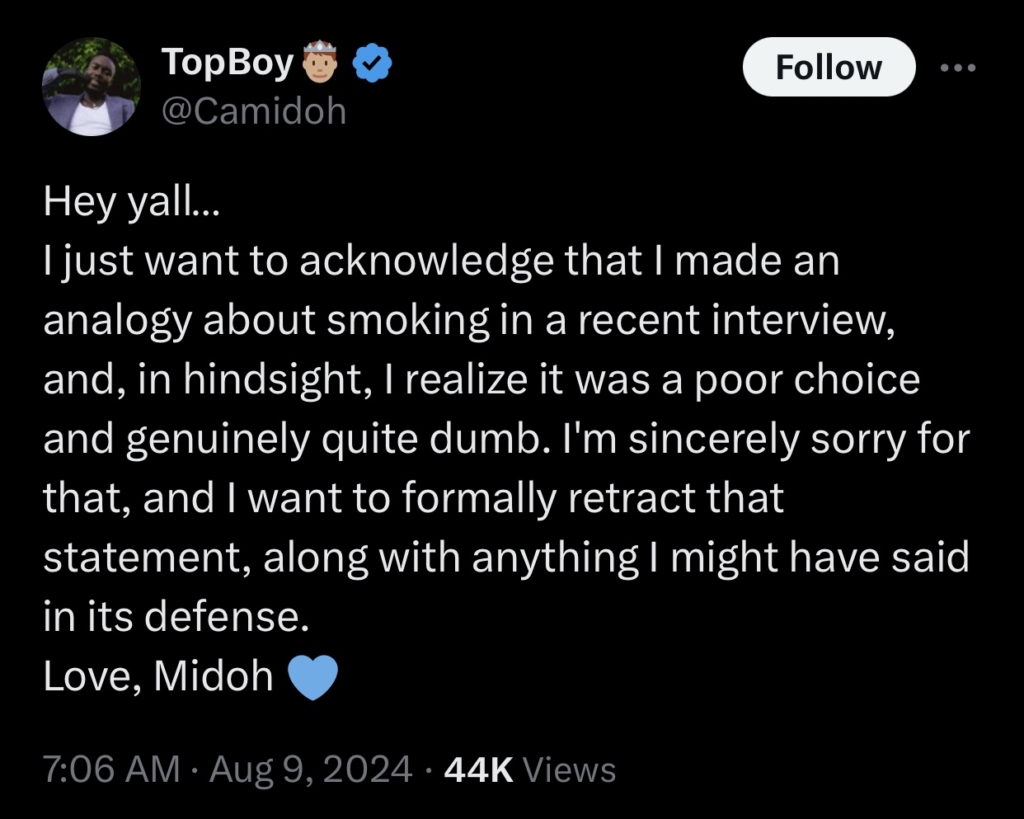
  • Camidoh renders apology for recent remarks on smoking and kenkey sellers

    Camidoh renders apology for recent remarks on smoking and kenkey sellers

    Ghanaian artist Camidoh has issued an apology for his recent remarks about smoking.

    In a conversation with Joy Prime, he had compared smoking to kenkey vendors working in a smoky environment.

    Camidoh explained to Roselyn Felli that while smoking is widely advised against due to its negative impact on lung health, other activities, such as cooking kenkey, also involve exposure to smoke.

    He proposed that the perceived harm of smoking may differ and should be evaluated on an individual basis.

    “Not everything that is portrayed as negative is negative. Generally, they say we shouldn’t smoke because it’s bad for our lungs. How about our parents who have been cooking kenkey? You see them when they are making kenkey, you see how smoky it gets? I just want to tell you, you don’t have to dwell on that…It is not bad in my eyes,” he said.

    Following the interview, Camidoh faced significant backlash on social media.

    In response, he has apologized to his fans, acknowledging that his defense of the comment was misplaced.

    “Hey yall. I just want to acknowledge that I made an analogy about smoking in a recent interview, and, in hindsight, I realize it was a poor choice and genuinely quite dumb. I’m sincerely sorry for that, and I want to formally retract that statement, along with anything I might have said in its defense. Love, Midoh,” he wrote on X.

    Camidoh, who released the track ‘Nothing Lasts Forever’ a few months ago, has shared that the song reflects a personal heartbreak that caused him “real pain” and led him to smoke as a way to cope.

    Health experts have strongly disagreed with this perspective, emphasizing that smoking is harmful to health.

    They point out that smoking significantly increases the risk of serious conditions such as lung cancer and various other cancers.

    Moreover, smoking has detrimental effects on eye health, heightening the risk of diseases like age-related macular degeneration, cataracts, dry eye syndrome, diabetic retinopathy, uveitis, Graves’ ophthalmopathy, and optic nerve damage, all of which can impair vision or lead to vision loss.

  • Smoking is not harmful to me – Camidoh

    Smoking is not harmful to me – Camidoh

    Ghanaian musician Camidoh has strongly defended his smoking habit, suggesting that it might not be inherently harmful.

    He argues that “not everything that is portrayed as negative is negative.”

    When asked to give a definitive answer on whether smoking is bad, he said, “If it’s bad for you, it is bad for you. The doctors have to detect that.”

    He continued, “Generally, they say we shouldn’t smoke because it’s bad for our lungs. How about our parents who have been cooking kenkey? You see them when they are making kenkey, you see how smoky it gets?

    I just want to tell you, you don’t have to dwell on that… It is not bad in my eyes because I’m telling a story,” he said.

  • Smoking shisha for one hour is the same as smoking 200 cigarettes – FDA

    Smoking shisha for one hour is the same as smoking 200 cigarettes – FDA

    CEO of the Food and Drugs Authority (FDA), Mrs. Delese Mimi Darko, has charged people to cease Shisha smoking, stating that“just one hour of Shisha use is equivalent to smoking about 200 cigarettes.”

    She noted that eight million people globally die from using tobacco products, deaths that could have been prevented.

    “Let us acknowledge the stark reality before us: tobacco stands as one of the foremost perpetrators of preventable death worldwide, claiming over 8 million lives annually. It’s a public health crisis that spares no one, particularly our children,” she said.

    The CEO’s speech, delivered by the Deputy CEO for Corporate Services Division, Mrs. Yvonne Nkrumah, on Friday in Accra to mark World No Tobacco Day, highlighted that a Global Youth Tobacco survey conducted in 2017 revealed that 8.8 percent of students used tobacco products, including shisha, while 8.5 percent turned to Electronic Nicotine Delivery Systems like e-cigarettes and vapes.

    World No Tobacco Day (WNTD) is an annual event observed on May 31 worldwide to highlight the harmful effects of tobacco and other tobacco products on health.

    The theme for this year’s commemoration is “Protecting Children from tobacco industry interference.”

    The event, organized by the FDA in partnership with the Ministry of Health (MoH), the World Health Organisation (WHO), the Ghana Revenue Authority (GRA), and Vision for Alternative Development-Ghana (VALD), aimed to raise awareness about the tactics used by the tobacco industry to attract children and adolescents.

    Mrs. Darko noted that, the tobacco industry, with its “insidious marketing strategies, preys upon our youth, ensnaring them in a web of addiction and suffering.”

    Earlier, Deputy Minister of Health, Mr. Alexander Akwasi Acquah, announced that through the WHO Framework Convention on Tobacco Control (FCTC) Project 2030, a 5-year National Tobacco Control Strategy had been successfully developed and is currently being implemented.

    He noted significant progress in enhancing inter-agency coordination, revising the smoke-free policy, and implementing and enforcing the ban on tobacco advertising.

    Dr. Alex Kombat, Head of the Research Unit at GRA, stated that Tobacco Excise Tax Revenue increased from Ghc 66.98 million in 2017 to Ghc 936 million in 2023. However, it costs the country GHȻ668 million annually to combat tobacco use.

  • Marijuana could cause heart attack, stroke – Report

    Marijuana could cause heart attack, stroke – Report

    Recent findings in the Journal of the American Heart Association reveal a potential link between cannabis use, regardless of consumption method (smoking, eating, or vaping), and an increased risk of heart attacks and strokes.

    Dr. Abra Jeffers, the lead author of the study and a data analyst at Massachusetts General Hospital in Boston, underscored the surge in cannabis use and the insufficient awareness surrounding its cardiovascular risks.

    She noted, “Despite common use, little is known about the risks of cannabis use and, in particular, the cardiovascular disease risks.”

    The research analyzed survey data from over 400,000 U.S. adults spanning the years 2016 to 2020, exploring the correlation between cannabis use and self-reported cardiovascular outcomes.

    The results indicated a higher risk of heart attacks and strokes among individuals using marijuana, with daily users showing the greatest odds.

    Dr. Robert L. Page II, a professor at the University of Colorado School of Medicine, stressed the significance of healthcare practitioners discussing cannabis use with patients.

    “As cannabis use continues to grow in legality and access across the U.S., practitioners and clinicians need to remember to assess cannabis use at each patient encounter,” he commented.

  • Snoop Dog’s “I’m giving up smoke” didn’t mean he was quitting smoking marijuana

    Snoop Dog’s “I’m giving up smoke” didn’t mean he was quitting smoking marijuana

    “The rapper/actor and noted marijuana lover, Snoop Dog, had people believing he was abandoning smoking. But, as it turns out, he meant he was going ‘smokeless’ in a different way.

    Snoop posted a video on Instagram on Monday with the caption, ‘I’m done with smoke. I’m going smokeless with @solostove. #ad’”

    “I have an announcement: I’m giving up smoke,” he says in the video. “I know what you thinking: ‘Snoop, smoke is kinda your whole thing.’ But I’m done with it. Done with the coughing and my clothes smelling all sticky-icky. I’m going smokeless.”

    At that point in the video, he reveals a Solo stove smokeless fire pit.

    “Solo Stove has since announced that Snoop Dogg will be their official ‘smokesman,’ in support of the company’s quest to eliminate smoke from backyards everywhere,” according to a press release from the company sent to CNN.

    “They changed the game and now I’m excited to spread the love and stay warm with my friends and family,” Snoop is quoted as saying in a press release for the product.

    The man, who, being an aficionado of weed, has become part of his brand, lit up the internet when he announced to his more than 2.5 million Instagram followers that he was done with smoke.

    “After much consideration and conversation with my family, I’ve decided to give up smoke,” he wrote on a photo of himself. “Please respect my privacy at this time.”

    CNN contacted his publicist for confirmation or clarification but did not receive a response.

    In the days following, Snoop Dogg appeared to be going through it. He posted a photo of himself looking pensive with a smoke emoji as the caption.

    In another photo, the 52-year-old artist has his eyes closed. The caption on that picture reads, “Natural high,” with a clock and musical note emojis.

    Lest anyone question his continued devotion to ganja, it was recently announced that he and Martha Stewart have partnered with BIC on “Best Buds” bags,” which are “both functional and stylish,” according to the company.

    Ironically (or maybe not), Snoop ends his “smokeless” reveal video by saying, “Clever.” Clever indeed, sir.

  • Flashback: Government insensitive to the people’s health – Prof Badu Akosa

    Ghana’s failure to implement a ban on public smoking has placed non-smokers under serious health risk, this, the former Director-General of the Ghana Health Service, Professor Agyeman Badu Akosa describes as insensitive on the part of the government.

    Prof. Akosa who spoke in an interview with GNA on May 31, 2006, mentioned that he was alarmed by the increasing rate of death associated with tobacco smoking and called for stricter measures to protect the populace.

    “The absence of a legislation to ban smoking of cigarettes in all public places, the ban on advertisements of tobacco products and the imposition of high taxes on tobacco products are just not doing us any good but rather giving the tobacco manufacturers the opportunity to penetrate our market”.

    In 2012, Ghana enacted and implemented a national Tobacco Control Act, the Public Health Act 851, which prohibited smoking in all public places. Due to the lack of compliance with the policy, people continue to smoke at public places.

    Professor Agyeman Badu Akosa, Director-General of the Ghana Health Service (GHS) on Wednesday blamed the Government for failing to ban smoking at public places.

    Prof Akosa said it was sad that the health of the people had not been of importance to the Government “and tobacco smoking is causing a lot of havoc to the health of our people and its use is a major cause of over 20 major categories of fatal, disabling health hazards such as cancers, heart attacks and respiratory diseases”, he said.

    A stick of cigarette contains over 4,000 chemicals which when inhaled could result in cardiovascular diseases including cancer of the kidney, lung, breast, pancreas, peptic and bladder and bronchitis and emphysema among others.

    Speaking to the Ghana News Agency (GNA) in an interview in Accra, Prof. Akosa said countries like Uganda, Kenya, Tanzania and the developed world had banned smoking and had succeeded in banning smoking in public places. In addition, warning inscriptions had been printed boldly on cigarettes to warn potential smokers.

    He said this had been successful in the developed countries where 40 per cent of cigarette package bears inscriptions of the harmful effects of tobacco smoking.

    “It is very unfortunate and sad that in Ghana less than 10 per cent of the packages bear such inscriptions while billboard adverts read: “Tobacco may be harmful to your health” had been written with smaller fonts.

    “The absence of a legislation to ban smoking of cigarettes in all public places, the ban on advertisements of tobacco products and the imposition of high taxes on tobacco products are just not doing us any good but rather giving the tobacco manufacturers the opportunity to penetrate our market”, he said.

    He explained that 45 per cent of the population in the three Northern Regions were addicted to smoking and described the situation as a very serious one which when not controlled could get out of hand and claim the lives Ghanaians, especially among the youth.

    A survey which was conducted by the Health Research Unit of GHS in Junior Secondary Schools throughout the country on 2,000 pupils showed that 14.3 per cent of the pupils had ever smoked cigarettes before the age of 18 years, with 4.9 per cent of the pupils currently still smoking.

    Prof. Akosa expressed regret about the delay in the passage of the draft bill on the Framework Convention on Tobacco Control and suggested that in the absence of the bill “Government could still ban smoking in public places whilst waiting for the passage of the bill. The bill, which would soon be put before Cabinet, if passed would address issues such as advertisements, sponsorship and warning to prevent people, especially the youth, from accessing tobacco and tobacco products.

    Ghana was the 37th country to ratify the Framework Convention on Tobacco Control FCTC) developed by the World Health Organisation (WHO). The FCTC treaty adopted in 2003 by the World Health Assembly is the world’s first treaty devoted to health to get people to quit smoking and to reduce the estimated five million deaths annually caused by smoking.

    He said there were 1.3 billion smokers worldwide with 4.9 million people dying each year.

    He said it was unfortunate that smoking and death had reduced in the developed world where the social vice originated from but had risen in poorer countries where women and young children were the most affected.

    Worldwide, statistics in the early 1990s indicated that 1.1 billion individuals used tobacco and this increased to 1.25 billion by 1998. The death toll from tobacco use is expected to reach 8.4 million by the year 2020; 70 per cent of which would occur in developing countries including Ghana.

    He reiterated the need for smokers to be firm and to quit smoking to make the country a tobacco-free one and called on all to join forces to fight this practice since “it destroys the human body”.

    Asked to give a message to mark World No Tobacco which falls on Wednesday, Prof. Akosa said 93 tobacco companies had deceived the world because they continued to maim and kill many human beings because of money”.

    The day, which is being launched in Kumasi, is on the theme “Tobacco: Dangerous Under any Form of Disguise”.

    Source: www.ghanaweb.com

  • E-cigarettes raise lung disease risks, but less than smoking – study

    E-cigarette use significantly increases the risk of developing chronic lung diseases like asthma, bronchitis, emphysema and chronic obstructive pulmonary disease, according to a long term study published Monday that also found vaping was less harmful than smoking.

    The results of the research, published in the American Journal of Preventive Medicine, are unrelated to the recent outbreak of an acute lung disease that has killed more than 50 people and has been linked to a substance commonly added to vaping products containing THC, the psychoactive component of cannabis.

    Scientists at UC San Francisco examined publicly available data that tracked e-cigarette and tobacco habits as well as new lung disease diagnoses in over 32,000 American adults from 2013 to 2016.

    Read:San Francisco becomes first US city to ban e-cigarettes

    They found that current and former e-cigarette users were 1.3 times more likely to develop chronic lung disease, while tobacco smokers increased their risk by a factor of 2.6.

    For people who both smoked and vaped, the risks of developing lung disease more than tripled.

    “What we found is that for e-cigarette users, the odds of developing lung disease increased by about a third, even after controlling for their tobacco use and their clinical and demographic information,” said senior author Stanton Glantz, a UCSF professor of medicine.

    “We concluded that e-cigarettes are harmful on their own, and the effects are independent of smoking conventional tobacco,” he added.

    Read:US man writes his own obituary to warn others against smoking

    The paper did not offer a new biological explanation for how vaping causes such harm, but cited earlier physiological studies in both animals and humans that have found that e-cigarettes suppress the immune system and increase the levels of stress-related proteins in the lung.

    Dual users

    There have been several earlier population studies that found an association between e-cigarette use and lung disease at a single point in time, but it was impossible to determine whether the illnesses were caused by e-cigarettes or if people with lung disease were more likely to vape.

    The authors of the new study wrote that by starting with people who had no prior history of lung disease and then taking account of their use of e-cigarettes and smoking, they could identify a stronger causal link.

    Read:German state proposes smoking ban in vehicles with children

    Vaping advocates contend that e-cigarettes offer people addicted to smoking a less harmful alternative, but according to Gantz, most of the participants in the nationally representative sample both smoked and vaped.

    “Switching from conventional cigarettes to e-cigarettes exclusively could reduce the risk of lung disease, but very few people do it,” he said. “For most smokers, they simply add e-cigarettes and become dual users, significantly increasing their risk of developing lung disease above just smoking.”

    Source: France24