The education think tank, Africa Education Watch (EduWatch), has called on Parliament to postpone the introduction of the Free Senior High School (Free SHS) Bill until comprehensive consultations with key stakeholders are completed.
In a statement released on December 13, EduWatch expressed concerns over the government’s intention to present the Bill to Parliament on December 16 without adequately involving relevant parties in discussions.
The organization emphasized the need for a broad, inclusive dialogue, urging the Education Minister, Dr. Yaw Osei Adutwum, to engage with education experts, civil society groups, parents, and teachers to ensure the Bill addresses the needs of all parties affected.
EduWatch believes that these consultations are critical to addressing any potential shortcomings in the policy and to building national support for the Free SHS initiative.
“We call on Parliament to defer deliberations on the Bill until consultations are held. In the spirit of inclusive policy governance, we urge the Minister of Education to convene stakeholder consultative meetings and engage education Civil Society Organisations, Development Partners, parents, and teachers, on the Bill.”
The Free Senior High School Bill, drafted by the Ministry of Education, aims to provide a legal framework to make Senior High School education both free and compulsory in Ghana.
Some young people in South Korea are so isolated from the outside world that the government is willing to pay them to “re-enter society.”
The Ministry of Gender Equality and Family announced this week that it will provide up to 650,000 Korean won (about $500) per month to isolated social recluses, in a bid to support their “psychological and emotional stability and healthy growth.”
About 3.1% of Koreans aged 19 to 39 are “reclusive lonely young people,” defined as living in a “limited space, in a state of being disconnected from the outside for more than a certain period of time, and have noticeable difficulty in living a normal life,” according to the ministry’s report, citing the Korea Institute for Health and Social Affairs.
That makes up about 338,000 people across the country, with 40% beginning their isolation in adolescence, according to the ministry. Various factors are thought to be at play, including financial hardship, mental illness, family problems or health challenges.
The new measures specifically target young people as part of the larger Youth Welfare Support Act, which aims to support people extremely withdrawn from society, as well as youths without a guardian or school protection who are at risk of delinquency.
The monthly allowance will be available to reclusive lonely young people aged 9 to 24 who live in a household earning below the median national income – defined in South Korea as about 5.4 million won (about $4,165) per month for a household of four people.The youths can apply for the program at a local administrative welfare center; their guardians, counselors or teachers can also apply on their behalf.
“Reclusive youths can have slower physical growth due to irregular living and unbalanced nutrition, and are likely to face mental difficulties such as depression due to loss of social roles and delayed adaptation,” the ministry said, stressing the importance of “active support.”
The report on Tuesday detailed several case studies, including one young student who had suffered from mental health issues and difficulties socializing since adolescence; she struggled to adjust to college, ultimately choosing not to attend, and withdrew further into herself.
Another student faced domestic violence and hunger at home – making it difficult for her to leave the house or form relationships with people outside. Neither individual was identified.
The report also detailed future plans for further action, such as distributing guidelines to local governments, boosting youth social safety nets and early detection systems, and working more closely with youth welfare facilities like shelters or rehabilitation centers.
Japan was already grappling with isolation and loneliness. The pandemic made it worse
Some cities and local governments already have similar systems in place; Seoul, the country’s capital, has a “Reclusive Youth Support Project” that provides mental health counseling, hobby development and work training, and life coaching for isolated young people.
This phenomenon isn’t unique to South Korea.
Japan has a similar problem, with nearly 1.5 million reclusive lonely young people, who are known as hikikomori, according to a recent government survey. Some go out only to buy groceries or for occasional activities, while others don’t even leave their bedrooms.
The phrase was coined in Japan as early as the 1980s. Authorities in that country have expressed increasing concern over the issue for the past decade, but Covid-19 has made things worse, the survey found.
Of those surveyed, more than a fifth cited the pandemic as a significant factor in their reclusive lifestyle. Other common reasons cited were pregnancy, job loss, retirement and having poor interpersonal relationships.
Whether worn for pleasure, for performance or as a powerful statement, shoes have long been used as symbols of status in human society. But even though not all shoes are made for walking, they can still fetch millions of dollars at auction. Take a look at some of the most expensive shoes in the world—from luxury stilettos and sneakers to coveted collectibles.
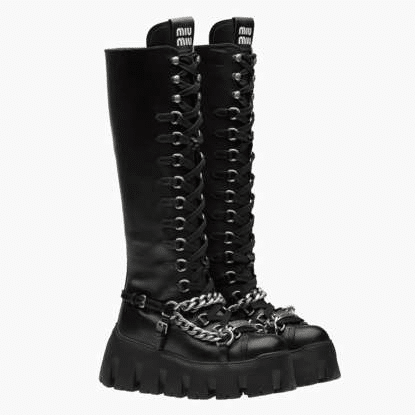
These leather boots from Miu Miu are some of the most expensive shoes available
Founded by Miuccia Prada in 1992, Miu Miu is famed for its subversive and contemporary takes on traditional feminine clothing. However, the brand still retains the high prices of its parent company, the Prada Group. These leather boots, complete with an oversized rubber sole and decorative metal chain, cost US$2,050.
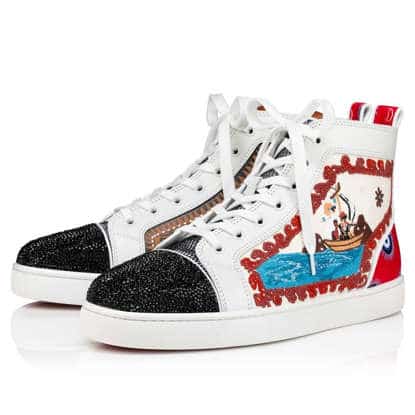
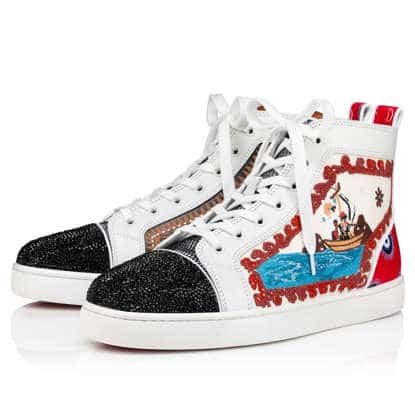
The No Limit Greek high-top sneaker from Christian Louboutin is one of this season’s most costly shoes
Expelled from school at 16, Christian Louboutin didn’t always have a smooth journey to becoming a star shoe designer. Yet, his footwear label is now one of the most recognizable (and expensive) in the world. These No Limit Greek high-top sneakers are no exception. Made from calf leather, suede, mesh and a graphic evil-eye-inspired print, the shoes also feature the unmistakable Louboutin red sole and ornate embroidery inspired by Ancient Greece. The price? A princely US$2,495.
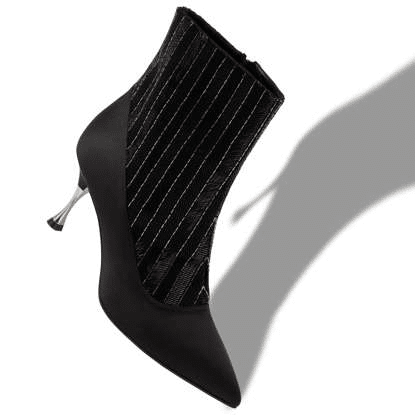
The expensive Zuelana boots from Manolo Blahnik cost more than US$2,500
Famed for his passion for heels and his commitment to hand-made models, Manolo Blahnik has been a favourite designer of Hollywood stars and fashion editors since the 1970s. Inspired by his love of Sicily and his admiration for the elegant and austere work of author Giovanni Verga, these black satin and sequin boots call to mind restrained femininity and modern menswear. The simplicity of this shoe clearly comes at a price, though—retailing at US$2,595, to be exact.
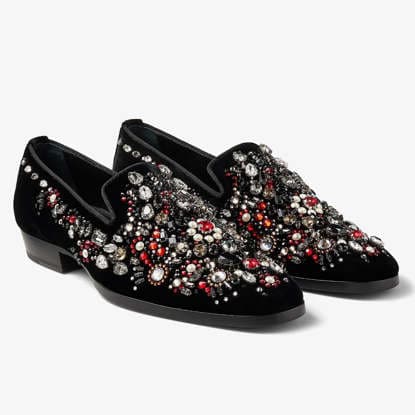
These jewelled Jimmy Choo evening shoes could set you back over US$4,000
From Princess Diana to Carrie Bradshaw, Jimmy Choo has designed shoes for some of the most recognizable faces in fashion. Although the renowned shoemaker doesn’t design custom footwear for everyone, style aficionados can own a pair of his creations for a price. The SAUL evening slip-on shoes are made from velvet and feature jewelled crystal mix detailing. The glamour comes at a price, though—any potential customer will need to foot a bill of US$4,595.
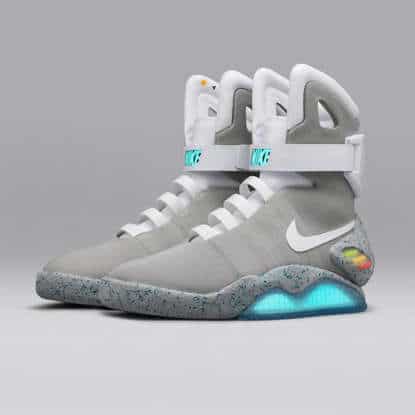
The self-lacing Nike Air MAG from ‘Back to the Future Part II’ is worth at least US$100,000
Twenty-two years after their appearance in Back to the Future Part II, the Nike Air MAG finally became available to buy in 2011. Although the initial model didn’t feature the futuristic patented sneaker’s auto-lacing technology, a pair still boasts an average resale value of US$8,593. A second model (complete with the auto-lacing system) was released in 2016 with 89 pairs produced and raffled off in aid of the Michael J. Fox Foundation. One pair of this model later sold for over US$100,000 at auction.
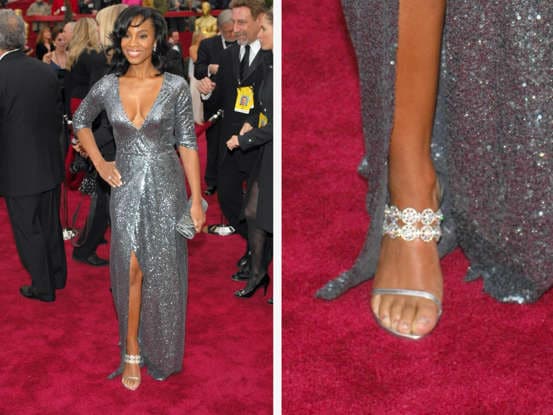
The expensive Diamond Dream Stilettos by Stuart Weitzman are valued at an incredible US$500,000
Stuart Weitzman is renowned in showbiz circles for his luxurious footwear designs. So, it’s no surprise that his Diamond Dream Stilettos are among the most expensive shoes in the world. Created for Dreamgirls star Anika Noni Rose, who wore them to the 2007 Academy Awards (pictured), the shoes are embellished with 30-carat diamonds arranged in two decorative platinum bands. In total, 1,420 individually cut diamonds are used—bringing the value of this pair of heels to a whopping US$500,000.
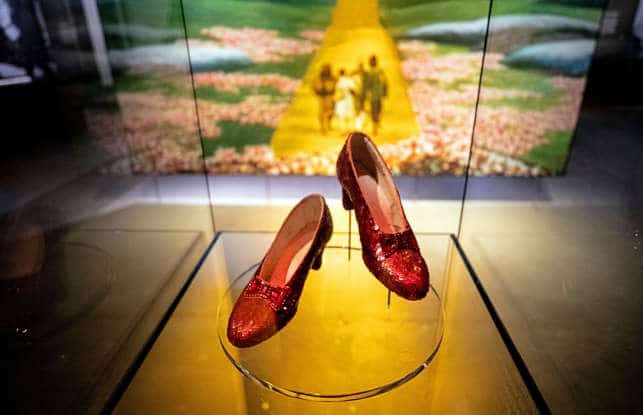
A pair of Judy Garland’s original ruby slippers from ‘The Wizard of Oz’ are now worth at least US$510,000
Arguably the most iconic shoes in Hollywood history, the ruby slippers worn by Dorothy in The Wizard of Oz now carry a hefty price tag. Five pairs are still known to exist—one is displayed at the National Museum of American History, while another has its home at the Academy Museum of Motion Pictures (pictured). Another pair was sold at auction for US$510,000 in 2011. Meanwhile, a fourth pair that was stolen (and then recovered) was estimated to be worth up to US$3 million.
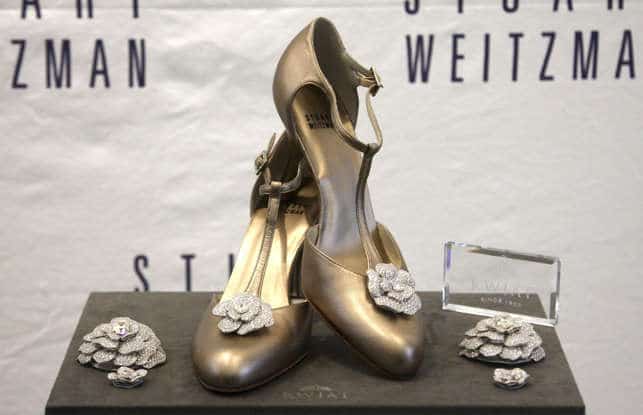
Stuart Weitzman’s diamond-encrusted Retro Rose Pump could cost you US$1 million
Stuart Weitzman is no stranger to designing some of the fanciest—and most expensive—shoes in the world. In 2008, he created yet another masterpiece: the Retro Rose Pump. The vintage-inspired, diamond-encrusted stilettos were estimated to be worth US$1 million at the time. The designer selected Oscar-nominated screenwriter Diablo Cody to wear the shoes on the red carpet. However, Cody refused to wear them, calling the offer “a lame publicity stunt.”
Source: MSN.COM
DISCLAIMER: Independentghana.com will not be liable for any inaccuracies contained in this article. The views expressed in the article are solely those of the author’s, and do not reflect those of The Independent Ghana
Kosmos Innovation Center Ghana, Glovo and Open Value Foundation are organizing an Impact Entrepreneurship Competition for innovative and successful Ghanaian-owned businesses making a positive impact on society, with a view to strengthening the impact ecosystem in the country and contributing to bridge the gap between impact and profit.The Impact Entrepreneurship Competition is designed for entrepreneurs and early-stage companies generating positive impact in Ghana’s economic, social and/or environmental sectors, contributing to sustainable development in the country.
Over 20,000USD in cash prizes and more than 5,000USD of in-kind prizes will be awarded to the selected entrepreneurs during the competition. The winner will receive a grant of 15,000USD powered by Open Value Foundation. 10,000USD will be awarded to a company working to improve the health and wellbeing of others, including businesses tackling environmental issues impacting people’s health by Anesvad Foundation.
Additionally, based on the jury’s criteria, any of the live-pitch participants will have the opportunity to receive a package of support including mentoring, investor-readiness advice, networks, and introductions to other sources of funding and opportunities to access products and/or services donated by partners and collaborators.
To participate in the competition, the Ghana registered company must have raised less than USD250,000 in funding, have been in operations for 2 or more years, have a clear for-profit or sustainable business model with potential for scale and the ability to demonstrate positive social impact in Ghana (on rural, low-income, or disadvantaged communities).
The Competition will be made up of 2 stages. The first stage will be through an online submission while the second stage will be a physical event where the top eight shortlisted businesses will pitch in person to a panel of judges and investors. The live pitch will be held on 4th November 2022 in Accra.
All applications should be submitted to bit.ly/ImpactGhanaAwards or to kicghana.org on or before October 10th, 2022. All questions and enquiries should be directed to info@kicghana.org or +233 0342295432.
About Kosmos Innovation Center Ghana
The Kosmos Innovation Center (KIC) is investing in the future by supporting innovators turning today’s problems into tomorrow’s opportunities. We are on a mission to scale innovations that apply commercial solutions to key development challenges in Africa, starting with agriculture. We have successfully invested in hundreds of young entrepreneurs and small businesses who have big ideas and want to see their country grow. We achieve this through tailored coaching, skills building, expert mentorship, seed funding, and facilitating connections within and across industries. For more information about Kosmos Innovation Centre, please visit: https://kicghana.org/
About Glovo
Glovo is a pioneering multi-category delivery app and one of the world’s leading technology platforms intermediating in the on-demand delivery industry. Founded in Barcelona in 2015, it operates in Southwest Europe, Eastern Europe, and Sub-Saharan Africa. For more information about Glovo, please visit: https://about.glovoapp.com/en/
About Open Value Foundation
Open Value Foundation is a family foundation on a mission to promote and encourage impact investing to improve people’s lives. It employs a hybrid model between traditional philanthropy and private capital investing, and works to accelerate the creation of innovative solutions to fight poverty and improve the lives of the most vulnerable people, bringing together impact stakeholders and strengthening the impact ecosystem. For more information about OVF, please visit: https://www.openvaluefoundation.org
About Anesvad Foundation
Anesvad Foundation has been committed to the Right to Health of all people for more than 50 years, focusing on those in the most vulnerable situations. It develops projects that guarantee access to health in Africa, seeking the greatest impact and the greatest sustainability. Anesvad Foundation also supports causes and projects that help improve people’s lives, in addition to guaranteeing its economic sustainability through a portfolio of impact investments. For more information, please visit: https://www.anesvad.org/
On Tuesday, the tennis superstar, 40, shared a black-and-white photo onInstagramof her posing with her 4-year-old daughter Olympia and Markle, 41, while teasing her interview on Markle’s podcast.
“I loved talking about so many important topics with my dear friend Meghan as her first guest on #archetypes for @spotify,” she captioned the snap. “It’s out now and worth the listen, especially if you’re ambitious â¤ï¸”
In the premiere episode, the duo discussed the double standard society sets for women who chase their dreams.
In the opening of the episode, which dropped Tuesday, Markle said that the nuns of Immaculate Heart, the all-girls Catholic school in Los Angeles she attended from sixth through twelfth grades, always empowered the students to go after what they wanted.
“This feminist ideology trickled down into nearly every aspect of my education. It’s probably safe to say into every aspect of my life,” she explained. “This message to me and my classmates was clear: our futures as young women were limitless. Ambition? That was the whole point!”
“So I don’t remember ever personally feeling the negative connotation behind the word ‘ambitious’ until I started dating my now-husband,” she said.
Pool/Samir Hussein/WireImage
Reflecting on life in the limelight as Prince Harry’s partner, she continued, “and apparently ambition is a terrible, terrible thing, for a woman that is — according to some. So, since I’ve felt the negativity behind it, it’s really hard to un-feel it. I can’t unsee it, either, in the millions of girls and women who make themselves smaller — so much smaller — on a regular basis.”
Introducing Williams as “someone who embodies the spirit of ambition,” the two addressed the negative light society views ambitious women.
“Often women are definitely put in these different boxes when we are ambitious or when we do have goals or when we reach our goals, it’s a negative connotation on how we reach the goals,” Williams said.
Noting that the notion even applies to “little girls in a school room,” Markle pointed out that if a young girl “is ambitious or raises her hand more,” she’s likely to be labeled “bossy” because of her gender, to which Williams agreed.
Markle and Williams first met at the Super Bowl in 2010 and immediately hit it off. They also appeared together at the 2014 Super Bowl, competing in DIRECTV’s Celebrity Beach Bowl. They played former NFL pros for the prize but made sure to make some time for fun on the sidelines.
Since then, the Duchess of Sussex and Williams have supported each other, including Markle watching her friend play at Wimbledon and the U.S. Open.