Threats to sue the government for the damaging its source of power in the nation have been made by opposition organizations, a trade union, and business owners in South Africa.
They have given the government up to Friday to stabilise electricity supply or face legal action for contravening its duty to provide electricity.
They have written a demand letter to the Public Enterprises Minister Pravin Gordhan and the chief executive of the state utility firm Eskom, Andre de Ruyter, saying the state was in breach of its obligation to provide electricity.
The blackouts have persisted for more than a decade, amid poor management and corruption at state firm Eskom
Recently the country has been having up to 10 hours of power cuts daily.
The problem has prompted the president to cancel a trip to the World Economic Forum in Davos to hold meetings at home with business and labour leaders.
A 60-year-old man who was mauled to death over the weekend by his own dogs in the South African town of Lichtenburg, has been formally identified as Zambian football star, Philemon Mulala.
Mr Mulala’s wife is reported to have found him lifeless in the garden of their home and quickly called for the emergency services who pronounced him dead at the scene, according to a statement by the South African Police
Tributes have been pouring in with the Football Association of Zambia (FAZ) leading the way. FAZ general secretary Adrian Kashala told South Africa’s Times Live newspaper; “We remain with wonderful memories that the late Philemon honoured us with on the pitch.”
Mr Mulala moved to South Africa in the 1980s to play for the Kaizer Chiefs and later, the Cape Town Spurs.
The South African Police Service has said that an inquest docket has been opened and investigation into the matter continues.
The Society for the Prevention of Cruelty to Animals have removed the three dogs from their home and put them in shelters.
South African Comedian, Trevor Noah, has hosted his final edition of The Daily Show after seven years as the host of the US late-night comedy show.
In an emotional farewell he gave what he called a “shout out to black women”.
“Who do you think teaches me? Who do you think has shaped me, nourished me, informed me? From my mum, my gran, my aunt – all the black women in my life,” he told the audience.
Trevor gives thanks to the fans who supported him over the last seven years and the Black women who shaped his life. pic.twitter.com/p2VpOkSm4T
In his goodbye monologue, he references the fact that he first found it hard to fill the seats in the studio but over the last seven years, Noah himself has brought in a younger enthusiastic audience.
He has also offered a more international take on events in the US. During his time as host he has covered the presidency of Donald Trump, the Black Lives Matter protests and the impact of the Covid-19 pandemic.
Noah said that it was black women who had taught him most about America as they know that if things go bad then they are the first to suffer.
When he announced his planned departure in September the 38-year-old said: “I remember when we first started… so many people didn’t believe in us… [Appointing me as host] was a crazy bet to make. I still think it was a crazy choice, this random African.
“I just [find] myself filled with gratitude for the journey. It’s been absolutely amazing. It’s something that I never expected.”
He got into many arguments over the years of hosting the programme, including one with the French government after he celebrated France’s 2018 World Cup win as an African victory:
South African President Cyril Ramaphosa is facing serious calls to step down after a parliamentary probe found he may have breached the country’s anti-corruption laws related to the theft of millions of dollars at his Phala Phala game farm.
This follows allegations laid by the country’s former head of intelligence, Arthur Fraser, that Ramaphosa tried to conceal the theft of millions of dollars at his farm in 2020.
Ramaphosa was due to appear in parliament on Thursday and answer questions but instead postponed.
Dr. Dale T. McKinley, an independent political analyst, said that “the evidence seems to be overwhelming” in lieu of all the evidence having been presented.
“I think it’s really the way in which he’s approached it,” McKinley said of Ramaphosa.
Ramaphosa approached it in “a very secretive, very non-disclosing kind of way” that will “permanently” damage his “political legitimacy” McKinley said.
In its report, the parliamentarypanel raised questions about the source of the money and why it wasn’t disclosed to financial authorities, and cited a potential conflict between the president’s business and official interests.
Ramaphosa has denied any wrongdoing, insisting that the money was proceeds from the sale of animals at his farm.
But opposition parties and Ramaphosa’s detractors in the ruling African National Congress party have called for him to step down.
The South African rand has fallen amid the uncertainty.
“I don’t see Cyril Ramaphosa stepping aside unless he’s charged. If he’s charged, he’s got to. He has to,” McKinley said.
Lawmakers are expected to debate the report on Tuesday, and they will vote on whether further action should be taken, including whether to proceed with impeachment proceedings.
ANC lawmakers are a majority in Parliament and may push back against attempts to impeach their leader.
Members of South Africa’s ruling African National Congress (ANC) and its allied Communist Party protested outside Johannesburg’s Constitutional Court to express their outrage over the decision to free the man who murdered anti-apartheid activist Chris Hani.
Janusz Walus, a Polish immigrant, murdered Hani in 1993 to sabotage the transition from white minority rule to democracy.
On Monday, Chief Justice Ray Zondo directed the country’s corrections minister to grant Walus parole.
Panyaza Lesufi, a senior ANC member, said more protests were planned to coincide with his expected release next week.
Walus killed Hani as he picked up the newspapers outside his home in April 1993 by shooting him at point-blank range in the chin, behind the ear and in the chest.
He was arrested and sentenced to death. The sentence was commuted to life after South Africa abolished the death penalty at the end of apartheid, a legalised system of racial discrimination, in 1994.
Hani’s murder still evokes deep emotions in South Africa. He was regarded as the most popular politician after South Africa’s first black President Nelson Mandela, and his death caused much shock and anger.
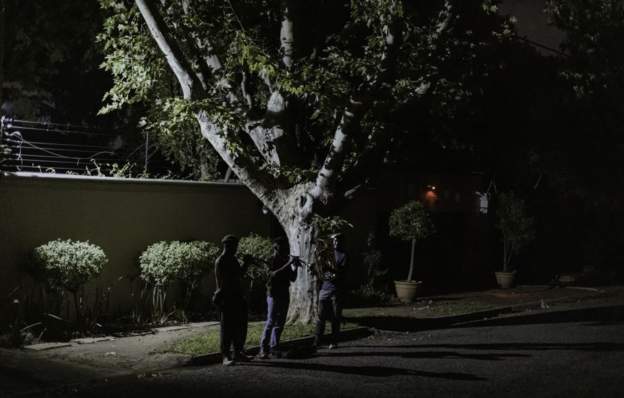
A South African mob attacked and killed a patient in an ambulance on suspicion of committing a crime, according to the Gauteng province health department.
The mob also attacked paramedics who were attending to the patient in Atteridgeville area and damaged the ambulance.
Paramedics had responded to calls for medical assistance after the man was injured in a mob attack. At the scene, they initiated treatment and prepared to transport the patient to the nearest hospital.
“As the ambulance was getting ready to leave the scene, community members started throwing stones and barricaded the road to prevent the ambulance leaving… they demanded justice on the spot,” the health department said in a statement.
It added: “Unfortunately the patient was further fatally assaulted while on an ambulance stretcher. The ambulance was extensively damaged and medical equipment was stolen.”
South African Hollywood star Charlize Theron has faced a mountain of criticism for suggesting that her mother tongue Afrikaans is “a dying language”, news site Times Live reports
She made the comments on the SmartLess podcast
(12 minutes in) when she was explaining that she grew up speaking only Afrikaans and then learned English when she was 19, which was why she speaks it with an American accent, she said.
She added that Afrikaans was a “dying language” which was “not very helpful” and spoken by “about 44 people”.
Some of the millions who do speak in South Africa were angered.
Times Live quotes one critic saying “it’s not dying… there are new songs and poems being written every day, movies made etc”.
Another Twitter commenter accused Theron that she “forgot where she came from. I am Afrikaans and will never talk bad about my mother tongue language! it is a beautiful language! Lots of people wish they could speak or understand it.”
Afrikaans is highly politicised in South Africa.
The imposition of the language in schools was the main reason behind the 1976 Soweto uprising against the apartheid regime, in which at least 170 people were killed, mostly schoolchildren.
It is the mother tongue of 13% of South Africans, mainly mixed-race people, known as coloureds, and white South Africans – the descendants of Dutch, German and French settlers who arrived in the 17th Century.
This year’s winner of South Africa‘s version of the talent show Idols, which is franchised around the world, is a police officer.
Warrant Officer Thapelo Molomo, 29, triumphed over ten other contestants in the season finale on Sunday night.
He collapsed to the floor and prayed onstage after being declared the winner.
“Thank you so much to everyone that has voted for me… I’m really grateful for what you have done for me. If it’s possible with me, it can be possible with you,” he later said.
The country’s police minister was at the show and congratulated the winner saying: “The officer serves as an inspiration to police officers across the country to believe in their talents as they serve and protect the nation”.
#sapsHQ#SAPS management congratulates Warrant Officer Thapelo Molomo for being crowned the @IdolsSA Season 18 winner. Minister of Police, General Bheki Cele, who attended the finale, has on behalf of the SAPS, congratulated the newly crowned winner. MEhttps://t.co/g8md95HRsbpic.twitter.com/PFKreNLj7e
A South African court on Tuesday convicted a man of more than 90 rapes, some of which involved children of nine years.
The Palm Ridge Court near Johannesburgconvicted Nkosinathi Phakathi, 38, who targeted schoolgirls and also forced children to watch him commit rape for nine years between 2012 and 2021.
“He would prey on his victims while they were going to or returning from school or work, in the morning or evening… He would prey on some of them in their own homes,” Lumka Mahanjana, spokesperson for the National Prosecution Authority (NPA) detailed in a statement.
“He pretended to be an electrician who came to repair a water heater or other household appliances and raped them (…) In some cases, when he raped several people at once, he forced the other person to watch,” she added.
He was arrested in March last year after attempting to return to the home of one of his victims, prosecutors said. Police shot him in the leg, which has since been amputated.
On Tuesday, wearing a gray hoodie, the convict, who pleaded guilty last week to 148 counts, sat staring at the floor, his head slumped between his forearms that rested on a pair of crutches, as the judge reviewed the long list of his crimes.
– “Pandemic” of rapes –
He was then convicted of 90 rapes, forcing four other people to rape, forcing a child to watch a sex act on three occasions, 43 kidnappings, two assaults, and four robberies.
He is scheduled to be served with his sentence in early December.
The verdict comes a week after South African President Cyril Ramaphosa said sexual violence should be considered the main “pandemic” affecting the country, while not a day goes by without new reports of “horrific” crimes.
Police data shows that rape and sexual offenses increased by 13% between 2017/18 and 2021/2022, while murders of women increased by 52% in the first three months of this year compared to the same period last year.
Some women’s rights advocates accuse the government of not doing enough to combat the violence.
South Africa has been rocked recently by a series of horrific crimes, including the gang rape of eight women in July and the discovery of half a dozen women’s bodies in a central Johannesburg building last month.
The IMF at its annual meetings in Washington this week indicated increased support for economic recovery in Africa.
The IMF wants to speed up long-delayed debt restructurings for Zambia and Chad to institute by year-end. In Zambia, a combination of tighter monetary and fiscal policies and the elimination of custom duties have tamed inflation to 9.9% from 21% in the past year.
The Kwacha has been Africa’s best performing currency, rallying around 18% year to date, after Zambia secured a $1.3bn bailout package from the IMF.
Prospects remain positive given the debt restructuring plans to be concluded this year in addition to improved global consumption for the copper producing country.
Debt restructuring should also help spur recovery for Chad amid a pick-up in oil and agricultural output. In other news from the IMF meetings, the Fund is seeking to include clauses in future debt contracts that will allow borrowers to suspend debt servicing commitments in the event of a climate shock.
Meanwhile, Rwanda is set to become the first African country to benefit from a $40bn Resilience and Sustainability trust fund set up by the IMF to help countries deal with the impact of climate change. A $310m staff-level agreement reached with the IMF will enable the Rwandan government to integrate climate-related considerations into its overall fiscal reforms. The Rwandan franc has contracted by about 5% in the past year to RWF 1065 per dollar, against a backdrop of inflation soaring to 23.9% this year amid continued dependence on Russian wheat and fertilizer. A combination of the country’s economic reforms and an agreed IMF climate change related support programme could be a long-term boost for the currency.
Naira weakens as Nigeria considers debt restructuring
The Naira continued its slide against the dollar this week, trading at 734 from 722 at last week’s close, as Nigeria’s government said it was considering options to restructure its debt. Finance Minister Zainab Ahmed said the country has appointed a consultant to look at ways to ease its debt burden, such as extending repayment periods, according to Bloomberg.
Nigeria’s oil output continues to decline amid rising oil theft and vandalism, with the country now Africa’s fourth biggest crude producer behind Angola, Libya and Algeria, having started the year as the continent’s largest. That is piling further pressure on the Naira given that oil revenues are by far the biggest source of FX for the central bank. We expect further depreciation in the unofficial market in the short term as demand pressures continue to weigh heavily on the local currency.
Cedi touches new low amid record 37% inflation
The Cedi depreciated against the dollar again this week, trading at 10.58 from 10.45 at last week’s close, having briefly touched a record low of 10.63 on Tuesday. Annual inflation hit a record high 37.2% in September, up from 33.9% in August.
Ghana’s interest rate is currently at 24.5%, its highest level since 2017 following last week’s 250 basis point hike. Given that inflation is being driven mainly by the supply side, the bank’s rate hikes are not proving as effective in curbing rising prices.
Fitch Ratings has warned that a sovereign debt default is a real possibility, with any kind of domestic restructuring likely to severely impact the local banking sector. Against that backdrop, we expect the Cedi to continue weakening towards the 11 level in the near term.
Risk-off drives Rand lower as planned power cuts ease
The Rand weakened against the dollar, trading at 18.18 from 18.04 at Friday’s close as risk-on sentiment of last week was snuffed out amid concerns about global growth and an escalation of Russia’s war in Ukraine. On the domestic front, planned power cuts are expected to ease this week.
A workers’ strike at freight company Transnet has seen South African coal exports slow to the lowest level in a year, causing coal prices to jump higher.
Europe’s increased dependence on South African coal amid the ongoing energy crisis is likely to provide some support to the Rand in the months ahead. For the near term, we expect the Rand to continue trading in line with global risk sentiment.
Egypt Pound at record low as banks limit FX withdrawals
The Pound edged to a fresh low against the dollar, trading at 19.69 from 19.66 at last week’s close.
Egyptian banks have been taking steps in recent days to limit the withdrawal of foreign currency to protect against a scarcity of dollars in the country. The central bank is also considering allowing non-deliverable forwards so companies and investors can hedge exposure to large swings in the Pound.
Meantime, annual inflation climbed to 15% in September from 14.6% a month earlier, pushed higher by rising food and transportation costs.
We expect the Pound to weaken further in the coming days, although Egypt’s hosting of next month’s UN climate change conference COP 27 could help drive FX inflows with increased visitors.
Shilling slides as Kenya reserves hit 7-year low
The Shilling depreciated against the dollar, trading at 120.80/121.00 from 120.70/120.90 at last week’s close—just shy of a record low—due to increased dollar demand by importers in the oil, energy and manufacturing sectors.
Economic growth slowed for a fourth consecutive quarter, hitting 5.2% in Q2 of the financial year from 6.8% in the previous three-month period as election-related uncertainty and the worst drought in 40 years weighed on activity. To support the Shilling, the central bank sold an unspecified amount of dollars.
Kenya’s FX reserves fell to $7.3bn last week from $7.4bn a week earlier—the lowest level in seven years—amid lower foreign funding, faster import growth and a slowdown in remittances. We expect the Shilling to stabilise in the coming week as the central bank continues to dip into reserves to cushion against volatility.
Ugandan Shilling weakens amid rate hikes
The Shilling weakened against the dollar, slipping to 3831 from 3817 at last week’s close. Uganda said it was working with China, the US and Russia to find potential investors to help develop East Africa’s first nuclear power plant, which the government hopes to have operational by 2031.
Meantime, Uganda’s purchasing manager’s index climbed to 51.6 in September from 50.5 in August, the strongest level in five months. The central bank said more rate rises could be on the cards following last week’s 100 basis point hike.
Uganda’s benchmark interest rate has increased by 350 basis points since June, now at a three-year high of 10%. We expect the Shilling to weaken further in the near term due amid higher import costs.
Tanzania outlook raised at Moody’s as exports soar
The Shilling appreciated marginally against the dollar, trading at 2331 from 2332 at last week’s close.
Moody’s upgraded Tanzania’s credit outlook to positive from stable, affirming its B2 rating, five levels below investment grade, based on lower political risk given the government’s new approach to promoting economic development and engagement with the international community.
Tanzanian exports hit $1.4bn during the 12-months to August, a 75% increase on the previous 12-month period. We expect the Shilling to continue strengthening modestly against the dollar in the week ahead.
The ninth Women’s Rugby World Cup kicked off in front of a world-record audience at Auckland’s Eden Park, New Zealand, on Saturday. In the opening match of the tournament, the South African Women Bok failed to secure a vitory.
French scrumhalf Laur Sansus scored the first try of the World Cup after only two minutes.
The score remained 19-0 at halftime as South Africa’s performance was lifted by a strong scrum. That revival continued when South African winger Nomawethu Mabenge scored the first try of the second half.
France who is ranked No04 in the world beat South Africa ranked No.11, 40-5.
The Springbok will have a chance to do better as they play Fidji next week.
The 12 teams at the World Cup are divided into three groups of four. The final will be played on Saturday, November 12 .
For years, students in a South African township have seen their parents struggle to use trains for daily commutes, the railways frequently hobbled by power outages and cable thefts.
To respond to the crisis, a group of 20 teenagers invented South Africa’s first fully solar-powered train.
Photovoltaic panels fitted to the roof, the angular blue-and-white test train moves on an 18-metre-long (60 feet) test track in Soshanguve township north of the capital Pretoria.
Trains are the cheapest mode of transport in South Africa, used mostly by the poor and working class.
“Our parents… no longer use trains (because of) cable theft… and load shedding,” said Ronnie Masindi, 18, referring to rolling blackouts caused by failures at old and poorly maintained coal-powered plants.
The state power company Eskom started imposing on-and-off power rationing 15 years ago to prevent a total national blackout.
The power outages, known locally as load-shedding, have worsened over the years disrupting commerce and industry, including rail services.
Infrastructure operator Transnet has struggled to keep rail traffic flowing smoothly since the economic challenges of the pandemic fuelled a surge in cable theft.
By 2020, rail use among public transport users was down almost two-thirds compared to 2013, according to the National Households Travel Survey with many commuters turning to more expensive minibus taxis.
Masindi said they decided to “create and build a solar-powered train that uses solar to move instead of (mains) electricity”.
The journey has not been without its challenges.
A lack of funding delayed production of the prototype locomotive, and the government later chipped in.
“It was not a straight line,” said another student, Lethabo Nkadimeng, 17. “It was like taking a hike to the highest peak of the mountain.”
The train, which can run at 30 kilometres (20 miles) per hour, was showcased at a recent universities innovation event.
For now, the prototype can run for 10 return trips on the track installed on the grounds of a school.
It will be used for further research, and eventually presented as a model the government could adopt.
Fitted with car seats and a flat-screen TV to entertain passengers, it took the students two years to build.
“What we have realised is, if we you give township learners space, resources and a little mentorship they can do anything that any learner can do around the world,” said Kgomotso Maimane, the project’s supervising teacher.
The controversial South African opposition figure, Julius Malema, has warned of an impending uprising similar to the “Arab Spring” that will target white people and “black elites”.
“When the unled revolution comes… the first target is going to be white people,” Mr. Malema told the BBC’s Hardtalk program.
He demanded an “intervention” to boost the quality of life to avoid unrest.
The MP, known for strident views, has twice been convicted of hate speech.
He has also faced fraud and corruption charges, which were later dropped. Mr. Malema said they were politically motivated.
The Arab Spring was a series of pro-democracy uprisings which began at the end of 2010 in Tunisia, where the president was toppled and spread to several other countries in the region.
In the BBC interview, Mr. Malema accused rich black people of committing “class suicide”.
“The violence that is going to happen in South Africa is because the elite is disappearing and the poor are becoming poorer,” he told the BBC’s Stephen Sakur.
“Therefore there’s going to be something that looks like an Arab Spring. That, we are guaranteed.”
Former President Thabo Mbeki issued a similar warning about a possible uprising last week. He criticized his own party, the governing African National Congress (ANC), saying it has no plan to deal with the problems of poverty, unemployment, and inequality.
‘Difficult time for South Africa’
With high levels of joblessness, inflation hitting a 13-year high, complaints about corruption, and a troubled energy sector, South Africa is facing many challenges.
Current President Cyril Ramaphosa, in a recent statement to the nation, acknowledged a “difficult time for our country”. But in a separate speech, he responded to Mr. Mbeki’s criticism, saying the ANC has a plan to fix things.
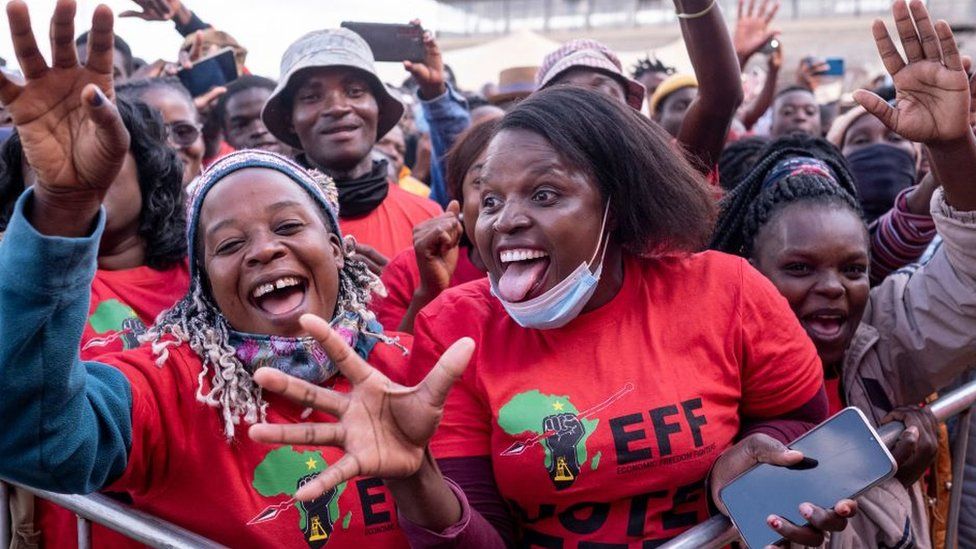
Mr. Malema, who leads the opposition Economic Freedom Fighters (EFF), has long courted controversy and has previously been found guilty of using hate speech, in 2010 and 2011 for comments he made about the woman that accused former President Jacob Zuma of rape and then for singing the song “Shoot the Boer (Afrikaner)”.
In the 2019 general election, the EFF won nearly 11% of the vote and has 44 seats in parliament.
Mr. Malema’s message that the ANC is not working for the poor has gained popularity
Mr. Malema is currently facing allegations of hate speech against white people but has denied that he is causing tensions between different races and says the violence in South Africa cannot be pinned on his following.
“I’ve engaged in democratic ways of trying to resolve problems in South Africa, and therefore those who are scared of our ideas try and create an impression of very violent people. We are not.”
The opposition leader used to be a member of the ANC but was kicked out for fomenting divisions and bringing the party into disrepute. He denied the accusations, saying he was being persecuted.
Mr. Malema also wants a national shutdown to protest against the ruling ANC.
“We are going to bring our bodies to the streets and demand that [President] Ramaphosa must resign.
As for his own party, the EFF, Mr. Malema believes they would govern the country much better than the ANC.
“There’s going to be the EFF that is going to take over South Africa and run it for the better.”
Five people have been killed after attackers stormed a South African church, reportedly amid an argument over its leadership.
South African police said they had rescued men, women, and children from a “hostage situation” on the outskirts of Johannesburg on Saturday morning.
They have also arrested at least 40 people and seized dozens of weapons.
Eyewitnesses say the men who stormed the International Pentecostal Holiness Church were part of a splinter group.
The church’s leadership has reportedly been the subject of infighting since its former leader died in 2016. Police had previously been called to the church following a shoot out between members in 2018, South Africa’s IOL reports.
The year before, the church’s finances had come under the spotlight, amid allegations some 110m rand ($6.5m; £5.2m) had gone missing, according to The Sowetan newspaper.
On Saturday, police were called to the church in Zuurbekom in the West Rand at 03:00 local time (01:00 GMT).
According to national police spokesperson Brigadier Vish Naidoo, a group of attackers indicated to those inside “that they were coming to take over the premises”.
He said four people had been found shot and burnt to death in cars, while a security guard, who was thought to have been responding to the incident, was also fatally shot.
Five rifles, 16 shotguns, and 13 pistols, along with other weapons, were found at the church, which police have been combing for evidence.
The South African Police Service (SAPS) said that among those arrested were members of SAPS, the South African National Defence Force, the Johannesburg Metro Police Department, and the Department of Correctional Services.
The International Pentecostal Holiness Church is thought to have about three million members in Southern Africa.
A two-day-old baby born became the youngest victim of coronavirus in South Africa after being born prematurely to a coronavirus positive mother.
It is the country’s first neonatal death.
Health Minister Zweli Mkhize said the premature baby had lung problems and required ventilation immediately after birth.
“The mother had tested positive for Covid-19 and the child subsequently tested positive for Covid-19 as well. It is important to appreciate the complexities of the underlying condition of prematurity,†he said on Wednesday.
South Africa, which has the highest coronavirus infections in Africa, reported 27 new deaths bringing the total fatalities to 339.
Some 803 new coronavirus cases were announced on Wednesday evening taking the total to 18,003 while 8,950 people have recovered.