In a groundbreaking moment for South Korea, the android robot EveR 6 assumed the role of conductor during a performance by the country’s national orchestra in Seoul.
Created by the Korea Institute of Industrial Technology, this two-armed robot, featuring a humanoid face, made its debut at the National Theater of Korea.
The robot captivated the audience as it began the show by bowing and then skillfully directing the musicians with its arm movements, controlling the tempo of the live performance.
“Movements by a conductor are very detailed,” Choi Soo-yeoul, who led Friday’s performance alongside the robot, said.
“The robot was able to present such detailed moves much better than I had imagined.”
According to Choi, a “critical weakness” of EveR 6 is its inability to listen. While the robot’s movements were flawless in maintaining the rhythm, Lee Young-ju, an audience member knowledgeable in traditional Korean music, noted that it lacked the essence of “breath” – the capacity to keep the orchestra synchronized and responsive, which is vital in a performance.
Lee emphasized that collective and immediate engagement is essential for a successful orchestral presentation.
“It seemed there was some work to be done for the robot to do the job,” Lee said.
Per to the legislation, on Wednesday, more than 51 million people in South Korea awoke to find themselves one or two years younger.
A law that took effect on Wednesday mandates that “all judicial and administrative areas” in the East Asian nation adopt the “international age” system used by the majority of the world. This puts an end to years of debate over the issues raised by the problems caused by the formerly widespread use of “Korean age” and “calendar age.”
Standardising ages will “reduce various social confusions and disputes,” according to Lee Wan-kyu, the Minister of Government Legislation, who made the statement during a news briefing on Monday.
The law, passed by South Korea’s Parliament last December, is also expected to “greatly reduce social costs that have been unnecessary due to the mixed use of age standards,” Lee said, adding this had been a major pledge by President Yoon Suk-yeol, who took office last May.
In South Korea, “international age” refers to the number of years since a person was born, and starts at zero – the same system used in most other countries.
But when asked their age in informal settings, most South Koreans will answer with their “Korean age,” which could be one or even two years older than their international age.
Under this system, which has its roots in China, babies are considered a year old on the day they’re born, with a year added every January 1.
In some circumstances, South Koreans also use their “calendar age” – a mash-up of international age and Korean age – which consider babies as zero years old on the day they’re born and adds a year to their age every January 1.
Take “Gangnam Style” singer Psy, for example. Born on December 31, 1977, he is considered 45 by international age; 46 by calendar year age; and 47 by Korean age.
If this sounds confusing, it is, with daily life in the country often switching between the hodgepodge of different systems.
Even with the new standardization, the old systems will still be used in some circumstances, the government said on Wednesday.
For instance, children typically enter elementary school in March of the year after they turn 6 years old (in international age), regardless of which month their birthday falls – which will continue.
Laws on age-restricted products like alcohol or tobacco will also be based on the year someone is born, regardless of month. This means two people born in January and December 1990 are judged to be the same age.
Under this law, people are allowed to buy alcohol starting in the year they turn 19 (in international age).
The same method will continue to be used for South Korea’s mandatory military service – meaning people are eligible based on the year they were born, rather than their specific age or birth date.
“The government decided to contain such exceptions even after the revisions go into effect, as it is easier to manage such issues on a yearly basis,” minister Lee said on Wednesday.
Many residents are likely to continue using the traditional Korean age system in day-to-day life and social scenarios, as is common.
But others may welcome the change; in a poll by the Ministry of Government Legislation, 86.2% of respondents had said that they would use the international age system. And it marks a victory for lawmakers who have spent years campaigning to standardize international age, fed up with the multiple systems.
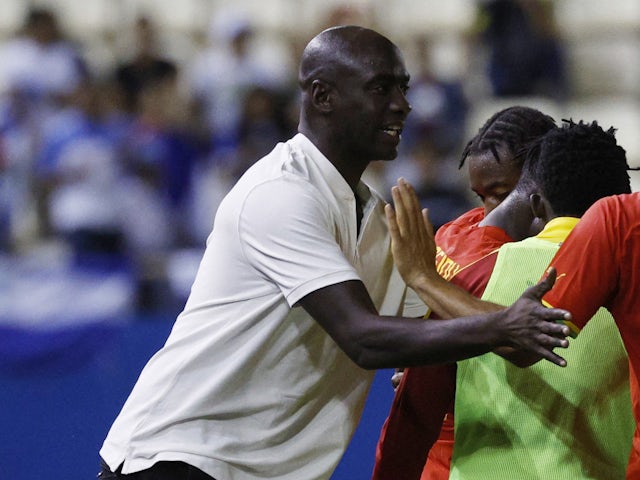
Maha Ayew, the mother of Ghanaian national team playersAndre Dede Ayew and Jordan Ayew, had to depart from the Education City Stadium during Ghana’s Group H match against South Korea at the 2022 World Cup in Qatar.
Jordan Ayew disclosed that his mother found the intensity of the game overwhelming and decided to leave before the match concluded.
According to the Crystal Palace player, Maha departed sometime between the 65th and 70th minute as she couldn’t bear the nerve-wracking experience of protecting a narrow lead in the final minutes of the game.
“My Mum, after 65 or 70 minutes, she couldn’t watch the game anymore. She had to leave the stadium! We like [the tension] like that, we enjoy it.
It was very stressful for her. She is very passionate about the game as well, so she just couldn’t watch it. With her two sons playing, it was not easy for her,” Ayew disclosed as quoted by Ghanasoccernet.
During the game, Ghana took a two-goal lead in the first before Korea pulled parity in the early minutes of the second half with a strong start.
However, the Black Stars responded and regain the lead and held on this time to record their first and only win of the tournament.
Jordan Ayew’s created the first goal with a beautiful cross, which Mohammed Salisu scored from a rebound. He later put in another sublime cross that was nodded in by Kudus Mohammed for the second.
After Cho Gue-sung’s brace pulled Korea level, Kudus restored Ghana’s lead in the 68 eight minutes connecting a cross from the right.
A lady is accused of killing two of her babies and keeping the bodies in her freezer for years, according to police in South Korea, for which they have asked for an arrest warrant.
According to a representative of the Gyeonggi Nambu Provincial Police, the mother, who was in her 30s, acknowledged to killing the infants and claimed that she did so because it was difficult for her to provide for her other three children, who are 12, 10, and 8, due to financial constraints.
The official said that the infants were barely one day old when they passed away.
Her first alleged victim was her fourth child, born in a hospital in November 2018. Police allege she strangled the girl the day after giving birth, and put the body in the freezer of her home. She is accused of doing the same to her fifth child, a boy born in November 2019.
Her husband said he had been told the two children were aborted, and therefore did not know about the alleged murders, according to police.
The case came to light in May when the government’s Board of Audit and Inspection found the babies’ births were never officially registered, although there was a record of their births in the hospital.
The board then notified Suwon City Hal, the municipal government, which requested a police investigation after the mother refused an on-site inspection.
On June 21, the police conducted a search and seizure operation in the woman’s home, during which she confessed to the murders, police say.
The woman is due to attend an arrest warrant hearing on Friday.
Police in South Korea have requested an arrest warrant for a woman who stands accused of killing two of her newborn babies and storing their bodies in her freezer for an extended period.
According to officials from Gyeonggi Nambu Provincial Police, the woman, who is in her 30s, admitted to the killings, citing economic difficulties in caring for her three other children aged 12, 10, and 8 as the reason behind her actions.
Both newborns were reportedly only a day old when they died. The first child, her fourth, was born in a hospital in November 2018, and the woman allegedly strangled the baby the day after giving birth before preserving the body in her home’s freezer.
Similarly, her fifth child, a boy born in November 2019, suffered the same fate.
The woman’s husband claims he was unaware of the alleged murders, as he was informed that the two children had been aborted, according to police statements.
The case came to the attention of authorities in May after the government’s Board of Audit and Inspection discovered that the births of the infants had never been officially registered, despite hospital records confirming their births.
The board then notified Suwon City Hal, the municipal government, which requested a police investigation after the mother refused an on-site inspection.
On June 21, the police conducted a search and seizure operation in the woman’s home, during which she confessed to the murders, police say.
The woman is due to attend an arrest warrant hearing on Friday.
Days after Hong Kong‘s local government filed an order to ban the song, a well-known song from the city’s democracy campaign has started to vanish from several major music streaming services, even in some foreign countries.
Demonstrators sang variants of “Glory to Hong Kong” throughout the massive rallies that raged around the city for months on end that year, and it eventually became the unofficial song of the city’s now-crumbling democracy protests.
The ballad’s lyrics make reference to the term “liberate Hong Kong, revolution of our times,” which the government and courts declared to have secessionist and subversive implications and was previously banned in 2020.
Multiple versions of the song posted by “ThomasDGX & HongKongers,” known to be the original composer of the orchestral anthem, were no longer available on Spotify, Apple Music, YouTube and Google to users within the city on Wednesday.
Multiple versions and covers of the song have been recorded by other artists.
The titles of those covers can still be seen on Spotify in other parts of the world, including the United States, South Korea and Australia.
But when CNN reporters in those countries tried to play the songs they were listed as “unavailable.”
Spotify told CNN that the song was removed by the distributor and not by the platform.
Users in the US cannot purchase the song on Apple Music either, although it also still yields search results on the platform.
The song can no longer be found on Apple Music and KKBOX in Taiwan, however multiple versions of it are still available on YouTube.
CNN has reached out to YouTube, Apple Music, KKBOX, and Alphabet – the parent company of Google – for comment.
By Monday, several new uploads of the song reappeared on YouTube, and the tune could be found again on Spotify and Apple Music – even within Hong Kong.
A Facebook account tied to the original composers said they have re-uploaded the soundtrack on several music platforms as a “2023 Edition,” after initially saying last week that they were “dealing with some technical issues unrelated to the streaming services.”
“(We) stand firm against any attempts to suppress freedom of thought and speech,” the latest post on Monday said, adding that the composers back listeners’ “refusal to lose their freedom to choose music.”
CNN has reached out to the Hong Kong government for comment following the reappearance of the tracks.
Following its 1997 handover to China, Hong Kong was promised key freedoms and autonomy to run its own affairs. As a result it flourished as a bastion for free speech and creative expression within authoritarian China.
But a crackdown on dissent in the aftermath of the democracy protests has since transformed the city, especially after a sweeping national security law was imposed by Beijing in 2020.
Protest leaders have been arrested or driven into exile, while the government persists on scrubbing references to the social unrest and calls for democracy in the city. New laws have also been passed to increase censorship of films to “safeguard national security.”
Music is now coming under closer scrutiny.
Hong Kong’s government filed a court injunction on June 5 seeking to ban the broadcast or distribution of the protest song after it was mistakenly played at several international sporting events.
Speaking to reporters on Tuesday, city leader John Lee – a former police chief – said authorities were taking action because “Glory to Hong Kong” was “not compatible with the national interest.”
Under the injunction filed by the Department of Justice, the song’s “melody or lyrics or in combination” would be banned to avoid “inciting others to commit secession.”
It further seeks to restrain anyone from “broadcasting, performing, printing, publishing, selling, offering for sale, distributing, disseminating, displaying or reproducing (the song) in any way.”
The writ also listed 32 YouTube videos of the song, including instrumental and sign language versions.
The government’s bid to outlaw the song was heard in the High Court on Monday, but the judge has postponed a decision on the interim injunction to July 21, public broadcaster RTHK reported.
The head of Amnesty International’s China team, Sarah Brooks, described the government’s move to outlaw the song as “absurd.”
“The Hong Kong government must end its increasingly fervent crackdown on freedom of expression. A song is not a threat to national security, and national security may not be used as an excuse to deny people the right to express different political views,” Brooks said.
The semi-autonomous city does not have its own anthem. It uses the Chinese national anthem “March of the Volunteers” at events and in schools ever since it returned to Chinese sovereignty in 1997, while during the years under British rule, the city sang “God Save The Queen.”
The use of “Glory to Hong Kong” at international sporting events infuriated officials who previously criticized Google for listing the song in search results for the city’s anthem, something Google said was decided by its algorithm which returns results based on a host of criteria including popularity and relevance.
Playing the song in public in Hong Kong is now fraught with legal risk. Last year, a man who played the tune on a harmonica during a vigil for Britain’s late Queen Elizabeth II was arrested by police on suspicion of sedition.
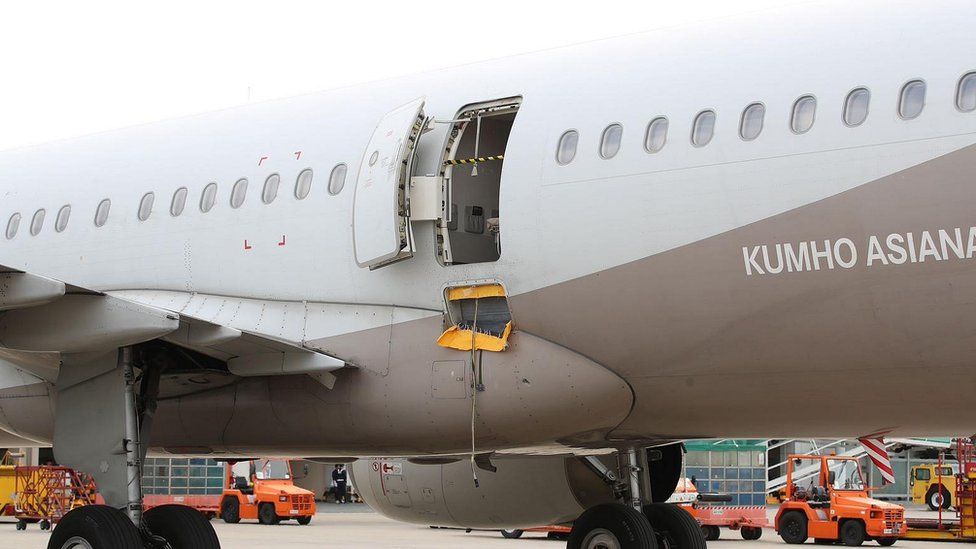
A man is in police grips after opening a door on an Asiana Airlines jet as it landed in South Korea.
The flight’s 194 passengers all survived after it landed safely but with the door remained open at Daegu International Airport on Friday.
According to local media, some passengers fainted, while others suffered breathing problems and were brought to the hospital.
The man in his 30s said he was feeling suffocated and wanted to get off quickly, Yonhap news agency reported.
Police said the man claimed during questioning that he was stressed after losing his job, according to the report.
“He is mentally struggling right now and losing his footing. We could not investigate him properly due to his state,” a local police officer told reporters, adding that the man could not be asked any questions as he was not “in a normal state”.
Flight OZ8124, an Airbus A321-200 jet, had taken off from Jeju Island on Friday about 11:45 local time (03:45 GMT).
As it was landing about an hour later, a male passenger opened the emergency door while the plane was still 250m from ground.
A passenger’s video shared on social media shows the gap in the left hand side of the plane and winds buffeting rows of seated passengers.
Flight attendants had not been able to stop him because the plane was about to land, witnesses recounted to local media.
They said the man had also tried to jump out of the plane after opening the door.
Passengers have described the panic on board.
“It was chaos with people close to the door appearing to faint one by one and flight attendants calling out for doctors on board through broadcasting,” one 44-year-old passenger told Yonhap.
“I thought the plane was blowing up. I thought I was going to die like this,” he added.
Image caption,The Asiana Airlines plane landed at Daegu with its door open
Several school age children had also been on board, on their way to a weekend sporting event.
The mother of one of the students told Yonhap: “The children were shaking, crying, and frightened.”
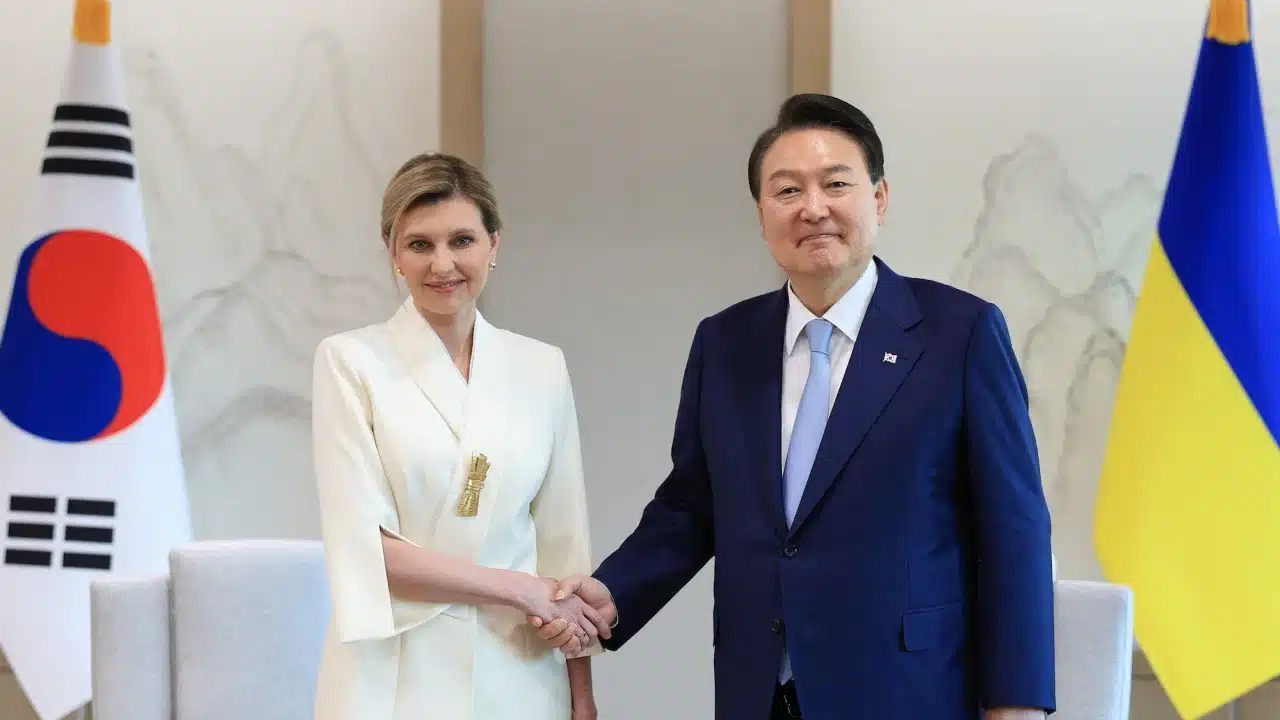
Olena Zelenska, the first lady of Ukraine, requested non-lethal military gear and air defence systems when she met with President Yoon Suk Yeol on Tuesday in Seoul, according to reports in both Koreas.
Zelenska, a representative of the Ukrainian president who is in the South Korean capital, made a long list of requests, according to Lee Do-woon, the president of South Korea. These included mine detectors, demining tools, and first aid trucks.
As stated by the Ukraine’s presidential office, Zelenska told Yoon that her country needed help with technologies South Korea “is famous for.”
“We discussed with the president the need for air defense systems to stop the missile terrorism of the aggressor country,” Zelenska was quoted as saying.
“We also need the means to clear the traps that Russia has left on our territory and medical equipment to save those who were wounded by the attackers,” she added.
Since the war broke out in Ukraine, South Korea has maintained its stance of not providing lethal weapons to a warring country, although Yoon has hinted at a possible major policy shift.
However, during an interview with Reuters in April, the South Korean leader said his country would consider sending lethal aid to Ukraine if there was a large-scale attack on civilians.
The East Asian country has previously faced calls from NATO Secretary General Jens Stoltenberg to relax its rule on not exporting weapons to countries in conflict, so it could help arm Ukraine.
During the Tuesday meeting, the Ukrainian first lady also expressed hope that South Korean companies would take part in rebuilding Ukraine, according to the spokesman for Yoon’s office.
Yoon greeted Zelenska by expressing his condolences to the victims and the Ukrainian people, and told her that South Korea would “actively support Ukraine” in cooperation with NATO countries and the international community.
Separately, Zelenska met South Korea’s first lady Kim Keon-hee, who praised the “courageous and devotional” efforts her Ukrainian counterpart has made in the midst of a war, the presidential office spokesman said.
The Ukrainian first lady handed Yoon “a personal letter and an invitation from the president of Ukraine” to visit her country, the Ukrainian side said.
Zelenska was in the country to take part in the Asian Leadership Conference, accompanied by Ukraine’s Deputy Prime Minister and Minister of Economy Yulia Svyrydenko and Deputy Head of the Presidential Office Rostyslav Shurma, according to Ukraine’s presidential office.
In a speech to the conference Wednesday, Zelenska said “humanitarian aid alone will not save” Ukrainians.
“Where there is a criminal in your house, who has come to kill your family, humanitarian aid alone will not save the residents,” Zelenska said, referring to Russia’s invasion.
“The first thing to do is stop the murderer. In the case of Kherson, it could be air defense systems, technologically advanced and effective like everything your country creates and produces.”
Since the beginning of the war, Zelenska has used her position to raise awareness of the plight suffered by her citizens and maintain diplomatic relations with global leaders.
Just before her trip to Seoul, she met European Commission President Ursula von der Leyen in the Ukrainian capital Kyiv to discuss the psychological rehabilitation of children in her country.
Last year, she met US first lady Jill Biden privately at the White House to discuss American support for Ukraine.
After a fan was captured on camera making what looks to be a discriminatory gesture towards South Korean star Son Heung-min of Spurs,Crystal Palace committed to ban him on Sunday.
After Son was replaced in Saturday’s 1-0 victory for Spurs, the incident happened in the 89th minute.
The gesture was performed by one of the Palace supporters when the South Korean captain had to pass them as he was leaving the pitch at the Tottenham Hotspur Stadium.
“We are aware of a video circulating online (as well as reports made directly to us) regarding an individual in the away end at Spurs yesterday, appearing to make racist gestures towards Heung-min Son,” said Palace in a statement.
“Evidence has been shared with the police, and when he is identified, he will face a club ban. We will not tolerate such behaviour in our club.”
Tottenham said they were working with Palace and the police to identify the individual.
“Discrimination of any kind is abhorrent and has no place in society, our game and at our club,” said Spurs.
Son was also racially abused during a match betweenChelsea and Tottenham at Stamford Bridge in August.
Chelsea banned a season-ticket holder indefinitely after footage emerged on social media of a fan in the home end making a racist gesture towards Son in the 2-2 draw.
“We will do everything in our powers to ensure that if found guilty, the individual will receive the strongest possible action — as was the case earlier this season when Son suffered similar racial abuse at Chelsea,” said Tottenham.
After the president of South Korea entertained US President Joe Biden with a karaoke performance of the song on Thursday, American singer-songwriter Don McLean joked that he was going to sing his iconic “American Pie” with the South Korean leader.
The two leaders got together on Wednesday at the White House state dinner, a glitzy event that attracted celebrities including Angelina Jolie and snowboarder Chloe Kim, who won an Olympic gold medal.
Following the audience’s enjoyment of a number of musical performances, Biden related a tale about how his sons would sing McLean’s 1971 hit song “American Pie” while en route to school.
“We know this is one of your favorite songs,” he told Yoon, who drew cheers from the crowd as he launched into the classic lyrics.
Yoon received a standing ovationfor his efforts beforeBiden presented him with a guitar signed by McLean.
The legendary singer later told CNN that he had big plans for the South Korean leader.
“I intend to go over to South Korea next year and sing it with the president, so that’s probably going to be another news story,” McLean joked on Thursday. “He wanted me at the White House to sing the song, but I’m in Australia right now on tour.”
McLean also spoke about the lasting legacy of the song, which at 8 minutes and 37 seconds held the record for the longest song to top the Billboard Hot 100 chart, until Taylor Swift re-released her hit “All Too Well” in 2021.
Of “American Pie,” McLean said: “It has a melody which is something that is pretty hard to find these days, and that’s just the opening part of the song – I mean, the song is eight and a half minutes, and it’s a rock and roll song.”
“I get a kick out of the fact that the song is still alive,” he added. “Musicians are dealing with a thing called alchemy, we deal in magic, and some of the things that we do fall on their face, and others if we’re very fortunate are magical and live forever.”
Wednesday’s events mark just the second state visit of the Biden presidency (Biden hosted French President Emmanuel Macron and his wife Brigitte in December 2022).
At the Wednesday bilateral meeting, the two leaders announced a key new agreement to deter North Korean aggression, including a new US commitment to deploy a nuclear-armed submarine in South Korea for the first time since the early 1980s.
Yoon also addressed Congress in a speech on Thursday, slamming North Korea over its human rights violations and condemning the war in Ukraine.
Some young people in South Korea are so isolated from the outside world that the government is willing to pay them to “re-enter society.”
The Ministry of Gender Equality and Family announced this week that it will provide up to 650,000 Korean won (about $500) per month to isolated social recluses, in a bid to support their “psychological and emotional stability and healthy growth.”
About 3.1% of Koreans aged 19 to 39 are “reclusive lonely young people,” defined as living in a “limited space, in a state of being disconnected from the outside for more than a certain period of time, and have noticeable difficulty in living a normal life,” according to the ministry’s report, citing the Korea Institute for Health and Social Affairs.
That makes up about 338,000 people across the country, with 40% beginning their isolation in adolescence, according to the ministry. Various factors are thought to be at play, including financial hardship, mental illness, family problems or health challenges.
The new measures specifically target young people as part of the larger Youth Welfare Support Act, which aims to support people extremely withdrawn from society, as well as youths without a guardian or school protection who are at risk of delinquency.
The monthly allowance will be available to reclusive lonely young people aged 9 to 24 who live in a household earning below the median national income – defined in South Korea as about 5.4 million won (about $4,165) per month for a household of four people.The youths can apply for the program at a local administrative welfare center; their guardians, counselors or teachers can also apply on their behalf.
“Reclusive youths can have slower physical growth due to irregular living and unbalanced nutrition, and are likely to face mental difficulties such as depression due to loss of social roles and delayed adaptation,” the ministry said, stressing the importance of “active support.”
The report on Tuesday detailed several case studies, including one young student who had suffered from mental health issues and difficulties socializing since adolescence; she struggled to adjust to college, ultimately choosing not to attend, and withdrew further into herself.
Another student faced domestic violence and hunger at home – making it difficult for her to leave the house or form relationships with people outside. Neither individual was identified.
The report also detailed future plans for further action, such as distributing guidelines to local governments, boosting youth social safety nets and early detection systems, and working more closely with youth welfare facilities like shelters or rehabilitation centers.
Japan was already grappling with isolation and loneliness. The pandemic made it worse
Some cities and local governments already have similar systems in place; Seoul, the country’s capital, has a “Reclusive Youth Support Project” that provides mental health counseling, hobby development and work training, and life coaching for isolated young people.
This phenomenon isn’t unique to South Korea.
Japan has a similar problem, with nearly 1.5 million reclusive lonely young people, who are known as hikikomori, according to a recent government survey. Some go out only to buy groceries or for occasional activities, while others don’t even leave their bedrooms.
The phrase was coined in Japan as early as the 1980s. Authorities in that country have expressed increasing concern over the issue for the past decade, but Covid-19 has made things worse, the survey found.
Of those surveyed, more than a fifth cited the pandemic as a significant factor in their reclusive lifestyle. Other common reasons cited were pregnancy, job loss, retirement and having poor interpersonal relationships.
The International media has reported that South Korea has made an announced that it will send a military aircraft to rescue its citizens who are currently living in Sudan.
According to the agency, which cited security sources, the plane carrying dozens of military and medical personnel is scheduled to leave later today.
Twenty-five South Korean citizens are stuck in Sudan but are known to be safe, media say.
More than 330 people have so far been killed in Sudan’s power struggle that began last weekend.
Young people in South Korea are so isolated from the outside world that the government is willing to pay them to “re-enter society.”
This Monday, the Ministry of Gender Equality and Family stated that it will give social recluses who live in isolation up to 650,000 Korean won (about $500) every month in an effort to promote their “psychological and emotional stability and healthy growth.”
According to the ministry’s report, which cited the Korea Institute for Health and Social Affairs, 3.1% of Koreans between the ages of 19 and 39 are “reclusive lonely young people,” who are described as having a “noticeable difficulty in living a normal life,” living in a “limited space, in a state of being disconnected from the outside for more than a certain period of time,” and living in such a state.
That makes up about 338,000 people across the country, with 40% beginning their isolation in adolescence, according to the ministry. Various factors are thought to be at play, including financial hardship, mental illness, family problems or health challenges.
The new measures specifically target young people as part of the larger Youth Welfare Support Act, which aims to support people extremely withdrawn from society, as well as youths without a guardian or school protection who are at risk of delinquency.
The monthly allowance will be available to reclusive lonely young people aged 9 to 24 who live in a household earning below the median national income – defined in South Korea as about 5.4 million won (about $4,165) per month for a household of four people.The youths can apply for the program at a local administrative welfare center; their guardians, counselors or teachers can also apply on their behalf.
“Reclusive youths can have slower physical growth due to irregular living and unbalanced nutrition, and are likely to face mental difficulties such as depression due to loss of social roles and delayed adaptation,” the ministry said, stressing the importance of “active support.”
The report on Tuesday detailed several case studies, including one young student who had suffered from mental health issues and difficulties socializing since adolescence; she struggled to adjust to college, ultimately choosing not to attend, and withdrew further into herself.
Another student faced domestic violence and hunger at home – making it difficult for her to leave the house or form relationships with people outside. Neither individual was identified.
The report also detailed future plans for further action, such as distributing guidelines to local governments, boosting youth social safety nets and early detection systems, and working more closely with youth welfare facilities like shelters or rehabilitation centers.
Some cities and local governments already have similar systems in place; Seoul, the country’s capital, has a “Reclusive Youth Support Project” that provides mental health counseling, hobby development and work training, and life coaching for isolated young people.
This phenomenon isn’t unique to South Korea.
Japan has a similar problem, with nearly 1.5 million reclusive lonely young people, who are known as hikikomori, according to a recent government survey. Some go out only to buy groceries or for occasional activities, while others don’t even leave their bedrooms.
The phrase was coined in Japan as early as the 1980s. Authorities in that country have expressed increasing concern over the issue for the past decade, but Covid-19 has made things worse, the survey found.
Of those surveyed, more than a fifth cited the pandemic as a significant factor in their reclusive lifestyle. Other common reasons cited were pregnancy, job loss, retirement and having poor interpersonal relationships.
This month, South Korea will start testing the sewage produced by its major cities and villages on a weekly basis to monitor the spread of COVID-19 and recognize potential waves.
According to representatives of the Korea Disease Control and Prevention Agency, wastewater surveillance may offer a less expensive and longer-lasting pandemic response option. According to them, it might also help with the early detection of epidemics of other diseases like the flu, norovirus, or germs that are resistant to certain medications.
Health professionals will analyze sewage samples obtained from 64 wastewater facilities across the country at least once a week, and they will routinely publish analyses of the test results on their website.
KDCA said its recent trial runs with cities and provincial governments showed that the levels of pathogens found in sewage samples largely aligned with infection trends in those areas, confirming the value of testing water released from faucets, toilets and bathtubs. Similar tests have also been adopted in the United States.
South Korea had maintained a stringent COVID-19 response based on aggressive testing, contact tracing and quarantines during the earlier part of the pandemic, but has eased most of its virus controls since last year as the omicron variant’s surge rendered those containment strategies irrelevant.
Government officials are also eager to revive a devastated service sector economy and attract more tourists.
Their plans for wastewater testing are also an extension of their bend-but-not-break approach with COVID-19 that tolerates the coronavirus’ spread among the broader population while concentrating medical resources to protect priority groups.
Lee Sang-won, KDCA’s director of epidemiologic research, said wastewater surveillance could help the country’s transition toward a more affordable virus monitoring regime.
South Korea’s current system is still aimed at tracking every COVID-19 case by requiring hospitals to report all positive tests, an approach Lee described as expensive and laborious. He said health officials are considering an eventual switch to “sample-based surveillance,” like they do with influenza monitoring, where only a certain number of designated hospitals register their cases.
“When that (transition) comes, we believe wastewater surveillance will function as a very effective tool” for providing complementary information on virus trends, Lee said during a briefing. “Another strength is that we can monitor various pathogens other than COVID-19.”
While coronaviruses causing COVID-19 don’t likely survive in water for long, Lee said the country’s genetic testing methods would also be able to detect fragments of dead viruses.
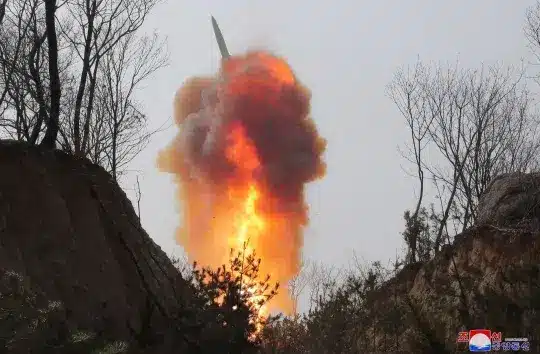
The North launched an intercontinental ballistic missile into the Sea of Japan on Thursday, and it was later revealed that the missile was a Hwasong-17.
Known as the country’s ‘monster missile’, it is the world’s largest road-mobile, liquid-fuelled ICBM.
It was tested just hours before the South Korean president Yook Suk-yeol was due to fly to Tokyo for discussions with Fumio Kishida, the prime minister of Japan.
Both united at the summit partly aimed at rebuilding security ties between the US allies in the face of North Korean nuclear threats.
State media quoted leader Kim Jong Un as saying Thursday’s launch was meant to ‘strike fear into the enemies’.
Kim Jong Un (C) and his daughter (L) watched on as the warhead missile was set off.The lauch over the weekend simulated a nuclear attack against South Korea.North Korea confirmed the launch of their Hwasong-17 missile a few days after it was detected by South Korea and Japan.
The ramping-up of testing activities comes as the US and South Korea carry out the biggest military drills of their kind in years.
In response to the latest launch, the South said the drills would continue as it maintains a readiness to ‘overwhelmingly’ respond to any provocation by North Korea.
The Biden administration wants better South Korea-Japan ties, which declined over historical issues in recent years, as it pushes to strengthen its alliance network in Asia to counter the North Korean nuclear threat and China’s rising influence.
On Sunday, the US flew at least one long-range B-1B bomber for joint aerial training with warplanes from South Korea.
The latest launch comes as the US and South Korea press ahead with the biggest military drills for years.According to local news reports, the US and South Korea plan more training involving an American aircraft carrier later this month after their current exercises end.
The use of the aircraft, which is capable of carrying a huge conventional weapons payload, has previously also been met with responsive missile test-launches from the North.
Toshiro Ino, the Japanese deputy defence minister, said there was no reports of damage from Sunday’s test launch as it landed outside the country’s exclusive economic zone.
However, he said the activity represented a ‘threat’ to the security of Japan, the region, and the international community and it ‘absolutely cannot be tolerated’.
The missile likely showed an irregular trajectory, he said, which could be a reference to North Korea’s highly manoeuvrable, nuclear-capable KN-23 missile.
The US Indo-Pacific Command said the launch does not pose an immediate threat to American territory or its allies, but highlighted ‘the destabilising impact of [North Korea’s] unlawful’ weapons programmes.
Pyongyang has threatened an “unprecedentedly strong” response to the upcoming joint military exercises between theUS and South Korea. The allied efforts to more effectively combat North Korea’s threats include the exercises scheduled for next week.
As South Korea and the US get ready for their annual joint military exercises, North Korea on Friday threatened a “unprecedentedly persistent, strong” response.
Shortly after South Korea announced joint tabletop exercises for the following week, a statement was made.
“In case the US and South Korea carry into practice their already announced plan for military drills that [North Korea], with just apprehension and reason, regards as preparations for an aggression war, they will face unprecedentedly persistent and strong counteractions,” the North Korean Foreign Ministry said in a statement carried by state media.
Pyongyang called South Korea and the US “the arch-criminals deliberately disrupting” regional peace and stability.
“This predicts that the situation in the Korean Peninsula and the region will be again plunged into the grave vortex of escalating tension,” the statement said.
Planned simulated drill on North Korea’s use of nukes
The South Korea-US joint drills, called the Deterrence Strategy Committee Tabletop Exercise, are set to begin on February 22 at the Pentagon in Washington.
The drills are part of efforts to thwart North Korea’s increasing nuclear and missile threats.
The exercises would involve defense policymakers from both sides, Seoul’s Defense Ministry said.
Military drills with the United States had been scaled back during the coronavirus pandemic. But they are now being bolstered under South Korean President Yoon Suk Yeol, as he looks to reassure an increasingly nervous South Korean public of Washington’s commitment to deter Pyongyang.
North Korea condemns UN Security Council
North Korea’s Foreign Ministry also cautioned that if theUnited Nations Security Council (UNSC) continues to be “inveigled” by Washington, it will reconsider additional actions beyond normal military activities, without elaborating further.
The ministry has accused the US of fueling tensions and using UNSC as “a tool for illegal hostile policy” to pressure North Korea.
In 2022, North Korea conducted a record number of military tests, firing about 70 ballistic missiles.
The tests included nuclear-capable weapons with the ability to strike targets in South Korea or reach the US mainland.
The alleged botched response to the Halloween crowd crush that left 159 people dead was blamed on Lee Sang-min by the parliament.
Due to his actions following a fatal Halloween crush in October, South Korean lawmakers have voted to impeach interior minister Lee Sang-min, paving the way for him to become the first cabinet member to be dismissed by the legislature.
The October 29 incident, when partygoers flocked to Itaewon’s popular nightlife district to celebrate the first Halloween festivities without a coronavirus mask in three years, resulted in as many as 159 fatalities and 196 injuries.
To be approved, the motion required the backing of at least 150 members.
The Democrats and other opposition parties had pushed for the expulsion of the interior minister urging him to take responsibility for botched responses to the crush.
“I will fully cooperate with the constitutional court’s impeachment trial so that the ministry of interior and safety can be normalised at an early date,” the minister said in a statement.
The impeachment suspends Lee from his duties and the country’s Constitutional Court has 180 days to rule on whether to unseat him for good or give him back the job, a process that could take up to six months.
Vice Minister Han Chang-seob will step in as acting minister until the Constitutional Court decides on Lee’s fate.
President slams ‘shameful’ parliamentary politics
President Yoon Suk-yeol, who counts Lee as a key ally, had rejected the opposition’s demand that he sack the interior minister, and his office and ruling party denounced the Democrats for abusing their majority power to press ahead with the impeachment.
“It is the renunciation of parliamentary democracy,” Yoon’s office said in a statement after the motion passed. “It will be recorded as a shameful history in parliamentary politics.”
Lee’s impeachment came weeks after police announced they are seeking criminal charges, including involuntary manslaughter and negligence, against 23 officials, about half of them law enforcement officers, for a lack of safety measures they said were responsible for the crowd crush in Itaewon, a major nightlife district in Seoul.
The case also highlights the growing impasse Yoon faces in a parliament controlled by his liberal opponents and could further intensify the country’s partisan political fighting that has fuelled a national divide.
A presidential official said there was no evidence that the minister had severely violated the constitution or any law
‘Man-made disaster’
Lee faced huge criticism shortly after the crowd crush after he insisted that having more police and emergency personnel on the ground still wouldn’t have prevented the tragedy in Itaewon, in what was seen as an attempt to sidestep questions about the lack of preventive measures.
Despite anticipating a crowd of more than 100,000, Seoul police had assigned 137 officers to Itaewon on the day of the crush. Those officers were focused on monitoring narcotics use and violent crimes, which experts say left few resources for pedestrian safety.
Some experts have called the crush in Itaewon a “man-made disaster” that could have been prevented with fairly simple steps, such as employing more police and public workers to monitor bottleneck points, enforcing one-way walk lanes and blocking narrow pathways or temporarily closing Itaewon’s subway station to prevent large numbers of people moving in the same direction.
Tension flared this week between theSeoul government and families of the crush victimsafter they set up an unauthorised memorial in front of city hall. On Tuesday, city officials said the memorial violated rules and ordered its removal in a week.
In 2017, President Park Geun-hye became South Korea’s first elected leader to be expelled from office when the Constitutional Court upheld her impeachment. The court dismissed an impeachment motion in 2004 for President Roh Moo-hyun.
The Korean Peninsula’s situation has reached an “extreme red line” as a result of South Korea and the United States’ joint military exercises, according to North Korea, which has denounced them and warned that they could turn the area into a “huge war arsenal and a more critical war zone.”
In addition to threatening the “toughest” response, North Korea said in a statement released on Thursday that it was not interested in dialogue as long as Washington continued its so-called “hostile” policies.
Days after US Defense Secretary Lloyd Austin visited Seoul and promised to increase Washington’s deployment of cutting-edge military assets, such as fighter jets, to the Korean Peninsula, Pyongyang issued the warning.
The North Korean statement, attributed to an unidentified spokesperson of its Foreign Ministry, said the expansion of the allies’ drills is threatening to turn the Korean Peninsula into a “huge war arsenal and a more critical war zone”. The statement said Pyongyang is prepared to counter any short-term or long-term military challenge by the allies with the “most overwhelming nuclear force”.
“The military and political situation on the Korean Peninsula and in the region has reached an extreme red line due to the reckless military confrontational manoeuvres and hostile acts of the US and its vassal forces,” the spokesperson said.
The “DPRK will take the toughest reaction to any military attempt of the US on the principle of ‘nuke for nuke and an all-out confrontation for an all-out confrontation!’” the spokesperson said, referring to the country by its formal name, the Democratic People’s Republic of Korea.
“If the US continues to introduce strategic assets into the Korean Peninsula and its surrounding area, the DPRK will make clearer its deterring activities without fail according to their nature,” the spokesperson added.
North Korea for decades has described the US’s combined military exercises with South Korea as rehearsals for a potential invasion, although the allies have described those drills as defensive. North Korea last year ramped up its own weapons demonstrations as the allies resumed their large-scale training that had been downsized for years.
North Korea’s actions included a slew of missile and artillery launches that it described as simulated nuclear attacks on South Korean and US targets.
Jeon Ha Gyu, a spokesperson for South Korea’s defence ministry, said the ministry had no immediate comment in response to the North Korean statement.
He said the allies’ latest aerial drills – which took place on Wednesday and involved the US’s B-1B bombers and F-22 and F-35 fighter jets – were aimed at demonstrating the credibility of the US “extended deterrence”, referring to a commitment to use the full range of its military capabilities, including nuclear ones, to defend South Korea.
South Korea in recent months has sought stronger assurances that the US will swiftly and decisively use its nuclear capabilities to protect its ally in the face of a North Korean nuclear attack. More than 28,500 US troops are based in South Korea as a legacy of the 1950-1953 Korean War, which ended in an armistice rather than a peace treaty.
During a political conference in December, North Korean leader Kim Jong Un called for an “exponential increase” in nuclear warheads, mass production of battlefield tactical nuclear weapons targeting South Korea, and the development of more powerful long-range missiles designed to reach the US mainland.
Experts say Kim’s nuclear push is aimed at forcing the US to accept the idea of North Korea as a nuclear power and then negotiating badly needed economic concessions from a position of strength.
Nuclear negotiations between North Korea and the US have been derailed since 2019 because of disagreements over a relaxation of Washington-led economic sanctions against North Korea in exchange for steps by Pyongyang to wind down its nuclear weapons and missile programmes.
The North Korean spokesperson said Pyongyang was not interested in any contact or dialogue with the US as long as it maintains its “hostile policy and confrontational line”, accusing Washington of maintaining sanctions and military pressure to force North Korea to “disarm itself unilaterally”.
Tehran is upset that South Korean President Yoon Suk-yeol referred to Iran as an “enemy” of the United Arab Emirates.
As a result of South Korean President Yoon Suk-yeol comparing Tehran to the threat posed by North Korea and the “enemy” of the United Arab Emirates, Tehran and Seoul have summoned their respective embassies.
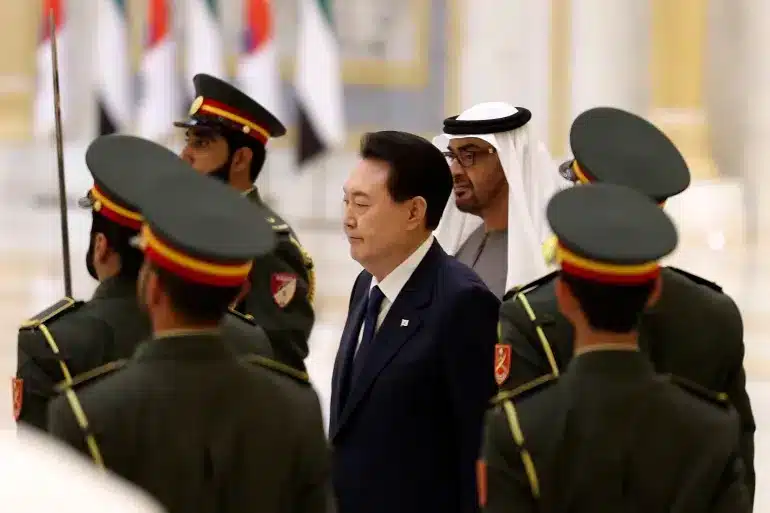
Yoon referred to the UAE as a “brother nation” of South Korea, citing the two countries’ expanding economic and military cooperation, while touring South Korean special forces stationed in Abu Dhabi on Monday.
The threat that Iran is allegedly posing to the UAE was then contrasted by Yoon with the danger that North Korea’s nuclear weapons pose to South Korea.
“The enemy of the UAE, its most-threatening nation, is Iran, and our enemy is North Korea,” Yoon said.
Yoon’s remarks triggered a stiff response from Iran’s foreign ministry, which said it was investigating Yoon’s “interfering statements”.
Iran’s deputy foreign minister on legal affairs, Reza Najafi, summoned the South Korean ambassador on Wednesday to protest against Yoon’s remarks, Iran’s official IRNA news agency said.
Najafi also accused Seoul of pursuing an “unfriendly approach” towards Iran, and noted the issue of Iranian funds frozen in South Korean banks. Iran has repeatedly demanded that Seoul release some $7bn of its funds frozen under US sanctions
On Thursday, South Korea’s First Vice Foreign Minister Cho Hyun-dong called in Iranian ambassador Saeed Badamchi Shabestari to explain Seoul’s stance “once again”, ministry spokesperson Lim Soo-suk said in a briefing.
“As we explained several times, [Yoon’s] reported comments were meant to encourage our troops serving their duties in the UAE, and had nothing to do with Iran’s foreign relations, including South Korea-Iran relations,” Lim said.
“Our government’s will to develop relations with Iran remains unchanged,” he said.
Yoon then compared the threat UAE supposedly faces from Iran to the threat South Korea faces from nuclear-armed North Korea.
“The enemy of the UAE, its most-threatening nation, is Iran, and our enemy is North Korea,” Yoon said.
Yoon’s remarks triggered a stiff response from Iran’s foreign ministry, which said it was investigating Yoon’s “interfering statements”.
Iran’s deputy foreign minister on legal affairs, Reza Najafi, summoned the South Korean ambassador on Wednesday to protest against Yoon’s remarks, Iran’s official IRNA news agency said.
Najafi also accused Seoul of pursuing an “unfriendly approach” towards Iran, and noted the issue of Iranian funds frozen in South Korean banks. Iran has repeatedly demanded that Seoul release some $7bn of its funds frozen under US sanctions.
On Thursday, South Korea’s First Vice Foreign Minister Cho Hyun-dong called in Iranian ambassador Saeed Badamchi Shabestari to explain Seoul’s stance “once again”, ministry spokesperson Lim Soo-suk said in a briefing.
“As we explained several times, [Yoon’s] reported comments were meant to encourage our troops serving their duties in the UAE, and had nothing to do with Iran’s foreign relations, including South Korea-Iran relations,” Lim said.
“Our government’s will to develop relations with Iran remains unchanged,” he said.
According to South Korea’s Yonhap News Agency, the foreign ministry in Seoul had stressed that Yoon’s comments were “irrelevant” to Seoul-Tehran relations, and also urged Iran against “unnecessary overinterpretation”.
Described by Yoon’s political opponents in South Korea as “diplomatically disastrous”, the spat comes as the UAE attempts to manage its relationship with Iran, which is an important business partner.
The UAE is also home to about 3,500 American soldiers and has spent billions of dollars buying South Korean surface-to-air missile systems as a means to protect itself against aerial attacks. Those threats include long-range drone attacks by Yemen’s Iran-backed Houthi rebels.
South Korea was once one of Iran’s biggest crude buyers in Asia and has now found itself squeezed by the tensions over Iran’s collapsed nuclear deal with world powers. Billions of dollars in Iranian funds remain frozen in South Korean banks after Washington reimposed sanctions on Tehran in 2018.
Iran held a South Korean oil tanker for months in 2021 amid the dispute. Both sides have been in talks over ways to unfreeze the funds and resume the oil trade.
According to South Korea’s Yonhap News Agency, the foreign ministry in Seoul had stressed that Yoon’s comments were “irrelevant” to Seoul-Tehran relations, and also urged Iran against “unnecessary overinterpretation”.
Described by Yoon’s political opponents inSouth Korea as “diplomatically disastrous”, the spat comes as the UAE attempts to manage its relationship with Iran, which is an important business partner.
The UAE is also home to about 3,500 American soldiers and has spent billions of dollars buying South Korean surface-to-air missile systems as a means to protect itself against aerial attacks. Those threats include long-range drone attacks by Yemen’s Iran-backed Houthi rebels.
South Korea was once one of Iran’s biggest crude buyers in Asia and has now found itself squeezed by the tensions over Iran’s collapsed nuclear deal with world powers. Billions of dollars in Iranian funds remain frozen in South Korean banks after Washington reimposed sanctions on Tehran in 2018.
Iran held a South Korean oil tanker for months in 2021 amid the dispute. Both sides have been in talks over ways to unfreeze the funds and resume the oil trade.
The main labour union in South Korea was raided by the country’s spy agency, which claimed the operation was part of a probe to see if any members had ties to North Korea.
The Korean Confederation of Trade Unions (KCTU) office in central Seoul was raided by the National Intelligence Service and the police on Wednesday.
According to the spy agency, some of its members may have had “ties with North Korea.” In the southwest of the city, the offices of the Korean Health and Medical Workers’ Union, which is affiliated with the KCTU, were also searched.
“We and the national police agency have been carrying out our own investigation into the suspects’ alleged ties with North Korea for several years,” an official from the spy agency told the Agence France-Presse news agency.
“Based on the evidence obtained in the process, we judged that a compulsory investigation was necessary, and we went ahead with the raid after the court issued a search and seizure warrant,” the source said.
South Korea remains officially at war with North Korea, and under a controversial and archaic National Security Act, possession of publications or other materials produced in the North can be a criminal offence. Local media reported that the raids were prompted by alleged violations of the security act.
The KCTU called the raid “barbaric”, accusing Seoul’s conservative government of “conniving” to target the labour organisation.
As one of South Korea’s largest union umbrella groups, the KCTU was linked to a recent strike by truck drivers whose union falls under the KCTU.
President Yoon Suk-yeol last month ordered striking drivers in the fuel and steel sectors back to work, threatening jail time or fines if they did not comply.
South Korea’s Yonhap News Agency reported that union officials had physically prevented the authorities from entering the KCTU head office, demanding that the raid and any seizure of property be conducted in the presence of a lawyer. A scuffle reportedly broke out between the police and union officials during the confrontation, Yonhap report.
The National Security Act, which dates back to 1948, prohibits citizens from accessing most North Korean-produced content, including its official Rodong Sinmun newspaper. The law has been widely criticised, including by the United Nations, which says it is a “seriously problematic” challenge to freedom of expression in South Korea.
Thousands of people, including union activists, were imprisoned under the law by the military governments that ruled South Korea for decades until the early 1990s. The act was often used to accuse people of engaging in pro-Pyongyang activities or spying for the North.
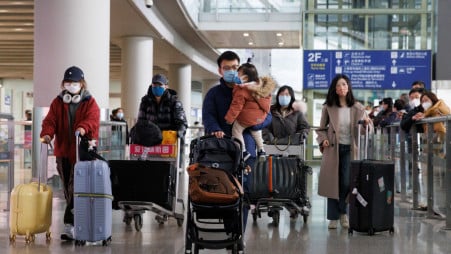
Beijing halts the issuance of visas to citizens ofSouth Korea and Japan in what appears to be retaliation for the COVID-19 restrictions placed on Chinese travelers.
China has reportedly stopped issuing short-term visas to citizens of South Korea and Japan, according to its embassies in Seoul and Tokyo, in what appears to be retaliation for COVID-19 travel restrictions put in place for Chinese citizens following a rise in coronavirus cases in the nation.
After Beijing changed its strict “Zero COVID” policy last month in response to widespread protests, Seoul and Tokyo joined more than a dozen other nations in imposing new travel restrictions on travellers arriving from China due to worries about rising infection rates.
Beijing claims that the limitations imposed on its citizens are unjust and not supported by science.
“Chinese embassies and consulates in Korea will suspend the issuance of short-term visas for Korean citizens,” Beijing’s embassy in Seoul said, adding that the measures would be “adjusted again in line with South Korea’s removal of the discriminatory entry restrictions on China”.
Beijing’s embassy in Tokyo announced in a brief statement late on Tuesday that the issuing of visas for Japanese citizens would also be halted, giving no specific reason or indication of how long the measure would last.
The move came soon after Japan toughened COVID-19 rules for travellers coming directly from China, requiring a negative result for a PCR test taken less than 72 hours before departure, as well as a negative test on arrival in Japan.
Seoul introduced a host of measures for visitors from China last month, including visa restrictions and testing requirements.
Hospitals in China have been overwhelmed by cases since Beijing began opening up after nationwide protests fuelled by growing frustration at three years of harsh controls that failed to eliminate the virus.
But the virus is spreading among its 1.4 billion people, and worries over the scale and impact of its outbreak have prompted Japan, South Korea, France, the United States and other countries to require negative COVID-19 tests from travellers from China.
“China seems to be using South Korea and Japan to send a message to other countries, which have imposed restrictions on Chinese travellers in hopes that they will roll [them] back and it also wants these nations that are considering restrictions to think twice about it,” said Al Jazeera’s Katrina Yu, reporting from Beijing.
China currently issues no tourist visas and requires a negative COVID-19 test for all arrivals.
South Korea is also capping flights from China, and travellers from the mainland, Hong Kong and Macau have to test negative before departure – measures Seoul’s foreign minister has defended as being “in accordance with scientific evidence”.
Mainland visitors are also being tested on arrival and are required to quarantine for a week if they test positive, authorities have said.
China has stopped publishing daily infection tallies despite the facing worst outbreak in three years. It has been reporting five or fewer deaths a day since the policy U-turn, figures that have been disputed by the World Health Organization and are inconsistent with funeral providers reporting surging demand.
The WHO has called the precautionary measures “understandable” in light of the lack of information and urged Beijing to share more data on genetic sequencing, as well as figures on hospitalisations, deaths and vaccinations.
Some governments have raised concerns about Beijing’s data transparency as international experts predict at least one million deaths in China this year. Washington has also raised concerns about future potential mutations of the virus.
China dismisses criticism over its data as politically-motivated attempts to smear its “success” in handling the pandemic and said any future mutations are likely to be more infectious but less harmful.
“Since the outbreak, China has had an open and transparent attitude,” said Foreign Ministry Spokesperson Wang Wenbin.
But as infections surge across China’s vast rural hinterland, many, including elderly victims, are not getting tested.
Al Jazeera’s Yu said the move is going to impact all parties involved, given that China is South Korea and Japan’s biggest trading partner.
“There are plenty of Japanese and South Korean businesses with operations here and they will no longer be able to send their business people here to tend to those in person,” she said. “This will also impact China’s foreign economic bottom line. But Beijing says it has the right to impose countermeasures on these countries.”
Japan and South Korea no longer receive short-term visas from China in response for Covid travel restrictions on Chinese citizens.
Visas for South Koreans entering China as tourists have been suspended, Beijing’s embassy in Seoul said.
Japanese media reported China was imposing similar measures there.
It’s a tit-for-tat move which Beijing says will remain in place until “discriminatory” entry restrictions against China are lifted.
Last week, South Korea stopped issuing tourist visas for those coming from China, which the Chinese foreign ministry called “unacceptable” and “unscientific”.
Reacting to China’s latest move, South Korea’s foreign ministry told the BBC that its policy towards arrivals from China was “in accordance with scientific and objective evidence”.
Japan meanwhile is currently allowing Chinese visitors into the country, provided they test negative for Covid.
According to South Korea’s Disease Control and Prevention Agency, around a third of all arrivals from China tested positive for Covid prior to the visa restrictions being put in place.
The curbs are supposed to last at least until the end of the month, which would give scientists time to analyse for any potential new variants coming from China.
“There’s no transparency at the moment in China about any monitoring for new variants. If a new variant comes from China, it would be a very difficult situation for the whole world,” Professor Kim Woo Joo, an infectious diseases expert at Korea University and a government adviser, told the BBC.
“It would also be a disaster for the Korean healthcare system. We currently have a lot of hospitalisations and deaths already and our elderly people are also under-vaccinated. This is what we are worried about.”
At the moment, only a small number of business or diplomatic travellers from China are being allowed into South Korea. They must test negative before departure and also on arrival.
One Chinese man who tested positive escaped from a bus taking him to a quarantine hotel near the airport. Two days later he was caught by police in a hotel in Seoul.
At Seoul’s Incheon International airport, the only South Korean airport still allowing flights from China, arrivals are met by military personnel in personal protective equipment.
The BBC managed to speak to some of them as they were escorted to the airport testing centre.
“Personally, I think it’s okay. I have been through much worse during this pandemic,” said William, a businessman from Shanghai. “As a traveller I just try to comply with the policies are much as possible.”
But another passenger disagreed.
“In my mind it’s not scientific at all,” says Emily, who arrived from Hong Kong. She, like those coming from mainland China, was required to test.
“I feel like it’s a little bit unfair on this side. They must feel really unsafe, I suppose.”
Many South Koreans support the idea of protecting their country from the China’s coronavirus surge, but not all are convinced that the decision to limit travel is a purely medical one.
“There is a political element to it and the relationship between the two countries isn’t a good one. A lot of Korean people hold a lot of animosity blaming China for the coronavirus,” said Jinsun, who was heading to Abu Dhabi.
Another woman going on her honeymoon to Paris said South Korea might not have implemented such rules if the country concerned wasn’t China.
“But then again, whatever we did, China would have a problem with it,” she said.
Tesla, an electric car manufacturer, claims it delivered a record 1.3 million vehicles in 2018, a 40% increase from 2021.
It follows the company’s more than 405,000 vehicle deliveries in the final three months of 2022.
That number, however, fell short of Wall Street predictions of 430,000 deliveries for the time period.
The demand for automobiles is anticipated to slow this year as potential customers fret over the recession and rising interest rates.
In a statement to investors, Tesla said it had to deal with “significant COVID and supply chain related challenges throughout the year”.
Meanwhile, on Tuesday, authorities in South Korea said they would fine Tesla $2.2 million (£1.8 million) for failing to tell its customers about the shorter driving range of its electric vehicles in low temperatures.
The Korea Fair Trade Commission said the company had exaggerated the “driving ranges of its cars on a single charge, their fuel cost-effectiveness compared to gasoline vehicles, as well as the performance of its superchargers.”
Tesla did not immediately respond to the BBC’s request for comment.
Highlighting the logistics issues faced by the world’s most valuable car maker, deliveries in the fourth quarter of the year were about 34,000 fewer than what Tesla produced.
The shortfall is unusual for Tesla, as it had previously managed to deliver about as many vehicles as it produced.
In October, Tesla chief executive Elon Musk said he was working to resolve the issue.
Like other car makers, Tesla faces the potential challenge of slowing demand for vehicles as customers deal with rising borrowing costs and concerns about an economic slowdown.
Tesla also faces competition from traditional motor manufacturing giants such as Ford and General Motors, as well as newer entrants to the market like Rivian and Lucid in the US and China’s BYD and Nio.
The company is scheduled to announce financial results for the fourth quarter of 2022 and the year as a whole on 25 January.
Tesla said in a separate statement that it plans to host its Investor Day on 1 March and livestream the event from its Gigafactory in Texas.
“Our investors will be able to see our most advanced production line as well as discuss long-term expansion plans, the Generation 3 platform, capital allocation, and other subjects with our leadership team,” the company said.
Tesla’s shares fell by 65% in 2022 – its worst year since going public in 2010 – as investors worried about disruptions to production, concerns over a slowdown in demand and Mr Musk’s focus on Twitter.
The multi-billionaire bought thesocial media platform at the end of October for $44 billion (£36.4 billion) and has spent much of his time since then trying to turn the business around.
When Yuna turned up for her first day at work, as a clerk at a major bank, she was not expecting the tasks she would be assigned. First was to make lunch for her team. Later, she was ordered to take the hand towels from the men’s toilet home and wash them. These jobs fell to her, she was told, as the newest female member of staff.
At first she politely refused. Could the men not take their own towels home to wash, she asked her boss, but he replied incredulously: “How can you expect men to wash towels?”
“He got very angry, and I realised that if I continued to fight this, the harassment would get worse, so I started washing the towels,” Yuna says. But because she had complained, she was marked.
As she wanders through the dark alleys of her local food market, dressed in a black baseball cap, oversized jeans, and a T-shirt, she tries to disguise herself as she recounts her experience. This is a small town, and she has done something she could have been fired for. She filmed everything and reported the bank to the government, to be investigated.
What tipped her over the edge was not just the abuse, which grew steadily worse, but the lack of support from her female colleagues – those in their 20s, like her.
“It’s like this everywhere, don’t make a fuss,” they had pleaded.
Yuna filmed herself making lunch for her colleagues and reported her workplace to the government
South Korea may have blossomed into a cultural and technological powerhouse, but in its rapid transformation into one of the richest countries in the world, women have been left trailing. They are paid on average a third less than men, giving South Korea the worst gender pay gap of any rich country in the world. Men dominate politics and boardrooms. Currently, women hold just 5.8% of the executive positions in South Korea’s publicly listed companies. They are still expected to take on most of the housework and childcare.
To this can be added a pervasive culture of sexual harassment. The booming tech industry has contributed to an explosion of digital sex crimes, where women are filmed by tiny hidden cameras as they use the toilet or undress in changing rooms.
But instead of promising to fix these problems, South Korea’s new President Yoon Suk-yeol has said structural sexism is “a thing of the past”. He was propelled to power by young men who claim that attempts to reduce inequality mean they have become victims of reverse discrimination.
Upon entering office, President Yoon scrapped government gender quotas, declaring people would be hired on merit, not sex. He appointed just three women to his 19-member cabinet. He is now trying to abolish the government’s Gender Equality Ministry, which supports women and victims of sexual assault, claiming it is obsolete. More than 800 organisations have come together to protest against the closure, arguing it could have a damaging impact on women’s lives.
Some young men in South Korea say they are victims of reverse discrimination
Hoping to fight this was 28-year-old Park Ji-hyun, a women’s rights campaigner, who, following the divisive election, was asked to lead the liberal opposition party. The party told her they needed her help to reform politics and represent young women. And so, despite having never been a politician, she agreed.
But just six months later, when we meet at a café on the outskirts of Seoul, she is no longer in post. She has had to leave her home because her address was leaked, and she was receiving so many death threats. The ones that stick with her, she says, are from the people who threaten to feed her acid or pour it in her face. It has been the hardest six months of her life, she admits, after experiencing first-hand the sexism and misogyny that pervades politics.
Park talks of her despair that she would be the only woman in meetings, and that when she spoke, nobody would respond. “They just ignored me, and I ended up shouting into a void,” she says. “When I wanted to discuss the economy or the environment, they would say: ‘You just focus on what you know – women’s issues and sex-crimes’. I realised I was a puppet in this position, being used to gather women’s votes.”
Park Ji-hyun says she experienced sexism when she was the co-chair of the liberal opposition party
Park made her name as a student journalist, when she uncovered an online sex ring, where young teenagers were being blackmailed into filming themselves performing sexual and degrading acts. The ringleaders were sent to prison as a result of her investigation.
Online sexual assault and harassment is increasingly widespread. Last year, 11,568 cases of digital sex crimes were reported, up 82% from the year before. Many involved the use of hidden spy-cameras. Women in South Korea speak of being too scared to go to the toilet, in case they are secretly filmed and then blackmailed – or worse, the footage is released, and their lives destroyed. One compared the fear to what women in other countries must feel when walking home late at night.
But when Park pushed to investigate allegations of sexual assault within her party, she was labelled a troublemaker, and after poor local election results she was pushed aside.
As we are talking, a waitress brings over a large plate of cakes, on the house. “Thank you for fighting for us,” she says. Embarrassed, Park laughs: “This has never happened before.” During her short time in politics, she became an icon for young women who felt they’d had no-one to represent them.
South Korea’s #MeToo movement sparked a new wave of anti-feminism
In 2018, South Korea spawned Asia’s first and most successful #MeToo movement. But in its wake, a wave of anti-feminism coursed through the country, fuelled by young men who were concerned that, in their hyper-competitive society, women were gaining the upper hand. They take issue with having to complete compulsory military service, which stops them from working for up to two years. They have succeeded in turning feminism into a dirty word, with some women now embarrassed, or even afraid, to use it. But more significantly they got the president to respond to their rallying cries.
“Women have been deprived of their rights in the past, but a lot has been resolved,” says 37-year-old Lee Jun-seok, whose idea it was to close the gender equality ministry. He led the winning party into the election, helping it attract young, male votes. “Gender equality has entered a new phase. We need a new system that looks beyond feminism and focuses on the rights of all minorities.”
The ministry currently accounts for just 0.2% of the government’s budget but women say it has made a concrete difference to their lives. Since it was established more than 20 years ago it has supported the victims of hidden spy-cams and women who have been fired after getting pregnant, and secured more generous child support payments for single mothers.
Ana hasn’t been able to sleep properly since she heard about the ministry’s abolition. She credits it with saving her life. From a safe house, she recounts – in a voice so quiet it is almost inaudible – how she was failed by everyone in her life she trusted to protect her. Six years ago, she was raped by her college professor. When she called her father to tell him, he hung up the phone. She had brought the family shame, he told her.
Only after the #MeToo movement did Ana find the strength to seek help. She went to a support centre for victims of crime, but they wanted evidence before agreeing to help her. She made her case to the doctor, who told her she was delusional and denied the support.
“It was heartbreaking. I couldn’t understand how a doctor running a support centre wouldn’t help me,” she says. “I felt like I was trapped in a dark room with no exit.” A few months later she tried to kill herself.
Ana was raped six years ago and says the gender equality ministry saved her life
Then the gender equality ministry stepped in. They found her a place in the safe house, provided counselling and helped Ana to pursue a successful prosecution. Her professor was sent to jail. This hasn’t stopped the flashbacks and nightmares, but – as she describes it – she has been resuscitated.
“I have received more help from this ministry than my own family, which shares my blood,” she says, holding out her hand to touch her counsellor Nam sitting beside her. “Closing it is a dangerous idea.”
The government says the ministry’s current services will continue, but be absorbed by other departments. In October the president said this would “protect women more”, though his reasoning is unclear. The plans could still be thwarted by the liberal opposition party, which holds a majority in parliament. It has voiced concern about the impact the closure will have on the progress yet to be made for women – in the workplace and at home.
South Korea’s society and job market are structured in a way that perpetuates its gender pay gap. Women struggle to re-enter the competitive workforce after leaving to have children. They often end up taking on unstable, poorly paid contract work, which can be juggled around childcare.
This was the case for 50-year-old Shin Hyung-jung, who used to work as an administrator at a school. The school expected her to work on Saturdays, but didn’t open their kindergarten then, meaning she had nowhere to leave her daughter. Her husband wouldn’t look after the baby, so she had to quit.
“He’s a typical patriarchal man, he does nothing to help,” she laughs. I ask why she is laughing. “Because it’s ridiculous, I’m dumbfounded.” For the past 20 years she has instead worked maintaining electrical items, such as water purifiers and clothes steamers, in people’s homes.
Since having her daughter, Shin Hyung-jung has taken contract work fixing electrical items in people’s homes
“It’s difficult lugging this around,” she says loading her equipment into a fancy elevator to service her third apartment of the morning. “I can be fired tomorrow morning and I’ll get nothing, and I have no pension. But at least I have been able to pick my daughter up from school.”
According to the latest government data, 46% of female workers are in non-permanent contract work, compared to just 30% of men. All but two of the employees on Shin’s team are women, who all started working for the company after having children. Two in their 30s joined this year, citing almost identical circumstances to the ones Shin experienced two decades ago.
Women who do not want to sacrifice their careers are now simply choosing not to have children. South Korea’s fertility rate (the average number of children a woman will have in her lifetime) has fallen to 0.81, the lowest in the world. Its population is predicted to halve by the end of the century, meaning it may not have enough people to sustain its economy and conscript into its army.
“Without solving its gender equality problem, South Korea cannot solve its birth-rate problem,” says Jeong Hyun-baek, the gender equality minister between 2017 and 2018. “The #MeToo movement did improve the culture of sexual harassment and discrimination in workplaces, but now we need structural reform to address the pay gap and the lack of opportunities for women.” She questions how the government can fix a problem it won’t acknowledge exists.
South Korea’s President Yoon Suk-yeol (centre) has abolished gender quotas in his cabinet and wants to close the gender equality ministry
For months I asked to interview the current Gender Equality Minister, Kim Hyun-suk, but the government declined. I later approached her at an event and asked whether she agreed with the president that structural sexism in Korea no longer existed. “There needs to be more women in politics, particularly in leadership and we must work to close the pay gap, particularly between fulltime and contract workers,” she replied, without directly answering the question.
There are some signs equality in South Korea is improving. Earlier this year, long-time contract worker Shin successfully negotiated a wage increase through her union, after a 10-year pay freeze. It was the first time a group of part-time contract workers in her industry had won such a battle.
“I do feel like society is slowly changing, and my daughter will have a better future,” she says. “I’ve given up on my husband, but I haven’t given up on my country.”
Then last month, Yuna, the bank clerk, got a call from the government. Their investigation concluded the bank had broken the law, by committing sexual harassment and discrimination. It has been ordered to pay a fine and she is being transferred to a different branch.
The thought of returning to work is making her ill, she said when we caught up over the phone, but she is happy she reported the bank. Since doing so, other female employees have reached out with similar stories.
“I do think over the past ten years equality has improved, but this is a small city, and things are not changing here, the president is not looking deep enough”, she said, worried the recent gains could be undone.
“If this ministry disappears, what we have built could collapse”.
The oldest member of the K-pop supergroup BTS, Jin, started his mandatory military service on Tuesday amidst high security at a South Korean army training facility.
After entering the Yeoncheon army base in northern Gyeonggi province, where security personnel and the media outnumbered the few hundred fans who had gathered to see the star – despite his earlier requests for them to stay away – Jin, 30, will spend 18 months in uniform.
Just before 2:00 p.m., six black vans entered the base in a motorcade that was thought to be carrying Jin and his security team.
Numerous banners along the roadway welcomed Jin and the other recruits to the base, which is less than 10 miles (16 kilometers) from the Demilitarized Zone that separates South Korea from North Korea.
Among the conscripts joining the 5th Infantry Division Tuesday was Kim Seok-jin, 20, from Daejon – who shares the same full name as the superstar recruit.
Waiting outside a restaurant across from the base with his parents, Kim showed off his new buzz haircut – the same style Jin had gotten a few days earlier – and said he was nervous as he waited to go inside.
“But I’m excited too to go in with Jin,” he said, adding that he hoped they might become friends.
Among the BTS fans outside the base Tuesday was Lee Hey-Kyoung, a 40-year-old from Seoul, who combined subway, bus and taxi rides to make the trip to the base Tuesday morning.
“It’s a very cold winter and I’m thinking of him going to suffer in the military. That’s why I came here,” Lee said.
“We wish him all the best and stay safe and healthy and we will wait him the 18 months,” she said.
Military service is compulsory in South Korea, where almost all able-bodied men are required to serve in the army for 18 months by the time they are 28 years old.
South Korea’s parliament passed a bill in 2020 allowing pop stars – namely those who “excel in popular culture and art” – to defer their service until the age of 30.
In October, BTS’ record label said that all seven members of the group were planning to undertake military service. BTS is expected to reconvene as a group around 2025, according to BIGHIT Music.
Jin’s service will begin with a five-week basic training course before being assigned to a unit, based on standard practice.
Kim Seok-jin, 20, from Daejon, the exact same name as the musical superstar, poses for pictures at Yeoncheon, South Korea, on December 13, 2022. Brad Lendon/CNN
Jin’s military routine
Park Si-woo, 23, who underwent training at the base in 2021, told CNN that Jin will likely find himself in barracks with about 40 other recruits sharing bunk beds.
Park said recruits will wake up around 6:30 a.m. to begin their daily routine, which involves physical workouts, plus combat and weapons training.
The recruits must give up their mobile phones, so Jin’s initial contact will be through letters that fans can submit online that will then be printed out and given to him. Military officials said Jin would get limited access to his cell phone at the weekend.
One thing Jin and the other recruits may appreciate is the food, Park said, adding: “We were given a lot of snacks during the training – beef jerky, butter waffle snacks, and drinks.”
Once integrated into South Korea’s forces, Jin will be one of about 560,000 army troops, according to the South Korean army website.
The military base in Yeoncheon, South Korea, on December 13, 2022. Brad Lendon/CNN
BTS have become worldwide superstars since debuting in 2013, earning No. 1 singles in more than 100 countries, more than 46 million followers on Twitter and awarded Time magazine’s Entertainer of the Year in 2020.
They have also become an important part of the South Koreaneconomy – a 2019 study showed BTS was responsible for 0.3% of the country’s gross domestic product with $4.9 billion in revenue.
Critics say BTS is a one-of-a-kind phenomenon.
“BTS’ place in the scene is unique,” said music critic Yoonha Kim. “I think no more needs to be said. In fact, not only in the K-pop scene but looking at the entire Korean music history, no such group existed and it will be difficult for another to emerge in the future.”
The current Korean agesystem in South Korea states that a person is one at birth and gains a year on January 1 of every year. Additionally, there is a different approach for determining conscription eligibility or the legal smoking and drinking age.
Many South Koreans will soon become a year or two younger as a result of laws that have been passed to replace the country’s outdated age-counting practises with the global norm.
The current Korean age system in South Korea states that a person is one at birth and gains a year on January 1 of every year. Therefore, a child born on December 31 would be considered two the following day.
A separate method also exists for conscription purposes or calculating the legal age to drink alcohol and smoke. Under this system, a person’s age is calculated from zero at birth and a year is added on 1 January.
However, South Korea also uses the international method of calculating age by starting at zero at birth and adding a year on every birthday.
To end any confusion, from 23 June, the country will officially adopt the international system – at least on official documents.
The move aims to standardise how age is calculated in the country.
Yoo Sang-bum, of the ruling People Power Party,told parliament: “The revision is aimed at reducing unnecessary socio-economic costs, because legal and social disputes as well as confusion persist due to the different ways of calculating age.”
“I remember foreigners looking at me with puzzlement because it took me so long to come back with an answer on how old I was.”
She added: “Who wouldn’t welcome getting a year or two younger?”
400
Every misfortune is a blessing in disguise is what social media users appear to trumpet Monday night as Brazil sent South Korea to the cleaners in their one-sixteenth game at the ongoing Qatar 2022 World Cup.
By half-time, Brazil had banged in four goals to nil, and on Twitter, fans appeared to say Ghana’s Black Stars, who would have been playing Brazil had the team made it out of the group stage, would have been at the receiving end. They were therefore grateful that the team was out of the tournament.
Why they thanked Dede Ayew
In Ghana’s final group game against Uruguay, the Black Stars needed a win to qualify to the one-sixteenth stage, and early on in the game, earned a penalty.
Captain, Dede Ayew elected to effect the spot kick. He missed the penalty, with Ghana going on to concede two goals later on. The game ended 2:0 in favour of Uruguay, who themselves failed to make it into the next round and ceded the spot to the South Koreans.
I think we have to say thank you to Dede Ayew cos Eii 😂😂
The North’s forces fired about 130 artillery rounds into a border area at the same time in what it called a “tit-for-tat” manoeuvre.
North Korea launched an artillery barrage into a maritime buffer zone, the latest in a series of provocative military moves that have enraged South Korea.
The South’s Joint Chiefs of Staff said in a statement on Monday that about 130 artillery rounds were fired simultaneously at 14:59pm (05:59 GMT) from two separate sites, one on North Korea’s east coast and one on the west coast.
The North Korean military said it was a warning against ongoing South Korean artillery exercises near the inland border town of Cheorwon, and blamed the South for the escalation of tensions.
Seoul’s military said the barrage was a “clear violation” of the 2018 agreement between the North and the South that established the buffer zone in a bid to reduce tensions.
It said none of the shells crossed the Northern Limit Line, the de facto maritime border between the two countries.
The military said it had issued “several warnings” over the barrage, without giving any further details.
“Our military is strengthening its readiness posture in preparation for emergencies while tracking and monitoring related developments under close cooperation between South Korea and the United States,” it added.
North Korea’s military said it fired artillery rounds as a “tit-for-tat” warning in response to South Korea firing dozens of projectiles earlier in the day, state-run KCNA news agency reported.
“We severely warn the enemy side to be prudent, not kindling the flame of escalation of tension unnecessary in the area around the front,” an unidentified spokesperson was quoted as saying.
Doubled down
At a summit in Pyongyang in 2018, former South Korean President Moon Jae-in and the North’s leader Kim Jong Un agreed to establish buffer zones along land and sea boundaries in a bid to reduce tensions.
But since talks collapsed in 2019, Kim has doubled down on his banned weapons programmes, and experts say he may now be testing South Korea by violating the buffer zone agreement.
Pyongyang has fired artillery into the buffer zone repeatedly in recent months.
It has also conducted a record-breaking blitz of missile launches in recent weeks, including its newest intercontinental ballistic missile (ICBM) last month, the most powerful such test by the nuclear armed country yet.
Pyongyang, which is banned from testing ballistic missiles by UN Security Councilresolutions, has repeatedly claimed its weapons tests are a legitimate response to Washington’s moves to boost the protection it offers to allies Seoul and Tokyo.
Officials and analysts in Seoul and Washington say the launches may build up to a seventh nuclear test.
North Korean state media said last week that leader Kim has called for a major political conference before the end of the year, at which he is expected to address increasingly tense relations with Washington and Seoul over the expansion of North Korea’s nuclear and missile programmes.
Four last-16 games remain, but Netherlands, Argentina, France, and England have already secured their places in the World Cup quarterfinals.
On Monday, Brazil will face South Korea and surprise package Japan will play Croatia.
The round concludes later that day when Cristiano Ronaldo will try to motivate Portugal to victory over Switzerland. On Tuesday, group G champions Morocco face off against Spain.
Qatar 2022 World Cup round of 16 fixtures
The elimination round began with Netherlands easily defeating the United States 3-1.
The South Americans defeated Australia 2-1 thanks to Lionel Messi, and Louis van Gaal’s team will now play them in the round of eight.
In addition to France’s victory over Poland and England’s 3-0 victory over Senegal, which came after some tense first-half moments, set up a matchup with Les Bleus. Olivier Groud became France’s all-time leading scorer.
Neymar has resumed training in preparation for Brazil’s World Cup match against South Korea, and if the team’s medical staff gives him the all-clear, he will play.
Since the Selecao’s 2-0 victory against Serbia in their opening Group G match, Brazil’s talisman has been absent from action in Qatar.
Neymar left that game early due to an ankle injury, making him unavailable for the remainder of the group stage.
The 30-year-old posted images from his return to training on social media on Saturday, along with the caption “I feel good, I knew that I would now”, and it was confirmed in Brazil’s pre-match press conference that Neymar will be available as long as he comes through a session unscathed on Sunday.
“Neymar’s going to practice today,” Brazil coach Tite said.
“If he practices okay then he will be playing. There’s a specific training today. He will practice and if everything is okay, he will play.”
Tite insisted, however, the final call will be with Brazil’s medical experts.
“We play a price to be the best, we want to be at our most competent but we never put health at risk,” Tite added when asked if Neymar would start if he came through the training session without any issues.
“Neymar being in the line-up depends on the medical department clearing it.
“I prefer to use my best from the start. Myself, as a head coach I have to take that responsibility, and that is my preference.”
Tite also confirmed Danilo is available for selection, though Alex Sandro is not. Gabriel Jesus and Alex Telles, meanwhile, have been ruled out of the remainder of the tournament.
While most Ghanaians were optimist that Ghanawould beat South Korea and qualify to the next stage, Tracey was playing the devil’s advocate. Apparently she had predicted a loss for Ghana ahead of the game; a prediction that failed abysmally.
Her husband who was making his way towards her seat in a plush living room, had already burst out laughing heartily – teasing her. He can be heard in the video calling out the name of the deceased pastor T.B Joshua.
Feigning anger, Tracey issued a stern but jovial caution to him not to come close. He found a seat in one of the chairs in the living room and continued with his hearty laughter.
Tracey then shouted “Ghana would go and meet Uruguay,” implying that Uruguay will beat Ghana.
Barefooted, wearing all white gear with a black belt. This is not quite how you expect to see a Foreign Minister dressed overseas.
But that was how Alfred Mutua, Kenya’s top diplomat was captured when he visited the Taekwondo Headquarters in South Korea.
Mutua was in Soeul together with President William Ruto, over the weekend, as the two nations aim at deepening diplomatic and cultural ties.
He posted a video in which the all-dressed up Taekwondo minister is seen fending off jabs and kicks from an opponent while he also attacks intermittently.
He captioned the video: “CULTURAL DIPLOMACY with a bit of TAE KWONDO. As part of our visit to Seoul Korea, my counterpart, Foreign Minister Dr. Park Jim, organized for me to visit the World Headquarters of Tae Kwondo (Kikkuwon) where Grandmaster Lee made me an honorary 6th Dan Black Belt.”
“In my late teens & early 20’s I practiced Tae Kwondo before picking up Temple Kungfu. I need to get back to the sport. I’m getting rusty.
“As they say, like father like son, I am proud of the fact that my 1st born son, 2 weeks ago, qualified as a black belt holder in Tae Kwondo,” Mutua wrote in a tweet accompanied by photos.
Bishop Daniel Obinim has made another epic appearance on social media, and this time around, it is to celebrate the Black Stars’ win against South Korea in the ongoing 2022 FIFA World Cup.
Social media has since been buzzing with intense excitement following the Black Stars’ 3:2 win against their South Korean counterparts.
Ghanaians have resorted to various means of jubilation, especially after a fierce battle with the Koreans.
However, the founder of International Godsway Chapel, who also joined in the celebration, has shared a video of himself captured in full glee.
Obinimwas heard saying in a viral video that appeared to be recorded immediately after the match,
“What a ball! What a ball! Ball ball ball! Heyy Ghana Black Stars! …Afa metrim” which translates to “It is driving me insane.”
His reaction has sparked all sorts of interesting and hilarious comments from individuals on social media.
However, it has been reported that Bishop Daniel Obinim has for some time now been inactive on social media after sacking all 72 of his pastors and asking them to go search for better jobs.
Members of the East Legon Executive Club weren’t left out of the jubilation ‘steeze’ after the Black Stars won their game against South Korea in the ongoing 2022 FIFA World Cup.
Touted as the crème de la crème of society, these affluent men were gathered at an unknown location where they watched the game live on a big screen.
Obviously proud and elated about the outcome of the match, they were seen chanting victory songs amidst loud cheers and applause.
Special Group of Companies CEO, Dr. Ernest Ofori Sarpong, and many other business moguls were captured in a viral video that showcased the jubilatory moments.
Dancehall musician Samini was also seen at the venue, ‘vibing’ with the wealthy businessmen.
Meanwhile, after a fierce battle with the South Koreans that led to a resounding victory for the Black Stars, Ghanaians are still basking in the celebration mood.
Barefooted, wearing all white gear with a black belt. This is not quite how you expect to see a Foreign Ministerdressed overseas.
But that was how Alfred Mutua, Kenya’s top diplomat was captured when he visited the Taekwondo Headquarters in South Korea.
Mutua was in Soeul together with President William Ruto, over the weekend, as the two nations aim at deepening diplomatic and cultural ties.
He posted a video in which the all-dressed up Taekwondo minister is seen fending off jabs and kicks from an opponent while he also attacks intermittently.
He captioned the video: “CULTURAL DIPLOMACY with a bit of TAE KWONDO. As part of our visit to Seoul Korea, my counterpart, Foreign Minister Dr. Park Jim, organized for me to visit the World Headquarters of Tae Kwondo (Kikkuwon) where Grandmaster Lee made me an honorary 6th Dan Black Belt.”
“In my late teens & early 20’s I practiced Tae Kwondo before picking up Temple Kungfu. I need to get back to the sport. I’m getting rusty.
“As they say, like father like son, I am proud of the fact that my 1st born son, 2 weeks ago, qualified as a black belt holder in Tae Kwondo,” Mutua wrote in a tweet accompanied by photos.
Ghana coach, Otto Addo has insisted that they will approach their final group game against Uruguay with a careful plan.
The Black Stars will face the two-time world champions at the Al Janoub Stadium with kick-off scheduled at 15:00GMT.
After securing an all-important win against South Korea in their second group game on Monday, Ghana will need to draw or win against the South American side to qualify for the next last 16.
Addo, after the win against Korea, shared that they will analyze the game to be able to map a strategy against Uruguay.
According to him, they approach the game with a careful plan.
“We will analyze the game against South Korea again before we think about Uruguay,” he said.
“We will approach the Uruguay game with a carefully worked strategy,” he added.
Meanwhile, Uruguay are with just a point after suffering a 2-0 defeat against Portugal in their second group game played on Monday.
Otto Addo was a happy man after Ghana achieved their first win at the in Qatar with a 3-2 victory over South Korea on Monday.
Black Stars took a 2-0 lead courtesy of goals from Mohammed Salisu and Kudus but two stunning headers in three minutes from Cho Gue-sung levelled the game after 61 minutes.
Kudus added a final twist when he thumped in a third for Ghana to break South Korea’s hearts.
“I had bad luck in the first match against Portugal, but today was good,” the 47-year-old said after the game.
“Korea pushed and tested us in the first 10 minutes, creating a lot of corners and chances. After that, we regained control and took the lead with a good free kick.”
“I couldn’t control Korea’s cross, so I tried to press it to stop it.”
On Mohammed Kudus performance against South Korea, he added, “He has a great personality and character, and he is well on his way to becoming a great player.”
Black Stars are currently second in Group H and will need a win or draw their final group game against Uruguay to process to the round of 16 stage.
Former Black Stars captain, Asamoah Gyan, is among the many Ghanaians who had a nerve-racking experience while watching Ghana play against South Korea today.
The Black Stars were in a comfortable lead in the first half of the game after they scored two goals. However, the smiles changed to worry as South Korea equalised within 10 minutes.
With team work, Ghana scored a third, but their victory was hanging by a thread as South Korea mounted more pressure as the end of the game drew near.
South Korea for 10 minutes, pounced on the defence of Ghana and this left Asamoah Gyan in discomfort. He paced around, hoping to hear the final whistle to signal Ghana’s victory.
Just as for many Ghanaians, this was one of the longest 10 minutes in Asamoah Gyan’s life.
He was impatient and continued shouting “Referee, it is time. This referee.”
A technical team member who is part of the Ghanaian team was seen trying to take a photo with South Korea’s star man Son Heung-min after their loss to Ghana.
Son was weeping uncontrollably at the moment but that did not stop the Ghanaian from wanting to catch a glimpse of the world renowned player.
The photo that was shared on the Twitter handle of ESPNFC had 18,000 reactions at the time of this publication, which comes less than one hour after the post was made on the bird app.
How Ghanaians are reacting to Son’s photo
Below were some of the captivating comments social media users piled up under the photo.
@honest_ghanaian, for instance, commented:
The way South Korea cross the ball should be written in the Guinness book of records!
@Alphacino30 indicated:
There is no shame in showing your admiration for a much more popular person. There are people Son will be craving to take pictures with aswell. This is not supposed to be a news but y’all just wanna nail the innocent man for a selfie. Jokers
@freco210 said:
Tbf though I don’t think that’s the right time to take a selfie with him.. Man’s obviously heartbroken right now
Immense joy after a victory today against South Korea today led Ghana fans to take up a role which the Japanese have happily assumed.
Supporters of the Black Stars to the surprise of many decided to clean up Education City Stadium in Qatar after the game, an action they failed to do when Ghana played Portugal.
Fans of Japansince the beginning of the tournament cleaned the stadium after every match they went to observe.
Ghana fans were cleaning up the stadium after their win against South Korea 🇬🇭❤️
Since the viral video, some Ghanaians on social media have expressed shock to the unanticipated act by their comrades in Qatar. Ghana beat South Korea by three goals. South Korea managed to score two goals.
President Akufo-Addo has praised the senior national team, Black Stars for their victory against South Korea today.
In front of a boisterous crowd at Education City Stadium, Ghana defeated South Korea in a thrilling game full of turns and turns.
Reacting to the news, President Akufo-Addo in a tweet said “Kudos to the Black Stars. Hard fought, but thoroughly well-deserved victory against South Korea. Proud of the entire team and the unalloyed support given to them by all Ghanaians.”
Ghana will on December 2 face Uruguay and the president wants the team to remain focus on qualifying to the next stage of the tournament.
“Now to the final group stage game against Uruguay,” President Akufo-Addo added.
Kudos to the Black Stars. Hard fought, but thoroughly well-deserved victory against South Korea. Proud of the entire team and the unalloyed support given to them by all Ghanaians. Now to the final group stage game against Uruguay. #WeCanDoIt#GoBlackStarsGopic.twitter.com/9ffkgil4pu
Ghana took a 2-0 lead after 10 minutes of play in the first half thanks to goals from Mohammed Kudus of Ajax and Southampton defender Mohammed Salisu.
However, South Korea’s comeback after the break subdued the boisterous celebrations of Ghana fans after halftime.
After 61 minutes, Cho Gue-sung, the top scorer in his domestic league, tied the score with two incredible headers in three minutes.
But the outstanding Kudus added a final twist when he hammered in a third goal for Ghana to break South Korea’s hearts. Kudus had skillfully headed in Jordan Ayew’s cross in the first half.
South Korea had more opportunities as they sought a second equalizer, but Ghana managed to hold on despite the addition of 10 minutes of extra time.
Korean actor Oh Yeong-su has been indicted on sexual misconduct charges, per Variety.
Best known for his Golden Globe-winning performance in the hit Netflix series Squid Game, the 78-year-old actor was charged by Suwon, South Korean prosecutors on Thursday. He has been accused of inappropriately touching a woman in 2017, which the alleged victim first told authorities about in December 2021. The case was closed in April 2022, but it was later reopened following a request from the victim. When questioned about the alleged incident, Oh denied the accusations.
“I just held her hand to guide the way around the lake,” said Oh in a statement provided to Korean broadcaster JTBC. “I apologized because [the person] said she wouldn’t make a fuss about it but it doesn’t mean that I admit the charges.”
A Suwon court official said “everything reported by local media is not factually correct.”
A TV commercial starring Oh from the Korean ministry of culture has been pulled after the news of the indictment was publicly released on Friday.
A Mohammed Kudusbrace helped Ghana beat South Korea 3-2 in a thrilling match to revive their hopes of reaching the last 16 of the 2022 World Cup at Doha’s Education City Stadium on Monday.
It was the first time in the history of the FIFA World Cup that a team like Ghana has been able to qualify for the knockout stages of the tournament,” the coach said. “The team has been able to get a good result in the last two years, but it’s not going to be easy. It’s a good thing we’re not going to be able to play in the World Cup,” he said. “We’re not going to be able to play in the World Cup,” he added.
It was the first time that the Black Stars had taken a 2-0 lead at the break, with Mohammed Salisu and Mohammed Kudus scoring the second. But Cho Gue-sung gave the South Koreans hope with a brace (58th, 61st), before Kudus followed suit to restore Ghana’s lead (68th).
The South Koreans were not to be denied, however, as Son Heung-min and his team-mates began to attack the goal in the opening minutes of the lively but fruitless match against Uruguay. But the six corners the South Koreans won in twenty minutes did not allow them to open the score against the Black Stars’ defence, which was not very reassuring.
It was the Ghanaians who finally took advantage of their second set-piece to open the scoring against the run of play.
Salisu took advantage of a free-kick from Jordan Ayew to give the Ghanaians the lead after a poor clearance by Napoli defender Kim Min-jae (24th). The goal was then ruled in as a result of a suspected handball by Andre Ayew, but the referee did not rule it out.
Ayew’s younger brother Jordan made full use of his coach’s confidence, setting up a second free-kick for the talented Ajax Amsterdam midfielder Kudus to head home (34′).
But the Taeguk Warriors showed great mental strength after the break. In the second half, the Taeguk Warriors showed great mental strength, with Cho of Jeonbuk Motors preferred to former Bordeaux man Hwang Ui-jo, who was ineffective against Uruguay (0-0), heading home a brace in the 58th and 61st minutes.
Kudus then put the South Koreans out of their misery with his second goal of the match, a left-footed strike (68th). He gave his team the right to dream of a place in the last 16.
It’s a great way to get back into the game,” he said, “but it’s not the only way to get back into the game.
Ghana is playing against South Korea and the tides are in favour of Otto Addo’s side.
The Black Stars are dominating the game. Two goals have been scored by Ghana before the end of the first half of the game.
At the 27th minute, Mohammed Salisu scored a goal. Mohammed Kudus, in less than 10 minutes added another for Ghana to lead with two goals.
The game is underway and social media users are singing the praise of Jordan Ayew, whom they say has been phenomenal.
As Ghana looks for a successful outcome, Jordan Ayew joins Andre Ayew and Inaki Williams in the front row.
Jordan Ayew is a good holder of the ball who links up play very well. He dribbles so well and knows how to draw fouls from his opponents. Drop the hate for the lad, he’s one of Ghana’s best playmakers.
Alidu Seidu, Daniel Amartey, Alexander Djiku, Mohammed Salisu, and Baba Rahman made up the back five. Tariq Lamptey and Gideon Mensah replace Seidu and Baba Rahman, and Djiku moves to the bench.
Otto Addo keeps the Abdul Salis Samed, Thomas Partey, and Mohammed Kudus trio in the center of the park.
Good afternoon and welcome to the live text coverage of the clash between South Korea and Ghana today in the 2022 FIFA World Cup;
All is set for the Group H contest between South Korea and Ghana to kick off at the Education City Stadium this afternoon.
Ghana after losing 3-2 to Portugal last Thursday must avoid a defeat today to stand any chance of advancing to the knockout stages of the 2022 FIFA World Cup.
Ahead of the game against South Korea, the national team of the West African country has targeted a win to have a good chance of progressing to the knockout stage of the tournament.
To this end, head coach Otto Addo has named a strong starting eleven team to do battle for the Black Stars.
Goalkeeper Lawrence Ati-Zigi keeps his place in the team from the first match and will be protected by a back four that includes Alexander Djiku and Mohammed Salisu.
Baba Rahman is dropped for Gideon Mensah while Jordan Ayew starts in attack with Inaki Williams and Mohammed Kudus.
Lawrence Ati-Zigi (GK)
Tariq Lamptey
Daniel Amartey
Mohammed Salisu
Gideon Mensah
Salis Abdul Samed
Thomas Partey
Mohammed Kudus
Andre Ayew (C)
Jordan Ayew
Inaki Williams
The two teams are out on the pitch for the warm-up ahead of kick-off. As usual, the Ghanaian fans are here in their numbers to support the Black Stars.
We are just 30 minutes away from kick off.
Ladies and gentlemen, kick-off is upon us. The two teams walk out onto the pitch amid cheers. We will now have the two national anthems of the countries.
First Half;
1′ We are off at the Education City Stadium as South Korea kicks us off.
In preparation for the match against South Korea, Ghana’s head coach, Otto Addo, has made three adjustments to the Black Stars squad that played Portugal in the team’s opening match.
Alidu Seidu, Daniel Amartey, Alexander Djiku, Mohammed Salisu, and Baba Rahman made up the back five for the match against South Korea. Addo has since switched to a four-back.
Tariq Lamptey and Gideon Mensah replace Seidu and Baba Rahman, and Djiku moves to the bench.
The gaffer keeps the Abdul Salis Samed, Thomas Partey, and Mohammed Kudus trio in the center of the park.
As Ghana looks for a successful outcome, Jordan Ayew joins Andre Ayew and Inaki Williams in the front row.
South Korea head coach Paulo Bento has set sights on beating Ghana in their second group game on Monday at the 2022 World Cup.
South Korea put on a spirited display in their opening match in Qatar, earning a hard-fought draw against Uruguay.
A win for South Korea will bolster their chances of a place in the Round of 16 for the first time since 2010 before going into their final group fixture against favourites Portugal.
“During the first game, we had a chance of at least ensuring a third-place finish. In the second game, we will keep this opportunity.”
“We will enter the field with a focus on a win,” said South Korea coach Paulo Bento.
“I don’t feel any pressure whatsoever. I would love the players to feel the way I do, but I know they come from a different culture. We will have a difficult game but we are able to do well.”
The match is scheduled for the Education City stadium on Monday, November 28, 2022 at (13:00 GMT).
Ghana need a win over South Korea on Monday to give themselves a chance of reaching the knockout stages of the World Cup in Qatar, while defeat would see them exit the tournament after only two matches.
Here are five things you need to know.
Promising signs
The Black Stars may have lost their opener to Portugal, but there were lots of promising signs in the game and it was, on paper at least, their hardest match in the pool. But they will have targeted the game against South Korea as a much win with a fixture against their nemesis Uruguay to come in their final fixture on Friday.
First time
This will be Ghana’s first meeting with an Asian nation at the World Cup finals. They played Australia in 2010 (and drew 1-1), but while the Socceroos play in the Asian confederation, the country itself is not part of that continent and the style of football is very different. They have, however, played South Korea seven times in the past, edging the head-to-head 4-3. They last played as a warm-up for the 2014 World Cup, where Ghana won 4-0 as Andre Ayew scored a hattrick.
Mixed record
South Korea have a mixed record against African teams at the World Cup having met opposition from the continent on three occasions – beating Togo in 2006, drawing with Nigeria in 2010 and losing to Algeria in 2014.
Knockout challenges
Ghana famously came within an Asamoah Gyan penalty of reaching the World Cup semifinals in 2010, but are one of three African nations to have made the quarterfinals along with Cameroon (2010) and Senegal (2002). South Korea are the only Asian country to have reached the semifinals, when they were co-hosts in 2002.
Winless in five
Ghana are winless in their last five World Cup games since they beat the USA in extra-time in the Last 16 in 2010. They have two draws with Uruguay (1-1) and Germany (2-2) since then, and losses to the USA (1-2) and Portugal twice (1-2 & 2-3). In all they have won four of their 13 World Cup games (D3 L6).
When Ghana travels to the Education City Stadium to play South Korea today, they risk being eliminated early from Group H of the 2022 World Cup.
On the first day, the Asian rivals impressively held Uruguay to a scoreless tie while the Black Stars suffered a heartbreaking 3-2 loss to Portugal.
On the opening day of the 2022 World Cup, there were a total of four 0-0 ties. South Korea put out a valiant effort in their 0-0 draw with Uruguay, however the woodwork did save them on a few occasions.
Paulo Bento’s team held on for a point against their South American opponents, displaying their defensive resiliency that was also present in their most recent games prior to Qatar. Federico Valverde and Diego Godin both saw shots crash off the goal frame.
The Tigers of Asiaenter their match against Ghana having only lost one of their previous 10 games across all competitions, and the Kim Min-jae-managed defense has kept three consecutive clean sheets during a four-game unbeaten run.
Despite their strength in the defensive third, South Korea failed to register a shot on goal during the Uruguay draw for the second time in four World Cup games, and Ghana undoubtedly had some experience holding teams at bay during the run-up to Qatar.
Another World Cup group game, another goal for Cristiano Ronaldo, but the five-time Ballon d’Or winner could only watch on from the bench in horror as A Selecao very nearly threw away a two-goal lead against Ghana on Thursday evening.
Following Ronaldo’s penalty, Joao Felix and Rafael Leao struck either side of Andre Ayew’s response before Osman Bukari reduced the deficit further, and the howler of the tournament award very nearly went to Portugal goalkeeper Diogo Costa, who rolled the ball out without knowing that Inaki Williams was behind him.
The Athletic Bilbao forward immediately tried to pounce on that gilt-edged chance right at the death, but he slipped at the vital moment as Ghana succumbed to a 3-2 loss, which leaves them bottom of the Group H standings and at real risk of an exit before the final matchday.
No matter what transpires in Uruguay’s showdown with Portugal, Ghana will be out if they suffer defeat to South Korea at the Education City Stadium, but a six-game scoring streak at the World Cup does stand the Black Stars in good stead.
Monday’s game will mark the 10th meeting between South Korea and Ghana in all competitions, with the last six yielding three wins apiece for both nations, but Ghana ran out convincing 4-0 winners during the most recent battle in a 2014 friendly.
South Korea fans rejoiced in the return to fitness of Son Heung-min, who donned a protective mask against Uruguay after his recent eye socket fracture and came through the game unscathed.
However, fellow Premier League attacker Hwang Hee-chan – who was an unused substitute on Thursday – is dealing with hamstring discomfort and will not be able to feature here.
Bento has also been handed a concern over key centre-back Kim Min-jae, who has been dealing with calf discomfort and is classed as a doubt for the contest.
As for Ghana, Otto Addo lined up in a defence-heavy formation for the showdown with Portugal, which very nearly paid dividends, but the need for victory could see the Black Stars shift to a four-man defence here.
Addo should be working with all 26 players for Monday’s meeting, where any change in system would likely put Mohammed Salisu’s place at risk as Bukari and Kamaldeen Sulemana push to return in a more attacking setup.
Andre Ayew won the battle of the brothers with Jordan Ayew to start in the loss to Portugal, and the Al-Sadd man’s goal last time out should be enough to see him retain his place alongside Williams.
Andre Ayew did train separately from the team alongside right-back Alidu Seidu on Friday, but there is nothing to suggest that the duo will not be ready for Monday.
South Korea possible starting lineup:
Seung-gyu; Moon-hwan, Min-jae, Young-gwon, Jin-su; Jung, In-beom; Na, Lee, Son; Ui-jo
Ghana possible starting lineup:
Ati Zigi; Lamptey, Amartey, Djiku, Baba; Partey, Abdul Samed; Sulemana, Kudus, A. Ayew; Williams
Ghana’s previous defensive resilience was broken with ease by Portugal, but they demonstrated plenty of attacking nous at the other end and should have no problem troubling this South Korea backline.
Bento’s side proved their worth against Uruguay, though, and we can only envisage a closely-fought battle ending with the spoils shared as the race for a top-two spot goes right down to the wire.