Tag: South Korea

  • Why South Korea just pardoned the Samsung ‘prince’ Lee Jae-yong

    Samsung heir Lee Jae-yong – convicted of bribery and embezzlement in 2017 – has been granted a special presidential pardon.

    One of South Korea’s most powerful white collar criminals, Lee was twice imprisoned for bribing a former president.

    South Korea’s government justified the move, saying the de-facto leader of the country’s biggest company was needed back at the helm to spearhead economic recovery post-pandemic.

    This marks another swing in a struggle over how the country is run that has raged since mass protests took over Seoul six years ago and ousted a president from office.

    Lee’s crimes were directly tied up in the corruption scandal that led to the imprisonment of former president Park Geun-Hye, in office from 2013-2017.

    The “Crown Prince of Samsung” – as he was dubbed by protesters – paid $8 million (£6.6m) in bribes to President Park and her associate to secure support for a merger opposed by shareholders that would shore up his control of his family’s empire.

    When it was revealed, millions of South Koreans turned out at candlelit protests every weekend in the 2016/2017 winter, demanding an end to Park’s government and the stitch-up between politics and business.
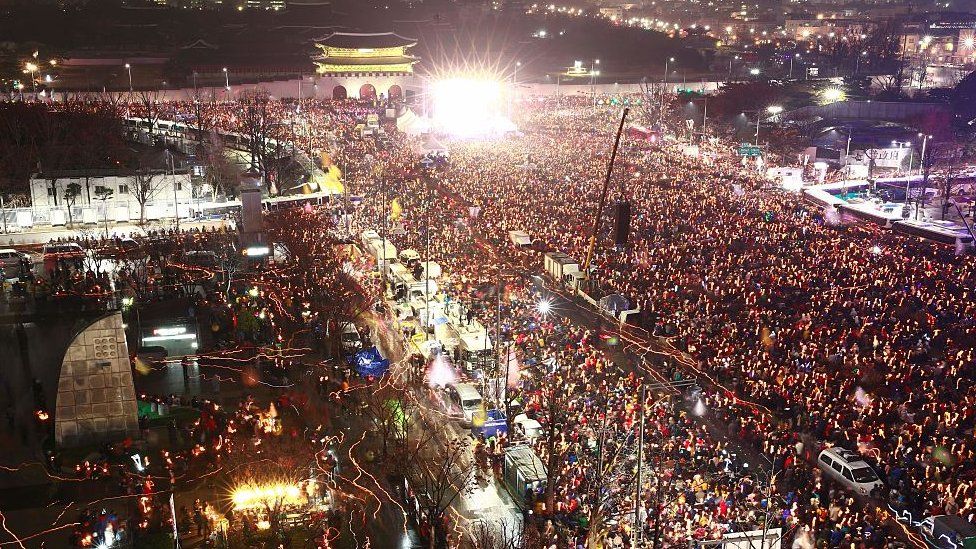
    Protesters pack the forecourt outside the Presidential Palace in Seoul during the 2016/2017 anti-corruption protests
    IMAGE SOURCE,GETTY IMAGES Image caption, Millions of people attended the protests against President Park and her corruption

    Korea’s parliament impeached Park and she was imprisoned in 2017 for 25 years.

    Lee, who is also known as Jay Y Lee in the West, was jailed a year later for offences including embezzling company funds to buy a $800,000 (£650,000) horse for the president’s friend’s daughter.

    A new president, Moon Jae-in swept into office with a mandate to clean up the mess. But he failed to make much headway. In his last days as president, he granted a pardon to his predecessor.

    Now eight months later, under another new president, Samsung’s chief has also received the same clemency.

    For those who have been fighting against corruption, it’s a dispiriting blow.

    “It is a setback. And it means Korea retreats to the time before the candlelit demonstrations,” said Sangin Park, an economics and industrial policy professor at Seoul National University.

    ‘Octopus’ influence

    Lee’s case reaffirms popular conception that business leaders are untouchable and above the law.

    In Korea, giant conglomerates dominate the economy, with the top 10 accounting for about 80% of GDP. Known as chaebols, they are family-controlled empires which provide a span of services. LG, Hyundai, Lotte, and SK are among them.

    But Samsung is the biggest and most powerful of them all.
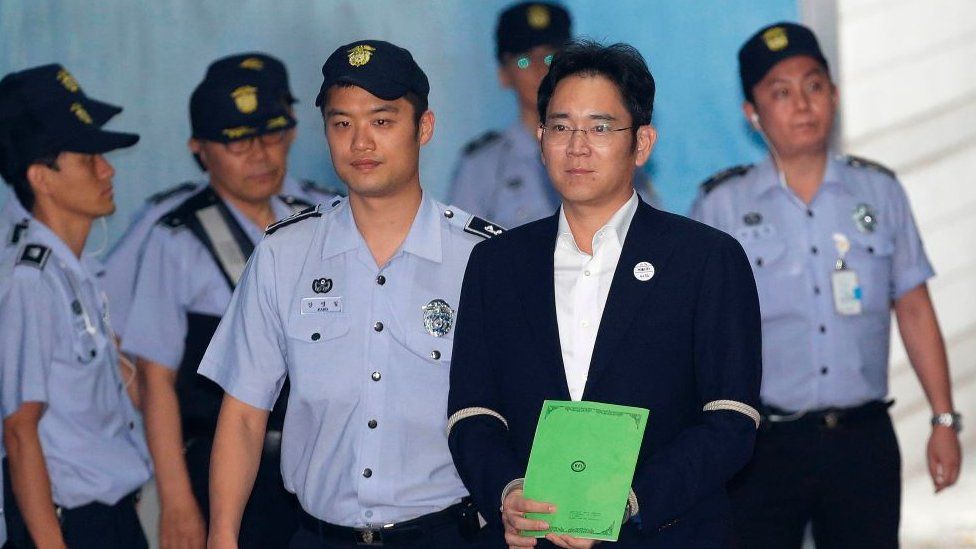
    Lee Jae-yong
    IMAGE SOURCE,GETTY IMAGES Image caption, Lee was first jailed for bribery and corruption in 2017 – but then was later released from jail twice.

    As the world’s largest smartphone maker, it’s a global electronics brand. But at home it does much more – hospitals, hotels, insurance plans, billboards, shipyards and even theme parks.

    Samsung and other chaebols are so omnipresent they’re known as “octopus” firms, says Prof YoonKyung Lee, a political sociologist at the University of Toronto.

    And those tentacles have long wormed their way into the highest levels of Korean politics. Prof Lee was at the 2016 protests and says most of the anger was directed at President Park’s personal actions. But she said labour activists and others strove to highlight the chaebols’ outsize influence on government.

    Chaebols were heavily supported by the government after the Korean War. They were given cheaper electricity and tax incentives, there was a “Buy-Korea” policy and even help in suppressing union movements.

    But the resulting monopolies also crushed competition, stifled labour movements and their practices spawned decades of bribery and corruption cases.

    In many cases, Prof Lee said, executives were given light or suspended sentences. In some cases judges said the economy might suffer if a chaebol leader was taken out of action.

    Mr Lee’s own father, Lee Kun-hee was convicted of bribery and fraud in the 1990s when he was Samsung chairman. But he didn’t serve a single day of jail time.

    So in 2017, when his son was hauled away to a cell on a five-year sentence, activists hoped the case would mark a turning point.

    In and out of jail

    Celebration however was short lived. Lee’s court battle dragged on for years with twists and turns worthy of the most dramatic Korean serials.

    An appeals court released him, a higher court then ordered a retrial at which he was again found guilty and jailed.

    But just a few months into his second jail term, the Moon government released him on parole, saying it was in the national interest.

    Since then, he has returned as the public face of Samsung – in May greeting US President Joe Biden on a trade visit to South Korea.
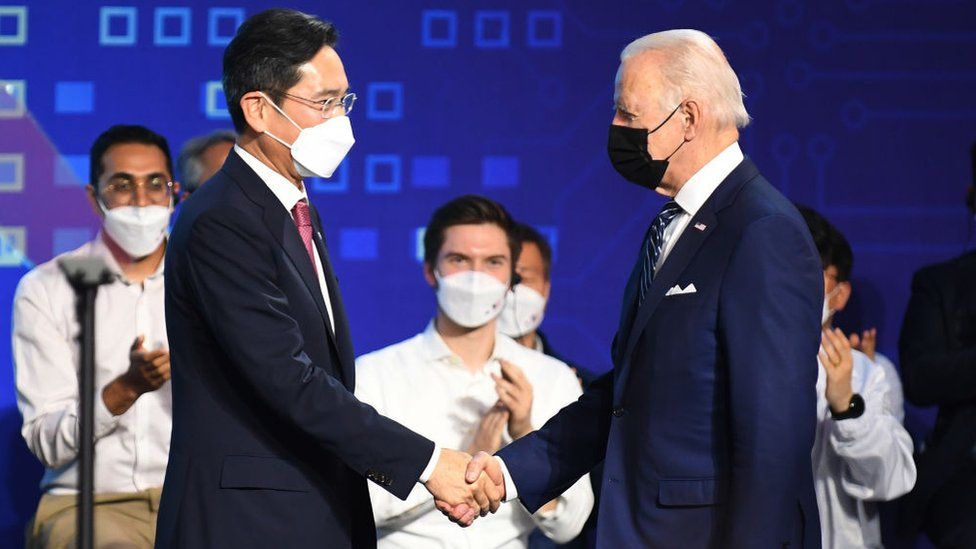
    Lee
    IMAGE SOURCE,GETTY IMAGES Image caption, Lee has largely resumed his public duties as a Samsung executive, meeting with the US leader in Seoul in May

    Lee still faces criminal allegations – of rigging company valuations, accounting fraud and making Samsung business decisions in breach of his sentence conditions. Clemency means he will be able to fully resume his executive responsibilities.

    It follows a pattern of convicted chaebol leaders having their slates wiped clean.

    “When it comes to formal power, there’s the president’s office and the National Assembly – they’re making the laws,” Prof Lee said.

    “But when it comes to political influence or cultural influence or even how people think about the importance of chaebol in Korean society, it’s really down to a coalition of conservative political and business elites who all have interests with each other.”

    Divided reaction

    The government’s pardon of Lee rests on the argument that chaebol leaders are needed for the economy. But numerous economists have pointed out this isn’t backed up by hard proof.

    “The pardoning of chaebol controllers has not contributed to economic growth or turnaround historically,” said Prof Park.

    Analysts say Samsung has fared perfectly well while Lee has been in and out of prison. Reform advocates say South Korea, where growth has been slowing for years, also needs to end its dependence on chaebols.

    “Several studies have shown that it’s getting harder to get the ‘trickle-down effect’ – it’s time to move away from the old notion that any illegal acts done by chaebols are ‘forgivable’ if they do their jobs,” says Roh Jong-Hwa, a lawyer from an advocacy group Solidarity for Economic Reform.

    Still the dismay among critics over Lee’s pardoning is not shared among the broader South Korean public. A recent public poll recorded 70% support for the pardon.

    How to explain that support?

    The desire to tackle corruption and chaebol influence remains, experts say. But it is mingled with fear and concerns over a looming recession – and residual pride over Samsung representing Korea on the world stage.

    “There’s a core belief that if Samsung does well, Korea does well. And Koreans have lived with this myth for so many decades, it’s really hard for ordinary citizens to break out of it,” says Prof Lee.

    “Right now, amid an economic downturn, people want to see some concrete sign that we are moving forward and Lee’s release is a sign of that.”

    Source: BBC
  • BTS could perform while doing military service

    Military service may not prevent BTS from performing, the South Korean defense minister has said.

    Normally, all men in the country must serve in the military between the ages of 18 and 28, for about 20 months.

    In 2020, exceptions were made for BTS members to delay their service until they were 30.

    With the oldest member of the K-pop band, J, turning 30 next year, the issue has come into focus in South Korea.

    There is a parliamentary debate in the country over shortening service to three weeks.

    And speaking about BTS, minister Lee Jong-sup said: “There would be a way to give them a chance to practice and perform together.”

    Military service is controversial in South Korea, as men must fulfill their duties as part of efforts to defend against nuclear-armed neighbor North Korea.

    Over the years, some men have won exemptions – either being allowed to put off service or do shorter service – including Olympics and Asian Games medal winners and classical musicians and dancers who win top prizes at certain competitions.

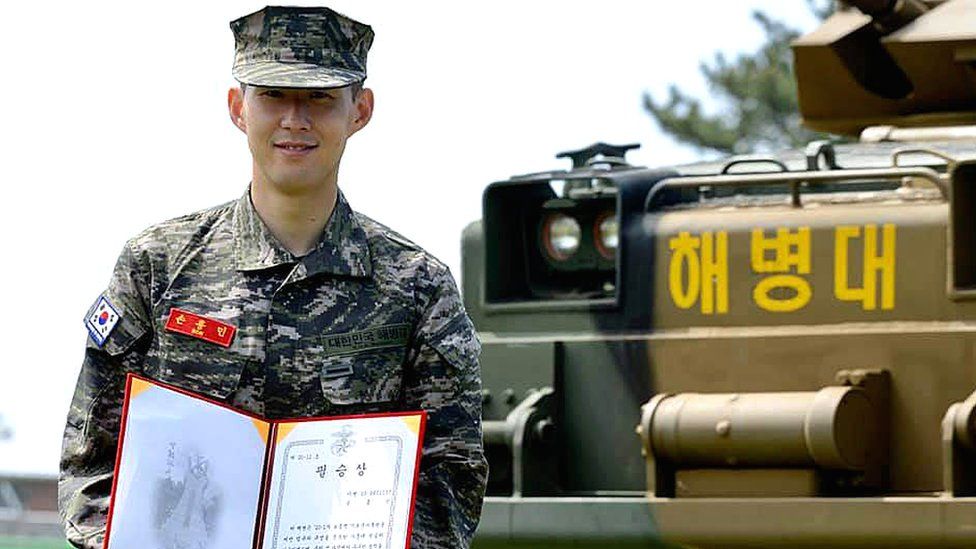
    Tottenham footballer Son Heung-min completed his three-week mandatory military service in 2020 - and won an award for the best performance.

    Son had earned an exemption from the mandatory 21-month military service after helping South Korea win the 2018 Asian Games.

    Son Heung-min winning a best performance prize among all traineesIMAGE SOURCE, GETTY IMAGES
    Image caption

    Son Heung-min won the best performance prize among all trainees

    BTS announced in June they were taking a break to grow and pursue solo projects for a while but said they were not splitting for good.

    At a parliamentary session, defense minister Lee Jong-sup said that by allowing BTS to continue performing, the military could serve national interests without affecting the shrinking pool of resources due to low birth rates.

    “As many people highly value [artists serving] in the military, that may help boost their popularity even more,” he said.

    BTS has been credited as being one of the big influences in spreading Korean culture across the world, with the Oxford dictionary announcing last year it was adding 26 Korean words to its edition.

    They were named as the world’s best-selling artists of 2021 in a chart recently compiled by the music industry body the IFPI.

    The band became the first Asian band to win artist of the year at the American Music Awards last year and met US President Joe Biden at the White House in May to discuss hate crimes targeting Asians.

    BTS’ representatives told Radio 1 Newsbeat they did not have a comment.

    Source: bbc.com


  • South Korea expands entry ban to Ghana, one other African country


    South Korea expanded its entry ban to two additional African countries on Wednesday amid growing concerns over the fast-spreading Omicron coronavirus variant.Source: Indian.com Source: Indian.com 

    From Friday to next Thursday, short-term foreign arrivals from Ghana and Zambia will be banned.

    South Korean nationals and long-term foreign arrivals from these countries will face a mandatory 10-day quarantine, regardless of their Covid-19 vaccination status, Yonhap news agency reported. 

    Effective November 28, South Korea had earlier banned foreign entries from South Africa, Botswana, Lesotho, Namibia, Mozambique, Malawi, Zimbabwe, Eswatini, and Nigeria. So far, South Korea has confirmed 38 Omicron cases. 

    Source: Indian.com

  • Coronavirus: South Korea confirms second wave of infections

    Health officials in South Korea believe the country is going through a second wave of coronavirus, despite recording relatively low numbers.

    The country had been a success story in dealing with Covid-19, but now expects the pandemic to continue for months.

    Head of the Korea Centers for Disease Control (KCDC), Jung Eun-kyeong, said the first wave lasted up until April.

    Yet since May, clusters of new cases have grown, including outbreaks at nightclubs in the capital, Seoul.

    Between those periods, daily confirmed cases had fallen from nearly a thousand to zero infections recorded for three days in a row.

    Officials on Monday said that over the last 24 hours, 17 new infections had been recorded, from different clusters in large offices and warehouses.

    Dr Jeong said the recent resurgence had led her to conclude that the country was in the grip of a second wave of the virus, and that she expected it to continue.

    Until now, the KCDC had said that South Korea’s first wave had never really ended.

    But Dr Jeong said it was now clear that a holiday weekend in early May marked the beginning of a new wave of infections focused in the greater Seoul area, which had previously seen only a few cases.

    Earlier on Monday, the city of Daejeon, south of the capital, announced it would ban gatherings in public spaces such as museums and libraries after a number of small virus clusters were discovered.

    The mayor of Seoul also warned that the capital may have to return to strict social distancing, should cases top 30 on average over the next three days and the bed occupancy rate of the city’s hospitals exceeds 70%.

    South Korea has managed to avoid locking down the country and has instead relied on voluntary social distancing measures alongside an aggressive track, trace and test strategy to combat the virus.

    A total of 280 people have died since the country reported its first case on 20 January. Overall, more than 12,000 infections have been recorded and it is thought that currently there remain 1,277 active cases in the country.

    Source: bbc.com

  • Coronavirus: South Korea closes schools again after biggest spike in weeks

    More than 200 schools in South Korea have been forced to close just days after they re-opened, due to a new spike in virus cases.

    Thousands of students had earlier on Wednesday returned to school as the country began easing virus restrictions.

    But just a day later, 79 new cases were recorded, the highest daily figure in two months.

    Most of these cases have been linked to a distribution centre outside Seoul.

    The warehouse, in the city of Bucheon, is run by the country’s biggest e-commerce firm Coupang, and officials have said the facility was not strictly complying with infection control measures. Health officials even discovered traces of Covid-19 on workers’ shoes and clothes.

    It’s possible that South Korea will continue to see a rise in cases as it continues to test thousands of employees from the centre.

    Some 58 new cases were recorded on Friday, bringing the total number of cases nationwide to 11,402.

    A ‘hotbed for the virus’

    A total of 251 schools in Bucheon have now been forced to close. A report by the Korea Times, quoting the Ministry of Education, says a further 117 schools in the capital Seoul have also postponed their re-opening.

    One student in Seoul, whose mother worked at the Coupang warehouse, had been found to have the virus.

    Public parks and museums across Seoul and its surrounding cities have now been closed, businesses are being urged to encourage more flexible working, and people are once again being asked to avoid mass gatherings.

    South Korea endured one of the worst outbreaks of the virus earlier this year, but had appeared to have brought it under control, thanks to an extensive “trace, test and treat” programme.

    Recent weeks, however, have seen new clusters emerge, including one linked to a man who visited five nightclubs and bars in Seoul’s nightlife district of Itaewon earlier this month.

    According to Yonhap News, some 266 cases have been traced to the Itaewon cluster.

  • Tottenham star Son completes mandatory military service in South Korea

    Tottenham star Son Heung-min has completed his mandatory three-week military service in South Korea, with the Spurs forward reportedly boasting the best performance of all the trainees who had been taking part.

    According to information published by the Korea Herald , the attacker finished as one of only five individuals to receive an award at the Marine Corps’ training camp graduation ceremony on the southern island of Jeju.

    While the exact scores of the trainees were not revealed, officials were quoted as saying that Son finished top out of a total of 157 people.

    The Premier League ace arrived at the camp on April 20 for a period of three weeks, with his military service having previously been delayed after the 27-year-old inspired his national team to a gold medal at the 2018 Asian Games.

    During his time back in his home nation, Son participated in a program that included shooting and bayonet skills, chemical, biological and radiological training, individual fighting skills and medical training. It is said that Son scored a perfect 10 out of 10 in the shooting discipline.

    Source: goal.com

  • Son Heung-min: Tottenham forward wins award as South Korea military service ends

    Tottenham Hotspur forward Son Heung-min has completed his three-week mandatory military service in South Korea – and won an award for the best performance.

    Officials said the 27-year-old excelled in shooting skills and was the top performer among 157 trainees.

    Son had returned to his homeland in March to continue his recovery from a fractured arm while the season is suspended because of coronavirus.

    All South Korean men must complete military service by the age of 28.

    Son had earned exemption from the mandatory 21-month military service after helping South Korea win the 2018 Asian Games.

    He graduated at a ceremony on Friday at a Marine Corps unit on the island of Jeju in the south of the country.

    His military service included shooting and bayonet skills, chemical, biological and radiological training, individual battle skills and first aid training.

    “He received the ‘Pilsung’ prize, which is one of five types of awards for best performers,” an officer said, as reported by Yonhap News Agency.

    “All the courses were judged in a fair and strict manner, and his military training officers have said he went through the training faithfully.”

    Spurs congratulated their player on social media and said he will return to London next week.

    Son had surgery in February after fracturing an arm during Tottenham’s 3-2 victory at Aston Villa.

    Spurs boss Jose Mourinho said he did not expect Son to play again this season, though that was before the Premier League’s shutdown.

    Although he has now finished his military training, Son will still have to complete 544 hours of community service over the next 34 months.

    Source: bbc.com

  • North and South Korea in gunfire exchange after Kim Jong-un reappears

    North and South Korea have exchanged gunfire in the Demilitarised Zone (DMZ) which divides the two countries.

    Seoul’s military said shots from the North hit a guard post in the central border town of Cheorwon. It said it returned fire and delivered a warning announcement.

    Such incidents across the world’s most heavily fortified border are rare.

    US Secretary of State Mike Pompeo told US media the shots from the North were believed to be “accidental”.

    Meanwhile South Korea’s Yonhap news agency quoted a government official as saying the shots were not likely to have been intentional.

    No injuries were reported in the incident. Military officials in the South say there was no sign of unusual troop movements.

    There’s a “low possibility” that the shots fired by North Korea were intentional, according to the South Korean military. But at this stage it is unclear how they’ve made that assessment.

    Even if it was an accident or a miscalculation, it shows just how important it is for troops to keep level heads in the heavily fortified DMZ to ensure the situation isn’t made much worse.

    If it was a more tactical decision by North Korea then that’s a very different matter.

    The timing is interesting. It’s just 24 hours since the North Korean leader Kim Jong-un re-appeared after a 21-day absence. There have also been a large number of military drills in the North in recent months to improve readiness to fight an “actual war”, according to state media.

    Pyongyang has sometimes used the tactic of escalate to de-escalate, using its military posturing as leverage in later negotiations.

    But any sign of direct fire will be a disappointment to many in South Korea. There has been a lot of work in the last two years to ease tensions between the two countries after President Moon Jae-in met Kim Jong-un. The two sides signed a military agreement – any deliberate shots fired would breach that pact.

    The last time the North opened fire on the South happened in 2017 when a North Korean soldier made a dash across the military demarcation line to defect.

    The demilitarised zone (DMZ) was set up after the Korean War in 1953 in order to create a buffer zone between the two countries.

    For the past two years, the government in Seoul has tried to turn the heavily fortified border into a peace zone.

    Easing military tensions at the border was one of the agreements reached between the leaders of the two countries at a summit in Pyongyang in September 2018.

    Kim Jong-un’s reappearance in public, reported by North Korean state media on Friday, followed an almost-three-week unexplained absence that sparked intense global speculation about his health.

    Source: bbc.com

  • North and South Korea exchange gunfire at border

    North and South Korea have exchanged gunfire in the Demilitarised Zone which divides the two countries.

    Gunshots fired by North Korea at 07:41 (23:41 BST) hit a South Korean guard post in the central border town of Cheorwon, Seoul’s military said.

    No casualties were reported on the South Korean side.

    In response, South Korea fired “two rounds of gunfire and a warning announcement according to our manual”, the military statement said.

    It added that officials were trying to contact North Korea.

    It is not clear what provoked the initial gunshots.

    This is the first time in five years that North Korean troops have directly fired on the South.

    The demilitarised zone (DMZ) was set up after the Korean War in 1953 in order to create a buffer zone between the two countries.

    For the past two years, the government in Seoul has tried to turn the heavily fortified border into a peace zone.

    This increase in tensions comes a day after North Korean leader Kim Jong-un appeared in public, following an almost-three-week unexplained absence that sparked intense global speculation about his health.

    Source: bbc.com

  • Coronavirus: South Korea holds elections in masks and clinics

    South Korea has been holding an election unlike any other.

    Voters wore masks and stood at least 1m apart. They had their temperature taken, disinfected their hands and wore plastic gloves.

    Only then were they given their voting slip and allowed to head into the booth to cast their ballot.

    These are just some of the measures taken to allow the scheduled National Assembly election to take place during the Covid-19 pandemic.

    Three hundred seats at the National Assembly are being contested. Thirty-five parties have registered candidates, but the race will be between the ruling Minjoo (Democratic) Party and the main opposition, the conservative United Future Party.

    The government’s handling of the coronavirus outbreak has dominated all discussions during this election. It has eclipsed fears of a struggling economy and a number of corruption scandals involving presidential aides.

    The National Assembly elections are seen as a bit of springboard to test candidates and party popularity ahead of the presidential elections in 2022.

    After voting closed on Wednesday, exit polls published by the three main broadcasters suggested President Moon Jae-in’s ruling Democratic party had won the majority of seats and increased its majority.

    The full results will take time to count, but polling also suggests that the North Korean defector and Pyongyang’s former deputy ambassador to the UK, Thae Yong-ho, could win a seat in Gangnam, the capitalist heart of Seoul. If confirmed, he will be the first defector from the North to win a seat in the South.

    ‘Our right to vote’

    Some critics feared the vote would be chaos. Instead, all I observed on the days of early voting was calm.

    People quietly stood in line at the designated mark, patiently waiting their turn.

    “I thought maybe the election should be postponed because people wouldn’t turn up,” one young female voter told us. “But now that I’m here and see so many others, I’m not worried.”

    The fear of infection didn’t keep people away. Overall the turnout was 66% – the highest in 16 years.

    More than 11 million people, about 26% of the population, cast their votes in advance. Some by post, but most travelled to early polling stations which were set up around the country on Friday and Saturday.

    It was also the first time that 18-year-olds were allowed to vote. We met a number of them at Seoul Station all excited to take part. The pandemic did not put them off.

    “This is about our right to vote,” said one waiting in a queue.

    “Voting is something we must do,” said another first-time voter. She admitted that the plastic gloves were a little bit “inconvenient” but they made her feel safe.

    Voting from quarantine in clinics

    South Korea has never postponed an election. Even during the Korean War in 1952, the presidential elections went ahead.

    The challenge for officials was how to avoid the risk of infection.

    They decided that if someone had a temperature above 37.5C, they would be taken to a separate voting area and kept separate from other people.

    Patients being treated for coronavirus were given the option of mailing their ballot.

    But polling booths were also set up outside residential centres, which care for hundreds of people with mild symptoms. We watched as one woman in a mask emerged from a facility in her hospital gown and was handed her ballot by staff in full protective clothing.

    The booth was outside to help prevent the spread of infection.

    “At first thought I couldn’t vote and I was disappointed,” she told the news agency Reuters. “But once I heard we would be able to vote as well I was thankful for this opportunity.”

    One of the biggest issues has been how to allow the 60,000 people in quarantine across the country to head to the polls.

    They have been under strict instructions to only vote at certain times and in designated polling stations. They could leave their homes from 17:20 until 19:00 on the day of polling, they couldn’t use public transport and could only walk or use their own car. They had to call health officials when they returned to their homes, otherwise, we were told, police officers would be despatched to find them.

    A number of people have already broken quarantine rules in South Korea in the last month, which is why the authorities are monitoring this so closely.

    Source: bbc.com

  • South Korea holds elections amid coronavirus outbreak

    South Korea held parliamentary elections on Wednesday amid the Coronavirus outbreak.

    According to Yonhap News Agency, polling for 300 seats of the country’s National Assembly started at 6 a.m local time [2100GMT] and will continue until 6 p.m. [0900GMT].

    Some 44 million people are expected to cast their votes wearing faces masks and gloves.

    They will also check their temperature and sanitize their hands before entering the polling station.

    More than 11 million people were allowed to cast their vote in advance to avoid crowds.

    The government has also decided to lift quarantine rules to allow around 50,000 self-isolators to cast their votes after the regular polling ends, the agency reported

    According to local media the ruling Democratic Party is expected to secure majority seats following recent response to the COVID-19 outbreak in the country.

    South Korea has so far confirmed 10,591 coronavirus cases with 225 fatalities, while 7,616 patients have successfully recovered.

    South Korea held parliamentary elections on Wednesday amid the Coronavirus outbreak.

    According to Yonhap News Agency, polling for 300 seats of the country’s National Assembly started at 6 a.m local time [2100GMT] and will continue until 6 p.m. [0900GMT].

    Some 44 million people are expected to cast their votes wearing faces masks and gloves.

    They will also check their temperature and sanitize their hands before entering the polling station.

    More than 11 million people were allowed to cast their vote in advance to avoid crowds.

    The government has also decided to lift quarantine rules to allow around 50,000 self-isolators to cast their votes after the regular polling ends, the agency reported

    According to local media the ruling Democratic Party is expected to secure majority seats following recent response to the COVID-19 outbreak in the country.

    South Korea has so far confirmed 10,591 coronavirus cases with 225 fatalities, while 7,616 patients have successfully recovered.

    Source: www.aa.com.tr

  • Customers desert South Korea’s animal cafes over virus fears

    A beige feline paces between two Gaudi-style columns at the empty 2 Cats cafe in Seoul, with upturned stools standing on the tables where humans sat to play with them in pre-virus days.

    Along with coffee, South Korea’s animal cafes offer the chance to cuddle companion creatures like dogs or cats for customers who cannot keep one themselves.

    Business has been devastated by the coronavirus outbreak, with South Koreans staying at home under social distancing guidelines, and tourism disappearing.

    But unlike other firms, these cafes cannot lay off staff as they have to look after the animals.

    Many also provide encounters with more exotic species. Meerkats and raccoons are particularly popular as both have behaviour patterns endearing to human eyes, although the trade in these creatures faces heavy opposition from animal rights groups.

    A family of wallabies; their names Alkong and Dalkong translate as “Lovey” and “Dovey” looked sheepish when caught stealing bananas at the Eden Meerkat Friends Cafe in the tourist district of Myeongdong.

    Staff member Kim Min-ji said customers were down to one or two a day.

    “Ninety percent of our customers had been foreigners, mostly Chinese, but they stopped coming since the coronavirus outbreak,” she said. “Korean customers also don’t come much.”

    And Ji Hyo-yeon, owner of the Raccoon Cafe Table A — which also stocks turtles and lizards as well as meerkats — said some people avoided his premises after hearing the virus was first contracted from a wild animal.

    South Korea was among the earliest countries to be hit outside China, where the coronavirus first emerged, and for a time had the world’s second-largest outbreak before it was largely brought under control through a widespread testing drive.

    Customers said the animals helped to put them at ease in the tense times of the pandemic.

    Hong Chan-wook and his girlfriend were the only visitors at the Eden Meerkat Friends Cafe on a weekday afternoon, and he told AFP: “After spending all my time at home and being bored, I feel healed by meeting these adorable new animals.”

    Source: France24

  • Coronavirus: South Korea reports lowest number of new cases in four weeks

    South Korea has reported the lowest number of new coronavirus cases since infection rates peaked four weeks ago, fuelling hope Asia’s worst outbreak outside China may be abating.

    The country recorded 64 new cases of Covid-19 in the last 24 hours, taking the total to 8,961 with 111 deaths.

    But health officials warn against complacency, saying the country still faces a long war against the infection.

    Europe is currently at the center of the pandemic.

    Italy reported 651 new deaths on Sunday, bringing the total there to 5,476, while Spain added another 462 deaths in the past 24 hours for a total of 2,182.

    In New York, the city mayor warned of a worsening outbreak, with damage accelerated by shortages of key medical supplies.

    And the expectation that the battle against the virus will be a long one was reinforced by news from Japan that its prime minister has admitted for the first time that the 2020 Tokyo Olympic Games could be postponed.

    How different is South Korea’s approach?

    Nearly 20,000 people are tested every day for coronavirus in South Korea, more people per capita than anywhere else in the world.

    The country has created a network of public and private laboratories and provides dozens of drive-through centers where people with symptoms can check their health status.

    South Korea developed its approach after an outbreak of Middle East Respiratory Syndrome (Mers) in 2015, when 36 people died in the country, which had the second-largest number of Mers cases after Saudi Arabia.

    Mers forced the country to reassess its approach to infectious diseases and its Centres for Disease Control set up a special department to prepare for the worst, a move which appears to have paid off.

    Laws on managing and publicly sharing information on patients with infectious diseases changed significantly after Mers and could be seen in action this year when the government used phone alerts to tell people if they were in the vicinity of a patient.

    This weekend, the government stepped up preventative action by sending out emergency alerts urging people to stay away from places which encourage mass gatherings such as churches, karaoke rooms, nightclubs and gyms.

    It also asked religious leaders to check the temperature of followers and keep them at least two metres apart during any services they deemed necessary.

    A number of churches are now facing legal action after violating the guidelines.

    Why is South Korea fearing a new wave?

    The country has seen two waves of infections, Yonhap news agency reports, the first beginning on 20 January with the first confirmed case, and the second with mass infections among a religious group.

    Now there are fears that imported cases could fuel the third wave.

    The government plans to install around 20 phone booth-style test facilities inside Incheon Airport to speed up the process of testing all arrivals from Europe.

    The new entry procedures started on Sunday. So far 152 people have arrived in the country showing symptoms of the virus and they are awaiting their test results.

    Source: bbc.com

  • Six killed as typhoon lashes South Korea

    At least six people were killed and several others missing after Typhoon Mitag lashed South Korea with heavy rain and strong winds, authorities said Thursday.

    The storm hit southern parts of the country on Wednesday night, prompting flood warnings and triggering landslides in affected areas.

    A woman in her 70s died after she was swept away by strong winds in the southeastern city of Pohang while another woman was killed after heavy rain caused her house to collapse as she slept, the Ministry of the Interior and Safety said.

    Read:South Korea confirms first swine fever outbreak

    A total of six people were killed across the country but the toll was expected to rise with several people missing.

    In the southern port city of Busan — one of the hardest hit areas — around 600 rescue workers were trying to locate four people believed to be trapped beneath a landslide.

    Read:South Korean doomsday cult leader jailed for six years

    “An enormous amount of sand and earth slid down several hundred metres and instantly buried a house and a restaurant,” said a witness quoted by Yonhap news agency.

    More than 100 homes were flooded and over 1,500 families evacuated their houses in advance, the ministry said.

    Mitag is the 18th typhoon this year and seventh to hit the Korean peninsula.

    Source: France24

  • Why are South Korean politicians shaving their heads?

    South Korea’s opposition leader has become the latest politician to publicly shave his head in a protest against the government.

    Hwang Kyo-ahn had his hair entirely shaved off in front of supporters and journalists outside the presidential palace on Monday evening.

    The protest is over a new justice minister, Cho Kuk, whose family is embroiled in corruption allegations.

    Last week, two female MPs shaved their heads over the same controversy.

    All three are from the conservative end of the political spectrum and oppose the current government under President Moon Jae-in.

    They want Mr Cho to resign or be sacked.

    Read:South Korea confirms first swine fever outbreak

    What are the protests about?

    Cho Kuk, a former law professor and aide to Mr Moon, took office last week as justice minister.

    But his critics are angry that he was nominated for the post by Mr Moon despite ongoing accusations of academic fraud and financial crimes against his family.

    His wife, also a professor, has been indicted for allegedly forging material which helped their daughter get into university and secure scholarships, something which has angered other university students.

    Prosecutors are also looking into investments into an allegedly dubious equity fund linked to another relative. In recent weeks, prosecutors carried out several raids linked to Ms Cho’s family.

    In his confirmation hearing last Friday, Mr Cho expressed his “deepest apologies to the younger generation” over the alleged perks his daughter received. But said he said he wanted to get on with reforms to the justice system.

    Mr Moon has stressed there has been no confirmation of illegal action and said it would be bad precedent not to appoint someone solely on the basis of allegations.

    But the case has caused a public debate about class privilege in South Korea, which has been rocked by corruption scandals over recent years.

    The previous government was toppled over corruption allegations and former President Park Geun-hye is currently serving prison time for bribery and abuse of power.

    Read:South Korean doomsday cult leader jailed for six years

    Mr Hwang served as prime minister under former President Pak – some observers have suggested his public stunt was in part motivated to undermine current President Moon Jae-in.

    Why shave the head?

    South Korea has a long tradition of hair shaving as a form of protest.

    The act is rooted in traditional Confucian teaching, and has historically been seen as a way of demonstrating commitment to a cause.

    During the 1960s and 70s, when South Korea was under military dictatorship, dissidents would often shave their heads as a sign of resistance.

    Over the past decades, activists and politicians have used it as way to protest.

    In 2018, women shaved their head at a march against the rise of spy cameras being placed in toilets and changing rooms to secretly film women.

    Two years before, more than 900 South Koreans shaved their heads in a show of protests at a US anti-missile system

    In 2007, hundreds of residents of Icheon City shaved their heads over a controversy where to build a new industrial plant.

    Mr Hwang’s public stand took place outside the presidential palace, the Blue House, on Monday evening.

    Referring to Mr Cho as “criminal” he urged him to stand down.

    He told the crowd watching: “I’m here to pledge my determination by shaving my head. I will not step back.”

    His protest drew wide attention on social media. He made it into the top 10 trending list on Naver, South Korea’s number one search engine.

    Many comments likened his looks to actor Gary Oldman – earning him the nickname Kimchi Oldman.

    Source: bbc.com