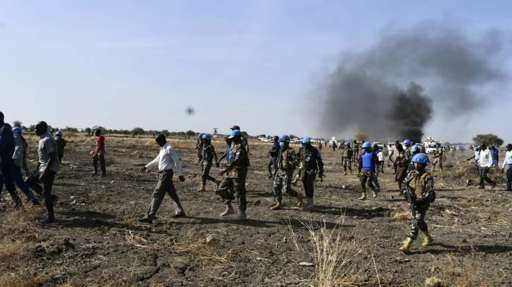
Local officials reported that a convoy was ambushed by the South Sudanese army, resulting in the deaths of at least three individuals and injuries to five others.
Nyinkwany Aguer Bol, the acting Minister of Information in the Abyei Special Administrative Area, characterized the attack, which occurred in Agok on Sunday, as an “attempted assassination” targeting key officials within the Abyei government.
Among those targeted were the Minister of Local Government and Law Enforcement Agencies, and the Commissioner of Rum-Amer County, who were part of the convoy.
The South Sudanese army did not respond to the BBC’s request for comment.
Mr. Aguer condemned the incident and highlighted the presence of South Sudanese soldiers in schools in Agok as well as Sunday’s attack as evidence of the South Sudan army’s efforts to undermine the Abyei Administration’s existence.
Abyei is jointly administered by South Sudan and Sudan, both of which claim ownership of the region, contributing to a long-standing dispute unresolved since South Sudan’s independence in 2011.
Mr. Aguer urged the South Sudan army leadership in the capital Juba to promptly relocate its troops stationed along the border of Abyei and Twic County of Warrap State.
In February, two armed youth groups from Warrap State in South Sudan launched a raid on Abyei, resulting in the deaths of at least 50 individuals, including two UN peacekeepers.
South Sudan is growing increasingly concerned about the potential impact of the ongoing conflict in neighboring Sudan on its oil transportation and revenue, which are vital for its economy.
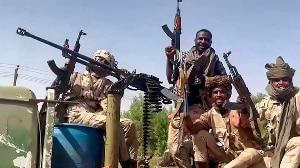
The conflict poses a significant security threat to the transportation of oil, and recently, the Rapid Support Forces (RSF) issued a threat to South Sudan. They warned that they would disrupt the transportation of oil passing through their controlled territories unless they receive a share of the rental and transit fees.
Furthermore, the RSF has also threatened to shut down the pipeline infrastructure unless South Sudan ceases its contributions to the military leadership led by Gen Abdel Fattah al-Burhan.
Ezekiel Lol Gatkuoth, a former Petroleum minister, acknowledged that it is unclear whether these threats are genuine or part of the wider propaganda of the war. However, he emphasized that a shutdown of South Sudan’s oil operations would have catastrophic consequences.
The oil sector is crucial to South Sudan’s economy, and any disruption in oil transportation or production would severely impact the country’s revenue and economic stability.
“A shutdown would be a loss to South Sudan, Sudan and our oil partners China National Petroleum Corporation, Petronas of Malaysia, and ONGC of India,” Mr Gatkuoth told The EastAfrican.
The RSF controls pumping stations at Heglig of South Kordofan, while government forces control transport routes to Port Sudan, where the oil is loaded onto cargo ships for international sale.
Deserting workers
Juba pays Khartoum fees and a non-commercial tariff to ship its crude abroad.
South Sudan transports crude oil to the Port of Sudan through the pipeline, with Sudan being the guarantor and protector of all oil infrastructure passing through its territory. Last year, South Sudan paid Sudan $148 million as a cost for oil processing, transportation, and transit fees.
South Sudan earned $1.4 billion in oil revenue.
The situation could adversely affect the economy of South Sudan, which depends on oil exports for 95 percent of its income, as oil production has been affected because some contractors ceased operations and foreign workers left oilfields due to fears of insecurity.
According to the Ministry of Petroleum, South Sudan produces 170,000 barrels per day, and Sudan gets $25 per barrel.
These threats led the government to announce plans to enhance the collection of non-oil revenue. Currently, the National Revenue Authority collects about $135 million per month in non-oil revenue, but the agency is targeting about $308 million per month by the end of the 2023/2024 fiscal year.
While Juba depends on oil to run the economy, most of the experts in the oil sector are Sudanese. According to the Ministry of Petroleum, South Sudan produces 170,000 barrels per day, and Sudan gets $25 per barrel.
In addition, 28,000 barrels a day are refined in Khartoum Refinery at Al-Jaili, and the products are consumed by both countries. The Central Processing Facilities at Al-Jabalain and Heglig are also operated by Sudanese experts.
The marine terminal at Port Sudan, through which oil is shipped to the international markets, employs hundreds of Sudanese. Al Khair terminal in Sudan has a storage capacity of 50,000 tonnes at a time and handles 67 million tonnes per year.
To avoid dependency on one route, South Sudan has been considering alternative oil export routes by road through Ethiopia to the port of Djibouti. The country is also constructing the road from the Bentiu oil refinery to Gogrial to transport refined oil and make space for storage.
The other potential Kenyan route, through the Lamu Port-South Sudan-Ethiopia-Transport corridor, is uncertain due to years of delays in completion.
The UN Office for the Coordination of Humanitarian Affairs (OCHA), has indicated that over 10,000 individuals have officially registered as refugees in South Sudan, having escaped the ongoing conflict in Sudan.
While, overall, 130,000 people have fled into South Sudan since the fighting started in April, most of them were South Sudanese returning home.
Ocha said the latest influx continues to compound a dire situation as the arrival numbers are projected to continue to increase as fighting continues.
Among those arriving include unaccompanied or separated children, the elderly, persons with disabilities, those with urgent medical needs, single- or female-headed households and pregnant women, Ocha added.
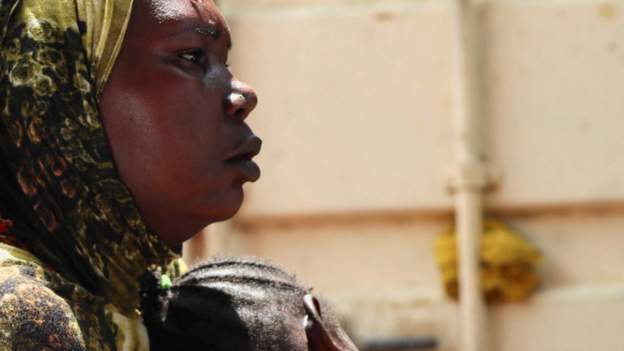
Many arrivals have witnessed, or were subjected to, violence and exploitation such as extortion and looting, including during their journey to South Sudan.
Looking at the rest of Sudan’s neighbours, Egypt – with 255,000 – and Chad – with 120,000 – have taken in the bulk of the refugees fleeing the violence.
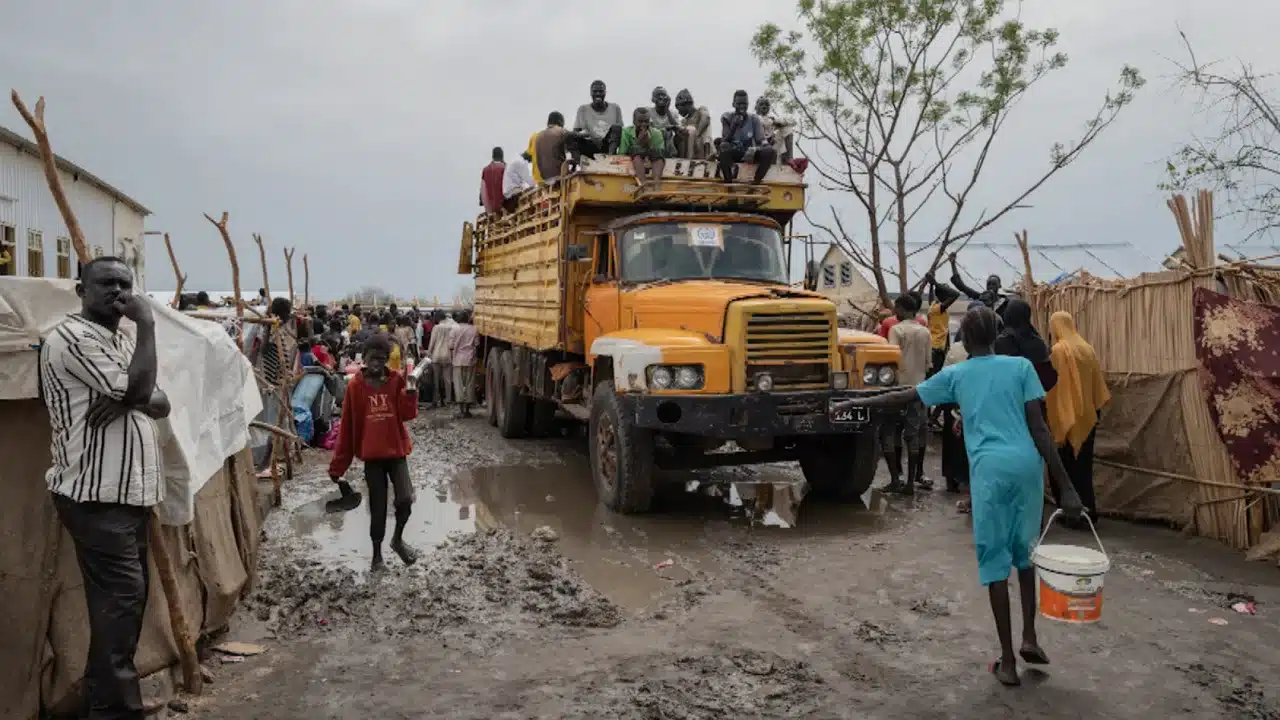
Kueaa Darhok struggles to navigate the sucking mud and deep puddles on his way to the communal cooking area at the heart of the transit camp he now calls home, his faded pants bagging over the top of borrowed rubber rain boots.
South Sudanese who have fled their country and refugees from Sudan wait there while charity workers and local women spoon through steel pots of lentils and porridge under his reassuring gaze and soft-spoken assurances.
Having South Sudanese ancestry, Darhok served as the principal of an English-language secondary school in Khartoum, the country’s capital, where he instructed students in works by renowned African writers like Chinua Achebe in an effort to instill in them, in his words, a sense of ethnic pride.
After fighting broke out over two months ago in Khartoum, he and his family made the terrifying journey back to South Sudan and he has become a community elder here at the camp.
Set up a week into the fighting in Sudan, when desperate families arrived seeking shelter, the Renk transit camp near the border of South Sudan and Sudan was not supposed to hold more than 3,000 people. It now houses more than double that. There are no sanitation facilities, not enough waterproof sheets and not enough food. Not enough of anything.
“I eat once a day, sometimes not even that,” Darhok says, keeping an eye on the meal distribution. “Most of the men here are the same, so that the most vulnerable – the women and children – can eat.”
Even then, Darhok says, not all those queuing up will get food, and they’ll return to expectant families empty-handed.
The UN estimates at least 860 people have been killed since fighting erupted on April 15 between Sudan’s Armed Forces and the rival paramilitary Rapid Support Forces (RSF).
With 6,000 people injured across Sudan as of June 3, half a million people have fled the country and more than 1.4 million are internally displaced.
Blighted by decades of fighting both before and after independence from the Republic of Sudan, South Sudan was already Africa’s largest refugee crisis, with 2.2 million people displaced outside the country’s borders and 2.3 million internally displaced. Now at least 800,000 South Sudanese have been driven back by the fighting in Sudan.
A spokesperson for the United Nations Refugee Agency (UNHCR) in Renk, Charlotte Hallqvist told CNN that an average of 1,500 people have been arriving daily since the fighting began in Sudan, adding to the burden of a country where 75% of the population are in need of assistance.
Hallqvist says the UN’s emergency response was already critically underfunded, “and the new emergency is adding additional strain to already limited resources.”
To respond to the Sudan crisis in neighboring countries, the UN needs $566 million, with the South Sudan response alone in need of $96 million.
According to UNHCR figures, two months into the crisis, international donors have so far only contributed 10% of the total figure, and 15% of the overall Sudan regional emergency response.
On June 19, the United Nations, the governments of Egypt, Germany, Qatar and Saudi Arabia, the African Union and the European Union will convene a High-level Pledging Event to support the humanitarian response in Sudan and the region in a bid to drive up donor contributions.
For many here in Renk, it’s too late; the international community’s delayed response has already cost lives.
Malnutrition and unsanitary conditions are triggering an epidemic of communicable diseases, and every day, Darhok tells us, a little boy or girl dies.
A CNN team visiting the camp witnessed the burial of one boy, not quite two years old, who had died in the early hours of that morning from measles.
His mother and grandmother sat in shocked silence as men shoveled earth onto his grave at the local cemetery, pausing to plant a spindly wooden cross before heading back to their own tents and their own vulnerable families, carrying with them the specter of a death that could have been prevented.