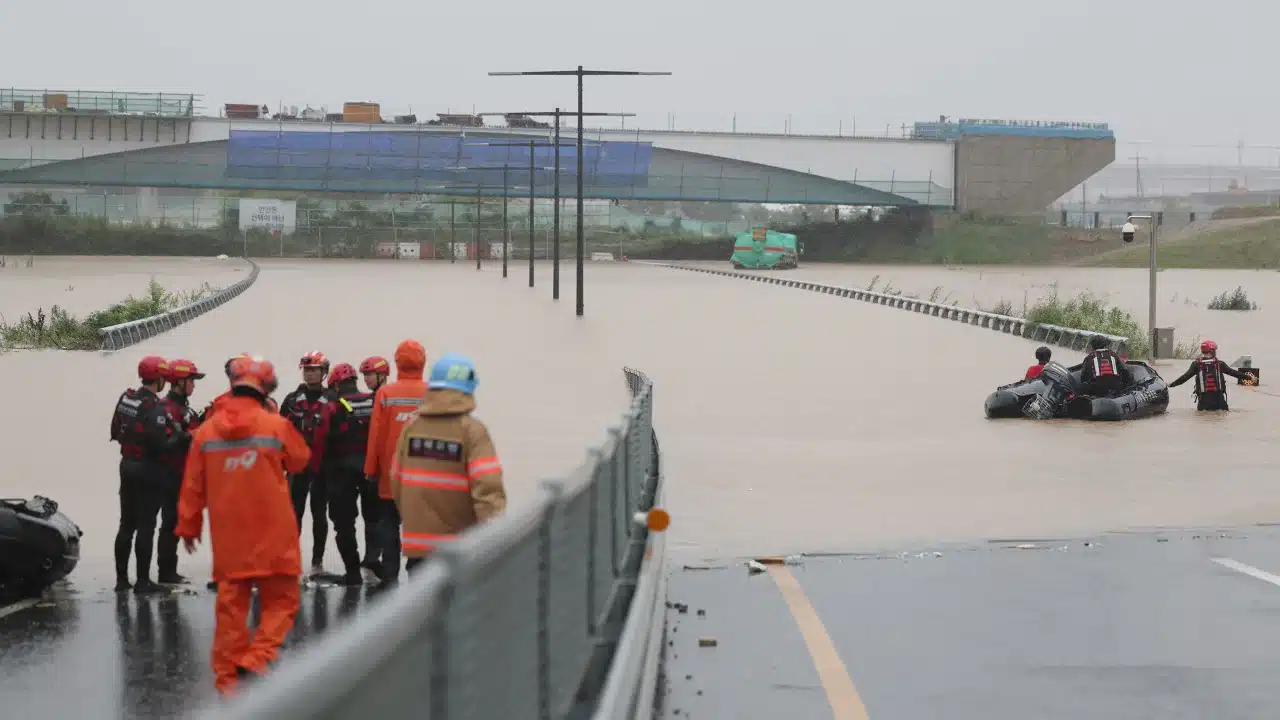
Authorities reported Sunday that seven remains were removed by rescuers from vehicles stranded in a flooded underpass in central South Korea, where days of torrential rain had created landslides and flash floods that had claimed at least 33 lives.
Seo Jeong-il, the head of the local fire department, said that after 15 vehicles, including a public bus, became stuck by rising flood waters in the Gungpyeong tunnel on Saturday, a massive search and rescue operation involving 400 employees and divers was started.
Seo said in a television briefing that the levee of the nearby Miho river in North Chungcheong province burst, allowing the flood to gushe into the tunnel and trapping the vehicles and individuals inside.
Dashcam footage from one vehicle that made it though the tunnel, shows water rushing into the underpass as cars drive head on into the flood waters.
The rescue operation was ongoing Sunday morning, with 10 people reported missing while authorities worked to identify the bodies, according to South Korean Ministry of the Interior and Safety.
Nine people had been rescued with injuries, Seo said.
Rescue teams continued to drain the tunnel of flood water Sunday morning, pumping out 80,000 liters per minute. At 4:33 a.m., the top of the bus became visible, Seo said. But authorities said the chance of finding any more survivors is unlikely.
“We are mobilizing about 30 divers in groups of two in rotation for the search operation,” said Seo. “We are trying our best right now, although it is difficult since the site is covered in mud.”
Five bodies were discovered when divers searched the trapped bus, among the dead is a woman in her 70s, according to Seo.
Dozens of people have died in South Korea in recent days as torrential monsoon rains triggered flooding and landslides across the country.
Across the country, more than 5,500 people have been forced to evacuate their homes and seek temporary shelter, the Ministry of the Interior and Safety said Sunday.
In addition, some 8,300 households in four provinces are experiencing power outages, Yonhap News Agency reported.
Public roads, houses and farm fields have been damaged by the severe flooding.
South Korean Prime Minister Han Duck-soo ordered authorities to evacuate those in landslide-prone regions and to carry out rescue efforts, according to the South Korean news agency.
Scientists have warned the frequency and intensity of heavy rainfall is increasing across East Asia as the human-caused climate crisis accelerates the probability of extreme weather events.
The latest round of heavy rains in South Korea come just days after devastating floods wreaked havoc in neighboring Japan, killing at least six people and injuring 19.
And flash floods have torn through southwest China in recent weeks, killing at least 15 people in the city of Chongqing.
Reports from local officials and state media suggests that , heavy rainfall in Chongqing and other parts of southwestern China has resulted in the deaths of fifteen people, with four individuals still missing.
China has been experiencing extreme weather conditions, including heavy rains and intense heatwaves, as global temperatures continue to rise.
The residents of Beijing and various other regions have been advised to stay indoors due to temperatures exceeding 35 degrees Celsius (95 degrees Fahrenheit).
The recent torrential rains in Chongqing represent one of the most severe natural disasters in China this year, claiming multiple lives.
“The heavy rains, mainly seen in the areas along the Yangtze River, have triggered floods and geological disasters, disrupting the lives of more than 130,000 people in 19 districts and counties,” state-run news agency Xinhua said.
Images from state broadcaster CCTV posted on social media on Tuesday showed torrents of muddy water in Chongqing’s heavily affected Wanzhou District overflowing embankments and pieces of debris being swept away.
And the Communist Party-backed People’s Daily posted photos of ongoing rescue efforts Wednesday, showing emergency responders helping residents evacuate flooded residential buildings.
On the outskirts of Chongqing, workers on Tuesday discovered that a closed-off railway bridge had collapsed after it was “damaged by the impact of mountain torrents”, CCTV said.
The government dispatched a working group to Chongqing early on Wednesday morning to oversee disaster relief efforts.
More is still to come, with officials warning that China is set to face “multiple natural disasters in July, including floods, severe convection weather, typhoons and high temperatures”.
In response, President Xi Jinping has ordered that “authorities at all levels must give top priority to ensuring people’s safety and property”, Xinhua said Wednesday.
China’s finance ministry has issued 320 million yuan ($44.2 million) in disaster relief to affected regions, which it said would be used by local governments to boost emergency search and rescue efforts.
– Widespread damage – In neighbouring Sichuan province, authorities said more than 460,000 had been affected by the heavy rain this month, Xinhua reported.
About 85,000 people have been evacuated from their homes as a result of the rain, officials said, with “flash floods in mountainous areas” and “possible mudslides in some parts” of China expected this week.
Scientists say that rising global temperatures — caused largely by burning fossil fuels — increase the likelihood of extreme weather events such as the flash floods and heatwaves experienced in many Asian countries in recent weeks.
China recorded an average of four days in which temperatures exceeded 35 degrees every month in the first half of this year, the highest since national records began in 1961, according to aNational Meteorological Center statement on Sunday.
In June, Beijing sweltered through a total of 14 days of temperatures exceeding 35 degrees, matching the record set in July 2000, according to the state-run Beijing Evening News.
As the crackdown on religious liberty grows, thousands of ethnic minority Muslims encircled a mosque in southwest China over the weekend in a last-ditch bid to stop what they claimed was an attempt by authorities to destroy its dome and minarets.
In the midst of a massive drive to “sinicize” religion, China’s leader Xi Jinping appears to have altered a Hui mosque in the Yunnan province village of Najiaying.
The goal of the programme is to rid religions of foreign influence and bring them more in line with traditional Chinese culture and the authoritarian leadership of the Communist Party, which is officially atheist.
In recent years, authorities have removed overtly Islamic architecture – destroying domes and tearing down minarets – from more than a thousand Hui mosques across the country, Hui activists say, with the Najiaying mosque being one of the last holdouts.
Now, the “sinicization” campaign is finally coming for Najiaying – a historic home to the Hui and an important hub for Islamic culture in Yunnan, an ethnically diverse province on China’s borders with Southeast Asia.
But the push has faced a fierce backlash from local residents.
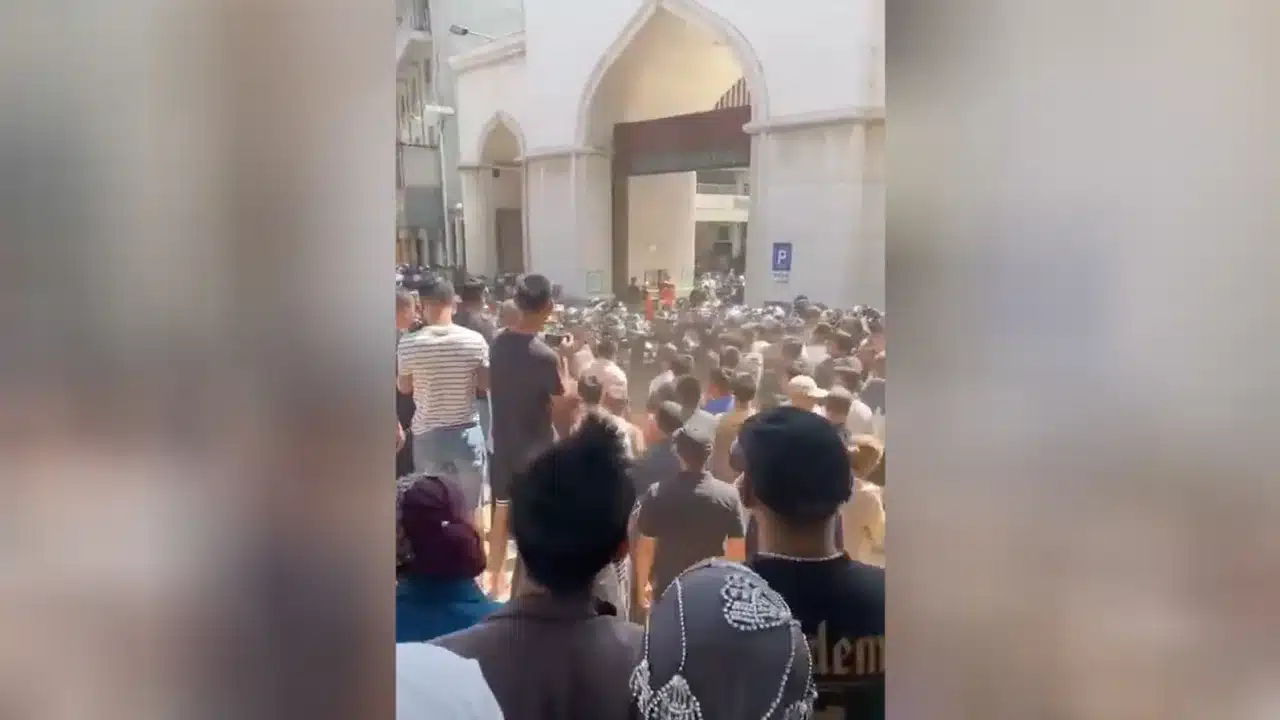
Videos posted on social media and geolocated by CNN show residents clashing with lines of police officers in riot gear, who blocked off the entrance to the mosque and pushed back the crowd with shields and batons.
Residents shouted back in anger, with some hurling water bottles and bricks at the police, the videos show.
“This is our last bit of dignity,” a local witness told CNN. “It’s like coming to our house to demolish our home. We can’t allow that to happen.”
The source, who declined to be named over fears for personal safety, said thousands of Hui residents – including men and women, elderly and children – had gathered around the mosque on Saturday, under the close watch of more than 1,000 police officers deployed nearby.
“After arriving at the mosque, we realized that they had driven the cranes into the compound and were ready for the forced demolition,” the source said, adding that scaffolding had already been erected around the mosque.
Tensions escalated around 1 p.m., with worshipers demanding to enter the mosque for noon prayers, the source said. They said they saw police officers hitting the crowd with batons, which prompted some residents to clash with police.
Dozens of protesters were arrested by police at the scene, the source said. Ma Ju, a prominent Hui activist who now lives in the United States and has kept close contact with Najiaying residents, said about 30 people were arrested.
CNN cannot independently verify the claims and has reached out to the local police and government for comment. CNN has also reached out to the Yunnan provincial government and its bureau for religious affairs for comment.
The hours-long standoff on Saturday yielded a temporary win for the protesters, who streamed into the mosque as the police retreated, according to the witness and online videos.
Throughout Saturday night and Sunday, residents took turns to guard the mosque, fearing that authorities would return to demolish its large centerpiece green dome and four minarets, the source said.
But repercussions quickly followed, according to those CNN spoke with.
By Sunday afternoon, word started to spread that authorities were arresting more people, according to the source.
On Sunday evening, law enforcement authorities in Nagu township, where Najiaying is located, issued a stern but vague statement. Without mentioning the protest or the mosque, it said police were investigating an incident that took place on Saturday, which “seriously disrupted social order” and caused “vile social impact.”
The authorities also called on the “organizers and participants” of the incident to turn themselves in before June 6 to receive leniency, and encouraged the public to report on each other.
By Monday, Najiaying was shrouded in a blanket of fear, the source said.
The internet has been cut off in many neighborhoods. Drones buzzed overhead and surveilled the village. Public loudspeakers blasted the authorities’ message on repeat, urging protesters to turn themselves in, according to the source and Ma, the US-based activist.
“It feels like our nightmare is only starting now,” the source told CNN. “Everyone is in fear…We don’t know what’s going to happen next.”
Other local residents appeared fearful to speak out.
One shop owner reached by CNN on the phone said: “You journalists should come here to report on what’s happening to us.” When asked by CNN to explain what happened, he replied he “didn’t know” and hung up.
This is not the first time that Hui Muslims have engaged in a tense standoff with authorities to protect a mosque.
In 2018, thousands of Hui residents in Ningxia, in the country’s northwest, staged a sit-in protest for three days to prevent authorities from demolishing a newly constructed mosque.
The local government held off on the demolition, but later replaced the mosque’s domes and minarets with traditional Chinese-style pagodas.
The architectural overhaul of mosques has come with allegations of shrinking religious freedoms for the Hui, a 11 million-strong ethnic minority that live in scattered pockets throughout China from the northwest to the coastal cities in the east, including an officially designated “autonomous region,” Ningxia.
Believed to be distant descendants of Arab and Persian traders, the Hui have been well assimilated into broader Chinese society dominated by the ethnic Han majority.
Most speak Mandarin, live alongside the Han, and in recent decades had been given more space to practice their faith than other ethnic groups.
But Hui activists say their ethnic group has become the latest target in the Communist Party’s crackdown on Islam, which began in the western region of Xinjiang.
Since at least 2017, the Chinese government has been accused of detaining more than a million Uyghurs and other Muslim minorities in internment camps in Xinjiang and conducting forceful assimilation to suppress their cultural and religious identity.
A United Nations report last year accused the Chinese government of serious human rights violations against Uyghurs that may amount to “crime against humanity.”
China has repeatedly denied these accusations and insisted that the massive camps are voluntary “vocational training centers.”
Hui activists and rights groups claim authorities have stepped up efforts in recent years to restrict religious practices of Hui Muslims across China, including the shuttering of Islamic schools, Arabic classes and barring children from learning and practicing Islam.
The implementation of the “sinicization” campaign has “had the effect of expunging communities of their connections to Hui culture, religion, and each other so thoroughly that some leaders view the erasure of a meaningful Hui identity within another generation as being a likely possibility,” according to a report submitted to a UN treaty body in January by the Chinese Human Rights Defenders and the Hope Umbrella International Foundation.
Ma, the US-based Hui activist who founded the Hope Umbrella International foundation, said Hui in China are now living in a constant state of fear.
Over two hundred mosques in Yunnan have already lost their domes and minarets, according to Ma, adding to the more than a thousand mosques in the country’s northwest.
CNN is unable to independently verify the number of mosques affected, and has reached out to the Chinese government for comment on the accusations made by Hui activists.
“At first, people thought it was only a question of architectural style…but it soon became apparent that (the government) is not only removing the domes from the mosques, but also removing their religious and social functionality,” Ma said.
Under a raft of restrictions imposed by the government, many Hui are now afraid to go to the mosque, which has long been a center of religious and social life for their communities, Ma said.
The end goal of the party is to implement a policy of “cultural and religious genocide,” just as it did in Xinjiang, he said. The Chinese government has denied accusations of genocide.
For the resident in Najiaying, the government’s plan to change the design of the mosque is only the harbinger of a harsher crackdown to come.
“This is only the first step. What we worry about is after that, (the authorities) will ban our children from going to (religious) classes, bar minors from entering mosques and forbid us from studying the Quran,” they said, referring to the alleged restrictions that have been imposed on Hui communities across China.
“After they trampled on your dignity, they will suppress you step by step, and assimilate the Hui ethnic group completely into the Han, generation by generation. Because we know, this is what they did to Xinjiang,” he said.
Despite the permeating culture of fear, he has vowed to “fight till the end” for the freedom of belief and the dignity of the Hui ethnicity.
“We commoners don’t ask for much. We just want to have our own religious freedom. We just want to live in peace,” he said.
“I want the world to know what we’re going through right now, and what we’re fearing next.”