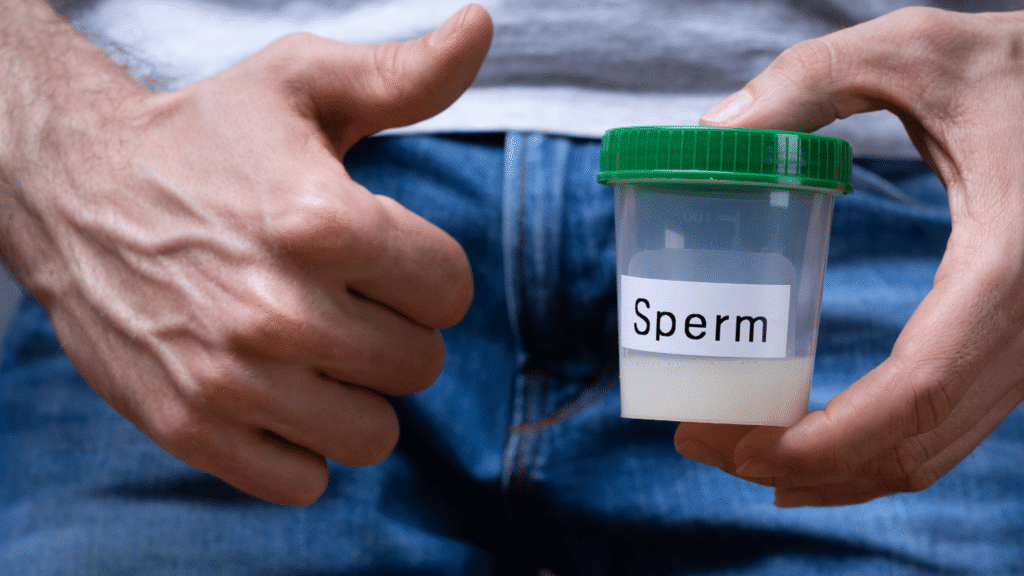
Tag: sperm

  • Sperm from donor with cancer-causing gene was used to conceive almost 200 children

    Sperm from donor with cancer-causing gene was used to conceive almost 200 children

    A sperm donor who unknowingly harboured a genetic mutation that dramatically raises the risk of cancer has fathered at least 197 children across Europe, a major investigation has revealed.

    Some children have already died and only a minority who inherit the mutation will escape cancer in their lifetimes.

    The sperm was not sold to UK clinics, but the BBC can confirm a “very small” number of British families, who have been informed, used the donor’s sperm while having fertility treatment in Denmark.

    Denmark’s European Sperm Bank, which sold the sperm, said families affected had their “deepest sympathy” and admitted the sperm was used to make too many babies in some countries.

    The investigation has been conducted by 14 public service broadcasters, including the BBC, as part of the European Broadcasting Union’s Investigative Journalism Network.

    The sperm came from an anonymous man who was paid to donate as a student, starting in 2005. His sperm was then used by women for around 17 years.

    He is healthy and passed the donor screening checks. However, the DNA in some of his cells mutated before he was born.

    It damaged the TP53 gene – which has the crucial role of preventing the body’s cells turning cancerous.

    Most of the donor’s body does not contain the dangerous form of TP53, but up to 20% of his sperm do.

    However, any children made from affected sperm will have the mutation in every cell of their body.

    This is known as Li Fraumeni syndrome and comes with an up to 90% chance of developing cancer, particularly during childhood as well as breast cancer later in life.

    “It is a dreadful diagnosis,” Prof Clare Turnbull, a cancer geneticist at the Institute of Cancer Research in London, told the BBC. “It’s a very challenging diagnosis to land on a family, there is a lifelong burden of living with that risk, it’s clearly devastating.”

    MRI scans of the body and the brain are needed every year, as well as abdominal ultrasounds, to try to spot tumours. Women often choose to have their breasts removed to lower their risk of cancer.

    The European Sperm Bank said the “donor himself and his family members are not ill” and such a mutation is “not detected preventatively by genetic screening”. They said they “immediately blocked” the donor once the problem with his sperm was discovered.

    Children have died

    Doctors who were seeing children with cancer linked to sperm donation raised concerns at the European Society of Human Genetics this year.

    They reported they had found 23 with the variant out of 67 children known at the time. Ten had already been diagnosed with cancer.

    Through Freedom of Information requests and interviews with doctors and patients we can reveal substantially more children were born to the donor.

    The figure is at least 197 children, but that may not be the final number as data has not been obtained from all countries.

    It is also unknown how many of these children inherited the dangerous variant.

    Dr Edwige Kasper, a cancer geneticist at Rouen University Hospital, in France, who presented the initial data, told the investigation: “We have many children that have already developed a cancer.

    “We have some children that have developed already two different cancers and some of them have already died at a very early age.”

    Céline, not her real name, is a single-mother in France whose child was conceived with the donor’s sperm 14 years ago and has the mutation.

    She got a call from the fertility clinic she used in Belgium urging her to get her daughter screened.

    She says she has “absolutely no hard feelings” towards the donor but says it was unacceptable she was given sperm that “wasn’t clean, that wasn’t safe, that carried a risk”.

    And she knows cancer will be looming over them for the rest of their lives.

    “We don’t know when, we don’t know which one, and we don’t know how many,” she says.

    “I understand that there’s a high chance it’s going to happen and when it does, we’ll fight and if there are several, we’ll fight several times.”

    DISCLAIMER: Independentghana.com will not be liable for any inaccuracies contained in this article. The views expressed in the article are solely those of the author’s, and do not reflect those of The Independent Ghana
  • 5-star hotel in California sued for serving woman with bottled water containing a man’s seed

    5-star hotel in California sued for serving woman with bottled water containing a man’s seed

    A woman has filed a lawsuit against a prestigious 5-star hotel after a laboratory analysis confirmed that the bottled water she purchased at the establishment was tainted with human semen.

    The woman, identified as Jane Doe, is an American citizen who, along with her husband, John Doe, stayed at the upscale Ritz-Carlton Hotel in Half Moon Bay, California, for a four-night visit in November.

    During their stay, an incident occurred where a hotel staff member provided Jane Doe with water that was later discovered to be contaminated.

    While at the hotel, Jane Doe had requested water, and a member of the hotel staff delivered several bottles. She placed one of these bottles on the nightstand beside her bed and went to sleep.

    Later in the night, she woke up feeling thirsty and decided to drink some water from the bottle. It was at this point that she noticed an unusual taste, leading to her realization that the water was not as it should have been.

    “She opened it, took a drink, and knew immediately that something was wrong with the liquid she had just swallowed. Jane Doe was mortified, terrified, embarrassed, and humiliated, but shared her suspicion with her husband, who then asked the hotel security and management representatives to call the police,” Jane Doe’s lawyers are quoted to have said in a lawsuit.

    Upon the arrival of the police, Jane and John expressed their suspicion that the water they had been served was potentially tainted with semen. Their serious accusation prompted the law enforcement officers to collect a sample for laboratory analysis.

    To the astonishment of all parties involved, the laboratory test unequivocally validated the couple’s claim, confirming that the water they had consumed was indeed contaminated with human semen.

    “The Ritz-Carlton subsequently sent the water bottle to a laboratory for analysis, and the testing confirmed that the water contained semen,” court documents are quoted to have revealed.

    Interestingly, reports say Ritz-Carlton has refused to “disclose the identities of the hotel employees on duty that day so that their backgrounds and criminal histories can be scrutinized.”

    In the lawsuit filed on October 12, Jane Doe said her experience at the hotel left her feeling “anguish, nervousness, anxiety, grief, worry, shock, humiliation, and embarrassment.”

    In her legal action, she has filed charges against the hotel, including accusations of sexual battery, intentional infliction of emotional distress, negligence, and the loss of consortium.

  • Dutch court bans sperm donor who fathered at least 550 children

    Dutch court bans sperm donor who fathered at least 550 children

    An individual who fathered at least 550 children in the Netherlands and other nations and deceived prospective parents about the number of children he contributed to conception has been prohibited by a Dutch court from contributing any more of his sperm.

    A judge at The Hague District Court ordered the halt in an injunction on Friday brought by the mother of a child conceived with the donor’s sperm and a foundation representing other parents.

    The mother, identified by the foundation only as Eva, welcomed the court’s decision.

    “I hope that this ruling leads to a ban on mass donation and spreads like an oil slick to other countries. We must stand hand in hand around our children and protect them against this injustice,” Eva said in a statement.

    The court noted under Dutch guidelines, sperm donors are allowed to produce a maximum of 25 children with 12 mothers, and the donor lied to prospective parents about his donation history.

    The donor, identified as Jonathan M under Dutch privacy guidelines, provided sperm to several Dutch fertility clinics and to a clinic in Denmark, as well as to many other people he connected with through advertisements and online forums, the court said.

    The donor’s lawyer said in a court hearing he wanted to help parents who would otherwise be unable to conceive.

    Video Duration 47 minutes 45 secondsSperm Smugglers – Al Jazeera World

    ‘Negative psychosocial consequences’

    The judge who heard the civil case said the donor “deliberately lied about this in order to persuade the parents to take him as a donor”.

    Sign up for Al Jazeera

    Week in the Middle East

    Catch up on our coverage of the region, all in one place.

    “All these parents are now confronted with the fact that the children in their family are part of a huge kinship network, with hundreds of half-siblings, which they did not choose,” the court said, adding this “could possibly have negative psychosocial consequences for the children”.

    The case was about “conflicting fundamental rights. On the one hand, the right to respect the privacy of the parents and the donor children … and on the other hand the same right of the donor”, it said.

    The court ruled “the interests of the donor children and their parents outweigh the interest of the donor in continuing to donate sperm to new prospective parents”.

    Jonathan M was ordered to immediately halt all sperm donations and pay 100,000 euros ($110,000) per case if he breaches the ban.

    Lawyer Mark de Hek called the ruling “a clear signal and, as far as I am concerned, a final warning to other mass donors”.

    The case is the latest in a series of fertility scandals to hit the Netherlands.

    In 2020, a deceased gynaecologist was accused of fathering at least 17 children with women thinking they were receiving sperm from anonymous donors.

    The year before, it emerged a Rotterdam doctor fathered at least 49 children while inseminating women seeking treatment.

  • I donate sperm for GH¢2,500 every week – Man reveals

    I donate sperm for GH¢2,500 every week – Man reveals

    A young man has revealed how he is making money out of donating his spermatozoa.

    In a yet-to-be-aired report by TV3, Curtis Jackson (not his real name), said the idea of donating his sperm was first sold to him by some friends in the university.

    “I had a couple of friends in the university and I wanted to know how they got their money because they always look good and okay. So they introduced me,” he stated in snippets of the report.

    To that end, Jackson disclosed that he earns as much as GH¢2,500 every week by donating sperm.

    “Well, I donate every week so let’s say GHC2,500 every week…As long as we have surrogate mothers, I think sperm donation is real as hell,” he stated.

    Beyond the monetary benefits of donating sperm, Jackson opined that the donation of his sperm will benefit society aside God’s instruction to mankind to populate the earth.

    “Well, I am doing God’s work because he said we should fill the earth,” he said.

    To give essence to the saying that not all heroes wear capes, Jackson shared his belief that donating sperm to help others conceive is a heroic act.

    “That is what heroes do, they always put others’ needs before theirs…” he said.

    In recent times, fertility clinics have become a thriving branch of health services in Ghana.

    This has brought with it the accompanying benefits of individuals making money by donating sperm or eggs to help couples or individuals with challenges to conceive.

    The report about Jackson’s exploits as a sperm donor has attracted various reactions on social media.

    To some, the idea of donating sperm raises religious and moral questions while others believe the practice is a good way of making money as well as helping society.