Tag: Sri Lanka

  • Seven people killed and twenty more injured as race car in Sri Lanka crashes off  track

    Seven people killed and twenty more injured as race car in Sri Lanka crashes off track

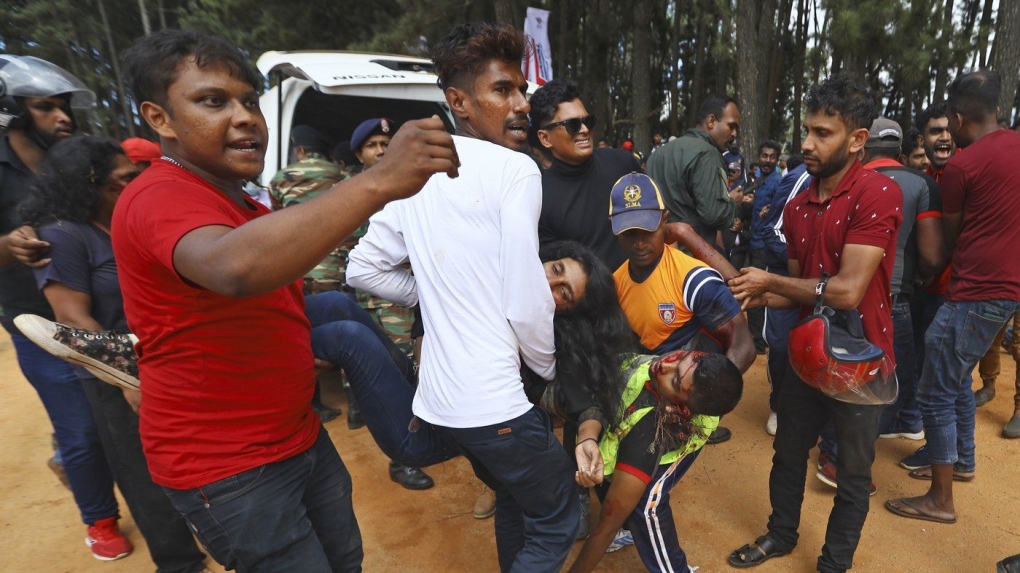
    A racing car crashed into a crowd in Sri Lanka, killing seven people and injuring 20 others. It happened during a competition on Sunday.

    Many people watched as a mistake happened during a race in Diyatalawa, a town that grows tea and is about 180 kilometers away from the capital city Colombo.

    It was not clear at first what caused the accident.

    A police officer named Nihal Thalduwa said that one of the cars went off the track and hit some people who were watching the event. Seven people died, including four government workers. Twenty more people were in the hospital getting medical help, according to Thalduwa. He said three of the hurt people were really hurt.

    Thalduwa said the police are looking into the accident that happened during the 17th event out of 24 planned. The race stopped because of the crash.

    About 45,000 people came to watch a race at a Sri Lankan military school. The Sri Lankan army and Sri Lanka Automobile Sports worked together to plan the event.

  • Sri Lanka Supreme Court clears the way to decriminalise homosexuality

    Sri Lanka Supreme Court clears the way to decriminalise homosexuality

    The speaker of parliament announced on Tuesday that the Supreme Court of Sri Lanka had approved a bill that sought to decriminalise homosexuality. Campaigners praised the decision as a “historic development”

    In Sri Lanka, where homosexuality is still punishable by a prison sentence and a fine, LGBTQ+ rights advocates have been fighting for years to reform the legislation. As a result, a private member’s bill was recently introduced in parliament.

    Speaker of Parliament Mahinda Yapa Abeywardena said the Supreme Court decided it was not illegal after hearing more than a dozen petitions on both sides of the issue.

    “The Supreme Court is of the opinion that the bill as a whole or as any provision thereof is not inconsistent with the constitution,” the speaker told parliament.

    The decision is seen as a “historic development that has created hope towards real change,” said Kaveesha Coswatte, an attorney-at-law and advocacy officer for iProbono in Sri Lanka, which supported many of the petitions backing the bill.

    Activists will still have to lobby for support from the 225 parliamentarians to push forward the proposed legislation through parliament.

    Neither the government nor the opposition have made any comment on whether they support the bill, proposed for consideration by an individual member of parliament, so the next steps for it to eventually become legislation, or not, are not yet clear.

    “But the door is finally open. This Supreme Court decision is major for the community in terms of any kind of progress they have seen over the last couple of years,” Coswatte added.

  • Rights organisations call on Sri Lanka to release students detained for protests

    Rights organisations call on Sri Lanka to release students detained for protests

    A strict anti-terrorism law is being used to imprison Wasantha Mudalige, who was arrested five months ago.

    Human rights organisations have pleaded with Sri Lanka to free a well-known student activist who was detained five months ago during anti-government demonstrations brought on by the nation’s worst economic crisis.

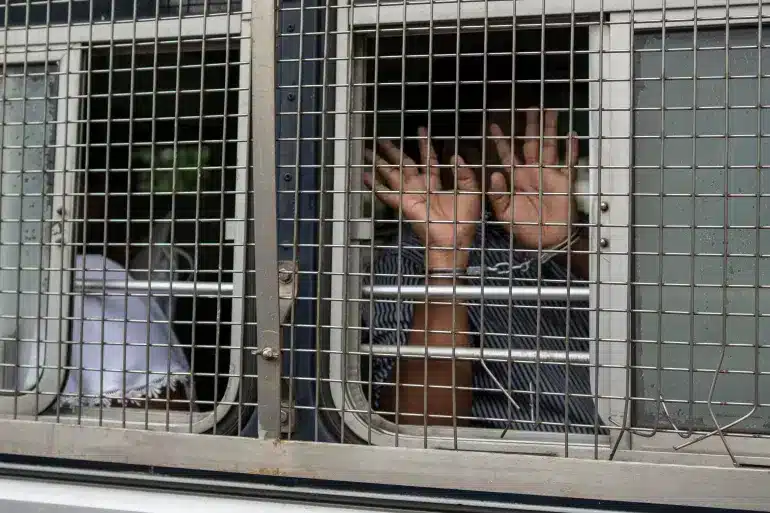
    Wasantha Mudalige, who is being held under a strict anti-terrorism law without being charged, was brought before a magistrate in Colombo on Tuesday, who ordered his remand until January 31.

    Seven human rights groups, including Amnesty International and Human Rights Watch, said under the powerful Prevention of Terrorism Act, which has been used since 1979, courts routinely deny bail if it is opposed by the attorney general.

    Mudalige is the convener of the Inter-University Students’ Federation and was involved in months of anti-government demonstrations last year. The protesters demanded wide-ranging reforms to resolve the economic crisis that caused severe shortages of essential goods, fuel and medicine.

    The protests culminated in the flight and resignation of then-President Gotabaya Rajapaksa after thousands of people stormed his residence in July.

    His successor, Ranil Wickremesinghe, initiated talks with the International Monetary Fund for a bailout package that is contingent on reforms and debt restructuring. Wickremesinghe’s government also gave sweeping powers to the authorities to crack down on the protests, arresting many activists.

    Rights groups say the military has sought to curtail protests through intimidation, surveillance and arbitrary arrests since Wickremesinghe took office in July.

    Many of those arrested have been released on bail, but the rights groups say authorities have used extraordinary powers to keep Mudalige in detention without producing any evidence of his “involvement in terrorism”.

    The groups said in a statement on Monday that for much of the time, Mudalige has been held in “solitary confinement and poor conditions, which can violate the prohibition on torture or other ill-treatment under international human rights law”.

    Sri Lanka student arrest
    A protester holds a placard demanding the release of student leader Wasantha Mudalige outside a magistrate’s court in Colombo [Eranga Jayawardena/AP Photo]

    Mudalige was also arrested and jailed for more than three months in 2021 after protesting for the right to free education.

    For months, opposition legislators, rights and student activists have been demanding the release of Mudalige and an end to the government crackdown on demonstrations linked to the economic crisis.

    The rights groups also urged the government to repeal the anti-terror law, which allows for up to a year of detention without charge on the orders of the defence minister, a position currently held by Wickremesinghe.

    In March, the government introduced some reforms to the anti-terror law. However, opposition and rights groups called them cosmetic and said the law still allows the detention of suspects without warrants and the use of confessions obtained through torture.

    Critics say the law, introduced during the country’s civil war in 1979, has been widely abused, causing a large number of innocent people to spend years in prison without trial.

    Wickremesinghe was elected by parliament to complete Rajapaksa’s term, which ends in 2024. He is unpopular because he is supported by legislators who are still backed by the Rajapaksa family, which ruled Sri Lanka for most of the past two decades.

    Many also accuse Wickremesinghe of protecting the Rajapaksas, who are widely blamed for corruption and misrule that led to the crisis.

    Sri Lanka is effectively bankrupt and has suspended repayment of nearly $7bn in foreign debt due this year pending the outcome of talks with the IMF. The country’s total foreign debt exceeds $51bn, of which $28bn has to be repaid by 2027.

    Source: BBC.com

  • Sri Lanka’s ex- presidents, Mahinda, Gotabaya sanctioned by Canada

    Sri Lanka’s ex- presidents, Mahinda, Gotabaya sanctioned by Canada

    Canada says, the sanctions were for human rights violations committed during armed conflict from 1983 to 2009.

    Canada has imposed sanctions on four top Sri Lankan officials, including former presidents Mahinda and Gotabaya Rajapaksa, over “gross and systematic violations of human rights” during armed conflict in the island nation from 1983 to 2009, the Canadian foreign ministry has said.

    The Sri Lankan government has taken “limited meaningful and concrete action” to uphold its human rights obligations, the foreign ministry said on Tuesday in a press release.

    “The impact this will have on the [Rajapaksa] brothers in particular cannot be understated,” Mario Arulthas, a Phd candidate at SOAS, University of London and an adviser to People for Equality and Relief in Lanka, told Al Jazeera.

    “Sri Lanka has been under pressure from countries such as Canada, the US and the UK for years, and has failed to deliver on repeated commitments it has made. This is a further signal, after similar sanctions by the US, that Sri Lanka will continue to be haunted by the crimes it committed against the Tamil people,” he said.

    “Sanctioning individuals won’t be enough, however – ultimately there needs to be an international judicial mechanism that puts the perpetrators on trial.”

    Alan Keenan, Senior Consultant, International Crisis Group, said that the sanctions “will not lead to quick or major changes within Sri Lanka”.

    “But they are a timely reminder that continued impunity will bring increasing costs to the government’s international reputation at a time when it is desperately appealing for international financial assistance to address the economic crisis.”

    Last October, the UN Human Rights Council renewed a mandate to collect and preserve evidence of atrocities during the decades-long civil war despite protests from Sri Lanka.

    Sagara Kariyawasam, general secretary and member of parliament of the Rajapaksa-dominated Sri Lanka Podujana Peramuna (SLPP), said that all Sri Lankans must condemn the Canadian move.

    “Sri Lanka faced the scourge of terrorism for 30 years. Not only a large number of civilians were killed from all communities but also Tamil politicians, intellectuals and civil servants. Even renowned Foreign Minister Lakshman Kadirgamar was killed by the LTTE,” he told Al Jazeera.

    “Former presidents Mahinda and Gotabaya Rajapaksa played a great role in ending the war. Now people live without fear of bombs going off, no more body bags go to villages each day.”

    Sri Lanka War
    Sri Lanka’s separatist war killed more than 100,000 people, according to United Nations estimates [File: Sri Lankan Government/Reuters Handout]

    ‘Culture of impunity’

    Gary Anandasangaree, a Canadian liberal party MP, told Al Jazeera that there is a culture of impunity that has prevailed in Sri Lanka.

    If the country is to move forward, it needs to be a state “based on the rule of law”, he said.

    “I hope Sri Lanka takes the direction of strengthening the rule of law and begins to hold people to account,” Anandasangaree said.

    “We are confident these sanctions will have a ripple effect with other countries undertaking similar measures based on their domestic laws,” he added.

    Meanwhile, the Canadian foreign ministry in its statement said it supports efforts towards “urgent political and economic reforms to alleviate the hardships faced by the people in Sri Lanka”.

    In response to the humanitarian crisis in Sri Lanka, Canada announced $3m to support the appeals launched by the UN and its partners to address “immediate needs, including food security and livelihoods, shelter and non-food items, as well as nutritional assistance and primary healthcare services for vulnerable children and women”, the statement said.

    The number of people in Sri Lanka needing urgent humanitarian help doubled to 3.4 million, the UN recently said. It warned of a worsening food crisis in the south Asian island nation that declared itself bankrupt in July.

    The island nation is facing its worst economic crisis since its independence from the United Kingdom in 1948 and has been enduring soaring inflation, power blackouts, and fuel rationing since last year.

    Months of protests against high prices and shortages of food and medicines led to the toppling of President Gotabaya Rajapaksa last July. Mahinda Rajapaksa resigned as prime minister last May. The Rajapaksa brothers were blamed for the economic crisis due to the mishandling of government policy.

    Since then, thousands with the support of civil rights groups and trade unions have rallied to express their anger over the economic situation and police brutality.

    Source: Aljazeera.com
  • Sri Lanka crisis: Parents forced to pick which child can go to school

    Sri Lanka crisis: Parents forced to pick which child can go to school

    Ten-year-old Malki is too excited to stay in bed.

    She’s up an hour before her two sisters and two brothers so that she can scrape some bright red gloss off her fingernails.

    Today is her first day back at school and she wants to be spotless.

    But her siblings must stay at home – her family can only afford to send her.

    Six months ago, Sri Lanka was in the eye of the storm for its worst economic crisis since independence.

    While calm has largely returned to the island nation, the full impact of mass unemployment and dramatic price rises is now visible among many families.

    Every parent’s nightmare

    Malki’s mother Priyanthika has had to pause her children’s schooling so they can earn money by selling fireworks.

    Food prices in Sri Lanka reached record levels when inflation hit an all-time high of almost 95%.

    Some days, no-one in Malki’s family eats.

    While school is free in Sri Lanka, meals are not provided. When you add in the cost of uniforms and transport, education is a luxury Priyanthika can no longer afford.

    Priyanthika had to pause schooling for all her children except Malki

    She says she needs about 400 rupees per day ($1.09, 90p) for each child if they are to return to school.

    Sitting in her one-bedroom home on the bed everyone shares, she wipes the tears from her face.

    “All these kids used to go to school every day. I don’t have the money to send them now,” she says.

    Malki can go to school because her shoes and uniform still fit.

    But her younger sister Dulanjalee lies in bed crying, upset that today is not her turn.

    “My darling, don’t cry,” says Priyanthika. “I’ll try and take you tomorrow.”

    A shattered education

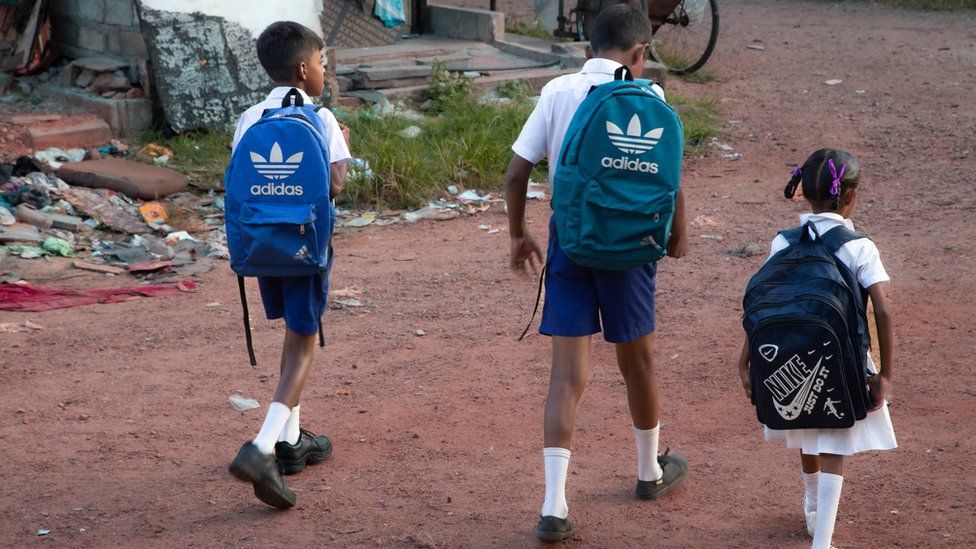
    As the sun rises, children who are going to class hurry along dirt roads in white cotton uniforms, jumping on the back of motorcycles or piling into tuk-tuks.

    Across town, Prakrama Weerasinghe sighs wearily.

    He is the principal of Colombo’s Kotahena Central Secondary College and sees the economic distress every day.

    Children walking to school with bags on their back
    Image caption,Parents are unable to send their children to school every day due to the economic crisis

    “When the school day begins, when we have the morning assembly, children tend to faint from hunger,” he says.

    The government says they have started distributing rice to schools but several schools contacted by the BBC say they have received no help.

    Mr Weerasinghe says student attendance fell as low as 40% before he was forced to ask teachers to bring in extra food to keep students returning to class.

    Joseph Stalin is General Secretary of the Ceylon Teachers Union.

    He believes the government is wilfully unaware of the increasing numbers of families giving up on education because of the cost.

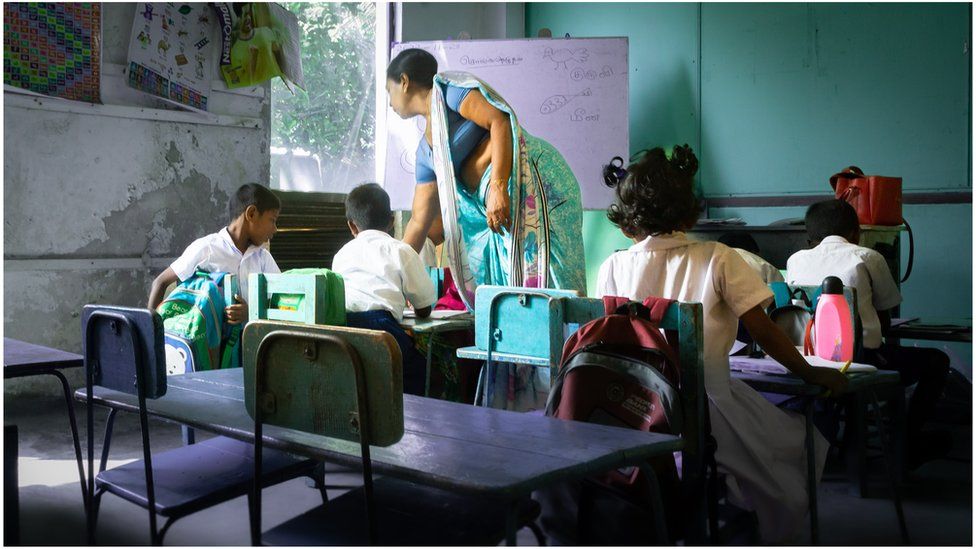
    Children at school
    Image caption,Education is in short supply for hungry children

    “Our teachers are the ones who see the empty lunch boxes,” he says. “The real victims of this economic crisis are the children.”

    “[The government] are not looking for an answer to this issue. It’s been seen and identified by UNICEF and others, rather than the Sri Lankan government.”

    UNICEF say it will get harder for people to feed themselves in the months ahead, with inflation in the cost of basic goods like rice continuing to cripple families.

    It’s expected more children across the country will be forced to stop attending class.

    The last hope?

    With the government seemingly unable to manage the situation, charities have had to step in.

    Samata Sarana is a Christian charity which has been helping Colombo’s poorest for three decades.

    Today, its food hall is packed with hungry students from schools across the capital.

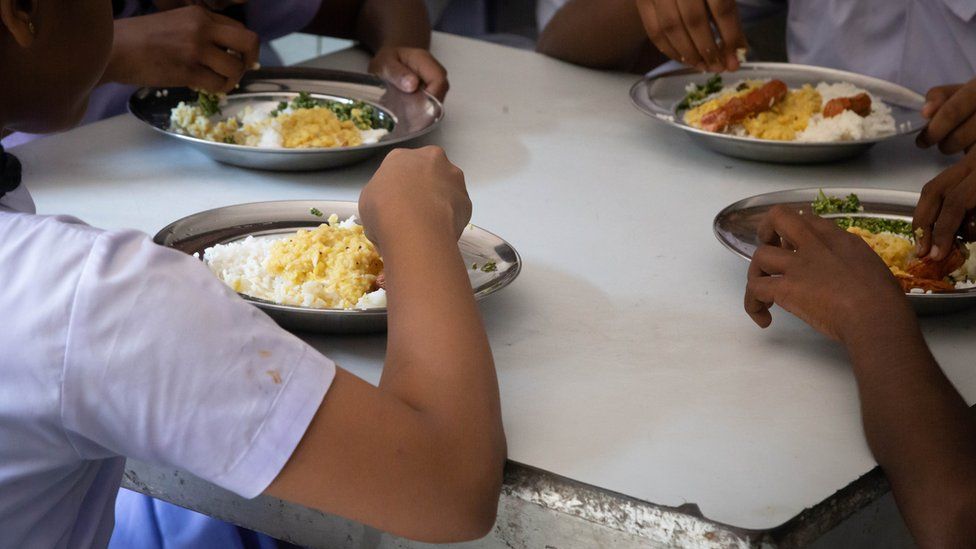
    Children eating a meal at the Samata Sarana Christian charity in Colombo
    Image caption,Charities are trying to keep as many children at school as possible

    While the charity can help around 200 children daily, it is clear it’s struggling to meet demand.

    “They give us food, buses to go home, they give us everything so now we can study,” says five-year-old Manoj as he waits in line for lunch with a group of friends.

    When Malki returns home from her first day back at school, she tells her mother how much she enjoyed seeing her friends again.

    But she also tells her mother she needs a new workbook and says her teachers are asking for extra money to buy materials for a school project.

    Money that the family does not have.

    “If we manage to find today’s meal, we go on to worry about how to find something to eat tomorrow,” says Priyanthika.

    “That has become our life.”

    Source: BBC.com
  • Sri Lanka’s most beautiful train journey

    The Colombo to Badulla railway is so enchantingly beautiful that it’s become a bucket list adventure for many visitors.

    I was woken by the long, forlorn sound of the siren. The brakes hissed and screeched as our train chugged up the hill and pulled into Radella, a station along one of the most beautiful train journeys in the world: the Colombo to Badulla railway.

    “The journey is so enthralling that you don’t want to take your head out of the window,” said Dayawathie Ekanayake, who has travelled extensively by train across the island during her career as a finance consultant. “It makes you feel constantly in awe. You wonder about what comes next – is it a waterfall? A stupa-like tea garden? Or is it mist-clouded peaks? You never know. You just have to keep looking.”

    Since my first journey along this route seven years ago, I have returned numerous times, eagerly jumping off the train to explore towns and hamlets flanked by tea estates.

    The 291km track takes in a mix of deep gorges, craggy cliffs, cascading falls, lakes and rivers from Sri Lanka’s west coast into its mountainous interior. It twists and turns through 46 tunnels, snaking past high montane canopy with bright red rhododendrons and wild ferns, a fragment of the native hill country forest cover left untouched by British colonisers.

    On a bright day, sun-drenched hills stretch down to the glistening southern coastline from the train window as far as the eye can see.

    Sri Lanka's most beautiful train journey
    The train journey has become an Instagram sensation in recent years (Credit: Mystockimages/Getty Images)

    This slow, 10-hour long journey might be inconvenient for the modern-day traveller, but it’s so enchantingly scenic that it’s become a bucket list adventure for many visitors.

    It’s not just the views that has travellers in awe. The train journey itself has become an Instagram sensation in recent years, with travel bloggers risking their lives to take photos of themselves hanging off the door as the train rumbles past rickety bridges (some of them have been criticised for their dramatic poses).

    Yet, the journey is also tied to Sri Lanka’s colonial history and gives passengers a deeper understanding of the island-nation.

    During British colonisation in the 19th Century, Sri Lanka was the third-largest coffee exporter in the world. As demand rose, it became expensive to ferry coffee on bullock carts from the central mountains to Colombo for shipment, especially with road conditions deteriorating during the monsoon months.

    Estates had to therefore store their coffee for long periods of time, causing the quality and value to deteriorate. So British estate owners pushed for a rail system to transport coffee. In 1867, the British completed a railway from the city of Kandy in central Sri Lanka to the coastal city of Colombo.

    “The British didn’t build railways to help locals travel,” explained Sanka Abeysinghe, naturalist at the luxury boutique hotel chain Teardrop Hotels, who also conducts railway hikes for resort guests. “They designed railways to transport estate produce.”

    I boarded the train in Colombo, leaving the muggy heat and low country farmlands to slowly ascend towards the rocky mountains surrounding Kandy. Cutting through rugged terrain, the train climbed 426m over a 21km stretch, passing through 12 tunnels, hugging treacherous curves along the mountains and soaring above thick tropical jungle.

    Sri Lanka's most beautiful train journey
    The cool, misty climate in Sri Lanka’s hill country creates the perfect conditions for growing tea (Credit: Anton Petrus/Getty Images)

    After leaving Kandy, we passed fertile riverine valleys, and entered Sri Lanka’s hill country. Tea flourishes in these damp, wet highlands, so, “when tea became prominent, after the coffee rust epidemic – a fungi disease that hindered the coffee trade [in 1869] – the British wanted to extend the railways to transport tea from the mountains to Colombo,” Abeysinghe explained.

    In the 1870s, the British began to expand the railway from Peradeniya, a railway junction near Kandy, extending the route to the terminal station Badulla in 1924. This 178km-long stretch involved navigating through rainy, forested mountains, steep ridges and a series of sharp twists and turns by building an impressive mix of bridges, viaducts, tunnels and embankments. It took 52 years to complete.

    We pushed out of the mountains, and over the next three hours we passed small and well-kept British-era railway stations like Galboda and Watawala, which were built solely for the purpose of transporting tea from each estate.

    We sluggishly ascended past Hindu temples tucked in tea gardens, small housing settlements where the tea estate labourers live, and turpentine forests shrouded in swirling mist. Sometime after leaving Hatton – the gateway town to Adam’s Peak, a holy mountain for pilgrims of all faiths – we entered the Poolbank Tunnel, the longest of the 46 tunnels at more than half a kilometre in length.

    “You cannot really see the light at the end of the tunnel here,” Abyesinghe said, chuckling.

    Sri Lanka's most beautiful train journey
    At Nanu Oya, visitors can tour the plantations and learn about the history of tea on the island (Credit: Saiko3p//Getty Images)

    From here, young passengers eagerly hung from the door to see the gushing cascades of the spectacular St Clair’s Falls through tea bushes. Cold air drifted in from the open windows and rising mist cloaked the towering Great Western mountain range.

    Many passengers got off the train at Nanu Oya, a tea-country town where visitors can tour the plantations and learn about the history of tea on the island; but I stayed on board, climbing up to Pattipola, the highest broad gauge railway station in the world. From here, we finally left the cold central hills, travelling past dairy farms towards the sun-drenched south-eastern mountains.

    After a couple of hours later, we pulled in at Ella. Over the last decade, this once-sleepy village has turned into a lively tourist hub with cafes and bars lining the streets and people posing for photos in front of the picturesque Nine Arch Bridge, a viaduct with nine arches that soars over tropical jungles of plantain trees and areca nut palms and has become one of the most photographed spots on the island.

    Flanked by thick jungle and tea plantations, the bridge was designed by British engineer Harold Marwood, but according to folklore, it never would have been built were it not for local knowledge.

    It’s said that during World War One, when it was difficult to source steel from Europe, British engineers had to rethink the bridge design. Since colonial rulers had little to no knowledge about local construction materials, a Sri Lankan builder chipped in to help. Locals completed the engineering marvel using only bricks, stone and cement.

    Sri Lanka's most beautiful train journey
    Nine Arch Bridge is one of the most photographed spots in Sri Lanka (Credit: Nathan Mahendra)

    Looking out of the train window, I gazed at the 90m-long viaduct rising through the trees, connecting Ella to the highland town of Demodara. The British also needed a way to manage the steep incline of the terrain from here. “The climb was too abrupt to handle for the engines,” Abeysinghe said.

    Again, folklore gives credit to locals who found a way to solve the problem by creating a spiralling track. As we reached Demodara Loop, the train halted at Demodara for passengers to deboard, snaked around a hillock and re-appeared from a 134m-long tunnel right beneath the station.

    According to legend, local engineer DW Wimalasurendra worked at the site and thought of this spiral design after seeing a kankami (a tea estate worker who manages South Indian labourers) tying and re-tying his turban. The cutting-edge engineering allowed the train to avoid the steep climb.

    Sri Lanka's most beautiful train journey
    The spiral track at Demodara Loop is said to have been inspired by a worker tying and re-tying his turban (Credit: Pius99/Getty Images)

    We were nearing the end of the journey, and the train slowly descended to the sleepy, terracotta-roofed town of Hali Ela to terminate at the city of Badulla in the lower central hills.

    As we pulled into the station, I realised that despite having travelled extensively around the world, I’ve often felt happiest during this slow journey through my own country.

    In many ways, as the train snakes past the century-old tea bushes, British stations and settlements of tea-estate communities, it quietly reveals the story of an island to those willing to put down their phones and look for it.

    Source: BBC

  • Economic crisis: ‘This government is clueless’ – Joyce Bawah

    Former President Mahama’s special aide, Joyce Bawah Mogtari, has described the Akufo-Addo government as “clueless” when it comes to the current economic turmoil and reducing the worsening plight of Ghanaians.

    According to her, this government is to be blamed for the high cost of living, inflation, corruption among others and ought to find measures in resolving them.

    Speaking on the Good Morning Ghana show monitored by GhanaWeb, she indicated that government lacked sensitivity when it comes to the current cost of living which continues to worsen.

    “… for an administration that was propelled to this level of popularity on the back of demonstrations in regards to the reduction of VAT, it is mind-boggling that today we speak about a 2.5 per cent increment. Ghanaians know what the difference is. VAT is now 15 per cent. Go out to the market and see how businesses are closing down, letting staff go because they can no longer afford to pay them, buy one item and see the number of taxes on it.

    “There is nothing such as burden sharing and there is nothing about the government taking responsibility, there is nothing about any sensitivity on the part of government. Government is currently clueless regarding what to do.” She said on Good Morning Ghana

    She added, looking at the state of the economy, “Ghana is ranked at par with Sri Lanka and yet the government is increasing the contingency vault from where it was to GHC1.4 billion, a figure larger for all the ministries put together at the time where Ghana is almost at a standstill.”


  • Ghana’s Economy will not be like Sri Lanka – Apostle of The Church of Pentecost

    The Koforidua Area Head of The Church of Pentecost Apostle Mike Kwame Etrue is hopeful that Ghana’s economy will bounce back strongly after the 3-day fasting and prayers by the Church.

    According to Apostle Mike Etrue, Ghana will never plunge into disastrous economic crises and political instability like Sri Lanka, saying, the country’s economy is going to be restored unto the path of prosperity.

    “In times of despair, there is only one hope. our hope is in the Lord. He will never fail our nation Ghana. Ghana will prosper. Ghana will succeed. Ghana will continue to be blessed. Ghana will move from grace to grace. Once we have petitioned God, fasted, and prayed God will surely answer our prayers and Ghana will enjoy peace. Ghana will be victorious out of this economic crises” Apostle Mike Etrue stated.

    He continued “Ghana will never be like Sri Lanka Ghana will never be shaken. Ghana’s economy will not collapse. Ghana will stand tall. The table will turn and Ghana will enjoy peace.”

    He said this at Central Terbenacle in Koforidua during Sunday service to climax the three-day fasting and prayers instituted by the Executive Council of the Church for divine intervention in Ghana’s economic crises.

    Apostle Mike Etrue said the fasting and prayers had nothing to do with politics but in fulfillment of divine responsibility that in times of adversity and despondency, God is the only hope to change situation.

    “We are not doing politics. We want to save Ghana.”

    Using Ezra 8:21-23 as main text, Apostle Etrue said, Ezra, camped the Israelites for three-days to proclaim a fast in order to humble themselves before God and to pray for His protection and leading during a perilous journey.

    Prayer was said for the manifold wisdom of God for the President, Ministers, CEOs, MMDCEs, and parliamentarians among others to manage the affairs of the country well.

    “God should intervene in the IMF negotiation. The nation will surely change. God should grant President, MPs, and Ministers wisdom to manage the economy.”

  • Economic woes: UN warns of worsening food crisis in Sri Lanka

    UN agencies in Sri Lanka say they have raised $79 million in aid, but they need another $70 million to help the country’s growing poor.

    According to the UN, the number of people in Sri Lanka who need immediate humanitarian assistance has more than doubled to 3.4 million, indicating a worsening food crisis in the south Asian island nation, which declared bankruptcy in July amid an unprecedented economic crisis.

    UN agencies working in Sri Lanka said in a joint statement on Tuesday that they had raised $79 million to feed those in need, but that the growing number of poor people required an additional $70 million.

    “Food insecurity in Sri Lanka has increased dramatically due to two consecutive seasons of poor harvests, foreign exchange shortages, and reduced household purchasing power,” the statement said.

    UN agencies had estimated in June that 1.7 million out of the 22 million population in Sri Lanka required help.

    The UN said its revised plan aims at feeding 2.1 million people, including pregnant mothers and school children and providing livelihood support to 1.5 million farmers and fishermen.

    Worst crisis

    Sri Lanka is facing its worst economic crisis since its independence from the United Kingdom in 1948 and has been enduring soaring inflation, power blackouts, and fuel rationing since last year.

    The country defaulted on its $51bn external debt in mid-April and is in talks with the IMF for a $2.9bn bailout.

    Months of protests against high prices and shortages of food and medicines led to the toppling of President Gotabaya Rajapaksa in July.

    The UN has said that the poverty rate in the South Asian nation has doubled to 25.6 percent this year, up from 13.1 percent last year.


  • T20 World Cup: Australia staying in Adelaide to support Sri Lanka

    Australia’s narrow win over Afghanistan on Friday sent New Zealand through to the T20 World Cup semi-finals and set England a straightforward target to join them.

    England need only a victory against Sri Lanka in Saturday’s final Group 1 match to be sure of a place in the last four.

    Hosts and defending champions Australia had been facing an uphill battle to improve their run rate ever since an 89-run thrashing at the hands of the Black Caps in their opener.

    With their meeting with England rained off, the margin of victory in other matches was going to prove pivotal.

    Although Australia survived a scare in beating Afghanistan by four runs, that tight affair left their net run rate at -0.173, below England’s mark of +0.547, which will improve further with victory over Sri Lanka.

    The home nation therefore need Sri Lanka to defeat England and keep them in the top two on seven points.

    Stand-in Australia captain Matthew Wade said: “We’ll stay the extra night here and watch that game. We’ll be hoping for a little bit of an upset there, obviously.

    “That’s tournament play – we put ourselves in this situation straight from the get-go this time. Although we’ve been trying to chase a little bit of run rate, it just hasn’t really gone our way.

    “We’ve been a little bit slow getting out of the blocks in this tournament. Hopefully it doesn’t cost us.”

    Glenn Maxwell struck a similar tone, saying: “We’ll certainly be following it. We’ve obviously put ourselves in this situation, but hopefully Sri Lanka can do the job for us.”

    Although Maxwell scored an unbeaten 54 off 32 against Afghanistan, he added: “It was quite hard to press the issue.

    “We probably got to about the 12-over mark, where we just had to put a total on the board to make sure we gave ourselves a chance of winning the game.

    “Even though we were trying to go hard at the back end, they bowled extremely well.”

    If Sri Lanka can do Australia a huge favour, Wade is “very hopeful” skipper Aaron Finch and all-rounder Tim David will return for the semi-finals.

    David was “really, really close” but failed a late fitness test on Friday, Wade added.

    Source: Livescore


  • T20 World Cup: Kusal and bowlers impress as Sri Lanka outclass Ireland

    Kusal Mendis carried his bat and Sri Lanka’s bowlers all impressed in an emphatic nine-wicket victory over Ireland in the T20 World Cup on Sunday.

    Opening batsman Mendis made an unbeaten 68 at the Bellerive Oval in Hobart as Sri Lanka easily chased down a target of 129 despite the absence of the injured Pathum Nissanka.

    Dhananjaya de Silva (31 off 25) and Charith Asalanka (31* off 22) also did their bit to open Sri Lanka’s Group 1 campaign with a resounding win.

    It had been Sri Lanka’s bowlers who laid the foundations for Mendis. Maheesh Theekshana (2-19) and Wanindu Hasaranga (2-25) claimed a pair apiece, while each of their bowling unit took a wicket to limit Ireland to 128-8.

    Paul Stirling opened with 34 off 25 and Harry Tector (45) ensured Ireland at least had something to defend, but the contest was decidedly one-sided.

    COOL KUSAL LEADS THE WAY

    Sri Lanka’s route to this stage started with an embarrassing loss to Namibia but wins over the United Arab Emirates and Netherlands booked a spot in the Super 12.

    Kusal ensured there would be no hiccup to begin this stage, whacking three sixes and five fours in his 43-ball knock, which he finished with a maximum off Simi Singh over deep-square leg, as Sri Lanka wrapped up the win with 30 balls remaining and nine wickets in hand.

    BOWLING UNIT IN SYNC

    One of the most pleasing aspects for Sri Lanka was the shared responsibility with the ball. Lahiru Kumara had already snared Ireland captain Andrew Balbirnie in the second over by the time Theekshana encouraged Lorcan Tucker to glove onto the stumps.

    Theekshana also took the bails off George Dockrell’s wicket and Binura Fernando took out dangerman Tector prior to Hasaranga taking a couple of late wickets.

    Source: Livescore


  • Inferior oil blamed for Sri Lanka power cuts

    A senior Sri Lankan official has attributed the shutdown of a power plant that resulted in prolonged outages to imports of crude oil of poor grade.

    The oil used in the furnaces, according to utility regulator chief Janaka Ratnayake, contained an excessive amount of sulphur.

    But the country’s energy minister has disputed the allegation.

    Last week, Sri Lanka increased its daily power outage from 80 minutes to 140 minutes because of a drop in power generating capacity.

    “Sulphur content is too high in the furnace oil [fuel oil] which is not suitable for the current power plants and it’s also not conforming with environmental standards,” Mr Ratnayake, the head of the Public Utilities Commission, told the BBC.

    “If you buy good quality crude oil for refineries, then this problem will not happen.”

    Mr Ratnayake said about 10% of the country’s electricity came from diesel and fuel oil power plants. The rest of the electricity is generated from hydro, renewable, and coal-powered plants.

    But Power and Energy Minister Kanchana Wijesekara defended the crude oil import policy.

    In a tweet, he said Sri Lanka’s state-run fuel retailer, Ceylon Petroleum Corporation, would respond legally to Mr Ratnayake’s allegation.

    According to Mr Wijesekara, the power cut was extended because of a breakdown at one of the hydro-power stations and insufficient funds for diesel and fuel oil.

    The South Asian nation has been facing its worst financial crisis since its independence from Britain in 1948. It is struggling to find enough dollars to import fuel and food.

    The shortages led to months of anti-government protests and long queues outside petrol stations.

    In July, the unrest came to a head when President Gotabaya Rajapaksa was forced to flee the country and then resign after thousands of protesters stormed his official residence.

    Veteran politician Ranil Wickremesinghe was subsequently elected by MPs as president.

    Since then, the government has introduced a ration system for fuel using a QR code that has reduced the queues outside petrol stations.

    Sri Lanka has reached a preliminary agreement with the International Monetary Fund for an emergency loan of $2.9bn (£2.7bn) and it expects the deal to be approved by the IMF board by the end of this year.

    But the conditions include Colombo reaching an agreement with its creditors on debt restructuring. Sri Lanka has about $50bn of external debt.

  • British headteacher who coached 131 children worldwide jailed for 20 months

    A British headteacher who groomed at least 131 children worldwide using social media while working at a school in Iraq has been jailed for 20 months.

    Using Facebook Messenger, Nicholas Clayton, 38, of The Wirral, made contact with kids as young as 10 and requested their images with the intention of sexually abusing them.

    He was apprehended after paying a 13-year-old Cambodian boy to come to Malaysia so they could meet and asking the boy for pictures of his bare upper torso.

    When he returned to the UK, the National Crime Agency (NCA) detained him after receiving information about the communication.

    Investigators found Clayton had been messaging hundreds of boys from across the globe, spanning the Philippines, Sri Lanka, Singapore, Thailand, Indonesia, Iraq, Morocco, Turkey and others over a period of just three months.

    He appeared at Liverpool Crown Court on 23 August where he admitted three counts of sexual communication with a child under 16 years and one charge of inciting the sexual exploitation of a child.

    On Tuesday, he was sentenced to 20 months imprisonment and made the subject of a sexual harm prevention order for 15 years.

    New Facebook plans will ‘hide similar predators’

    The case has prompted fresh calls for a “robust” Online Safety Bill, with the NSPCC warning plans by Meta, which owns Facebook, to introduce end-to-end encryption will “blindfold” authorities to similar predators.

    Andy Burrows, head of child safety online policy at the charity, said: “Clayton’s case highlights the ease with which offenders can contact large numbers of children on social media with the intention of grooming and sexually abusing them.

    “Private messaging is the frontline of child sexual abuse online. It’s therefore concerning that Meta plans to press on with end-to-end encryption on Facebook Messenger, which will blindfold themselves and law enforcement from identifying criminals like Clayton.

    “The UK government can show global leadership in tackling online child abuse by delivering without delay a robust Online Safety Bill that embeds child protection at the heart of every social media site.”

    New Culture Secretary Michelle Donelan has previously said there are no plans to water down the proposals for new internet safety laws, which Mr Burrows welcomed as “really encouraging”.

    Hazel Stewart, from the NCA, said: “Nicholas Clayton abused his position of trust as a headteacher by attempting to sexually contact and exploit children, using technology to access hundreds of potential victims across the globe.

    “Clayton was very cautious and careful in his communications, making them appear to be innocent, but as NCA investigators we could see the patterns of predatory grooming he was using on vulnerable children.

    “Protecting children from sex offenders is a priority for the NCA, and we continue to pursue criminals in the UK and internationally to ensure abusers like Clayton are held to account.”

    Facebook ‘taking our time to get it right’

    A Facebook spokesperson said: “We have no tolerance for child exploitation on our platforms and are building strong safety measures into our plans.

    “We’re focused on preventing harm by banning suspicious profiles, defaulting under-18s to private or ‘friends only’ accounts, and more recently introduced restrictions that stop adults from messaging children they’re not connected with.

    “We’re also encouraging people to report harmful messages to us so we can see the contents, respond swiftly and make referrals to the authorities. As we roll out this technology we’re taking our time to get it right and working with outside experts to help keep people safe online.”

    Source:Skynews.com
  • Sri Lankans delivered from Russian brutality in Ukraine

    Ukraine‘s recapture of the city of Izyum has assisted with the redemption of a group of Sri Lankans held captive for months.

    There are have been multiple allegations of atrocities under Russian occupation.

    Dilujan was one of seven Sri Lankans captured by Russian forces in May. The group had just set out on a huge walk to safety from their homes in Kupiansk, north-eastern Ukraine, to the relative safety of Kharkiv, some 120km (75 miles) away.

    But at the first checkpoint they came across, they were captured by Russian soldiers. The Sri Lankans were blindfolded, their hands tied, and taken to a machine tool factory in the town of Vovchansk, near the Russian border.

    It was the start of a four-month nightmare which would see them kept prisoner, used as forced labour, and even tortured.

    “We thought we would never get out alive,” says Dilujan Paththinajakan.

    WARNING: You may find some of the details below about abuse distressing.

    The group had come to Ukraine to find work, or study. Now, they were prisoners, surviving on very little food, only allowed to use the toilet once a day for two minutes. On the occasions they were allowed to shower, that too was restricted to just two minutes.

    The men – mainly in their 20s – were all kept in one room. The only woman in the group, 50-year-old Mary Edit Uthajkumar, was kept separately.

    Mary Edit Uthajkumar
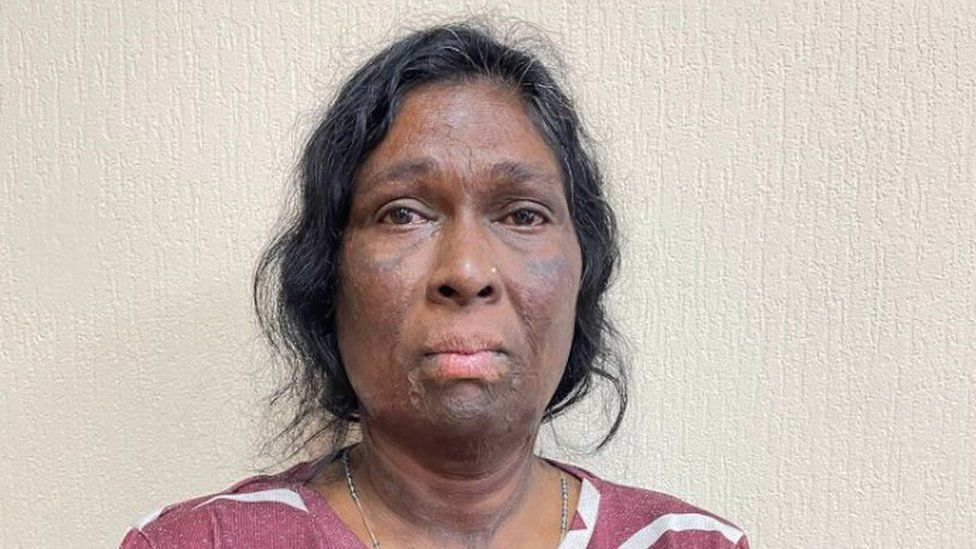
    Image caption, Mary Edit Uthajkumar, 50, said months of solitary confinement had taken a toll

    “They locked us in a room,” she said “They used to beat us when we went to take a shower. They didn’t even allow me to meet the others. We were stuck inside for three months.”

    Mary, her face already scarred by a car bomb in Sri Lanka, has a heart condition, but didn’t receive any medicine for it.

    But it was the impact of the solitude which really took its toll.

    “Being alone, I was so tense,” she says. “They said I was having mental health issues and gave me tablets. But I didn’t take them.”

    Others have been left with even more visible reminders of what they had endured: one of the men removed his shoes to show his toenails had been torn off with pliers. A second man reportedly also suffered that torture.

    The group also spoke of being beaten for no apparent reason – of Russian soldiers who would get drunk and then attack them.

    “They hit me across the body many times with their guns,” said 35-year-old Thinesh Gogenthiran. “One of them punched me in the stomach and I was in pain for two days. He then asked me for money.”

    “We were very angry and so sad – we cried every day,” Dilukshan Robertclive, 25, explained.

    “The only thing that kept us going was prayer – and family memories.”

    Russia has denied targeting civilians or committing war crimes, but the Sri Lankans allegations come alongside many other reports of atrocities committed by Russian occupying forces.

    Ukraine has been exhuming bodies from a burial site in forest near Izyum, some of which show signs of torture. And Ukrainian President Volodymyr Zelensky has said “more than 10 torture chambers have already been found in the liberated areas of Kharkiv region, in various cities and towns”.

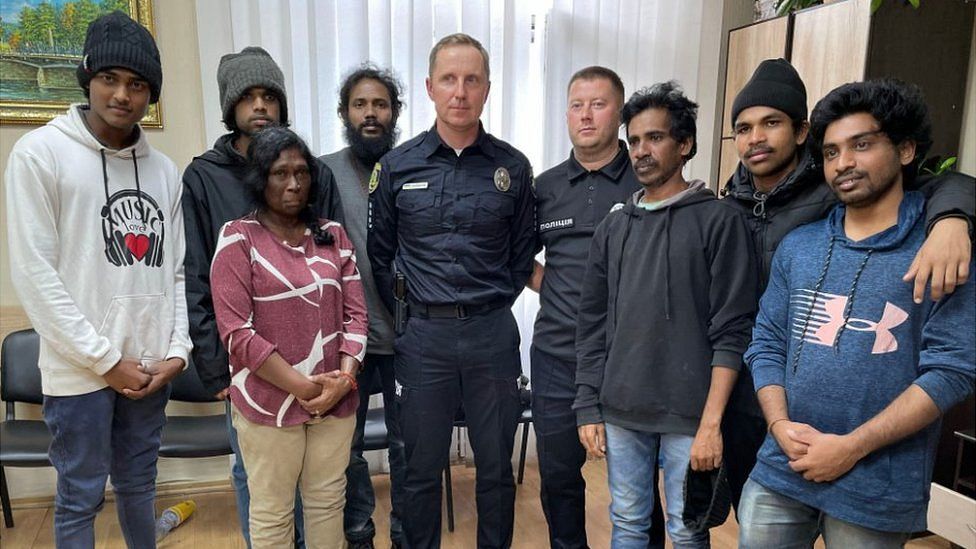
    The liberated Sri Lankans with Ukrainian police in Kharkiv, 18 Sep 22
    Image caption, The liberated Sri Lankans with Ukrainian police in Kharkiv

    Freedom for the seven Sri Lankans finally came when the Ukrainian military began retaking areas in eastern Ukraine earlier this month – including Vovchansk.

    Once again, the group was able to begin their walk towards Kharkiv. Alone, and without their phones, they had no way to contact their families.

    But finally, their luck changed: someone spotted them along the way and called the police. One officer offered them their phone.

    The moment Ainkaranathan Ganesamoorthi, 40, saw his wife and daughter on the screen he broke down in tears. Other calls followed, more tears flowed. Eventually, the group huddled around the surprised police chief, engulfing him in a hug.

    The group have been taken to Kharkiv, where they are getting medical attention and new clothes, while sleeping in a rehabilitation centre with a pool and gym.

    “Now I feel very, very happy,” says Dilukshan, with a broad smile.

  • Sri Lanka claim thrilling victory as India lose control of Super Four destiny

    India’s Asia Cup defence is in ruins after a thrilling six-wicket loss to Sri Lanka on Tuesday left the reigning champions needing a miracle to reach the final.

    Defeat to Pakistan last time out left India essentially requiring a victory here, and they fell short as Sri Lanka ultimately held their nerve.

    While Rohit Sharma top-scored with 72, India rarely looked in control, with Suryakumar Yadav (34) the only other to go over 17 runs.

    With the impressive Dilshan Madushanka (3-24) helping to reduce India to 173-8, Sri Lanka will have been confident going into bat and an opening stand of 97 from Pathum Nissanka (52) and Kusal Mendis (57) had victory looking almost certain.

    But Yuzvendra Chahal (3-34) sowed the seed of doubt as he took both openers and Charith Asalanka (0), while Ravichandran Ashwin (1-32) claimed the scalp of Danushka Gunathilaka (1).

    Sri Lanka’s momentum had dissipated, but Dasun Shanaka (33 not out) and Bhanuka Rajapaksa (25 not out) got them back on track, their two boundaries in each of the 18th and 19th overs proving crucial as they reached 174-4 with a single ball remaining.

    Shanaka turns up the heat

    Sri Lanka’s chase appeared to be petering out there was a moment when they required a rate of more than 12 runs per over but were averaging just over eight.

    Shanaka’s haul of 33 may have been outscored by four other players on the day, but his knock came from just 18 balls at a strike rate of 183.3, the highest of anyone to record more than 15 runs, and it was crucial to Sri Lanka claiming victory.

    Deadly Dilshan

    This was a tremendous bowling display by the 21-year-old, with his dismissal of Virat Kohli for a duck particularly satisfying.

    From his four overs with the ball, India hit just one boundary every other Sri Lankan bowler had at least two against them.

    Source:livescore.com

  • Refugees losing ‘hope for future’ due to barriers to higher education in UK, charity warns

    Language barriers, complex enrolment processes and a lack of awareness among colleges and universities on asylum applications are leading to delays and postponements for more and more young people.

    For the period September 2021 to August 2022, the total number of inquiries increased by 45% compared to the previous year.

    And this figure has more than doubled (a 125% increase) compared to the total three years previously (September 2018 – August 2019).

    The charity says students are waiting for several rounds to join the next academic year due to language barriers, complex enrolment processes and a lack of awareness among colleges and universities on asylum applications.

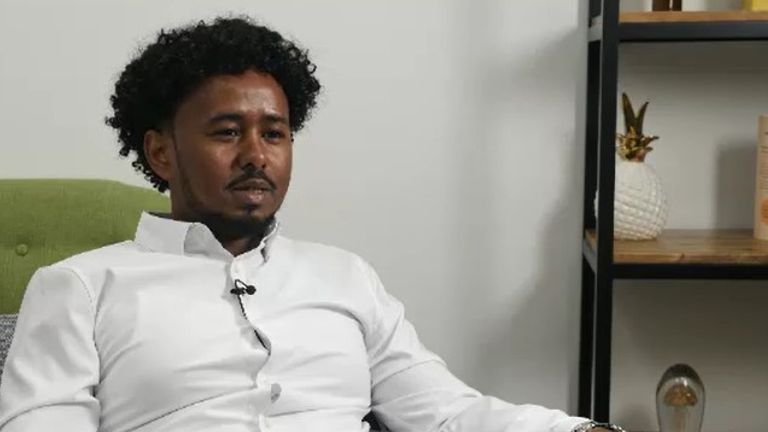
    Ahmed Mohammed, 21, is a refugee from Eritrea and says a delay in enrolment means he is years behind his age group.

    “Enrolment is a very hard process,” he told Sky News.

    “Sometimes they say you need an online application and as a person that doesn’t know English, you cannot do this and so you just give it up and the whole year goes by. It’s just wasted.”

    ‘I felt I was in the wrong place’

    Ahmed Mohammed talking to Sadiya Chowdhury about struggles with the education system in the UK as a refugee
    Image:Ahmed Mohammed says he is years behind his age group

    Ahmed says he was already behind because of the time it took to flee Eritrea and get enrolled in a UK school.

    “I couldn’t even write my surname. My mathematics was very basic because my last education was in grade 4 (9-10 years old).”

    “I remember being in a high-level GCSE class but the only thing I knew was plus, minus and multiplication. Everyone else was answering the teacher’s questions with ease.

    “I was thinking it’s because of me. I felt like I’m not smart or that I’m in the wrong place.”

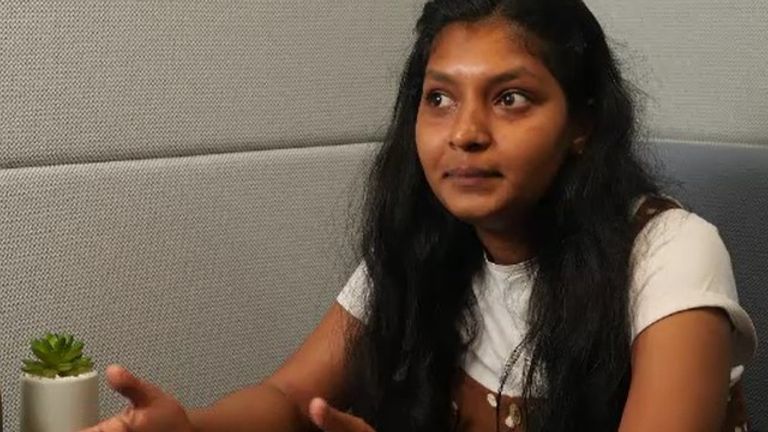
    Gobika, 24, is from Sri Lanka and struggling to get into university because she is yet to pass GCSE English.

    “I’d already taken a GCSE in Sri Lanka, but when I came here I was asked to take it again. So I’m doing GCSE English. It’s almost been five years,” she told Sky News.

    ‘I’m not able to plan my future’

    Gobika, 24, from Sri Lanka talking to Sadiya Chowdhury about struggles with the education system in the UK as a refugee
    Image: Gobika, 24, was forced to re-sit her GCSE in English

    “It’s very frustrating. People my age have started working in good jobs. For me, I’m still doing English GCSE. I need to go to university, and that’s for three years. So I’m not able to plan my future. I’m almost 25.”

    Refugee Education UK’s Chief Executive, Catherine Gladwell, says when students cannot start their education, it removes hope for the future.

    “We often have young people say to us that so much of what they get asked about is backward-looking.

    “A solicitor trying to establish their claim for asylum in the UK is going to be asking, ‘What happened to you in order for you to be referred to here?’ If they’re referred to a counselor, it’s about unpicking previous experiences.

    “Education is often the one thing in their lives that is actually forward-looking. So when you take that away, what you’re doing is taking away that young person’s chance to imagine and envision and be equipped for the future that they should have.”

    Most vulnerable

    A government spokesperson said it recognized that refugee and asylum-seeking children were among the most vulnerable in society – and that being in a school was vital to help children integrate into their communities.

    A statement added: “Local authorities are responsible for providing enough school places for children in their area, and should consider their linguistic and cultural needs.

    “Our Free Schools programme and capital funding for school places are also making sure every child has the opportunity of a place at a good school, whatever their background.”

    Source: skynews

  • Chinese research ship Yuan Wang 5 docks at Sri Lanka’s Hambantota port

    A Chinese research ship docked at a southern Sri Lankan port Beijing leases from the government on Tuesday, officials said, despite security concerns raised by India about the vessel’s presence in nearby waters.

    Port workers at Hambantota gave an enthusiastic welcome to the Yuan Wang 5, waving Sri Lanka and China flags, while the ship displayed a large banner reading: “Hello Sri Lanka.”
    However, the ship’s arrival appears to have aggravated tensions between New Delhi and Beijing, who have both spent billions of dollars on development and deals with Sri Lanka, an island of 22 million people that sits on a key trading route.

    The Yuan Wang 5 had originally requested permission to dock at the port last week, but the visit was delayed after concerns were raised about the ship’s presence, though India denied putting any pressure on Colombo.
    China says the ship is used for scientific research, but the US Defense Department says the ship is under the command of the People’s Liberation Army (PLA) and is capable of tracking satellites and missile launches.
    On Saturday, Sri Lanka’s Foreign Ministry said the government had engaged in “extensive” consultations with “all parties concerned” with a “view to resolving the matter in a spirit of friendship, mutual trust and constructive dialogue.”
    It said the ship had been given permission to dock on the condition that no scientific research was conducted in Sri Lankan waters.
    China's research and survey vessel, the Yuan Wang 5, arrives at Hambantota port on August 16, 2022.
  • Sri Lanka: Ranil Wickremesinghe elected president

    Sri Lankan MPs have elected prime minister Ranil Wickremesinghe as the country’s new president, despite his unpopularity with the public.

    Mr Wickremesinghe faces the task of leading the country out of its economic collapse and restoring public order after months of mass protests.

    He roundly defeated his main rival for the job, Dullus Alahapperuma, with 134 votes to 82 in the parliamentary vote.

    Sri Lanka’s ex-president Gotabaya Rajapaksa fled the country last week.

    He bolted to the Maldives and then Singapore after thousands of protesters stormed his presidential residences and other government buildings, calling for his resignation.

    They had also called for the resignation of Mr Wickremesinghe, who was appointed prime minister in May. Protesters burnt down his private home and also stormed his prime ministerial office in Colombo in demonstrations against his leadership.

    Sri Lanka is effectively bankrupt and facing acute shortages of food, fuel and other basic supplies.

    After his election, Mr Wickremesinghe told parliament the nation was “in a very difficult situation” adding that “we have big challenges ahead”.

    He is aiming to restore political stability so the country can resume negotiations with the International Monetary Fund (IMF) for a bailout package. He has been involved in the talks so far.

    The 73-year-old also called on his political opponents to work with his government for the good of the country.

    Mr Wickremesinghe has been in Sri Lankan politics for 45 years and has previously twice run for presidency been prime minister six times.

    The ruling Sri Lanka Podujana Peramnua (SLPP) party also said the majority of their members had backed Mr Wickremesinghe because of his economic credentials.

    “We feel that Ranil Wickremesinghe is the only person with the experience, the know-how and the capacity to provide solutions to the economic crisis,” General Secretary Sagara Kariyawasam told the Reuters news agency.

    However Mr Wickremesinghe’s election may spark further unrest and mass protests. On Wednesday, ahead of the results, barricades were set up around the parliament and soldiers lined the perimeter in preparation for any protests.

    The past fortnight has seen demonstrators calling on Mr Wickremesinghe to step down, as they view him as part of the political elite who had mishandled Sri Lanka’s finances.

    But he has defied those calls and last week assumed the position of acting president after Mr Rajapaksa fled. His victory means he will serve out the rest of the presidential term until November 2024.

    His challenger Mr Alahapperuma is a dissident MP in the ruling party who gained the backing of the main opposition. He had pledged to bring a new cross-party government to Sri Lanka that would “put an end to the deceitful political culture”. However he failed to muster majority support.

    Source: BBC


  • Sri Lanka swears in Ranil Wickremesinghe as acting leader after mass protests

    Sri Lanka’s prime minister Ranil Wickremesinghe has been sworn in as acting president as the country reels from an economic crisis and unrest.

    He replaces Gotabaya Rajapaksa who fled to Singapore after unprecedented mass protests which saw demonstrators overrun the presidential palace.

    Protesters defied a curfew to celebrate his resignation during the night.

    Sri Lanka is experiencing economic chaos as it faces an acute shortage of food, fuel and other basic supplies.

    The process of parliament electing a new president will begin on Saturday, with MPs likely to take a vote in a week’s time.

    Given the governing party has a majority, MPs are thought likely to back Mr Wickremesinghe, who has close links with the Rajapaksa family.

    But whether Sri Lanka’s public would accept this is another matter, because Mr Wickremesinghe’s resignation as PM was a key demand of protestors.

    Earlier this week, crowds stormed the former prime minister’s compound, clashing with security forces.

    A demonstrator, Manuri Pabasari, told the BBC at the time that a protest rally against Ranil Wickremesinghe was expected in the coming days.

    “He has no people’s mandate [and] is a well known Rajapaksa supporter,” she added. “I mean the new president and the new prime minister should be not a Rajapaksa supporter.”

    The governor of Sri Lanka’s central bank, Nandalal Weerasinghe, has warned the country may shut down if no stable government is formed soon.

    There was a “lot of uncertainty” over whether enough foreign exchange can be found to pay for essential petroleum, he told the BBC’s Newsnight programme, and progress on getting an international bailout package depended on having a stable administration.

    Meanwhile, Singapore says the ousted president Gotabaya Rajapaksa did not ask for political asylum when he arrived there.

    The former president, who arrived with his wife and two bodyguards, no longer has legal immunity as a head of state and his position is now more precarious as he tries to find a safe country to shelter in.

    He is expected to stay in Singapore for some time before possibly moving to the United Arab Emirates, Sri Lankan security sources told AFP news agency.

    Source: BBC

  • Sri Lanka political dynasty ends as Rajapaksa quits

    Sri Lanka’s parliament has accepted ousted president Gotabaya Rajapaksa’s resignation, ending rule by a family that wielded power for nearly 20 years.

    Mr Rajapaksa quit after fleeing to Singapore amid mass protests over his mismanagement of the economy.

    Sri Lanka is in the grip of economic chaos as it faces an acute shortage of food, fuel and other basic supplies.

    Mr Rajapaksa’s resignation paves the way for the country to begin the process of electing a new president.

    Sri Lanka’s speaker of parliament, Mahinda Yapa Abeywardena, said on Friday that he accepted Mr Rajapaksa’s resignation, which he received late on Thursday.

    He has called for parliament to convene on Saturday to start the process of electing a new leader. PM Ranil Wickremesinghe has been sworn in as acting president.

    Parliament has up to a month to elect a new leader, who could be Mr Wickremesinghe.

    Mr Rajapaksa fled to Singapore on Thursday from the Maldives, as huge protests roiled Sri Lanka. He is believed to have wanted to leave Sri Lanka before stepping down in order to avoid the possibility of arrest under a new administration.

    The embattled leader arrived in Singapore earlier on Thursday after first flying to the Maldives on Tuesday night. Reports say he is accompanied by his wife and two bodyguards.

    Singapore’s foreign ministry said Mr Rajapaksa had not asked for asylum or been granted asylum. “Singapore generally does not grant requests for asylum,” it added.

    Jubilation in the streets

    In the capital Colombo on Thursday, delighted demonstrators greeted news of the president’s departure with dancing.

    “We are beyond happy, but also beyond relieved so we can take a break and go back to our lives,” Viraga Perera told the BBC.

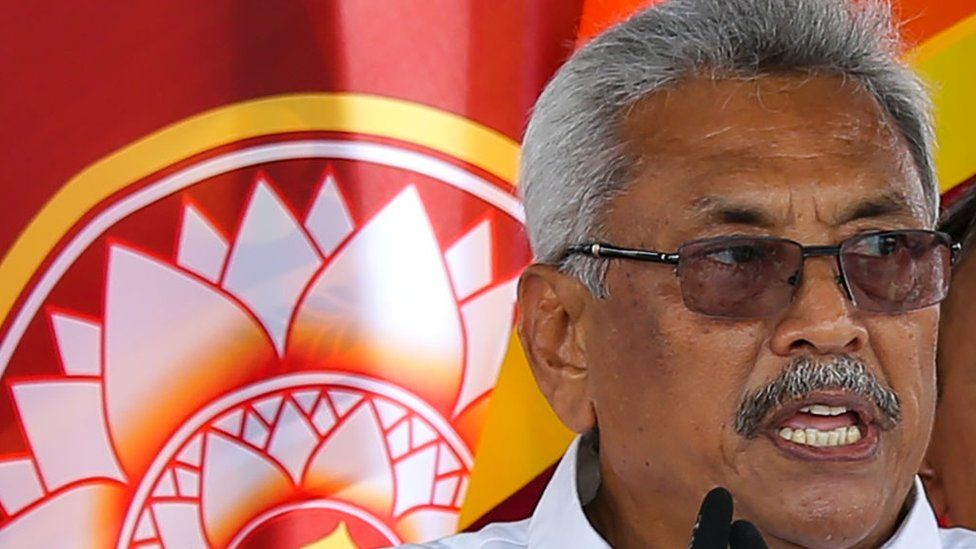
    Gotabaya Rajapaksa (file image)
    IMAGE SOURCE,GETTY IMAGES Image caption, President Gotabaya Rajapaksa defied calls for his resignation for months but has now fled

    But the crowds appeared smaller than before after Mr Wickremesinghe imposed a fresh round of curfews on Thursday to quell protests.

    The streets of Colombo were calmer as anti-government demonstrators began leaving some of the official buildings they had occupied.

    “We are peacefully withdrawing from the presidential palace, the presidential secretariat and the prime minister’s office with immediate effect, but will continue our struggle,” said a spokeswoman for the protesters.

    One person died and 84 others were injured during Wednesday’s protests, which took place at key landmarks around the capital, Colombo, including the prime minister’s office.

    Protesters broke into the presidential palace on Saturday and set fire to the prime minister’s private home.

    Police fired tear gas at protesters attempting to break down the gates of the prime minister’s office in Colombo, before finally forcing their way in. They later headed for parliament but did not get in.

    Wednesday saw some of the biggest demonstrations since the protests first began in April.

    Source: BBC

  • Sri Lanka: Prime Minister Ranil Wickremesinghe appointed acting President

    Prime Minister of Sri Lanka, Ranil Wickremesinghe, has been appointed Acting President, according to the country’s Parliament’s Speaker.

    It is reported that President Gotabaya Rajapaksa, who has fled the country on a military jet informed Ranil Wickremesinghe of the appointment under Article 37.1 of Sri Lanka’s constitution.

    But there remains no direct word from Rajapaksa himself.

    Per reports, all announcements concerning the country in recent days have come from the parliament speaker and the prime minister’s office.

    Ranil Wickremesinghe’s appointment comes at a time when citizens are displeased with the running of the country.

    Sri Lanka has defaulted on its debt for the first time in its history as the country struggles with its worst financial crisis in more than 70 years.

    Also, the country has suspended sales of fuel for non-essential vehicles as it faces its worst economic crisis in decades.

    In view of the challenges, citizens have hit the street to protest. The protesters are staying defiant in the face of a nation-wide curfew imposed by the prime minister’s office.

    They are gathered outside the Prime Minister’s office.

    But the police are at the scene and have fired more volleys of teargas on the crowd in a bid to drive them back.

    According to international media outlets, the avenue is wreathed in smoke.

    A protester in Colombo throws back a canister of tear gas fired by police forces
    Credit: BBC

    “People are running, trying to escape the gas. Those hit are dousing themselves with water and coughing.

    “Soldiers are still holding down the fort. Perched on the building’s gates, they’re even dumping water on protesters to help those struggling to breathe,” BBC reported.

    The protesters have managed to rip open the gates to the prime minister’s office in Colombo, but a wall of soldiers are holding them back.

    Soldiers stand on fences guarding the Prime Minister's office
    Credit: BBC

    A 31-year-old protester Viraga Perera told the BBC “the people here are here so they can have a vote for the future.”

    “Our country is facing an extreme economic crisis. We will keep coming, we will keep fighting until we have some assurance that we and our children have some future in this country,” the said protestor added.

    Amidst the crisis, Sri Lanka’s national television channel Rupavihini has suspended its telecast due to protestors entering the state television office.

    On the other hand, President Gotabaya Rajapaksa has confirmed his resignation due to the challenges facing the country.

    Rajapaksa is currently not in Sri Lanka but in Maldives with his wife and two security officials.

    His brother, former Finance Minister Basil Rajapaksa, has also left Sri Lanka and is said to be heading to the US, according to sources.

    Source: The Independent Ghana

  • Sri Lanka: President Gotabaya Rajapaksa flees the country on military jet

    President Gotabaya Rajapaksa has fled Sri Lanka on a military jet, amid mass protests over the island’s economic crisis.

    The country’s air force confirmed the 73-year-old flew to the Maldives with his wife and two security officials.

    In his absence, he has appointed Prime Minister Ranil Wickremesinghe as acting president.

    Mr Rajapaksa’s departure ends a family dynasty that has dominated Sri Lanka’s politics for the past two decades.

    The president had been in hiding after crowds stormed his residence on Saturday, and had pledged to resign on Wednesday 13 July.

    A source told the BBC that Mr Rajapaksa will not remain in the Maldives and intends to travel on to a third country.

    His brother, former Finance Minister Basil Rajapaksa, has also left Sri Lanka and is said to be heading to the US.

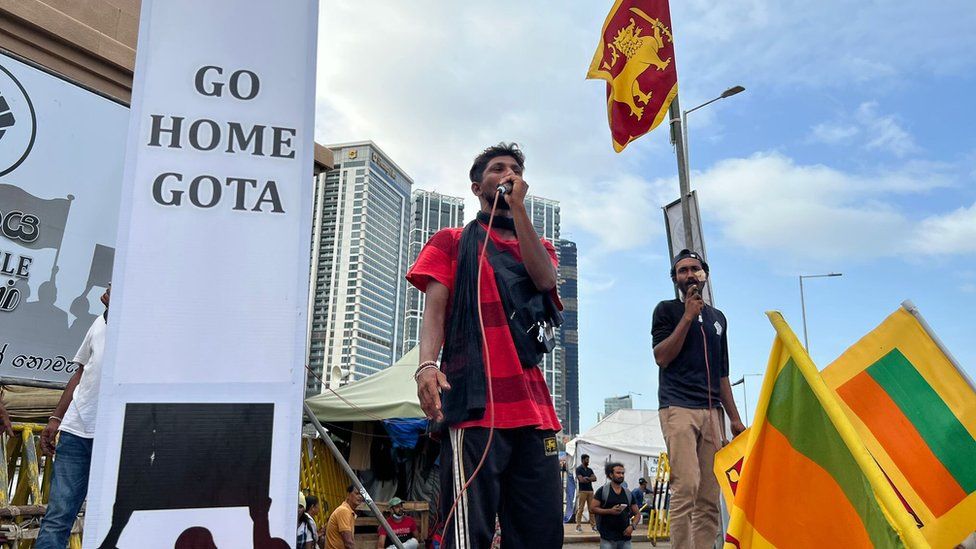
    As Sri Lankans awoke to the news, thousands of people took to the streets of the capital, Colombo. Many gathered at Galle Face Green, the city’s main protest site. Some listened to fiery speeches at a makeshift stage set up for ordinary people to take the mic.

    Punctuated by cries of “Victory to the struggle”, the rallying cry of the protest movement, speakers railed against a government and the leaders they feel have failed them.

    Sri Lankan Prime Minister, Ranil Wickremesinghe, has declared a state of emergency across the country and a curfew has been imposed in the western province, a spokesperson in his office said.

    Police have fired tear gas to disperse a group of protesters who were walking near the prime minister’s office and towards parliament.

    Some demonstrators were furious about Mr Rajapaksa’s departure, seeing a lack of accountability.

    “We don’t like it. We want to keep him. We want our money back! And we want to put all the Rajapaksas in an open prison where they can do farm work,” said protester GP Nimal.

    But 23-year-old university student Reshani Samarakoon told the BBC that the former president’s exile offered “hope that in the future we can eventually become a developed country, economically and socially”.

    A demonstrator in Colombo
    Image caption, One of the demonstrators in Colombo delivers a speech to the crowd

    Sri Lankans blame President Rajapaksa’s administration for their worst economic crisis in decades.

    For months they have been struggling with daily power cuts and shortages of basics like fuel, food and medicines.

    The leader, who enjoys immunity from prosecution while he is president, is believed to have wanted to flee abroad before stepping down to avoid the possibility of arrest by the new administration.

    The president’s departure threatens a potential power vacuum in Sri Lanka, which needs a functioning government to help start digging it out of financial ruin.

    Politicians from other parties have been talking about forming a new unity government but there is no sign they are near agreement yet. It’s also not clear if the public would accept what they come up with.

    Under the constitution, it’s the prime minister, Ranil Wickremesinghe, who should act in the president’s stead if the latter resigns. The prime minister is considered the president’s deputy in parliament.

    However, Mr Wickremesinghe is also deeply unpopular. Protesters set fire to his private residence on Saturday – he and his family were not inside – and he said he would resign to make way for a unity government, but gave no date.

    That leaves the parliament’s speaker as the next most likely to step in as caretaker president, constitutional experts say. But Mahinda Yapa Abeywardena is an ally of the Rajapaksas, and it is unclear whether the public would accept his authority.

    Whoever does become acting president has 30 days to hold an election for a new president from among members of parliament. The winner of that vote could then see out the remainder of Mr Rajapaksa’s term until late 2024.

    On Monday, the main opposition leader Sajith Premadasa told the BBC he would be tilting for the presidency. But he also lacks public support and there is deep public suspicion of politicians in general.

    The protest movement which has brought Sri Lanka to the brink of change also does not have an obvious contender for the country’s leadership.

    Source: BBC

  • Sri Lanka: President confirms resignation, PM’s office says

    Sri Lanka President Gotabaya Rajapaksa has confirmed he will be resigning, the prime minister’s office has said.

    It comes two days after crowds stormed the official residence of both leaders. Demonstrators are still occupying the buildings and are refusing to leave until both leaders are gone.

    The parliament Speaker had earlier said the president would resign on 13 July.

    Mr Rajapaksa’s current whereabouts are unknown. The BBC has been told that he is on a navy vessel at sea.

    His resignation was first announced by the parliament Speaker on Saturday, but many Sri Lankans responded with scepticism to the idea that he would relinquish power.

    On Monday, Prime Minister Ranil Wickremesinghe’s office said in a statement it had been informed by Mr Rajapaksa that he would step down on Wednesday.

    However, there has still been no direct word from Mr Rajapaksa.

    Under Sri Lanka’s constitution, his resignation can only formally be accepted when he resigns by letter to the parliament Speaker – which has yet to happen.

    Mr Wickremesinghe had earlier also said he would step down from his position.

    Mr Rajapaksa had departed the presidential palace before protesters entered on Saturday, calling for his resignation.

    His brother, former Prime Minister Mahinda Rajapaksa, is at a naval base in the country, the sources say.

    For months, Sri Lankans have been calling for the resignations of the Rajapaksa brothers.

    The president has been blamed for the country’s economic mismanagement, which has caused shortages of food, fuel and medicine for months.

    Inside the occupied palace on Sunday, protesters were refusing to budge.

    “Our struggle is not over,” student protest leader Lahiru Weerasekara said, quoted by AFP. “We won’t give up this struggle until [President Rajapaksa] actually leaves,” he said.

    “The next couple of days are going to be extremely uncertain times as to see what transpires politically,” political analyst and human rights lawyer Bhavani Fonseka told Reuters, adding that it would be interesting to see if the two leaders “actually resign”.

    Other politicians in Sri Lanka met on Sunday to discuss how to handle a smooth transition of power.

    The speaker of Sri Lanka’s parliament told the BBC World Service Newshour programme a new cross-party coalition government would need to be formed within a week of the president officially stepping down.

    Sri Lanka: The basics

    • Sri Lanka is an island nation off southern India: It won independence from British rule in 1948. Three ethnic groups – Sinhalese, Tamil and Muslim – make up 99% of the country’s 22 million population.
    • One family of brothers has dominated for years: Mahinda Rajapaksa became a hero among the majority Sinhalese in 2009 when his government defeated Tamil separatist rebels after years of bitter and bloody civil war. His brother Gotabaya, who was defence secretary at the time, is the current president but says he is standing down.
    • Presidential powers: The president is the head of state, government and the military in Sri Lanka but does share a lot of executive responsibilities with the prime minister, who heads up the ruling party in parliament.
    • Now an economic crisis has led to fury on the streets: Soaring inflation has meant some foods, medication and fuel are in short supply, there are rolling blackouts and ordinary people have taken to the streets in anger with many blaming the Rajapaksa family and their government for the situation.
    line

    Sri Lankan anti-government protesters invade the president's office during a protest
    IMAGE SOURCE,GETTY IMAGES Image caption, Protesters made their way into the house, chanting slogans and waving the national flag on Saturday

    The palace storming on Saturday was the culmination of months of mainly peaceful protests in Sri Lanka.

    Huge crowds converged on the official residence of President Rajapaksa, chanting slogans and waving the national flag before breaking through the barricades and entering the property.

    Footage online showed people roaming through the house and swimming in the president’s pool, while others emptied out a chest of drawers, picked through the president’s belongings and used his luxurious bathroom.

    Mr Rajapaksa vacated his official residence on Friday as a safety precaution ahead of the planned protests, two defence ministry sources said, according to Reuters.

    Although it is Mr Rajapaksa’s official residence, he usually sleeps at a separate house nearby.

    Source: BBC

  • Sri Lanka Energy Minister warns petrol stocks about to run dry

    Sri Lanka’s Energy Minister has issued a stark warning over the country’s fuel stocks as it faces its worst economic crisis in more than 70 years.

    On Sunday, Kanchana Wijesekera said the nation only had enough petrol left for less than a day under regular demand.

    He also said its next petrol shipment was not due for more than two weeks.

    Last week, Sri Lanka suspended sales of petrol and diesel for non-essential vehicles as it struggles to pay for imports like fuel, food and medicines.

    Mr Wijesekera told reporters that the country had 12,774 tonnes of diesel and 4,061 tonnes of petrol left in its reserves.

    “The next petrol shipment is expected between the 22nd and 23rd [of July],” he added.

    A shipment of diesel is expected to arrive at the weekend, however, Mr Wijesekera warned that the country does not have enough money to pay for planned fuel and crude oil imports.

    He said Sri Lanka’s central bank could only supply $125m for fuel purchases, far less than the $587m needed for its scheduled shipments.

    Mr Wijesekera added that the country owed $800m to seven suppliers for purchases it made earlier this year.

    It came after Sri Lanka banned sales of fuel for private vehicles until next week.

    Experts believe it is the first country to take the drastic step of halting sales of petrol to ordinary people since the 1970s oil crisis, when fuel was rationed in the US and Europe.

    The island nation of 22 million people is facing its worse economic crisis since gaining independence from the UK in 1948 as it lacks enough foreign currency to pay for imports of essential goods.

    Acute shortages of fuel, food and medicines have helped to push up the cost of living to record highs in the country, where many people rely on motor vehicles for their livelihoods.

    Last Thursday, an International Monetary Fund team concluded a fresh round of talks with Sri Lanka over a $3bn (£2.5bn) bailout deal.

    While no agreement has been reached yet, the team said in a statement that it had made “significant progress on defining a macroeconomic and structural policy package”.

    It added that it had “witnessed some of the hardships currently faced by the Sri Lankan people, especially the poor and vulnerable who are affected disproportionately by the crisis”.

    The cash-strapped country has also sent officials to the major energy producers Russia and Qatar in a bid to secure cheap oil supplies.

    Source: BBC

  • Non-essential petrol sales halted for two weeks in Sri Lanka

    Sri Lanka has suspended sales of fuel for non-essential vehicles as it faces its worst economic crisis in decades.

    For the next two weeks only buses, trains, and vehicles used for medical services and transporting food will be allowed to fill up with fuel.

    Schools in urban areas have shut and officials have told the country’s 22 million residents to work from home.

    The South Asian nation is in talks over a bailout deal as it struggles to pay for imports such as fuel and food.

    On Monday, the government said it will ban private vehicles from buying petrol and diesel until 10 July.

    Bandula Gunewardena, a spokesperson for Sri Lanka’s cabinet, said Sri Lanka “has never faced such a severe economic crisis in its history”.

    The cash-strapped country has also sent officials to the major energy producers Russia and Qatar in a bid to secure cheap oil supplies.

    Sri Lanka’s economy has been hit hard by the pandemic, rising energy prices, and populist tax cuts.

    Without enough foreign currencies to pay for imports of essential goods, an acute shortage of food, fuel and medicines has helped to push the cost of living to record highs.

    Over the weekend, officials said the country had only 9,000 tonnes of diesel and 6,000 tonnes of petrol to fuel essential services in the coming days.

    It has been estimated that the stocks would last for less than a week, under regular demand.

    “We are doing everything we can to get new stocks but we don’t know when that will be,” power and energy minister Kanchana Wijesekera told reporters on Sunday.

    Alex Holmes, a senior economist at Oxford Economics, told the BBC the fuel restrictions were “yet another small sign of a worsening crisis”.

    “Mobility appears to have already been severely limited given that people were waiting in [long] queues for fuel. But the complete ban for private vehicles goes one step further, and will compound the economic pain,” he added.

    In May, the country defaulted on its debts with international lenders for the first time in its history.

    Last week, a team from the International Monetary Fund arrived in Sri Lanka for talks over a $3bn (£2.4bn) bailout deal.

    The government is also seeking assistance from India and China to import essential items.

    Prime Minister Ranil Wickremesinghe said earlier this month that the country needed at least $5bn over the next six months to pay for essential goods such as food, fuel and fertiliser.

    In recent weeks, the government has also called on farmers to grow more rice and given government officials an extra day off a week to grow food, amid fears of a shortage.

    Source: BBC

  • Sri Lanka defaults on debt for first time in its history

    Sri Lanka has defaulted on its debt for the first time in its history as the country struggles with its worst financial crisis in more than 70 years.

    It comes after a 30 day grace period to repay $78m (£63m) of unpaid debt interest payments expired on Wednesday.

    The governor of Sri Lanka‘s central bank said the country was now in a “pre-emptive default”.

    Defaults happen when governments are unable to meet some or all of their debt payments to creditors.

    It can damage a country’s reputation, making it harder to borrow the money it needs on international markets, which can further harm confidence in its currency and economy.

    Asked whether the country was now in default, central bank governor P Nandalal Weerasinghe said: “Our position is very clear, we said that until they come to the restructure [of our debts], we will not be able to pay. So that’s what you call pre-emptive default.

    “There can be technical definitions… from their side they can consider it a default. Our position is very clear, until there is a debt restructure, we cannot repay,” he added.

    Sri Lanka is seeking to restructure debts of more than $50bn it owes to foreign creditors, to make it more manageable to repay.

    The country’s economy has been hit hard by the pandemic, rising energy prices, and populist tax cuts. A chronic shortage of foreign currency and soaring inflation had led to a severe shortage of medicines, fuel and other essentials.

    In recent weeks, there have been large, sometimes violent, protests against President Gotabaya Rajapaksa and his family due to the growing crisis.

    The country has already started talks with the International Monetary Fund over a bailout and needs to renegotiate its debt agreements with creditors.

    The government has said previously that it needs as much as $4bn this year.

    Mr Weerasinghe also warned that Sri Lanka’s already very high rate of inflation was likely to rise further.

    “Inflation obviously is around 30%. It will go even [higher], headline inflation will go around 40% in the next couple of months,” he said.

    Source: BBC

  • One dead as firefighters battle blaze aboard oil tanker off Sri Lanka

    Firefighting crews from Sri Lanka and India are working to put out a large blaze aboard an oil tanker that has been burning since Thursday, off the coast of the south Asian island nation.

    One Filipino crew member died after a boiler in the main engine room exploded, causing the fire, the Sri Lankan Navy said.

    All other persons on board, 22 in all, were rescued from the ship, which is carrying 270,000 metric tons of crude oil.

    Photos and video showed thick black smoke pouring from one end of the Panamanian-flagged tanker, MT New Diamond, 38 nautical miles (70 kilometers) off Sangamankanda Point in southern Sri Lanka.

    The 20-year-old vessel had been bound from Ahmadi in Kuwait to the Indian port of Paradip, according to Marine Traffic, which monitors global shipping.

    Speaking to CNN, Sri Lankan Navy Captain Indika Desilva said that as of Friday morning local time, the fire was “still on.”

    “Efforts are on to prevent the fire from spreading to the cargo oil. No information has been received of an oil spill yet. Firefighting continues,” he said.

    The Sri Lanka Navy, Sri Lanka Air Force, Sri Lanka Ports Authority, the Indian Navy and the Indian Coast Guard are all working to put out the fire.

    According to a statement from the Sri Lankan Navy, currently the fire has had “no effect” on the oil stored on board, and “necessary steps are being taken to prevent the fire from spreading to those crude oil storage facilities.”

    “There is still no risk of the ship leaking oil into the ocean,” the statement said.

    Source: CNN