Tag: survivors

  • Turkey earthquake: Survivors living in fear and panic on streets

    Turkey earthquake: Survivors living in fear and panic on streets

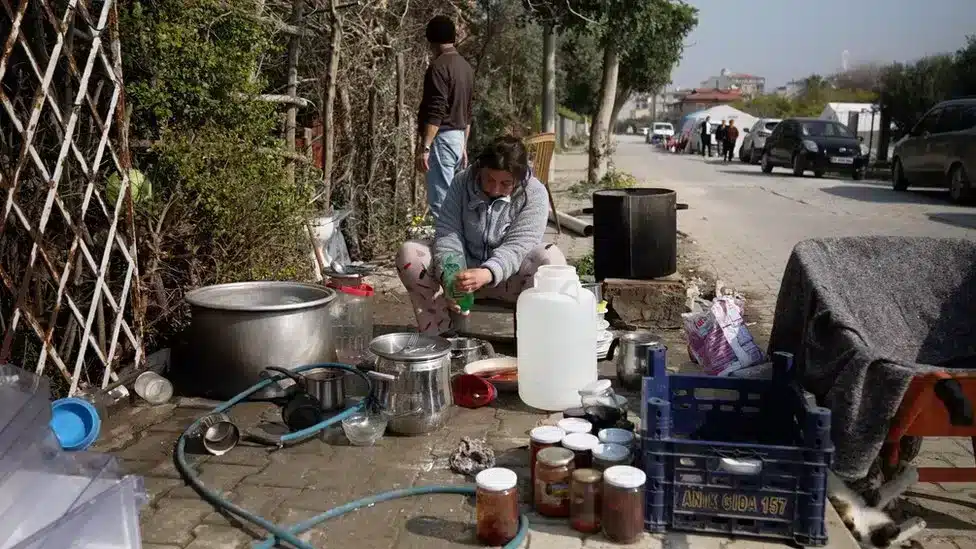
    Songul Yucesoy meticulously cleans her dishes, soaping the plates and silverware before washing off the bubbles and setting them out to dry. Unremarkable scene—except she’s sitting outside in the shadow of her derelict home.

    It tilts at an alarming angle, the window frames are hanging out and there’s a large chunk of the rusty iron roof now resting in the garden.

    A month after the devastating earthquakes in Turkey and Syria, those who survived face an uncertain future. One of their most serious problems is finding somewhere safe to live. At least 1.5 million people are now homeless, and it’s unclear how long it will take to find them proper shelter.

    The Turkish disaster agency Afad, meanwhile, says almost two million people have now left the quake zone. Some are living with friends or loved ones elsewhere in the country. Flights and trains out of the region are free to those who want to leave. 

    But in the town of Samandag, near the Mediterranean coast, Songul is clear that she and her family aren’t going anywhere. “This is very important for us. Whatever happens next – even if the house falls down – we will stay here. This is our home, our nest. Everything we have is here. We are not going to leave.”
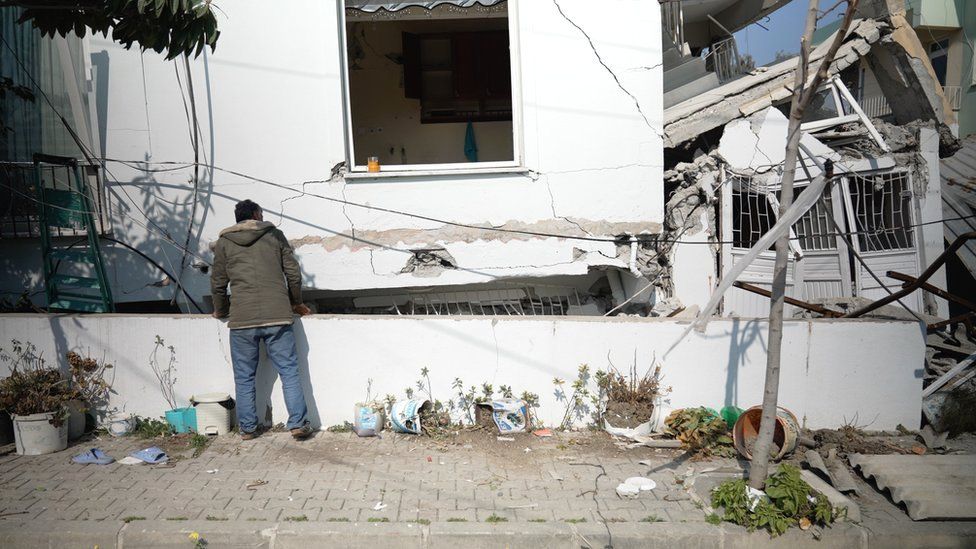
    Damage to a property in the Turkish town of Samandag, caused by an earthquake
    Image caption,The deadly quake destroyed properties in the region, leaving thousands of families homeless
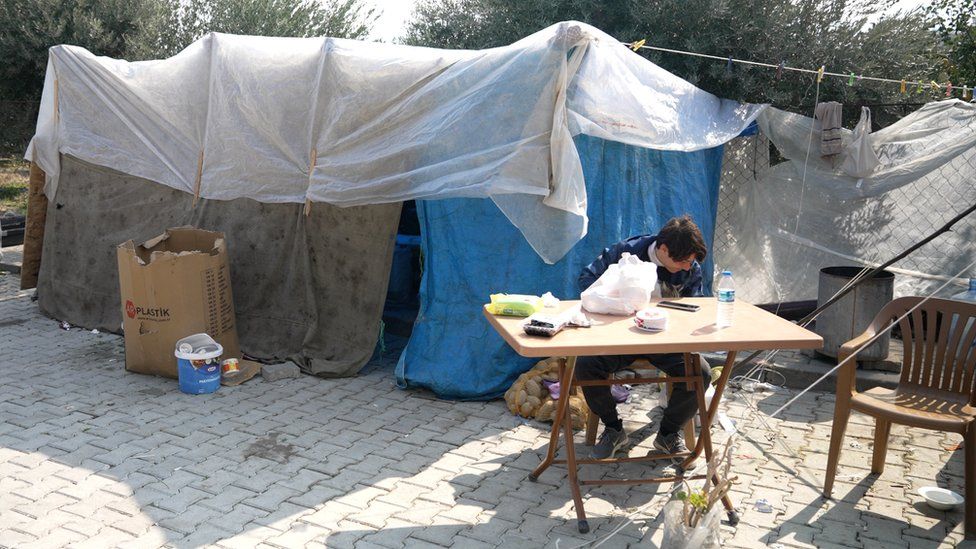
    Tents have appeared everywhere in Samandag, from sprawling new encampments to individual ones dotted amidst the rubble
    Image caption,Tents have appeared everywhere in the town of Samandag, but more are needed

    Precious pieces of furniture have been carefully pulled from the house and set up outside. On top of a polished wooden side table is a holiday souvenir, a picture made of shells from the Turkish resort of Kusadasi. There’s a bowl of fruit, with white mould creeping across a large orange. Things that look normal indoors feel strange and out of place when they’re sitting in the street.

    Right now, the whole family is living in three tents just a few steps away from their damaged home. They sleep and eat there, sharing food cooked on a small camping stove. There’s no proper toilet, although they’ve recovered one from the bathroom and are trying to plumb it in in a makeshift wooden shed. They’ve even created a small shower area. But it’s all very basic, and the lack of space and privacy is obvious. These tents are cramped and overcrowded.

    It’s been an agonising month for Songul. Seventeen of their relatives were killed in the quake. Her sister Tulay is officially missing. “We don’t know if she is still under the rubble,” she tells me. “We don’t know whether her body was taken out yet or not. We’re waiting. We can’t start mourning. We can’t even find our lost one.”
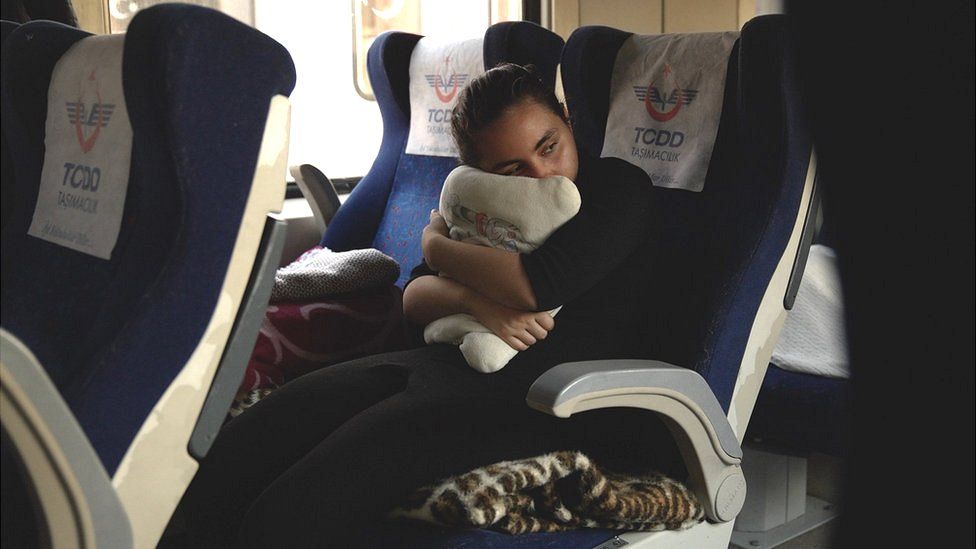
    A young girl rests on a train
    Image caption,People are sleeping on seats in train carriages in the port city of Iskenderun

    Songul’s brother-in-law Husemettin and 11-year-old nephew Lozan died when their apartment building in Iskenderun collapsed around them as they slept. We visited what was left of their home, a sprawling pile of twisted debris. Neighbours told us three blocks of flats had fallen.

    “We brought Lozan’s body here,” Songul says quietly. “We took him from the morgue and buried him close to us in Samandag. Husemettin was buried in the cemetery of the anonymous, we found his name there.”

    A picture of the family smiles out of Tulay’s still-active Facebook profile, their arms around each other, faces close. Lozan holds a red balloon tightly.

    The homelessness crisis created by the quake is so acute because of the real shortage of safe spaces that are left standing. More than 160,000 buildings collapsed or were badly damaged. The United Nations Development Programme (UNDP) estimates at least 1.5 million people are still inside the quake zone, but with nowhere to live. It’s hard to know the real figure, and it could be far higher.

    Study cabins are arriving, but too slowly. Tents have appeared everywhere, from sprawling new encampments to individual ones dotted amidst the rubble. There still aren’t enough. News that the Turkish Red Crescent had sold some of its stock of taxpayer-funded tents to a charity group – albeit at cost price – led to frustration and anger.

    In some cities, people are still living inside public buildings.
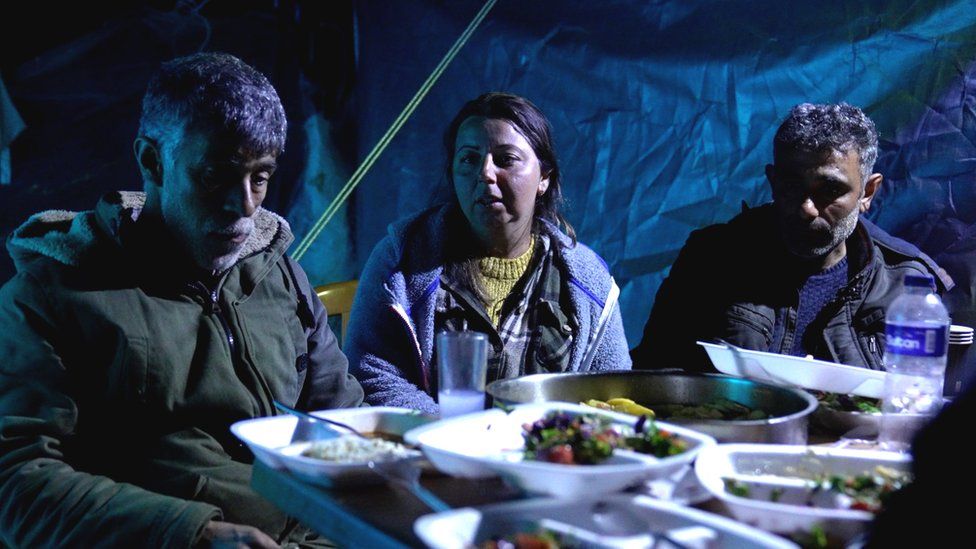
    Songul Yucesoy (centre) is now homeless, and eats alongside a tent
    Image caption,Families are sharing tents together, weeks after the disaster

    In Adana, I met families sleeping on blankets and mattresses spread across a volleyball court. In the port city of Iskenderun they have made their home on two trains parked at the railway station. Seats have become beds, luggage racks are filled with personal possessions and the staff there try hard to keep things clean and tidy. Tears fill the eyes of one young girl as she hugs a pillow instead of a teddy bear. This isn’t home.

    Songul’s children are struggling, too. Toys and games are stuck inside dangerous houses, and there’s no school. “They’re bored, there’s nothing to keep them busy. They just sit around. They play with their phones, then go to bed early once they run out of charge.”

    When night falls, things are even harder. There’s no electricity in Samandag now. Songul has draped colourful solar lights across their white tent, just above the bold UNHCR logo. Homeless in their own country, they’re not refugees, but they’ve still lost everything.

  • Survivors of DR Congo slaughter make ends meet in an IDP camp

    Survivors of the Kishishe massacre recounts how they escaped to Kitshanga, a camp for internally displaced people that has housed many displaced people for more than 20 years, after leaving the bloody east of the Democratic Republic of Congo.

    “We were told that many people died in Kishishe,” says one woman who followed the river’s path to escape the massacre with some of her children.

    They saw horrors in their village of Kishishe fled and walked in fear and cold for dozens of kilometres to escape the M23 rebels who are backed by Rwanda, according to the UN.

    An AFP team met Samuel, Tuyisenge, Eric, Florence and others on Friday in a camp for displaced people in the locality of Kitshanga, in the Masisi territory, where they arrived in recent days.

    Depending on the route they took, they travelled 40 or 60 kilometres through the hills to arrive at this camp called Mungote, after fleeing the November 29 killings.

    According to a preliminary U.N. investigation, at least 131 civilians were executed that day by the M23 (“March 23 Movement”), a predominantly Tutsi rebellion that has seized large swaths of Rutshuru territory, neighbouring Masisi, north of the North Kivu provincial capital, Goma, in recent months.

    The rebels are also accused of rape, abduction and looting, committed against the civilian population in retaliation for an attack by mainly Hutu armed groups.

    “The M23 rebels started shooting everywhere,” said Samuel, a young man who said he saw six dead – three members of his family, including his older brother James, and three other residents of Kishishe.

    “I decided to run away and it took me a week to get to Kitshanga on foot,” he says.

    Tuyisenge is a 30-year-old mother. “I was in church and I was able to escape. Some resisted and were killed. I saw nine dead,” she says, with tears in her eyes.

    “I have seven children, but I came here with three. The other four have disappeared and my husband, I have no news”, she adds, surrounded by other women who also want to tell the terror they have experienced.

    They have nothing, just the clothes they were wearing when they ran away.

    A little further on, in the middle of the displaced persons’ huts, Florence, 45 years old, explains that she walked for several days to get here. She has no news of her husband or two of her children. “In the camp, the one who takes pity on me gives me sweet potatoes,” she says sadly.

    Eric is haunted by the image of his older brother’s two children who “came out of the house shouting ‘there’s shooting’”. “They were shot right at the door and died on the spot”, their names were Jacques and Musayi.

    According to the Congolese government, UN experts and the American and Belgian diplomatic corps, Rwanda supports the M23. Kigali disputes this, accusing Kinshasa of supporting Hutu rebels, some of whom were involved in the 1994 genocide of Rwandan Tutsis.

    The former colonial power Belgium tweeted a statement about the massacre.

    It called on Rwanda “to cease all assistance to the M23 and to continue to use all the means at its disposal to persuade it to re-engage in a process of disarmament, demobilization and community reintegration.”

    There have been war-displaced people in Kitshanga for years, some having arrived at the time of a previous M23 offensive. The movement occupied Goma for about 10 days in late 2012, before being defeated the following year by the Congolese army supported by UN peacekeepers.

    The M23 took up arms again late last year, blaming the Kinshasa government for not respecting commitments to demobilize its fighters.

    According to its officials, the Mungote camp was already home to more than “40,000 households” and about 4,000 more arrived just recently.

    “Up to four families are sleeping in a hut, men, women and children. People are dying,” says Vumilia Peruse, vice president of the camp. “They arrive with nothing… The authorities must intervene as soon as possible to avoid a catastrophe,” she said.

    “We thought that this war was between soldiers and that we would be spared,” comments Toby Kahunga, president of the civil society of the Bashali chiefdom (grouping of villages). “But they are killing people,” he said, demanding that Rwandan President Paul Kagame “withdraw his men.”

    Source: African News


  • Survivors of suicide attempts call for decriminalisation of act

    Some survivors of attempted suicide have called on the government to decriminalize the law on suicide attempts and instead channel resources towards its prevention.

    Their calls come as the world marks World Suicide Prevention Day observed on 10th September every year, to provide worldwide commitment and action to prevent suicides.

    In Ghana, suicide rates in the country have decreased from 7.80 in 2010 to 6.60 in 2019, with 1500 reported cases of suicide nationwide yearly and over 700,000 global suicide deaths annually. Also, in Ghana, in each reported case of suicide are four unreported cases, summing the number of unreported cases to almost 6000 yearly.

    The 1960 Criminal Code Act 29, Section 57 states: “Whoever attempts to commit suicide shall be guilty of a misdemeanour.”

    But describing the law as senseless and meaningless, Mr. Edmond Tetteh Padi, a 48-year-old survivor of three suicide attempts and a resident of Somanya in the Eastern Region, argued that victims of suicide attempts need to be counselled and not prosecuted.

    “I don’t think that law is meaningful and sensible enough… it’s like something is urging you, something is pushing you to do it, either psychological or whatever, so at the end of the day, the person rather needs to be counselled than rather you prosecuting the person and putting the person in jail,” he reasoned.

    Proposing how such survivors should rather be used in sensitizing members of the public against the act, he said, “I think that they have to give us counselling and then maybe gather people that have made an attempt and survived to come out and talk to people that are thinking or want to do a similar thing that all hope is not lost yet.”

    Mr. Edmond Tetteh Padi is one of several thousands of Ghanaians who have survived attempts to take their life, his case on three occasions – and all three had a common underlining cause – frustrations due to what he described as life’s failures.

    Speaking about his experiences for the very first time to GhanaWeb’s Eastern Regional Correspondent, Michael Oberteye in Somanya, the divorcee and father of one attributing his actions to dejection following failures in his life and hardships especially considering his age, Mr. Padi intimated, “It is like out of perplex and frustration simply because what I was expecting in life, I was not getting it and I thought that if such situations should continue then the best way is to end my life.”

    Adding that he carefully thought over his intended actions before proceeding, the businessman and commercial farmer recalling the last incident in 2019 disclosed, “I sat down, and I thought of it for three days, and I took action. I bought chemicals that I thought that if I take it, I’ll surely die, so I mixed the DDT with water, and then I took it.”

    The suicide survivor who said the chemical didn’t take his life attempted the act again three days later, this time with rat poison but added that just before he could drink the toxic substance, he received a call from someone he described as God-sent who counselled him.

    Describing his survival as miraculous, he said, “I’ll say all the occasions of attempting, I took the drugs, but they didn’t work…after taking the medicines, I went to bed expecting to die, but I didn’t, so I’ll say survival is a miracle and the work of God.”

    GhanaWeb Special: Suicide survivors share how they escaped death

    0 seconds of 15 minutes, 39 secondsVolume 90%

    Asked if he had finally gotten over his troubles and was not likely to attempt the act again, Mr. Padi answered in the affirmative, adding that he was ever ready to serve as an advocate against the act.

    Madam Tettey Kenie, a 51-year-old food seller at Asitey in the Lower Manya Krobo Municipality, attempted suicide on two occasions, the second only three weeks ago.

    Also attributing her actions to financial challenges and abandonment by her estranged husband, the mother of seven (one deceased) sharing her story, narrated that being abandoned by her former husband more than ten years ago after realizing their daughter whom she had delivered couldn’t speak and being pursued by her debtors whom she had credited food items from convinced her that death was the only way out.

    “I had a daughter with my husband, but he abandoned us due to the child’s inability to speak. My debtors and the police were also coming after me, and I ran away. When I returned home, I realized I had no money, so I decided to end it all.

    “I mixed DDT with salt and drank the contents. I realized the walls of my stomach had shed,” she narrated, adding that it took her landlord to rush her to the hospital after she disclosed her actions to him.

    Three weeks ago, Madam Kenie repeated her suicide attempt by mixing powerzone bleach with alcohol and akesha (a local chemical used to scrub floors and other surfaces), once more attributing her actions to financial difficulties. Again, she survived after being rushed to the hospital.

    Asked if she could be tempted to attempt taking her life if her predicaments persisted, she answered: “While my debtors come after me and I have the money? For that, I can’t stand it.”

    She called for the repeal of the act criminalizing attempted suicide in Ghana, arguing that such persons need support and not be prosecuted and possibly jailed.

    Madam Kenie’s brother, 40-year-old Mr. Stephen Odei Kwabla confirmed his elder sister’s actions, adding that he personally counsels his sister against her suicidal habits.

    He also condemned the law criminalizing attempted suicide and called for its immediate repeal.

    Mr. Eric Narh, a medical statistician, however, maintained that the law must be maintained to serve as a deterrent to persons who may want to take their lives.

    “The law should be maintained because once there’s a law, it means that once you want to commit any crime, you should look at the magnitude of the crime because once it involves a penalty for you to be sentenced or jailed or to be fined, you know that once what you’re going to do [can land you in prison, you avoid it],” said the statistician.

    He further called on the government to resource and empower the state agencies and service providers, particularly the Mental Health Authority of Ghana, Ghana Health Service, and the Department of Social Welfare, among others, to sensitize and make comprehensive psychological support available at all levels of the health system and in educational institutions for people who might have the tendency to attempt suicide.