Tag: Tanzanian

  • Unrest grips Tanzania as post-election protests spread across the country

    Unrest grips Tanzania as post-election protests spread across the country

    Protests have erupted in several Tanzanian cities as opposition supporters denounce Wednesday’s presidential and parliamentary elections, alleging widespread fraud and manipulation.

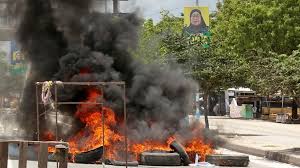
    Demonstrators have taken to the streets in major urban centers, with some crossing into Kenyan territory where they blocked roads, lit bonfires, and tore down posters of President Samia Suluhu Hassan.

    Kenyan police confirmed two deaths following violent clashes involving Tanzanian protesters and security forces at the border.

    The demonstrations were triggered by claims that the government had suppressed democracy by imprisoning the main opposition leader and disqualifying another candidate, moves critics say were aimed at ensuring President Samia’s re-election.

    Tensions deepened on Thursday after the electoral commission began releasing results showing Samia with nearly 95 percent of the votes in Mbea Province, with similar leads reported across mainland Tanzania and Zanzibar.

    European Union lawmakers have described the vote as “a fraud that had been unfolding for months,” while observers reported multiple incidents of violence and intimidation on election day.

    In a statement, Tanzania’s military chief, Gen Jacob Mkunda, blamed “ill-intentioned individuals” for causing destruction during the polls. Gunfire was heard in Mwanza, while clashes were reported in Dodoma and Dar es Salaam, where roads were sealed off under tight security.

    Kenyan authorities have cautioned their citizens against joining protests near the Namanga border, where commercial activity has been paralyzed.

    Security forces in Tanzania fired tear gas to disperse protesters, leading to hours of confrontation. The U.S. Embassy reported that several key roads, including the one leading to Dar es Salaam’s international airport, remained closed on Thursday.

    An eyewitness in Mwanza told the BBC that hundreds of protesters poured into the city before security forces opened fire and launched tear gas, injuring several people.

    The government has instructed public servants to work from home until Friday as tensions mount nationwide.

    Amnesty International expressed concern over reports that a civilian and a police officer were killed in clashes, calling the situation “deeply troubling.”

    Authorities have imposed a nighttime curfew in Dar es Salaam, where hospitals, including Muhimbili, are reportedly receiving dozens of injured protesters.

    Internet access remains heavily restricted across the country, with Amnesty urging the government to restore connectivity to avoid escalating the crisis. Protesters have reportedly turned to a walkie-talkie app, Zello, to coordinate their actions.

    President Samia is widely expected to secure a second term as key opposition figures remain sidelined. Her ruling party, which has governed Tanzania since independence, is also projected to maintain its dominance.

    Opposition leader Tundu Lissu remains in custody on treason charges he denies, while ACT-Wazalendo candidate Luhaga Mpina was disqualified on technical grounds. Sixteen smaller parties with little public backing were cleared to participate in the vote.

    President Samia, who assumed office in 2021 following the death of John Magufuli, initially earned praise for easing political restrictions but now faces accusations of suppressing dissent through arrests and abductions.

    Tanzania’s internet blackout entered its third day on Friday as reports of renewed protests surfaced and opposition groups in Zanzibar rejected the results of the recent elections.

    President Samia Suluhu Hassan, whose administration faces accusations of political repression, is alleged to have tightened her grip on power through a widely uncontested vote in which key opponents were either imprisoned or disqualified.

    Wednesday’s election sparked widespread chaos, with hundreds of protesters taking to the streets of Dar es Salaam and other major cities. Demonstrators tore down campaign posters, attacked polling stations, and clashed with police, prompting authorities to impose a curfew and shut down internet access nationwide.

    Foreign journalists were barred from covering the polls, and the ongoing communications blackout has made it difficult to verify reports from the ground.

    Residents in the towns of Sinza and the capital, Dodoma, told AFP that demonstrations continued late Thursday, with protesters burning tyres in defiance of security forces.

    Unconfirmed reports suggest several fatalities, but hospitals and clinics have declined to comment, citing fear of reprisals.

    Local media outlets have not been updated since Wednesday, and President Hassan has yet to address the escalating unrest.

    The only official comment so far came from Army Chief Gen. Jacob Mkunda, who described the protesters as “criminals” in a statement issued late Thursday.

    In Zanzibar, a popular tourist destination, President Samia Suluhu Hassan’s ruling party was declared winner of Thursday’s local elections, a result the opposition has fiercely rejected.

    The opposition party, ACT-Wazalendo, accused the ruling Chama Cha Mapinduzi (CCM) of rigging the vote, claiming, “They have robbed the people of Zanzibar of their voice. The only solution to deliver justice is through a fresh election.”

    A senior ACT-Wazalendo official told AFP that ballot boxes were stuffed, voters were allowed to cast multiple ballots without identification, and party observers were expelled from counting centers.

    The CCM was expected to hold a press briefing later in the day to address the allegations.

    At an opposition meeting point in Zanzibar, frustration and fear were palpable. “There has never been a credible election since 1995,” said a 70-year-old man, referring to the country’s first multi-party poll. Others declined to share their names, expressing fear of reprisals. “We are afraid of speaking because they might come to our houses and pick us up,” one said.

    Analysts say President Hassan has faced internal opposition from sections of the military and allies of her late predecessor, John Magufuli, since assuming office in 2021. They believe she sought a decisive victory to consolidate her power.

    Ahead of the election, authorities banned the main opposition party, Chadema, and charged its leader with treason.
  • Landslide in Tanzanian mine claims the lives of 22

    Landslide in Tanzanian mine claims the lives of 22

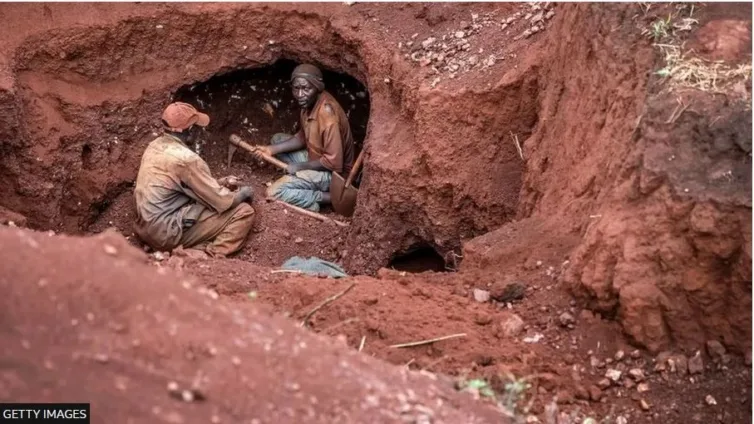
    A landslide at the Ng’alita mine in Bariadi district, Simiyu region, resulted in the tragic death of twenty-two individuals, as reported by district commissioner Simon Simalenga.

    The incident occurred on Saturday when a group engaged in mining activities in a restricted area due to heavy rains, according to Simalenga’s statement to Reuters news agency.

    Upon learning of the incident, President Samia Suluhu Hassan expressed her profound sadness at the loss of lives.

    “These fellow Tanzanians were small miners in the area, trying to earn a living for themselves, their families,” she said in a post on X, formerly known as Twitter.

    Mr Simalenga said he was initially told that there were 19 to 20 people trapped in the mines, but that 22 bodies ended up being retrieved.

    According to quotes attributed to Faustine Mtitu, the acting commander of the region’s fire and rescue forces, as reported by AFP news agency, the search has been concluded. Mtitu stated that he is “convinced that there are no more bodies trapped in the rubble.”

    Mr. Simalenga mentioned that approximately three weeks ago, a group of individuals commenced mining activities in the mineral-rich area. Subsequently, the government implemented safety procedures in response. The area had been restricted due to persistent heavy rains, leading to flash floods.

    “The regional mining officer visited them and stopped them from mining as it was working on the required procedures” Mr Simalenga said.

    Unregulated and illegal mining is common in Tanzania, which is one of the largest gold producers in the world.

  • Tanzanian students reported missing in Israel amid ongoing Palestinian-Israeli conflict

    Tanzanian students reported missing in Israel amid ongoing Palestinian-Israeli conflict

    Tanzanian authorities have reported that two Tanzanian students are missing in Israel in the midst of the continuing Palestinian-Israeli conflict.

    The Ministry of Foreign Affairs and East African Cooperation issued a statement in the capital city of Dodoma, confirming that the missing students are part of a group of 260 Tanzanian students who are studying modern agricultural methods and techniques in Israel.

    The government is actively collaborating with relevant authorities and other stakeholders to determine the whereabouts of the missing students and ensure their safety.

    The ministry is also maintaining regular communication with the families of the missing students to provide updates on the ongoing efforts.

    In a related development, nine Tanzanians living in Israel have chosen to take up the government’s offer of assistance to return home. They were received at the Julius Nyerere International Airport in Dar es Salaam on October 18.

    https://www.youtube.com/watch?v=ecC0Snak0Uo
  • Tanzanian and Kenyan presidents joke about their language skills

    Tanzanian and Kenyan presidents joke about their language skills

    Kenyans and Tanzanians on social media are arguing playfully about their presidents’ comments on who is better at speaking Swahili.

    Swahili is the main language spoken in two countries in East Africa. Kenyans are often made fun of for not speaking Swahili properly, while Tanzanians are made fun of for not speaking English well.

    At a recent meeting about farming and food in Tanzania, President Samia Hassan scolded the Kenyan President William Ruto for not using the right greetings in Swahili language.

    The other day, Mr. Ruto visited us and taught us to say ‘jambo’, but the correct way to greet is ‘habari ya mchana’. “They are Kenyan people. we should make them take Swahili lessons,” she said in Swahili.

    But CNN reporter Larry Madowo, who is also from Kenya and was leading the discussion, defended their president.

    I have to support and protect my president. Because Kenyans and Tanzanians are like siblings, we speak to Tanzanians using poor Swahili and they respond to us using poor English. We continue doing this, just like it’s the truth,” he said in Swahili, and the audience laughed loudly.

    The exchange showed that the neighboring countries have a friendly relationship and similar culture.

  • Tanzania allegedly prevents European MPs from visiting country

    Tanzania allegedly prevents European MPs from visiting country

    Three politicians from Europe claim that the Tanzanian government has stopped them from going to the country to look into the forced removals of the native Maasai people.

    The three members of the Green Party, Michele Rivasi, Claude Gruffat, and Pierrette Herzberger-Fofana, said that they were supposed to start their visit on Monday but they were told less than 24 hours before that it had been delayed.

    They said it was the third time that they were not allowed to go on a mission to observe something since the end of last year.

    The Maasai say they were kicked out of their traditional home in the northern part of the country without their consent.

    The government says that the people who live in this area have chosen to move on their own, because it is important to protect the environment.

  • Tanzania detains politician and a lawyer during port protest

    Tanzania detains politician and a lawyer during port protest

    A lawyer and an opposition politician were detained by Tanzanian police on charges of inciting and plotting to organise massive rallies intended to topple the government.

    Through an attorney, Mpaluka Nyagali and Boniface Anyasile Mwabukusi both denied wrongdoing.

    According to Human Rights Watch, this follows the imprisonment or threat of prosecution of 22 people who had opposed parliament for authorising a port management agreement between Tanzania and an Emirati corporation.

    The Tanzanian government has been accused of selling off its nation, although this accusation has been refuted by activists, people, and opposition leaders.

    The lack of a time frame for the end of Emirati management of the ports in the deal particularly worries critics.

    According to Tanzanian activist Maria Sarungi-Tsehai, who spoke on the BBC’s Newsday show, the country’s human rights situation has been deteriorating and there has been significant public opposition to the port contract, which has resulted in crackdowns.

    “Mostly citizens who are not politicians” were being targeted, and she claimed that “it’s never been this bad.”

    The two arrested, according to her, were transferring the matter to a higher court for an appeal when they were detained. They had been involved in a case at a regional court seeking to prevent an Emirati corporation from managing Tanzania’s ports, which they lost.

  • Woman from Tanzania marries three men

    Woman from Tanzania marries three men

    A mother of two, identified as Nellie, has astounds people by telling them about her happy marriage to three husbands, Jimmy, Danny, and Hassan.

    She married her brother in law after her husband of eight years died in a car accident and later proceeded to marry the other two men. Nellie is a car dealer and provides for all her three husbands who are currently unemployed.

    The most fascinating part is that she bought all her three husbands cars, they all live in the same house and they all spend quality time with her.

    Nellie is confident that her husbands can not cheat since they are happy and claims that she treats them equally.

    They have all lived together for three years and the husbands say that this has resulted to them becoming bestfriends. Their respect for each other is what has made them live peacefully.

  • Tanzanian victim killed in Ukraine’s body is returned home

    Tanzanian victim killed in Ukraine’s body is returned home

    On Friday January 27, 2023, the body of a Tanzanian national killed in combat with Russian soldiers in Ukraine was brought home.

    Nemes Tarimo, 37, died three months ago after agreeing to sign up with the Russian mercenary group Wagner.

    His body was received by his family at the main airport in Dar es Salaam with burial scheduled for Saturday in his home village in the southern highlands of country.

    Tanzanian victim killed in Ukraine’s body is returned home

    Mr Tarimo had been in Moscow as an ICT master’s student at the Russian Technological University. But he was then imprisoned some time after January 2021 for what were described as drugs-related offences.

    Last year, he was enticed with a deal: sign up with the Russian mercenary group Wagner and be pardoned or stay in prison.

    Source: BBC

  • Tanzanian Precision Air plane crashes into Lake Victoria

    A Tanzanian passenger plane has crashed into Lake Victoria as it attempted to land in the lakeside town of Bukoba, killing at least three people.

    The Precision Air flight was carrying 43 people, 26 of whom have been rescued and sent to hospital, an official said.

    The two pilots survived the crash but remain trapped inside the cockpit and have been speaking to local officials.

    Rescue workers and local fishermen are on the scene trying to rescue those still inside the aircraft.

    Emergency workers have used ropes to pull the ATR-42 aircraft closer to the shore of Lake Victoria, Africa’s largest lake. One end of the runway at Bukoba airport lies right next to the shore.

    After the crash, the plane was almost completely submerged with only the brown and green tail fin above the water.

    Top regional official Albert Chalamila said that three bodies had been recovered so far following the crash, which has been blamed on bad weather.

    President Samia Suluhu Hassan has expressed her condolences to those affected and called for calm as the rescue operation continues.

    The plane was flying from Tanzania’s biggest city, Das es Salaam, to Bukoba via Mwanza.

    Precision Air is Tanzania’s largest private airline and is partly owned by Kenya Airways. It was founded in 1993 and operates domestic and regional flights.

    Source: BBC

  • More than 400 poters, tour guides join groups battling fire – Tanzanian authorities

    World leaders are set to discuss action to tackle climate change, at the UN climate summit in Egypt.

    It follows a year of climate-related disasters and broken temperature records.

    What is the UN climate summit?

    UN climate summits are held every year, for governments to agree steps to limit global temperature rises.

    They are referred to as COPs, which stands for “Conference of the Parties”. The parties are the attending countries that signed up to the original UN climate agreement in 1992.

    COP27 is the 27th annual UN meeting on climate. It will take place in Sharm el-Sheikh from 6 to 18 November.

    Why are COP meetings needed?

    The world is warming because of emissions produced by humans, mostly from burning fossil fuels like oil, gas and coal.

    Global temperatures have risen 1.1C and are heading towards 1.5C, according to the UN’s climate scientists, the Intergovernmental Panel on Climate Change (IPCC).

    If temperatures rise 1.7 to 1.8C above 1850s levels, the IPCC estimates that half the word’s population could be exposed to life-threatening heat and humidity.

    To prevent this, 194 countries signed the Paris Agreement in 2015, pledging to “pursue efforts” to limit global temperature rises to 1.5C.

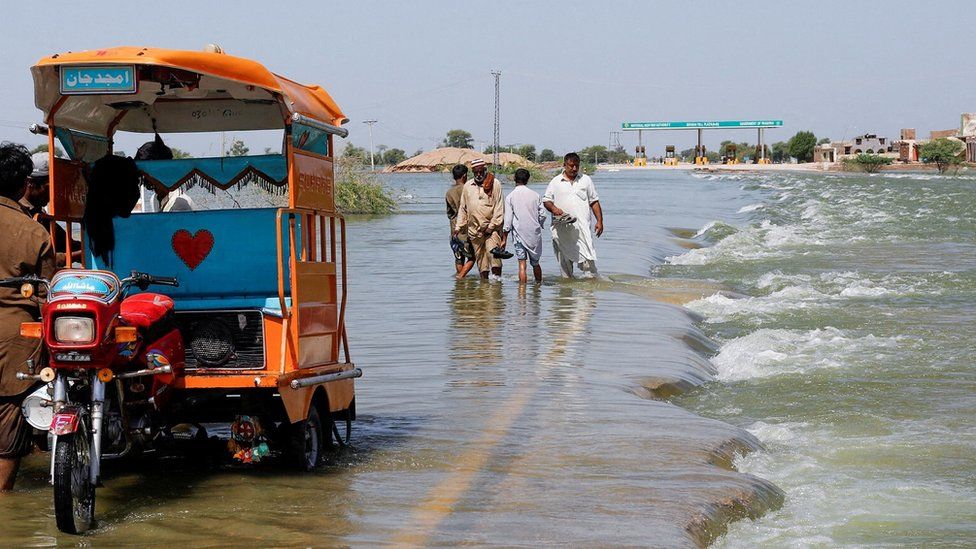
    Flooded road with stranded travellers in PakistanImage source, Reuters
    Image caption, The Pakistani floods this year are a “wake-up call” to the world on the threats of climate change, experts have said

    Who will be at COP27?


    More than 200 governments are invited.

    However, some leaders of major economies including Russian leader Vladimir Putin are not expected to attend. Delegates from the country are still expected.

    Other countries, including China, have not confirmed whether their leaders will take part.

    Hosts Egypt have called on countries to put their differences aside and “show leadership”.

    Environmental charities, community groups, think tanks, businesses and faith groups will also take part.

    Why is COP27 in Egypt?


    This will be the fifth time a COP has been hosted in Africa.

    The region’s governments hope it will draw attention to the severe impacts of climate change on the continent. The IPCC says Africa is one of the most vulnerable regions in the world.

    Currently, 17 million people are estimated to be facing food insecurity in east Africa because of drought.

    However, choosing Egypt as the venue has attracted controversy.

    Some human rights and climate campaigners say the government has stopped them attending because they have criticised its rights record.

    What will be discussed at COP27?


    Ahead of the meeting, countries were asked to submit ambitious national climate plans. Only 25 have – so far.

    COP27 will focus on three main areas:

    • Reducing emissions
    • Helping countries to prepare and deal with climate change
    • Securing technical support and funding for developing countries for these activities

    Some areas not fully resolved or covered at COP26 will be picked up:

    • Loss and damage finance – money to help countries recover from the effects of climate change, rather than just prepare for it
    • Establishment of a global carbon market – to price the effects of emissions into products and services globally
    • Strengthen the commitments to reduce coal use

    There will also be themed days for focused talks and announcements on issues including gender, agriculture and biodiversity.

    Do we expect any sticking points?

    Finance has been long been an issue at climate talks.

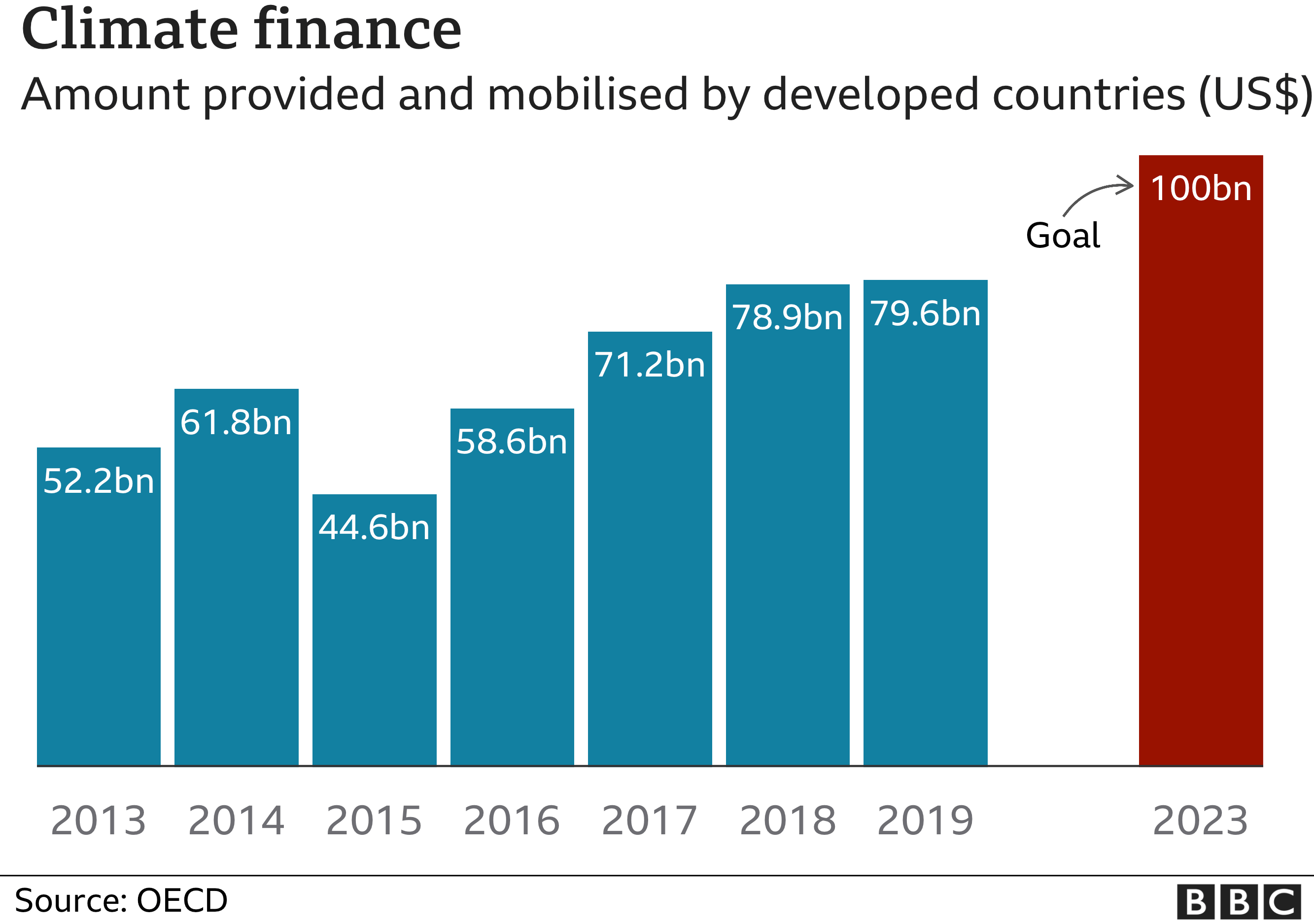
    In 2009, developed countries committed to give $100 billion a year, by 2020, to developing countries to help them reduce emissions and prepare for climate change.

    The target was missed and moved back to 2023.

    Climate finance chart

    But developing nations are also calling for payments for “loss and damage” – the impacts faced now.

    An option for making payments was excluded from the Bonn climate talks, after pushback from wealthier nations who feared they would be forced to pay compensation for decades.

    The EU agreed discussions should take place at COP27.

    You will hear a lot of jargon:

    • Paris accord: The Paris Agreement united all the world’s nations – for the first time – in a single agreement on tackling global warming and cutting greenhouse-gas emissions
    • IPCC: The Intergovernmental Panel on Climate Change examines the latest research into climate change
    • 1.5C: Keeping the rise in global average temperature below 1.5C – compared with pre-industrial times – will avoid the worst impacts of climate change, scientists say

    How will we know if it has been successful?

    It depends who you speak to.

    Developing countries, as a minimum, will want loss and damage finance to be an agenda item. They will also be pushing to have a date set for when they might start to receive payments.

    Developed nations will be looking for more commitment from large developing countries – such as China, India, Brazil, Indonesia and South Africa – to move away from coal, the dirtiest of the fossil fuels.

    There are also pledges from last year – on forests, coal, and methane – that more countries may sign up to.

    However, some scientists believe world leaders have left it too late and no matter what is agreed at COP27, 1.5C will not be achieved.


    Source: BBC

  • Tanzanian firefighters battle blaze on Mount Kilimanjaro


    More than 300 people have been mobilised to tackle a blaze on the slopes of Tanzania’s famous Mount Kilimanjaro, local officials said Saturday, with police and local people helping firefighters.

    The fire was burning near the camp Karanga site used by climbers ascending the mountain, at about 4,000 metres altitude on the south side of mountain.

    Mount Kilimanjaro, situated in the northeast of the country, is Africa’s highest summit at 5,895 metres (19,340 feet).

    Officials have not yet established how the fire started, but it comes exactly two years after another blaze, which raged for a week in October 2020 across 95 square kilometres (37 square miles).

    No one was killed in that fire and on Saturday officials said that the current blaze did not threaten any of the tourists on the mountain. Kilimanjaro is popular with both trekkers and mountain climbers.

    The fire started on Friday evening and was spread by strong winds during the night, said regional officials. They could not yet say how much ground it covered.

    A plane transporting local officials and leading members of the Tanzania National Parks Authority (TANAPA) for a visit to evaluate the situation was unable to land on Saturday.

    “Large clouds and the smoke prevented us from reaching the fire zone,” the prefect of Kilimanjaro, Nurdin Babu, told journalists. “We will try again when the situation improves.”

    The chief of the region’s police, Yahaya Mdogo, said that they were focusing on getting the fire under control and could not yet say how big it was or what impact it was having on the population.

    But videos posted on social media appeared to show the flames devouring vegetation and giving off thick clouds of grey smoke.

    Police, firefighters, students from the local university and even staff from tour operators were working hard to bring the blaze under control, TANAPA said in a brief statement.

    Mount Kilimanjaro, with its snow-capped peak, is known around the world.

    The forests surrounding it form part of a national park, and Kilimanjaro National Parks is registered by UNESCO as a World Heritage site, in part because many endangered species live there.

    Source: Africa News

  • Tanzania gets first Oscars Awards entry In 20 years

    A Tanzanian film has been shortlisted for an Academy Award, ending a two-decade wait for the country’s participation in the award.

    The film Vuta N’kuvute – which means “hard struggle” in Swahili – has been shortlisted in the “Best International Film” category at the 95th Academy Awards.

    Released in Swahili and with a predominantly African cast, the film tells the story of a young Indian-Zanzibari woman whose romance blossoms on the back of a political revolt in the last days of British imperial rule.

    “The future of Tanzanian cinema is finally in our hands. A wave of Swahili filmmakers is growing every day with pride, intelligence and boldness,” posted Amil Shivji, the film’s co-producer, on Instagram.

    In September 2021, Vuta N’kuvute made history by becoming the first Tanzanian feature film to screen at the Toronto International Film Festival (TIFF).

    Tanzania’s first appearance at the Academy Awards was Maangazi: The Ancient One in 2002.

    Source: Africa News

  • Contract rebel Bernard Morrison retained as YANGA sack 14 players

    Ghanaian winger Bernard Morrison survived a massive overhaul at Tanzanian giants Young Africans after fourteen players were shown the exit door.

    The former Ashantigold forward who has been in the news for all the bad reasons was retained by the club even though he was reported to have signed for only six months when he joined the club in January.

    Morrison’s clash with Police in Tanzania last week was believed to be a way of earning a bad boy reputation which will force the club to let him leave.

    The winger is also rumoured to have penned a deal in principle with rivals Simba FC.

    Despite all the bad news surrounding the player, he escaped the overhaul while 14 others, including club captain Papy Tshishimbi have been released.

    YANGA secured CAF Champions League qualification after finishing second in the Tanzanian topflight league, and are bent on keeping some key players including Morrison.

    The 27-year-old joined the Tanzanian giants from South African side Orlando Pirates in 2020.

    Source: Ghana Soccernet

  • ‘My Tanzanian family is split over coronavirus’ – BBC reporter

    BBC Tanzania reporter Sammy Awami writes that President John Magufuli’s faith-based approach to coronavirus has caused tension in his family.

    Since the first case of coronavirus was confirmed in Tanzania in March, I have been bombarded with messages and phone calls from colleagues, friends and family members living abroad.

    They’ve been wondering: how did a country with some of the most relaxed coronavirus measures in Africa manage to so far escape the kind of crisis which has visited many parts of the world.

    It’s a question puzzling even those of us who are living in the country.

    President Magufuli was among the few leaders who declined to impose any sort of lockdown and has scorned what he’s termed unnecessary panic in other countries.

    Yet, despite what many of his critics – and the more anxious among us – feared was a woefully reckless approach, the nation seems to have avoided for now the catastrophic number of deaths that many anticipated.

    The most confusing thing about all of this, is that no-one really knows how.

    ‘Prayers are true healing’

    One of the issues is that we don’t have any figures to go on.

    President Magufuli chose to put statistics in lockdown rather than people.

    As analyst Aidan Eyakuze said: “He officially made the country operate in data darkness.”

    Three doctors I spoke to off record said hospitals had not been overwhelmed.

    Some would argue that they support the government’s narrative because of fear of possible retaliation if they were to speak out.

    The president of the Medical Association of Tanzania, Dr Elisha Osati, has said there has never been a cover up, but he now wants to run for parliament as a candidate for the governing Chama Cha Mapinduzi party.

    In a situation where the government is not releasing figures and journalists cannot access health facilities to investigate independently, it’s the doctors’ word against their doubters.

    While some government health officials warned the public that the virus posed a real threat and urged them to follow basic hygiene guidelines, the president encouraged people to carry on with their business and pray to God for protection.

    As a devout Catholic, he told a congregation of worshippers that prayers are where “true healing” is found, and the disease had been been “eliminated thanks to God”.

    The president’s stance made things awkward between me and both my immediate and extended family.

    Most of my close relatives are supporters of the president and all of them are die-hard, thoroughly devout Christians.

    ‘WhatsApp battleground’

    From the very start of the outbreak, when daily reports of case numbers started to climb, I became increasingly worried about their safety.

    But the creeping politicisation of coronavirus in the country made it hard to convince some of my loved ones that they needed to take precautions.

    The family WhatsApp group became a battleground.

    It was flooded with a cocktail of re-shared media supporting the president and pseudo-science urging people to throw caution to the wind and hope for the best.

    They were also anxious about the loss of income that could result from a fierce lockdown.

    And as we learnt of the police brutality used in neighbouring countries to enforce such restrictions, this was only compounded.

    Take three of my uncles for instance, all of whom are full-time pastors.

    For them, the church is not only their core spiritual and social community, it is also their main source of income.

    ‘I tried to educate older relatives’

    My parents run a convenience store in their neighbourhood in the capital, Dodoma.

    It’s their sole source of income and a spot where they meet with their neighbours and friends on a daily basis.

    Because they are older I was concerned that their daily movements put them at risk.

    So, I set out to craft WhatsApp messages tailored to older family members to try to educate them about the pandemic, and convince them to stay at home.

    Unlike people living in other countries, they do have a choice.

    Do they listen to me, stay at home and lose their livelihood? Or follow the president’s advice to carry on their business and pray for the best?

    ‘Inventing a new enemy’

    Of course they believe the virus is deadly. But they also believe in prayers – perhaps even more so when their earnings are on the line.

    In a country where almost everyone identifies with one religion or another, and where the majority of people live hand-to-mouth, the president honed in on faith and income to promote his strategy.

    The president also made sure to invent a new enemy in the fight against the pandemic – the West.

    He consistently refers to powerful Westerners as “mabeberu”, literally “male goats”.

    The term was coined during the independence struggle which referred to a colonialist. This resonates well with the older generation, like that of my parents and uncles.

    Mr Magufuli alleged that the “mabeberu” and their cronies in the country were keen to use the virus to distract the country from achieving its economic goals.

    In one of his freestyle speeches he even suggested that the West could plant the virus on imported goods just to hurt Tanzanians.

    The president hearkened back to the era of measles and the early years of HIV/Aids, reminding people of a time when some parents stopped their children from visiting neighbours, for fear that their sons and daughters would be infected.

    At this point the government’s policy seems to be: “If people are not dropping dead in the streets, then life should go on.”

    It’s a risky strategy, but one that many here are willing to accept, and pray that the government is right.

    Source: BBC

  • Tanzania opposition figure Tundu Lissu returns from exile

    Tanzanian opposition politician and presidential hopeful Tundu Lissu has returned from exile in Belgium where he underwent treatment after he was shot multiple times three years ago.

    Lissu, a former politician with the Chadema main opposition party, was welcomed by hundreds of supporters, who clamoured around his car as he waved from an open sunroof on Monday.

    A critic of President John Magufuli, Lissu was shot 16 times in an attack by unknown gunmen in the administrative capital, Dodoma, in September 2017.

    At the time, Magufuli condemned the shooting and ordered security forces to investigate, but no one has been arrested.

    Lissu was arrested eight times in the year leading up to his attack and charged with incitement, among other alleged offences. His most recent arrest was in August 2017 – two weeks before he was shot.

    Upcoming election

    Tanzania will hold a general election on October 28, and the United States last month accused the country of seeking to “stifle democratic norms” ahead of the polls, with a string of arrests of opposition figures and the closure of a newspaper.

    Lissu’s return comes as the top opposition parties consider joining forces behind a single candidate to challenge Magufuli, who seeks a second five-year term.

    In an interview with AFP news agency shortly before leaving for Tanzania, Lissu said he was “going back home to try and fight for the presidency”.

    “Whether we are going to have free and fair elections, that is not the question, we don’t expect that. The issue is … are we going to have our lives by the end of the electoral process?”

    He said the opposition and his political party had “gone through hell during these five years”.

    “The biggest thing has been the untold suffering. Killings of political leaders, attacks on political leaders, abductions, disappearances, torture, illegal prosecution of opposition leaders and activists in courts of law, with trumped-up charges.”

    Lissu said his heath was good after his ordeal, in which he was shot at his home.

    “You have to be aware of the fact that I was shot 16 times. All my limbs, my legs, my waist, my arms, my stomach were basically ripped apart by 16 bullet shots and therefore to mend me, to put me back on my feet, took a long time.

    “Of course I’m not as I was three years ago: my leg is shorter by several centimetres (an inch or so). But otherwise, I’m fine.”

    Lissu told AFP that Magufuli’s handling of the coronavirus pandemic had been “a national embarrassment” and raised concerns about the holding of the election.

    Magufuli claims there are no more cases in the country, which last released official figures in April. However Tanzanian truck drivers regularly test positive in neighbouring countries.

    “So we have total blackout on corona and because there is total blackout, the president wants the world to believe that there is no corona. It’s a disaster.”

    Source: aljazeera.com

  • Tanzania’s Benjamin Mkapa had malaria, not coronavirus

    Former Tanzanian president Benjamin Mkapa was suffering from malaria and died of a heart attack, his family said Sunday, scotching rumours that he succumbed to coronavirus.

    “Mkapa was found with malaria and he was admitted for treatment since Wednesday,” family member William Erio revealed during a funeral mass broadcast on state television TBC1.

    Mkapa, who ruled the East African country for two terms from 1995 to 2005, died early Friday aged 81 in a Dar es Salaam hospital but the government did not reveal the cause of the death.

    “He was feeling better on Thursday and I was with him until 8pm that day,” Erio said.

    “After watching the evening news bulletin, he died of cardiac arrest,” Erio added, saying he wished to dispel rumours spreading on social media that Mkapa had contracted the new coronavirus.

    NO TRANSPARENCY

    President John Magufuli attended the funeral mass along with his vice president and prime minister at the national stadium.

    The opposition has accused Magufuli’s government of a lack of transparency regarding its handling of a pandemic which the president said last Monday was no longer present in the country as he urged tourists to return.

    Tanzania ceased publishing official statistics on the virus on April 29 and, unlike its neighbours, has taken no specific measures designed to halt its spread.

    Officially, Tanzania has logged a mere 509 Covid-19 cases to date whereas neighbours such as Kenya and DR Congo have respectively registered more than 16,000 and more than 8,000.

    QUESTIONS

    Questions arose over Mkapa’s cause of death after Magufuli did not immediately make an official announcement on the time, place and cause in line with 2006 legislation.

    Mkapa, who was the country’s third president after independence from Britain in 1962, will be buried in his home village in the southeastern region of Mtwara on Wednesday.

    After leaving office he remained active, taking part in mediation talks in Kenya after 2007-08 election violence.

    He also attempted, unsuccessfully, to mediate between Burundi’s government and opposition groups after a disputed 2015 election plunged the country into crisis.

    Source: theeastafrican.co.ke

  • Tanzanian president accused of coronavirus cover-up

    A Tanzanian opposition party, ACT, has accused the president of “broadcasting a select few statistics” to falsely claim that there’s been a big drop in the number of coronavirus patients in hospitals.

    President John Magufuli told an applauding church congregation on Sunday that there had been a “sharp decline”, adding, “God has answered your prayers.”

    That was despite a report days before by the US embassy in Tanzania saying many hospitals had been “overwhelmed”.

    On Monday, the ACT said in a statement it “will not simply assume that the president is right in saying we are winning the battle against coronavirus, just because he says so”.

    It wants the government to release “the full set of data” on infection and death rates, and adds that the last such report was made more than a fortnight ago.

    “Transparency is essential. President Magufuli must commit to this core principle of governance. He owes it to the people of Tanzania,” the statement adds.

    Source: bbc.com

  • Tanzanian president promises to import coronavirus ‘cure’

    The president of Tanzania says he will send a plane to Madagascar to import a herbal tonic which has been touted as a cure for coronavirus by the country’s president.

    Congo-Brazzaville’s president has also promised to import the drink.

    It is produced from the artemisia plant – the source of an ingredient used in a malaria treatment.

    The World Health Organization has said there is no proof of any cure and has advised people against self-medicating.

    The drink was launched as Covid-Organics was being marketed after being tested on fewer than 20 people over a period of three weeks, the president’s chief of staff Lova Hasinirina Ranoromaro told the BBC.

    In response to the launch of Covid-Organics, the WHO said, in a statement sent to the BBC, that the global organisation did not recommend “self-medication with any medicines… as a prevention or cure for Covid-19”.

    It reiterated earlier comments by WHO head Tedros Adhanom Ghebreyesus that there were “no short-cuts” to finding effective mediation to fight coronarvirus.

    International trials were under way to find an effective treatment, the WHO added.

    In March, the US-based National Center for Complementary and Integrative Health warned against purported coronavirus remedies, including herbal therapies and teas – saying the best way to prevent infection was to avoid exposure to the virus.

    Speaking on TV, Tanzania’s President John Magufuli said he was already in contact with the government of Madagascar and would despatch an aircraft to the island nation to collect the medicine.

    “I am communicating with Madagascar, and they have already written a letter saying they have discovered some medicine. We will despatch a flight to bring the medicine so that Tanzanians can also benefit. So as the government we are working day and night,” he said.

    Mr Magufuli has already been widely criticised for his reaction to the coronavirus pandemic.

    He has encouraged the public to continue gathering in places of worship, while much of the world has faced lockdown.

    Tanzania’s delay in enforcing stricter measures to prevent further spread of coronavirus in the country, could have led to the spike in positive cases, according to the WHO.

    The country has 480 confirmed cases of coronavirus while Congo-Brazzaville has 229 and Madagascar has 135.

    Source: bbc.com