Tag: tear gas

  • India police once more target protesting farmers with tear gas

    India police once more target protesting farmers with tear gas

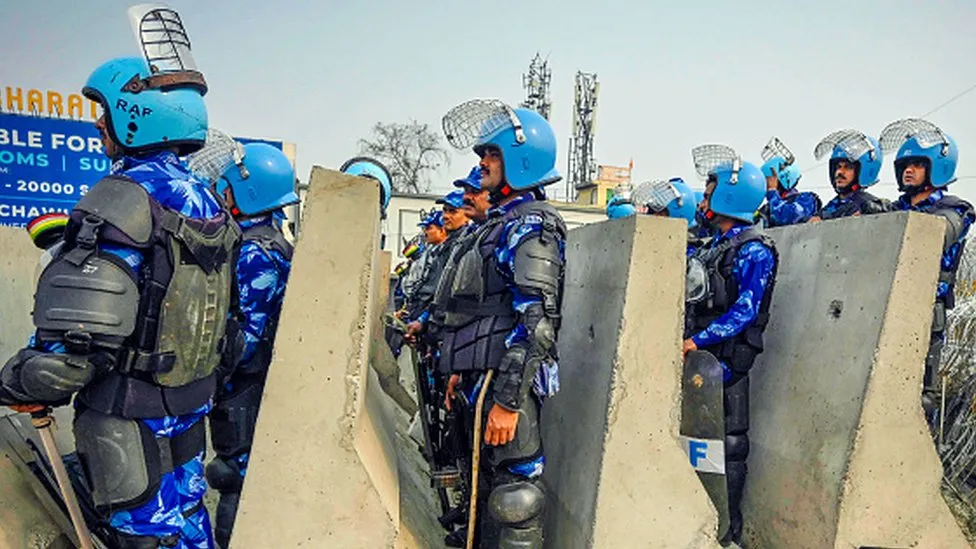
    The Indian police used tear gas again to stop farmers from marching to the capital Delhi. The farmers are asking for fair prices for their crops.

    Most of the farmers are from Punjab state. They are currently 200km (125 miles) away from Delhi at the Shambhu border in Haryana state.

    The city is surrounded by sharp wire, blocks of cement, and fences on three sides to stop people from getting in.

    On Tuesday, the Haryana police used tear gas when farmers started moving barricades.

    Later in the night, the leaders of the farm agreed to stop fighting for now and said they would continue their march in the morning.

    On Wednesday morning, there were lots of police and soldiers near the Delhi borders to stop the protesters from getting through.

    Farmers at the Shambhu border are giving out goggles to protesters because the police are using tear gas to stop their protest.

    Farm leaders in the area had a meeting with reporters and said that they were shot with plastic and rubber bullets.

    They also said the media is making it seem like the farmers are “terrorists” or working with other political parties during the protests.

    “We don’t have any connection with anyone else,” said the farm leader Sarwan Singh Pandher to the reporters. “We have asked for the same things since the start. ”

    Mr Pandher asked Prime Minister Narendra Modi to make a law for MSP.

    Minimum support price (MSP) is the lowest price that government promises to pay to farmers for their crops at wholesale markets. The farmers want the government to keep its promise of increasing their income by two times.

    Farmers leaders say that police have arrested at least twelve farmers since Tuesday, when the protest march started after two rounds of talks between farm unions and government ministers did not solve the problem.

    Over 200 unions are joining the march, and the farmers want to get to the capital after going through Haryana.

    On Tuesday, pictures from Ambala city, north of the capital, showed lots of tear gas in the air. At the Shambhu border, there was a fight between police and protesters as the protesters tried to break through the barricades. The police used drones to drop tear gas on the crowd.

    Many people protesting got hurt when the police took action. The security officers got hurt from the stones thrown by the protesters.

    Traffic was really bad in Delhi because the roads were closed and the usual routes were changed.

    Before, Mr Pandher told the ANI news agency that about 10,000 people were at the Shambhu border. He called the attack on the farmers “shameful” and said that as farmers and laborers, they do not want any fights.

    Farmers are a powerful group of voters in India, and experts believe that Prime Minister Narendra Modi’s government will try to keep them happy and not upset them.

    “We want the government to hear what we want,” Mr. Pandher said before the march.

    In 2020, farmers protested by sitting down for many months and blocking the highways that connect the capital to nearby states. Their protest lasted for a year and was a big problem for Mr Modi’s government. It made the authorities cancel the controversial agriculture reforms.

    The court said the farmers have the right to move freely and supported the protesters.

    India’s leaders from different political parties have shown their support for the farmers and criticized the government for trying to prevent them from going to Delhi.

    Rahul Gandhi and Mallikarjun Kharge from the Congress party promised to make a law that ensures farmers get a fair price for their crops if their party wins the elections.
  • Kenyan doctor provides free services to save 53 tear-gas infested children

    Kenyan doctor provides free services to save 53 tear-gas infested children

    A Kenyan physician told the BBC that 53 children were treated at his hospital without charge after police on Wednesday used tear gas in their school.

    “As a parent, you positively and fearfully react, which compelled me to act without asking for money,” Dr Aron Shikuku, from the private Eagle Nursing Home hospital in the capital, Nairobi, told the BBC’s Newsday programme.

    According to the most recent data from 2018, only 19% of the population in Kenya has access to any type of medical insurance, making healthcare highly expensive.

    While receiving care at a private hospital is sometimes more expensive and can result in crippling medical debt, the nation’s public hospitals are typically grossly understaffed and underequipped.

    The children were treated for shock and respiratory issues brought on by the tear gas, according to Dr. Shikuku, and then released.

    He said they were being monitored as they settle back into their school, which is in Kangemi, a slum area in the north-west of the city.

    There were demonstrations around the country called by the opposition over the rising cost of living, but they turned deadly.

    Six people were killed, the authorities said.

  • Over 30 Nigerian schoolchildren hospitalised after inhaling tear gas

    Over 30 Nigerian schoolchildren hospitalised after inhaling tear gas

    Over 30 schoolchildren have been hospitalized after inhaling tear gas discharged by anti-riot police during a morning drill in Osogbo, a city in Nigeria’s south-western Osun State.

    The incident occurred at the opposition Fakunle Comprehensive School, but the tear gas fumes drifted onto the school campus.

    Secondary school students who lost consciousness were quickly transported to two different hospitals for urgent medical attention.

    The occurrence triggered panic among parents, prompting some to promptly collect their children from school as authorities advised closure for the day.

    Osun police spokesperson, Yemisi Opalola, issued an apology for the incident and assured that the officers would take necessary measures to prevent any future recurrences.

  • Police officer under investigations for using tear gas on journalists – Kenya police

    Police officer under investigations for using tear gas on journalists – Kenya police

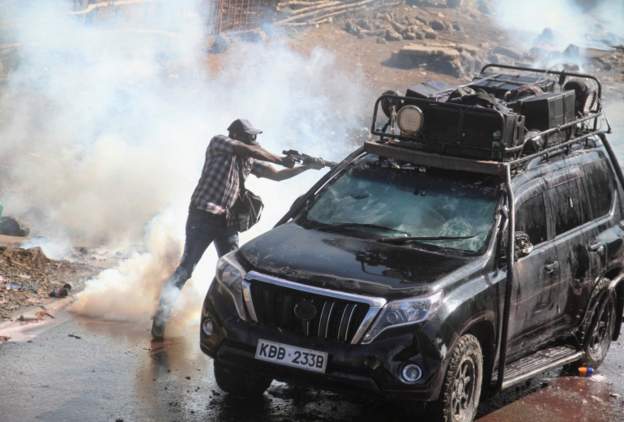
    A plain-clothes cop who allegedly fired tear gas at journalists at point-blank range during last week’s anti-government rallies is the subject of an internal police probe, according to Kenyan media.

    A viral video which appears to show the officer breaking a windscreen and firing tear gas at journalists inside a car drew condemnation from diplomats and politicians.

    The car was part of a convoy accompanying opposition leader Raila Odinga as he made his way through neighbourhoods in Nairobi to rally supporters.

    On Tuesday the Inspector General of Police Japheth Koome said that all alleged incidents of police misconduct during the protests were being probed.

    “A policeman breaking a window of the car? Regarding all officers, any issue of malpractice or misconduct brought to us is investigated and we take action. I received those complaints and they are being handled,” he is quoted as saying by The Star news website.

  • Opposition leaders in Kenya arrested over tear gas protest

    Opposition leaders in Kenya arrested over tear gas protest

    Protests are being held across the country in opposition to President William Ruto‘s election victory and Kenya’s rising cost of living.

    Although hundreds of people demonstrated against President William Ruto, the high cost of living, and allegations of election fraud, the Kenyan police deployed tear gas and detained many key opposition members.

    Veteran political figure Raila Odinga, who lost to Ruto in August’s poll, has urged nationwide protests as he attempts to harness dissatisfaction with the president.

    The discontented include some who voted for Ruto and feel he has not delivered on pledges to help the country’s forgotten “hustlers”, or working-class Kenyans.

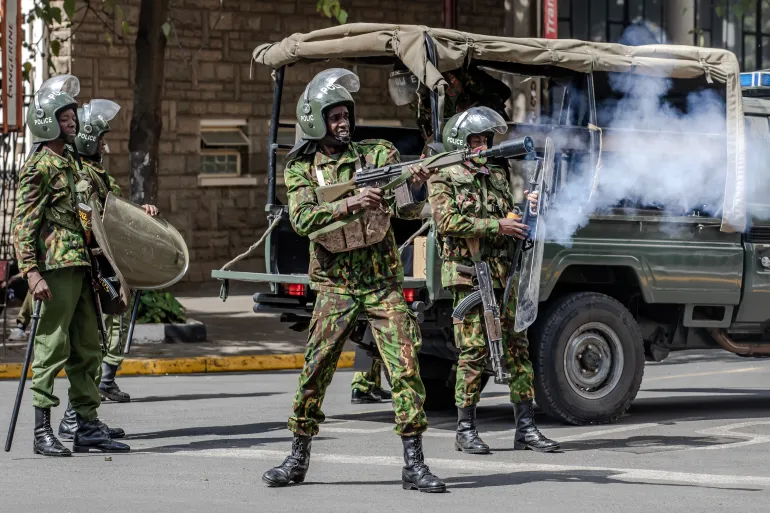
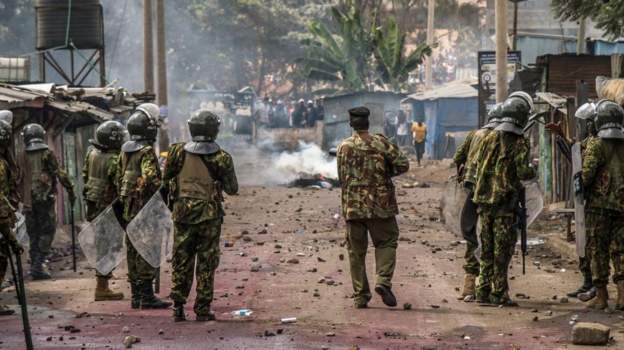
    Police officers in riot gear fired tear gas at hundreds of rock-throwing protesters in the capital Nairobi’s vast Kibera slum, who chanted: “Ruto must go.”

    They also used tear gas to disperse demonstrators trying to gather in the Central Business District, from where Odinga has called for a march towards the president’s State House residence, Reuters reporters said.

    In the western city of Kisumu, an Odinga stronghold, police fired barrages of tear gas in the direction of protesters who had started fires in the road, footage on Citizen TV showed.

    At least four members of parliament were arrested during protests in Nairobi, including the minority leaders of the National Assembly and Senate, Odinga’s spokesman, Dennis Onyango, said.

    Nairobi police chief Adamson Bungei told reporters he would have details about the arrests later in the day.

    Despite Ruto’s promises to bring down living costs since taking power in September, inflation has remained high in East Africa’s economic powerhouse, rising to 9.2 percent in February.

    Ruto has said his government is laying the foundations of a healthier economy, including by cutting reliance on borrowing.

    Odinga, who has lost five presidential elections, has cast the demonstration as an opportunity to protest against the August vote, which he says was tainted by fraud.

    He challenged the results in the Supreme Court last year, but the court affirmed Ruto’s win and there was little of the violence that marred elections in 2007 and 2017.

  • Boca Juniors game: One dies after police use tear gas at Gimnasia

    During the match between Gimnasia and Boca Juniors in Argentina, police used tear gas on spectators outside the stadium, resulting in at least one death.

    On Thursday, police attempted to prevent supporters from entering the already crowded stadium by firing rubber bullets at them.

    The game was called off after nine minutes, with fans spilling onto the pitch trying to escape the turmoil.

    Buenos Aires security minister Sergio Berni confirmed there was one death and that they “died of cardiac arrest”.

    Authorities at San Martin hospital in La Plata, the city where Gimnasia is based, also confirmed the death, of a 57-year-old man because of cardiac arrest as he was being transferred from the stadium to the hospital.

    An estimated 10,000 fans were outside the 20,000-capacity stadium and unable to get in.

    Berni said an investigation would be opened, with the possible over-selling of tickets in one area being looked at.

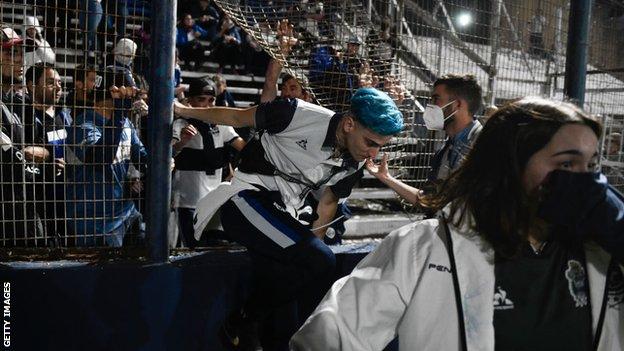
    Fans were squeezing through fencing to try to get onto the pitch of the Juan Carmelo Zerillo stadium in La Plata.

    Referee Hernan Mastrangelo said: “It affected all of us on the field.

    “The air became unbreathable. The situation got out of control and there were no security guarantees.”

    The events in Argentina took place in the wake of the recent tragedy in Indonesia when at least 131 people died.

    The disaster in Indonesia happened when police fired tear gas at fans who invaded the pitch after a game and hundreds tried to flee through the exits, which caused a deadly stampede.
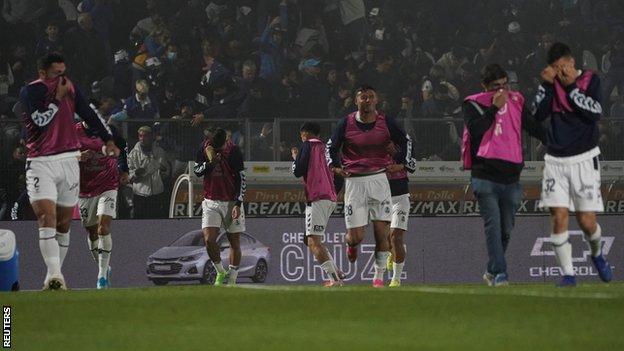
    Players cover their faces to stop being affected by tear gas
    Players cover their faces to stop being affected by tear gas
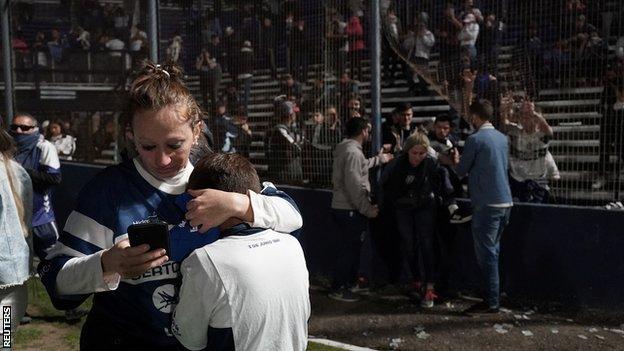
    Fans of Gimnasia y Esgrima La Plata affected by tear gas jump the fence into the field of play
    Fans affected by tear gas jumped the fence into the field of play
    Fans got through fencing to get onto the Carmelo Zerillo stadium in La Plata
    Fans got through fencing to get onto the Carmelo Zerillo stadium in La Plata
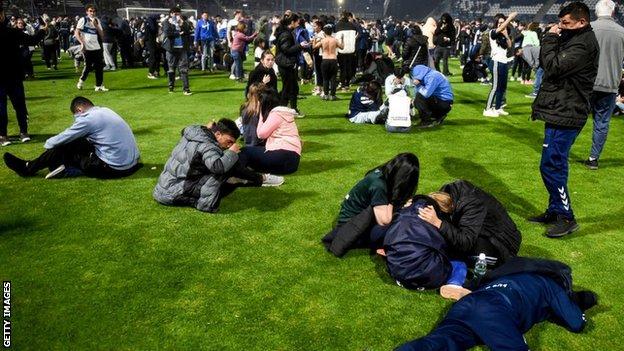
    Fans of Gimnasia y Esgrima La Plata react in the field of play after being affected by tear gas
    Fans recovered from the effects of tear gas on the pitch