Tag: Tehran

  • Middle East tensions: Ghana Embassy in Tehran closed indefinitely 

    Middle East tensions: Ghana Embassy in Tehran closed indefinitely 

    Ghana has closed its embassy in Tehran indefinitely and evacuated all diplomatic staff in response to escalating tensions involving the United States, Israel, and Iran.

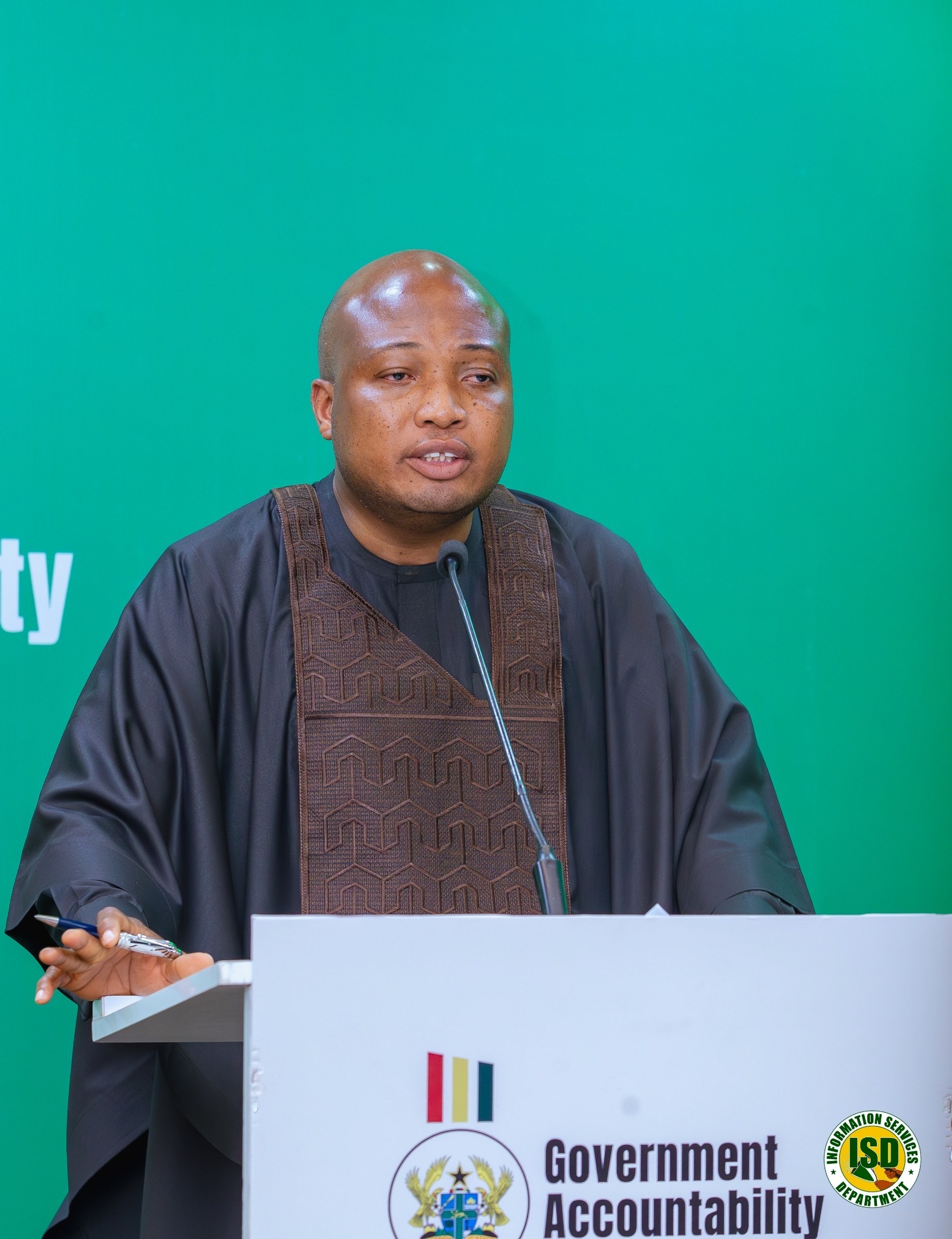
    Announcing the decision on social media on Monday, March 2, Foreign Affairs Minister Samuel Okudzeto Ablakwa confirmed that all Ghanaian embassy staff have been safely evacuated from Iran. 

    “The safety, welfare, and protection of Ghanaians remains our utmost priority in these tempestuous times,” he stated. On Monday, March 2, the Ghanaian Embassy in Doha directed all Ghanaian nationals residing in Qatar to register with the mission as part of emergency preparedness measures amid escalating tensions in the Middle East.

    The Embassy in a statement explained that this forms part of ongoing efforts to ensure the safety of Ghanaian nationals. The Embassy of Ghana Doha, State of Qatar on Sunday, March 1, advised Ghanaians living in the area to exercise caution and remain vigilant during this period.

    A press statement from the Embassy of Ghana Doha, State of Qatar read, “Due to missle attack and its impact in Doha, please take shelter until further notice, obtain information from official sources. We urge everyone to stay from military states, remain indoors, avoid crowded areas for any exposure to danger and keep essentials supplies like medication and food”.

    “The Embassy of the Republic of Ghana in Doha hereby urges all Ghanaian nationals residing in the State of Qatar who have not registered to immediately do so, as part of ongoing emergency preparedness measures.

    “In view of the heightened tensions and unrest within the region, this registration will enable the Embassy to effectively communicate with, assist, and, if necessary, coordinate evacuation arrangements for Ghanaian citizens,” it noted.

    The ongoing tensions have been linked to the death of Iran’s Supreme Leader, Ayatollah Ali Khamenei. Ayatollah Ali Khamenei was reportedly killed in strikes by the Unites States (U.S.) and Israel. This development significantly impacting travelers from Ghana to Asia, Europe, and North America, as Dubai is a major transit hub connecting travelers through the United Arab Emirates.

    On Saturday, 28 February, Emirates flight EK 788 from Kotoka International Airport (ACC) in Accra to Dubai International Airport (DXB) was cancelled, and passengers were advised to contact their airlines for rebooking or refund options due the ongoing tensions.

    The airline suspended its services following reported bombings in Iraq and retaliatory attacks across the region.

    The flight from Accra to Dubai International Airport, scheduled for 7:15 pm GMT on Saturday, 28 February 2026, was canceled at the last minute through a notice.

    Last year, the Minister for Foreign Affairs, Samuel Okudzeto Ablakwa, warned the Israeli Embassy against maltreating Ghanaian nationals. Speaking to the media on Thursday, December 11, Mr. Ablakwa noted that Ghana will respond with equal force if any of its citizens are deported.

    According to him, “If they deport ten Ghanaians, we will deport ten. If they deport twenty, we will deport twenty. If they deport fifty, we will deport fifty. We are not going to accept this.”

    His comments are in response to an incident in which several Ghanaian travellers, including four members of a parliamentary delegation en route to Tel Aviv for an international cybersecurity conference, were detained and deported by Israel Embassy officials.

    Mr. Ablakwa narrated, “We were told that the Ghanaian Embassy was uncooperative, but the facts simply do not support that. Out of the six people on the list that Israel provided, one is not even Ghanaian. He is Gabonese. Our embassy had every right to verify the identity of the individuals involved.

    “One of the people listed was seriously ill, and Israeli doctors themselves advised that she should not travel until she had recovered. How can you deport someone who is unwell and needs medical attention? Another individual had already been issued a travel certificate, so there was no reason to stop their entry into Israel.”

    But in their actions, Israeli officials indicated that six Ghanaians who were supposedly due for deportation failed to provide the necessary details needed by Ghana’s Embassy in Tel Aviv to issue travel certificates.

    The matter adds to broader concerns surrounding deportation practices. In September, eleven West African nationals filed two ex-parte applications at the Labour Division of the High Court in Accra, challenging their alleged detention in Ghana after being deported from the United States (U.S).

    The eleven individuals include Nigerians Daniel Osas Aigbosa, Ahmed Animashaun, Ifeanyi Okechukwu, and Taiwo K. Lawson; Liberian national Kalu John; Togolese nationals Zito Yao Bruno and Agouda Richarla Oukpedzo Sikiratou; Gambian national Sidiben Dawda; and Malians Toure Dianke and Boubou Gassama.

    According to the applicants, they were forcibly transported to Ghana without prior notice. They allege that they were secretly moved from the U.S. detention centers between September 5 and 6 in shackles.

    They want the court to temporarily stop them from being deported back to their home countries until the court decides on their case. Their submission further revealed that Ghanaian authorities allegedly confined them in a military facility.

    They cited Article 14(1) of Ghana’s 1992 Constitution, which guarantees personal liberty, as well as Article 23, which protects the right to administrative justice.

    They are arguing that Ghana is violating international law by trying to send them back to countries where their lives or freedom could be at risk.

    As a result, they have demanded that the Attorney-General, the Chief of Defence Staff, and the Comptroller-General of the Ghana Immigration Service appear before the Human Rights Division of the High Court with valid reasons. The court has fixed Tuesday, September 23, to hear the case.

  • Iran unrest: Tehran court sentences first person to death over protest

    State media has reported that , an Iranian court has sentenced to death the first person arrested for participating in the country’s protests.

    The defendant, who was not named, was found guilty of “enmity against God” by the Revolutionary Court for setting fire to a government facility.

    Another court sentenced five people to prison terms ranging from five to ten years on national security and public order charges.

    A human rights organisation warned that authorities may be planning “hurried executions.”

    According to official reports, at least 20 people are currently facing charges punishable by death, according to the Norway-based Iran Human Rights.

    Its director, Mahmood Amiry-Moghaddam, called on the international community to take urgent action and “strongly warn the Islamic Republic of the consequences of executing protesters”.

    Protests against Iran’s clerical establishment erupted two months ago after the death in custody of a young woman detained by morality police for allegedly breaking the strict hijab rules.

    They are reported to have spread to 140 cities and towns and evolved into the most significant challenge to the Islamic Republic in over a decade.

    At least 326 protesters, including 43 children and 25 women, have been killed in a violent crackdown by security forces, according to Iran Human Rights.

    The Human Rights Activists News Agency (HRANA), which is also based outside the country, has put the death toll at 339 and said another 15,300 protesters have detained. It has also reported the deaths of 39 security personnel.

    Iran’s leaders have portrayed the protests as “riots” instigated by the country’s foreign enemies.

    Last week, judiciary chief Gholamhossein Mohseni Ejei declared that “key perpetrators” should be identified as soon as possible and handed sentences that would have a deterrent effect on others.

    He warned that “rioters” could be charged with “moharebeh” (enmity against God), “efsad fil-arz” (corruption on Earth) and “baghy” (armed rebellion) – all of which can carry the death penalty in Iran’s Sharia-based legal system.

    Those possessing and using a weapon or firearm, disrupting national security, or killing someone could receive “qisas” (retaliation in kind), he said, apparently responding to a call for retributive justice from 272 of the 290 members of Iran’s parliament.

    More than 2,000 people have already been charged with participating in the “recent riots”, according to judiciary figures.

    On Sunday, local media cited judiciary officials as saying that 164 had been charged in the southern province of Hormozgan, another 276 in the central province of Markazi, and 316 in neighbouring Isfahan province.

  • Protests continue as Iran holds its first court sessions for alleged ‘rioters’

    Iranian officials criticise a United Nations rapporteur, while a large number of journalists demand the release of their detained colleagues.

    Protests in Iran that began last month in response to the death of a young woman in police custody have been documented in cities across the country this week, even as protesters’ first court hearings have been held and internet restrictions remain in place.

    More protests were seen on social media at universities, particularly in Tehran and Sanandaj, the capital of Kurdistan’s northwestern province, where Mahsa Amini, 22, was from. She died on September 16 after being detained by Iran’s morality police.

    Social media footage showed clashes breaking out on Sunday at Tehran’s Azad University between students and security forces, who fired tear gas.

    The demonstrations persisted after Hossein Salami, the commander-in-chief of the Islamic Revolutionary Guard Corps, said on Saturday, “Today is the last day of the riots,” as he warned people “not to come to the streets”.

    An unknown number of protesting students was suspended from universities this week, reports on social media and foreign-based outlets said. It prompted their fellow students to demonstrate on Monday in their support, according to images on social media, which could not be independently verified.

    Meanwhile, a court in Tehran on Sunday held the first hearings for “rioters” accused, among other things, of intentionally killing police officers and burning public and government property. Several people are charged with “corruption on Earth” and “waging war against God”, which carry the death penalty.

    The Iranian judiciary said more than 1,000 indictments have been issued for people participating in “riots” across the country after a call this month by the judiciary chief to fast-track cases and hand out harsh sentences.

    Iranian media reported that one arrest was of Toomaj Salehi, a dissident rapper who had filmed himself participating in protests and regularly posted his opposition to the Iranian establishment on social media. His friends rejected reports that he was arrested in a border province while trying to flee the country. Salehi had been previously detained in September 2021 after releasing songs with lyrics decrying the establishment but was released on bail.

    ‘Let’s free the journalists’

    Amini died days after being detained by Iran’s morality police and taken to a “re-education centre” for allegedly not fully complying with the country’s mandatory dress code.

    Those arrested since the start of the protests include a slew of reporters and photojournalists. More than 500 local journalists have signed a statement that calls on authorities to release their colleagues. They say the detained journalists have been denied access to lawyers and charged prior to facing public trials and official submission of evidence.

    “Let’s not blind the eyes of the society,” said the statement on Sunday, which was carried on the front page of several newspapers. “Let’s free the journalists.”

    Its publication came two days after Iran’s intelligence community, in a rare joint report, accused two journalists – Niloufar Hamedi and Elaheh Mohammadi – of covering Amini’s death after being trained abroad by the United States spy agency.

    Hamedi had reported on Amini’s death from a hospital in Tehran and posted an image of the woman’s parents holding each other. Mohammadi had travelled to Amini’s hometown of Saqqez to cover her funeral. The editors-in-chief of the two newspapers they work for have said the reporters were on assignment and only did their job.

    Dozens of people are thought to have been killed during the protests and many more injured, but Iranian authorities have yet to release an official tally. Dozens of members of the security forces have also been killed. Several of them died this week, according to authorities, who release their names and hold state funerals for them.

    Speaking with the family of a security officer killed in Tehran, President Ebrahim Raisi promised, “We will under no circumstances allow the enemy’s designs for harming our security.”

    Top Iranian authorities, including Supreme Leader Ali Khamenei, have accused the United States and Israel of being behind the unrest.

    Some officials have signalled that they are open to reforms as a result of the protests, provided protests are differentiated from “riots” and efforts to “overthrow the establishment”.

    “The country’s political establishment is a definitive platform for any type of reforms and changes to secure popular interests, and some of this change consists of reforms in governance within the framework of the Islamic Republic’s political establishment that must lead to new governance,” Parliament Speaker Mohammad Bagher Ghalibaf said.


    Foreign tensions rising

    The persistent protests and lingering internet restrictions have put the Iranian state at odds with a number of other countries and officials.

    The US and Albania are preparing to hold an informal meeting of the United Nations Security Council on Wednesday to discuss what Washington has called “brutal suppression” of the protests.

    Speaking to reporters on Monday, Iranian foreign ministry spokesman Nasser Kanani criticised Javaid Rehman, the special UN rapporteur on human rights in Iran, for a “deeply anti-Iranian approach” and for agreeing to participate in the Security Council meeting, which Tehran considers to be politically motivated.

    “Unfortunately, human rights have become a tool for pursuing the political goals of some countries, especially the US,” Rehman said.

    On Sunday, a group of prominent women from 14 countries – including Nobel laureates Malala Yousefzai and Nadia Murad, former US Secretary of State Hillary Clinton and former US first lady Michelle Obama – published an open letter calling for Iran’s immediate expulsion from the UN Commission on the Status of Women.

    German Foreign Minister Annalena Baerbock said the European Union was examining whether to classify the Revolutionary Guard as a “terrorist” organisation for its response to the protests, something the Iranian foreign ministry on Monday called “illegal”. The US already designated the elite force as a “terrorist” group in 2019.

    Tehran has responded to human rights sanctions by the US, EU the United Kingdom, and Canada with sanctions of its own and has said new measures on US and Canadian officials and entities would be imposed.

    Iran this week blocked a host of services by Google, including its maps and Android apps store after the store flagged a major state-backed application as being unsafe because of suspicions of “spying” on users’ data. Authorities denounced Google’s move as being politically motivated.

    State-affiliated media showed footage of “large numbers of students and professors” who were reported to be taking part in demonstrations denouncing a “terrorist” attack on a major Shia religious shrine in Shiraz last week. It killed 15 people and wounded dozens.

    Authorities organised rallies in the southern city and elsewhere to denounce the attack. Top Iranian officials have linked the attack to “riots” and pledged to take revenge as a website linked with ISIL (ISIS) claimed responsibility.


  • Ukraine war: In two days, Russia deploys dozens of drones – Zelensky

    President Volodymyr Zelensky says, Russia has launched over 30 drone attacks on Ukraine in just two days.

    He went on to say that Moscow had carried out 4,500 missile strikes and over 8,000 air raids in total.

    Mr Zelensky, speaking from Kyiv and standing next to what appeared to be a downed Iranian Shahed drone, pledged to “clip the wings” of Moscow’s air power.

    Western officials believe Iran has supplied a large number of drones to Russia, but Moscow and Tehran deny it.

    It comes as US Secretary of State Antony Blinken called Russia’s aggressive use of drones “appalling”.

    The top US diplomat accused Russian commanders of using the devices to “kill Ukrainian civilians and destroy the infrastructure they rely on for electricity, for water, for heat” during a visit to the Canadian capital Ottawa.

    “Canada and the United States will keep working with our allies and partners to expose, to deter, and to counter Iran’s provision of these weapons,” Mr Blinken said.

    In recent weeks, Russian attacks have targeted Ukraine’s civilian infrastructure, damaging the country’s electricity and water supply just as temperatures begin to drop.

    Western countries say Iran is supplying its domestically developed drones to Moscow and that Iranian military experts are on the ground in Russian-occupied Crimea to provide technical support to pilots.

    Kyiv has identified the drones used in some attacks on its infrastructure as Iranian Shahed-136 drones. They are known as “kamikaze” drones because they are destroyed in the attack – named after the Japanese fighter pilots who flew suicide missions in World War Two.

    Ukraine says around 400 drones have already been used by Russia, from a total order of roughly 2,000 weapons.

    But Tehran has repeatedly denied that it has struck any arms deal with the Kremlin, and Moscow also denies using Iranian drones.

    On Wednesday, Iran’s Foreign Minister Hossein Amir-Abdollahian called the accusations “baseless” and urged Ukraine to “present any evidence supporting the accusations”.

    “If… it becomes clear to us that Russia has used Iranian drones in the war against Ukraine, we will definitely not be indifferent about this issue,” he added.

    Tehran’s regional adversary, Israel, has also attacked Iran over the alleged exports. During a meeting with US President Joe Biden at the White House on Thursday, President Isaac Herzog slammed the regime’s activities.

    “The fact that Iran, following its activities in killing its own citizens, in working towards nuclear weapons endlessly, endangering the entire world and the region — and now killing innocent civilians in Ukraine, clearly that gives you a picture of what Iran is all about,” Mr Herzog said.

    Prior to the visit, he had pledged to share “proof” with Mr Biden that Iran was supplying the weapons.

    Meanwhile, US officials have said they will supply Ukraine with an additional $275m (£237m) of military aid, according to the Associated Press.

    The assistance is expected to be used to restock ammunition for Ukrainian artillery systems, including the HIMARS launchers that Kyiv’s forces have used to great effect.

    On the ground, fighting has slowed in recent days, with a much anticipated Ukrainian advance on the southern city of Kherson stalled due to poor weather.


  • Iran protests: Clashes after crowds gather at Mahsa Amini’s grave

    Clashes have been reported in Mahsa Amini’s hometown between Iranian security forces and protesters after crowds gathered near her grave to mark 40 days since her death in custody.

    Security personnel in Saqqez’s Zindan Square fired live rounds and tear gas, according to a Kurdish rights group.

    The semi-official news agency Isna reported a clash on the city’s outskirts.

    Earlier, thousands of mourners at the Aichi cemetery shouted “Woman, life, freedom” and “Death to the dictator”.

    They are two of the signature chants of the anti-government unrest that has swept across Iran since Ms Amini died.

    The 22-year-old Kurdish woman was detained by the morality police in the capital, Tehran, on 13 September for allegedly wearing her hijab “improperly”.

    She fell into a coma after collapsing at a detention centre and died three days later. There were reports that officers beat her on the head with a baton and banged her head against a vehicle, but the police denied that she was mistreated and said she suffered a heart attack.

    Many Iranians were enraged and the first protests took place after Ms Amini’s funeral in Saqqez, when women ripped off their headscarves in solidarity. The protests spread quickly and evolved into one of the most serious challenges to the Islamic Republic since the 1979 revolution.

    Women have been at the forefront, defiantly waving their headscarves in the air, setting them on fire, and even cutting their hair in public.

    Schoolgirls have also been demonstrating in playgrounds and on the streets in an unprecedented show of support.

    Norway-based Iran Human Rights says at least 234 protesters, including 29 children, have been killed by security forces in a violent crackdown on what Iran’s leaders have portrayed as “riots” fomented by foreign enemies.

    Riot police and members of the paramilitary Basij Resistance Force were reportedly deployed in large numbers in Saqqez and other parts of Kurdistan province on Wednesday, in anticipation of fresh unrest on the 40th day of mourning for Ms Amini – a culturally significant occasion for Iranians.

    However, videos showed thousands of residents walking along a highway and through a field – apparently to bypass roadblocks – to reach the Aichi cemetery.

    “They tried to stop us from entering the cemetery… but I managed to get in,” Reuters news agency quoted a witness as saying.

    Kurdish human rights group Hengaw, which is also based in Norway, posted several videos that it said showed a large crowd shouting “Down with traitors” and “Kurdistan, Kurdistan, the fascists’ graveyard”.

    In another clip, men and women were seen waving scarves and shouting “Freedom, freedom, freedom”.

    It was not clear whether members of Ms Amini’s family were at the cemetery. Activists said security forces had warned them not to hold a mourning ceremony and had threatened the safety of their son.

    State news agency Irna, meanwhile, cited what it claimed was a statement from the family saying that they would not hold an event in order to avoid “unfortunate issues”. But a source close to the family told the BBC they had written no such message.

    Kurdistan Governor Esmail Zarei Koosha said the situation in Saqqez was calm on Wednesday morning and denied that roads had been shut.

    “The enemy and its media… are trying to use the 40-day anniversary of Mahsa Amini’s death as a pretext to cause new tensions, but fortunately, the situation in the province is completely stable,” he was quoted as saying by Irna.

    Later, Hengaw posted videos it said showed a crowd of protesters walking towards the governorate’s office in Saqqez and clashes between protesters and security forces in the Qukh neighbourhood.


    Isna reported that “a limited number of those present at Mahsa Amini’s memorial clashed with police forces on the outskirts of Saqqez and were dispersed”. It added that the local internet service was cut off “due to security conditions”.

    Hengaw also reported protests in the nearby cities of Sanandaj and Mahabad as well as general strikes in cities and towns across Kurdistan.

    Authorities closed all schools and universities in the province “because of a wave of influenza”, according to state media.

    Opposition activist collective 1500tasvir said protests were also held on Wednesday at Tehran’s Grand Bazaar, as well as at universities in Tehran, the north-eastern city of Mashhad, and in Ahvaz, in the southwest.

    Video also appeared to show that security forces fired tear gas inside Amirabad girls’ school in Tehran in response to a protest by students.


  • Iran protests: Iran blacklists EU officials, entities for allegedly ‘inciting terrorism’

    Tehran sanctioned several media outlets and a French town mayor in addition to parliament members.The Iranian government has blacklisted a number of European Union officials and organizations, primarily because of their stance on the country’s ongoing protests, which Iran claims are “inciting terrorism.”

    While the bulk of the sanctions is related to recent developments concerning the weeks-long protests that erupted last month after the death of a young woman in custody, others deal with Tehran’s repeated grievances with the bloc’s officials and member states over issues that have led to longstanding political disputes.

    The Iranian foreign ministry said on Wednesday it had imposed sanctions on 12 individuals and eight organizations for their “intentional actions in supporting terrorism and terrorist groups, inciting terrorism and propagating violence and hatred that has led to riots, violence, terrorist acts and violation of human rights of the Iranian nation”.

    The sanctions entail an entry and visa ban for the individuals in addition to the confiscation of any assets they may have in Iran.

    The targeted entities include the Friends of Free Iran and the International Committee in Search of Justice, two informal groups in the European Parliament, in addition, to Stop the Bomb, an organization that has advocated sanctions on Iran with the stated goal of preventing it from acquiring nuclear weapons – which Tehran maintains it will never seek.

    The Persian-language services of Germany’s Deutsche Welle and France’s RFI were also targeted, extending Iran’s push against foreign-based channels that it says are promoting “terrorism” on Iranian soil. Two directors of the German newspaper Bild were also blacklisted.

    The Karl Kolb and Rhein Bayern Fahrzeugbau companies were blacklisted for “delivering chemical gases and weapons” too late Iraqi ruler Saddam Hussein, who is said to have used them against the nascent Islamic Republic during the eighth-year conflict that began with Iraq’s invasion of Iraq in 1980.

    A number of European Parliament members were also targeted, in addition to Martine Valleton, the mayor of Villepinte, a commune in the northeastern suburbs of Paris where French authorities said a plot had been uncovered to bomb a 2018 rally of the Mojahedin-e-Khalq group, which is outlawed in Iran. This led to the arrest of Iranian diplomat Asadollah Assadi, who served at Iran’s embassy to Austria, in Germany, and his subsequent sentencing in a Belgian court.

    The measures mark the first time Iran has officially sanctioned EU officials and institutions, a move that comes as a reaction to the bloc’s sanctions on Iran’s so-called morality police and others earlier this month over their alleged roles in what it called the “brutal repression” of the protests that have gripped Iran since the death of 22-year-old Mahsa Amini in custody 40 days ago.

    Separately, Iran has previously blacklisted a group of British individuals and organizations in retaliation for their sanctions related to the protests.


  • Four convicts were killed in a fire at Tehran’s Evin prison, according to state media

    According to the country’s judiciary, at least four prisoners were killed and 61 others were injured after a fire broke out overnight at Tehran’s Evin prison following a dispute between convicts, according to the official state news agency IRNA.IRNA reported smoke inhalation was the cause of the deaths, with 10 convicts hospitalized and four in “critical condition.”

    The facility mostly holds political prisoners, including Iranians with dual nationality. Families of about two dozen political prisoners have called to say they are unharmed, according to their accounts on social media.


    The prison has long been criticized by Western rights groups and was blacklisted by the United States government in 2018 for “serious human rights abuses”.


    The incident took place as nationwide protests over the death in detention of Mahsa Amini, a 22-year-old Iranian woman, entered the fifth week.


    The protests have posed one of the most serious challenges to the Iranian government since the 1979 revolution, with demonstrations spreading across the country and some people chanting slogans against Supreme Leader Ayatollah Ali Khamenei.

    State TV on Sunday aired footage of the fire’s aftermath, showing scorched walls and ceilings in a room it said was the upper floor of a sewing workshop at the prison. Tehran prosecutor Ali Salehi said the prison unrest was not related to the nationwide protests and the situation was peaceful after the incident.

    The fire started at about 10 pm (6.30 pm GMT), Al Jazeera’s Resul Sardar said, adding that it involved different units of the prison.

    iran
    Damage caused by a fire inside the building of the Evin prison [IRNA via AFP]

    “Officials here say there were clashes between prisoners and that some of those prisoners have set the fire in the warehouse, in the sewing workshop of the prison,” Sardar said, referring to a statement made earlier by Tehran Governor Mohsen Mansouri.


    “However some witnesses are saying that some Molotov cocktails were thrown into the prison and that they started the fire. Right after that, we have seen security forces firing and also using tear gas to disperse people,” he added.

    A witness contacted by the Reuters news agency said roads leading to Evin prison have been closed to traffic. “There are lots of ambulances here,” he said. Another witness said families of inmates gathered in front of the main prison entrance. “I can see fire and smoke. Lots of special forces,” the witness said.


    A security official said calm had been restored at the prison, while IRNA reported that “the situation is currently completely under control”. But the first witness told Reuters that ambulance sirens could be heard and smoke still rose over the prison.

    Early on Sunday, IRNA carried a video it said showed parts of the prison damaged by fire. Firefighters were seen dousing the debris with water, apparently to prevent the blaze from reigniting.

    ‘Numb with worry’

    The detainees include French-Iranian academic Fariba Adelkhah and US citizen Siamak Namazi, whose family said he was taken back into custody this week after a temporary release.

    Reacting to reports of the fire, Namazi’s family said in a statement to the AFP news agency shared by their lawyer that they were “deeply concerned” and had not heard from him.


    They urged Iran’s authorities to grant him “immediate” means to contact his family and to give him a furlough “as he clearly isn’t safe in Evin Prison”.

    The sister of another US citizen held at Evin, businessman Emad Shargi, said in a Twitter post his family was “numb with worry”.


    An unnamed Iranian official told the Tasnim news agency that none of the political prisoners was involved in Saturday’s unrest.

    “No security prisoner was involved in today’s clash between prisoners, and basically the ward for security prisoners is separate and far from the wards for thieves and those convicted of financial crimes,” the official was quoted as saying.

    Asked about the prison fire, US President Joe Biden told reporters during a campaign trip to Portland, Oregon: “The Iranian government is so oppressive.”

    He said he was surprised by “the courage of people and women taking [to] the street” in the recent protests and had enormous respect for them. “It’s been really amazing,” he added. “They’re not a good group, in the government.”


    US Department of State spokesman Ned Price tweeted, “We are following reports from Evin Prison with urgency. We are in contact with the Swiss as our protecting power. Iran is fully responsible for the safety of our wrongfully detained citizens, who should be released immediately.”


    Human Rights Watch has accused the prison authorities of using threats of torture and indefinite imprisonment, as well as lengthy interrogations and denial of medical care for detainees.

    Protests erupted after the September 16 death of Amini, who was arrested by Iran’s morality police for wearing an improper hijab. She died in custody. A coroner’s report said she did not suffer blows to the head or vital organs.


    Amini’s family has refuted the official accounts that attributed the 22-year-old’s death to conditions arising after a brain tumour surgery at age eight.

    Although the unrest does not appear close to toppling the government, the protests have widened into strikes that have closed shops and businesses, touched the vital energy sector, and inspired brazen acts of dissent against Iran’s religious rule.


    On Saturday, protesters across Iran chanted in the streets and in universities against the country’s religious leaders.


    A video posted by the Norway-based organisation Iran Human Rights purported to show protests in the northeastern city of Mashhad, Iran’s second-most populous city, with demonstrators chanting “Clerics, get lost”, and drivers honking their horns.


    Videos posted by the group showed a strike by shopkeepers in the northwestern Kurdish city of Saqez – Amini’s hometown. Another video on social media showed female high school students chanting “Woman, Life, Freedom” on the streets of Sanandaj, the capital of Kurdistan province.

    The authenticity of the videos could not be verified immediately.


    The Iranian activist news agency HRANA said online that 240 protesters had been killed in the unrest, including 32 minors. It said 26 members of the security forces were killed, and nearly 8,000 people had been arrested in protests in 111 cities and towns and some 73 universities.


    But the official death toll is much lower than estimated by rights groups and protesters.


    Among the casualties have been teenage girls whose deaths have become a rallying cry for more demonstrations demanding the downfall of Iran’s government.


    Protesters called on Saturday for demonstrations in the northwestern city of Ardabil over the death of Asra Panahi, a teenager from the Azeri ethnic minority who, activists alleged, was beaten to death by security forces.


    Officials denied the report and news agencies close to the Islamic Revolutionary Guard Corps quoted her uncle as saying the high school student had died of a heart problem.


  • Iran protests: Outrage over police sex assault video

    A video showing Iranian anti-riot forces sexually assaulting a female demonstrator while attempting to arrest her has sparked outrage on social media.

    Users expressed their fury, with many demanding “justice” and the resignation of the police chief. Some pro-government users condemned the perpetrators as well.

    Despite blocks on some social media tools, Iranians are still managing to share powerful images of the protests.

    The country has been rocked by the most intense unrest in decades.

    The protests erupted last month when anger over the death in police custody of 22-year-old Kurdish Iranian Mahsa Amini boiled over. Officials say she died from an underlying health condition, but her family says she died after being beaten by the morality police.

    Numerous videos of the protest have gone viral both inside and outside of Iran. This latest video, which happened in Tehran’s Argentina Square on Wednesday, shows a group of officers in protective gear and helmets surrounding a woman on the main road.

    One of them grabs her by the neck and leads her into a crowd of about two dozen police, many of whom are on motorcycles.

    While the woman is being forced towards one of the bikes, another officer approaches her from behind and puts his left hand on her bottom.

    The woman then crouches on the ground as more officers surround her. A female voice behind the camera is heard saying: “They are pulling her hair.”

    Drivers in vehicles next to where it is happening start sounding their horns, a form of protest in similar situations seen in the past few days across the country.

    The woman, who appears to have no hijab or headscarf, is then seen standing up and running away from the scene.

    At this point, the same voice on the clip is heard saying: “Look at him [the security force officer], he is laughing”.

    The BBC is not responsible for the content of external sites.View original tweet on Twitter

    The footage has been verified by the BBC’s Persian service.

    Tehran’s Police Public Relations office has said the incident is being investigated, state news agency Irna reported.

    The police statement does not give details of what happened, but says that “enemies using psychological warfare tried to cause public anxiety and incite violence”.

    The fact that the incident happened in public has led human rights activists to question what security forces might also be doing behind closed doors.

    “Have you brought out the harassment of the girls of this land from [your] prisons into the open streets with the aim to shout out [at us] in public your obscenity, lechery and filth?” posted a social media user by the name of Atefeh.

    Mistreatment, including sexual and psychological abuse, has been reported by many inmates, especially political prisoners, for years.

    Many Iranians commented on social media that the video from Tehran had made them more determined to go out on the streets to protest, with one person saying they intended “to put their anger and fury into action”.


  • EU will not slap more sanctions on Iran over alleged drone deal with Russia

    European Union foreign ministers meeting in Luxembourg on Monday would not take any decisions on additional Iran sanctions after reports of drones delivered from Tehran to Moscow, Reuters has reported, citing an unnamed senior EU official.

    The official added that the 27-nation bloc is still trying to find independent evidence for the alleged use of Iranian drones by Russia in Ukraine.

    Iran, which blames NATO as the root of the Ukraine conflict, has denied supplying Russia with arms.

    “The Islamic Republic of Iran has by no means supplied any side with arms to be used in the war in Ukraine, and its policy is to oppose arming either side with the aim of ending the war,” Hossein Amirabdollahian, Iran’s foreign minister, told his Polish counterpart on Sunday.

    Source: Aljazeera.com


  • Nika Shakarami: Close source says Iran protester’s family forced to lie about death

    According to a source close to the family, relatives of a child who was killed during protests in Iran have been coerced into giving false statements.

    On September 20, Nika Shakarami, 16, vanished from Tehran after telling a friend she was being pursued by authorities.

    On Wednesday night, a state TV report showed her aunt, Atash, saying: “Nika was killed falling from a building.”

    Her uncle was also seen on TV speaking against the unrest, as someone seems to whisper to him: “Say it, you scumbag!”

    The source told BBC Persian that these were both “forced confessions” that came “after intense interrogations and being threatened that other family members would be killed”.

    Atash and Nika’s uncle, Mohsen, were detained by authorities after Atash posted messages online about her niece’s death and spoke to the media. The televised statements were recorded before they were released, according to the source.

    Relatives of a girl who died during protests in Iran have been forced into making false statements, a source close to the family has told BBC Persian.

    Nika Shakarami, 16, went missing in Tehran on 20 September after telling a friend she was being chased by police.

    On Wednesday night, a state TV report showed her aunt, Atash, saying: “Nika was killed falling from a building.”

    Her uncle was also seen on TV speaking against the unrest, as someone seems to whisper to him: “Say it, you scumbag!”

    The source told BBC Persian that these were both “forced confessions” that came “after intense interrogations and being threatened that other family members would be killed”.

    Atash and Nika’s uncle, Mohsen, were detained by authorities after Atash posted messages online about her niece’s death and spoke to the media. The televised statements were recorded before they were released, according to the source.

    Relatives of a girl who died during protests in Iran have been forced into making false statements, a source close to the family has told BBC Persian.

    Nika Shakarami, 16, went missing in Tehran on 20 September after telling a friend she was being chased by police.

    On Wednesday night, a state TV report showed her aunt, Atash, saying: “Nika was killed falling from a building.”

    Her uncle was also seen on TV speaking against the unrest, as someone seems to whisper to him: “Say it, you scumbag!”

    The source told BBC Persian that these were both “forced confessions” that came “after intense interrogations and being threatened that other family members would be killed”.

    Atash and Nika’s uncle, Mohsen, were detained by authorities after Atash posted messages online about her niece’s death and spoke to the media. The televised statements were recorded before they were released, according to the source.

    Atash told BBC Persian prior to her arrest on Sunday that the Revolutionary Guards had told her that Nika was in their custody for five days and then handed over to prison authorities.

    The judiciary has said that on the night she disappeared Nika went into a building where eight construction workers were present and that she was found dead in the yard outside the next morning.

    Tehran judiciary official Mohammad Shahriari was cited by state media as saying on Wednesday that a post-mortem showed Nika suffered “multiple fractures… in the pelvis, head, upper and lower limbs, arms and legs, which indicate that the person was thrown from a height”.

    He declared that this proved her death was nothing to do with the protests.

    However, a death certificate issued by a cemetery in the capital, which was obtained by BBC Persian, states that she died after suffering “multiple injuries caused by blows with a hard object”.

    Nika’s Instagram and Telegram accounts were also deleted after she went missing, according to Atash. Iranian security forces are known to demand that detainees give them access to social media accounts so that the accounts or certain posts can be deleted.

    Wednesday night’s state TV report also featured footage in which Atash was seen confirming that her niece’s body was found outside the building mentioned by the judiciary, even though that contradicted previous statements made by her and other members of the family.

    The family has said they located Nika’s body at the mortuary of a detention centre 10 days after she went missing, and that they were only allowed by officials to see her face for a few seconds in order to identify her. Atash said before she was detained that she did not go to the mortuary.

    Nika’s family transferred her body to her father’s hometown of Khorramabad, in the west of the country, on Sunday – on what would have been her 17th birthday.

    A source close to them told BBC Persian that the family agreed, under duress from authorities, not to hold a public funeral. But, the source said, security forces then “stole” Nika’s body from Khorramabad and secretly buried it in the village of Veysian, about 40km (25 miles) away.

    Hundreds of protesters later gathered in Khorramabad’s cemetery and chanted slogans against the government, including “death to the dictator” – a reference to Supreme Leader Ayatollah Khamenei.

    Photos of Hadis Najafi (L) and Sarina Esmailzadeh (R)
    IMAGE SOURCE,TIKTOK/FACEBOOK Image caption, Hadis Najafi, 22, and Sarina Esmailzadeh, 16, died after taking part in protests in the city of Karaj

    Nika is not the only young female protester to have been killed during the unrest that erupted last month following the death of Mahsa Amini, a 22-year-old woman who was detained by the morality police for allegedly violating the Islamic Republic’s strict hijab law.

    The family of Hadis Najafi, 22, have said that she was shot dead by security forces while protesting in the city of Karaj, west of Tehran, on 21 September. Officials allegedly asked her father to say that she died of a heart attack.

    Another 16-year-old girl, Sarina Esmailzadeh, died after being severely beaten on the head with batons by security forces during protests in Karaj on 23 September, Amnesty International cited a source as saying. The source also told the human rights group that security and intelligence agents had harassed the girl’s family to coerce them into silence.

    Several videos made by Sarina before her death have now been posted on social media. In one record after finishing some school exams, she says: “Nothing feels better than freedom.”


  • Iran protests: Schoolgirls jeer at paramilitary speaker

    A recent online video appears to show schoolgirls heckling at a member of Iran’s dreaded paramilitary Basij force after nationwide anti-government demonstrations spread to the classroom.

    The teenagers wave their headscarves in the air and shout “get lost, Basiji” at the man, who was asked to address them.

    The BBC could not verify reports that it was filmed in Shiraz on Tuesday.

    The Basij has helped security forces crack down on the protests sparked by the death in custody of a young woman.

    Other footage circulated on social media shows a man shouting “death to the dictator” as another group of girls walk through traffic in the north-western city of Sanandaj and an elderly woman clapping as unveiled schoolgirls chant “freedom, freedom, freedom” at a protest on a street.

    In a fourth video, a teacher appears to threaten students with expulsion if they do not cover their heads after they stage a sit-down protest in a schoolyard.

    And a fifth, reportedly filmed in the city of Karaj, shows schoolgirls seen screaming and running from a man, thought to be a member of the security forces in plainclothes, who is driving a motorcycle along a pavement.

    The unrest was triggered by the death of Mahsa Amini, a 22-year-old woman who fell into a coma hours after being detained by morality police on 13 September in Tehran for allegedly breaking the strict law requiring women to cover their hair with a hijab, or headscarf. She died in hospital three days later.

    Her family has alleged that officers beat her head with a baton and banged her head against one of their vehicles. The police have denied that she was mistreated and said she suffered a heart attack.

    The first protests took place in north-western Iran, where Ms Amini was from, and then spread rapidly across the country.

    Young women have been at the forefront of the unrest, but it was not until Monday that schoolgirls began participating publicly in large numbers.

    It came a day after security forces briefly besieged the prestigious Sharif University of Technology in Tehran in response to a protest on the campus. Dozens of students were reportedly beaten, blindfolded and taken away.

    Monday also saw the Supreme Leader, Ayatollah Ali Khamenei, break his silence on the unrest and accuse the US and Israel, Iran’s arch-enemies, of orchestrating “riots”. He also gave his full backing to the security forces, which have been accused by human rights groups of killing dozens of people.

    On Tuesday, there were reports that the death toll resulting from clashes between security personnel and anti-government protesters in the south-eastern city of Zahedan had risen to 83.

    Zahedan is the capital of Sistan Baluchistan province, which borders both Pakistan and Afghanistan, and has a sizeable Sunni Muslim population.

    Authorities have said the security forces were attacked by armed Baluchi separatists – something the imam of the city’s biggest mosque has denied.

    The violence erupted on Friday, when protesters surrounded a police station and officers opened fire.

    Tensions in the city had been compounded by the alleged rape of a 15-year-old girl by a police chief elsewhere in Sistan Baluchistan.

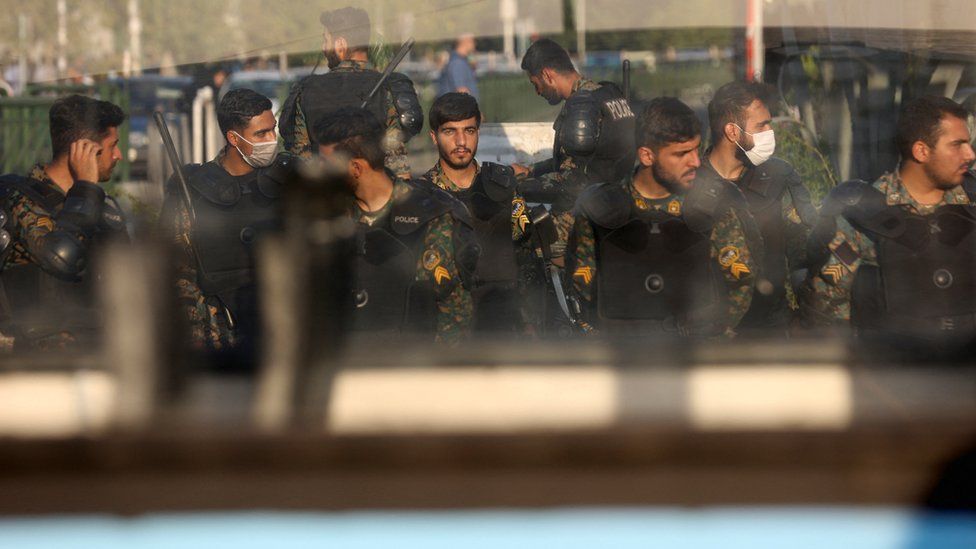
    Iranian riot police stand in a street in Tehran, Iran (3 October 2022)
    IMAGE SOURCE,WANA NEWS AGENCY VIA REUTERS Image caption, Iran’s supreme leader has called on security forces to be ready to deal with more unrest if necessary

    In another development on Tuesday, state media cited Tehran’s chief prosecutor as saying the judiciary had opened an investigation into the death of Nika Shakarami, a 16-year-old girl who went missing after taking part in protests in the capital on 20 September.

    Her aunt has said that in her last message Nika told a friend that she was being chased by police, and that her family found her body in a mortuary at a detention centre 10 days later.

    Sources close to the family told BBC Persian that before they could bury Nika, security forces stole her body and buried it secretly in a village 40km (25 miles) from her father’s hometown of Khorramabad, in the west of the country.


  • Iranian schoolgirls protest against the government by taking off their hijabs

    In an unprecedented display of support for the protests rocking the nation, Iranian schoolgirls have been yelling against clerical authorities and waving their hijabs in the air.

    Videos verified by the BBC showed demonstrations inside schoolyards and on the streets of several cities.

    They echoed the wider unrest sparked by the death last month of a woman who was detained for breaking the hijab law.

    In Karaj, girls reportedly forced an education official out of their school.

    Footage posted on social media on Monday showed them shouting “shame on you” and throwing what appear to be empty water bottles at the man until he retreats through a gate.

    In another video from Karaj, which is just to the west of the capital Tehran, students are heard shouting: “If we don’t unite, they will kill us one by one.”

    In the southern city of Shiraz on Monday, dozens of schoolgirls blocked traffic on the main road while waving their headscarves in the air and shouting “death to the dictator” – a reference to the Supreme Leader, Ayatollah Ali Khamenei, who has the final say on all state matters.

    Further protests by schoolgirls were reported on Tuesday in Karaj, Tehran, and the north-western cities of Saqez and Sanandaj.

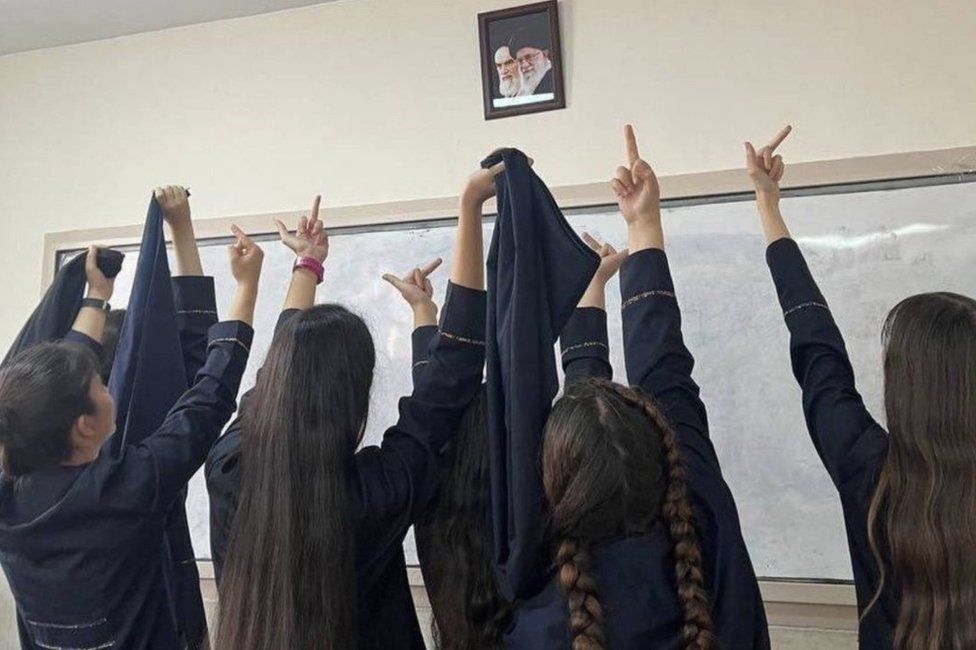
    A number of students were also photographed standing in their classrooms with their heads uncovered.

    Some were raising their middle fingers – an obscene gesture – at portraits of Ayatollah Khamenei and the founder of the Islamic Republic, Ayatollah Ruhollah Khomeini.

    Iranian schoolgirls without headscarves raise their middle fingers towards portraits of Ayatollah Ruhollah Khomeini and Ayatollah Ali Khamenei
    IMAGE SOURCE,TWITTER Image caption, The protests by the schoolgirls began hours after Iran’s supreme leader defended the government’s response


  • Iran protests: Students stuck in Tehran during protests in Iran, reports

    Iranian police and students battled on Sunday at one of the nation’s most prestigious institutions according to reports in the official media and social media.

    Reports say a large number of students at Sharif University in Tehran have been trapped in the campus car park.

    Videos on social media appear to show students running away from security forces, with apparent gunshots fired.

    Anti-government protests erupted in Iran in September after the death of a woman detained by the morality police.

    Mahsa Amini, 22, fell into a coma hours after morality police arrested her for allegedly breaking headscarf rules.

    Officers reportedly beat Ms Amini’s head with a baton and banged her head against one of their vehicles. The police have said there is no evidence of any mistreatment and that she suffered “sudden heart failure”.

    Protests started at her funeral and have spread across the country to become the worst unrest seen in the country for years.

    One video posted on social media shows students running from security forces on Sharif university’s campus. Sounds resembling gunshots can be heard from a distance.

    In another, security forces on motorbikes appear to shoot at a car holding the passenger filming the video.

    Iran International cites reports which say security forces attacked student dormitories and fired guns at their dorms. Other reports mention the use of tear gas on protesters.

    Sunday was the first day of term for many students attending Sharif university for the first time. Reports say crowds had gathered outside the campus’s main gate late in the evening after hearing about the clashes.

    The BBC is unable to verify the events at the university.

    The last two nights have seen an escalation in anti-government protests in Tehran and many other cities across the country, despite a growing death toll.

    Iran Human Rights, an NGO based in Norway, says 133 people have been killed across Iran to date.

    Authorities have promised to come down hard on the protesters, who they say have been put up to it by Iran’s external enemies.