More on the 12 Thai hostages that were just freed from Hamas custody in Gaza.
According to Thai media, the hostages were being transported to the Shamir Medical Centre (Assaf Harofeh), which is located south of Tel Aviv in Jerusalem, after entering Israel through the Rafah crossing.
They are expected to stay for 48 hours and receive medical attention there.
According to an official briefed on the talks, they were released under a separate accord with Hamas mediated by Egypt and Qatar.
The 12 Thai hostages, according to the official, were all men.
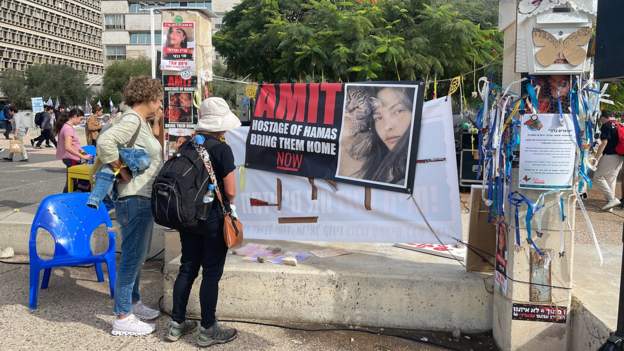
I am at the square outside the Museum of Art in Tel Aviv. It is called hostages plaza. People come here to protest and show support for hostages and their families.
The Shabbat table is still standing with empty chairs for each hostage.
Some places are set aside for women and children. It is expected that they will be brought back within the next day.
There is a lot of activity happening here this morning. A person is playing the piano near posters displaying photos of the hostages. The posters are surrounded by Israeli flags.
A chessboard is shown with each kidnap victim represented as a chess piece.
Today feels like a time when something new and important might happen.
Last night, we heard a sudden protest from the families of the hostages. They really wanted to make the deal happen.
Now, there is a mixture of excitement and worry.
This deal is very delicate. People will stay worried until they see the hostages being released.
An irate swarm in Russia’s generally Muslim locale of Dagestan raged an air terminal where a flight from Israel arrived on Sunday, constraining specialists to shut the office and occupy flights.
Clashes cleared out at slightest 10 individuals harmed, counting two individuals in basic condition, agreeing to a explanation by the Dagestan Wellbeing Service late Sunday.
Concurring to Russian state media TASS, “those assembled contradict the Palestinian-Israeli conflict.”
The Makhachkala Uytash Air terminal (MCX) was briefly closed and flights were occupied, concurring to a explanation from the Russian Government Discuss Transport Organization, saying “unknown persons” broke into the office.
The Ruddy Wing Carriers flight from Tel Aviv arrived Sunday at 7:17 p.m. nearby time, concurring to Flight Mindful, and was rapidly encompassed by nonconformists upon landing.
Different recordings posted on social media appeared a swarm of individuals interior the air terminal and on the runway, a few waving the Palestinian hail, others constraining their way through closed entryways within the universal terminal.
In photographs and recordings confirmed by CNN, the swarm exterior the airplane terminal held antisemetic signs that included trademarks such as “We are against Jewish refugees,” and “There is no put for child-killers in Dagestan.”
In one video, a pilot takes to the speaker of his airplane to say: “It isn’t secure to open the doors” since “protesters are below our plane.”
The occurrence is the most recent to demonstrate gigantic worldwide pressures and separates over the progressing Israel-Hamas war, which was started by a facilitated October 7 assault by the activist bunch that murdered a few 1,400 individuals, for the most part civilians, and the seizing of more than 200 individuals.
Israel’s striking back has been persistent, with Gaza beneath attack and intensely assaulted, kindling pressures distant past the Center East.
Israeli strikes on Gaza have brought about in a few 8,000 fatalities, the Palestinian Service of Wellbeing in Ramallah said on Sunday, drawing the information from sources within the Hamas-controlled enclave. Around 3,000 of those slaughtered are children, concurring to the same specialists.
Dissents have emitted over the world, in back of both Israel and Gaza, with pressures regularly spilling over.
“Israel expects the Russian legitimate specialists to protect the well-being of all Israeli citizens and Jews wherever they are and to require solid activity against the agitators and against the wild prompting being coordinated against Jews and Israelis,” the Israeli Prime Minister’s office and the Service of Remote Issues said in a joint explanation.
“Israeli Envoy to Russia Alex Ben Zvi is working with the Russian specialists to secure the well-being of Jews and Israelis at the site,” it included.
The US too called on Russia to secure Israelis and Jews.
“The Joined together States enthusiastically condemns the antisemitic challenges in Dagestan, Russia,” National Security Chamber representative Adrienne Watson composed on social media.
In a car-ramming attack on Friday night in Tel Aviv, Israel, a tourist from Italy was killed and seven others were hurt.
The Tel Aviv boardwalk’s bike path was entered by a car, according to Israeli police, which then struck pedestrians before flipping over on a grass.
The driver was shot by police after they got at the scene and saw him reaching for what appeared to be a rifle-like weapon that was with him, according to Israeli police.
Israeli and Italian police have identified the victim of the attack as Alessandro Parini. He was a 35-year-old lawyer, according to Italian media.
In a tweet posted Friday, Italy’s Prime Minister Georgia Meloni expressed “deep condolences for the death of one of our compatriots, Alessandro Parini, in the terrorist attack that took place in the evening in Tel Aviv,” and condemned the “cowardly attack that hit him.”
Three of the seven people injured in the attack are still in hospital as of Saturday morning local time, according to Ichilov Medical Center. All of those killed or injured in the attack were tourists.
Police said that the car was driven by a 45-year-old resident of Kfar Kasem, an Arab-Israeli city east of Tel Aviv.
Israeli authorities described the incident as a “terror attack.”
The attack occurred after Israel struck Palestinian militant targets in southern Lebanon and Gaza, amid days of tensions in the region following police raids on the al-Aqsa mosque in Jerusalem.
The leader of the United Arab List and Knesset Member Mansour Abbas rejected any “use of violence against any citizen.”
“Especially in these difficult times, it’s important for me to emphasize… this is not the way of the Arab community and Arab citizens in Israel,” Abbas said Saturday.
The changes would, among other things, make it simpler for the parliament to overturn Supreme Court judgements.
The proposed changes by Prime Minister Benjamin Netanyahu were branded an assault on democracy by protesters.
It comes after the installation of the most pious and rigidly conservative government in Israeli history.
Local media reported that protests were also held in front of the prime minister’s home in Jerusalem and the northern city of Haifa.
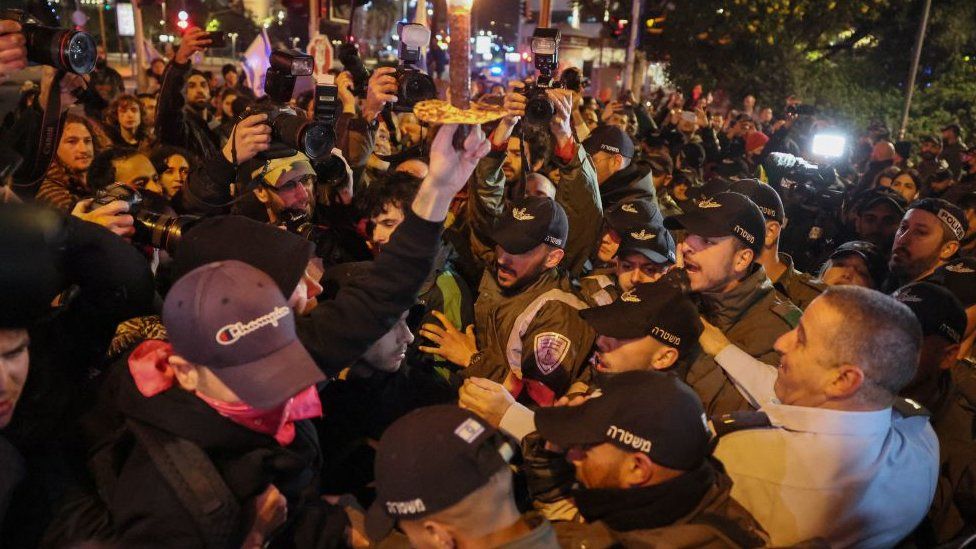
One group of protesters clashed with police while attempting to block a major road, Ayalon highway, in Tel Aviv.
Critics say the reforms would cripple judicial independence, foster corruption, set back minority rights and deprive Israel’s court system of credibility.
Banners referred to the new coalition led by Mr Netanyahu as a government of shame.
Image caption,Israeli security forces with left-wing protesters during the rallies in Tel Aviv
Among those opposed are Israel’s Supreme Court chief justice, Esther Hayat, and the country’s attorney-general.
The BBC’s Samantha Granville in Tel Aviv saw protesters draped in Israeli flags, carrying posters in Hebrew, and pictures of Mr Netanyahu with X’s over his mouth.
There was a group of young girls with red-painted hand prints over their mouths. They wanted to tell the government they won’t be quiet.
One woman, who asked not to use her name, said through her tears she was a second-generation Holocaust survivor.
“My parents immigrated from non-democratic regimes to live in a democracy,” she said. “They came from the totalitarian regime to live freely. So seeing that destroyed is heart-breaking.”
She and her friend said they expected Mr Netanyahu to try radical changes, but never thought they would come so fast.
These are the largest demonstrations since Mr Netanyahu’s new coalition government was sworn in, in December.
Opposition parties had called on Israelis to join the rallies to “save democracy” and in protest at the planned judicial overhaul.
Under the plans announced by Justice Minister Yariv Levin earlier this month, a simple majority in the Knesset (parliament) would have the power to effectively annul Supreme Court rulings. This could enable the government of the day to pass legislation without fear of it being struck down.
Critics fear the new government could use this to scrap Mr Netanyahu’s ongoing criminal trial, although the government has not said it would do that.
Mr Netanyahu is being tried on charges of bribery, fraud and breach of trust – something he strongly denies.
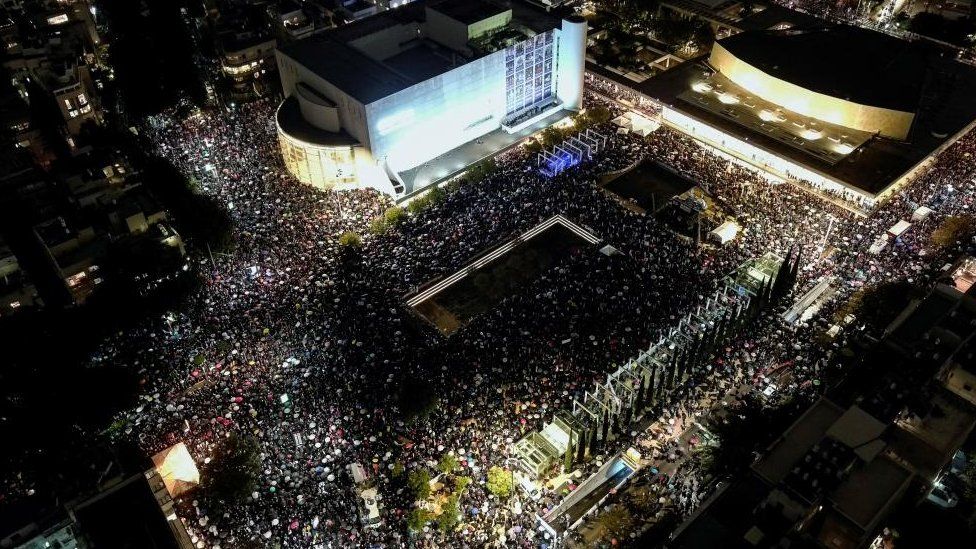
Image caption,A huge crowd gathered in Tel Aviv to protest at the judicial reforms to reduce Supreme Court powers
The reforms would also give politicians more influence over the appointment of judges, with most members of the selection committee coming from the ruling coalition.
If it passes into law, the plan could make it easier for the government to legislate in favour of Jewish settlements in the occupied West Bank without worrying about challenges in the Supreme Court.
Israel has previously highlighted the power of the court to rule against it, as a way of blunting international criticism of such moves.
Exploration in the Qana field is set to begin following the signing of a framework agreement with the contractor by Tel Aviv.Following a United States-mediated agreement that ended a decades-long maritime border dispute between Lebanon and Israel last month, French oil giant TotalEnergies has announced that it will soon begin gas exploration activities in the Mediterranean Sea off Lebanon’s coast.
TotalEnergies and its partner, Italy’s Eni, signed a framework agreement with Israel on Tuesday, paving the way for exploration in the so-called Qana field.
Israeli authorities provided no immediate confirmation.
Under the terms of the deal signed by Lebanese and Israeli representatives on October 27, Israel retains full rights to develop the Karish field while Lebanon retains full rights in Qana – but with a caveat.
As Qana extends southward of the agreed demarcation line – Line 23 – Israel is entitled to receive royalties under the terms of a separate deal negotiated with the operator of the so-called Block 9.
Analysts have expressed their concern that the failure to reach a profit-sharing arrangement could potentially stall production on Lebanon’s side.
Diana Kaissy, advisory board member at the Lebanese Oil and Gas Initiative (LOGI), told Al Jazeera the signature of the framework agreement was “a step forward”.
“But we don’t want it to be a faulty step,” Kaissy added. “Lebanon should be privy to the agreement.”
Cash-strapped Lebanon, which has been technically at war with Israel since its creation in 1948, is hoping that future gas discoveries will help pull itself out of the worst economic and financial crisis in the country’s modern history.
Lebanese officials have said the maritime border agreement does not represent any form of normalisation of relations between the two countries and have avoided direct negotiations with Israeli officials.
Kaissy argued that while Lebanon had contracted TotalEnergies, the state maintained a sovereign right to its resources and should therefore have a say in how Israel’s royalties over its gas field are calculated.
@TotalEnergies needs to publish the framework agreement signed between them and Israel.
@LOGI_Lebanon
Agreement on Maritime Border Line between Israel and Lebanon: TotalEnergies Will Launch Exploration Activities on Block 9 | https://t.co/47Y9zibaGk
It was not immediately clear whether Lebanese authorities had been informed of the terms of the framework agreement, which has not been made public.
Further complicating the debate around Israel’s royalties is uncertainty around which companies have a stake in Block 9.
TotalEnergies said in the statement that it would have 60 percent stake and Eni the rest.
But Lebanon in 2017 had approved licences for an international consortium including TotalEnergies, Eni and Russia’s Novatek. Novatek recently withdrew, and Lebanese officials, including Energy Minister Walid Fayad, have said that Qatar is interested in filling that gap.
“Qatar does not have any formal relation with Israel, which might explain why it was not part of the framework agreement,” Kaissy said.
TotalEnergies CEO Patrick Pouyanné said the company was “proud to be associated with the peaceful definition of a maritime border between Israel and Lebanon”.
“By bringing our expertise in offshore exploration, we will respond to the requestof both countries to assess the materiality of hydrocarbon resources and production potential in this area,” Pouyanné said.
The maritime border deal has been hailed as “historic” and mutually beneficial. It represents the first significant diplomatic breakthrough between the two countries in years.
In September, Hezbollah leader Hassan Nasrallah called the extraction of gas from Karish by Israel a “red line”. In turn, Israel’s Defence Minister Benny Gantz said that if Hezbollah harmed its offshore rig, “the price will be Lebanon”.
Alongside easing regional tensions, the deal could also be a boon for Europe as it attempts to disengage from Russian gas over Moscow’s invasion of Ukraine.
Former Israeli Prime Minister Benjamin Netanyahu is on the verge of a dramatic comeback after preliminary results showed he was on track to win a parliamentary majority with the help of the far right.
With 84% of general election votes counted, Mr Netanyahu’s bloc is on track to win 65 of 120 seats.
“We are close to a big victory,” he told jubilant supporters in Jerusalem.
However, he will be dependent on the support of the ultra-nationalist Religious Zionism party.
Its leaders, Itamar Ben-Gvir and Bezalel Smotrich, have gained notoriety for using anti-Arab rhetoric and advocating the deportation of “disloyal” Arab politicians or civilians.
Mr Ben-Gvir was a follower of the late, explicitly racist, ultra-nationalist Meir Kahane, whose organisation was banned in Israel and designated as a terrorist group by the United States. Mr Ben-Gvir himself has been convicted of incitement to racism and supporting a terrorist organisation.
Last month, Mr Ben-Gvir hit the headlines when he was filmed pulling out a gun after being targeted with a stone thrown by Palestinians while visiting a predominantly Arab area of occupied East Jerusalem, and calling for police to shoot the culprits.
Speaking to reporters on Wednesday, Mr Ben Gvir promised to “work for all of Israel, even those who hate me”.
Mr Netanyahu, accompanied by his wife Sara, appeared at his Likud party’s election night venue at 03:00 local time (01:00 GMT) on Wednesday to thunderous applause.
“We have won a huge vote of confidence from the people of Israel,” he told his cheering supporters.
Hours earlier, when exit polls predicted that Mr Netanyahu’s bloc would win 61 or 62 seats, the room had been a scene of celebration as people jumped up and down, waved flags, and chanted his nickname, Bibi. One man repeatedly blew a shofar, or ram’s horn, a ritual instrument used by some Jewish people at times of special significance.
At his party’s camp in Tel Aviv however, current Prime Minister Yair Lapid told his supporters that “nothing” was yet decided and his center-left Yesh Atid party would wait for the final results.
Mr Netanyahu, 73, is one of Israel’s most controversial political figures, loathed by many on the centre and left but adored by Likud’s grassroots supporters.
He is a firm supporter of Israel’s settlement-building in the West Bank, occupied since the 1967 Middle East war. Settlements there are considered illegal under international law, though Israel disputes this.
He opposes the creation of a Palestinian state in the West Bank and Gaza Stripas a solution to the Israel-Palestinian conflict – a formula supported by most of the international community, including the Biden administration in the US.
Mr Netanyahu is also currently on trial for alleged bribery, fraud, and breach of trust – charges he fiercely denies. His possible partners in a Likud-led coalition government have said they would reform the law, in a move that would bring a halt to his trial.
According to the partial results, Likud stands to be the biggest party, with 31 seats, commanding a majority with the support of nationalist and religious parties.
Yesh Atid, which led the coalition which brought down Mr Netanyahu in elections last year, is projected to win 24 seats.
Religious Zionism appears to have won 14 seats, which would make it the third-largest party.
“It will be better now,” said Religious Zionism supporter, Julian, at the party’s venue in Jerusalem.
“When [Religious Zionism politician Itamar Ben-Gvir] will be a minister of public security, it will be even better – he’ll bring back security to the people of Israel. That’s very important.”
However, political scientist Gayil Talshir, from the Hebrew University of Jerusalem, warned that if the exit polls “reflect the real results, Israel is on its way to becoming Orban’s Hungary”, recently branded an “electoral autocracy” by the EU.
If Mr Netanyahu can secure a majority, it will stave off the prospect of a sixth election in just four years after analysts predicted deadlock.
It would mark a remarkable turnaround for Mr Netanyahu, whose political future was widely written off after Mr Lapid formed an unlikely alliance of ideologically diverse parties to take power in June 2021, with the uniting aim of making it impossible for Mr Netanyahu to form a government.
At the time, Mr Netanyahu vowed to bring it down as quickly as possible and one year later the coalition government concluded it could not survive and collapsed after resignations meant it no longer had a majority.
Ukraine’s foreign minister says he has spoken with Israeli Prime Minister Binyamin Netanyahu about the harm inflicted by “Russian missiles and Iranian-made drones.”
Ukrainian and Israeli officials met to discuss Kyiv’s request for Israeli air defence support, just days after Russia purportedly used Iranian “kamikaze” drones in a new wave of air strikes on war-torn Ukraine.
Ukrainian foreign minister Dmytro Kulebasaid on Thursday he had spoken on the phone to Israeli Prime Minister Yair Lapid and “discussed in detail” the provision of air and missile defense systems and technology.
“I informed him [about the] unspeakable suffering, loss of life, and destruction caused by Russian missiles and Iranian-made drones,” he tweeted.
I spoke to Israeli Prime Minister @YairLapid and informed him on unspeakable suffering, loss of life, and destruction caused by Russian missiles and Iranian-made drones. We discussed in detail Ukraine’s request for Israel to provide air and missile defense systems and technology.
Lapid’s office said in a statement on Thursday that the Israeli prime minister had expressed “deep concern” over the military ties between Russia and arch-foe Iran.
Ukraine this week accused Russia of using four Iranian-made drones to bomb Kyiv and said its air defences have shot down 223 Iranian drones since mid-September.
The Kremlin said it had no knowledge of its army using Iranian drones in Ukraine and Tehran said the claims that it is providing Russia with weapons are “baseless”.
European Union countries, however, said they had found evidence supporting Kyiv’s claim and on Thursday adopted sanctions on Iran over its provision of drones to Russia.
The phone call between Kuleba and Lapid came two days after Ukraine stepped up appeals for Israeli help with air defence systems to intercept Iranian drones and ballistic missiles.
In the request, Ukraine also demanded that Israel train its forces in operating the systems, Axios reported.
Israel has walked a delicate diplomatic line since the start of the Russian invasion in late February, seeking to preserve ties with Moscow.
While condemning Russia’s move, it has limited its assistance to humanitarian relief, citing a desire to ensure the well-being of Russia’s Jews and to continue cooperation with Moscow over war-ravaged neighbour Syria.
On Wednesday, Israeli defence minister Benny Gantz reiterated Tel Aviv’s position that it would not sell weapon systems to Ukraine.
According to a statement by his office, however, Gantz had asked Ukraine “to share information about their needs for air defence alerts”.
Israel would be able to “assist in the development of a life-saving civilian early-warning system”, the statement said. Ukraine’s ambassador had asked for systems that would shoot down the drones instead.
Russia warned on Monday that an Israeli move to bolster Kyiv’s forces wouldseverely damage relations between Moscow and Tel Aviv.
The UK’s plan to relocate its embassy from Tel Aviv to Jerusalem has been labeled as a “blatant violation of international law” by the Palestinians.
While at the UN, UK PM Liz Trussreportedly informed her Israeli colleague, Yair Lapid, of the review.
Such a move would be highly controversial. The opening of the US embassy in Jerusalem in 2018 was met with outrage across the Arab world.
Mr Lapid tweeted his thanks to Ms Truss for “positively considering” it.
He described Ms Truss as his “good friend”, writing in Hebrew after the pair met on the fringes of the UN General Assembly in New York.
Downing Street has not given any indication of timing but has confirmed that a review is underway.
British officials said they would not speculate on the outcome, adding that Ms Truss was aware of the sensitivity and importance of the location of the British embassy in Israel.
The status of Jerusalem is one of the thorniest issues in the decades-old Israel-Palestinian conflict.
Israel sees the entire city as its eternal, undivided capital while Palestinians claim the eastern part as the capital of their hoped-for future state.
East Jerusalem, along with the West Bank and Gaza Strip, were captured by Israel from Jordan and Egypt in the 1967 Middle East war and have since been viewed internationally as occupied Palestinian territory.
On Twitter, the Palestinian ambassador to the UK, Husam Zomlot, wrote that it was “extremely unfortunate” that Ms Truss had used her first appearance at the UN as prime minister to “commit to potentially breaking international law”.
He said any embassy move would be “a blatant violation” of “the UK’s historic responsibilities”, undermining the two-state solution of an independent Palestinian state alongside Israel to the Israel-Palestinian conflict.
“Such promise is immoral, illegal and irresponsible!” he said.
It is extremely unfortunate that Prime Minister @trussliz uses her first appearance at the UN to commit to potentially breaking international law by promising a “review” of the location of the British embassy to Israel 1/3 https://t.co/qgC1QnIUhi
Up until now, the UK – like most other countries – has kept its embassy in Tel Aviv, rather than in bitterly contested Jerusalem, holding that it should only move to the holy city after a final peace deal between Israel and the Palestinians.
Britain has a consulate in East Jerusalem.
Ms Truss reportedly raised the idea of relocating the embassy during therecent Conservative leadership campaign.
When US President Donald Trump recognised Jerusalem as Israel’s capital – fulfilling a campaign promise – it brought international condemnation. It also led to a flare-up in violence in which dozens of Palestinians were killed by Israeli forces.
At the time, the British PM, Theresa May, criticised the US action.
The only countries to have since followed Mr Trump’s example by moving their embassies from Tel Aviv to Jerusalem have been Honduras, Guatemala and Kosovo.
Liz Truss, who is following Donald Trump’s lead, says she is thinking of moving the British embassy in Israel from Tel Aviv to Jerusalem. This would be a radical change from decades of UK foreign policy.
In a meeting on the sidelines of the UN general assembly in New York, the prime minister told Israel’s caretaker leader, Yair Lapid, about a “review of the current location” of the building, Downing Street said in a statement.
The status of Jerusalem, which Israelis and Palestinians claim as their capital, is one of the most sensitive issues in the long-running conflict.
East Jerusalem, along with the West Bank and Gaza Strip, has been considered occupied Palestinian territory under international law since the six-day war in 1967.
Like the vast majority of the international community, the UK’s position until this point has been that the divided city should host consulates, rather than embassies until a final peace agreement is reached.
Trump’s 2018 fulfillment of an election campaign promise to recognise Jerusalem as Israel’s capital prompted international condemnationand led to protests and clashes in which Israeli forces killed dozens of Palestinians. The then UK prime minister Theresa May criticised the move at the time.
On Thursday, the Israeli prime minister tweeted his thanks to Truss for what he described as “positively considering” the move. “We will continue to strengthen the partnership between the countries,” he said.
מודה לידידתי הטובה, ראשת ממשלת בריטניה ליז טראס, שהודיעה כי היא שוקלת בחיוב את העברת שגרירות בריטניה לירושלים בירת ישראל- אנחנו נמשיך לחזק את השותפות בין המדינות 🇮🇱🇬🇧
The Guardian understands that the embassy move was one of a range of options put forward to Truss by Foreign Office staff in late 2021 during her stint as foreign secretary. However, she did not make any substantial policy changes during her two years at the foreign office.
The prime minister appears to have first publicly floated the idea of relocating the embassy in a letter to the Conservative Friends of Israel (CFI) parliamentary group during the Tory leadership campaign over the summer.
She wrote: “I understand the importance and sensitivity of the location of the British embassy in Israel. I’ve had many conversations with my good friend … Lapid on this topic. Acknowledging that, I will review a move to ensure we are operating on the strongest footing within Israel.”
At a hustings with CFI, she vowed that “under my leadership, Israel will have no stauncher friend in the world. That’s what I’ve done as foreign secretary and trade secretary. I don’t just talk the talk – I walk the walk.”
Pressed in the House of Commons on 6 September by the backbench Tory MP Michael Fabricant to follow the US and move the embassy from Tel Aviv to Jerusalem, the Foreign Office minister Amanda Milling said: “The British embassy to Israel is in Tel Aviv. I am aware of the possibility of a review, but will not speculate further on this point.”
Her remarks suggest the review is only just under way, but advocates of the move inside the Conservative party claim the proposal will prove less controversial than even a few years ago due to the Trump administration setting a precedent, and the thaw in relations between Israel and some Arab countries following the Abraham accords.
Downing Street has been contacted to explain how long the review will take.
Other than the US, only three states have embassies to Israel in Jerusalem – Kosovo, Honduras and Guatemala – which all moved from Tel Aviv after the US relocation.