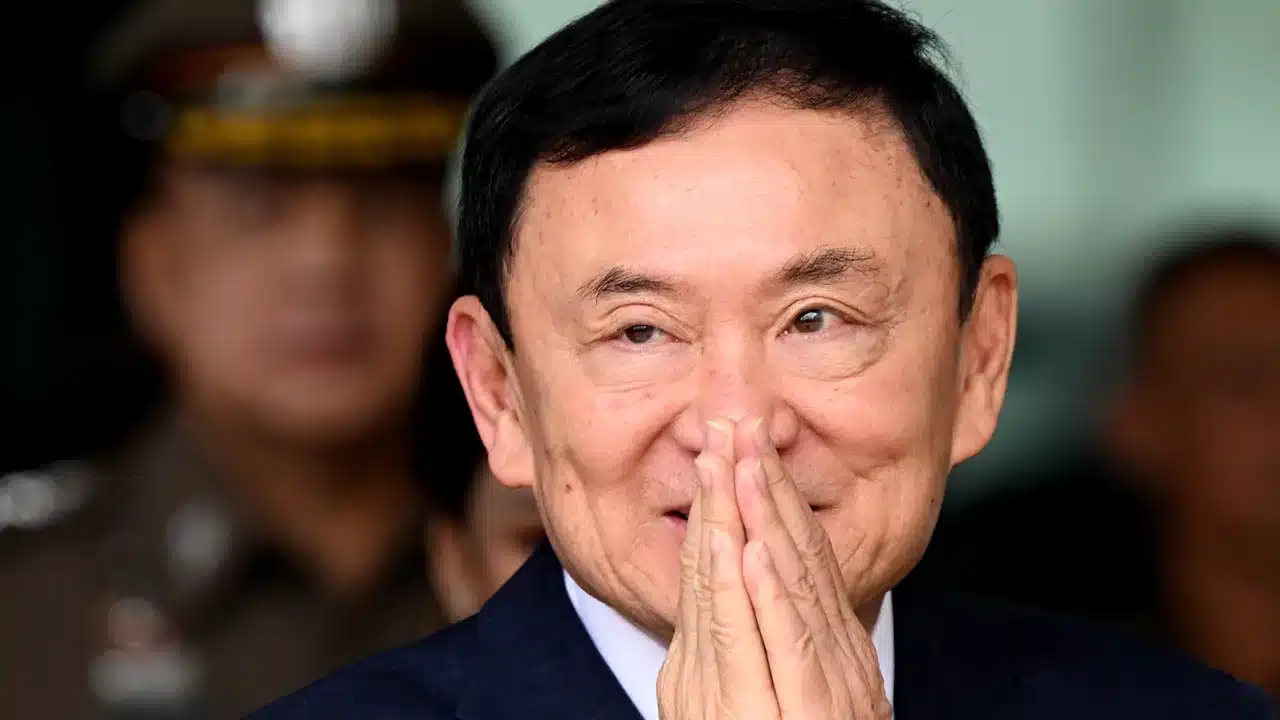
Thailand’s former Prime Minister, Thaksin Shinawatra, convicted of corruption and abuse of power, has been released on parole and returned to his mansion in Bangkok.
The billionaire, aged 74, was freed from a police hospital where he had been serving a one-year sentence. He had been detained upon his return to Thailand in August after 15 years in self-imposed exile but did not spend a night in jail due to health complaints.
Originally sentenced to eight years, his term was reduced to one by the king shortly after his return, sparking criticism over preferential treatment for the wealthy and powerful.
Thailand’s Move Forward Party, which won the majority of seats in the last election but was blocked from forming a government, called for equal treatment under the law.
Questions have been raised about Thaksin’s health, with Senator Somchai Swangkarn questioning the need for parole.
Thaksin, a polarizing figure, was seen leaving the police hospital, greeted with well wishes on social media. He is eligible for parole due to age and health reasons, though conditions of his release were not disclosed.
Prime Minister Srettha Thavisin stated readiness to listen to Thaksin’s political advice but has no immediate plans to meet him.
Thaksin, ousted by a coup in 2006, spent years in exile in London and Dubai. His family’s Pheu Thai party currently holds power in Thailand.
While reviled by Bangkok’s elite, he remains popular among rural Thais for his populist policies. Thaksin made history as Thailand’s first elected PM to serve a full term from 2001-2006.
The duration of the penalty for former prime minister Thaksin Shinawatra has been reduced by King Maha Vajiralongkorn of Thailand. Instead of being in prison for eight years, Thaksin will only have to stay for one year. This is surprising and ends a long political story.
Thaksin, the leader of a famous political family, recently came back to Thailand after being away for 15 years. The country’s justice minister has confirmed that he has asked for a royal pardon.
A message posted in Thailand’s official journal on Friday stated that the King has recognized Thaksin’s request and, “with his kindness, he has shortened Thaksin Shinawatra’s prison sentence to one year. ”
The statement said that it considered Thaksin’s service to the country, loyalty to the monarchy, and his confession and regret for his past actions.
“He was once the leader of Thailand, and during his time, he helped the country and its people. ” And when he was accused and found guilty by the court of the mentioned prison sentence, he admitted to his actions and expressed regret, stated the announcement.
“He was ready to accept the punishment even though he was old and had health problems that needed treatment from special doctors. ”
The statement did not mention the specific time when Thaksin asked for a royal pardon. The king gave an order on August 31 and it was signed by the previous Prime Minister Prayut Chan-o-cha, who used to be a military leader and removed a government that was previously led by Thaksin’s sister.
Thaksin, who is now 74 years old, served as the prime minister from 2001 until he was removed from power in a military takeover in 2006. He went back to Thailand for a short time in 2008 but then ran away from the country because he was found guilty of corruption.
Thaksin returned to Thailand on August 22 after running away for a while. He came back on a fancy airplane called a private jet. When he arrived in Bangkok, his family and fans were there to greet him.
He was arrested and given a punishment of eight years in jail by the highest court for doing things that were not fair and right while he was in charge. Thaksin was found guilty of the charges while he was away and unable to attend the trial.
Justice Minister Wissanu Krea-ngam, who is leaving his position, told reporters on Thursday that he had received a letter from Thaksin asking for forgiveness from King Vajiralongkorn.
Wissanu, a experienced person who has lived through Thailand’s unstable politics and has worked in the government during Thaksin’s time and also with the military leaders afterwards, said that the request for a royal pardon will go forward and “will be handled following the rules. ”
“He said it all depends on the kindness of His Majesty. ”
After coming back to Thailand, Thaksin was put in prison. However, the next day he was taken to the hospital because he had chest discomfort, high blood pressure, and low oxygen levels. The Thai Corrections Department explained that his heart disease couldn’t be treated at the prison hospital and he required care from specialists.
Only a few hours after reaching Thailand, the parliament selected Srettha Thavisin from the Pheu Thai party to become the country’s 30th prime minister.
In order to get enough votes in parliament, Pheu Thai joined forces with two political parties supported by the military. These parties have connections to the military group that overthrew Pheu Thai’s government, which was chosen by the people and led by Yingluck Shinawatra, Thaksin’s sister, almost ten years ago.
Pheu Thai is a new political party started by Thaksin from the powerful Shinawatra family. They have been a strong force in Thai politics for two decades.
Some experts think that Thaksin may have made an agreement with the influential conservative and royalist group in the country, allowing him to come back despite his convictions and charges. In return, they may have given him a shorter prison sentence, more lenient treatment, or a chance for forgiveness.
Thaksin has said that he did not make this agreement.
However, it is important to notice that the king made the decision quickly.
In Thailand, prisoners can ask the justice minister for forgiveness from the king. The minister then sends the request to the prime minister, who finally gives it to the king for his decision.
The temporary government, led by the current prime minister who came to power through a coup in 2014, only has a short time left before the new government takes over. The new prime minister is a friend of Thaksin and his name is Srettha.
A divisive person, Thaksin is a very wealthy businessperson in the telecommunications industry. He gained his political influence by implementing policies that were liked by the rural poor in Thailand who make up most of the country’s population. However, the country’s wealthy and conservative people strongly disagreed with his policies and accused Thaksin of being a dangerous and corrupt leader who catered to the needs of the general public.
Thailand’s former PM Thaksin Shinawatra has been jailed upon returning to the country after 15 years in exile.
But many believe he has struck a deal that will keep him from serving more than a short period in prison.
He arrived on Tuesday morning in a private jet, ahead of a vote for the next Thai leader – the frontrunner is from his Pheu Thai party.
He was then sentenced to eight years, on former criminal convictions he says were politically motivated.
Mr Thaksin, Thailand’s most successful elected leader, has long been feared by conservative royalists, who have backed military coups and contentious court cases to weaken him.
But now the brash, politically ambitious telecoms tycoon is back, years after he was deposed by a military coup.
He landed in Bangkok’s main airport to cheers from hundreds of loyal supporters who had gathered overnight to see him.
Flanked by his two daughters and son, he emerged briefly from the airport terminal and paid his respects to a portrait of the king and queen.
The 74-year-old was immediately taken to the Supreme Court where he was sentenced to eight years on three former convictions, and then to Bangkok Remand Prison.
Prison authorities there say he will be kept in a wing with specific medical equipment, given his advanced age. He will also immediately undergo a 10-day quarantine – the first five days of which he will be confined to his room, authorities said.
It has been speculated that Thaksin will seek a royal pardon, and prison authorities on Tuesday said he would be able to submit a petition from jail immediately. The process can take one to two months.
Mr Thaksin greets supporters after arriving in Bangkok
Hundreds of “red shirt” loyal supporters had gathered at Bangkok’s Don Mueang Airport on Tuesday morning to welcome the former leader’s return.
Samniang Kongpolparn, 63, had been waiting since Monday evening to see Mr Thaksin. She, like many of the other supporters, had travelled from Surin province in the northeast, the stronghold of Mr Thaksin’s party in past decades.
“He’s the best prime minister we’ve ever had. Even though I won’t get to see him today, I still wanted to come to show him support,” she said. “I’m ok with them reconciling with the pro-military government, or else we’re stuck with the senators. We don’t want that.”
Thaksin’s political party in the front seat
Mr Thaksin’s Pheu Thai party is expected later today to join a coalition government – a byzantine process which in three months has taken Thailand full circle.
It began with the heady hopes of a new dawn led by the radical young Move Forward party, which won the most seats in the May election.
Move Forward initially formed a partnership with Pheu Thai but it’s now certain that the coalition will include almost everyone but the reformers, including two parties led by former coup-makers – a deal with its sworn enemies that Pheu Thai vowed it would not do.
Pheu Thai insists the two developments are unconnected. Few people believe that.
It is true that Pheu Thai’s hands have been tied by the unelected senate, a 250-seat constitutional landmine planted in Thailand’s political landscape by the military junta which ruled for five years after a 2014 coup.
And Pheu Thai’s bargaining position was weakened by its poorer-then-expected performance in the election, when it lost a lot of support to Move Forward and for the first time was relegated to second place.
The senators, all appointed under the junta, are allowed to join the 500 elected MPs in voting for the new prime minister. Their thinly-disguised remit is to block any party which might threaten the status quo – the nexus of monarchy, military and big business which has dominated decision-making in Thailand for decades.
Unsurprisingly they refused to back the Move Forward-led coalition with Pheu Thai, despite its commanding majority in the lower house. When it was Pheu Thai’s turn to negotiate a new coalition, its need for senate support meant it had to take in some of its former opponents.
Many of the supporters had come from the northeast, a Thaksin stronghold
However some Pheu Thai politicians argue that the party should have held out for a better deal, by refusing to be in a government with the most hard-line conservative groups. Any minority administration formed without Pheu Thai and Move Forward would quickly collapse, because the senators cannot join normal parliamentary votes on issues like the budget.
But the Pheu Thai leadership was not willing to wait; it even invited the ultra-royalist party United Thai Nation to join the coalition, whose leaders have in the past been virulently critical of the Shinawatra family and their supporters, and were instrumental in ousting the last Pheu Thai government led by Thaksin’s sister Yingluck. That these two factions will now sit together in the same government is a mark of how far Thai politics has shifted.
In the end for the ultra-royalists the perceived threat posed by Move Forward, and by a younger generation of Thais demanding a conversation about the power and wealth of the monarchy, eclipsed their long feud with the Shinawatra family.
For the Shinawatras, and Pheu Thai’s more conservative, business-minded elements, getting into government again and guaranteeing the deal to bring Thaksin back, have been bigger priorities than worrying about the party’s reputation.
But there are those, even within Pheu Thai, who are horrified by the cynical pragmatism of this deal. They are warning that the party will lose even more of its once-passionate grass-roots supporters, and lose, perhaps forever, the dominance it held over electoral politics in Thailand for two decades.