Tag: Tigray Fight

  • Fighting threatens eastern town in Democratic Republic of Congo

    Fighting threatens eastern town in Democratic Republic of Congo

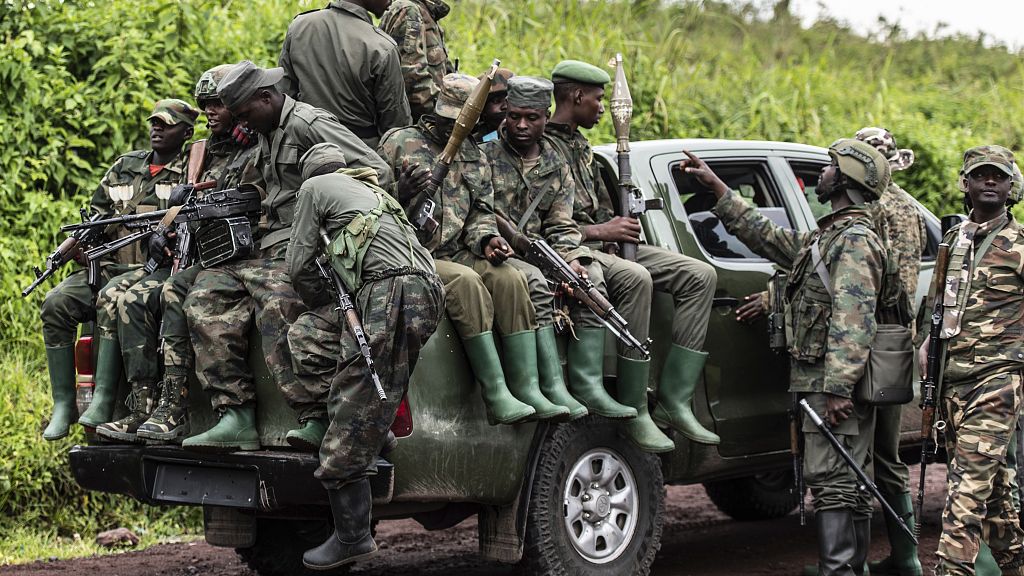
    Fighting has intensified around  Kitchanga, a town in the eastern Democratic Republic of Congo as the M23 rebel group seeks to expand its territory.

    The group has increased pressure on government troops defending the town in North Kivu province, which has led to hundreds of civilians fleeing their homes.

    Videos on social media appeared to show fighters in the M23 group celebrating and claiming they’d captured the town. It was impossible to independently verify their authenticity.

    Kinshasa for months has accused neighbouring Rwanda of supporting the M23 group — whose origins lie in the region’s ethnic fighting — and powerful voices in the West have openly agreed. Rwanda denies backing the group, which is one of the dozens operating in the mineral-rich east.

    At a Nov. 23 summit in Angola, which included Congo’s president and Rwanda’s foreign minister, regional leaders called for a cease-fire in eastern Congo to be followed by a withdrawal of rebels from major towns under M23 control.

    The group said it would leave some of the occupied territories before Jan. 15, but some areas remain under its control and it’s seeking to capture others from government forces. M23 has been accused by the United Nations and rights groups of atrocities against civilians.

    Kitchanga is a key town as it sits on the last open route between North Kivu’s main economic hubs of Goma and Butembo. The others were cut off due to the fighting.

    Many of Kitchanga’s inhabitants fled Thursday’s violence.

    “We have just been through the war in Kitchanga, we saw M23 killing people, we were afraid, that’s why we fled so we wouldn’t die too,” said Angelique Mukeshimana. The mother of four went to a makeshift displacement site on the outskirts of Goma, some 150 kilometres away, leaving all her belongings behind.

    The fighting comes days before Pope Francis is due in Congo’s capital Kinshasa for a three-day visit. The trip was originally supposed to include a stop in the east, however, the Vatican scrapped that amid the rising violence.

    M23′s political spokesman, Lawrence Kanyuka, in a statement on Thursday accused government troops of attacking civilians in Kitchanga and elsewhere, and said the rebel group was “obliged to intervene and stop another genocide.”

    A spokesperson for a United Nations peacekeeping mission in Congo said more than 500 civilians have taken refuge in and around the U.N. peacekeeping base in Kitchanga, where they’ve been given tents, food, water and first aid.

    “The M23 must cease all hostilities and withdraw from the occupied areas,” Ndeye Khady Lo said.

    Analysts say the rebel group’s drive to expand has devastating consequences for civilians.

    “If reports that the group has taken control of Kitchanga … are true, this is yet another indication of the group’s ongoing territorial ambitions and apparent unwillingness to withdraw,” said Daniel Levine-Spound, a researcher at the Center for Civilians in Conflict.

    “The group’s continued westward expansion also raises meaningful fears that M23 could seek to fully encircle Goma. Sustained international pressure, including on M23’s backers, will be critical in halting the group’s advance,” he said.

    Largely comprised of Congolese ethnic Tutsis, M23 rose to prominence 10 years ago when it seized Goma on the border with Rwanda. It’s part of a long line of rebel groups linked with Rwanda since the 1990s when the country sought out ethnic Hutu militias, who had fled to Congo after killing Rwandan Tutsis during the genocide.

    Source: Africa News
  • Ethiopia conflict: Tigray aid lorry drivers arrested, UN says

    The United Nations says that 72 drivers contracted to deliver humanitarian aid have been arrested in the war-torn north of Ethiopia.

    It said that the drivers, who were working for the World Food Programme (WFP), were detained in Semera, capital of the Afar region.

    The UN is speaking to the government to establish why they were stopped.

    The war in Ethiopia has caused a massive humanitarian crisis, with more than five million in need of aid.

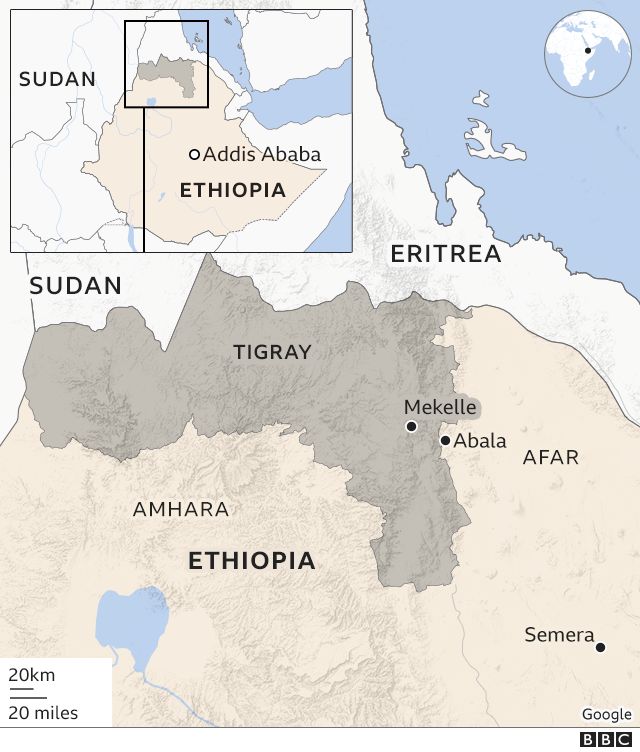
    The city of Semera is a staging post for aid lorries trying to reach the neighbouring region of Tigray, where the conflict flared up last year and where the UN says 400,000 people are living in “famine-like conditions”.

    Hundreds of lorries are believed to be stuck in the city, prevented from taking the only viable overland route into Tigray.

    Map showing Tigray and other regions with key places

    There was no immediate comment on the arrests from the Ethiopian authorities.

    On Tuesday, the UN said 16 members of its local staff and their dependents In the Ethiopian capital, Addis Ababa, had been arrested in raids. Six others were released.

    The UN has urged the government to release the detainees immediately.

    Lawyers and rights groups say the authorities targeted ethnic Tigrayan employees. The government denies arbitrarily arresting Tigrayans.

    Spearheaded by the Tigray People’s Liberation Front (TPLF), rebel forces have been advancing towards Addis Ababa. They have been joined by another rebel group, the Oromo Liberation Army (OLA).

    In response the government has declared a state of emergency, calling on citizens to register their weapons and get ready to protect their neighbourhoods.

    The US embassy has told all US citizens to leave Ethiopia as soon as possible amid a “very fluid” security situation.

    The ferocity of the conflict in the north has been brought out in reports by international non-governmental human rights organisations about sexual violence.

    Sixteen survivors from the attack at Nifas Mewcha were interviewed by Amnesty.

    Amnesty previously documented widespread rape and sexual violence by government-allied troops and militias in Tigray.

    Ethiopia, with its population of more than 100 million, has been portrayed as a beacon of stability for the Horn of Africa, and is the African base for many international organisations.

    In a statement last week, the UN Security Council called for an end to fighting, and reiterated support for African Union mediation efforts.

    Source: bbc.com

  • Ethiopia’s Tigray conflict revives bitter disputes over land

    As rifle-toting militiamen fired celebratory rounds into the air, young men marched through the streets denouncing the former ruling party of Ethiopia’s Tigray region as “thieves.”

    The party, the Tigray People’s Liberation Front (TPLF), is the target of military operations ordered by Prime Minister Abiy Ahmed, last year’s Nobel Peace laureate, that have reportedly left thousands dead since early November.

    But the impromptu parade this month in Alamata, a farming town in southern Tigray flanked by low, rolling mountains, was unrelated to any kind of battlefield victory.

    Rather it was to hail the release of Berhanu Belay Teferra, a self-described political prisoner under the TPLF whose pet issue, analysts warn, risks becoming Ethiopia’s next flashpoint.

    In 2018, Berhanu, 48, was detained by the TPLF for advocating that his homeland — located in an area known as Raya, of which Alamata is the biggest city — had no business falling under Tigrayan control.

    Berhanu argued that the TPLF had illegally incorporated the famously fertile land into Tigray after it came to power in the early 1990s.

    Source: theeastafrican.co.ke/afp

  • UN calls for ‘full access’ to Tigray

    The UN says it is increasingly concerned about the plight of civilians in Ethiopia’s Tigray region and has once again called on the government to allow full access so that allegations of war crimes can be investigated.

    The UN High Commissioner for Human Rights, Michelle Bachelet, said two humanitarian assessment missions were able to enter the region on Monday.

    But she said due to restrictions it had not yet been possible to investigate allegations of artillery strikes on populated areas, extrajudicial killings and widespread looting.

    The UN said it had received consistent reports of artillery strikes last month on homes and a hospital in the town of Humera on the border with EritreaArticle share tools

    Source: bbc.com

  • More than 63,000 people internally displaced in Tigray – UN spokesman

    A UN spokesman said Tuesday that more than 63,000 people have been recorded as “internally displaced” in Tigray, but the UN hopes to know the true number once the world body has more access.

    Stephane Dujarric, spokesman for UN Secretary-General Antonio Guterres, told the regular press briefing that in Ethiopia, the UN continues to engage at the highest levels with the federal government to work out operational details “to guarantee humanitarian access.”ÿÿ

    “We are also working to scale up humanitarian assistance in the Tigray region once access is re-established,” he said.ÿ

    “In the meantime, our humanitarian colleagues tell us that arrangements are being made to deploy surge teams to different areas in Tigray, Afar and Amhara, and that supplies – including food, health, emergency shelter, and other items – are being continuously mobilized,” he added.

    The spokesman said that in neighboring Sudan, UN humanitarian teams there have said that “there are still challenges to help the increasing number of refugees crossing the border.”

    “Water, hygiene and sanitation services are extremely limited in all transit centers, as well as in Um Raquba settlement, to where over 16,000 refugees have now been relocated,” said the spokesman.

    More than 50,000 people have now fled to Sudan since the beginning of the conflict in Tigray, which started in early November, Dujarric added.ÿ

    The crisis erupted early last month during clashes between Tigray rebels and the federal government, cutting civilians from necessities, forcing tens of thousands to flee their homes and refugee camps running out of supplies.

    Source: GNA

  • Ethiopia admits to firing at UN staff in Tigray

    The Ethiopian government has confirmed that soldiers shot at a United Nations team which was driving in the north of the country where the army has been fighting Tigrayan forces.

    A spokesman blamed the UN staff saying they were not supposed to be in the area.

    He accused them of driving straight through two check points before they were detained.

    The UN is yet to comment on Sunday’s incident.

    The team was reportedly trying to reach a camp for Eritrean refugees.

    There are fears that some have been caught up in the conflict and reports that refugees have been forced onto trucks and back to Eritrea.

    The Ethiopian authorities have released a statement saying that humanitarian assistance must be “led and coordinated by the Ethiopian government”:

    Source: bbc.com

  • Damaged roads, airports could slow aid work in Ethiopia’s Tigray

    Aid workers hoping to access Ethiopia’s Tigray region will have to overcome challenges such as the region’s damaged infrastructure to develop tons of relief items for those in need.

    After nearly a month of fighting, the full extent of the damage on roads and airports in the state is only being known now.

    On Wednesday, state TV broadcast images purporting to show Axum airport’s ransacked terminal.

    The Ethiopian army has accused Tigray rebel forces of damaging the facility and access roads in the region to delay its advance.

    More TV footage showed debris strewn on the runaway with sections of it appearing to have been dug up.

    Aid workers given access

    Ethiopia on Wednesday granted the United Nations access to deliver aid to the northern region of Tigray, following weeks of lobbying amid military operations there.

    The agreement, signed by Ethiopia’s peace minister, comes four weeks after Prime Minister Abiy Ahmed sent in troops and warplanes in a campaign targeting leaders of the region’s ruling party, the Tigray People’s Liberation Front (TPLF).

    Food running out

    Before the fighting began, around 600,000 people living in Tigray depended on food handouts, among them 96,000 Eritrean refugees.

    The agreement notes that the region was also home to 42,000 malnourished women and children as well as 100,000 internally displaced people.

    Food, fuel, and cash are in short supply, according to the UN Office for the Coordination of Humanitarian Affairs, while the International Committee of the Red Cross says basic medical equipment is lacking.

    On Tuesday the UN refugee agency warned that Eritrean refugees in Tigray were believed to have run out of food, saying concerns for their welfare were “growing by the hour.”

    Meanwhile, communications are returning to parts of Tigray.

    Ethio Telecom, the country’s telecommunications provider, said Wednesday that services had partially resumed in cities including Humera, Dansha, Mai-Kadra, and Mai-Tsebri.

    Source: africanews.com

  • Top TPLF official ‘surrenders’

    A top official from the conflict-hit Ethiopian northern region of Tigray has surrendered, state media reports.

    Keria Ibrahim is one of nine executive committee members of Tigray People’s Liberation Front (TPLF), whose forces have been fighting government troops for the past month.

    Ms Keira served as speaker of the House of Federation, Ethiopia’s upper parliamentary chamber, before resigning in June after the planned August election was postponed due to the coronavirus pandemic.

    At the time she accused Prime Minister Abiy Ahmed of running a “dictatorial regime” and violating the constitution.

    In September TPLF went on and held its local elections, a move that angered the federal government.

    Mr Abiy launched a military offensive in Tigray on 4 November accusing TPLF leaders of treason after its fighters attacked a federal government military base.

    The month-long conflict has killed hundreds and displaced thousands of people.

    Despite Mr Abiy announcing over the weekend that the military campaign was over and successful, fighting is reportedly still ongoing in parts of Tigray region.

    It has been difficult to verify claims from the federal and Tigray regional government because communication is heavily hampered.

    Source: bbc.com

  • Ethiopia Conflict: The story of a pregnant refugee

    Like all mothers-to-be, Berekhti Burro dreamt of bringing new life into the world in a safe place, with love and care at home to give her baby the best start.

    But Burro, nine-months pregnant, was forced to flee intense fighting near her home in Humera in Ethiopia’s northern Tigray region, trekking for hours in the blazing sun to safety in neighbouring Sudan.

    Now the 27-year-old sits with her husband in their new home; a makeshift shelter in the rapidly growing tent-town of Um Raquba refugee camp, some 80 kilometres (50 miles) from the border.

    With her baby due any day now, she has only one thought; what will become of her child?

    “It’s all I think, about day and night,” Burro told AFP.

    “I am really scared to give birth here. What if he got sick, or needs an operation. What will I do then?”

    She is not alone. UNFPA, the UN Population Fund, estimates there are more than 700 pregnant women among the new arrivals of refugees.

    Thousands of refugees

    Ethiopian Prime Minister Abiy Ahmed, last year’s Nobel Peace Prize winner, unleashed a military campaign on November 4 against Tigray’s dissident leaders, accusing them of attacking federal military camps and trying to destabilise his government.

    Hundreds are reported to have been killed, and thousands of refugees have fled into neighbouring Sudan. Fighting continues, with Ethiopia’s army on Sunday warning civilians to flee the key city of Mekelle before an all-out assault.

    Sudan’s government is already burdened by its own economic woes and grinding poverty, but authorities immediately sought to prepare camps.

    The numbers of people arriving are overwhelming.

    Some 36,000 Ethiopians have already come, according to Sudan’s refugee commission, but the United Nations warns numbers could rise to 200,000 within months.

    “Sudan is receiving more new refugees per day than most European countries accept in a year,” Jan Egeland, head of the Norwegian Refugee Council, one of the aid agencies providing support, said Sunday. “We must help all in need.”

    Conditions are tough; one mother, pregnant for nine months, lost her baby in Um Raquba “due to a lack of services,” said Massimo Diana, UNFPA’s head in Sudan.

    “No woman should have to go through this,” Diana said in a statement. “We are working to ensure services are available to save lives.”

    Basic clinic

    Um Raquba camp once housed refugees who fled Ethiopia’s 1983-85 famine that killed more than a million people, but it was closed 20 years ago.

    Now it has reopened, with a makeshift clinic set up in an old building.

    “We can only do check-ups at this clinic,” said midwife Nawal Adel, who has examined several expectant mothers, who she notes are “fatigued and lacking proper nutrition.”

    The clinic provides basic healthcare, with medics treating patients suffering from sicknesses such as malaria and dysentery, made worse because the refugees are sleeping in the open with limited hygiene facilities.

    “Child delivery would be very tough here,” Adel said.

    There are also fears of Covid-19, although there have been no reported coronavirus cases among the refugees.

    Aid workers worry about the conditions at the crowded camp.

    “We don’t even have a proper building to provide appropriate medical care,” said Mohamed al-Moatasem, a doctor at Um Raquba.

    “Most medicines are lacking especially life-saving ones, like antibiotics and anti-malarial drugs.”

    ‘Can’t go back’

    In a makeshift shelter, Berekhti Calaio rocks her crying son, who was born less than a month ago.

    “I struggle to feed my baby because I have not been eating well myself for more than week — and I can’t afford to buy milk,” said Calaio.

    The UN is providing kits with basic supplies to help mothers give birth safely, while medics say several pregnant women have been taken to local hospitals.

    Despite the conditions, Berekhti Burro says she knows she made the right decision to flee Ethiopia.

    “I know I can’t go back home to Tigray and that it is much safer here, despite the lack of proper food, water or health facilities,” she said.

    “I just keep wishing to deliver my baby somewhere clean and safe. All I want for him is to be healthy.”

    Source: africanews.com

  • Ethiopia: Tigray rejects 72 hours ultimatum to surrender

    Leader of the Tigray People’s Liberation Front (TPLF) Gebretsion Micheal rejected Monday the 72 hours ultimatum issued by the Ethiopian Prime Minister Abiy Ahmed for the dissident region of Tigray to surrender.

    Nearly three weeks after the start of a military operation aimed at restoring its authority over this region of northern Ethiopia, the federal government on Sunday said it plans to “encircle” Mekele, the capital of Tigray and seat of the local government of the Tigray People’s Liberation Front (TPLF), which it wants to replace with “legitimate authorities”.

    Ten days ago, Mr. Abiy issued a first ultimatum to the Tigrayan fighters, calling on them to defect and join the federal army. A few days later, he announced that the military intervention in Tigray, launched on November 4, was entering its “final phase”.

    “How many times (Abiy Ahmed) has he said three days? He doesn’t understand who we are. We are a people of principles and ready to die to defend our right to administer our region,” the president of Tigray and leader of the TPLF, Debretsion Gebremichael said on Monday.

    “This is to cover up the defeat that (Ethiopian soldiers) suffered today on three fronts. In order to have time to regroup,” he added, without specifying which fronts it was about.

    “Your destruction”

    The TPLF also announced, via its official news agency, Tigray Mass Media Agency, to have fired rockets on Monday at the airport of Bahir Dar, capital of the neighboring region of Amhara. This is the third time this airport has been targeted by TPLF attacks, which claims that it is used by Ethiopian aircraft bombing Tigray.

    On Monday, two residents of Bahir Dar told AFP they heard rockets falling. “Three rockets fell on the city near the airport area. We do not know if there are casualties or damage,” said one of them.

    Field and independent verification of each side’s claims is very difficult, as Tigray has been virtually cut off since the beginning of the conflict.

    No accurate account of the fighting, which has resulted in at least hundreds of deaths, is available either.

    More than 40,000 Ethiopian refugees have arrived in Sudan since November 10, fleeing the government offensive against Tigray, the United Nations High Commissioner for Refugees (UNHCR) said Monday.

    “The road to your destruction is coming to an end,” Mr. Abiy, prime minister since 2018 and Nobel Peace Prize winner the following year, wrote Sunday to TPLF leaders.

    The federal government now claims to control the locality of Edaga Hamus, 100 kilometers north of Mekele, and the army said last week that it controls Mehoni, 125 kilometers to the south. Both towns are on the main road to the regional capital.

    Attempts at mediation

    The army warned Sunday of an imminent attack on Mekele, which it intends to “surround with tanks”. One of its spokesmen invited its half million inhabitants to “save themselves”, announcing that there would be “no mercy”.

    The Prime Minister accused the TPLF on Sunday of having destroyed many infrastructures in Tigray, including the airport of the ancient city of Aksum (northwest), also controlled by the federal army according to Addis Ababa, as well as “schools, medical centers, bridges and roads that were the property of the country”.

    Calling for a rapid de-escalation of the conflict, the international community launched several mediation attempts. The African Union (AU), in particular, appointed former Mozambican president Joaquim Chissano, Liberian Ellen Johnson-Sirleaf and South African Kgalema Motlanthe as special envoys.

    On Monday, the spokesman of the government crisis unit for Tigray, Redwan Hussein, declined in substance this mediation, but said that the government would “talk with these envoys out of respect for (…) African leaders.

    “There could be several scenarios in which the issue of a lasting peace could be discussed, but not with” the TPLF, Redwan said.

    The UN Security Council will hold its first meeting on Tuesday on the war in Tigray, at the request of South Africa, Niger, Tunisia and St. Vincent and the Grenadines, diplomatic sources said Monday. This virtual meeting will be held behind closed doors.

    Tensions between Addis Ababa and the TPLF, which has controlled Ethiopia’s political and security apparatus for nearly three decades, culminated in September in Tigray in a vote that the federal government called “illegitimate”.

    Abiy justified sending the army to Tigray by accusing the TPLF of subsequently attacking two federal army bases in the region, which the Tigrayan authorities deny.

    Source: africanews.com

  • Ethiopia resists mediation in Tigray conflict

    The Ethiopian government said on Monday it had not asked any country to mediate in a conflict in its northern region as the federal air force bombed the Tigrayan capital Mekelle, according to diplomatic and military sources.

    Uganda’s president Yoweri Museveni had tweeted a call for the conflict to stop. Mr Museveni’s tweet would later be deleted.

    Kenya and Djibouti urged a peaceful resolution and the opening of humanitarian corridors while former Nigerian leader Olusegun Obasanjo went to Ethiopia.

    Ethiopian Prime Minister Abiy Ahmed announced Tuesday that the ongoing military operation in the breakaway region of Tigray (North) will enter its “final” phase in the “coming days”.

    On November 4, Abiy sent the federal army to attack the northern region after months of tensions with the regional authorities of the Tigray People’s Liberation Front (TPLF).

    The fighting has left several hundred people dead, according to Addis Ababa, and has forced more than 25,000 people to flee to neighboring Sudan.

    Source: africanews.com

  • ‘Dismembered bodies’: Refugees recount horrors of Tigray fighting

    For Ethiopians who escaped intense fighting in their northern homeland of Tigray by fleeing into Sudan, they are now safe; but the terrifying nightmare of what they witnessed still haunts them.

    “I saw bodies dismembered by the explosions,” said Ganet Gazerdier, a 75-year-old sitting alone in the dust at Um Raquba refugee camp in eastern Sudan, newly opened to cope with a sudden influx of over 25,000 people fleeing air strikes, artillery barrages and massacres in Ethiopia.

    “Other bodies were rotting, lying on the road, murdered with a knife”, she added.

    Distraught at having been forced to flee their homes, traumatised by becoming separated from family members in the mad rush, and horrified after witnessing killings, refugees wander as if dazed in the camp.

    “I lived with my three daughters,” said Gazerdier, dressed in a blue dress and white headscarf to protect her from the blazing sun. “When the shells started to rain down on our house, we all panicked and fled in the dark.”

    The bombardment not only destroyed her house in the western Tigray town of Humera, the site of reportedly some of the heaviest fighting, but also separated her from her family.

    Everyone scattered, and she has yet to make contact with them.

    “I met some friends who were fleeing too, and I followed them,” she added. “I looked around several times in search of my daughters, but to no luck.”

    She has found some help at Um Raquba, 80 kilometres from the border, but conditions are spartan, with so far only basic emergency relief set up at the isolated camp.

    She stops other Ethiopians to tell them her story, but no one pays attention. So many have terrible stories to tell.

    “I have a daughter who lives in Khartoum but I don’t know her address,” she said quietly. “How can I find her in this big city?”

    Ethnic divides

    Ethiopian Prime Minister Abiy Ahmed announced on November 4 he had ordered military operations in Tigray in response to attacks by the regional ruling party, the Tigray People’s Liberation Front (TPLF).

    The conflict has turned ethnic divides deadly, said Gerdo Burhan.

    If you are Tigrayan and captured by government soldiers, you are in trouble, said the 24-year-old.

    “They ask you, with a gun pointed at you, if you belong to Tigrayan forces,” he said. “At the slightest hesitation, you are dead. They shoot you down on the spot and leave the body in the street.”

    Pleading with them that you are a civilian does not make a difference, said Burhan.

    “They beat you, sometimes to death, or they take you with them to an unknown destination – and I doubt if you come back alive from there,” he added. “It’s terror.”

    Burhan managed to escape to Sudan, trekking through the hot bush across the border, but he was separated from his father, mother and two sisters on the way.

    “I don’t know if they’re okay,” he said.

    Faced with long columns of refugees suddenly crossing into Sudan, the government decided to reopen Um Raquba, a camp closed 20 years ago.

    It once housed refugees who fled Ethiopia’s 1983-85 famine that killed more than a million people. Now the basic camp is expected to house 25,000 refugees.

    ‘Slaughtered like sheep’

    For the Ethiopians who arrive, there is an initial sense of relief that they are safe.

    But for many, a sense of guilt soon kicks in, as they sit and wait in the hope that those they love — and who they were separated from in the panic – may also turn up.

    To escape, Messah Geidi split from his wife and four-year-old son – and he cannot forgive himself.

    “I don’t know where they are, and if they are still alive,” he said.

    Geidi comes from the Ethiopian town of Mai-Kadra, where Amnesty International said last week that “scores, and likely hundreds, of people were stabbed or hacked to death.”

    “I fled Mai-Kadra, because the army slaughtered the young people like sheep,” Geidi said.

    The United Nations last week warned of possible war crimes in Tigray, and condemned “reports of targeted attacks against civilians based on their ethnicity or religion”.

    Source: africanews.com