Despite Teleperformance’s promise to leave the business after shareholder outrage last year, employees are still analyzing TikTok’s most upsetting content, including child sexual assault.
According to those acquainted with the situation who requested to remain anonymous because they were revealing private information, the Paris-based contractor has approximately 500 individuals working for TikTok in Tunisia. Some of them spend their days searching at detrimental films posted to the social network. According to them, they include pictures of violence, gore, and sexual assault of children and animals.
Teleperformance said it would exit the “highly egregious part of the trust and safety business” in November, weeks after a report alleged Colombian employees moderating TikTok content were subject to occupational trauma from looking at harmful content. This led to a Colombian probe into labor practices and the biggest drop in share price in more than three decades.
The revelations highlight the challenges that social media companies and their content review teams face in protecting their users from extremely disturbing material. While AI tools can screen some of the content, they aren’t good enough to replace human judgment entirely. This means companies like TikTok, Meta Platforms Inc. and Alphabet Inc. still rely on teams of people, often low-paid contractors, to review and remove posts. Repeated exposure to extreme material has been linked to emotional and psychological distress.
At the time, Chief Executive Officer Daniel Julien said Teleperformance would continue to offer content moderation services, but its workers wouldn’t review the most extreme posts, such as child-abuse images. It would work with its clients to find “suitable alternatives for its current business in the field,” the company said in a statement. The announcement was praised by analysts who had grown concerned about possible ESG risks.
Teleperformance Chief Financial Officer Olivier Rigaudy said in an interview that the company’s position hadn’t changed since November and that it was honoring existing contractual commitments with clients. He declined to comment on when individual contracts end, but said they typically last two to three years.
Rigaudy said that the company was also working to define what “highly egregious” content means, depending on different cultures, laws and customers. The process is “extremely complicated” because it involves 40 clients, each with 30 or 40 contracts, he said.
TikTok did not respond to requests for comment.
Workers in Tunis are moderating content posted by users in the Middle-East and North Africa, through a contract that started around last summer, the people said. Tunisia has recently become a hub for TikTok moderation in the region, with the work split between Teleperformance and another subcontractor, Concentrix Corp. A representative for Concentrix declined to comment.
A portion of the Tunis-based TikTok moderators review queues of videos in a restricted-access room. One of the queues can include highly egregious content, one of the people said. Videos are filtered into the different queues by an AI system, the person added, so that more highly trained staff review the most offensive material.
Employees can talk to on-site therapists, whose presence is a requirement from TikTok, the people said. They work in 9-hour shifts and earn around 900 to 1200 dinars ($290 to $385) a month, depending on experience and bonuses for working at night, the people said.
The job includes planned breaks and is favored by some employees over talking to customers in Teleperformance’s more traditional call center business, one of the people said.
Five young Iranian women who were dancing to the song “Calm Down” by Nigerian Afrobeat artist and rapper Divine Ikubor, also known as Rema, are purportedly in custody.
Due to their lack of head scarves while dancing to Rema’s hit song, the five ladies’ video went viral on Tuesday.
The Times of Israel reported that there are anxieties about their well-being for filming themselves dancing as they were arrested and forced into confessing by Iran’s authorities.
The footage showed the women dancing and slightly showing their stomachs, near highrise buildings in the Tehran residential district of Ekbatan to the song.
It spread widely on TikTok and other social media channels last week around International Women’s Day on March 8.
Activists, apparently from the Ekbatan area, first posted the video on Telegram and Twitter. They said authorities had been asking residents in the area if they knew the women, based on the footage, The Times of Israel said.
On Tuesday, the activists alleged the women had been detained and forced into making a video in which they expressed regret.
In the Islamic Republic, it is illegal for women to dance in public as well as to not wear the Islamic headscarf.
Abolition of the obligatory headscarf rule has been one of the chief demands of the civil unrest that erupted in September after the death of Mahsa Amini, 22, who had been arrested for allegedly violating the dress code.
This video of Iranian girls in Tehran’s Ekbatan neighbourhood dancing unveiled to the song Calm Down by Rema and Selena Gomez has gone viral.
After the initial viral footage of the five, another video emerged on social media of four women, their heads fully covered, stepping forward one by one to express regret.
It appeared to have been filmed in a similar Ekbatan area, but neither the video nor the circumstances in which it was made could be verified.
Whether the women had been released was also not immediately clear.
Ekbatan, a middle-income area popular with young professionals and families, saw repeated anti-regime actions in the past few months.
Rema retweeted the video of the women dancing with their long hair uncovered and commented: “To all the beautiful women who are fighting for a better world, I’m inspired by you, I sing for you and I dream with you.”
The song “Calm Down” became a global hit after Rema issued a remix with superstar Selena Gomez.
The leaders of Canada’s two main opposition parties, who have usedTikTok more actively than the ruling Liberals to win over supporters, stand to suffer the consequences of the country’s ban on Chinese-owned TikTok on devices provided by the government.
The leaders of the two biggest opposition parties – Conservative party leader Pierre Poilievre and New Democratic partyleader Jagmeet Singh – are among politicians who actively used TikTok to reach constituents.
But that strategy may be in jeopardy after Prime Minister Justin Trudeau’s government on Monday announced a ban on TikTok on government-issued devices due to security risks, amid fears that user data could end up in Chinese government hands.
Register for free to Reuters and know the full story
That prompted lawmakers from both the ruling Liberals and opposition Conservatives to go even further by suspending their accounts on TikTok. Liberal lawmakers were also told to remove the app from personal devices and suspend all related accounts, the party said.
The NDP’s Singh, whose party has an agreement that is expected to keep Trudeau’s minority government in power until 2025, also similarly deactivated his account on Tuesday.
Singh, who made TikTok videos of dance moves in his signature neon turbans in the 2021 election, has used TikTok to post videos of his political plans and his family, helping him accumulate more than 800,000 followers.
By contrast, the ruling Liberal Party had a more modest presence on TikTok – Trudeau, for example, did not have a public account on the app.
“Any limitation on social media is a problem for any opposition politician,” Nik Nanos of Nanos Research told Reuters, saying they do not have the incumbent advantage of being featured regularly on more traditional media outlets.
Singh’s office said it takes “all security concerns seriously and we will comply with any directives issued about banning TikTok from government devices to ensure that information is protected.”
Singh also told reporters that taking a pause to assess how to safely use the social media platform is “something that I feel very comfortable doing and I have no hesitation to do.”
AN OPPOSITION PROBLEM
There is no doubting the reach and appeal of apps like TikTok to target voters: Insider Intelligence projects 9 million Canadians will use the app this year and over 10 million will do so by 2025 – more than a quarter of Canada’s population.
But TikTok – owned by Chinese firm ByteDance – is facing a growing backlash from Western governments worried about whether China’s government could harvest user data or advance its interests. Beijing has repeatedly denied any such intentions.
The European Parliament became the latest EU body to ban the app from staff phones this week and on Wednesday a U.S. House panel approved a bill giving President Biden the power to ban the app altogether.
TikTok has also complained about the Canadian ban, saying it was issued “without citing any specific security concern or contacting us.”
Analysts like Nanos say anything that limits or undermines the role of social media as a platform could be a problem for politicians like the Conservatives’ Poilievre, who has shunned mainstream media in Ottawa.
Poilievre’s account, deactivated this week alongside that of his entire caucus, garnered around 200,000 followers.
Poilievre – who has styled himself as an anti-establishment figure – has relied on a strategy of directly reaching voters through social media platforms such as TikTok, where he frequently attacks opponents and makes parody videos.
“It’s always much more difficult for opposition politicians to insert themselves into the dialogue,” Nanos said.
Teenagers will also receive a weekly notification that includes a summary of their previous week’s screen time.
For users under the age of 18, TikTok has announced that it will soon automatically cap daily screen time at 60 minutes.
The new limitations are a part of a suite of standard features that the Chinese-owned social media behemoth is introducing to enhance the wellness of the app’s youthful users.
‘Every account belonging to someone below age 18 will automatically be set to a 60-minute daily screen time limit,’ said TikTok.
‘If teens decide to turn off this new default limit, and spend more than 100 minutes on TikTok in a day, we’ll prompt them to set a daily screen time limit for themselves,’
TikTok said that in first month of testing, this approach increased the use of its screen time management tools by 234%.
Teens will also get a weekly notification with a recap of their screen time for that week.
Since managing screen time on TikTok is a problem for most people, everyone will soon be able to set up customised screen time limits for each day of the week and a schedule to mute notifications.
TikTok has also updated its ‘Family Pairing’ feature introduced in 2020, giving parents the ability to set a custom daily screen time limit for their teens.
Sign up for our News Updates newsletter for the latest news, exclusives and more from Metro sent straight to your inbox
A screen time dashboard will provide caregivers with summaries of time spent on the app, the number of times TikTok was opened, and a breakdown of the total time spent during the day and night.
Parents can also set a custom schedule to mute their kids’ TikTok notifications.
The White House has given government organizations 30 days to prohibit the use of TikTok on federal systems and devices. (Reuters, image)
The TikTok app has been forbidden on federal devices by government agencies by a date imposed by the White House.
The Chinese-owned software must not be installed or functioning on any federal networks for the next 30 days, the White House announced on Monday.
In a guidance memorandum, Office of Management and Budget Director Shalanda Young informed federal agencies that they must purge TikTok from devices including phones to keep government data safe and stop internet traffic from getting to the company.
Congress ordered the ban in December, after more than half of US states, the European Union, Canada and Taiwan acted to ban TikTok. Lawmakers gave the Biden administration 60 days to issue directives to agencies.
Office of Management and Budget director informed government agencies of the deadline to purge TikTok in a guidance memorandum (Picture: AP)
Federal Chief Information Security Officer Chris DeRusha stated that ‘this guidance is part of the Administration’s ongoing commitment to securing our digital infrastructure and protecting the American people’s security and privacy’.
The ban came amid fears that China could be using companies within its boundaries to spy on Americans.
ByteDance, which owns TikTok, has denied that the app is used to spy on Americans and blamed the allegations on misinformation.
Before the congressional vote, government agencies including the White House, State Department, Department of Defense and the department of Homeland Security had already banned TikTok from government systems.
The House Foreign Affairs Committee is slated to vote on a bill on Tuesday that would give President Joe Biden the authority to ban TikTok from all American devices.
Committee chair Rep Mike McCaul stated: ‘My bill empowers the administration to ban TikTok or any software applications that threaten US national security.
‘Anyone with TikTok downloaded on their device has given the (Chinese Communist Party) a backdoor to all their personal information.
Employees were informed that if they did not remove the Chinese-owned social media website by March 15, they would lose access to their email accounts and video conferencing systems.
“To protect the Commission’s data and increase its cybersecurity, the EC [European Commission] Corporate Management Board has decided to suspend the TikTok application on corporate devices and personal devices enrolled in the Commission mobile device services,” bosses told staff in an email message.
TikTok is allegedly intended to collect more personal data than any other social media app or messaging service, according to experts.
This has sparked fears within Western governments that TikTok poses a potential security risk because of concerns over its Chinese parent company’s close relationship with Beijing.
The EU ban will also apply to its staffs’ personal phones if they have work-related applications installed on them.
It follows a decision by the US Congress to restrict TikTok usage on federal government devices.
The Dutch intelligence agency has also launched a probe into the risks posed by government workers with the app installed on their mobile phones.
Time for UK Government ban?
But as it stands, no European government has followed the US lead in officially banning the app.
At the time, Forbes reported the application was being used to spy on journalists covering its parent company ByteDance.
On Thursday, TikTok said that a decision by the European Commission to ban the video-sharing app on its staff’s official devices was based on mistaken ideas about its platform.
“We are disappointed with this decision, which we believe to be misguided and based on fundamental misconceptions,” a spokesperson for the Chinese-owned company said, after the Commission cited data protection concerns.
A video of a little girl happily dancing at her mothers funeral circulated on social media .
Clearly, the innocent child is still too young to understand the implications of the passage of her mother because she’s naive and doesn’t even understand the concept of death.
The way she played throughout the whole event clearly showed she was unable to figure out what was going on correctly.
Almost anyone who has come across the clip on Tiktok got emotional after viewing the video.
Some even shared their experiences when they lost their mother at her age.
The video-sharing app plans to add two more data centres in Europe, according to a senior executive.
According to a senior executive, Chinese social media companyTikTok plans to open two more data centres in Europe, which could allay worries about the security of user data and lessen regulatory pressure on the business.
TikTok has been attempting to reassure governments and regulators that users’ personal information cannot be accessed and that its content cannot be altered by the Chinese Communist Party or anyone else working for Beijing.
According to Rich Waterworth, general manager of operations for TikTok in Europe, the short video-sharing app wants to increase the amount of data it stores in the continent. TikTok is owned by the Chinese company ByteDance.
“We are at an advanced stage of finalising a plan for a second data centre in Ireland with a third-party service provider, in addition to the site announced last year,” he said.
“We’re also in talks to establish a third data centre in Europe to further complement our planned operations in Ireland. European TikTok user data will begin migrating this year, continuing into 2024,” Waterworth said.
The company on Friday also reported on average 125 million monthly active users in the European Union between August 2022 to January 2023, subjecting it to stricter EU online content rules known as the Digital Services Act (DSA).
The DSA labels companies with more than 45 million users as very large online platforms and requires them to do risk management, external and independent auditing, share data with authorities and researchers and adopt a code of conduct.
The European Commission had given online platforms and search engines until February 17 to publish their monthly active users. Very large online platforms have four months to comply with the rules or risk fines.
Alphabet provided one set of numbers based on users’ accounts and another set based on signed-out recipients, saying that users can access its services whether they sign into an account or when they are signed out.
It said the average monthly number of signed-in users totalled 278.6 million at Google Maps, 274.6 million at Google Play, 332 million at Google Search, 74.9 million at Shopping and 401.7 million at YouTube.
Earlier this week, Meta Platforms said it had 255 million average monthly active users on Facebook in the EU and about 250 million average monthly active users on Instagram in the last six months of 2022.
US Senator Chuck Schumer stated that a proposal to outlaw TikTok in the US “should be looked at.”
“We do know there’s Chinese ownership of the company that owns TikTok. And there are some people in the Commerce Committee that are looking into that right now,” Schumer, the Senate majority leader, told George Stephanopoulos of ABC News in a Sunday interview. “We’ll see where they come out.”
US lawmakers Marco Rubio, a Republican senator from Florida, and Angus King, an independent from Maine, said Friday they had reintroduced new legislation that aims to ban TikTok from operating in the United States unless it cuts ties with its current owner.
TikTok is owned by ByteDance, one of the most valuable private companies in China.
US officials have raised concerns that China could use its laws to pressure TikTok or ByteDance to hand over US user data that could be used for intelligence or disinformation purposes.
Those worries have prompted the US government to ban TikTok from official devices, and more than half of US states have taken similar measures, according to a CNN analysis.
TikTok has previously pushed back on the claims, saying it doesn’t share information with the Chinese government, and that a US-based security team decides who can access US user data from China.
The company did not immediately respond to a new request for comment on Monday morning Asia time.
TikTok’s Singaporean CEO, Shou Zi Chew, is slated to testify before Congress in March, on topics including TikTok’s privacy and data security practices, its impact on young users and its “relationship to the Chinese Communist Party,” according to a House committee statement.
“We hope that by sharing details of our comprehensive plans with the full Committee, Congress can take a more deliberative approach to the issues at hand,” the TikTok spokesperson.
Ghanaian TikToker, Time, who goes by the name @timegh2 on the app, has elaborated that TikTok is a whole industry on its own and therefore can be considered to be a full-time job.
He mentioned that it’s almost impossible to categorise TikTok as a side business because of the time and devotion it requires. He noted that for a TikToker to have a video go viral, the account owner must give it his all.
In an interview with Paula Amma Broni on Talkertainment on Ghanaweb TV, he gave reasons to back his claims. According to him, Tiktok is a whole industry and it requires creativity and hard work.
Time further disclosed that TikTok there are times when some TikTokers quit their job to make it their full job due to its time consumption.
“It’s a full-time job because when you start working on Tiktok let me put it that way, you will realise you wouldn’t have time for any regular job. Some people to come in and quit their job”.
He buttressed his claim by stating how lucrative TikTok is and how individuals earn so much money on the app. On how TikTokers cash out, Time said he and his colleagues earn their money via brand ambassadorial deals and advertisements.
Time, as a TikToker, has attracted the attention and audience as a result of the creative videos he makes. He has about two million followers on the social media app.
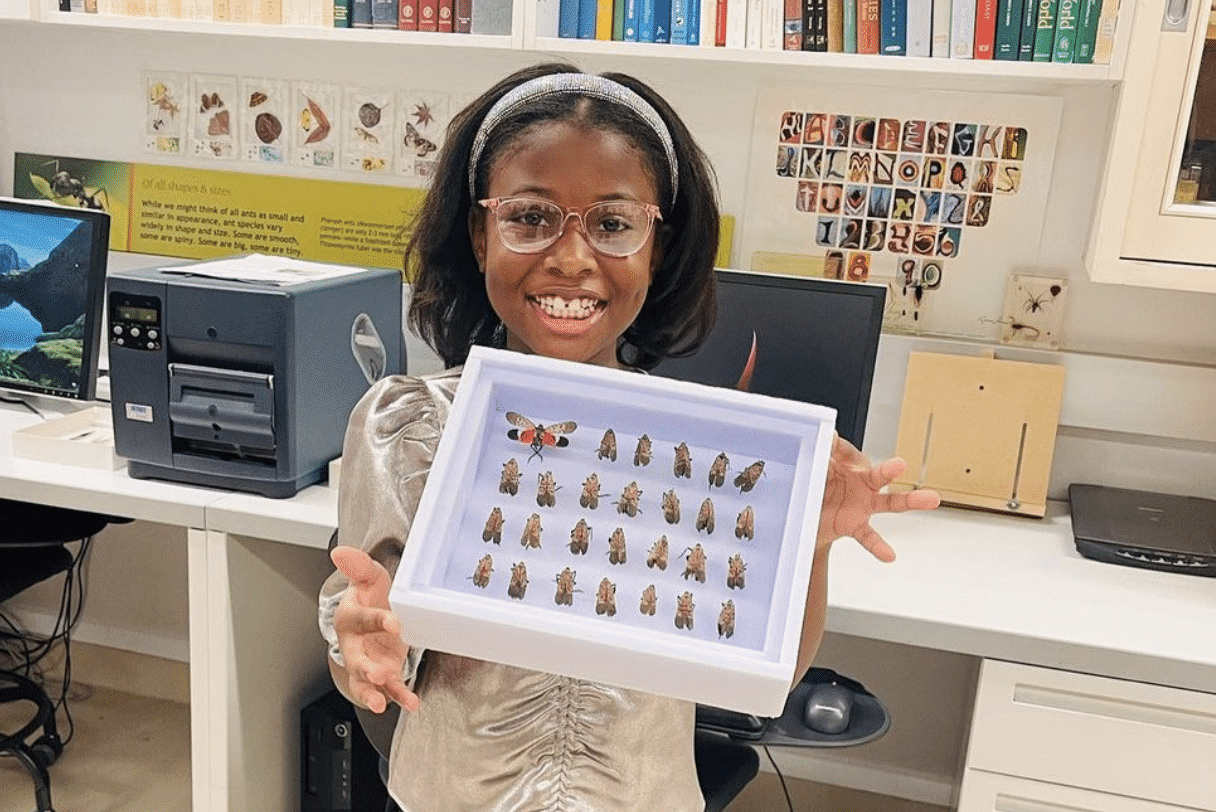
A nine-year old girl has been honoured by Yale University.
Yale University has honored the work of Bobbi Wilson, a 9-year-old Black girl who was wrongly reported to the police while catching insects in her neighborhood.
According to NBC News, the New Jersey fourth-grader became fascinated with spotted lantern flies after learning about the invasive species in school. Though the insects don’t directly harm humans or animals, they pose a serious risk to trees, plants, and crops. So, in an effort to curb the insects’ presence, Bobbi turned to TikTok and found a homemade recipe for bug repellent, which consisted of soap, dish water, and apple cider vinegar. She then went around her neighborhood, sprayed every lantern fly she could find, and placed them in a plastic bottle.
While going from tree to tree, Bobbi was approached by a police officer who was responding to a report of a “suspicious person.” It turns out the call had come from one of her neighbors, former town council member Gordon Lawshe.
“There’s a little Black woman walking, spraying stuff on the sidewalks and trees on Elizabeth and Florence,” Lawshe told the dispatcher, according to October 2022 audio obtained by outlets. “I don’t know what the hell she’s doing. Scares me, though.”
Bodycam footage captured officer Kevin O’Neill’s interaction with Bobbi as well as her mother, Monique Joseph.
“Am I in trouble?” the girl asked.
“No,” the adults responded.
“How many trees did you save?” her mother asked.
Joseph later said that the incident was another example of racial profiling.
“You know, you hear about racism; you kind of experience it in your peripheral if you’re lucky in your life,” she said, according to Yale University. “It doesn’t come knocking on your door. That morning when it happened, my world stopped.”
Fast-forward to Jan. 20, when the Yale School of Public Health honored Bobbi for her efforts to improve her community’s environment. The school also thanked the student for her donating 27 spotted lantern flies to Yale’s Peabody Museum, where they will be used for future research.
“Yale doesn’t normally do anything like this … this is something unique to Bobbi,” said Ijeoma Opara, an assistant professor at School of Public Health. “We wanted to show her bravery and how inspiring she is, and we just want to make sure she continues to feel honoured and loved by the Yale community.”
They wanted to know if the FBI had additional information to support a ban in their state amid dire warnings by the law enforcement agency’s leadership and Republican governors that the Chinese-owned app posed serious threats to privacy and national security.
“Good morning gentlemen. We’re looking for any recommendations on TikTok after Maryland moved to ‘ban’ its use,” Jeff Brown, the chief information security officer for Connecticut, said in an email to a contact at the FBI on December 7.
“Our logic is captured below, but we’d be interested in your thoughts. Appreciate any feedback,” Brown said in the email, which was also sent to contacts at the Cybersecurity and Infrastructure Security Agency (CISA) and the Department of Homeland Security.
Brown included in his message an email chain in which he and Mark Raymond, Connecticut’s chief information officer (CIO), expressed agreement that Maryland’s ban appeared to be a case of “overreach”.
Offered a chance to provide additional information in support of a ban, the FBI contact declined.
[Connecticut Department of Administrative Services]
“I asked one of my analysts to reach out to our HQ,” the FBI agent, who leads a team in Connecticut focused on cybercrime, said in an email to Brown.
“She emailed me towards the end of the day to say that she couldn’t find evidence that we had any additional information to share.”
Maryland and other states that had announced TikTok bans appeared to have “based their decisions on news reports and other open source information about China in general, not specific to Tik Tok,” the FBI agent quoted his analyst as saying.
“Sorry we don’t have more to offer,” the FBI agent said.
The CISA contact, a cybersecurity adviser for Connecticut, told Brown he had “no additional” information and would recommend deferring to the guidance of the FBI.
Al Jazeera obtained the Connecticut state government emails, along with emails from several other state governments, after submitting public records requests with the 50 US states and the District of Columbia.
Cybersecurity officials in Connecticut last month asked the FBI for advice on banning TikTok [File: Yuri Gripas/Reuters]
Raymond, the Connecticut CIO, ultimately determined that the risk of TikTok was “low” based on the fact that, among other criteria, he had received no information suggesting Tiktok had misused data, concerns about the app appeared to have nothing to do with the platform itself, and a ban could “drive additional Chinese cyber activity and interest in Connecticut.”
He recommended that Connecticut Governor Ned Lamont, a Democrat, “take no action at this time” but continue to monitor the situation.
[Connecticut Department of Administrative Services]
When contacted by Al Jazeera for comment, Raymond said protecting state networks is an “extremely high priority for us”.
“We regularly review security threats against the state and act as warranted,” he said. “We are supportive of national action on topics that may threaten our national security and continue to work with all our partners on the most appropriate recommendations for our state.
The episode in Connecticut, which has not been previously reported, stands in contrast to the dire public warnings FBI Director Christopher Wray has made about TikTok.
Wray has repeatedly warned that China could use TikTok to “manipulate content” to carry out influence operations and steal personal data for espionage purposes.
“All of these things are in the hands of a government that doesn’t share our values, and that has a mission that’s very much at odds with what’s in the best interests of the United States,” Wray told a University of Michigan event last month. “That should concern us.”
In response to a request for comment, the FBI National Press Office directed Al Jazeera to past comments by Wray in which he said the agency is advising the Committee on Foreign Investment in the United States (CFIUS) amid its discussions with TikTok on ways to address national security fears and expressed concern about the Chinese government forcing companies to hand over sensitive data.
FBI Director Christopher Wray has repeatedly described TikTok as a national security threat [File: Graeme Jennings/pool via Reuters]
TikTok’s parent company ByteDance, which has its headquarters in Beijing and is incorporated in the Cayman Islands, argues that the FBI’s warnings about the app relate to purely hypothetical concerns and no evidence has been presented of wrongdoing.
ByteDance has long insisted it would never share user data with the Chinese government and says it is working to address hypothetical national security risks as part of a deal it is negotiating with CFIUS.
“As we have said before, these state and university bans are not driven by specific intelligence about TikTok and are driven by misinformation about our company and our service,” TikTok spokeswoman Brooke Oberwetter told Al Jazeera.
“We stand ready to fully brief state and local officials about our comprehensive plan to address national security concerns, plans developed under the oversight of our nation’s top national security agencies.”
Even as bans on TikTok gather steam, tech experts — and even some government officials, as in the case of Connecticut — acknowledge there is little technical evidence to justify the level of fear and anxiety the video-streaming platform, one of the world’s most popular apps, has inspired.
Instead, most arguments for restricting the app have rested on broader mistrust of Beijing, including fears the Chinese government could access users’ personal data or manipulate public opinion for nefarious ends.
“We haven’t seen any evidence that TikTok is a greater risk than any other social media platform,” Cliff Lampe, a professor of information at the University of Michigan, told Al Jazeera.
“The sole concern expressed is that its main owner is a Chinese company — even though most TikTok traffic in the US is managed on US servers. The logic is that the Chinese government could importune TikTok for private user data.”
TikTok’s parent company, ByteDance, has denied claims that the popular app poses a threat to privacy or national security [File: Dado Ruvic/Illustration]
While the Trump administration first put TikTok in the crosshairs in 2020 with proposals for an outright ban, efforts to stymie the app gained momentum after South Dakota announced its ban in November last year.
South Dakota Governor Kristi Noem claimed the Chinese Communist Party used the app to “manipulate the American people” and said her state would have no part in the “intelligence gathering operations of nations who hate us”.
Among Republicans, the party affiliation of Noem and other governors that rolled out early bans appears to have had some influence in persuading other states to follow suit.
In December last year, the Republican Governors Public Policy Committee (RGPPC), a public policy organisation for promoting conservative policy at the state level, sent out a newsletter to Republican-led state governments highlighting recent bans in South Dakota, South Carolina, Maryland and Texas.
“Within the past week, four Republican governors banned or limited the social media platform, TikTok, on state devices,” Zach Swint, a senior policy adviser for the RGPPC, wrote in the December 7 newsletter.
In North Dakota, which banned TikTok on state devices on December 13, the newsletter prompted the chief of staff to Governor Doug Burgum to request state cybersecurity officials to “quickly determine if we have any state devices using TikTok and if we should consider an action like other governors below”.
“Please expedite this and send a recommendation as quickly as possible,” Jace Beehler said in an email dated December 8.
Lampe, the University of Michigan professor, said that states appear to have looked to each other for lessons on how to handle TiKTok “given their lack of expertise in the area”.
“The danger of that, however, is that if the legislation is misguided then it will replicate itself quickly with little critical examination. My sense is that part of this is that legislatures are mostly run by older people, who may see a youth-oriented social platform as banal, so the danger of being too strict is low.”
Bipartisan concerns
At least 28 US states, including Texas, Alabama, North Carolina and Georgia, have introduced bans on TikTok for government devices so far. While a majority are led by Republican governors, Democratic-led states such as Wisconsin and North Carolina have also rolled out bans, which have increasingly attracted bipartisan support.
In December, US President Joe Biden signed legislation containing a ban for federal government devices, while a number of Republican politicians are pushing legislation to ban the app outright. Universities in Texas, Oklahoma, Arkansas, Georgia and Iowa have in recent weeks also announced bans for official devices.
Marc Faddoul, codirector of AI Forensics, a European non-profit that researches the mechanics of TikTok, said that concerns that the app has access to large amounts of personal data and could be used to sway public opinion are both reasonable and mired in hypocrisy.
“The concerns, I think, are legitimate but I think the US government’s position is hypocritical because the same concern is true for any other country with respect to the American platforms,” Faddoul told Al Jazeera, adding that it is also important to acknowledge that the US government has more respect for democratic norms than its Chinese counterpart.
“The US government could and has in the past leverage their power, their domestic companies for national security interests and could in the context of a war make use of it potentially to filter to promote specific types of information.”
Faddoul said discussions should focus more on protecting user data across the industry instead of just TikTok alone.
“I do believe that a better approach is to do something that is systematic for the whole industry in terms of data protection laws,” he said.
Connecticut Governor Ned Lamont has not announced restrictions on TikTok [File: Jessica Hill/AP]
Even as a majority of US states have rolled out TikTok bans, some state officials have expressed ambivalence about the app.
In some cases, state governments have carved out exemptions in recognition of the app’s usefulness for some official business.
In Utah, which banned TikTok on state devices on December 12, officials at the Division of Juvenile Justice and Youth Services sought an exemption to allow some staff to access the app, emails obtained by Al Jazeera through a public records request show.
In South Carolina, one of the first states to announce a ban, officials retroactively introduced changes to allow “identified” law enforcement personnel to access TikTok, according to emails obtained via a public records request.
In New Jersey, where Democrats control the governorship and both branches of the legislature, the state’s top cybersecurity official last month expressed a preference for restricting the app to “separate and isolated devices” rather than a total ban, according to emails revealed by Al Jazeera last month. New Jersey, like most other Democratic-led states, has yet to publicly announce restrictions on the app.
Some states appear to have preferred a quiet approach to limiting the use of TikTok.
In Michigan, Caleb Buhs, the state’s director of communications, told colleagues TikTok would be added to a list of social media platforms not approved for official use from the following month, emails show.
Michigan has not yet announced a ban on the app and Democrat Gretchen Whitmer, the state’s governor, continues to operate a TikTok account where she regularly posts videos.
Sara Collins, an expert in data protection and consumer privacy at the non-profit Public Knowledge, said TikTok’s links to China deserve scrutiny, but the controversy around the app has distracted from the broader lack of privacy protections in the internet age.
“Given China’s authoritarian government and its control of its corporations mean that TikTok rightly deserves additional scrutiny,” Collins told Al Jazeera.
“However, the discourse surrounding the TikTok bans have mostly moved away from addressing specific risks and become a convenient way for politicians to signal they are anti-China. TikTok, like all social media platforms, collects enormous amounts of data about its users. As we have seen with other major tech companies, this constant surveillance can cause harm.”
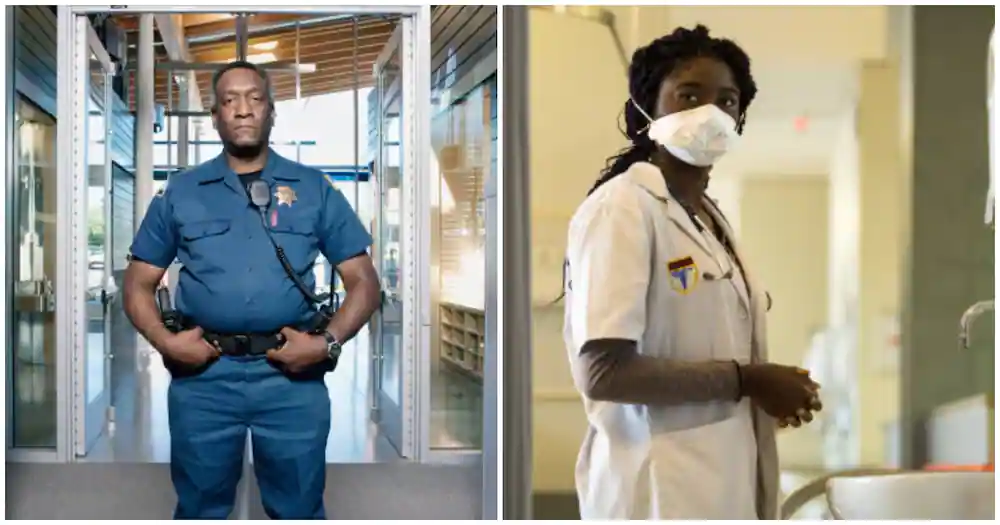
Two Ghanaian men living in the United Kingdom (UK) have opened up about the financial benefits they enjoy, although they do jobs that are considered to be demeaning in Ghana.
In a video posted by @achieve_doctor, on TikTok, the two men who apparently had closed from work laughed about how one of them who works as a security guard for a company in the UK earns more money a day than a nurse in Ghana earns in a month.
Delving into details, one of the men revealed that his friend earns 200 pounds daily which is equivalent to GH₵2900 from working as a security guard as compared to a nurse in Ghana who takes a little above GH₵2000 as a monthly salary.
They concluded by telling Ghanaians not to listen to naysayers who discourage others from travelling abroad.
Ghanaians yearn to travel abroad
At the time of writing the report, the video had gathered over 14,000 likes and 600 comments.
Some netizens who reacted to the video also shared how much they are making from their jobs abroad, whereas others also expressed a desire to travel.
Jerome Yankey said he used to pull all-nighters when he was in college – not studying or partying, but scrolling on TikTok until the sun came up.
“I saw me not putting the effort into my own life, rather just trying to live vicariously through what I’m seeing,” said 23-year old Yankey. He said he lost sleep, his grades suffered, and he fell out of touch with friends and himself.
In 2021, he deleted the app. The positive impact, he said, was obvious. “It’s so great to be able to be sleeping again starting at midnight,” he said. “It’s great to be able to be up early and be more productive with the sun.”
In recent months, TikTok has faced growing pressure from state and federal lawmakers over concerns about its ties to China through its parent company, ByteDance. But some lawmakers and researchers have also been scrutinizing the impact that the short-form video app may have on its youngest users.
GOP Rep. Mike Gallagher, the incoming chairman of a new House select committee on China, recently called TikTok “digital fentanyl” for allegedly having a “corrosive impact of constant social media use, particularly on young men and women here in America.” Indiana’s attorney general filed two suits against TikTok last month, including one alleging that the platform lures children onto the platform by falsely claiming it is friendly for users between 13 to 17 years old. And one study from a non-profit group claimed TikTok may surface potentially harmful content related to suicide and eating disorders to teenagers within minutes of them creating an account.
TikTok is far from the only social platform to be scrutinized by lawmakers and mental health experts for its impact on teens. Top execs from several companies, including TikTok, have been grilled in Congress on the matter. And this week, Seattle Public Schools sued social media companies like Facebook, Instagram, TikTok, Snapchat and YouTube alleging the platforms have been “causing a youth mental health crisis,” making it hard for the school system “to fulfill its educational mission.”
But psychologist Dr. Jean Twenge said TikTok’s algorithm in particular is “very sophisticated” and “very sticky,” which keeps teens engaged on the platform longer. TikTok has amassed more than one billion global users. Those users spent an average of an hour and a half per day on the app in last year, more than any other social media platform, according to the digital analytics platform SensorTower.
“A lot of teens describe the experience of going on TikTok and intending to spend 15 minutes and then they spend two hours and or more. That’s problematic because the more time a teen spends on social media, the more likely he or she is to be depressed. And that’s particularly true for at the extremes of use,” said Twenge.
That may only compound a longer-term rise in mental health issues, partly fueled by technology. Psychologists say as smartphones and social media grew around 2012, so did the rate of depression among teens. Between 2004 and 2019 the rate of teen depression nearly doubled, according to the Substance Abuse and Mental Health Services Administration. And for teen girls its worse. By 2019, one in four US girls have experienced clinical depression, according to Twenge.
TikTok said it has tools to help users set limits for how long they spend on the app each day. TikTok also continues to roll out other safeguards for its users, including ways to filter out mature or “potentially problematic” videos and more parental controls.
“One of our most important commitments is supporting the safety and well-being of teens, and we recognize this work is never finished. We continue to focus on robust safety protections for our community while also empowering parents with additional controls for their teen’s account through TikTok Family Pairing,” TikTok said in a statement to CNN.
The company said between April and June of 2022 it removed 93.4% of videos on self-harm and suicide from the app before they were ever viewed. But teens say it’s not the most egregious videos that keep them engaged. It’s the content programmed to them in the “For You” section of the app.
“It’s so curated to you,” said Angelica Faustino, an 18-year-old sophomore at the University at Buffalo, who says she spends 3 to 4 hours a day on TikTok.
“There is a lot of body checking on TikTok – a lot of people showing off things about themselves that are maybe unachievable. You see if enough times you are like maybe I should be that way,” said Faustino.
For all the concerns, however, there are signs that TikTok and other social networks can have a positive impact on younger users, too.
The majority of teens say social media can be a space for connection and creativity, according to Pew Research. Eight in 10 teens ages 13-17 say social media makes them feel more connected to what’s going on in their friends lives and 71% say social media is a place they can be creative, according to Pew.
And some in Gen Z, the generation that has been raised on TikTok, have found unique opportunities on the platform.
Hannah Williams spends her time on TikTok running her business, Salary Transparent Street. She interviews everyday Americans about the salary they make at their jobs, providing pay transparency to her nearly 1 million followers.
“I quit my job in May of 2022 to work on my social media page on Tik Tok full time because I saw a great opportunity to do something with my career,” said 26 year-old Williams.
“I think it’s interesting that we can try to use social media to really impact the world for good,” she said, “and I’m hoping that’s what happens.”
France on Thursday fined TikTok 5 million euros ($5.4 million) for shortcomings linked to the short video platform’s handling of online tracking known as “cookies”, which the ByteDance-owned company said it had now addressed.
French data protection watchdog CNIL said that its investigation only concerned the website tiktok.com and not the service’s much more heavily used smartphone applications.
The CNIL found that for tiktok.com’s users, it was not as easy to refuse online trackers as to accept them. The authority also found that internet users were not sufficiently informed about TikTok’s use of the cookies.
Register for free to Reuters and know the full story
“These findings relate to past practices that we addressed last year, including making it easier to reject non-essential cookies and providing additional information about the purposes of certain cookies,” a spokesperson for TikTok said.
“The CNIL itself highlighted our cooperation during the course of the investigation and user privacy remains a top priority for TikTok,” the spokesperson added.
Under European Union rules, websites must clearly ask for the prior consent of internet users for any use of cookies – small pieces of data stored while navigating on the Web.
They should also make it easy to refuse them, according to the EU’s rules.
($1 = 0.9253 euros)
Register for free to Reuters and know the full story
Reporting by Tassilo Hummel and Mathieu Rosemain; Editing by GV De Clercq and Alexander Smith.
JoJo Siwa is seemingly calling out her ex-girlfriend, TikTokcreator Avery Cyrus.
In a clip posted to her mom Jessalynn Siwa’s Instagram Stories on Monday, the 19-year-old appeared to address her split from Cyrus after three months of dating. Jessalynn asked her daughter why she was upset as she paced back and forth in a room.
“’Cause I got used!” JoJo said. “For views and for clout, and I got tricked into being told that I was loved, and I got fucking played!”
While JoJo did not directly name the TikTok creator in the rant, Cyrus later spoke with People about the viral video. Cyrus explained that her relationship with JoJo ended in an amicable place. “From my perspective, me and JoJo left on great terms and are still friends. The relationship was very real and I have nothing but love for JoJo and her family. I’m still very hurt that JoJo broke up with me and am saddened and confused by the situation.”
Siwa and Cyrus were romantically linked in August after the “Hold the Drama” singer’s on-and-off relationship with Kylie Prew. The couple became social media official following a TikTok video of them together. “Happiest girl,” Siwa captioned the clip.
One day after confirming their relationship, Cyrus and Siwa made their red carpet debut. They attended the opening night of Alanis Morissette’s jukebox musical Jagged Little Pill at the Pantages Theatre in Los Angeles. At the event, the two smiled ear to ear as they packed on the PDA.
Actor, Lilwin, is the latest dad in town. Following the birth of his daughter, he has issued a stern warning to Ghanaian boys to stay away and resist any attempt to woo her. Failure according to him will incur his wrath.
He is filled with joy over the birth of his first daughter with his current wife, Maame Serwaa.
The new mother in a series of TikTok videos announced that they had welcomed their third child together who is a girl.
The popular Ghanaian actor who is a father to five sons in an Instagram post on Thursday, December 15 officially confirmed the latest addition to their family with a warning to all men.
“Ghana boys don’t try because am mad,” read the cation of a video that captured LilWin’s precious baby.
In May this year, LilWin shared photos from his customary marriage with Maame Serwaa.
Sky News’ additional investigation revealed that users were given recommendations for eating disorder content via TikTok’s suggested search feature.
According to research on TikTok’s video recommendation algorithm, it immediately recommends eating disorders and self-harm content to some new teen accounts.
One account showed suicide content within 2.6 minutes, and another suggested eating disorder content within 8 minutes, according to research from the Centre for Countering Digital Hate (CCDH).
Sky News conducted additional research and discovered that, despite not specifically searching for harmful content, TikTok’s suggested searches function was recommending harmful eating disorder content.
The UK’s eating disorder charity, BEAT, has said the findings are “extremely alarming” and has called on TikTokto take “urgent action to protect vulnerable users.”
Content warning: this article contains references to eating disorders and self-harm
TikTok’s For You Page offers a stream of videos that are suggested to the user according to the type of content they engage with on the app.
The social media company says recommendations are based on a number of factors, including video likes, follows, shares and device settings like language preference.
But some have raised concerns about the way this algorithm behaves when it comes to recommending harmful content.
The CCDH set up two new accounts based in the UK, US, Canada and Australia. For each, a traditionally female username was given and the age was set to 13.
Each country’s second account also included the phrase “loseweight” in its username, which separate research has shown to be a trait exhibited by accounts belonging to vulnerable users.
Researchers at CCDH analysed video content shown to each new account’s For You Page over a period of 30 minutes, only interacting with videos related to body image and mental health.
It found that the standard teen users were served videos related to mental health and body image every 39 seconds.
Not all of the content recommended at this rate was harmful, and the study did not differentiate between positive content and negative content.
However, it found that all users were served eating disorder content and suicide content, sometimes very quickly.
CCDH’s research also found that the vulnerable accounts were shown this kind of content three times as much as the standard accounts were, and those accounts were shown more extreme content than standard accounts.
It follows CCDH’s findings that TikTok is host to a community of eating disorder content that has amassed over 13.2 billion views across 56 different hashtags.
Some 59.9 million of those views were on hashtags that contained a high concentration of pro-eating disorder videos.
However, TikTok says that the activity and resulting experience captured in the study “does not reflect behaviour or genuine viewing experiences of real people.”
Image:Eating disorder content is banned on TikTok and it says it regularly removes content that violates it terms and conditions. Pic: REUTERS/Dado Ruvic/File Photo
Kelly Macarthur began suffering from an eating disorder at the age of 14. She’s now recovered from her illness, but as a content creator on TikTok, she has concerns about the impact that some of its content could have on people who are suffering.
“When I was unwell, I thought social media was a really healthy place to be where I could vent about my problems. But in reality, it was full of pro-anorexia material giving you different tips and triggers,” she told Sky News.
“I’m seeing the same thing happen to young people on TikTok.”
Further investigation from Sky News also found harmful eating disorder content being suggested by TikTok in other areas of the app, despite not explicitly searching for it.
Sky News conducted its own research into TikTok’s recommendation algorithm using several different accounts. But instead of analysing the For You Page, we searched for non-harmful terms like “weight loss” and “diet” in TikTok’s search bar.
A search for the term “diet” on one account brought up another suggestion “pr0 a4a”.
That is code for “pro ana” which relates to pro-anorexia content.
TikTok’s community guidelines ban eating disorder related content onits platform and this includes prohibiting searches for terms that are explicitly associated with it.
But users will often make subtle edits to terminology that mean they can continue posting about certain issues without being spotted by TikTok’s moderators.
While the term “pro ana” is banned on TikTok, variations of it still appear.
Sky News also found that eating disorder content can be accessed easily through TikTok’s user search function, despite not explicitly searching for it.
A search for the term “weight loss” returns at least one account that appears to be an eating disorder account in its top 10 results.
Sky News reported this to TikTok and it has since been removed.
“It’s alarming that TikTok’s algorithm is actively pushing users towards damaging videos which can have a devastating impact on vulnerable people.” said Tom Quinn, director of external affairs at BEAT.
“TikTok and other social media platforms must urgently take action to protect vulnerable users from harmful content.”
Responding to the findings, a spokesperson for TikTok said: “We regularly consult with health experts, remove violations of our policies, and provide access to supportive resources for anyone in need.
“We’re mindful that triggering content is unique to each individual and remain focusedon fostering a safe and comfortable space for everyone, including people who choose to share their recovery journeys or educate others on these important topics.”
Julia Fox, who recently starred in a KNWLS campaign shot by Elizaveta Porodina, says she was “delusional” about being able to help the artist formerly known as Kanye West during their brief relationship.
In a clip shared to TikTok on Friday, Fox responded to a remark about “dating a famously violent misogynist and antisemite” by reflecting on what she says she observed during her and Ye’s time together.
“First of all, the man was being normal around me,” Fox said, as seen below. “And not only that but the Kardashians, when I had a fashion line 10 years ago, they actually bought our clothes and sold them in their stores. So I’ve always had, like, a love for Kim, especially. And, like, even Kourtney especially. All of them pretty much. But no, like, the big three: Khloé, Kim, Kourtney. So by the time me and him got together, he hadn’t been doing anything, you know, like ‘out there’ yet. The only thing he had done was change the name in the song and said ‘Come back to me, Kimberly.’ That was, like, the only thing when we met.”
The latter, of course, is a reference to Ye changing up the lyrics to “Runaway” during the Free Larry Hoover Benefit livestream last year. From there, Fox made mention of an apparently tense text-based interaction she had with Ye, highlighting the moment as when she first thought she might be able to “help” him.
“He kept going and going and he was like, ‘You have bad text etiquette,’” Fox said. “And then I was like, ‘Oh my god, Kanye’s yelling at me. What do I do?’ But then I had this thought and I was like, ‘Oh my god, maybe I can get him off of Kim’s case. Like, maybe I can distract him.’”
During their month together, Fox further noted, Ye wasn’t initially using social media. Additionally, Fox said, he wasn’t talking about his relationship with Kim. Instead, the two talked about “clothes and weird ideas and plans for the future and our hopes and dreams for childhood and education.”
But once certain social media-focused developments started to take place, Fox explained, the relationship had already come to a close.
“I’d already been like, ‘Dude, I’m not gonna stick around for this shit,’” Fox said, adding that she also realized “pretty quickly” that Ye wasn’t going to accept her help.
“I was like, ‘I wanna help him. I wanna help him.’ I sounded almost as dumb as you guys saying that I should have done something to stop him,” she said.
And while Fox now sees this belief as a “delusional” one, she still respects Ye as an artist.
“I don’t wanna shit on that,” she said on Monday. “I don’t wanna reduce his whole career to his really bad moments, you know. But that being said, I stand with the Jewish community. Period.”
See more from Fox below. In a follow-up clip, also shared on Monday, Fox elaborated further on her defense of Ye as an artist, noting there are “a lot of really good things” about him despite the “really, really messed up” things he’s said or done.
Kwadwo Sheldon is undoubtedly one of Ghana’s finest content creators on social media currently.
He has been giving people a lot of great content on his various social media pages ever since his break-through in the last two years and it is pretty obvious Ghanaians and the world love what he has been doing.
Well, his works plus a few others as content creators have been seen by BBC Africa News, who decided to put the spotlight on them in a new documentary titled Social Media Money In Ghana.
According to the BBC, the documentary is centered on the struggles of being a content creator in Ghana and also how these content creators struggled to make some money for themselves in an economy that is begging on its knees to be saved.
Following this feature and the revelations he made, Kwadwo Sheldon took to social media to heap praises on his grandmother who nurtured him to become the man he is today.
Sheldon disclosed that her granny at a point in time had to sell her clothes just to get money for him to register and write his BECE simply because she was not getting enough money as a peasant farmer.
The young entrepreneur disclosed that she decided to feature her in this documentary as his way of showing his appreciation.
Facebook’s parent company, whose stock has lost more than two-thirds of its value, also announced plans to cut discretionary spending and extend its hiring freeze into the first quarter.On Wednesday, Meta Platforms Inc announced the layoff of 13% of its workforce, or more than 11,000 employees, in one of the largest technology layoffs this year as the Facebook parent company battles rising costs and a weak advertising market.
The massive layoffs, the first in Meta’s 18-year history, come on the heels of thousands of layoffs at other leading technology companies such as Elon Musk’s Twitter and Microsoft Corp.
The pandemic boom that boosted tech companies and their valuations has turned into a bust this year in the face of decades-high inflation and rapidly rising interest rates.
Meta, whose shares have lost more than two-thirds of their value, said it also plans to cut discretionary spending and extend its hiring freeze through the first quarter.
“Today I’m sharing some of the most difficult changes we’ve made in Meta’s history,” the company’s founder Mark Zuckerberg said in a message to employees announcing the layoffs.
“I want to take accountability for these decisions and for how we got here. I know this is tough for everyone, and I’m especially sorry to those impacted.”
Potential recession
An economic slowdown and a grim outlook for online advertising – by far Meta’s biggest revenue source – have contributed to the company’s woes. This summer, Meta posted its first quarterly revenue decline in history, followed by another, bigger decline in the fall.
Some of the pain is company-specific, while some is tied to broader economic and technological forces.
Last week, Twitter laid off about half of its 7,500 employees, part of a chaotic overhaul as Musk took the helm. He tweeted there was no choice but to cut the jobs “when the company is losing more than $4M/day”, though did not provide details about the losses.
Meta has worried investors by pouring more than $10bn a year into the “metaverse” as it shifts its focus away from social media.
Zuckerberg predicts the metaverse, an immersive digital universe, will eventually replace smartphones as the primary way people use technology.
Meta and its advertisers are bracing for a potential recession. There is also the challenge of Apple’s privacy tools, which make it more difficult for social media platforms such as Facebook, Instagram and Snap to track people without their consent and show them specially tailored advertisements.
Competition from TikTok is also an a growing threat as younger people flock to the video sharing app over Instagram, which Meta also owns.
Meta’s profits fell to $4.4bn in the last quarter, a 52 percent decrease year-on-year.
“Fundamentally, we’re making all these changes for two reasons: our revenue outlook is lower than we expected at the beginning of this year, and we want to make sure we’re operating efficiently,” wrote Zuckerberg.
Ramon Abbas flaunted a luxurious lifestyle on Instagram, but it was paid for by crime. According to prosecutors, the social media star is a prolific international fraudster who conspired to launder tens of millions of dollars stolen in various online scams.
An Instagram influencer was sentenced to more than 11 years in prison for his role in a multi-million dollar global scam that targeted a Premier League club.
Ramon Abbas, also known as Ray Hushpuppi among his followers, was sentenced to 135 months in prison and ordered to pay more than $1.7 million (£1.5 million) to two fraud victims by a California judge.
Abbas pleaded guilty to one count of conspiracy to engage in money laundering in April 2021, having targeted American and international victims with online scams.
Don Alway, the assistant director in charge of the FBI’s Los Angeles field office, described the 40-year-old online celebrity as “one of the most prolific money launderers in the world”.
He used his “considerable following” of around 2.8 million on Instagram to “brag about the immense wealth he acquired by conducting business email compromise scams, online bank heists, and other cyber-enabled fraud”.
Some victims were left “financially ruined” and his operation even provided assistance to the North Korean regime, according to Mr Alway.
The Premier League club
Abbas tried to steal £100m from an unidentified Premier League club in May 2019, prosecutors say.
He conspired with convicted Canadian money launderer, Ghaleb Alaumary, 37, during the operation, which also targeted another British company.
In connection with the scheme, Abbas provided his co-conspirator with details for a bank account in Mexico that “could handle millions and not block”.
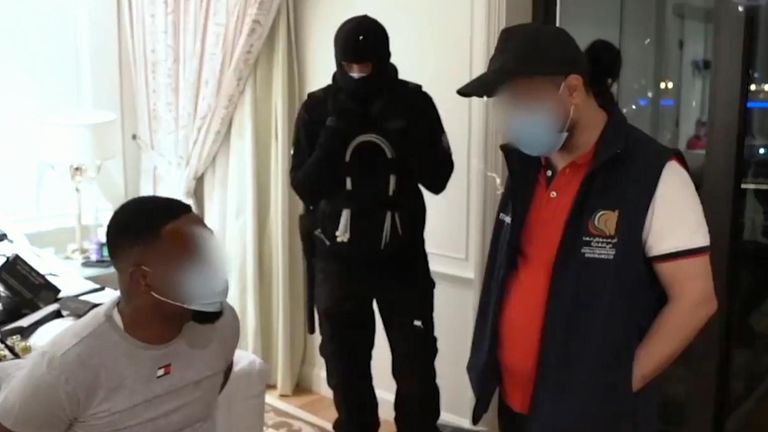
Image:Dubai Police released footage of the arrests
The North Korean regime
In January 2019, Abbas and Alaumary conspired to launder funds stolen from a bank in Malta by providing account information for other banks in Romania and Bulgaria.
The Malta cyber-heist would allegedly have seen the funds head for Pyongyang, and the US has also charged three North Korean hackers in connection with the crime.
Abbas admitted the intended loss was $14.7m (£12.8m), which would have been part of the total £1.2bn (£1bn) the hackers are accused of trying to steal from banks in a number of countries.
Operation Top Dog
Other schemes included Abbas fraudulently inducing a New York law firm to transfer more than $922,000 (£804,000) to a fellow conspirator’s account under someone else’s name, and attempting to defraud an individual in Qatar who wanted a $15m loan to build a school.
Among the luxuries Abbas spent his money on was a $230,000 (£200,000) Richard Mille RM11-03 watch, which he regularly showed off on his Instagram account.
His demise was the result of an FBI investigation called Operation Top Dog.
US attorney Martin Estrada said: “Abbas bragged on social media about his lavish lifestyle – a lifestyle funded by his involvement in transnational fraud and money laundering conspiracies targeting victims around the world.
“Money laundering and business email compromise scams are a massive international crime problem, and we will continue to work with our law enforcement and international partners to identify and prosecute those involved, wherever they may be.”
Alaumary is serving a 140-month prison sentenceand has been ordered to pay more than $30m (£26.2m) after admitting conspiracy to engage in money laundering in November 2020.
Auri Katariina, a cleaner from Finland, began posting videos on social media which became an instant hit. a cleaner from Finland, began posting videos on social mediawhich became an instant hit.
People started reaching out to her for help and she now cleans homes around the world for free.
Auri’s videos get millions of views and the BBC went to meet her on a recent trip to the United Kingdom.
A young woman has recently got many social media users talking after sharing a video of herself.
The post sighted by YEN.com.gh on the TikTok timeline of @tabsalterego had her sharing a picture of herself before she got pregnant alongside photos of her during pregnancy.
Many who saw the young mother’s video took to the comments section to share their experiences and opinions. At the time of this publication, the post has gathered over 1.3 million likes with close to 14,200 comments and 33,000 shares.
Some of the comments have been highlighted below by YEN.com.gh;
@Sassyjammy replied:
Your baby is absorbing your beauty. Everything will be back once you give birth
@user4409472368536 wrote:
Pregnancy will humble you
@Marcus commented:
When my sister who lives abroad was pregnant I went to visit her and I walked past her in the airport because I didn’t recognise her
@Ellie said:
My nose is already huge. Ain’t no way I’m getting pregnant.
From @AshleyRamirez:
Bruhhh that was me and people be saying “ omg you have such a glow” like ma’am ma’am where
@Mimi202 commented:
Give your children your last names. Y’all do all the work and put your lives on the line to create life!
@MaggMonya commented:
you only had to do your hair, you were not bad at all❤
Meanwhile, YEN.com.gh earlier reported that a woman showcased her body’s transformation by sharing her before and during pregnancy pictures and video.
The touching video shared by @yabaleftonline on Instagram showed the petite woman in jeans before her pregnancy.
The next photo that followed showed that her stomach was beginning to protrude, signalling that she was pregnant. What followed next is a hilarious and emotional video capturing her entire ordeal at the hospital moments when she was to give birth.
Ghanaian comic actor, Kofi Adu, popularly known as Agya Koo, has stirred reactions online after he was spotted driving an expensive Infinity vehicle.
In a hilarious video, Agya Koo was approached by a young man as he was headed for his vehicle.
The actor looked stylish and was well-dressed in a beautiful white long-sleeve shirt, a round hat and a pair of fashionable designer shoes.
The young man asked Agya where he was headed, and he hilariously replied that he was attending a TikTok meeting.
He sarcastically told the young man free cars would be shared at the meeting, so he should come along with him. Agya Koo quickly hopped in the car and sped off after.
The white Infinity looked luxurious and showed that the actor was wealthy. Agya Koo has been actively involved in the movie industry for over a decade and seems to have made a good fortune since rising to stardom. Fans of the actor found the video hilarious and dropped funny comments.
Agya Koo Gets Peeps Laughing
tettehgideon116 reacted to the funny video:
Free car like seriously I can’t stop laughing.
Bra Dan commented:
agya i like your style
Otoobea also said:
Once a legend, always a legend
Uncle Fred also commented:
Agya atwa seven
Maytvgh1 also reacted:
We miss you kofi
Agya Koo: 5 Times the Kumawood Actor Turned a Funeral Party into Highlife Concerts
In other news, popular Kumawood actor Agya Koo has proven to be a force to reckon with not only in the movie and comedy industry.
The legendary Ghanaian actor is also known for his show-stopping music performances with his Tete Mmofra Band.
Four teenagers were killed in a car crash in Buffalo Monday morning that has been linked to an alarming “Kia Challenge” on TikTok.
The Associated Press reports there were six passengers inside the vehicle at the time of the accident. The victims were between the ages of 14 and 17. As for the other two, one was the 16-year-old driver, who has since been treated and released. The other was hospitalized and placed in intensive care.
According to WGRZ, Buffalo Police Commissioner Joseph Gramaglia said investigators believe the car, which was stolen around 8 p.m. Sunday, was at the center of the “Kia challenge.” It instructs viewers how to steal a Kia model built within the last decade by using a cell phone charger and USB cord.
“They’re very easy unfortunately to steal,” Gramaglia said. “You can look up the information that’s been put out there. There are numerous cities across the country that are looking at looking into or have filed lawsuits against Kia because of the ease that they are able to steal these cars.”
The unidentified driver has been ticketed for criminal possession of stolen property and unauthorized use of a motor vehicle. The Erie County District Attorney’s office has launched an investigation into the crash with additional charges expected to be filed.
“It’s an extremely sad morning in the city of Buffalo when you lose four young lives in a horrific accident like this,” D.A. John Flynn said. “And now we need to do a thorough investigation to find out what happened and what the appropriate charges are against the driver of this vehicle.”
Blac Chyna is threatening legal action against Ava Louise, a TikTok star who accused the model of allegedly trying to kidnap and sex traffic her.
TMZ reports Chyna, whose real name is Angela Renée White, is denying the allegations, and has had her attorneys send a cease and desist letter to Louise. The TikToker recently went on social media to accuse Chyna of a sex trafficking attempt.
Louise alleged “Blac Chyna held me hostage and I’m pretty sure she was trying to sex traffic me,” as well as saying “I was getting trafficked.” She claimed Chyna forced her to sign an NDA upon arriving at her home, at which point she was then reportedly held hostage for six hours while Chyna “drank an entire bottle of Casamigos.”
Blac Chyna’s attorney JD Sanchez has sent Ava Louise a cease and desist, which blasts the social media star for making “false, extreme, and outrageous statements about [Chyna] in public.”
“Your false allegations that Ms. White engaged in such heinous criminal conduct is defamatory per se under California law,” Sanchez stated, per Page Six.
The letter also rips Louise for displaying a pattern of “menacing and outrageous conduct” on social media, which includes the TikTok star previously admitting to making false statements about Kanye West hooking up with YouTuber Jeffree Star.
The 38-year-old comedian addressed the issue in a between-the-scenes TikTokvideo posted by The Daily Show. The clip begins with an audience member asking Noah about his and Ye’s so-called “beef”—a term that he believed was inapplicable to the situation.
“Why am I beefing with Kanye? That’s an interesting way to phrase it because a beef has to go both ways,” Noah said. “Genuinely, it does. In my limited understanding of the world, beef has always been something that generally will happen between two hip-hop artists. I was never beefing with Kanye West. I was concerned about Kanye West.”
Noah went on to highlight Ye’s mental health struggles and how they’re largely ignored by his critics. The host pointed out that Kanye has been quite open about his health issues, and has even admitted to not taking his medication. Noah said it was “a little shitty” that some people would chose to platform and exploit Kanye during one of his “episodes.”
“My grandfather was bipolar … and I’m not saying Kanye is, by the way—I’m just saying my grandfather was bipolar, and one thing we knew was when he was having one of his episodes, he could act in a certain way and could do certain things … but our job was to support him,” he explained. “It would be weird if I was there going, ‘Oh, my grandfather’s having an episode again. I’m going viral tonight!’ I think it’s a little bit strange.”
Noah reiterated that his criticism of Ye didn’t come from a bad place. The host has previously called out the rapper for his antisemitic remarks as well as his treatment of Kim Kardashian and Pete Davidson. Ye responded to the latter criticism back in March, when he shared an Instagram post in which he used a racial slur directed at Noah. The social media platform suspended Ye’s account shortly after.
“For me, it’s not a beef …” he continued. “I don’t have beef with a human being who has expressed openly that they’re dealing with a mental health issue. I don’t have beef with that human being.
What I have beef with is us as society not coming together around the person and going like, ‘Hey, hey, maybe this is not the moment to put a microphone in your face so that you just go off saying everything.’
If this is what you want to say when you’re on your medication, then that’s a different story. But because you’ve told us that, I’m not going to sit by and say that.”
A TikTok video about sexual consent has been inundated with comments from men accusing women of assault.
Many of them mention Andrew Tate, the divisive influencer who has been barred from multiple sites due to his misogynist views.
The two-minute video, posted by an account with approximately 1,700 followers, has been viewed almost 1.2 million times.
Its creator Emmeline Hartley says she believes TikTok’s algorithms are driving more hate toward the film.
People using TikTok are served content based on a mixture of videos they have previously liked, and on which people like them have watched and commented.
TikTok said misogyny was prohibited on the platform.
“Our community guidelines specifically call it out as a hateful ideology and we are crystal clear that we do not want that content on our platform,” said a spokesperson.
It added that it had removed more than 100 comments from Ms Hartley’s video, which it said was a small proportion of the number that had been left.
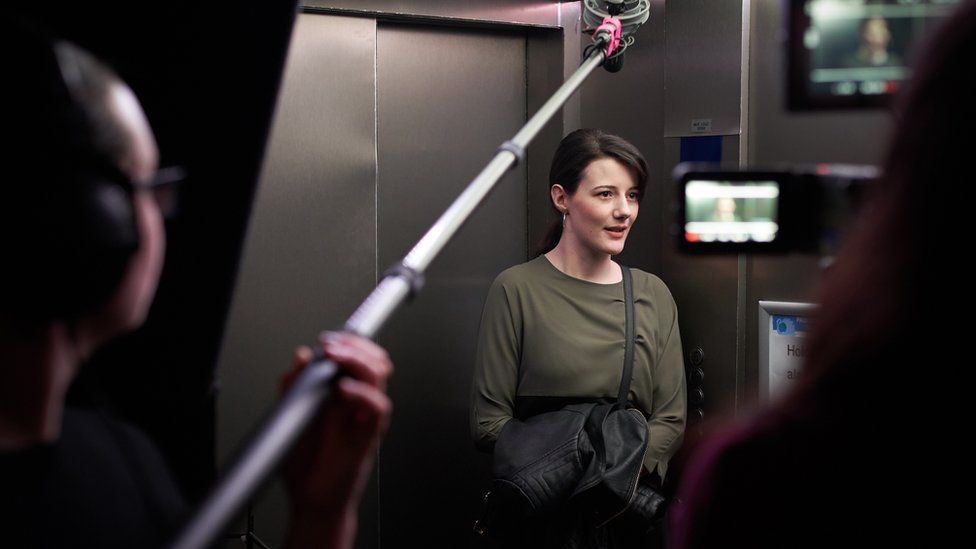
IMAGE SOURCE, EMMELINE HARTLEY Image caption, Emmeline Hartley performs in the film as well as having created it
Ms Hartley said she had found it impossible to make direct contact with someone from the platform to get help.
“We don’t have the capacity or the manpower to respond to all the comments,” Ms Hartley said.
“I thought, ‘what have I done? I’ve made a film that’s helping rape culture.”
She says she has seen other videos on TikTok that have been swamped with abusive comments where the creator is appealing for likes and positivity to help “pull them back from the wrong side of TikTok”.
Fictional story
Ms Hartley’s original video, Keep Breathing, was 18 minutes long and made in 2018, with funding from various local organizations in Derby and backed by the British Film Institute.
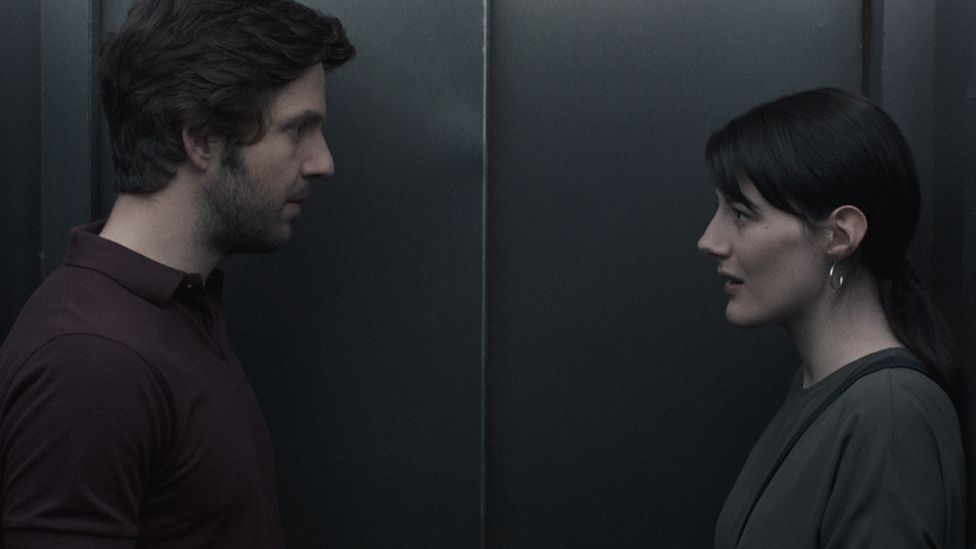
It is a fictional story featuring a couple arguing in a lift about a previous sexual encounter, interwoven with flashbacks to the evening it took place.
The characters had both been drinking alcohol, they met in a nightclub, and there were misunderstandings about how they were going to get home and whether the man was going to stay with the woman.
IMAGE SOURCE,EMMELINE HARTLEY Image caption, Ms Hartley said the film was intended to be nuanced, and to explore complex issues around consent
However, the clip she posted to TikTok in September featured only the pair’s argument and not the contextual flashbacks. When Ms Hartley tried to add a separate video featuring those, they were repeatedly removed by TikTok on the grounds that they were explicit.
She has now been able to share the context but says there are still many comments which are abusive towards women.
Although she considered removing the videos, Ms Hartley says she is content that she decided to share the post.
“I don’t regret it, but I’m trying to navigate how to respond,” she said.
“Some of the comments have been healthy, a couple of people have changed their minds while replying to each other. I think it’s important, it needs to go out there.”
How the algorithm works
Social media consultant Matt Navarra said that TikTok’s algorithm functions as a recommendation service, drawing both on the previous activity of the individual user and others like them, in order to serve up new content with which the person is also likely to engage.
This keeps them on the platform for longer and more frequently, which is good for advertisers and therefore also good for TikTok’s advertising revenue.
“It means if this content has been seen, engaged with, and liked by a group of users who are, for example, Andrew Tate fans, then it’s likely to show that piece of content to even more people who are that sort of user,” he said. “It’s self-perpetuating.”
The creator cannot stop this train once it is in motion, because they have no control over the algorithm itself and there are limited options for reporting issues, Mr Navarra added.
In July it was reported that Meta, which owns Facebook and Instagram, was going to make its algorithm more similar to TikTok’s, rather than prioritising content from accounts that individuals were already following.
In celebration of his 36th birthday next week, the OVO rapper is blessing the public with customer-favorite items from Dave’s Hot Chicken—an LA-based restaurant chain he invested in last year.
“I tried the food and it was amazing,” Drake said in 2021. “After meeting the founders and hearing their story, I jumped at the opportunity to invest.”
The giveaway will take place between 11 a.m. to 9 p.m. local time Monday at all restaurant locations. All guests have to do is show the staff that they follow Dave’s Hot Chicken on Instagram or TikTok; they will then receive a free spiced-to-order slider or tender at their preferred heat levels.
Customers must visit the locations in-person if they want to participate in the celebration. The free fare is not available through online orders or via third-party delivery services.
“Dave’s Hot Chicken will blow your mind! Every Tender is hot, juicy and spicy,” Dave’s Hot Chicken’s CEO Bill Phelps said in a press release. “Our guests across the world have shown the same level of enthusiasm for this company that the founders had five years ago when they were operating a little pop up in Hollywood. Now, in celebration of his birthday and our first national ad campaign, our most famous investor wanted to give something back to fans by letting everyone try Dave’s Hot Chicken on him.”
The celebration coincides with the launch of the restaurant’s first-ever ad campaign, titled “Don’t Die Before You Try It.” The ad includes a series of commercials that take a comedic look at those who never got the chance to taste Dave’s Hot Chicken. You can check out one of the spots below.
Since its inception in 2017, Dave’s Hot Chicken has reportedly become the “Fastest Growing Restaurant Chain in America.” The eatery has locations across California, as well as Colorado, Illinois, Michigan, New York, Texas, and more. You can learn more about Dave’s Hot Chicken at its official website.
TikTok star, Felicia Osei has denied rumours of an amorous relationship with Ogidi Brown, remarking that the musician is her ‘gee’ on the social media app, a street term for a friend.
The two showbiz personalities have in the past flaunted each other and shared a couple of videos of themselves having good moments together. On top of that, they released a song titled ‘Yobo Love’, fanning to flame the suspicion.
Reports were rife Felicia Osei had announced she was getting married to the CEO of Ogidi Brown Music triggering anticipations as many showed interest in their supposed affair.
But in an interview on The Delay Show aired on October 16, 2022, Felicia Osei said “Ogidi Brown was my gee. He wasn’t my boyfriend; we were only doing comedy.”
Felicia mentioned that she has a boyfriend while noting that she is not a side chick.
“He stays in Kumasi,” Felicia disclosed the location of her boyfriend. “All the rumours [being promiscuous] are untrue.”
Meanwhile, Felicia has said her father absconded when she was six and never returned. Her father, Mr. Frimpong, according to the narrative, escaped when the wife was asleep.
“Growing up, I saw my father in the house. The last time I saw him was when I was about 6 years old. He said he was going to buy something,” Felicia Osei recalled. “We had always gone with him but that day, he said he would go alone. He locked the door, said goodbye and didn’t return. That was it. He run away and left us and I’ve never set eyes on him again.”
According to her, together with her two siblings, they decided after the incident to use their mother’s surname ‘Osei’ instead of their father’s ‘Frimpong’.
She, however, hopes to meet her father who has been calling her ever since she became famous.
Displaced families in Syrian camps are begging for donations on TikTok while the company takes up to 70% of the proceeds, a BBC investigation found.
Children are livestreaming on the social media app for hours, pleading for digital gifts with a cash value.
The BBC saw streams earning up to $1,000 (£900) an hour, but found the people in the camps received only a tiny fraction of that.
TikTok said it would take prompt action against “exploitative begging”.
The company said this type of content was not allowed on its platform, and it said its commission from digital gifts was significantly less than 70%. But it declined to confirm the exact amount.
Earlier this year, TikTok users saw their feeds fill with livestreams of families in Syrian camps, drawing support from some viewers and concerns about scams from others.
In the camps in north-west Syria, the BBC found that the trend was being facilitated by so-called “TikTok middlemen”, who provided families with the phones and equipment to go live.
The middlemen said they worked with agencies affiliated to TikTok in China and the Middle East, who gave the families access to TikTok accounts. These agencies are part of TikTok’s global strategy to recruit livestreamers and encourage users to spend more time on the app.
Image caption, Children are livestreaming for hours at a time begging for gifts on TikTok
Since the TikTok algorithm suggests content based on the geographic origin of a user’s phone number, the middlemen said they prefer to use British SIM cards. They say people from the UK are the most generous gifters.
Mona Ali Al-Karim and her six daughters are among the families who go live on TikTok every day, sitting on the floor of their tent for hours, repeating the few English phrases they know: “Please like, please share, please gift.”
Mona’s husband was killed in an airstrike and she is using the livestreams to raise money for an operation for her daughter Sharifa, who is blind.
The gifts they’re asking for are virtual, but they cost the viewers real money and can be withdrawn from the app as cash. Livestream viewers send the gifts – ranging from digital roses, costing a few cents, to virtual lions costing around $500 – to reward or tip creators for content.
For five months, the BBC followed 30 TikTok accounts broadcasting live from Syrian camps for displaced people and built a computer program to scrape information from them, showing that viewers were often donating digital gifts worth up to $1,000 an hour to each account.
Families in the camps said they were receiving only a tiny fraction of these sums, however.
With TikTok declining to say how much it takes from gifts, the BBC ran an experiment to track where the money goes.
A reporter in Syria contacted one of the TikTok-affiliated agencies saying he was living in the camps. He obtained an account and went live, while BBC staff in London sent TikTok gifts worth $106 from another account.
At the end of the livestream, the balance of the Syrian test account was $33. TikTok had taken 69% of the value of the gifts.
Image caption, Keith says 50,000 people watched the TikTok live he did with a Syrian family
TikTok influencer and ex-professional rugby player Keith Mason donated £300 ($330) during one family’s livestream and encouraged his nearly one million followers to do the same.
When told by the BBC that most of these funds were taken by the social media company, he said it was “ridiculous” and “unfair” to families in Syria.
“You’ve got to have some transparency. To me, that’s very greedy. It’s greed,” he said.
The $33 remaining from the BBC’s $106 gift was reduced by a further 10% when it was withdrawn from the local money transfer shop. TikTok middlemen would take 35% of the remainder, leaving a family with just $19.
Hamid, one of the TikTok middlemen in the camps, told the BBC he had sold his livestock to pay for a mobile phone, SIM card and wi-fi connection to work with families on TikTok.
He now broadcasts with 12 different families, for several hours a day.
Hamid said he uses TikTok to help families make a living. He pays them most of the profits, minus his running costs, he said.
Like the other middlemen, Hamid said he was supported by “live agencies” in China, who work directly with TikTok.
“They help us if we have any problems with the app. They unlock blocked accounts. We give them the name of the page, the profile picture, and they open the account,” Hamid said.
Media caption, Hamid helps families go on TikTok live. Watch how the BBC investigated TikTok’s commission from digital gifts
Agencies like these, known as “livestreaming guilds” and based all around the world, are contracted by TikTok to help content creators produce more appealing livestreams.
TikTok pays them a commission according to the duration of livestreams and the value of gifts received, the agencies told the BBC.
The emphasis on duration means TikTokers, including children in the Syrian camps, go live for hours at a time.
Marwa Fatafta, from digital rights organisation Access Now, says these livestreams run contrary to TikTok’s own policies to “prevent the harm, endangerment or exploitation” of minors on the platform.
BBC News investigates a new trend on TikTok – hundreds of families in refugee camps in Syria, begging for gifts on TikTok livestreams.
“TikTok clearly states that users are not allowed to explicitly solicit gifts, so this is a clear violation of their own terms of services, as well as the rights of these people,” she said.
She acknowledges that people have the right to share their stories online “to try to seek support and sympathy”, but she says these livestreams “lack dignity, and are humiliating”.
TikTok’s rules say you must have 1,000 followers before you can go live, you must not directly solicit for gifts and must “prevent the harm, endangerment or exploitation” of minors on the platform.
But when the BBC used the in-app system to report 30 accounts featuring children begging, TikTok said there had been no violation of its policies in any of the cases.
After the BBC contacted TikTok directly for comment, the company banned all of the accounts.
It said in a statement: “We are deeply concerned by the information and allegations brought to us by the BBC, and have taken prompt and rigorous action.
“This type of content is not allowed on our platform, and we are further strengthening our global policies around exploitative begging.”
TikTok, the world’s fastest-growing social media app, has made more than $6.2bn in gross revenue from in-app spending since its launch in 2017, according to analytics company Sensor Tower.
The BBC approached several charities working in Syria to support families in the camps as an alternative to making money on TikTok Live.
A local charity Takaful Alsham said it would provide basic supplies to the families for the next three months, helping the children find schools and covering their educational expenses.
But for many in the camps, there are few options to make money other than begging online. Hundreds of families continue to go live every day, and most of the money donated is still going to TikTok.
“A lot of people have followed along with the process since it takes time.
“But I’m glad that people are seeing the fascinating side of bacteria and my videos are opening up a new perspective.”
IMAGE SOURCE,CHLOE FITZPATRICK Image caption, This “knuckle-duster” ring is made from a petri dish containing bacteria
Chloe swabs parts of her body, or plants, and transfers the samples to petri dishes with a special growth medium inside called agar.
The bacteria samples are covered and allowed to multiply into coloured colonies for about a week at room temperature.
She then isolates particular colours in a new dish so they can multiply further.
The colours can be used to dye materials like cotton clothing or resign jewellery sustainably.
“When you press your hands and feet into the agar plates, you get lots of different reds, oranges, and yellows.
“Everyone’s bacteria is so different and develops differently,” she said.
IMAGE SOURCE,CHLOE FITZPATRICK Image caption, Chloe Fitzpatrick has worked with scientists at the University of Dundee on her bacteria project
And she claims it is more environmentally friendly than traditional dying processes used in the textile industry.
“They used a lot of harmful chemicals,” she said.
“Using bacteria is an eco-friendly alternative, they multiply fast, and you get a good range of colours.”
Chloe has mostly created rings and she has even used the bacteria dye to create resin “gemstones”.
Each sample is a gamble, but she has noticed some patterns in how the bacteriadevelops.
She said: “Human bacteria tend to have more colours, especially from the skin.
“So humans tend to have a variety of pinks, reds, and yellows, and while plants can show the same colours, it is normally in a smaller amount.”
Image caption, Chloe dyed cotton strands using isolated colours from bacteria
She has worked with scientists at the University of Dundee throughout the development of the process, to ensure the experiments are streamlined and safe.
She said: “Everything is tested thoroughly to make sure the bacteria has been killed off.
“I want to test the limits of this process as there’s so much I can do with it.
“I wanted to be part of the BioArt movement, which is a collaboration of art and science.
“I believe the art world is heading in that direction since there’s a lot of possibilities and it’s not been fully explored yet.”
Examples of her work are currently on display in an exhibition of BioArt at Kulanshi Art Centre in Nur-Sultan, Kazakhstan
And she has been commissioned by the University of Dundee to create a bacteria-inspired sculpture for the medical garden outside of the School of Life Sciences.
Tulsi, a small village in India’s Chhattisgarh state, has become known as ‘YouTube Village” because a third of its population makes videos for a living.
Online video content is more popular than ever, and it’s no wonder that millions of people around the world are working hard trying to build careers as video creators. But nowhere is the concentration of would-be YouTubers than in Tulsi Village, a small rural settlement in Chhattisgarh, where over a third of the 3,000-strong local population is actively making videos and posting them on YouTube for profit. Many of these creators used to be farmers, but after hearing that some of their peers had doubled, even tripled their income making YouTube videos, they decided that it was time for a career change.
The story of India’s YouTube Village began with two friends, Gyanendra Shukla and Jai Verma, who left their jobs as network engineer and teacher, respectively, to make video content. Before long they started earning a pretty penny from their new endeavor, and word of their success spread throughout the village, inspiring others to follow in their footsteps.
“I worked in SBI earlier, as a network engineer. My office had high-speed internet and I used to watch YouTube videos there,” Shukla told the ANI news agency. “I was already fond of movies. In 2011-12, a new version of YouTube was launched. At that time, there were very few channels on youtube. I was not satisfied with my 9 to 5 job. So I left the job and started with YouTube.”
Around 40 percent of the village population is now engaged in making video content for platforms like YouTube, TikTok or Instagram, with the youngest being 15 and the oldest being an 85-year-old grandmother. The 40 or so major channels based in Tulsi village range from comedy and music to education and DIY, with the most popular numbering over 100,000 subscribers on YouTube alone.
Hadis Najafi took to the streetsof Karaj last week in protest at Iran’s hijab mandate and was shot dead. She was not openly outspoken about women’s liberation but enjoyed sharing her life with her followers on social media.
She was not an activist or openly outspoken online about women’s liberation, but she was still gunned down in her home city campaigning for her right to live and dress how she wanted.
Hadis Najafi, 23, took to the streets of Karaj last week to speak out against Iran’s strict hijab mandateand was shot dead.
Her death has fuelled further anger in a country already reckoning with the strict rule of the so-called morality police.
Part of Iran’s Generation Z, Hadis was a young woman who grew up in the age of the internet and social media.
Like Zoomers everywhere, these digital natives are connected to the rest of the world in a way their parents could never have imagined.
Hopes for a better future
An avid user of TikTok and Instagram, Hadis enjoyed sharing her life with her followers on social media.
She was not openly outspoken about women’s liberation, but she posted videos on her TikTok account dancing to the latest viral trend, including to pop music and Iranian singers.
Her social media would not have looked out of place anywhere in the world. Smiling and pouting at the camera, she danced around her room in bright clothing.
She worked as a cashier at a restaurant and loved sharing fashion on her Instagram, styling her hair both with and without her hijab – but only in the safety of her home or other private places.
Hijabs are mandatory in public for all women in Iran, regardless of religion or nationality.
A close friend described her as “always happy and energetic”.
But then violence erupted after another young woman, Mahsa Amini, 22, died in police custody on 16 September. She had been detained, allegedly, for wearing her hijab too loosely.
Outcry over her death has boiled over into some of the biggest protests in the country for years and the anger of a generation of women who had grown used to freedom online poured out on to the streets.
Women removed their head coverings and burnt them as others recorded the scenes on mobile phones, uploading them to social media where they have been shared worldwide.
To make it difficult for protesters, the authorities have restricted internet access in several provinces, according to internet blockage observatory NetBlocks.
Sky News spoke to one of Hadis’s close friends on Instagram and asked if she had been scared when she set off on 21 September.
#حدیث_نجفی در آخرین پیامی که قبل از رفتن به اعتراضها (چهارشنبه ۳۰ شهریور) برای دوستانش فرستاد، میگوید:
«خیلی دوست دارم الان که دارم میرم آخرش وقتی چند سال گذشت خوشحال باشم رفتم تظاهرات و همه چی عوض شده…»#مهسا_امینی#Mahsa_Aminipic.twitter.com/oORoUyTpNW
“Several nurses… told her family to run, because Hadis had been at the protests so they might also be targeted if the police came,” her friend said.
“The husband of one of Hadis’s sisters works for the Basij [an Iranian paramilitary volunteer militia], so they let him go into the mortuary to do the formal identification. Only him.
“They didn’t let her family see her.”
After two days, the family agreed with authorities not to have a public funeral: “What I tell you now comes from her family,” Hadis’s friend said.
“On Friday morning they let her crying mother and sisters see her face, to make sure they were burying the right person. There wasn’t a real funeral because of the agreement.
“After she was buried, her sisters Afsoon and Shirin decided to publish her photos and tell people she was shot. The authorities didn’t want people to say she was shot, they were told to say she’d died in a car crash, or a brain injury, that she’d died a natural death.”
Masked forces shoot directly at protesters
Ebrahim Raisi, the Iranian president, has vowed to investigate Ms Amini’s death but said that the authorities would not tolerate any threats to public security.
He said protesters should be “dealt with decisively” and the subsequent crackdown by authorities has been swift, brutal, and violent.
On 21 September, the footage was first shared online of masked men shooting directly and from close range at protesters on Eram Boulevard, where her friend said Hadis was last seen alive.
The location of this clip was verified by Sky News by cross-referencing the car dealership in the background with images of the street shared on Google Maps.
Although Hadis is not in this clip it indicates it is not the only time Iranian police have been accused of using excessive force on protesters.
And Hadis is not the only woman to have been killed. The names of at least four other women alleged to have died in the protests have gone viral in the past week.
Speaking at a charity event over the weekend in the US, Fatima Bio said that unknown individuals wanted to have her husband removed from power.
Julius Maada Bio’s wife, Fatima Bio, has said that because Julius Maada Bio has a Ph.D. in coup planning, no one can remove him.
She was referring to the violent riots that took place on August 10 in strongholds of the opposition and left 31 people dead, including six police officers.
The president blamed the protests – which were generally about the high cost of living – on the opposition alleging that they were part of a plot to overthrow him, leading to the dismissal of the top three in the army.
Speaking over the weekend at a fundraising event in the US, Mrs Bio accused unnamed people of wanting to overthrow her husband.
“Maada Bio has a Ph.D. in coup d’état, can you remove him?” she asked rhetorically, before reiterating: “The man has a Ph.D. in [staging] coups, how can you remove someone who teaches people how to stage a coup?,” the first lady said in a video shared on Facebook.
Mrs Bio was making an apparent reference to the fact that her husband first came to power in April 1992 as part of a group of young military officers who overthrew the civilian government of Joseph Saidu Momoh of the All People’s Congress, the party he defeated at the polls in 2018 and whom he accused of being behind the August protests.
TikTok could face a £27m fine for failing to protect children’s privacy when they’re using the platform.
The UK’s Information Commissioner‘s Office (ICO) found the video-sharing platform may have processed the data of under-13s without appropriate consent.
The watchdog said the breach happened over more than two years – until July 2020 – but that it had not yet drawn final conclusions.
TikTok says it disputes the findings, noting that they are “provisional”.
The ICO has issued TikTok Inc and TikTok Information Technologies UK Limited with a “notice of intent” – a legal document which precedes a potential fine.
The notice sets out the ICO’s provisional view that TikTok breached UK data protection law between May 2018 and July 2020.
The ICO investigation found the social platform may have:
processed the data of children under the age of 13 without appropriate parental consent
failed to provide proper information to its users in a concise, transparent and easily understood way
processed special category data, without legal grounds to do so
According to Ofcom, 44% of eight to 12-year-olds in the UK use TikTok, despite its policies forbidding under-13s on the platform.
Information Commissioner John Edwards said: “We all want children to be able to learn and experience the digital world, but with proper data privacy protections.
“Companies providing digital services have a legal duty to put those protections in place, but our provisional view is that TikTok fell short of meeting that requirement.”
TikTok has rolled out a number of features to strengthen the privacy and safety on the site – including allowing parents to link their accounts to their children’s, and disabling direct messaging for under-16s.
But Mr Edwards continued: “I’ve been clear that our work to better protect children online involves working with organisations, but will also involve enforcement action where necessary.
“In addition to this, we are currently looking into how over 50 different online services are conforming with the Children’s Code, and have six ongoing investigations looking into companies providing digital services who haven’t, in our initial view, taken their responsibilities around child safety seriously enough.”
Rolled out in September last year, the Children’s Code put in place new data protection codes of practice for online services likely to be accessed by children, built on existing data protection laws, with financial penalties a possibility for serious breaches.
The ICO said its findings in the notice were provisional, with no conclusion to be drawn at this stage that there had been any breach of data protection law.
It added: “We will carefully consider any representations from TikTok before taking a final decision.”
A TikTok spokesperson said: “This notice of intent, covering the period May 2018-July 2020, is provisional and as the ICO itself has stated, no final conclusions can be drawn at this time.
“While we respect the ICO’s role in safeguarding privacy in the UK, we disagree with the preliminary views expressed and intend to formally respond to the ICO in due course.”
Previous action
In 2019, the firm was given a record $5.7m fine by the Federal Trade Commission, for mishandling children’s data.
It has also been fined in South Korea for similar reasons.
In July, the US Senate Commerce Committee voted to approve a measure that would raise the age that children were given special online privacy protections to 16, and prohibit targeted advertising to children without consent.
A spell binding performance by a South African musician has got the attention of R&B singer John Legend after he challenged musicians to record a verse for his latest song.
Mthandazo Gatya added “an African touch” as he called it, to Legend’s Nervous hit.
The American singer had posted a video of himself on TikTok singing a verse from his hit song and cueing others to join in.
Gatya, according to many fans, created the magic that Legend was looking for. Watch below:
“Thank you all for making sure John Legend sees my duet, great news is that he loved it and replied,” Gatya tweeted.
His verse, sang in his native Zulu, quickly became the fans’ favourite attracting more than one million views. Others urged Legend to end the challenge because there was a clear winner.
Gatya, a well known Amapiano artist, gained fame for a song widely shared online during South Africa’s lockdown to curb the Covid-19 pandemic.
Google said the “exciting” findings showed how social media can actively pre-empt the spread of disinformation.
The research was founded on a developing area of study called “prebunking”, which investigates how disinformation can be debunked by showing people how it works – before they are exposed to it.
In the experiment, the ads were shown to 5.4 million people, 22,000 of whom were surveyed afterwards.
After watching the explanatory videos, researchers found:
an improvement in respondents’ ability to spot disinformation techniques
an increased ability to discern trustworthy from untrustworthy content
an improved ability to decide whether or not to share content
The peer-reviewed research was conducted in conjunction with Google, which owns YouTube, and will be published in the journal Science Advances.
Beth Goldberg, head of research and development for Google Jigsaw, called the findings “exciting”.
“They demonstrate that we can scale prebunking far and wide, using ads as a vehicle,” she said.
‘Common tropes’
Jon Roozenbeek, the lead author on the paper, told the BBC the research is about “reducing the probability someone is persuaded by misinformation”.
“Obviously you can’t predict every single example of misinformation that’s going to go viral,” he said. “But what you can do is find common patterns and tropes.
“The idea behind this study was – if we find a couple of these tropes, is it possible to make people more resilient against them, even in content they’ve never seen before?”
The scientists initially tested the videos with members of the public under controlled-conditions in a lab, before showing them to millions of users on YouTube, as part of a broader field study.
The anti-misinformation campaign and prebunking campaign was run on YouTube “as it would look in the real world”, Mr Roozenbeek said.
“We ran them as YouTube ads – just like an ad about shaving cream or whatever… before your video plays,” he explained.
How the study worked
Advertisers can use a feature on YouTube called Brand Lift, which tells them if, and how, an advert has raised awareness of their product.
The researchers used this same feature to assess people’s ability to spot the manipulation techniques they had been exposed to.
Instead of a question about brand awareness, people were shown a headline and asked to read it. They were told the headline contained manipulation and asked to identify what kind of technique was being used.
In addition, there was a separate control group who were not shown any videos, but were shown the headline and corresponding questions.
“What you hope to see is that the group that saw the videos is correct in their identification significantly more often than the control group – and that turned out to be the case,” Mr Roozenbeek said.
“On average, the group that got the videos was correct about 5% more often than the control group. That’s highly significant.
“That doesn’t sound like a lot – but it’s also true that the control group isn’t always wrong. They also get a number of questions correct.
“That improvement, even in the noisy environment of YouTube, basically shows that you can improve people’s ability to recognise these disinformation techniques – simply by showing them an ad.”
‘Evidence-based solutions’
Cambridge University said this was the first real-world field study of ‘inoculation theory’ on a social media platform.
Professor Sander van der Linden, who co-authored the study, said the research results were sufficient to take the concept of inoculation forward and scale it up, to potentially reach “hundreds of millions” of social media users.
“Clearly it’s important for kids to learn how to do lateral reading and check the veracity of sources,” he said, “but we also need solutions that can be scaled on social media and interface with their algorithms.”
He acknowledged the scepticism around technology firms using this type of research, and the broader scepticism around industry-academia collaborations.
“But, at the end of the day, we have to face reality, in that social media companies control much of the flow of information online. So in order to protect people, we have come up with independent, evidence-based solutions that social media companies can actually implement on their platforms.”
“To me, leaving social media companies to their own devices is not going to generate the type of solutions that empower people to discern misinformation that spreads on their platforms.”
With more than 10 million TikTok followers and more than 570,000 monthly Spotify listeners, FN Meka is referred to as a “robot rapper not welcomed by this planet” on social media. It has temporarily made its 220,000-follower Instagram account private.
After accusations that a “robot rapper” encouraged racist stereotypes, a record label dropped the rapper.
Just days after announcing it had signed the computer-generated FN Meka, Capitol Music Group announced it had “severed ties” with the project and apologised to the black community for its “insensitivity” and lack of research.
It comes after activist group Industry Blackout shared an open letter to the label, describing the augmented reality (AR) rapper as an “amalgamation of gross stereotypes” and a “careless abomination”.
Posting the letter on social media, the group highlighted the use of the N-word and depictions of the rapper being beaten by a police officer.
In a statement sent to Sky News, a spokesperson for Capitol said: “CMG has severed ties with the FN Meka project, effective immediately.
“We offer our deepest apologies to the Black community for our insensitivity in signing this project without asking enough questions about equity and the creative process behind it.
“We thank those who have reached out to us with constructive feedback in the past couple of days – your input was invaluable as we came to the decision to end our association with the project.”
A teenager who went missing in the US has been found after she used hand signals that went viral on TikTok to show she was in danger.
The girl had been reported missing by her parents in North Carolina on Tuesday morning, and was spotted inside a car in Kentucky two days later.
The 16-year-old used the gesture designed to help domestic abuse victims ask for help to alert a passing driver.
Authorities say they arrested a 61-year-old man.
A driver called police after noticing “a female passenger in the vehicle making hand gestures that are known on the social media platform TikTok to represent violence at home – I need help – domestic violence,” the Laurel County Sheriff’s Office said in a statement.
The caller noted that the girl “appeared to be in distress” and was being driven by an older male.
The girl, who has not been named, told officers she had travelled through North Carolina, Tennessee, Kentucky, and Ohio.
Police later arrested James Herbert Brick, 61, of Cherokee, North Carolina, while he was driving near a Kentucky interstate on Thursday afternoon.
Signal for Help
The hand gesture is a one-handed sign someone can use when in distress, according to the Canadian Women’s Foundation.
The victim holds up their hand with their palm facing out, then tucks their thumb into their hand before closing their fingers on top of the thumb.
The campaign, called the “signal for help”, spread across social media in 2020 during the initial pandemic lockdowns, in an attempt to address a rise in domestic violence.
Warning: Third party content may contain adverts
The idea was a way for domestic abuse victims to seek help using a non-verbal cue.
Videos demonstrating the signs also gained momentum in the UK in the aftermath of the murder of Sarah Everard, which sparked a debate over women’s safety.
A court in the self-declared republic of Somaliland has ordered the deportation to Somalia of a popular social media star after a video was released of him drinking tea which was decorated with the image of the Somali flag.
Bilal Bulshawi, who is known by Somalis as “the president of TikTok”, has been in detention for nearly two months.
Somaliland, which broke away from Somalia nearly 30 years ago, has punished others for displaying the Somali flag.
In 2015, members of a popular band were arrested on return to Somaliland after they waved the Somali flag at a concert in Mogadishu.
President Donald Trump has told US firms they have 45 days to stop doing business with TikTok and WeChat, claiming the Chinese apps are a threat to national security.
Mr Trump signed two executive orders targeting two of China’s biggest apps.
It is a major escalation in Washington’s stand-off with Beijing over its power in global technology.
The announcement comes as Microsoft is in talks to buy TikTok ahead of a 15 September deadline set by Mr Trump.
The executive orders against the short-video sharing platform TikTok – owned by Chinese firm ByteDance – and the messaging service WeChat – owned by the Tencent conglomerate is the latest measure in an increasingly broad Trump administration campaign against China.
Mr Trump’s orders are likely to be liable to legal challenges, analysts say.
Earlier on Thursday, Washington announced recommendations that Chinese firms listed on US stock markets should be delisted unless they provided regulators with access to their audited accounts.
What did Trump say?
In both executive orders, Mr Trump says he has found “additional steps must be taken to deal with the national emergency with respect to the information and communications technology and services supply chain”.
He adds: “The spread in the United States of mobile applications developed and owned by companies in the People’s Republic of China (China) continues to threaten the national security, foreign policy, and economy of the United States.”
He refers to both apps as a “threat”. Both orders say any unspecified “transactions” with the apps’ Chinese owners or their subsidiaries will be “prohibited”.
The orders cite legal authority from the National Emergencies Act and the International Emergency Economic Powers Act.
Mr Trump’s executive order claims TikTok’s data collection could allow China to track US government employees and gather personal information for blackmail, or to carry out corporate espionage.
He notes that reports indicate TikTok censors content deemed politically sensitive, such as protests in Hong Kong and Beijing’s treatment of the Uighurs, a Muslim minority.
The US president says the Department of Homeland Security, the Transportation Security Administration (which oversees US airport screening) and the US Armed Forces have already banned TikTok on government phones.
ByteDance and Tencent have declined so far to comment.
Microsoft has spent decades building goodwill with Beijing, and that could help its bid to buy TikTok’s operations in the United States and a few other countries. That is, unless deteriorating US-China relations get in the way.
Microsoft (MSFT) has emerged as the leading candidate to save TikTok from President Donald Trump’s threat to ban the app unless it finds an American buyer. The app is owned by Beijing-based ByteDance. A deal would give Microsoft ownership and operation of TikTok services in the United States, Canada, Australia and New Zealand.
Unlike other big US tech companies, Microsoft has some major clout in China, and its products have a significant presence there.
It has been in China since 1992, and employs 6,000 people in the country. Microsoft software is used by the Chinese government and companies, LinkedIn is a popular social media platform for Chinese professionals, and Bing is the only foreign search engine with any amount of market share in the country. The Washington State-based company also boasts an A-list alumni network in China, thanks to the hugely influential Microsoft Research Lab Asia, or MSRA.
Microsoft’s clout
The Beijing-based lab — a world-class computer science research hub — is widely viewed as a boot camp for China’s technology sector. Many founders and senior executives at companies such as Alibaba (BABA), smartphone maker Xiaomi, and e-commerce upstart Pinduoduo (PDD) got their start at Microsoft and were trained at MSRA. Even Zhang Yiming, the founder and CEO of ByteDance, briefly worked at Microsoft before reportedly leaving out of boredoma
Microsoft “is really well respected” in China’s tech community, according to Edith Yeung, who spent years investing in Chinese companies with venture capital firm 500 Startups. She is a partner with Race Capital, investing mostly in US firms.
That respect is especially true when it comes to artificial intelligence, Yeung said. One of the best-known AI experts in the world, former head of Google China Kai-Fu Lee, helped establish MSRA.
ByteDance has a slew of addictive apps that all rely on AI algorithms. The apps learn from users’ behavior, and continuously feed them content that they want to see.
Many in China’s tech industry believe Microsoft is “the best choice,” to buy TikTok, because at least Microsoft has “the AI chops to understand what ByteDance is doing,” said Yeung.
A forced sale of TikTok to Microsoft would be “a win-win-win, in a pretty horrible situation,” said Tony Verb, co-founder of GreaterBay Ventures & Advisors, which works with Chinese entrepreneurs.
It will likely be a victory for Trump, it’s good for Microsoft to get a fast-growing product like TikTok, and for ByteDance, “it’s the less horrible outcome,” according to Verb.
Microsoft and ByteDance did not respond to requests for comment for this story.
Challenges in China
Like other multinationals, Microsoft has had its fair share of challenges in China.
Rampant piracy prevents the company from making significant inroads in the market. Microsoft president Brad Smith said in January that even though Microsoft software is widely used in China, the country accounts for less than 2% of the company’s global revenue.
Last year, Microsoft’s search engine Bing, was briefly blocked in China. It wasn’t clear what sparked the suspension, but it came as tensions between the United States and China were spilling over into the tech sector, with Washington stepping up its campaign against Chinese tech firm Huawei.
Microsoft is also facing scrutiny from China’s State Agency for Market Regulation, which is investigating whether it has violated the country’s anti-monopoly laws. The probe is focused on Windows and Office software.
And at a time of escalating tensions between Washington and Beijing, Microsoft’s business in China could prove to be a liability, as the world’s two largest economies shun cooperation and inch closer to a technological decoupling.
Some Trump administration officials are suspicious that Microsoft is too cozy with Beijing.
Microsoft-owned products such as Bing and Skype have enabled Chinese surveillance and censorship, White House trade adviser Peter Navarro said in an interview on CNN on Monday.
Bing is able to operate its Chinese site, cn.bing.com, because it censors its search results. During a panel at the World Economic Forum in Davos, Switzerland, last year, Smith said Microsoft has “days when there are either difficult negotiations or even disagreements” with Chinese authorities.
“There’s some fishy stuff going on there,” Navarro said. If people use Skype in China, the Chinese Communist Party “is listening in,” he added.
“The question is, is Microsoft going to be compromised?” Navarro said. He also questioned whether Microsoft should be forced to “divest its Chinese holdings” if it buys TikTok.
China could still claim ‘a pretty good win’
Meanwhile, Trump has touted the forced sale of TikTok as a win, and said that the US Treasury should get a cut of the deal if it goes through. Industry experts say the TikTok deal could cost Microsoft between $40 billion and $50 billion.
Trump’s comments sparked an outcry in China. State-run newspaper China Daily likened the sale of TikTok to a “smash and grab” raid orchestrated by the US government.
But the sale of TikTok should also be viewed as a huge win for China’s tech industry and the innovation coming out of Beijing, according to Rich Robinson, a professor at Peking University and founding partner of Whip Wham, an investment practice focused on China and Asian markets.
“Last time I checked, $50 billion is a pretty good win,” Robinson said.
ByteDance was able to get hundreds of millions of users around the world hooked on TikTok, the app brought in tens of billions of dollars in revenue last year and it was the first Chinese social media platform to breakthrough in international markets, he points out.
“That’s all winning,” said Robinson. “Too bad it got politicized.”
Celebrities like basketball star Giannis Antetokounmpo are using puns and making bad jokes on camera in the latest social media craze — the “Don’t Leave Me” challenge.
The challenge, trending on social media, involves users playing around with puns on camera.
Antetokounmpo, who plays for the Milwaukee Bucks of the National Basketball Association (NBA), is seen on the Chinese video-sharing social network TikTok using dry humour to join the challenge.
In the video, the basketball player is asked by his camera handler to say something to the audience. He responds with a joke about Hannah Montana, a fictional music star in a Disney Channel series.
“If you take Hannah Montana, and you put her in France, what do you have? French Montana,” he laughed in the video. French Montana is a Moroccan-American rapper.
The challenge involving a lot of wordplay is the brainchild of Nigerian comic sensation Josh Alfred.
In March, Alfred, also known as “Josh2funny,” posted a skit on Instagram, TikTok, and Twitter consisting of a series of puns.
The 29-year-old’s skit went viral in June, with hundreds of social media users mimicking his play on words and employing dry humour in their uploads.
Alfred told CNN that he has been making similar skits since 2018 but decided to do the now-viral one differently with added humour.
In the skit, he is seen standing on leaves from a tree, and when asked by his friend and camera operator, Bello Khabir, to say something to the camera, he joked that he couldn’t because he was “on leave.”
His friend’s chants of “Don’t leave me” as Alfred walked away at the end of the video is what gave the challenge its name.
“I decided to add some more fun to my skits with puns. I didn’t want people to get tired so I tried to be dynamic and added stronger words,” he told CNN.
“Someone later did a similar video like mine and that’s how it started trending,” he added.
The funny play on words has been watched more than 500,000 times on Twitter and recreated multiple times by TikTok users from the United States, Japan, and Europe.
Alfred says his skits are purposely designed with a play on words to astonish viewers, “I just want people to think, to wonder how I’m able to come up with things like that,” he said.
Nigerian actors like Olu Jacobs and Kanayo O. Kanayo have also participated in the challenge. And, according to Alfred, videos relating to the challenge have received more than two billion views on TikTok so far.
As a way to keep the challenge going, he says in July, he will release music around it.
“‘Don’t leave me’ music is coming out in July. I put a lot of wordplay in the song and I hope people like it,” he said.
Facebook has apologised after its latest software update crashed rival apps on iPhones and iPads.
Popular apps such as dating service Tinder, music-streaming app Spotify and video platform TikTok were among those rendered unusable.
The problem affected apps that had integrated the “login with Facebook†feature, which eliminates the need for a separate username and password.
Facebook said it had “identified the issue quickly and resolved itâ€.
It had updated the software development kit (SDK) used by app developers to integrate its services, on Wednesday.
But independent developers were soon warning, on coding site Github, it was crashing their apps.
And on Thursday, Facebook said: “Yesterday, a new release… included a change that triggered crashes for some users in some apps using the Facebook iOS SDK.
Popular Ghanaian video vixen, Rosemond Brown who is widely known as Akuapem Poloo has also joined the TIK TOK challenge.
In the video she posted on her Instagram handle, Akuapem Poloo was seen doing what she does best.
Sharing the video, she wrote;
“Let twerk tonight at 2am will be going live since we are free to move around now no more quarantine tomorrow lol 😆 but please guys stay safe corona is realâ€
How is Drake coping with life in lockdown? Fighting boredom by dropping dance moves, if the video for his new single, Toosie Slide, is anything to go by.
Beyond showing the rapper taking isolation seriously, donning a face mask and gloves while staying home like so many of us (admittedly from his astronomically large Toronto pad) it also introduces the track’s namesake dance routine.
“It goes right foot up, left foot slide / Left foot up, right foot slide,” he sings, while demonstrating the moves in his lobby.
Seemingly harmless fun – but for Maddy Raven of digital music marketing agency Burstimo, it doubles as a “fantastic” social media marketing ploy.
Drake’s simple, easily-copied choreography is perfect for the new wave of video-based social media platforms, in particular Tik Tok.
The Chinese-owned social media app, in which users create 15-second clips, usually set to music, was second only to WhatsApp in global downloads last year.
With a billion users of its international version, it’s increasingly established itself as a way for unknown artists to score a breakout hit – from Lil Nas X’s Old Town Road, to Doja Cat’s Say So and Arizona Zervas’s Roxanne – in the same way that featuring in a television advert could supercharge an artist’s sales in the pre-internet era.
“TikTok’s an entirely new way of engaging, not only with your direct fanbase but anyone who wants to dance or show their creativity in short-form video,” says Sammy Andrews, CEO of Deviate Digital, an advisory agency to the entertainment industry.
Skip Youtube post by Best TikTok Compilations
Drake himself alluded to this in December’s single, War, chastising rappers who “spend too much time on [Instagram] captions, not enough time on action.”
Shortly after he took his own advice, messaging internet-famous dancer Toosie a beat with some lyrics, and asking for help creating a routine. Four months on, the song has topped Billboard charts.
‘Don’t you want to dance with me?’
The star is no stranger to viral dance recognition. His awkward moves in the video for 2015’s Hotline Bling spawned endless memes, while the track In My Feelings inadvertently sparked the ‘Kiki challenge’ of summer 2018. The Toosie slide, however, is noticeably more transparent about its ambitions.
Raven believes this is a dance partnership of self-interest, capitalizing on Drake’s dance pop-culture heritage, and making new music directly to his young fanbase.
The majority of TikTok’s users are aged between 16-24, firmly Gen Z – an audience with fragmented consumption habits, who rank Drake as one of their generation’s most influential musicians.
Dance is also central to the platform’s success – with routines like The Get Down, Renegade and Cannibal all going viral since parent company ByteDance absorbed lip-syncing app Musical.ly, (plus its huge database), in 2017.
Add to this TikTok’s unique layout, which prioritises content discovery over subscriber clout, using an algorithm that learns from viewing preferences and therefore rewards retention rather than simply pushing popular content – and it’s a stage that even a megastar like Drake, now 33, can’t ignore.
“This is a new frontier for music discovery and music interaction,” says Andrews. “Unlike many other apps people are actively seeking music to engage with, in ways that most have not on other platforms”.
Toosie Slide is a “perfect example” of writing specifically for the platform says Raven. “Its straightforward lyrics provide clear instructions for a potential dance trend, even if it isn’t publicly stated”.
And it’s a tactic that appears to be paying off. Two days after the video’s release, views of Tik Tok entries submitted under the #toosieslide hashtag had already hit 20 million. A fortnight later, the tag has been viewed 2.4 billion times (including three attempts by Justin Bieber). That’s a lot of eyes and ears by anyone’s standards.
“Make no mistake every record label in the world is now actively looking for ways to utilise TikTok as part of a marketing campaign for a track,” says Andrews.
Snowball effect
The hungry marketing push is part of a broader picture, as TikTok traction can often be a springboard for further success on mainstream music streaming platforms like Spotify and Apple Music.
Just last month The Weeknd’s Blinding Lights started trending on TikTok and is “now chart-topping and one of his most streamed songs,” explains Raven, helping him reach 64 million monthly listeners on Spotify for the first time in his career.
One of the most famous examples of TikTok’s potential snowball effect is Nas X’s Old Town Road. Prior to becoming a global country-crossover smash with Billy Rae Cyrus, the rapper’s original version broke out on TikTok, with creators playing it in their videos as they transformed themselves into cowboys and cowgirls.
Its continued success saw Nas X go from a college dropout sleeping on his sister’s floor to instigating a major-label bidding war, ultimately signing to Columbia Records.
“I should maybe be paying TikTok,” Nas X told Time magazine last year. “They really boosted the song.