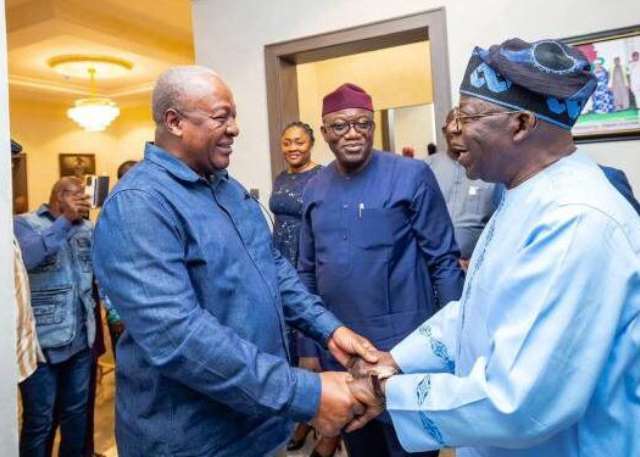
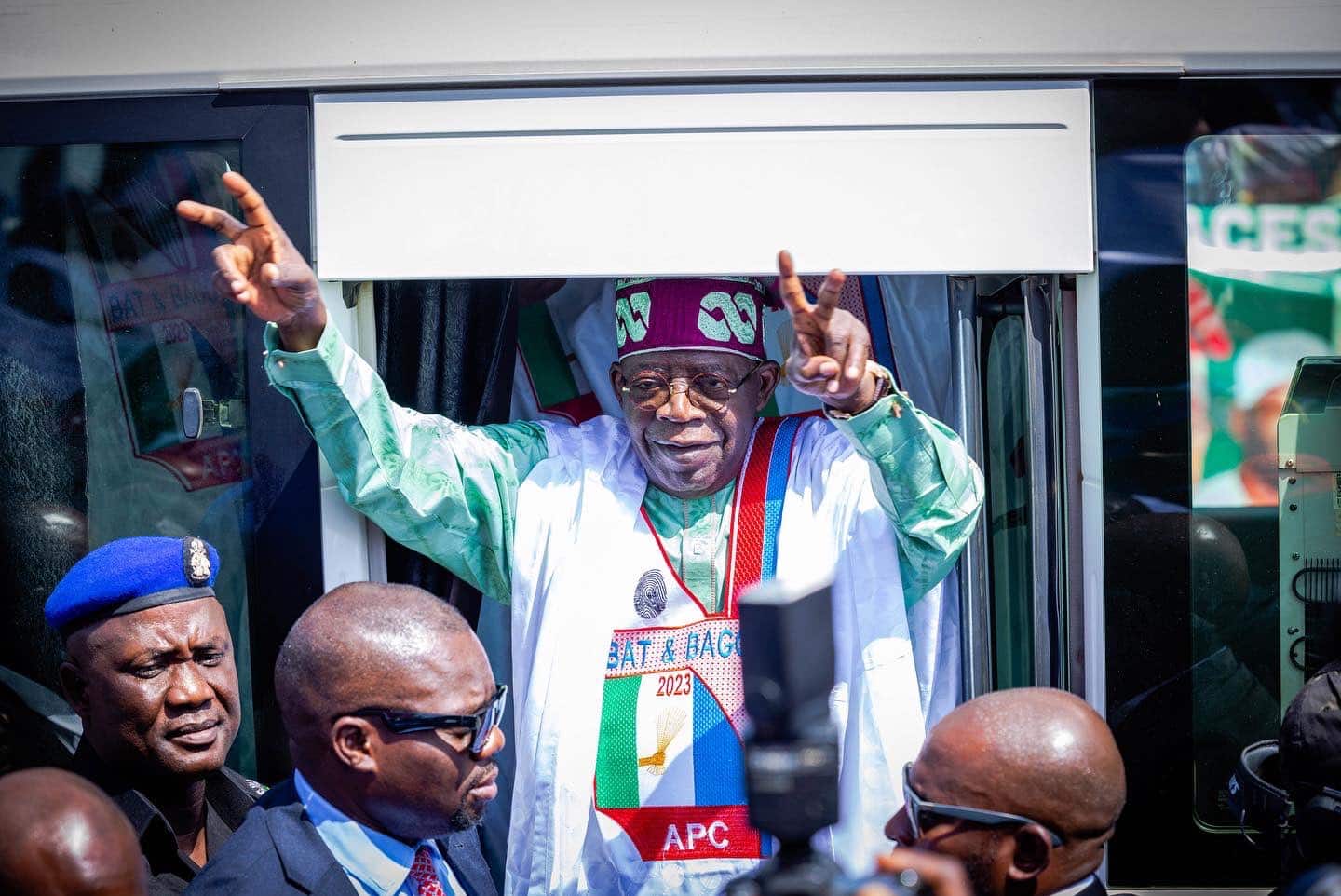
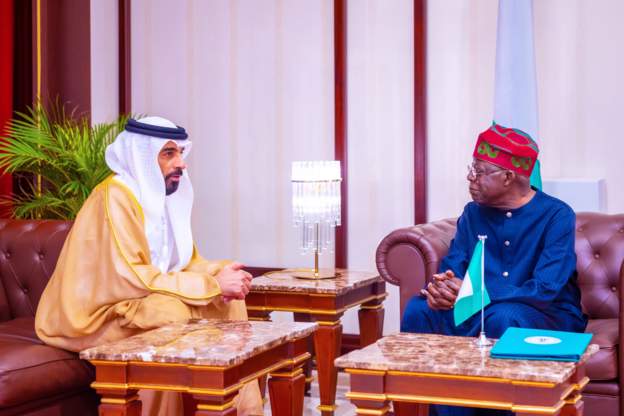
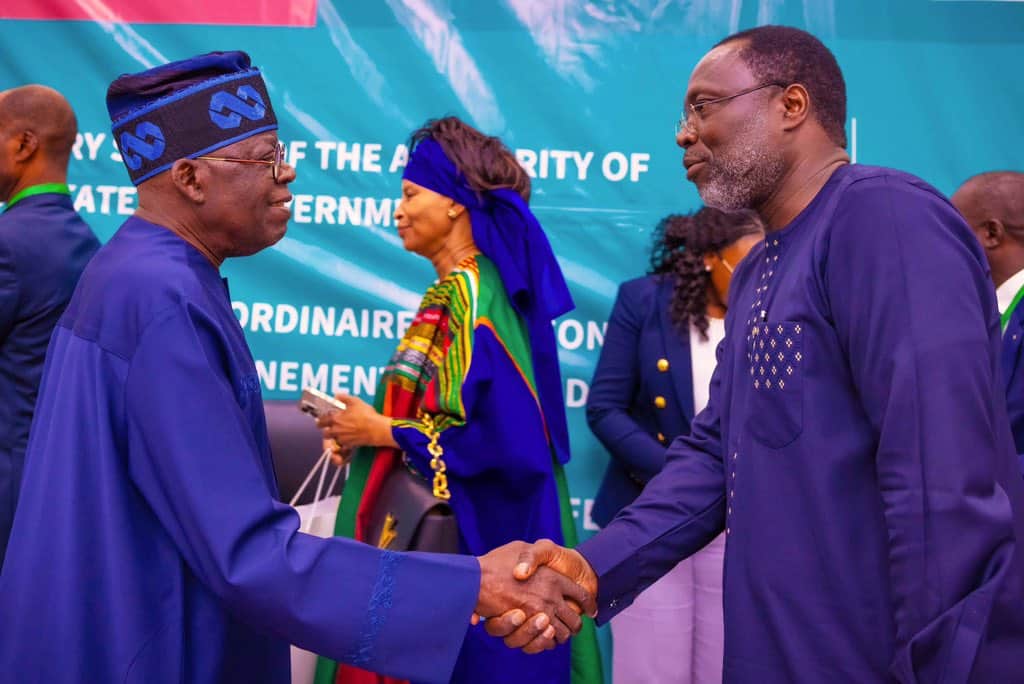
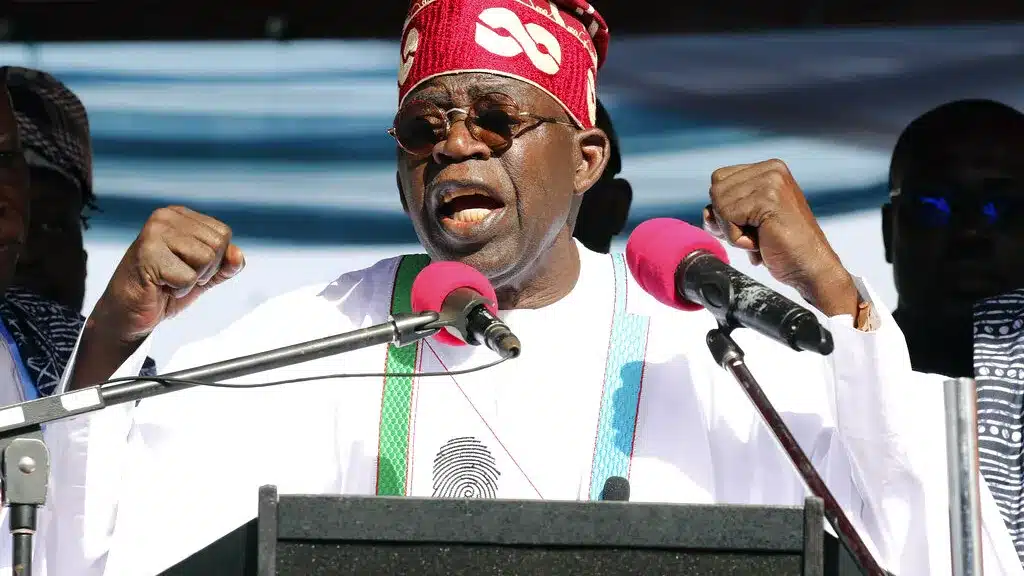
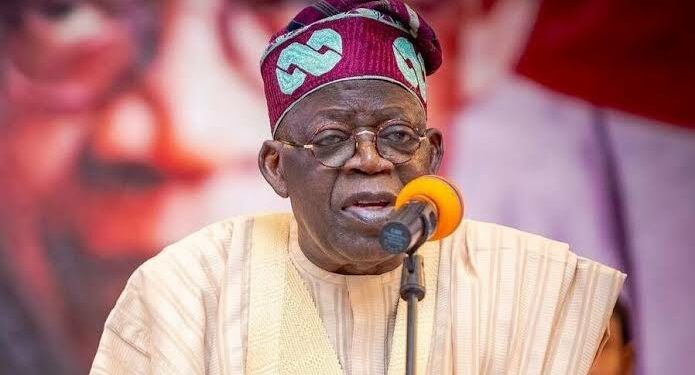
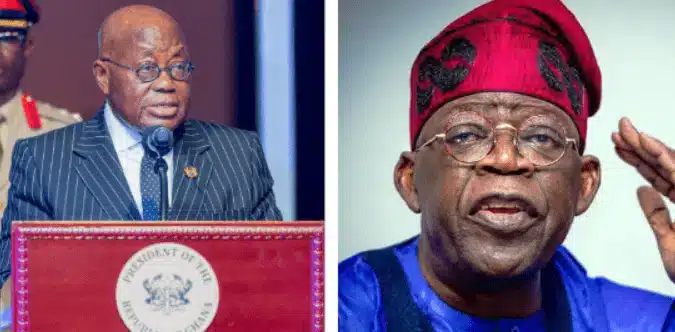
Nigerian President Asiwaju Bola Ahmed Tinubu has expressed confidence in Ghana’s newly inaugurated President, John Dramani Mahama, praising his leadership and the promise it holds for the nation’s future.
Speaking at the swearing-in ceremony in Accra on Tuesday, January 7, 2025, Tinubu commended Mahama’s capabilities and expressed optimism about the positive transformation his presidency would bring to Ghana.
“I’ve no doubt your administration will bring about positive change and progress,” Tinubu stated, reaffirming his faith in Mahama’s leadership.
He further assured Mahama of Nigeria’s unwavering support, pledging to stand by Ghana in its developmental journey while encouraging Mahama to seek Nigeria’s assistance whenever needed.
Meanwhile, in his inaugural speech, President Mahama laid out his vision for Ghana’s future, calling for a national reset to tackle the economic and governance challenges the country faces.
Acknowledging the difficult economic conditions of recent years, Mahama remained hopeful, assuring citizens that the hardships were not permanent and pledging to bring positive change.
“If democracy is celebrated as a superior means of governance, then its outcomes must be more tangible and benefit them in their individual lives. Any honest introspection and reflection on the pulse of our nation would reveal that many within the population of our nation do not feel that they have benefitted from or partaken in this democratic dividend,” he said.
“We are a people hit by a severe economic crisis and hardships and in the last few years, we have moved from crisis to crisis. But there is hope on the horizon.
“Today should mark the beginning of a new opportunity. An opportunity for us to make a difference in our governance and our economic management. We shall reset our dear nation, Ghana,” President Mahama declared.
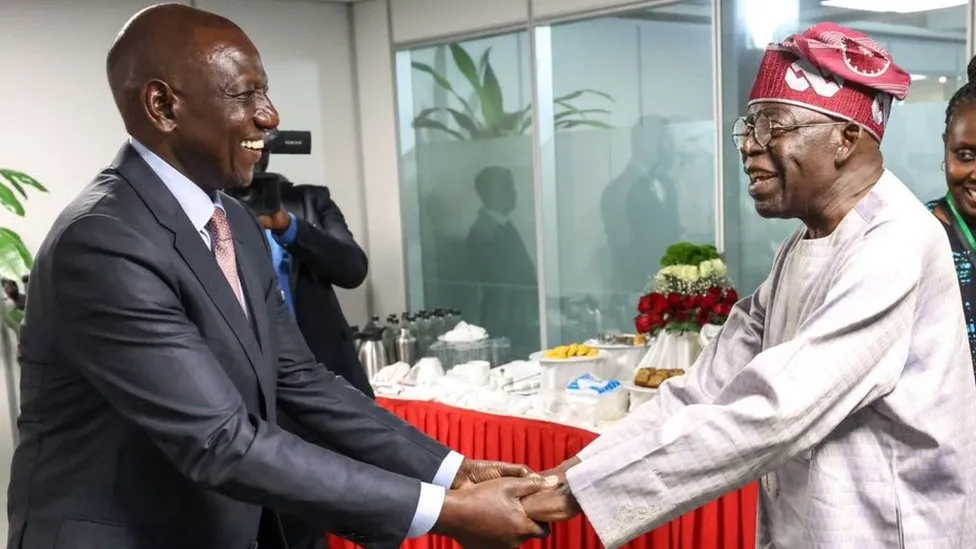
Nigerian President Asiwaju Bola Tinubu has assured Ghana’s newly inaugurated President, John Dramani Mahama, of Nigeria’s unwavering support and solidarity as Mahama begins his new term in office.
Speaking at President Mahama’s inauguration ceremony in Accra on Tuesday, January 7, Tinubu reaffirmed Nigeria’s commitment to strengthening its relationship with Ghana and collaborating for mutual growth.
“My dear brother, I am here to walk with you. You know you can count on my support at any given time you call on me. We are your brothers and sisters. We shall always be there for you,” Tinubu stated, emphasizing the bond between the two nations.
Extending his well wishes to Mahama, he added, “May your administration be a profound success and progress for you, Ghanaians, and the entire region.”
President Tinubu further stressed the importance of cooperation between Ghana and Nigeria, expressing optimism about the potential for shared development under Mahama’s leadership.
“I am confident that the new government under the leadership of President John Mahama will work with Nigeria to strengthen this powerful bond, leading to greater shared progress and prosperity for the people of our two nations,” Tinubu remarked.
Nigerians have expressed widespread outrage after President Bola Tinubu acquired a new presidential plane, at a time when the country is facing its worst economic crisis in a generation.
The move has sparked criticism, coming just two weeks after thousands of citizens took to the streets to protest against the rising cost of living and widespread hunger.
Elected last year to lead Africa’s most populous nation, President Tinubu has introduced several economic reforms aimed at reducing government spending, including the controversial removal of fuel subsidies.
While these measures have been touted as necessary for long-term growth, they have exacerbated inflation, which currently exceeds 30%, further straining the pockets of ordinary Nigerians.
In January, Tinubu announced a 60% reduction in the size of official travel delegations, including his own, as part of efforts to cut government expenses.
However, on Monday, he departed for France aboard a newly acquired Airbus A330, a plane that adds to the presidential fleet of more than five aircraft. The cost of the plane, as well as the details of his trip, remain undisclosed.
President Tinubu jets off to France on a 'work stay' as Nigeria suffers fuel shortages, soaring inflation, and students in captivity.
This has led to mounting anger, with many questioning whether the plane purchase had been approved by lawmakers, especially since it was not mentioned in this year’s budget. Critics argue that the acquisition contradicts the president’s message of fiscal restraint and comes at a time when many Nigerians are struggling to afford basic necessities.
In defense of the decision, President Tinubu’s media aide, Bayo Onanuga, took to X (formerly Twitter) to explain that the new plane would actually result in cost savings. “The new plane, bought far below the market price, saves Nigeria huge maintenance and fuel costs, running into millions of dollars yearly,” Onanuga stated.
The 15-year-old Airbus A330, which has been configured for VIP use, replaces the country’s aging 19-year-old Boeing BBJ 737-700. The purchase follows the release of the plane to the Nigerian government after it was previously seized by a Chinese firm, Zhangson Investment Co. Limited, due to an investment dispute with Ogun state in southwest Nigeria. Nigerian officials had previously raised concerns over the high maintenance costs of the aging presidential fleet, which had prompted calls for new aircraft.
In June, lawmakers recommended the purchase of two new planes for the president and his deputy, citing safety concerns over the older planes in the fleet. Last month, they passed a supplementary budget that increased the 2024 national budget from 28.7 trillion naira ($18bn; £14bn) to 35.06 trillion naira, though it is unclear whether the new plane purchase was part of this allocation.
Despite government reassurances that the acquisition would save money in the long run, many Nigerians remain furious, viewing the purchase as ill-timed and insensitive given the current economic hardships faced by the population.
Nigeria’s President Bola Tinubu has called for a halt to protests over the rising cost of living, urging citizens to allow room for dialogue.
This marks his first public statement since demonstrators began taking to the streets last week.
Amnesty International reported that at least 13 people were killed in clashes with security forces on the first day of protests on Thursday. Police, however, denied using excessive force and stated that seven people had died as of Saturday.
The casualties included four individuals killed by an explosive device during a march in Borno state, two struck by a car, and one shot by a guard during a shop looting.
In a televised address, Tinubu appealed for an end to the violence that has erupted in several states since the protests began, emphasizing his willingness to engage in dialogue.
“My dear Nigerians, especially our youth, I have heard you loud and clear. I understand the pain and frustration that drive these protests, and I want to assure you that our government is committed to listening and addressing the concerns of our citizens,” he stated.
Nigerians have been using social media to organize protests against economic hardships and poor governance, demanding reductions in petrol prices and electricity tariffs, among other issues.
My fellow Nigerians,
Today, I address you with a sense of responsibility, as we navigate through these times. The protests, which turned violent in some parts of our nation, have caused unimaginable pain and loss, particularly to the families of those who have tragically lost… pic.twitter.com/mSR9zHc4Lb
Tinubu, who assumed office in May 2023, defended his economic reforms, including a partial rollback of petrol and electricity subsidies and the devaluation of the naira, as essential steps to address years of economic mismanagement.
He noted that government revenues had more than doubled to 9.1 trillion naira ($5.65 billion) in the first half of this year, with 68% of revenue now allocated to debt servicing, down from 97% before he took office.
The president also highlighted increased government spending on infrastructure projects, a new loan scheme for university students, and the construction of thousands of housing units across Nigeria’s 36 states.
“But we must not let violence and destruction tear our nation apart,” Tinubu cautioned.
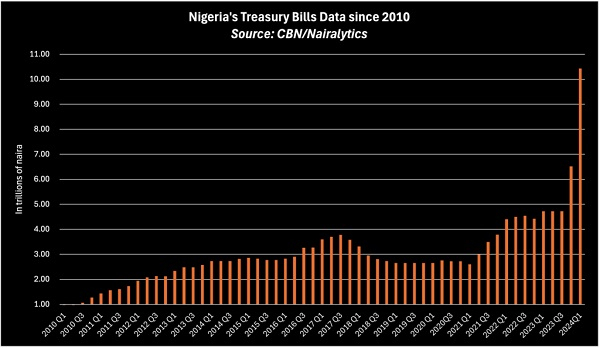
Nigeria’s Treasury Bills (T-Bills) debt has soared to N10.4 trillion, marking a 60% increase in just three months, according to the Debt Management Office (DMO) data.
This sets a new record for Nigeria’s highest T-Bills debt balance since at least 2010, based on Nairalytics’ analysis of central bank records.
The DMO, through the central bank, has conducted multiple Treasury Bills auctions in the first half of 2024. These auctions are crucial for managing inflation and financing short-term government expenditures.
Under the All Progressives Congress (APC) government, T-Bills have become a primary source of short-term funding, expanding significantly from N2.8 trillion during the Peoples Democratic Party (PDP) era under Goodluck Jonathan to the current N10.4 trillion.
As of December 2023, Nigeria’s Treasury Bills stood at N6.5 trillion, representing 11% of the domestic debt portfolio. By March 2024, this figure surged to N10.4 trillion, comprising 16% of the total domestic debt.
This translates to T-Bills debt accounting for 4.37% of Nigeria’s Gross Domestic Product (GDP).
In the first quarter of 2024 alone, the central bank offered N2.1 trillion in Treasury Bills, attracting a massive subscription of N21.7 trillion from yield-seeking investors.
Despite offering N5.64 trillion in total, yields spiked up to 21.1% in Q1 2024, prompting investors to shift funds from equities to fixed-income securities.
A further N1.64 trillion in Treasury Bills auctions was scheduled for Q2 2024, mainly to roll over maturing bills, ensuring continuity rather than repayment.
Under the Bola Tinubu administration, Nigeria has increasingly relied on domestic debt markets, especially T-Bills, for short-term funding, contrasting with the previous administration’s preference for Central Bank’s Ways and Means Advances.
The fiscal shortfall in government revenues has exacerbated reliance on public debt, with the central bank, under Yemi Cardoso, employing high interest rates to attract T-Bill buyers.
Despite oversubscriptions in most auctions, concerns persist over the rising cost of servicing Nigeria’s domestic debt, with actual yields nearing 30% per annum.
Moreover, Nigeria’s total domestic debt climbed to N65.6 trillion in Q1 2024, up 11% from December 2023, while external debt slightly declined to $42.1 billion due to reduced IMF debt.
Overall, Nigeria’s public debt amounts to N114.7 trillion in naira terms or $92.2 billion in dollar terms, surpassing the self-imposed debt-to-GDP limit of 40%.
The DMO attributes much of the debt surge in naira terms to currency devaluation, with only N7.71 trillion borrowed domestically in Q1 2024.
Rising debt levels have raised concerns about increased interest payments, potentially consuming a larger share of Nigeria’s declining revenue, as highlighted by Moody’s and PricewaterhouseCoopers (PwC) warnings on the country’s debt trajectory.
Under President Bola Tinubu’s administration, Nigeria has secured a total of $4.95 billion in loans from the World Bank, raising concerns about the country’s increasing external debt servicing costs.
At least six loan projects have been approved, including funding for power ($750 million), women’s empowerment ($500 million), girls’ education ($700 million), renewable energy ($750 million), economic stabilization reforms ($1.5 billion), and resource mobilization reforms ($750 million), as reported by Nairametrics.
Loan Breakdown
$750 Million for the Power Sector: Approved on June 9, 2023, this loan aims to enhance Nigeria’s power sector, providing additional financing for the power sector recovery performance-based operation.
$500 Million for Women’s Empowerment: On June 27, 2023, the World Bank approved this loan to support Nigeria’s efforts in women’s empowerment, scaling up financing for the Nigeria for Women Program.
$700 Million for Educating Adolescent Girls: In September 2023, a $700 million loan was approved to improve educational opportunities and empowerment for adolescent girls in Nigeria, supporting the ongoing ‘Adolescent Girls Initiative for Learning and Empowerment’ (AGILE) project.
$750 Million for Renewable Energy: Approved on December 14, 2023, the $750 million Distributed Access through Renewable Energy Scale-up (DARES) project aims to provide over 17.5 million Nigerians with better access to electricity through distributed renewable energy solutions.
$1.5 Billion for Economic Stabilization Reforms: On June 13, 2024, the World Bank approved a $2.25 billion financial package, including $1.5 billion for the Nigeria Reforms for Economic Stabilization to Enable Transformation (RESET) Development Policy Financing Program. This project focuses on increasing fiscal oil revenues, boosting non-oil fiscal revenues, expanding social safety nets, and raising the import value of previously banned products.
$750 Million for Resource Mobilization Reforms: Also approved on June 13, 2024, this loan supports the Nigeria Accelerating Resource Mobilization Reforms (ARMOR) Program-for-Results. The program aims to enhance non-oil revenues and protect oil and gas revenues from 2024 to 2028 through significant tax, excise, and administrative reforms.
Additional Insights
The World Bank disclosed that Nigeria was the top recipient of its fresh loans in 2022, with about $2.9 billion released to the country, followed by Tanzania with $2.7 billion.
According to the external debt stock report from the Debt Management Office (DMO), Nigeria owed the World Bank a total of $15.45 billion as of December 31, 2023.
The increase in debt stock has sparked concerns over rising debt service costs. Nigeria’s foreign debt servicing costs surged by 96%, reaching $2.19 billion in the first five months of 2024, compared to $1.12 billion in the same period in 2023.
The escalating costs of servicing foreign debt pose significant challenges for Nigeria’s economy, potentially diverting resources from critical sectors such as healthcare, education, and infrastructure, thus exacerbating socio-economic issues.
Guinness is set to join a growing list of multinationals exiting Nigeria due to an increasingly hostile economic environment.
Companies like GlaxoSmithKline and Microsoft have already left the country for similar reasons.
After operating in Nigeria since 1950, Guinness has announced its departure, attributing the decision to the severe economic conditions exacerbated by President Bola Tinubu’s administration.
On Tuesday, Guinness revealed plans to sell its controlling shares to the Singaporean conglomerate Tolaram Group.
The brewery brand reported a substantial N61.9 billion loss after tax from July 2023 to March 2024, following President Tinubu’s decision to float the naira in an attempt to unify the currency’s value on both official and parallel foreign exchange markets.
This policy move backfired, causing significant financial setbacks for many multinational companies, including Guinness Nigeria, which saw its N61.7 billion loss after tax in Q3—a stark contrast to the N5.9 billion profit reported in the same period the previous year.
The continued depreciation of the naira likely influenced Diageo, Guinness’ parent company, to sell its 58.02 percent majority stake to Tolaram Group.
“Under the terms of an agreement signed today, 11 June 2024, Tolaram will acquire Diageo’s 58.02% shareholding in Guinness Nigeria royalty agreements for the continued production of the Guinness brand and its locally manufactured Diageo ready-to-drink and mainstream spirits brands,” the company said in a statement Tuesday.
Guinness Nigeria Plc, listed on the Nigerian Stock Exchange, was incorporated on April 29, 1950, initially importing Guinness Stout from Dublin. With Tolaram’s acquisition expected to conclude by 2025, Guinness will have marked 75 years in Nigeria.
In their statement, Guinness confirmed it would leave Nigeria next year, transitioning operations to a third-party venture.
“The transaction is expected to be completed during fiscal 2025, subject to obtaining the requisite regulatory approvals in Nigeria,” said the statement signed by Abidemi Ademola, Guinness’s legal director.
Diageo emphasized that this sale would not affect its ownership of the Guinness global brand. The company “will retain ownership of the Guinness brand, which will be licensed to Guinness Nigeria for the long term.”
Diageo’s departure adds to a list of multinationals like GlaxoSmithKline and Microsoft that have exited Nigeria in recent years, citing unprofitable business conditions due to the challenging economic climate.
Diageo “will retain ownership of the Guinness brand, which will be licensed to Guinness Nigeria for the long term.”
Popular Diageo brands in Nigeria include Smirnoff Ice, Smirnoff Vodka, Orijin Bitters, Malta Guinness, Gordons Orange Sunset, and Dubic Malt.
In the aftermath the one-year anniversary of Nigeria’s current administration under President Bola Tinubu, both the country’s achievements and shortcomings were brought to light.
Unfortunately, the deficiencies overshadowed the progress, as conveyed through infographics presented by Bismarck Rewane, the Managing Director/Chief Executive Officer of Financial Derivatives Company Limited. The overall sentiment surrounding the president’s first year in office appeared lackluster.
As reported by Nigerian newspaper The Punch, Bismarck Rewane disclosed on a segment aired on Nigerian news channel Channels Television that Nigeria had slipped from being the 32nd largest economy globally to 42nd.
He made this revelation during a presentation analyzing the impact of the president’s tenure since assuming office. He illustrated how hyperinflation had impacted consumer prices of various essential goods over the past year, with some food items experiencing increases of over 200%.
Additionally, beyond essential commodities, he revealed that Nigeria had dropped from first to fourth place in terms of wealth management and accumulation in Africa.
The economist then pointed out that Ghana has also surpassed Nigeria, stating, “In the past, we were always richer than Ghana, now we are here. External reserves and GDP figures speak for themselves.”
He however expressed optimism, noting that things may look bleak, but there may be some hope.
“Our ranking among African countries has declined. Last year, our GDP growth was 2.98 percent; South Africa was 1.93 percent, Kenya was 4 percent, and Ghana was 3.8 percent. Inflation was 33 percent for us, 5 percent for South Africa, 5 percent for Kenya, and 25 percent for Ghana,” he said.
“Our GDP per capita is $1,111, while South Africa’s is $6,700, Kenya’s is $2,000, and Ghana’s is $2,200. External reserves as a percentage of GDP illustrate a tough picture. In the past, we were always richer than Ghana, but now we are here. External reserves and GDP figures speak for themselves,” the renowned economist added.
Given the fact that Ghana’s GDP per capita is almost double that of Nigeria’s, it’s fair to say that the economist’s assessment could be considered accurate.
Additionally, with a GDP of $1,111, Nigeria is nowhere near the richest countries on the continent, according to Global Finance GDP-PPP per capital index, Nigeria is currently the 46th poorest country in the world.
Nigeria has implemented a new mandatory annual levy targeting organizations employing expatriate workers.
This is part of efforts to promote local employment opportunities and boost revenue.
The levy requires companies to pay $15,000 for a director and $10,000 for other categories of expatriate employees.
The move, announced by President Bola Tinubu during the launch of the Expatriate Employment Levy (EEL) handbook, aims to encourage foreign companies to hire more Nigerian workers while closing wage gaps between expatriates and the local labor force.
President Tinubu emphasized that the levy should not deter potential investors but rather foster a balanced employment landscape between Nigerians and expatriates. He stressed the importance of clear implementation to achieve the intended objectives of the program.
According to data from the interior ministry, Nigeria hosts over 150,000 expatriates primarily working in sectors such as oil and gas, construction, telecommunications, and hospitality. The imposition of the levy comes amidst Nigeria’s worst economic crisis in recent memory, prompting widespread protests against economic hardships.
Acknowledging the challenges faced by Nigerians, President Tinubu reassured efforts to improve the country’s financial situation and stimulate economic growth.
The levy applies to expatriate employees working for at least 183 days in a year and carries penalties of up to three years in jail for non-compliance, including providing inaccurate information. The Nigerian Immigration Service will oversee enforcement, operating in collaboration with a private firm under a public-private partnership model.
Interior Minister Olubunmi Tunji-Oj highlighted the partnership’s framework, underscoring its role in effectively administering the levy and ensuring compliance with regulations.
Kenya’s William Ruto and Nigeria’s Bola Tinubu have been criticized for traveling abroad a lot since they became presidents.
The two men have been described in a bad way – it’s said that they spend a lot of money on flying, which is a problem when the economy is not doing well at home.
The Standard, a newspaper in Kenya, gave Mr. Ruto the nickname “Flying President”. It means that he loves flying so much that he always wants to do it, even if he has a lot of other important things to take care of.
Last month, Mr. Tinubu went to Europe again, and Nigeria’s opposition leader Atiku Abubakar said on social media that Nigeria doesn’t need a “tourist-in-chief. ” He didn’t like that the president went on a private trip when there are a lot of problems in Nigeria.
This can be seen as a quick and easy criticism that anyone can make. Presidents have to go to meetings with other leaders and build good relationships with other countries. This is important for diplomatic and economic reasons because it can lead to profitable investment deals.
But some people have noticed that late Tanzanian President John Magufuli did not travel outside of Africa during his six years as president.
Some presidents really enjoy flying in planes. He said that some of these trips are more about showing off themselves than benefiting the country.
Mr Ruto and Mr. Tinubu, along with their representatives, say that their trips are important for solving the problems they are being criticized for not addressing.
In the eight months since Mr. Tinubu became president, he has taken 14 trips, which is less than two trips each month. Meanwhile, Ruto has made about 50 trips since he became president in 2022, which is more than three trips each month.
Mr Ruto’s predecessor, Uhuru Kenyatta, usually took about one foreign trip per month during his ten years as president. This is similar to the behavior of Nigeria’s former president, Muhammadu Buhari. However, when it comes to the total number of days spent abroad, the difference is not very big.
Other leaders from different countries have also been traveling a lot by air, but people keep asking if Mr. Ruto and Mr. Tinubu really need to take so many trips.
The leaders of Nigeria and Kenya were both in Europe at the end of last month. Ruto was in Italy for a summit and Mr. Tinubu was in France for a private visit, his third time there since last May. Since that time, Mr. Ruto has gone on more trips.
In June 2023, only three weeks after starting his new job, Mr Tinubu went to Paris for a two-day meeting about the climate. He had already visited there a few months ago to take a break and make plans for the time after he became president.
In August he went to Benin, and in September he went to India, the United Arab Emirates, and the US for a meeting of the United Nations before going back to Paris.
He was at home all through October and then started traveling again in November. He went to Saudi Arabia, Guinea-Bissau, and Germany at the end of November, and a week later he went to Dubai.
The Nigerian president’s office said that these trips are necessary to bring in money from other countries.
“Every time I travel to another country, I always tell investors and business people the same thing. ” Nigeria is prepared and available for doing business,” President Tinubu said in his New Year message for 2024.
Mr Ruto has been very busy traveling since he became president in 2022.
From September of that year to December of last year, he went to other countries at least two times every month. In May 2023, he took five journeys. He has visited many African countries, Europe and the US for international events and meetings with other countries.
This year in January, he visited Uganda, the Democratic Republic of Congo, and Italy. This month, Mr Ruto has already visited Japan and the UAE.
Frequency and cost are both important factors to consider.
According to the Nigerian newspaper Punch, Mr Tinubu spent at least 3. 4 billion naira on travel in the first six months of his presidency. This is 36% more than the budgeted amount for 2023. The information comes from GovSpend, a civic tech platform that monitors government spending.
In Kenya, the Controller of Budget, which is a separate office that watches over how the government spends money, reported that the president’s travel spending went up a lot in the year until last July. This included nine months when Mr. Ruto was president.
Total spending on travel, both within the country and abroad, was over 1. 3 billion Kenyan shillings ($9. 2 million; £73 million) for the year. This was more than 30% higher than the travel budget for the previous year.
The person who speaks for the government of Kenya did not answer the BBC’s questions about Mr. Ruto’s trips, even though the president and the spokesman have said they are okay.
Mr Ruto said he doesn’t travel for fun. He goes on these trips to bring in money from other countries and to find jobs for Kenyans living abroad. He mentioned that he has found over 300,000 job opportunities through his talks with other countries.
After the recent visit to Japan, Mr Ruto said he had made agreements worth more than $2. 3 billion
Nigeria and Kenya are defending the benefits of presidential trips while also responding to criticism of government employees traveling overseas.
Kenya has reduced its government worker travel budget by half after being accused of wasting money on trips within the country and abroad. However, the president himself does not seem to be affected by this and has said he will continue to take trips as long as they are helpful.
Last month, the leader of Nigeria said that he will be cutting back on the number of people who travel with him for official purposes by about 60%. His spokesperson, Ajuri Ngelale, said the president will reduce the number of people he travels with, but it’s not clear if he will also reduce the number of trips he takes.
However, it’s not only Kenya and Nigeria that have been worried about the cost of traveling.
In November, Malawi’s President Lazarus Chakwera stopped himself and his ministers from traveling outside the country. He also told anyone who was already abroad to come back because the country was having money problems.
Other countries, like Uganda, The Gambia, Namibia, and Sierra Leone, have also needed to deal with government officials spending money on travel since last year. The leaders of Namibia and Sierra Leone have been called the “flying president” by local newspapers, similar to Kenya’s Mr. Ruto
But many people on social media are upset and saying that there were other people who were better and deserved the job more than Mr.
“Showing favoritism to family and friends is a bad quality in a leader. ” “The fact that Nigerian leaders don’t consider it a moral failure is sad,” someone wrote on X.
Some people support Mr. Ojo being named for the role and say that his connection to the president should not stop him from getting government jobs.
He was chosen by the president to help change how the housing ministry is run.
The FHA, managed by the government, helps to provide low-cost homes in Nigeria.
The government has not said anything yet about the complaints about the appointment.
In a move aimed at fostering patriotism and allegiance to Nigeria’s values, President Bola Tinubu has directed the compulsory recitation of the national pledge at all official and public gatherings across the country.
Presidential spokesperson Ajuri Ngelale conveyed the directive, emphasizing its significance in upholding respect for national symbols and reinforcing citizens’ commitment to the nation’s ethos.
President Tinubu underscored the importance of upholding national values and promoting unity through adherence to established norms and ideals.
Ngelale reiterated the president’s call for optimism and positivity, emphasizing that collective efforts toward national prosperity contribute to Nigeria’s success.
The national pledge, to be recited following the national anthem, symbolizes the citizens’ fidelity and loyalty to Nigeria, serving as a key national symbol.
This directive comes amidst ongoing challenges, including communal conflicts between herders and farming communities, highlighting the need for unity and adherence to national values in addressing societal issues.
Nigeria’s President Bola Tinubu has ordered that the national pledge must be said at all official and public events in the country.
This is to make sure that people show great respect for the symbols of Nigeria, remain loyal to the country, and keep Nigeria’s values and character strong, said a spokesperson for the president.
The president said it’s important to honor our country’s values, and follow its rules.
“We all love winning. ” We really like winning. “When you feel good and have hope, Nigeria is doing well,” the statement said.
Nigeria’s President Bola Ahmed Tinubu, the chairman of the Economic Community of West African States (ECOWAS) is yet to call for a meeting among member states to discuss the recent exit of Mali, Niger and Burkina Faso from the bloc.
This information was disclosed by Ghana’s President Akufo-Addo, who expressed regret over the unfortunate decision made by Mali, Niger, and Burkina Faso to withdraw their membership.
Currently under military rule, these countries have stated that ECOWAS has become obsolete and does not align with their interests.
As the former ECOWAS Chair, President Akufo-Addo noted that this decision would have repercussions for the citizens of those nations.
He mentioned that discussions were pending to assess the consequences of their withdrawal and determine the next steps forward.
“This unfortunate decision by Mali, Burkina Faso, and Niger to withdraw from the ECOWAS community is going to be very negative for the populations there. But ECOWAS is yet to meet. It happened on Sunday, and we are waiting for a signal from the head, Nigerian President Tinubu, to indicate the time when we will have a summit to examine the implications of what has happened and the way forward for the community,” he is quoted to have said by CitiNews.
President Akufo-Addo did not explicitly state what these three countries stand to lose. Being a member of ECOWAS has its advantages. Hence, it is fair to conclude that no longer being a part means one may or can no longer enjoy such privileges.
Some benefits of being a member of ECOWAS include reduced tariffs and quotas, facilitating the flow of goods and services within the region, and free movement of people across member states.
On Tuesday, President Bola Tinubu of Nigeria called for a thorough investigation into a military drone attack, following the state emergency agency’s report in northern Kaduna state, which indicated that at least 85 people were killed over the weekend.
Governor Nasir el-Rufai, a religious leader, and eyewitnesses informed Reuters on Monday that numerous civilians lost their lives during the military drone operation aimed at targeting insurgents and bandits on Sunday night.
Providing the first official acknowledgment of the toll from the weekend incident, the Kaduna State Emergency Management Agency confirmed on Tuesday that at least 85 individuals had lost their lives during the attack.
“The Northwest Zonal Office has received details from the local authorities that 85 dead bodies have so far been buried while a search is still ongoing,” the agency said.
Tinubu, who is attending the Cop28 Climate Summit in Dubai, said the “the bombing mishap” in a village at Tundun Biri, was “very unfortunate, disturbing, and painful,” his spokesman Ajuri Ngelale said in a statement.
“The President directs a thorough and full-fledged investigation into the incident and calls for calm while the authorities look diligently into the mishap,” said Ngelale.
The Nigerian Army has not provided any comments regarding the incident; however, the Air Force has denied its involvement in the mission leading to the attack on Sunday.
Nigeria’s military, with support from the United States, Britain, and other non-Western allies, is engaged in a protracted war against Islamist insurgents in the northeast. Over the years, the military has conducted lethal aerial operations in various parts of the country.
Kaduna, situated 163 km (101 miles) from the capital Abuja, has witnessed an increased security challenge. In addition to the conflict in the northeast, the army and air force have been tasked with addressing the escalating threat in Nigeria’s northwest and central regions, including Kaduna state.
These threats are posed by armed criminal groups carrying out violent attacks on villages and engaging in large-scale kidnappings.
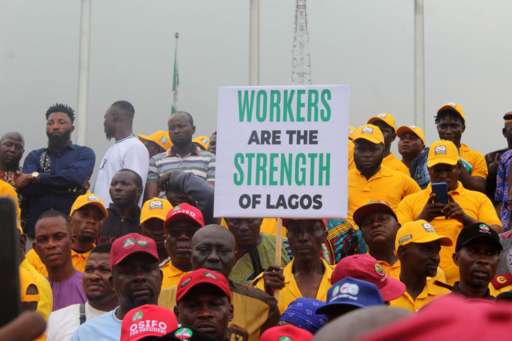
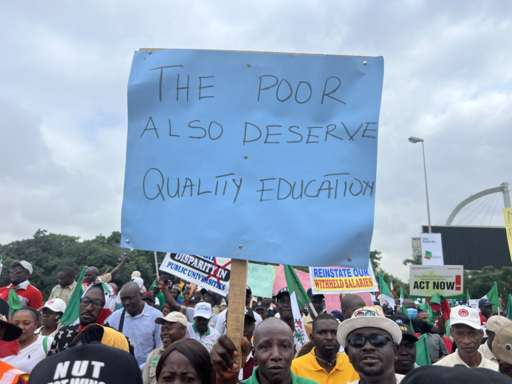
Nigeria’s two largest labor unions, the Nigeria Labour Congress (NLC) and the Trade Union Congress (TUC), have instructed their members to commence an indefinite nationwide strike and stay at home starting Tuesday, defying a court order prohibiting such action.
The protest is in response to the escalating cost of living and a surge in fuel prices.
The unions have been urging President Bola Tinubu to reverse the elimination of the longstanding petrol subsidy, which had maintained low fuel prices but was deemed financially draining by the government. The government asserted that the funds saved would be redirected towards social projects.
Central to their demands, the unions are calling for an increase in the minimum monthly wage to at least $120 (£97), denouncing some of the government’s economic policies as “anti-people.”
The strike will remain until “governments at all levels wake up to their responsibilities”, TUC President Festus Osifo said in a statement.
The strike announcement comes in the wake of a recent restraining order by an industrial court in the capital, Abuja, theoretically barring the unions from initiating the strike.
The duration of the strike remains uncertain, but it is anticipated to impact crucial services in hospitals, railway stations, and schools in Africa’s largest economy.
This statement was made in response to the recent outrage following the publication of details of the N2.1 trillion supplementary budget submitted to the National Assembly, where the yacht was listed under the Nigerian Navy’s proposed capital expenditure of N42.3 billion.
The supplementary budget included allocations of N5.09 billion for a yacht, N2.9 billion for sport utility vehicles for the Presidential Villa, and an additional N2.9 billion for the replacement of operational vehicles for the presidency.
The yacht was categorized under the Nigerian Navy’s proposed capital expenditure of N42.3 billion.
In response to this, Ajayi expressed skepticism about the necessity of a yacht for his principal to carry out his official duties.
“The trending issues on social media since yesterday are two items in the 2023 supplementary budget. One is the provision for a presidential yacht in the supplementary budget by the Navy, and the other is over N6 billion for vehicles for the State House.”
“It is important to state clearly that President Bola Tinubu didn’t ask for a presidential yatch, and I doubt he needs one to perform the functions of his office. From what I know, the request for a yacht, however it is named or couched in the budget, is from the Navy, and they must have operational reasons for why it is required.
“The budget office should be in a position to also explain to the public why such expenditures should be accommodated now, considering the economic situation of the country. I must readily admit that the one reason our budgeting system has been the subject of public attack is the very simplistic way some of the line items are described by civil servants who prepare the budget.
“Examples abound. Sometimes in 2016, an Enterprise Resource Planning (ERP) project of the Ministry of Solid Minerals worth over N300 million was captured in that year’s budget as a “website”. Naturally, it generated a massive controversy as people, rightly, asked to know the type of website that would be built with N300 million.
Ajayi further stated, “It is important to say that journalism should enrich public enlightenment and not create an atmosphere of siege. It is poor reporting to always reduce State House budgetary provisions to the President and Vice President.
A presidential spokesman, Tope Ajayi said President Bola Tinubu did not ask for a yacht.
This comes amid outrage after details of the N2.1 trillion supplementary budget Tinubu submitted to the National Assembly were published.
According to the budget, N5.09 billion was allocated for the yacht, N2.9 billion for sport utility vehicles for the Presidential Villa, and another N2.9 billion for the replacement of operational vehicles for the presidency.
The yacht was listed under the Nigerian Navy’s proposed capital expenditure of N42.3 billion.
Speaking on the development, Ajayi said he doubted if his principal needed one to perform the functions of his office.
“The trending issues on social media since yesterday are two items in the 2023 supplementary budget. One is the provision for a presidential yacht in the supplementary budget by the Navy, and the other is over N6 billion for vehicles for the State House.”
“It is important to state clearly that President Bola Tinubu didn’t ask for a presidential yatch, and I doubt he needs one to perform the functions of his office. From what I know, the request for a yacht, however it is named or couched in the budget, is from the Navy, and they must have operational reasons for why it is required.
“The budget office should be in a position to also explain to the public why such expenditures should be accommodated now, considering the economic situation of the country. I must readily admit that the one reason our budgeting system has been the subject of public attack is the very simplistic way some of the line items are described by civil servants who prepare the budget.
“Examples abound. Sometimes in 2016, an Enterprise Resource Planning (ERP) project of the Ministry of Solid Minerals worth over N300 million was captured in that year’s budget as a “website”. Naturally, it generated a massive controversy as people, rightly, asked to know the type of website that would be built with N300 million.
Ajayi further stated, “It is important to say that journalism should enrich public enlightenment and not create an atmosphere of siege. It is poor reporting to always reduce State House budgetary provisions to the President and Vice President.
“When the State House makes provision for vehicles, it is reported as if it is the President that will use all the vehicles or eat all the food when a provision is made for food and catering services.
“We have had such inaccurate reporting in the past. A President and Vice President cannot, for any reason, spend N20 million naira to eat in a year if it is about the food they will eat as first and second families. How much food can a person really eat?
“Yet, we will read headlines that Tinubu, Buhari, Jonathan, or whoever the President is wants to spend N5 billion on food and catering in a year when in actual fact such budgetary provisions are made to accommodate many state events, meetings, hosting of VIPs, foreign dignitaries, and even visits by other Heads of State and bilateral and multilateral meetings that the State House will deal with in a given year,” he said.
Nigeria’s House of Representatives has rejected the government’s proposal to procure a presidential yacht for $6 million amid public criticism of extravagant spending during an economic crisis, according to senior lawmaker Abubakar Bichi.
Instead, lawmakers redirected the $6 million to increase the budget for student loans, effectively doubling its allocation.
President Bola Tinubu, who assumed office in May with a pledge to reduce waste and alleviate financial burdens on citizens, sparked controversy when he presented a supplementary budget to the National Assembly.
The proposed purchase of the yacht was listed within the Nigerian Navy’s capital expenditure of $53 million.
Human rights activist and former lawmaker Shehu Sani reacted by saying that “the poor can’t be struggling for survival in a canoe while their leader is yachting”.
Mr. Tinubu’s spokesperson, Temitope Ajayi, clarified that the president had no involvement in the plans to acquire the yacht.
“From what I know, the request for a yacht, however it is named or couched in the budget is from the navy and they must have operational reasons for why it is required,” he said.
The budget, which was approved by the House of Representatives on Thursday, allocates $36 million for State House expenses, including luxury vehicle purchases and the construction of a presidential office complex. Additionally, $15 million is earmarked for the presidential air fleet.
This issue has arisen at a critical time when President Tinubu is facing significant challenges related to the cost of living and the steep depreciation of Nigeria’s currency, the naira, against the US dollar. Nigeria’s annual inflation rate reached 26.7% in September, according to official data.
A leading advocacy group in Nigeria, the Socio-Economic Rights and Accountability Project (Serap), said the purchase of a yacht could not be justified when “137 million Nigerians live in extreme poverty”.
Furthermore, their situation has deteriorated following President Tinubu’s decision to eliminate fuel subsidies in his inaugural address, leading to increases in fuel prices and the cost of essential goods.
Activist Omoyele Sowore accused the government of spending on luxuries while it “maintains the miseries of the Nigerian populace”.
Mr Ajayi said the president and his vice-president were not planning to add new vehicles to their fleet, and were using “inherited vehicles” from the previous administration.
He said the budget for vehicles was for hundreds of civil servants and political aides working at State House.
President Bola Tinubu’s administration has put forward a proposal to allocate N1.5 billion for the procurement of vehicles for the First Lady’s office.
This expenditure is included in the 2023 supplementary budget, which the President submitted to the National Assembly for approval and has passed the second reading in the House of Representatives.
Despite the prevailing high levels of poverty and economic hardship in the country, the supplementary budget also allocates N19.3 billion for the purchase of vehicles for the President and the renovation of the Presidential and Vice Presidential lodges in Abuja and Lagos.
Additionally, the budget includes N3 billion for the acquisition, renovation, and rehabilitation of two fortified quarters used by the Economic and Financial Crimes Commission (EFCC) within the State House Complex in Guzape and Mabushi.
The Nigerian Navy’s capital expenditure is proposed to be ₦42.3 billion, with a recurrent expenditure of ₦20.42 billion, including N5.095 billion designated for the acquisition of a presidential yacht.
The supplementary budget outlines further allocations, including N2.9 billion for the purchase of SUVs, N2.9 billion for the replacement of operational pool vehicles, N4 billion for the renovation of residential quarters for the President, N2.5 billion for the renovation of Aguda House (Vice President’s residence), N200 million for the computerization and digitalization of the State House, N4 billion for the construction of an office complex within the State House, N4 billion for the renovation of Dodan Barracks (the official residence of the President), and N3 billion for the renovation of the official quarters of the Vice President in Lagos.
The Senate has swiftly passed the 2023 Supplementary Appropriation Bill amounting to N2.18 trillion, which was submitted for consideration by President Bola Tinubu.
Following the reading of the President’s letter during the Senate’s plenary session on Tuesday, the request received prompt attention and approval.
Additionally, the Senate granted swift approval of the supplementary budget on Thursday, following the presentation of the report by Senator Solomon Adeola, the Chairman of the Senate Committee on Appropriations.
The Committee on Appropriations held meetings with the ministers overseeing the agencies included in the supplementary budget on Wednesday.
These ministers consisted of David Umahi, the Minister of Works; Ahmed Dangiwa, the Minister of Housing; Senator Abubakar Kyari, the Minister of Agriculture and Food Security; Hon Bello Matawale, the Minister of State for Defence, as well as the Service Chiefs.
Nigerians on Twitter, now under the X platform, have expressed their frustration with their government following a recent visa waiver agreement between Ghana and South Africa.
These concerned citizens widely shared Ghana’s foreign ministry statement, which announced the agreement with South Africa, and questioned why their government has not been able to secure similar arrangements.
While some Nigerians on social media mocked the situation, others attributed it to a lack of seriousness on the part of the Bola Ahmed Tinubu government.
For some, Nigerians believed that the situation was a consequence of actions they had taken, particularly crimes that had been reported, especially in South Africa, Africa’s most industrialized nation.
The Ministry of Foreign Affairs and Regional Integration made an announcement last week regarding a visa waiver for individuals holding ordinary passports in both Ghana and South Africa.
In their statement, the ministry highlighted that this agreement would lead to substantial improvements for travelers between the two countries.
The Visa Waiver Agreement is slated to come into effect on November 1, 2023.
“Travellers may transit through, depart from and stay in the territory of both countries for a cumulative period of up to ninety (90) recourse to work. The travelling public is thereby advised to take note,” the statement concluded.
Here are tweets from some Nigerians.
Most Nigerians don't know or have an mind how gone their beloved ex"Giant of Africa" is,Like no country takes Nigeria serious. The world even sees the citizens as criminals or drug dealers
Do you know what it means for South Africa to grant Ghana visa free & kicking out Nigeria?
Nigeria should asked itself, why is South Africa not extending this same visa regime to Nigeria? What has our fellow country done in the past that South Africa is not extending this 90 days free entry visa to Nigeria. We need to look at the mirror to answer this question. https://t.co/XlQlLxdVY5
Ghana and South Africa have concluded agreement so that their citizens can inter-travel VISA-free . Nigeria is concentrating on mass weddings pic.twitter.com/Hqi8HA9l5e
Claims that President Tinubu’s educational credentials were fraudulent became widely shared on social media after Chicago State University (CSU) made his academic records public last week.
We have examined some of the most popular statements that are widely spread.
The president’s academic papers are being made public because of a court case that started in August. Atiku Abubakar, one of the president’s opponents in the presidential election, filed the case.
Mr Abubakar wanted the winner to be disqualified because he said that the person faked their diploma in Business Administration from CSU in 1979, which was submitted to the electoral authority (INEC).
Mr Abubakar asked a US court in August to make CSU give him Mr. Tinubu’s school records as evidence for his case in Nigeria. This is done through a process called discovery, where both sides share information and documents before a trial.
Mr Tinubu’s lawyers didn’t want the discovery application to happen because they were worried about privacy. However, the US court decided that it should still go forward.
Mr Abubakar asked for certain papers.
You can get a copy of any diploma that was given out by CSU in 1979.
In 1979, Mr. Tinubu received a diploma from CSU.
Diploma copies that look like the one Mr. Tinubu got from CSU in 1979, with the same writing style, official stamp and signatures, and the same words on it, were given to other students too.
Jamar Orr, who worked at CSU, certified documents for CSU between 1 August 2022 and the next 12 months. CSU provided seven diplomas for different areas of study as requested. The names of the students were removed. The university’s registrar says that the students did not pickup these diplomas.
CSU said they couldn’t find Mr. Tinubu’s diploma from 1979 because they don’t keep copies of diplomas once they have been given to students.
CSU added that, they made a new diploma for Mr. Tinubu on June 27, 1979. It also gave out diplomas to other students that looked similar to Mr Tinubu’s diplomas.
As a response to request four, CSU provided additional academic documents that were confirmed and released by Mr. Orr
Atiku Abubakar is disagreeing with Bola Tinubu’s win as president, because Atiku came in second place in the February 2023 elections.
Following the judge’s decision, Mr. Abubakar’s lawyer, Angela Liu, asked Caleb Westberg, who is currently the registrar at CSU, some questions during a legal session.
Mr Abubakar’s spokesperson, Phrank Shaibu, allowed the BBC to see and use the deposition transcript.
Some people on social media in Nigeria claim that the evidence from CSU shows that Mr. Tinubu’s diploma given to Inec was fake. Last week, one of Mr Abubakar’s lawyers, Kalu Kalu, said the same thing at a press conference.
We didn’t find any proof for this statement.
The CSU gave out a bunch of certificates from 1979 to 2003. We looked at all of them.
In our analysis, we talk about three diplomas belonging to Mr. They are different from each other.
The first version of the text, made in 1979, which he previously mentioned that he lost while living away from his home in the 1990s. He submitted another diploma to Inec, which was supposed to be a replacement for his original diploma from CSU. This diploma resembles the ones that CSU issued in the 1990s. Moreover, CSU has an extra diploma for Mr. Tinubu which they believe was issued in the early 2000s, but he never picked it up.
People on social media are saying that Mr. Tinubu’s document that he gave to Inec is similar to the diplomas from CSU in 1979.
During Mr Westberg’s statement, Mr Atiku’s lawyer paid attention to the diploma given by President Tinubu to the electoral commission and argued that it was different from any of the diplomas issued by CSU.
But, Mr Westberg agreed with Ms Liu that the diploma does not resemble the samples from 1979. However, he said that the certificate actually looks similar to three of the diplomas CSU gave to Mr Abubakar. Our study says the same thing.
The reason why the diploma looks different is because it was re-issued in the 1990s.
MrWestberg mentioned that the design of CSU’s diploma has been changed many times in the past. He said if a student wants a new diploma, it would look like the template at the time they request it, regardless of when they graduated.
So, if Mr Tinubu had requested a replacement for his diploma in the late 1990s, the new one would have looked like the diplomas from that time.
CSU gave out diplomas to students in 1998 and 1999. The diploma from 1998 looks exactly the same as the one Mr Tinubu gave to Inec.
CSU submitted three diplomas from the 1990s that were like Mr.
One of them, which was from 18 December 1998, is exactly the same (except for the names, degree class, and dates) as the diploma Mr. Tinubu gave to Inec.
Mr Westberg also said that CSU doesn’t keep track of when a graduate asks for a new diploma, so Mr. Tinubu’s request for a copy of the diploma wasn’t written down.
The copy he gave to the election commission was missing part of the university logo. Westberg said in his statement that it may have been “cut off” during photocopying.
We looked at the diploma. It looks like the bottom of it was not copied. The BBC asked Mr. Tinubu’s team for a copy of his diploma. They sent the only copy of the diploma that they claimed existed. This is a black and white copy of the document that was given to Inec.
Another organization in Nigeria that checks facts claimed that Mr. Tinubu’s diploma was not from CSU because CSU’s diplomas do not say “with honors” under the degree title.
But the BBC discovered that although this was not shown in the other diplomas published by CSU, it does exist in Mr Tinubu’s diploma given in the early 2000s, which was confirmed by Mr Westberg during his statement.
The text means that the words “with honors” on the diploma match the information submitted by the president to INEC. Mr Tinubu’s diploma, which was requested again in the 1990s, is still with CSU because he did not pick it up.
Mr Westberg said that the school could confirm that this specific diploma is real because the school still has it since nobody has come to get it.
Not all students finish university with honours. Tinubu completed his studies at CSU and received high marks, according to court documents reviewed by the BBC.
The BBC asked CSU about its diplomas and CSU directed us to a statement that said they are confident that Tinubu met all the requirements for attending and graduating from CSU.
There is a claim on social media that someone named Bola A Tinubu, who went to CSU, is actually a woman.
Daley College) in Chicago, where he studied Accounting. Daley College is where I went to school first before I moved to CSU in 1976. In the Southwest transcript, it shows that a person who is identified as female attended the school. This has made people say that the person named Mr. Tinubu took the identity of that woman. Atiku’s lawyer, Mr. Kalu, mentioned this during a press conference last week.
However, Westberg made it clear during his statement that there was no doubt that the person who went to CSU was a man named Bola A Tinubu. He said the university used additional things besides the name to make sure the student was who they said they were.
He said that the Social Security Number (SSN) in the transcript from Southwest College is the same as in other documents where the student’s gender is clearly noted as male.
But the documents that were made public made people wonder about Mr. Tinubu’s real birth date and which secondary school he went to.
According to one document, Mr Tinubu went to Government College Lagos in 1970. However, the school website says that it was started in 1974.
Other than the difference in gender, the birth dates mentioned in some of the released documents don’t match President Tinubu’s official birth date, which is 29 March 1952.
The document from CSU shows that he was born on 29 March 1954. The form he used to apply for college asks for his birthday, and he wrote down March 29, 1955.
During Westberg’s questioning, Mr. Atiku’s lawyer stated that Mr. Tinubu had provided his birth date as March 29, 1952 on the forms submitted to Inec.
During questioning, Mr. Westberg said that the differences might have happened because someone made a mistake.
We reached out to Mr. Tinubu’s team to ask about these differences, but instead of giving us a response, a spokesperson told us to contact his political party, the All Progressives Congress. We spoke to Festus Keyamo, who is both Mr. Tinubu’s spokesperson for his campaign and a minister in the government. He ignored our calls and messages.
We also sent some questions to Mr Abubakar’s team. They did not reply.
A staff member of Nigeria’s President Bola Tinubu has said that the claim of Mr Tinubu using a fake university diploma for the country’s electoral body is not true.
At a meeting on Tuesday, a person from Chicago State University (CSU) stated that Mr. Tinubu finished his studies at the university in 1979.
But the official also said that the university cannot confirm if Mr. Tinubu’s diploma is real because they don’t keep copies of student diplomas.
He also said that the signature, logo, and seal on Mr Tinubu’s certificate that he showed to Inec were different from those on the other certificates given out by the CSU when Mr Tinubu graduated.
Atiku Abubakar asked a court in the United States to make CSU give out Mr Tinubu’s school records. Mr Tinubu and Atiku Abubakar both ran for president in Nigeria’s February elections.
He planned to use the documents as evidence to show that Mr. Tinubu’s election should be cancelled because he supposedly gave Inec fake university documents.
Temitope Ajayi, who works for Mr Tinubu as his media and publicity assistant, said on Wednesday that the accusation that President Tinubu gave Inec a fake certificate doesn’t make sense because Mr Tinubu already has a genuine university certificate.
He also mentioned that the new certificate Mr. Tinubu showed to Inec was legitimate because the CSU official verified that “the university does not issue replacements for lost certificates, vendors do. ”
Two losing presidential candidates, from Nigeria’s main opposition parties, have gone to the Supreme Court to challenge the dismissal of their cases against the victory of Bola Ahmed Tinubu as president in February’s election.
An election petition tribunal ruled in a unanimous decision earlier this month that both the Labour Party’s Peter Obi and Atiku Abubakar of the Peoples Democratic Party failed to prove that the election was flawed.
The tribunal declared that the politicians could not establish the allegations of over-voting and voter suppression. The judges also said there was not enough evidence the support the cases.
Mr. Abubakar is petitioning the Supreme Court to invalidate the verdict, asserting that it resulted in a “serious error and a miscarriage of justice” by confirming Mr. Tinubu‘s win.
He also criticized the court for using “derogatory language” that, in his view, displayed bias.
Likewise, Mr. Obi contended that the election tribunal neglected the facts of his case and failed to give proper consideration to the evidence he presented, leading to an incorrect conclusion.
As of now, a hearing date for these cases has not been scheduled.
The Presidential Election Petition Court in Abuja has issued a ruling stating that the allegations of drug trafficking in the US against President Bola Tinubu, made by the Labour Party’s presidential candidate, Peter Obi, were unsubstantiated.
A five-member panel of the court, led by Haruna Tsammani, delivered the lead judgment on the substantive suit and clarified that President Tinubu had not been convicted of any crime in the United States.
The court referenced correspondences between the Nigeria Police and the US embassy in Nigeria, indicating that the US consulate in Lagos had cleared Mr. Tinubu of any criminal record in the US.
Mr. Obi had asserted in court that Mr. Tinubu was convicted of drug trafficking, resulting in the forfeiture of $460,000.
However, the court emphasized that the forfeiture of $460,000 by Mr. Tinubu was part of a civil case and could not serve as a basis for disqualification from the election under Nigerian law.
Vice President Kashim Shettima highlighted the potential for a transformative economic turnaround through enhanced collaboration with experts in the Banking and Finance industry.
As the special guest of honor, he made these remarks today in Abuja during the commencement of the 16th Annual Banking and Finance Conference, which was themed ‘Nigeria’s Economic Growth and Empowerment: The Role of The Financial Services Industry.’
The vice president whose remarks was titled ‘Our Priorities in a Post-Pandemic World’, noted that “we must now do what pessimists may regard as impossible: turning the economy around in record time. We seek your partnership in getting this done. We cannot take your support for granted.”
Continuing he said, “this journey towards economic rejuvenation is not one to be undertaken in isolation. It is a call to forge robust partnerships with strategic nations and multilateral organisations, for in unity, Nigeria can reposition itself as a formidable, globally competitive partner.”
Addressing the role of the banking and finance sector in this economic rejuvenation, Mr. Shettima called on the stakeholders to “join us in serving the nation. We have promised to reposition consumer finance, and that can’t be done without you.
“We have promised to incentivise and finance value-addition to our agricultural and other products, and you are our ally in this. We need you because Nigeria teeters on the edge of a precarious balance of payments as we import more than we export.”
“The future is already here, and this industry is a springboard for the success of our reforms and programmes. Whether in incorporating blockchain technology or expanding financial inclusion to deliver dividends of democracy to banking and unbanked citizens, Nigeria is here to occupy the high-table in a fast-changing world,” the vice president added.
A recent report has suggested that the President-elect, Asiwaju Bola Tinubu, who emerged as the victor in the 2023 presidential elections, could potentially have faced defeat.
Published by TheCable, this report highlights a noteworthy detail: all of Tinubu’s primary opponents were former members of the main opposition party, the PDP.
Collectively, they garnered a significant total of 14,582,740 votes, surpassing the number of votes secured by Tinubu to secure the presidency.
For context, the presidential candidate of the All Progressive Congress, Tinubu, received a total of 8,794,726 votes to clinch the victory over his rivals, which included Atiku Abubakar of the Peoples Democratic Party (PDP), Peter Obi of the Labour Party, and Senator Rabiu Kwankwaso of the New Nigeria People’s Party (NNPP).
Atiku, the former Vice President, secured the second position with a total of 6,984,520 votes, while Obi accumulated 6,101,533 votes, placing him third in the race. Kwankwaso came in fourth with 1,496,687 votes.
In terms of the nationwide distribution of votes, the APC garnered 37%, compared to PDP’s 29%, and LP’s 25%.
Last year, the UAE stopped giving visas to Nigerians because Emirates airlines couldn’t fly there anymore. This happened because the airline couldn’t bring back money from Nigeria because of currency restrictions.
Emirates said at that time that it had not been successful in making progress, despite trying hard to talk with the relevant authorities to find a workable solution.
On Thursday, the president said the issue should be resolved right away, mentioning that he was ready to become personally involved.
We need to see the problems as something that affects our whole family and find a peaceful solution. We have to collaborate and help each other. “He said we have to come to an agreement on important topics like aviation and immigration. ”
Mr Al-Shamsi said that he had been working on 24 agreements with the Nigerian government. He also mentioned that these agreements were not major problems and they will be resolved because they are like issues within a family.
Godwin Emefiele, recently suspended as head of Nigeria’s central bank, has sued the Department of State Services (DSS), the nation’s secret police, over his incarceration.
The newly elected President Bola Tinubu suspended the 61-year-old on June 10; a day later, he was arrested. The man has not yet been officially charged.
At the time the president’s office said it was part of an “ongoing investigation of his office and the planned reforms in the financial sector”.
When Mr. Emefiele was absent from the Abuja High Court on Tuesday for the hearing, his attorney claimed that the continued imprisonment of the politician violated his constitutional rights.
According to DSS lawyers, a lower court had authorized the agency to keep the banker while inquiries are made.
It was decided to adjourn the case until July 13th.
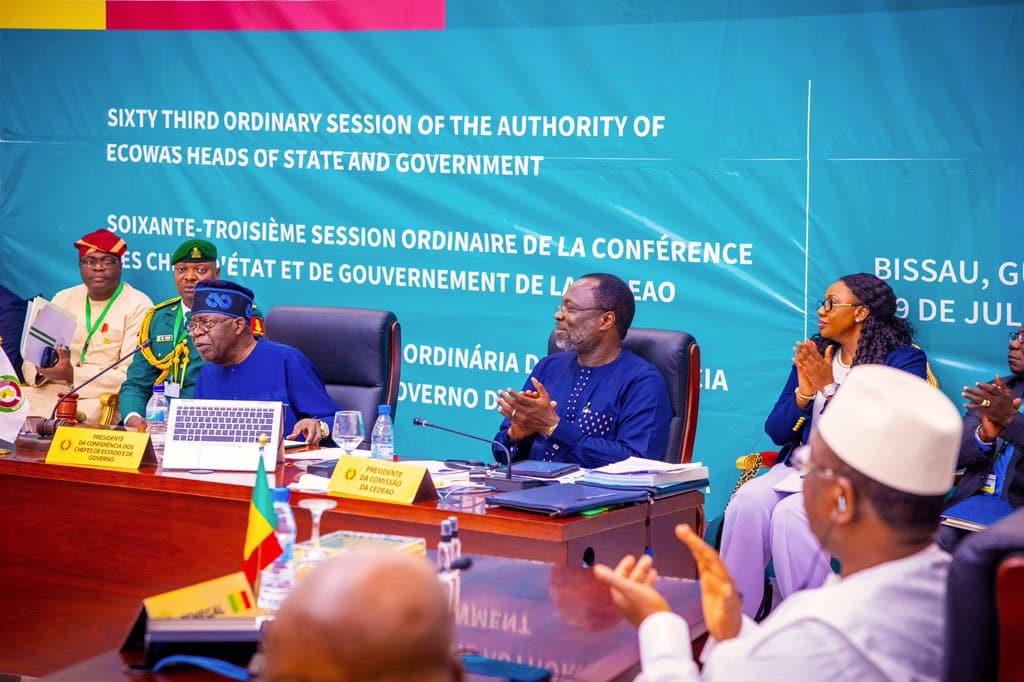
President Bola Ahmed Tinubu of Nigeria is now Chairman of the Economic Community of West African States (ECOWAS).
This was announced at the 63rd Ordinary Session of the Authority of Heads of State and Government of ECOWAS on July 9.
Tinubu takes over from President Umaro Embalo of Guinea Bissau as ECOWAS chair.
President Tinubu in his acceptance speech pledged to ensure democracy in African states that form part of ECOWAS.
“We will take democracy seriously. Democracy is very tough but it is the best form of government,” he said.
In a Twitter post, Tinubu described the development as a noteworthy affirmation of Nigeria’s continued leadership in the sub-region and the African continent.
I’m grateful to my distinguished colleagues for the honour of being elected as the Chairman of the Authority of Heads of State and Government of the Economic Community of West African States (ECOWAS) at the 63rd Ordinary Session that took place today in Bissau, Guinea-Bissau.… pic.twitter.com/o7uuqME2Kh
“As Chairman of the important coalition, I renew my dedication and that of our nation to the cause of peace and progress as we foster the collaboration and commitment required to tackle trans-border issues of security, economic growth and sustainable development,” he added.
Considered one of the pillars of the African Economic Community, ECOWAS was set up to foster the ideal of collective self-sufficiency for its member states namely Benin, Burkina Faso, Cabo Verde, Côte d’Ivoire, The Gambia, Ghana, Guinea, Guinea Bissau, Liberia, Mali, Niger, Nigeria, Sierra Leone, Sénégal and Togo.
Source: The Independent Ghana | Andy Ogbarmey-Tettey
Nigeria’s President Bola Tinubu has taken action to alleviate business costs in the country by ordering the suspension of certain taxes and duties.
One of the measures suspended is a newly introduced 10% tax on single-use plastics, including plastic containers and bottles.
This tax aimed to address Nigeria’s significant plastic pollution issue, as the country contributes around 2.5 million tonnes of plastic waste annually, some of which ends up in the ocean.
Additionally, the executive orders signed by President Tinubu suspended the implementation of a 5% telecoms tax that was initially proposed by the previous government.
Furthermore, an increase in car import duty and excise duty on specific locally manufactured goods was halted.
The intention behind these measures is to reduce business costs in Africa’s largest economy.
“As a listening leader, the president issued these orders to ameliorate the negative impacts of the tax adjustments on businesses and chokehold on households across affected sectors,” Alake told reporters.
Tinubu, who took office in May, has embarked on Nigeria’s boldest reform agenda in decades, including the removal of a popular petrol subsidy and restrictions on foreign exchange trading, as he seeks to boost sluggish growth.
There would be no further tax rises without wider consultations, Alake said, adding that Tinubu would pursue business-friendly policies.
On Tuesday, a group from the International Bank of America paid a visit to President Bola Tinubu at the State House in Abuja and praised him for the economic reforms he has already implemented.
The team, which was led by Mr. Bernard Mensah, President of the bank, expressed delight about the first actions taken by the new administration, which, according to him, was returning Nigeria to its proper position on the international stage.
Dele Alake, the President’s Special Adviser on Special Duties, Communications, and Strategy, who made this announcement in a statement on Tuesday, also cited the American bank as saying it was willing to help Nigeria address its short- and long-term challenges by providing ideas and financing, among other things.
Mensah said, “We’re excited about the initial direction of the government. We’re looking to see how we can help and partner. We have a lot of global resources that we think can help the Nigerian economy.
“We operate on such a global basis. We’re a huge international firm. We touch so many things. We think we can help think through the markets, the financial architecture and structure.”
Mensah asserted that the bank may also aid in considering new technological applications, the global conversation surrounding climate change, and how it might mobilize resources so that Nigeria can take a position on the global arena with regard to such concerns.
In his remarks, the Nigerian President said though his administration had been on the right track in the past over 30 days, it needed strategic help from international partners.
“We believe we are on the right track so far. We believe we need all the help we can get,” Tinubu told the delegation.
The President said Nigeria’s governance and development challenges could not be addressed without fiscal and institutional reforms.
He said, “21st-century actions on climate change, finance and innovation are intertwined.
“Having a good platform and believing in innovation will help in undertaking reforms and tackling the issues.
“This is the largest economy and democracy in Africa and if we cannot do it, nobody will do it for us,” Tinubu said.
He invited the International Bank of America and other willing financing institutions to help make sure that Nigerian gas competes favorably on the world market as a viable alternative revenue source by highlighting specific areas of support.
Wale Edun, the President’s Special Advisor on Monetary Policy, reported that topics covered during the meeting included the importance of financing and liquidity in advancing the economy as well as the critical function of technology in economic growth.
Mensah was accompanied on the trip by Mr. Chuba Ezenwa, Head of Investment Banking Sub-Saharan Africa, and Mrs. Yvonne Fasinro, Head of Sub-Saharan Africa, International Bank of America.
In a comprehensive overhaul, President Bola Ahmed Tinubu of Nigeria took decisive action on Monday by removing the country’s security chiefs and the head of police from their positions.
The defence chief, as well as the heads of the army, navy, and air force, were retired from their roles, making way for the appointment of new officers to assume these important positions.
An official statement said Mr Tinubu had “approved the immediate retirement of all service chiefs and the inspector-general of police, advisers, comptroller-general of customs from service … with immediate effect”.
In addition, Mr. Tinubu has taken the decision to dissolve the boards of all federal government institutions, although certain bodies such as the judicial council, electoral body, and police service commission have been exempted from this action.
These security changes come after Mr. Tinubu’s meeting with the security chiefs two weeks ago, during which he directed them to collaborate in addressing the various challenges posed by terrorism, insurgency, banditry, oil theft, and piracy.
Nigeria has been grappling with an alarming surge in attacks attributed to jihadist groups and other criminal organizations, particularly bandits who primarily engage in kidnapping for ransom.
During the previous administration, there were persistent demands from civil society groups for the replacement of the security chiefs due to their perceived inability to effectively address the situation.
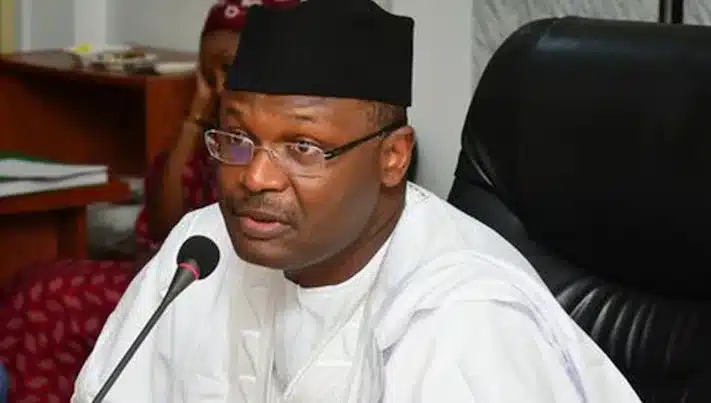
On Thursday, Prof. Mahmoud Yakubu, the Chairman of the Independent National Electoral Commission (INEC), is scheduled to appear before the Presidential Election Petition Court.
This information was disclosed by Chris Uche, SAN, the lead counsel representing Atiku Abubakar and the Peoples Democratic Party (PDP) in their ongoing petition.
The petition, registered as CA/PEPC/05/2023, challenges the outcome of the presidential election held on February 25, which declared President Bola Tinubu as the winner. The respondents in the case include the Independent National Electoral Commission (INEC), President Bola Tinubu, and the All Progressives Congress (APC).
During the hearing, Uche informed the court that the INEC chairman would testify about the conduct of the disputed presidential election. Uche also expressed his desire for the respondents, particularly Tinubu and the APC, to be prepared and not caught off guard.
Before Prof. Yakubu’s appearance, the petitioners presented their 19th witness, Alex Ter, who is a lawyer, politician, and the National Coordinator of the PDP’s National Situation Room.
However, Abubakar Mahmoud, SAN, representing INEC, objected when the witness was about to adopt multiple statements. Mahmoud argued that the petitioners’ reply on the additional statements was not pleaded in accordance with the provisions of the law. He requested the court to dismiss it and uphold the objection. Mahmoud also stated that their detailed reasons for the objections would be communicated during the final addresses.
In response, Uche, representing the petitioners, informed the court that the objections raised by INEC had been argued, and the ruling on them was reserved by the court.
“Whatever objection that INEC has should be kept aside, “ Uche said.
He therefore, urged the court to overrule the objection and allow the process go on.
He told the court that they are tendering Manual for the conduct of the 2023 election.
He said he will be tendering video clips of broadcast, by the chairman of INEC on the preparation for the election and that of Festus Okoye National Commissioner and Chairman of the Information and Voter Education Committee of INEC on the election.
The also said that he will be tendering European Union (EU) election observers mission broadcast alongside the transcripts and the certificates of authenticity of the three videos.
He said this was pursuant to Section 84 of the Evidence Act.
He also tendered INEC I-reV screen shots of the portal as of March 18 and March 19.
Also tendered was I-reV results portal at the pulling units of March 1 and the transcripts and certificates of authenticity.
INEC did not object but Tinubu and APC objected, but all the respondents reserved their responses until their final written addresses.
Under cross examination by INEC’s lawyer, Mahmoud, the witness admitted that he was not at the National Collation Center but was at the PDP situation room in the Federal Capital Territory (FCT).
He also admitted not being an ICT experts but that he based his report from information obtained from agents of the PDP at the collation centers.
The witness faulted INEC for not transmitting presidential election results electronically, adding that calculation errors led the electoral body into grave errors .
Also cross examined by Akin Olujimi SAN, counsel for Tinubu, the witness said that he came to the conclusion that the presidential election was invalid by reason of corrupt electoral practices as related to him by PDP agents.
Testifying as the petitioners ‘ 20th witness (PW20) was Olutunji Shelle.
He alleged during cross examination by INEC counsel that there were some secret pulling units set up by APC in Lagos.
He however said he did not visit any.
The News Agency of Nigeria (NAN) reports that the petitioners have called 20 witnesses so far out of 100 the told the court their would call.
Meanwhile, the five-man panel led by Justice Haruna Tsammani adjourned until tomorrow for further hearing of the petition.
President Bola Ahmed Tinubu of Nigeria has enacted a groundbreaking student loan bill, marking a significant milestone in the country.
The new law provides financial support to underprivileged students pursuing higher education.
This legislation enables local students enrolled in tertiary institutions, including universities, colleges, and polytechnics, to easily access interest-free loans from the Nigerian Education Loan Fund, covering their tuition fees.
I was pleased, today, to have signed into law, the Access to Higher Education Act which provides interest-free loans to deserving students across the country who wish to further their education in tertiary institutions.
In November, the Nigerian parliament approved the bill, which aimed to establish a national education bank responsible for offering loans to students. However, former President Muhammadu Buhari did not give his assent to the bill before leaving office on May 29. No official explanation was provided for his inaction.
The bill was initially introduced in 2016 by Femi Gbajabiamila, who served as the speaker of the House of Representatives and currently holds the position of Chief of Staff to President Tinubu.
He now says the “future of the country” is guaranteed, adding that “no Nigerian child [will] be denied access to tertiary education on account of lack of financial resources”.
Beneficiaries of the loan are expected to start repayment as soon as they gain employment, following the completion of their studies and mandatory national service.
Before now, banks in Nigeria could only grant student loans to parents of the students with very stringent conditions.
Some students have had to drop out or get odd jobs to pay their way through college.
Nigerian President Bola Tinubu has finally addressed the contentious issue of ending the fuel subsidy.
He broke his silence on the matter, which he initially announced as “gone” during his inauguration two weeks ago. The decision resulted in a rapid increase in petrol prices.
Speaking on Nigeria’s Democracy Day holiday, President Tinubu empathetically stated, “I feel your pain,” acknowledging the concerns of the citizens regarding the removal of the fuel subsidy.
In exchange for the ending of the subsidy, Tinubu promised that he would repay Nigerians “through massive investment in transportation infrastructure, education, regular power supply, healthcare and other public utilities that will improve the quality of lives”.
But he said that sacrifices must be made: “This is one decision we must bear to save our country from going under and take our resources away from the stranglehold of a few unpatriotic elements.”
The sudden announcement of the end of the fuel subsidy during President Bola Tinubu’s initial moments in power came as a surprise to many, despite expectations for its eventual termination.
For a significant number of Nigerians, the subsidy had been viewed as one of the few benefits provided by the state. However, it also placed a substantial burden on public finances, prompting the need for its cessation.
The occasion of Democracy Day holds special significance as it commemorates Chief Moshood Abiola, who was presumed to be the winner of the 1993 presidential election held on June 12. Regrettably, the military annulled the election, and this day serves as a tribute to his memory.
In his inaugural meeting with security and intelligence chiefs since assuming the presidency, Bola Ahmed Tinubu has pledged to implement reforms to address Nigeria’s pressing security challenges.
The country faces deep-rooted issues, including terrorism and an Islamist insurgency in the north-east, prevalent banditry and armed militias in the north-west and central regions, as well as separatist movements, oil theft, and sea piracy threatening the south.
Tinubu’s predecessor, Muhammadu Buhari, famously failed to fulfill his promise of defeating Islamist insurgents.
However, President Tinubu has made his determination clear to build upon any progress made, reverse setbacks, and shift the tide in favor of security and stability, according to national security adviser Babagana Monguno after their meeting in Abuja.
Tinubu emphasized the need for enhanced coordination, consultations, and timely reporting to foster better collaboration among security agencies.
During his inauguration on Monday, Tinubu also highlighted health, education, and infrastructure development as major priorities for his administration.
Nigeria’s new president’s first full day in office is seeing panic buying of fuel following an announcement to end a decades-long subsidy on petroleum goods.
In Monday’s inaugural address, Bola Tinubu said the subsidy was “gone”.
But gave no timeframe or any more details of this major policy move.
On Tuesday, his team clarified that he meant end of June and that the panic buying is “needless” as the policy will not take immediate effect.
President Tinubu wants to ease pressure on government finances, but ending the subsidy will increase the petrol price and impact other prices too at a time when inflation is already high.
In response to Monday’s statement, many filling stations hiked the petrol price while others stopped selling altogether.
Nigeria’s state-owned oil company, the sole importer of petroleum products, assured the public that it has enough supplies.
But this did not prevent the panic buying, with most people fearing a drastic rise in price of petrol which should be sold at the regulated price of 185 naira per litre (£0.32, $0.40).
Some people have posted videos online of filling stations already increasing prices, in some cases by more than 200%.
Some private bus drivers, which many Nigerians rely on to get around, have also been unable to fill up their vehicles. This has left people stranded at major bus stops in the capital, Abuja, and the country’s biggest city, Lagos.
Despite its oil wealth, Nigeria is unable to refine enough crude to meet local demands so it imports petroleum products, which are then sold at a government-set price.
But the subsidy is a huge drain on public finances. Last year it gulped 4.3trn naira ($9.3bn; £7.5bn) and for the first half of this year, 3.36trn naira was budgeted for it.
On Monday, Mr Tinubu said It could no longer be justified and that the funds would instead be spent on public infrastructure and to improve the lives of people.
But the subsidy has long been seen by many Nigerians as one of the few perks they receive from the state.
The last attempt to remove it in 2012 led to nationwide protests and then President Goodluck Jonathan had to perform a policy U-turn.
So far, a powerful association of those who sell petroleum products has come out to say it does not support President Tinubu’s plan. It said the new government should begin a dialogue before taking the decision.
The spokesman of the Independent Petroleum Marketers Association of Nigeria, Ukadike Chinedu, is quoted by Nigeria’s Punch newspaper as saying that the move will cause “galloping inflation and inflict more hardship on the masses”.
President Bola Tinubu was sworn in as Nigeria’s 16th president today Monday May 29 2023, amid colorful ceremonies and a joyous atmosphere at Eagle Square.
Tinubu, in his inaugural speech, touched on keynote policies and initiatives that will herald the start of his administration.
Here are seven major takeaways from the President’s speech.
Fuel subsidy is gone
TInubu, has reaffirmed that the era of fuel subsidy is gone.
He said, “We commend the decision of the outgoing administration in phasing out the petrol subsidy regime which has increasingly favoured the rich more than the poor. Subsidy can no longer justify its ever-increasing costs in the wake of drying resources.
“We shall instead re-channel the funds into better investment in public infrastructure, education, health care and jobs that will materially improve the lives of millions.
We’ll create jobs, prosperity for youth
The president emphasized that his administration must create meaningful opportunities for our youth, saying “We shall honour our campaign commitment of one million new jobs in the digital economy.
“Our government also shall work with the National Assembly to fashion an omnibus Jobs and Prosperity bill. This bill will give our administration the policy space to embark on labour-intensive infrastructural improvements, encourage light industry and provide improved social services for the poor, elderly and vulnerable,” he said.
We shall reform security doctrine
Tinubu noted that security shall be the top priority of his administration, because neither prosperity nor justice can prevail amidst insecurity and violence.
He said, “To effectively tackle this menace, we shall reform both our security DOCTRINE and its ARCHITECTURE.
“We shall invest more in our security personnel, and this means more than an increase in number. We shall provide, better training, equipment, pay and firepower.”
We’ll target higher GDP growth
On the economy, Tinubu said he will target a higher GDP growth and to significantly reduce unemployment.
“We intend to accomplish this by taking the following steps: First, budgetary reform stimulating the economy without engendering inflation will be instituted.
“Second, industrial policy will utilize the full range of fiscal measures to promote domestic manufacturing and lessen import dependency.
“Third, electricity will become more accessible and affordable to businesses and homes alike. Power generation should nearly double and transmission and distribution networks improved. We will encourage states to develop local sources as well.
“I have a message for our investors, local and foreign: our government shall review all their complaints about multiple taxation and various anti-investment inhibitions.
“We shall ensure that investors and foreign businesses repatriate their hard earned dividends and profits home,” he said.
We’ll create agricultural hubs across nation
Tinubu said rural incomes shall be secured by commodity exchange boards guaranteeing minimal prices for certain crops and animal products, adding that “A nationwide programme for storage and other facilities to reduce spoilage and waste will be undertaken.
“Agricultural hubs will be created throughout the nation to increase production and engage in value-added processing. The livestock sector will be introduced to best modern practices and steps taken to minimize the perennial conflict over land and water resources in this sector.
“Through these actions, food shall be made more abundant yet less costly. Farmers shall earn more while the average Nigerian pays less.”
Monetary policy needs thorough housecleaning
President Tinubu noted that the monetary policy needs thorough housecleaning, saying the Central Bank must work towards a unified exchange rate.
“This will direct funds away from arbitrage into meaningful investment in the plant, equipment and jobs that power the real economy.
“Interest rates need to be reduced to increase investment and consumer purchasing in ways that sustain the economy at a higher level.
“Whatever merits it had in concept, the currency swap was too harshly applied by the CBN given the number of unbanked Nigerians. The policy shall be reviewed. In the meantime, my administration will treat both currencies as legal tender,” he said.
Our foreign policy objective is peace, stability
Tinubu said, “Given the world in which we reside, please permit a few comments regarding foreign policy.
“The crisis in Sudan and the turn from democracy by several nations in our immediate neighbourhood are of pressing concern.
“As such, my primary foreign policy objective must be the peace and stability of the West African subregion and the African continent. We shall work with ECOWAS, the AU and willing partners in the international community to end extant conflicts and to resolve new ones.
“As we contain threats to peace, we shall also retool our foreign policy to more actively lead the regional and continental quest for collective prosperity.”
A chieftain of the All Progressives Congress (APC), James Faleke, says Bola Tinubu will unveil members of his cabinet within 60 days after his inauguration as Nigeria’s President on Monday.
The righthand man of the former Lagos State governor stated this on Monday morning in an exclusive interview with Channels Television at the Eagle Square, venue of the inauguration.
Asked whether Nigerians should expect Tinubu to unveil his cabinet as soon as possible, Faleke said, “Of course, within 60 days, that’s what the law says. He can announce anytime but I just know he must do it within 60 days.”
Many analysts had attributed the slow take-off of the Muhammadu Buhari administration to his late announcement of ministers. Buhari, who hands over to Tinubu after eight years, unveiled his cabinet six months after his inauguration in 2015. But Tinubu is expected to do things differently.
Asked whether he would like to serve in Tinubu’s cabinet, Faleke said it is the prerogative of the APC powerbroker to choose members of his cabinet.
Faleke, who was the All Progressives Congress (APC) Presidential Campaign Council Secretary and lawmaker representing Ikeja Federal Constituency in the House of Representatives, said some members of opposition parties are at the Eagle Square for Tinubu’s inauguration.
Former Lagos State Governor Asiwaju Bola Ahmed Tinubu was sworn in as Nigeria’s 16th President on Monday May 29, 2023.
The oath of office was administered by the Chief of Nigeria, CJN Olukayode Ariwoola at the ongoing inauguration ceremony at Eagles Square, Abuja.
Recall that Tinubu emerged Nigeria’s President-elect on the platform of the ruling APC following the outcome of February 25 presidential election after polling highest votes cast to defeat his closest rivals; former Vice President and candidate of the PDP, Atiku Abubakar and the Labour Party’s candidate, Peter Obi.
Following his oath of office, Tinubu has become the new President of the Federal Republic of Nigeria succeeding the two terms of eight years by former President Muhammadu Buhari.
On Sunday night, President-elect Asiwaju Bola Tinubu informed Nigerians that he applied to be President and that he would live up to expectations and deliver on his promises.
The President-elect said he would set Nigeria back on the path of growth, poverty, and policy inconsistency notwithstanding.
Asiwaju Tinubu spoke at the Inauguration Dinner/Gala Night, organized by the Presidential Transition Council (PTC), at the Old Banquet Hall, Presidential Villa, Abuja.
He that though there are many issues confronting the country, including corruption, poverty and policy inconsistency, none of them would be an excuse for nonperformance by his administration, saying there will be no excuses for failure.
According to him, “To the many Heads if State present here, our brothers and sisters, celebrating with us, I thank you, but I want to say clearly for us to take away, what lessons has Nigeria democracy taught the rest Africa, if not the whole world.
“Resilience, determination, courage, love in diversity, though our tongues and tribes differ. Byb tomorrow afternoon, my predecessor is heading to Daura, on the border with Niger, but I have told him not to worry, he will still get a knock on his door. No matter how short a man is, he will see the sky. I will still be able to find him when I need his help.
“Here is a country that has stumbled a number of times, but has never faltered. We can be squeaky like old mama’s car, but we will never break apart. We are just a unique country.
“We must fight corruption, poverty, inconsistencies in policies and many other problems confronting us, but don’t pity me, I asked for the job, I campaigned for it, no excuses, I will live up to the bill deliver. I promise you” he said.
In his speech, the outgoing President Muhammadu Buhari, thanked the dignitaries who have come to honour Nigeria, stressing that the success the country just achieved with the election, which produced the incoming set of leaders.
He said that the electoral process has given power back to the Nigerian electorate.
He said, “I congratulate fellow Nigerians who have realized their power that their votes count. I’m looking forward to tomorrow to fly to my base and go back to my cows and sheep, which are much easier to control than fellow Nigerians.
“Your Excellencies, Heads of States and Government, and their representatives that have come to share this day with us, distinguished ladies and gentlemen, I thank very much and I say good bye to you and wish us the best of luck”, he said.
Earlier, the First Lady, Aisha Buhari, in company of Tinubu, incoming First Lady, Senator Remi Tinubu, Vice President-elect, Kashim Shettima and his wife unveiled a book titled “Renewed hope, Greater together”.
Some of the world leaders seen at the colourful event included the Presidents of South Africa Sierra Leone, Ghana, Burundi, Liberia, Republic of Congo, Ethiopia, Central Africa Republic, Gabon, the Prime Minister of Morocco, Vice President of Venezuela and many more.
Ahead of the inauguration of President-elect Bola Tinubu, the presidential candidate of the Labour Party (LP) in the last election, Peter Obi, has urged his supporters and citizens in general to remain calm and law abiding, as only a court of law will determine the actual winner of the poll in due course.
Obi who spoke on the sidelines of an event in Kaduna State, where he said the unity, peace and security of the country is paramount than any other interest, and as such, he called on all citizens to be law abiding and work for the progress and development of the country.
“We must continue to live on the path of peace, religious harmony, ethnic harmony, coexistence, that is the most important thing for now.
“Let’s have a peaceful, quiet Nigeria where government will concentrate on caring for the sufferings of the people,” the LP flagbearer stated.
While noting that there are questions and issues with the last election, Obi, however, said citizens must have to live peacefully and be able to work and concentrate on facing the issues of Nigeria which is insecurity, poverty, education and other very important aspects of the nation’s existence.
Accompanied by his running mate, Senator Datti Baba-Ahmed, the Labour Party Presidential candidate also tasked the incoming administrations at all levels to deals with issues of high youth unemployment , poverty and insecurity especially in the Northern region, adding that such critical areas must be addressed by elected leaders if the country must achieve progress and development.
Many of the presidents from Africa other foreign dignitaries have settled in Nigeria for the inauguration of Bola Tinubu as the continent’s 16th president.
Movements around Eagle Square in Abuja, the venue of the handover and inauguration parade, have been restricted until Tuesday.
Local media say about 20 African leaders are expected in Abuja.
Rwanda’s President Paul Kagame, Cyril Ramaphosa of South Africa and Algerian President Abdelmadjid Tebboune are among leaders who arrived on Sunday.
Also in Abuja is the president of Tanzania, Samia Suluhu Hassan, the president of the Republic of Congo Brazzaville, Denis Sassou Nguesso, the president of Guinea Bissau, Umaro Sissoco Embaló and Sierra Leone’s President Julius Maada Bio.
The president of Burundi, Évariste Ndayishimiye, the transitional President of Chad Mahamat Déby, the president of Niger Republic, Mohamed Bazoum and President Nana Akufo-Ado of Ghana are also in Nigeria for the ceremony.
The prime cabinet secretary of Kenya, Musalia Mudavadi, will be representing President William Ruto.
A nine-member delegation from the US and Chinese officials led by a Communist Party senior member have also arrived for the event.
Mr Tinubu’s electoral victory is being challenged by opposition rivals.
On Tuesday, a tribunal will begin to hear the main arguments in the election petition.
Nigeria’s president-elect, Asiwaju Bola Ahmed Tinubu, has expressed readiness to kick start work ahead of the May 29th handing-over date.
The President-elect returned to Nigeria on Monday evening after about a month trip to Paris, France.
He was received by a mammoth crowd of enthusiastic associates and supporters who thronged the Presidential Wing of the Nnamdi Azikwe International Airport, Abuja where his plane touched down.
The President-elect was in the company of his wife, Senator Remi, and son, Seyi.
Among those at the airport to receive him were Vice President-elect Kashim Shettima, House of Representatives Speaker Femi Gbajabiamila, as well as Governors Simon Lalong (Plateau) and Abubakar Sani-Bello (Niger), former Borno State Governor Ali Modu Sheriff.
Also at the airport were former Chairman of the Economic and Financial Crimes Commission, Mallam Nuhu Ribadu, the All Progressives Congress, APC Deputy National Chairman, North, Senator Abubakar Kyari, Deputy National Chairman, South, Barrister Emma Enekwu, and National Woman Leader, Dr. Betta Edu.
There were also Senators Barau Jibril, Adeola Olamilekan Yahyi, Opeyemi Bamidele, Dayo Adeyeye, Sabi Abdullahi and Adelere Oriolowo as well as Secretary of the recently-dissolved Presidential Campaign Council, Hon. James Faleke, Hon. Babajimi Benson and Mr. Bayo Onanuga, Director of media and publicity in the dissolved Presidential Campaign Council.
Speaking to the tumultuous crowd who followed him home, the President-elect said: “I’m happy to be back. I have rested, I’m refreshed and I’m ready for the task ahead.
“Forget about what the rumour mill may have told you. I’m strong, very strong.”
Asked about about his plans for the country, he said he had been consulting and planning with a view to putting together a strong team so he could hit the ground running once he assumes office on May 29.
The President-elect left the country on March 21 for Paris on a vacation after a hectic campaign and election season.
Despite legal challenges to his victory, the president-elect of Nigeria, Bola Tinubu, will be sworn in on May 29, according to Lai Mohammed, the minister of information.
As outgoing President Muhammadu Buhari officially leaves office in May, groups angry over the results of the presidential election on February 25 are calling for an interim administration.
Mr Mohammed said there was “no basis” for the constitution of an interim government. He said the opposition political parties have the right to challenge the presidential election in court
Four presidential candidates filed legal challenges on 21 March against Mr Tinubu’s victory, alleging widespread rigging and manipulation of tallies.
It takes about eight months for the judiciary to determine a presidential election petition. The petition must be heard within 180 days from the day it is filed. A petitioner can appeal the tribunal’s judgement at the Court of Appeal within 21 days from the decision date.
If petitioners are dissatisfied with the appellate court’s decision, which is delivered within 60 days, they have 21 days to appeal it at the Supreme Court, whose decision is final.
President Akufo-Addo has asked Bola Ahmed Tinubu, the recently elected president ofNigeria, to strengthen the close ties that already exist between Ghana and Nigeria.
Mr Akufo-Addo in his congratulatory message to him said it is his expectation that the President-elect would continue in the stead of past Nigerian leaders..
In a tweet on Thursday, March 2, Mr Akufo-Addo said “On behalf of the Ghanaian people and their Government, I extend warm congratulations to the Presidential Candidate of the All Progressives Congress (APC), Bola Ahmed Tinubu, on his victory in the Nigerian presidential election of Saturday, 25th February.
“It is my expectation that the President-elect would continue in the stead of past Nigerian leaders, and deepen even further the strong friendship that exists between Nigeria and Ghana, which has been based on a shared agenda of freedom, development, security, progress and prosperity.
“Warm congratulations, once again, to President-elect Bola Ahmed Adekunle Tinubu, and to the people of Nigeria. Best wishes for his and Nigeria’s success.”
Warm congratulations, once again, to President-elect Bola Ahmed Adekunle Tinubu, and to the people of Nigeria. Best wishes for his and Nigeria’s success.
— Nana Akufo-Addo (@NAkufoAddo) March 2, 2023
Per the official results announced by the Independent Electoral Commission (INEC) the Mr Tinubu polled 8,794,726 votes – 36% of votes counted.
The former Lagos Governor beat his closest rivals Atiku Abubakar of the People’s Democratic Party (PDP) and Peter Obi of the Labour Party (LP).
In his address to the nation on Wednesday, March 1, he said “…No woman, no nation, they did everything possible – creative dancing, intelligent discussions, programmes of ideologies.”
The outgoing President of Nigeria, Muhammadu Buhari also said in a tweet on Wednesday morning, that his successor is the “best person for the job”.
The election was Africa’s largest democratic exercise. In a region that has undergone backsliding and military coups in recent years, this election demonstrates democracy’s continued relevance and capability to deliver for the people it serves.
— Muhammadu Buhari (@MBuhari) March 1, 2023
“I shall now work with him and his team to ensure an orderly handover of power.”
Nigeria’s President-elect, Bola Ahmed Adekunle Tinubu, is a Nigeria politician and a former governor of Lagos who is married to the pastor of Redeemed Christian Church of God (RCCG) and Senator, Oluremi Tinubu.
They got married in the year 1987 and have 6 children.
According to sources, Asiwaju had three children with different women before he got married to Oluremi.
His first three children are Jide Tinubu, Seyi Tinubu, and Shade Tinubu, while his kids with Remi are Zainab Abisola Tinubu, Habibat Tinubu, and Olayinka Tinubu.
According to information gathered by the local media, Bola Tinubu sadly, sadly lost his first child Mr Jide Tinubu in 2017. Therefore, he has 5 children as of May 2022 who are still alive.
Here are the names and details of his children:
OlaJide Tinubu (late)
Folashade Tinubu-Ojo
Seyi Tinubu
Zainab Abisola Tinubu
Habibat Tinubu
Olayinka Tinubu
Olajide Tinubu
Jide Tinubu is the first child and first son of Bola Tinubu whom he had with his alleged first wife. Jide was born on October 12, 1974 (some reports state his year of birth as 1980) and graduated from the University of Liverpool, England where he studied law. Before his death, he practised as a lawyer in Mobil and also spent the majority of his lifetime in London. There he lived with his wife and three sons.
Sadly, he died of cardiac arrest on October 31, 2017, at the age of 43. After his death, Tinubu his dad described him as a “highly intelligent person with a vibrant personality and a zest for life”.
Tinubu’s first son, Jide Tinubu (Late)
Folashade Tinubu-Ojo
Folashade Tinubu, is the second child and first daughter of Bola Tinubu. She graduated from Middlesex University in London with a degree in business administration. Folashade has served as the Iyaloja General of Lagos State since 2013. She has authority over all traders in the markets of Lagos, including the ability to collect taxes from them. Oyetunde Ojo, a former member of the House of Representatives, is currently married to Folashade Tinubu Ojo. The pair has two children together as of May 2022 who were both born through surrogacy.
Iyaloja Folashade Tinubu-Ojo
Seyi Tinubu
Seyi Tinubu is the third child and second son of Bola Tinubu. He was born on October 13, 1985, and is 36 years old as of May 2022. Seyi Tinubu’s mother is allegedly Prophetess Bunmi Oshonike. According to reports, Tinubu had an affair with Bunmi leading to Seyi’s birth.
Seyi Tinubu graduated from the University Of Buckingham where he bagged a degree in Law. Aside from being a lawyer, Seyi is an entrepreneur and also philanthropist. He is the CEO of Loatsad Promomedia LTD, an advertising agency. Seyi is also the founder of the Noella Foundation. His foundation is a non-profit organization that creates job opportunities for Nigerians.
In August 2016, Seyi Tinubu married Nigerian-Lebanese entrepreneur Layal Holm. They had a colourful wedding ceremony at Lake Como, Italy. As of May 2022, Seyi Tinubu and his wife Holm have 2 lovely children.
Meanwhile, Seyi Tinubu allegedly has another child with Freda Francis, a Nigerian socialite and businesswoman who is also known to be an ex-girlfriend of music artist Iyanya. In 2021, there were rumours that Seyi Tinubu had gotten Freda pregnant for the second time. There was also news that his wife Layal Holm left him because of this. However, the Loatsad CEO debunked the rumour.
Seyi Tinubu and wife, Layal Holm
Zainab Abisola Tinubu
Zainab Tinubu is Tinubu’s fourth child. However, she is the first child of Tinubu with his wife Oluremi Tinubu because the first three children were from Asiwaju’s past relationships. Information about Zainab is currently scarce because her parents like to keep her off the media.
Habibat Tinubu
Habitat Tinubu is Tinubu’s fifth child and last daughter. She is Tinubu’s second child from Senator Oluremi. The only information about Habibat that is public is that she is a graduate of music. She graduated from Berklee College of Music, Boston on May 11, 2013.
Olayinka Tinubu
Olayinka Tinubu is Tinubu’s last child and third child from Pastor Oluremi. However, there is no information about Olayinka that is available online apart from his name.
On Wednesday, All Progressive Congress (APC) members and die-hard xx of the newly elected president of the Country, Senator Ahmed Tinubu, trooped out to Osogbo, Osun state capital and in Iragbiji, his country home, to rejoice with him on his victory at the poll.
The president-elect lovers who trooped out in scores in Osogbo around 11.00 a.m of the day marched round some major streets like Oriolowo, Old- garage, and Olaiya junction of the town with wild jubilation to associate with his victory; they described as long-expected one.
Speaking with journalists, one of the triumphant, who identified herself as Adewumi Adesoji, told our reporter that, Tinubu is a tested and trusted politician who could whether all political hurdles and murders when the matter goes crucial in the political realm.
She described him as a man of people and a humanitarian politician that listens and provides for whoever is need.
Adewumi, however charged people in the state, irrespective of different political affiliations, to rally round and join hands with him to make the country more virile.
Head of the Independent National Electoral Commission, Mahmood Yakubu, has named Bola Tinubu the winner of the 2023 presidential election, March 1, 2023.
The national leader of the APC, Tinubu, won in 12 of the 36 states that make up the country. But in Lagos State, which he had ruled for eight years between 1999 and 2007, Obi crushed him.
In addition to this, the PDP’s Atiku won the election in Katsina. The second term of President Muhammadu Buhari, the head of his party, expires on May 29 this year, and he is from Katsina.
The states that the Jagaban Borgu prevailed in are Niger, Benue, Kogi, Zamfara, Jigawa, Oyo, Rivers, Ogun, Ondo, Kwara, Ekiti, and Borno.
“It’s my turn actually!” An ecstatic Bola Tinubu roared an hour after he was declared on Wednesday morning.
“I am profoundly humbled to serve as the 16th President of our beloved country. This is a shining moment in the life of any man and an affirmation of our democratic existence,”
“I take this opportunity to appeal to my fellow contestants to let us team up together. It is the only nation we have. It is one country and we must build together,” he said.
As they say, the road to success is often winding and challenging. This claim is made in reference to Tinubu’s climb to the presidency, which he has called his “long-life aspiration.”
The former governor of Lagos State faced fierce resistance from over 23 other candidates vying for the nomination and had to weather all storms to originally hold onto the party ticket in June 2022.
His political allies from the south-west region, such as Vice President Yemi Osinbajo, Governor Kayode Fayem of Ekiti State, Ajayi Borofice, Deputy Senate Leader Ibikunle Amosun, and former House Speaker Demiji Bankole, were featured in this.
Under the Social Democratic Party (SDP) banner, Tinubu was first and foremost elected to the Senate in 1992 to represent Lagos West. He also participated in the NADECO-based activists who advocated for the restoration of democracy.
In the first post-transition election for governor of Lagos State in 1999, Tinubu of the Alliance for Democracy defeated Dapo Sarumi of the Peoples Democratic Party and Architect Nosirudeen Kekere-Ekun of the All Peoples Party. In 2003, he won reelection, and he served until his resignation in 2007. One of Nigeria’s most powerful politicians, Tinubu continues to play a major role in politics in Lagos and other states, particularly in the South West.