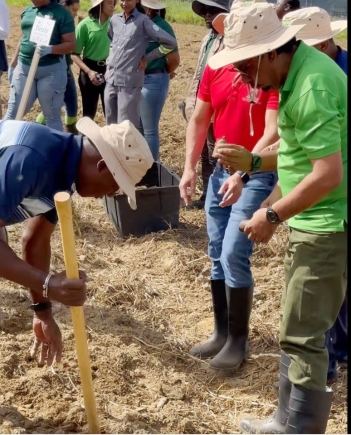
Trinidad and Tobago has taken a significant step toward strengthening its agricultural sector following the donation of 10,000 yam seeds from Ghana.
The initiative, which stems from Prime Minister Dr. Keith Rowley’s recent visit to the West African nation, is aimed at expanding local food production and reducing the country’s dependency on imported goods.
Speaking at the Tucker Valley Shade House in Chaguaramas, Dr. Rowley expressed optimism that the introduction of these new yam varieties would not only enhance local diets but also contribute to efforts to lower Trinidad and Tobago’s billion-dollar food import bill.
“We recently received as a gift from Dr. Mitchell at the Ghanaian authorities, 10,000 units of planting material of four varieties of yams, so we are introducing those varieties into Trinidad and Tobago now. I am particularly pleased this morning to associate my office and myself with this initiative, because I believe that it will have far-reaching contributions to something that we talk about a lot, and that is reducing our food import bill,” he stated.
Dr. Rowley emphasized that the success of this initiative depends largely on the willingness of citizens to incorporate locally grown produce into their diets rather than relying on imported foods.
“If you talk to anybody in this country about food import, they will tell you that this country imports too much of its food and we need to reduce our food import bill. But that objective can only be achieved in two ways: if we produce more food locally and if we consume what we produce,” he noted.
The Prime Minister reminisced about his upbringing in Tobago, where local produce played a central role in daily meals. He underscored the potential of these yams as a healthier and viable alternative to imported white potatoes.
“While I was in Ghana, I was able to sample a number of these white yams—smooth, soft, beautifully tasting white yams—which can replace the white potato that we import. You know we import a lot of what you call ‘Irish potatoes.’ It’s a white potato from Canada. That forms a huge part of our diet in very many ways.
“A lot of that can be replaced by yams, and the older ladies will tell you that just having boiled yam as part of the diet, associated with stews and vegetables and so on, had been a part of our diet which we have lost over time. So, we are aiming to put back on the table in Trinidad and Tobago tasty, healthy white yams.”
The four yam varieties will be planted across both Trinidad and Tobago, with the first harvest expected in six to nine months. Dr. Rowley revealed that planting has already begun in western Tobago, and additional planting will commence in Mason Hall in the coming weeks.
He explained that growing the yams in multiple locations would help determine the most suitable soil conditions for each variety, guiding future investment in large-scale cultivation.
“I really would like to see the output of these yams in the market of T&T, because it is only when we plant more and do so sensibly that we will be able to bring in new varieties. The ones that we’ve lost, we need to improve our gene pool by bringing in better gene quality as tested in other countries. We test them here, do our own research, come up with our own data, and choose our own varieties.
“So, when we do that, we can now encourage the farmers confidently to plant these varieties. And when we plant them, we could say to our national population, ‘Get to know these produce. They are good for you. They are good for the country.’”
The Prime Minister further emphasized that growing and consuming locally produced food is key to reducing food import costs and strengthening food security.
“We want to grow what we eat, and we’re asking you to eat what we grow. That is the only way that we can impact significantly this food import bill—by having more food grown locally and consuming what we grow. These yams are now in our hands. As we grow them, we won’t have to spend any foreign exchange on them. All we have to do is want to eat them.
“So, let’s look forward to the harvest, and let’s look forward to the main news that will come where slices of white yams obtained from Ghanaian diets, from Ghanaian fields, from our friends in Ghana, from the government and people of Ghana to the people of Trinidad and Tobago.”
The event was attended by several government officials, including Prime Minister-designate Stuart Young, Minister of Youth Development and National Service Foster Cummings, Minister of Agriculture, Land and Fisheries Kazim Hosein, and Minister in the Ministry of Agriculture Avinash Singh.