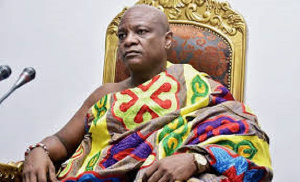
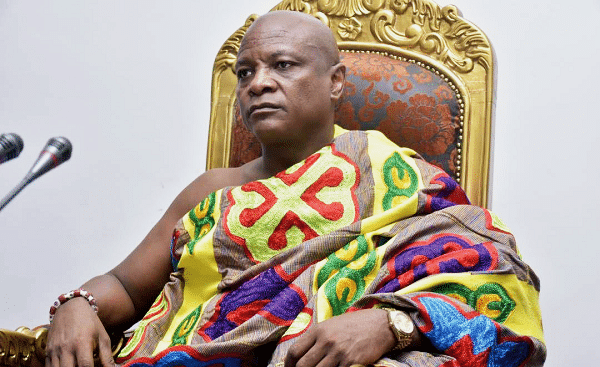
Agbogbomefia of the Asogli State, Togbe Afede XIV, has called on the Electoral Commission (EC) to ensure a transparent and credible election in the upcoming general polls.
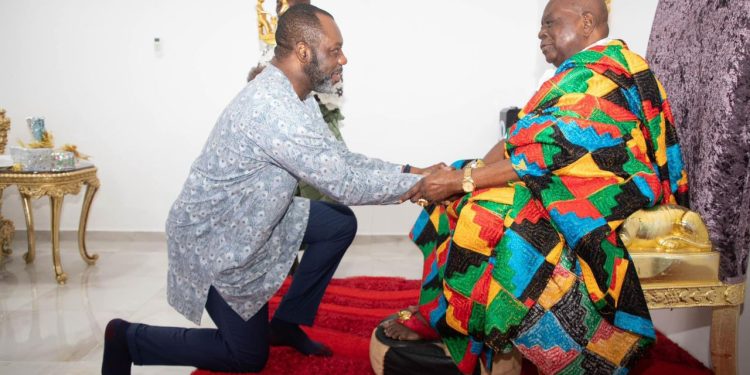
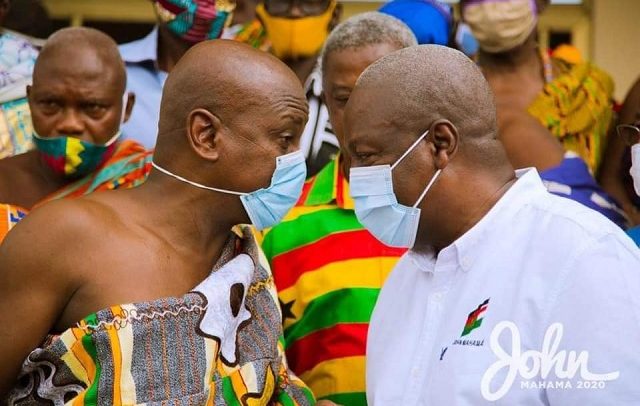
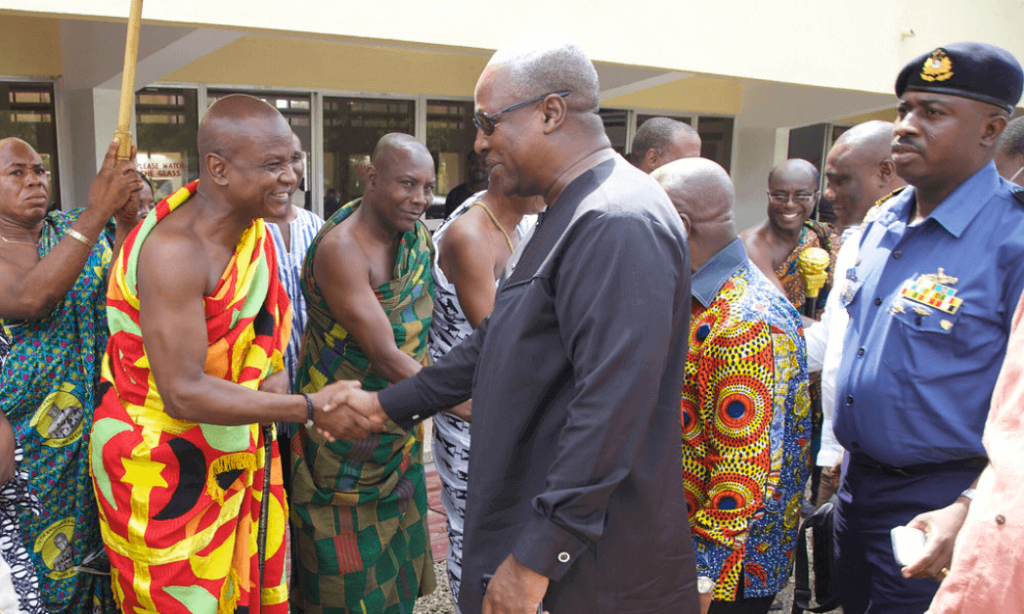
Speaking at his palace on Tuesday, 13 August 2024, during a courtesy visit from the NDC’s flagbearer, John Dramani Mahama, Togbe Afede emphasized the need for the EC to uphold the integrity of the electoral process.
“I want to ask that the Electoral Commission commits itself to doing its best for our country to ensure that we have free and fair elections so that the peace that has defined us as Ghanaians over the years and our enviable peaceful environment can be sustained into the future because that is very important for our development,” Togbe Afede stated.
The paramount chief also expressed concerns over corruption, the politicization of public institutions, and the state of the economy.
He urged presidential aspirants to be truthful and prioritize the well-being of all citizens, regardless of political affiliations.
“Politicians should aim at giving an opportunity to everyone and not just their factions,” he added.
In response, John Dramani Mahama lauded the NDC’s track record in national development and assured that his government would continue to invest in the future of Ghana if given the mandate in December.
Togbe Afede XIV, the Agbogbomefia of the Asogli State, has revealed that recent events in the past few years have led him to revisit his earlier skepticism regarding the legitimacy of the ‘Agyapadie’ document.
Speaking at a durbar held to welcome former President Mahama and his campaign team, Togbe Afede shared experiences where both he and his businesses came under targeted actions, prompting him to reevaluate the authenticity of the document.
“I found it difficult to believe that, that was a genuine document but of course, certain things we go through gave us thoughts to the contrary. I recall that in 2019 thereabouts, we received a letter for us to sign, pre-written in our names, to resign from the group of companies that advises the government on its bond issues. That came as a shock.”
“When I reflect on some of these things,” the overlord said, “I begin to wonder,” he stated.
I thought the AGYAPADIE akyem sakawa mafias state capture document was fake until I carefully reflected on what happened to SAS and my other companies – Togbe Aƒede XIV, Agbogbomefia. AGYAPADE3 is real, @GabbyDarko and his small Clans are the beneficiaries that’s why he’s doing… pic.twitter.com/ai9YVymwEV
The controversial 38-page document titled ‘Agyapadie,’ which prominently features the Okyenhene, Osagyefo Amoatia Ofori Panin, alongside President Nana Akufo-Addo and his late father, has resurfaced, reigniting discussions about its contents.
The document, whose author remains unidentified, is believed to outline strategies for a particular family or clan to establish significant influence and control over key sectors of Ghanaian society, including the economy, politics, media, judiciary, telecommunications, and banking.
Here are three actions that were projected to happen in the document that have materialised.
SSNIT and Kofi Bosompem Osafo Maafo
The Agyapadie document predicted that the son of the Senior Presidential Advisor, Yaw Osafo-Maafo, would find his way into the Social Security and National Insurance Trust (SSNIT) to aid entry into Ecobank.
“ii. Ecobank: We have two routes of entry into this institution. First is through SSNIT, which has a seat on the Board of Ecobank Ghana by virtue of its shareholding. That seat is occupied by the Director General of SSNIT. In Phase 2 of our agenda, Kofi Bosompem Osafo Maafo, who is a Deputy Director General of SSNIT, should be made the DG to give him the seat on the Ecobank (Ghana) Board,” the document stated.
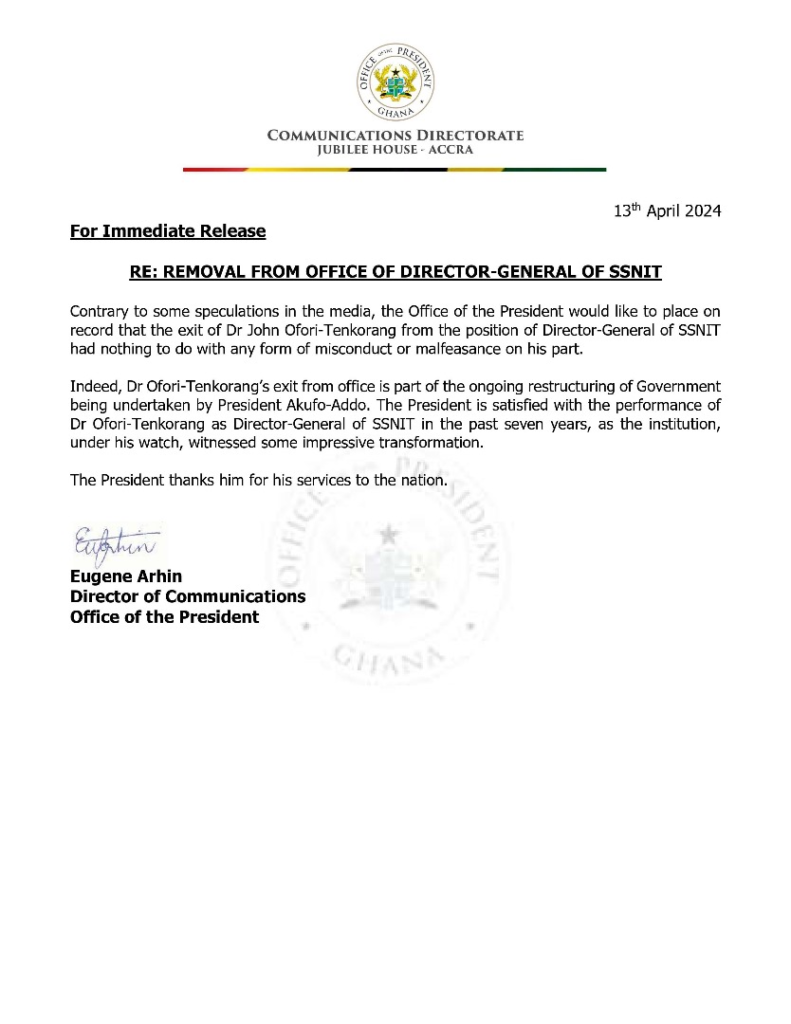
In April 2024, President Akufo-Addo appointed Kofi Osafo-Maafo, the son of Osafo-Maafo, as the new Director-General of the Social Security and National Insurance Trust (SSNIT), following seven years of serving as Deputy Director-General.
He replaced Dr. Ofori-Tenkorang. In a statement released on Saturday, April 13, Eugene Arhin, the Director of Communications at the Presidency, explained that Dr. Ofori-Tenkorang’s dismissal was not a result of misconduct or malfeasance.
The Presidency asserted that Dr. Ofori-Tenkorang’s departure is part of the ongoing restructuring initiated by President Akufo-Addo.
Kofi Osafo-Maafo assumed responsibilities on Monday, April 15, 2024.
Bawumia to succeed Akufo-Addo
While stressing the need to intensify Databank’s presence as a government adviser on financial transactions, the ‘Agyapadie’ document made mention of the succession of Vice President Dr Mahamudu Bawumia in the New Patriotic Party (NPP).
The document noted that the role of Databank would be to generate the needed funds to aid the succession plan.
“Biological Children: Databank is a household name in the financial industry. It is our beloved child in the industry. Its presence as government adviser on financial transactions is to be intensified, including knobbing interested foreign companies to partner with Databank on such issues. In furtherance of this end, all major government financial transactions are to be executed in the first two years of Nana’s 2nd term. This will bring in the needed funds to fight the battle to install Bawumia as part of the succession plan to the advantage of Bawumia,” the document stated.
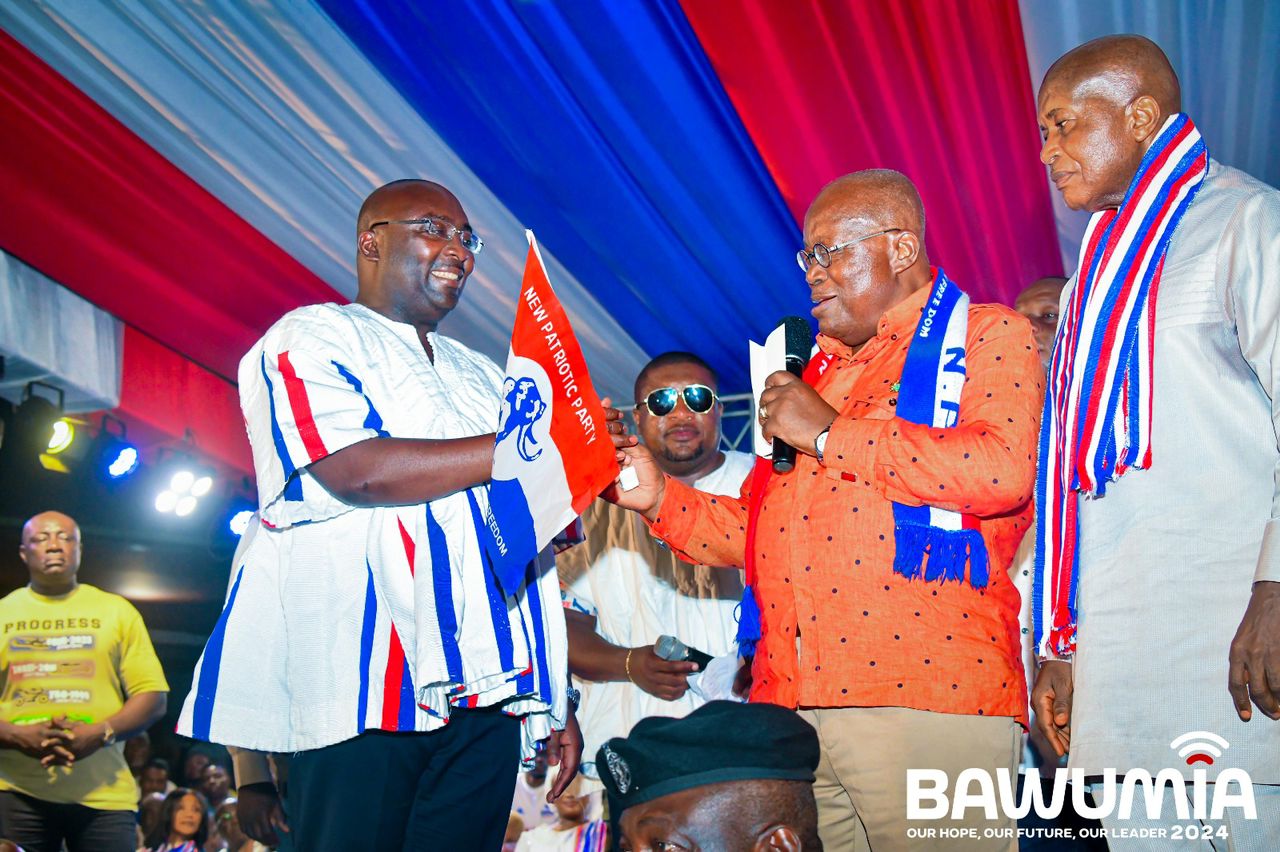
On Saturday, November 4, 2023, Vice President Dr Mahamudu Bawumia was declared winner by the Electoral Commission at the Accra Sports Stadium, as the flagbearer of the New Patriotic Party after his contenders, Honourable Kennedy Ohene Agyapong (Assin Central Member of Parliament) polled 71,996 votes, representing 37.41%, Dr. Owusu Afriyie Akoto (former Minister for Agriculture) polled 1,459 votes, representing 0.76% and Honourable Francis Addai-Nimoh (former Member of Parliament of Mampong) polled 781 votes, representing 0.41%.
Vice President Dr. Mahamudu Bawumia won the 2023 Presidential Primaries with 118,210 votes, representing 61.47% of the total valid votes cast.
Following Dr Bawumia’s victory, Alan Kyerematen, one of the contenders resigned from the party.
Mr Kyerematen lamented that the New Patriotic Party has gone through an unhealthy transition in recent years and has been hijacked by some selected party leaders of which he can no longer be a part.
“I have devoted the best part of my professional career to serving the Party, and I still believe in the vision of the founding fathers of the Party. However, the NPP as it exists now has very little resemblance to the Party that I joined in 1992 and helped to nurture. The Party has been hijacked by a selected group of Party leaders and elders, government appointees, “behind the curtain power brokers” and some unscrupulous Party apparatchiks.”
Introduction of Kelni GVG
The ‘Agyapadie’ document alleged that the New Patriotic Party (NPP) doesn’t have much foothold in the telecommunication sector, and as such will have the “successful planting of Kelni GVG into the telecom sector” to give “unparalleled advantage in terms of having a view of activity flow within the sector and the ability to monitor communication of persons of our choosing.”
The document further adds, “The intelligence gathering power allows us to target and eliminate any potential threat from within the NPP; particularly those not inherently loyal to our cause and Nana’s, which include members of the opposition NDC.”
“Our sister in charge of the ministry responsible for this sector is doing remarkably well especially her confrontations with MTN Ghana resulting in administrative measures aimed at curtailing the business of MTN. From 2021, legislation will need to be introduced to breakup the business of MTN using national security and anti-trust reasons as justification. Our loyal allies will then be enabled to occupy the spaces to be ceded by MTN. such entry will yield significant strategic advantages over our competitors.”
In May this year, investigative journalist Manasseh Azure Awuni expressed concerns over the contract awarded to NextGen InfraCo Ltd. for the 5G network rollout.
In a Facebook post on Thursday, May 30, Awuni highlighted that the company was incorporated barely a week before President Akufo-Addo granted executive approval for the deal.
Awuni pointed out that the contract, estimated to be worth hundreds of millions of dollars, was awarded through sole sourcing, without giving other companies the opportunity to bid for the project. This lack of competitive bidding raises suspicions about the transparency and fairness of the procurement process, according to Awuni.
Before these claims, the government had announced a partnership with seven industry leaders to develop a new shared infrastructure aimed at delivering affordable 5G mobile broadband services across Ghana. The partners, including Ascend Digital, K-NET, Radisys, Nokia, Tech Mahindra, and two telecommunications companies – AT Ghana and Telecel Ghana, have formed the Next-Gen Infrastructure Company (NGIC), which has been awarded a 5G license.
Communications and Digitalisation Minister Ursula Owusu-Ekuful has confirmed that NextGen InfraCo, the company awarded the contract for the rollout of the 5G network, was established just one week before receiving the contract.
Madam Owusu-Ekuful clarified that the company was specifically created for this purpose because there was no existing neutral infrastructure company capable of handling the rollout at that time.
During a press briefing on the 5G rollout, she elaborated on the government’s reasoning behind this decision. She noted that auctioning the contract was not pursued due to previous experiences and setbacks that had hindered the rollout of the country’s 4G technology, which has achieved only a 15% nationwide penetration since its introduction in 2015.
The Minister highlighted that the challenges faced during the 4G rollout influenced the government’s approach to the 5G deployment. By directly awarding the contract to a newly created entity, the government aims to avoid similar obstacles and expedite the implementation process for the 5G network.
The Member of Parliament for Ablekuma West provided insight into the government’s strategic decision-making process, emphasizing the need for a dedicated infrastructure company to ensure the successful and timely rollout of 5G technology across the country.
“This is a special purpose vehicle and once the government took the decision that we will use a neutral infrastructure company to deliver this service, there is no existing neutral infrastructure company that can deliver it at the moment.”
“So, it had to be specifically formed for the purpose of delivering this service based on the strategic policies and decisions of the government, and it is borne out of our experiences and that is why we chose not to auction it,” she stated.
The ‘Agyapadie’ document has gotten many Ghanaians concerned, especially after some of its predictions have materialised.
A leading member of the governing New Patriotic Party (NPP), Dr Arthur Kennedy, has expressed difficulty in accepting that the ‘Agyapadie’ document is fictitious and holds no relationship with Ghana’s present situation.
He noted that when he came into contact with the document some years ago, he dismissed it but can no longer do so since recent happenings cannot be left to coincidence.
“I would have agreed with the president a year ago……but the problem is as time has gone on there are things in the document that have gone on so if it was indeed a fake document, whoever has prepared the document has very good prophetic skills because a lot of the things they are predicting are coming true. So it is very difficult to see these things that are coming true,” he said in an interview on TV3.
On August 1, 2024, President Akufo-Addo addressed growing speculation about the document, which is purported to be a strategic plan of the Akyem faction within the ruling New Patriotic Party (NPP).
The president and the government New Patriotic Party (NPP) have dismissed the document as a fabrication, attributing its circulation to political adversaries aiming to discredit the party and its affiliates.
The Okyenhene, Osagyefo Amoatia Ofori Panin, has also denounced the document as a baseless creation by those intent on sowing discord and inciting animosity towards the Ofori Panin family and the Okyeman community.
Agbogbomefia of the Asogli State,Togbe Afede XIV, has praised NDC flagbearer John Mahama for his ambitious 24-hour economy policy and his commitment to reviving Ghana’s economy and addressing youth issues.
He noted that the former President’s proposed 24-hour economy could be a key solution to restoring the nation’s struggling economy, generating jobs, and boosting foreign exchange through increased exports, particularly in the manufacturing sector.
Togbe Afede shared these remarks when Mr. Mahama, along with his delegation, paid him a courtesy visit in Ho during the NDC’s campaign tour of the Volta Region.
“Let me congratulate you, first of all on your 24-hour economy policy. As someone who believes in hard work, I believe this is what we need. It is obvious that the application of this policy in the manufacturing sector can indeed be a game changer”, he said.
He indicated that machinery in the manufacturing sector is designed to keep running 24 hours to maximize profit and hence must be used as such.
He said the 24-hour Economy Policy would help Ghana expand its production capacity to benefit from the African Continental Free Trade Area Agreement (AfCFTA), which seeks to promote intra-trade on the African continent.
“It has been established that we are far behind those countries currently in the pilot phase as far as export to our counterparts are concerned.
“I am aware that Nigeria actually launched an ambitious $50 billion program to expand production and, therefore, export to Africa, taking advantage of AfCFTA.
“So I think your policy is a sure way of making us ready to also export to other African countries and of course by so doing expand employment. The factory which just runs for 8 hours, one shift, decides to do 3 shifts”, he said.
He further indicated the proposed 24-hour policy would reduce the cost of production and promote competition adding that “so I think it is a great policy and it deserves all of our support.”
The esteemed traditional leader praised the NDC Flagbearer, John Mahama, for his commitment to engaging the youth in decision-making across all levels of government, recognizing the importance of empowering the next generation.
Togbe Afede also expressed support for Mahama’s plan to reassess the payment of ex-gratia to Article 17 officeholders.
Additionally, he congratulated Mahama on his recent exoneration in the Airbus scandal, acknowledging the significance of this development.
“I want to wish you, on behalf of all of our people, success in all your endeavours as you tour the length and breadth of our region. Thank you very much for coming”, he concluded.
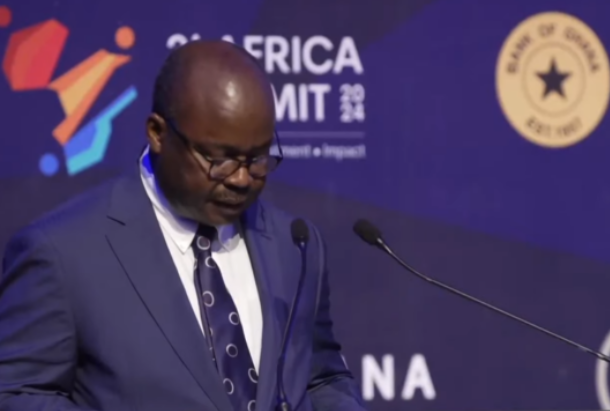
Bank of Ghana (BoG) has denied allegations of profiting from elevated interest rates.
In a statement released on its official X account, formerly Twitter, the Central Bank clarified that the increased interest rates actually escalate the expenses related to open market operations, ultimately leading to financial losses for the bank.
“Bank of Ghana does not benefit from high interest rates. On the contrary, high interest rates raise the cost of open market operations and lead to central bank losses.
But it is a necessary price to pay to bring down inflation,” the Bank of Ghana said on May 18, 2024.
This reaction follows criticism from businessman and the Agbogbomefia of the Asogli State, Togbe Afede XIV, who accused the Bank of Ghana of unfairly benefiting from its policy of maintaining high interest rates, as outlined in an opinion piece.
Togbe Afede XIV expressed concerns that these interest rates, which he deemed as “unnecessarily high,” could exacerbate challenges faced by the local currency if appropriate actions are not taken to address the issue.
He further warned that the performance of the cedi is likely to suffer from ripple effects on the prices of goods and services, consequently impacting the overall cost of living.
“The truth is, all these variables are related. While the policy rate is an important tool of monetary policy, its misuse, as in our case, can have damaging effects.
As long as interest rates are kept unnecessarily high, our currency, the cedi, will continue to suffer adverse consequences, with pass-through effects on other prices, including transport fares, utility tariffs, and fuel prices.
Persistent cedi depreciation has been a key factor in our energy (including power) sector problems. We have always felt the need to adjust prices, not because consumers were not paying enough, but because the cedi has been depreciating,” Togbe Afede XIV wrote.
He added, “BOG concluded that their monetary policy rate decision underscores their commitment to balancing economic stability amid persistent ‘inflationary risks’ and supporting the sustainable growth of the economy.
The Agbogbomefia of the Asogli State, Togbe Afede XIV, has criticized the Bank of Ghana (BoG) for its decision to uphold a high monetary rate.
He expressed skepticism about the justifications provided by the central bank for maintaining the recent high monetary policy.
On March 25, 2024, the Monetary Policy Committee (MPC) of the Bank of Ghana opted to retain the policy rate at 29%, citing ongoing upward risks to inflation.
In response, Togbe Afede asserted that the nation’s struggle to achieve and sustain low inflation is attributable to factors on the supply side rather than the demand side.
“BOG’s ‘mopping up excess liquidity’ explanation for its high monetary policy rate is not convincing. ‘Excess liquidity’ presumes a certain optimal liquidity that has still not been defined. Secondly, supply-side rather than demand-side factors are at the root of our inability to achieve sustained low inflation.”
“Thirdly, it is difficult to persuade people to save when they are struggling to make ends meet,” Togbe Afede explained.
Togbe Afede, formerly a board member of the Central Bank of Ghana from 2003 to 2013, raised concerns about the International Monetary Fund’s (IMF) persistence with high-interest rates that have proven ineffective for Ghana over nearly two decades.
“It is surprising, therefore, that the IMF insists on these high-interest rates that have not worked for us, the reason why we are engaging them for the seventeenth (17th) time!” he pointed out in a statement.
Togbe Afede XIV, the Agbogbomefia of the Asogli State, has expressed concern about the impact of the Bank of Ghana’s (BoG) high interest rates on the stability of the Ghanaian cedi.
He emphasized that as long as interest rates remained “unnecessarily high,” the Ghanaian cedi would continue to face detrimental consequences.
The BoG recently highlighted forecasts indicating a potentially elevated trajectory, citing factors such as potential adjustments in transport fares, utility tariffs, and higher fuel prices. The Central Bank stated that these factors collectively contribute to economic pressures and could influence the country’s financial landscape.
In a piece dated April 11, 2024, Togbe Afede XIV expressed his belief that the stability of the cedi would significantly affect other prices, including transport fares, utility tariffs, and fuel prices. He underscored the interconnectedness of various economic variables and the repercussions of interest rate policies on overall economic stability.
According to the respected chief, the persistence of unnecessarily high interest rates exacerbates the challenges faced by the cedi, amplifying its vulnerability to adverse consequences. Togbe Afede XIV urged the central bank to take proactive measures and reassess its approach to interest rate management to mitigate the negative impacts on the currency’s stability.
“The truth is, all these variables are related. Whilst the policy rate is an important tool of monetary policy, its misuse, as in our case, can have damaging effects. As long as interest rates are kept unnecessarily high, our currency, the cedi, will continue to suffer adverse consequences, with pass-through effects on other prices, including transport fares, utility tariffs and fuel prices.”
“Persistent cedi depreciation has been a key factor in our energy (including power) sector problems. We have always felt the need to adjust prices, not because consumers were not paying enough, but because the cedi has been depreciating,” he said.
Currently, there has been a surge in demand for the dollar and other major foreign currencies, leading to a sharp depreciation in recent times. The dollar is currently trading at about GH¢14.50 to one US dollar and GH¢18.00 to one British pound in the retail market.
The Awomefia of Anlo State, Togbe Sri III, offered his support to Energy Minister Dr. Matthew Opoku Prempeh, urging him to remain focused on his commendable work for the nation during a courtesy visit to his palace in Anloga on Wednesday, May 8th, 2024.
Expressing delight at seeing the Energy Minister, whom he referred to as his son, Togbe Sri encouraged Dr. Prempeh to make regular visits to his palace and continue his diligent efforts that have defined his tenure in public office.
“I fully support you and urge you to maintain your focus. Greater things lie ahead, so don’t let anything distract you,” the Awomefia advised Dr. Opoku Prempeh.
“I am solidly behind you and I want you to keep being focused. What is ahead of you is greater and so do not be distracted by anything,” the Awomefia told Dr. Opoku Prempeh.
Dr. Prempeh, in turn, acknowledged the longstanding relationship between himself and Togbe Sri, which motivated his visit. He also reminisced about the strong bond between his grandfather, the Asantehene, and Togbe Sri, which prompted a previous visit by the Asantehene to the Awomefia.
The discussions further revolved around the enduring collaboration between the government and traditional leadership in Ghana, emphasizing a mutual commitment to inclusivity, dialogue, and development.
“I have enormous confidence in Ghana’s future, where the political class and traditional authorities work together harmoniously for the advancement of the growth and prosperity of the people,” Dr. Prempeh said.
Togbe Afede voiced his astonishment at the motives behind the protest, highlighting the substantial infrastructural advancements achieved during his tenure.
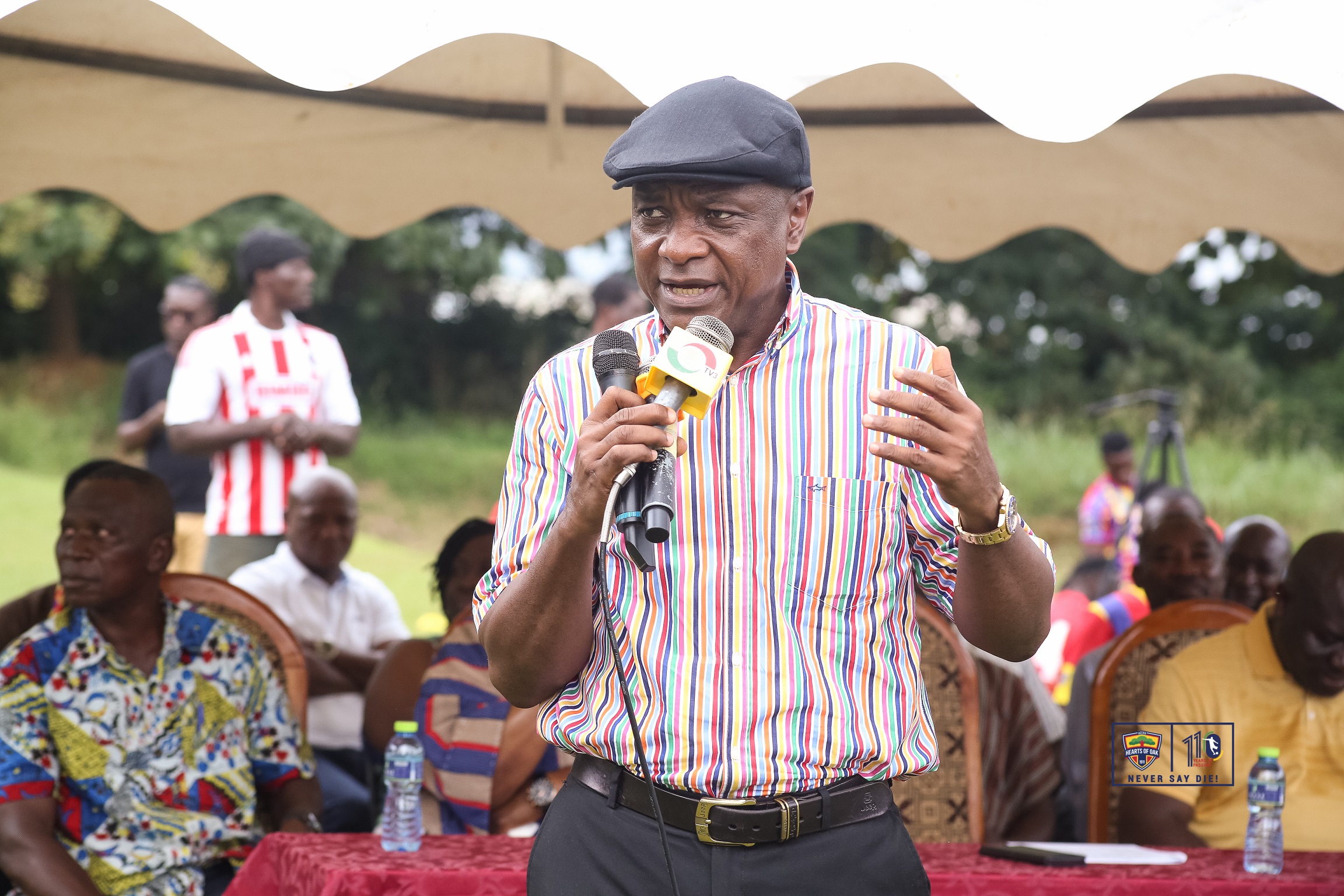
Speaking after touring the club’s Phobia House on Tuesday, he said, “Yes, I heard that some people were going on demonstrations yesterday and I asked myself, ‘what do they want?What do they want?’
“What do they want that we haven’t done? We’ve done everything. After all this, the only thing that Hearts doesn’t have is a stadium.
“We are streets ahead of all our counterparts. I would even say that we will come out as one of the very best in the whole of the subregion,” he added.
Togbe’s off-field work is showing in his over a decade in charge of the club but the results are not forthcoming on the field.
The club has won just one league title and two FA Cups.
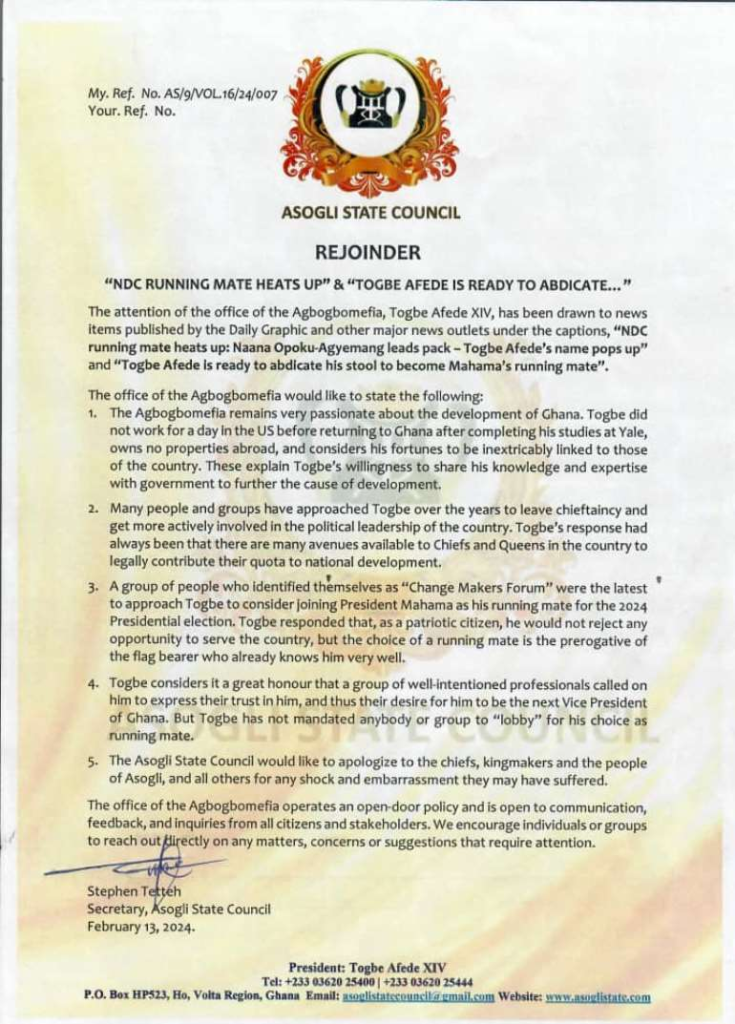
The Agbogbomefia of the Asogli State, has stated on behalf of Togbe Afede that he has not instructed anyone to engage in lobbying activities on his behalf with the aim of securing the position of vice president to John Mahama.
It was revealed in a statement that a group under the umbrella name “Change Makers Forum” visited Togbe and pleaded with him to consider partnering with John Mahama in the upcoming general elections.
Even though he considers it a great honour, the Asogli State Council clarified that he did not give them the go ahead to “lobby” for his choice as running mate.
“As a patriotic citizen, he would not reject any opportunity to serve the country, but the choice of a running mate is the prerogative of the flag bearer who already knows him very well. Togbe considers it a great honour that a group of well-intentioned professionals called on him to express their trust in him, and thus their desire for him to be the next Vice President of Ghana.But Togbe has not mandated anybody or group to “lobby” for his choice as running mate”, stated Mr. Tetteh” the Asogli State Council clarified in a statement.
The council, therefore, rendered an unqualified apology to all and sundry who may have been taken by surprise and embarrassed learning of the skewed news.
“The Asogli State Council would like to apologise to the chiefs, kingmakers and the people of Asogli, and all others for any shock and embarrassment they may have suffered.
“The office of the Agbogbomefia operates an open-door policy and is open to communication, feedback, and inquiries from all citizens and stakeholders. We encourage individuals or groups to reach out directly on any matters, concerns or suggestions that require attention”, it concluded.
The Agbogbomefia of the Asogli State, has stated on behalf of Togbe Afede, that the decision to appoint Togbe Afede as a running mate to John Mahama is entirely within the authority of the flagbearer of the National Democratic Congress (NDC).
This comes after the council revealed that a group of people who identified themselves as “Change Makers Forum” approached Togbe to consider joining President Mahama as his running mate for the 2024 Presidential election and went further to lobby on his behalf.
But the Asogli State council said Togbe Afede cannot influence Mahama to make him his running mate because “the choice of a running mate is the prerogative of the flag bearer who already knows him very well.”
Meanwhile, The council, has rendered an unqualified apology to all and sundry who may have been taken by surprise and embarrassed learning of the skewed news.
“The Asogli State Council would like to apologise to the chiefs, kingmakers and the people of Asogli, and all others for any shock and embarrassment they may have suffered.
“The office of the Agbogbomefia operates an open-door policy and is open to communication, feedback, and inquiries from all citizens and stakeholders. We encourage individuals or groups to reach out directly on any matters, concerns or suggestions that require attention”, it concluded.
The Asogli State Council has emphatically denied allegations suggesting that Togbe Afede XIV, the Agbogbomefia of Asogli, has directed individuals to lobby for his selection as the running mate of National Democratic Congress (NDC) flagbearer, John Dramani Mahama.
In a statement released on Tuesday, the Asogli State Council clarified that Togbe Afede XIV, while willing to serve Ghana in any capacity, has not instructed any person or group to advocate for his candidacy as the running mate.
The statement is in response to recent reports linking Togbe Afede to the possibility of being John Mahama’s running mate for the 2024 Presidential election.
The Asogli State explained that a group known as the “Change Makers Forum” recently approached Togbe Afede to consider joining President Mahama as his running mate.
According to the Council, Togbe Afede responded that the choice of a running mate is the prerogative of the flag bearer, and he would not reject any opportunity to serve the country.
The statement clarified that Togbe Afede did not mandate anyone or any group to lobby for his selection as a running mate.
The Asogli State Council apologized for any shock and embarrassment caused to the chiefs, kingmakers, the people of Asogli, and others.
“But Togbe has not mandated anybody or group to “lobby” for his choice as running mate,” it added.
It also emphasized the open-door policy of the Agbogbomefia’s office, encouraging direct communication on matters, concerns, or suggestions requiring attention.
“The office of the Agbogbomefia operates an open-door policy and is open to communication, feedback, and inquiries from all citizens and stakeholders. We encourage individuals or groups to reach out directly on any matters, concerns or suggestions that require attention,” it added.
Togbe Afede XIV, the Agbogbomefia of Asogli State, is reportedly prepared to step down from his traditional stool to assume the role of the running mate for the flagbearer of the National Democratic Congress (NDC), John Dramani Mahama, according to sources.
Ivan Tsidi Akrobortu, a lead advocate for the Change Makers Forum, is reported to have made this claim.
According to a report by Ghanaweb, citing graphic.com.gh, Togbe Afede XIV’s name has emerged as a potential contender to partner with John Dramani Mahama for the upcoming 2024 elections.
Tsidi Akrobortu, as reported, has advocated for the selection of the Agbogbomefia as Mahama’s running mate, citing Togbe Afede’s extensive expertise in finance, economy, banking, and entrepreneurship.
Mr Akrobortu believes that Togbe Afede’s inclusion would greatly impact the National Democratic Congress (NDC) and enhance their prospects of winning the election.
“Togbe is ready to abdicate his stool in fulfilment of the constitutional requirement once he is selected as the running mate to the NDC flag bearer,” Akrobortu is quoted to have said by graphic.com.gh, according to Ghanaweb.
The selection of a running mate for John Dramani Mahama in the upcoming 2024 elections is a crucial decision for the National Democratic Congress (NDC). According to reports, the party is seeking a candidate who possesses the ability to understand the president’s mindset, offer honest feedback based on data and facts, and effectively analyze government policies.
Togbe Afede meets Mahama
The pool of potential candidates has reportedly been narrowed down to three individuals representing different regions: Professor Naana Jane Opoku-Agyemang from the Central Region, Julius Debrah from the Eastern Region, and Kwame Awuah-Darko from the Ashanti Region.
Professor Naana Jane Opoku-Agyemang previously served as Mahama’s running mate in the December 2020 general election. However, she faced criticism for allegedly not adding value to the ticket and failing to secure victory in her home region of the Central Region.
Julius Debrah, a former chief of staff during Mahama’s administration, is being considered as another potential candidate. Hailing from the Eastern Region, Debrah brings a wealth of experience from his time in government.
Kwame Awuah-Darko, a former Managing Director of BOST and TOR under the Mahama administration, is also under consideration. Known for his contributions to the transformation of these institutions, Awuah-Darko is a businessman and banker with roots in the Ashanti Region, where he hails from a prominent traditional family.
The selection of Mahama’s running mate will be a strategic decision for the NDC, as they aim to bolster their chances in the upcoming elections and present a strong and cohesive leadership team to the electorate.
Agbogbomefia of the Asogli State has lashed out at Ghana’s past and present leaders over the sorry state of the country.
He said the country has failed because of Ghana’s corrupt, despicable, etc. leaders.
“The Ghana we have today is obviously not what our founding fathers dreamt of”, the Paramount Chief of Asogli state, Togbe Afede XIV, has lamented.
“We have failed woefully but have pretended otherwise,” he emphasised.
He contended that instead of giving hope, Ghana’s leaders have created a frightening sense of helplessness among the populace, especially the youth.
Referring to a statement he made during a courtesy visit by the Speaker of Parliament in December 2021, he reiterated his concern that if Ghana were a company, it would have filed for bankruptcy.
He pointed to the nation’s recourse to the IMF for a bailout and the implementation of the Domestic Debt Exchange Programme (DDEP), resulting in defaulting on debts, causing substantial losses for government bondholders, and painting a gloomy economic outlook.
In his view, the nation has been brought to the brink by “despicably dishonest, corrupt, reckless, arrogant, and divisive leadership”.
He says Ghanaians are also victims of bad fiscal and monetary policies.
Thankfully, he attributed the nation’s relative peace and stability to the resilience and patience of Ghanaians, and prayed that it remains so.
Hearts of Oak’s Executive Board Chairman, Togbe Afede XIV, has expressed disappointment with the National Sports Authority’s (NSA) decision to suspend football activities at the Accra Sports Stadium in December to accommodate concerts.
The directive led clubs such as Hearts of Oak, Accra Lions, and Great Olympics to temporarily relocate from the Accra Sports Stadium.
Togbe Afede XIV voiced his dissatisfaction with the decision, questioning the rationale behind such an initiative.
“Somebody wakes up and suddenly closes up a sports stadium for a concert. What kind of reasoning is this?” Togbe Afede quizzed.
“When you raise the money to maintain the stadium for what event? Sports or more concerts. What is the logic here? But we sit down and not complain. Why are we afraid of the truth?
“Personally, it stinks and makes me ashamed that a stadium can be closed in favor of a concert while the Ghana Premier League is in action.”
As a result of the closure, both Hearts and Olympics have shifted their home games to the Baba Yara Stadium, while Accra Lions have chosen the WAFA Park in Sogakope as their temporary home venue.
Agbogbomefia of the Asogli state, Togbe Afede XIV, has strongly criticized the government of Nana Akufo-Addo in his latest publication titled “Our Self-Inflicted Monumental Economic Crisis.”
Togbe Afede XIV expressed dismay in his book about what he perceives as the arbitrary implementation of policies under the Akufo-Addo government, attributing it to the current economic challenges in Ghana.
The traditional ruler particularly voiced concerns about corruption and the extravagant lifestyle in the country. He highlighted that despite Ghana being a poor country, the government continues to spend beyond its means, leading to excessive borrowing to finance its expenditure.
“We are poor, earn so little, but spend the way even the most affluent countries would not on things which are not necessary.… quite obviously, not much thought or planning appear to have gone into some of the choices we made. We all were witnesses to the rushed introduction of the Single Spine Salary Structure and the Free SHS Programme and the sudden and reckless cancellation of road tolls without adequate planning. Many other programmes have been decided without any idea where the required resources would come from. And very soon, our small country will be boasting of three international airports while our internal road network remains very poor.
“We also set targets without detailed roadmaps defining required actions, their timing, and their effects as was the case with the E-levy, which failed to bring in the expected revenues. All these, combined with corruption, made budget shortfalls and excessive borrowing inevitable,” part of the book reads.
The chief also criticized the government’s commitment to proceeding with the construction of the National Cathedral of Ghana, citing the challenges the country is currently facing.
“When Houphet Boigny built the 18,000 capacity Basilica of Our Lady of Peace, in Yamousokro in 1990, 32 years ago, Ghanaians mocked at him. Little did we know that decades later, we will be attempting to outdo him with our own National Cathedral,” he wrote.
Togbe Afede XIV, the Agbogbomefia of Asogli, has emphasised the importance of any new political administration seriously considering a comprehensive review of Ghana’s Constitution.
The constitutional review process in Ghana received significant support during the late Professor Mills’ administration. During this time, a committee was established, which produced a substantial 900-page report.
Unfortunately, this report has remained untouched since Professor Mills’ untimely passing.
Speaking at the grand durbar of the 2023 Asogli Yam Festival, Togbe Afede highlighted his concerns regarding the existing Constitution.
He pointed out that the current Constitution has granted an excessive concentration of power, which has created a significant imbalance.
Consequently, he believes that it is essential to revisit and revise the Constitution.
The Agbogbomefia also drew attention to how this over-centralization of power within the presidency has negatively impacted the nation’s efforts to combat corruption.
“Our 1992 Constitution is not helping the fight against corruption. It has given too much power to the president and until it is changed, we will not see the needed development.
“I admonish that our next government, just like Attah Mills did, take the review of our Constitution seriously.”
He spoke of weakening state institutions, including the security services and the judiciary, as constitutional powers continued to suffer abuse.
Togbe Afede reiterated the call for unity and the leadership of the nation to eschew corruption and place the interests of the people above themselves to be able to transform their fortunes.
“If Ghana is all we have and we have to continue to shine as a bearer of peace, then we all must come together”.
The Agbogbomefia, who is also marking two decades of reign this year, said he held fast to the two most important goals of his leadership: to bring development to the community and to keep the state united.
Togbe Afede noted that his leadership impacted the community and said, although not yet a major economic hub, the ongoing development attests to commendable progress.
“We have tried so hard to bring development to Volta and I am extremely proud of how far Ho has come,” he stated, and said stakeholders should address bad roads and others in the region.
Togbe Afede said jobs for the youth remained a major area of focus and was reassured of plans to establish a “Ghana Aviation Training Academy” in the coming months to help fill the needs.
The festival was held on the theme “20 Years of Selfless and Inspiring Leadership,” and Oseadeayor Agyeman Badu, the Dormaahene, who was a special guest of honour, commended Togbe Afede for leading a new generation of outspoken traditional leaders.
He urged everyone to remain committed to holding politicians accountable, ensuring that the nation’s resources benefit everyone rather than just a select few.
Chiefs representing the Asante Kingdom conveyed their congratulations from Otumfour to Togbe Afede, emphasising that other chiefs should follow his example and speak out for the betterment of society.
Numerous dignitaries, including political leaders and diplomatic figures, extended their best wishes to Togbe Afede on his anniversary.
The grand durbar marked the conclusion of a three-week celebration that included various activities. Notable among them were the observance of an anti-corruption day, a summit gathering Ewe Chiefs from West Africa, and a women’s day celebration.
The ban on funerals in the municipality, in effect throughout this period, is scheduled to be lifted in the coming week.
The Agbogbomefia of Asogli State, Togbe Afede XIV, has urged all African leaders to work together to reap the benefits of the African Continental Free Trade Agreement (AfCFTA).
He stated that the continent’s unity is required for the free trade zone to reach its full potential.
Togbe Afede XIV stated during the Made in Ghana Awards night on September 30, 2023, that “AfCFTA needs the unity of this continent to realise its dream so even if we can’t come together politically, we can do so economically to harness the full benefit of the agreement.”
The AfCFTA, a cornerstone of Agenda 2063, represents an ambitious trade agreement with broad-ranging coverage, encompassing vital aspects of Africa’s economy, including digital trade and investment protection, among other key areas.
Its primary aim is to remove trade barriers across the African continent, with the goal of substantially enhancing intra-African trade, particularly in value-added production and across all sectors of the African economy.
Launched in January 2021, the AfCFTA stands as the world’s largest free trade area, spanning 55 African nations, boasting a collective population of 1.3 billion people, and a combined Gross Domestic Product (GDP) exceeding $3.4 trillion.
This initiative is anticipated to fortify African economies, rendering them more resilient in the face of internal and external economic shocks.
The Asogli State would this year, mark two decades of the reign of Togbe Afede XIV, its Agbogbomefia.
Togbe Afede was installed in the year 1993, and this year’s Te Za, Yam Festival is being designed to celebrate him, a renowned entrepreneur who is among the nation’s most reputed traditional leaders.
The annual festival has gathered steam in recent years and has become a popular event on summer calendars with visual enchantments deep sated in colourful tradition and culture.
The Agbogbomefia, speaking at a recent coronation of new leaders for the State, made mention of the festival, and said it would continue to be a canvas for the promotion of African traditional culture and wealth.
He noted the growing reputation of Asogli which he said must be enhanced by the chiefs and the people.
“Doors are opening for Asogli because of our growing reputation, and we need to uphold it,” Togbe Afede said.
Steven Tetteh, Secretary to the State, told the GNA preparations were underway and that a media launch within the coming weeks would officially commence the festival.
Highlights of the glamorous event include the hailing of the new yam; a traditional ceremony at sundown that brings out the entire community in a street-clogging procession and is one that natives in the diaspora hardly miss.
The grand durbar has also become a popular event drawing the attendance of many political and non-political leaders, and also corporate organisations far and near.
The State Secretary told the GNA how Togbe Afede’s ascension to the throne had cemented the festival as a platform for unifying Asogli for development, and that the planning committee was on the task of delivering a more impacting event this year.
Last year’s festival, which was a return from a two-year coronavirus induced break, made waves with a series of events including an anti-corruption day celebration, a youth forum, and a conference of traditional leaders of Ewe communities in West Africa.
The GNA has caught wind of the lineup for the 2023 event, among which would be the launch of a foundation, and the usual blend of activities to promote the tourism-endowed Region.
Togbe Afede is expected to officially unveil a “Volta City” project, miniature design of which has been teasing visitors to the Asogli Palace since the last event.
The ambitious project would include hundreds of housing units on a serenading landscape somewhere in the Volta Region.
About six weeks ago I was in New York, and for the first time in almost three decades, I struggled to sell the economic credentials of my country. When we were approaching the runway at Kotoka International Airport, at the end of my return journey, I looked outside from my window seat, and my joy about a safe return, as often, turned into sadness – the sharp contrast to what one sees when approaching the runway of the international airport of an average modern city was distressing. I asked myself, why?
Any hope of accelerating our development is now dimmed by our current economic crisis, the result of a monumental failure of leadership. I saw it coming when after only three months in office, the government rushed to raise USD2.25billion from a single source. I thought the interest rate, 19.75%, was punitive, and the redemption premium was protective of the term (duration) of the bond. I saw tell-tale signs of recklessness and I advised a more critical look at proposals from the Ministry of Finance.
Our economy is in a mess and the growing frustration and sense of helplessness among the youth is frightening. I am worried about the greed-inspired, divisive and acrimonious politics which is at the root of all this. What has become of all the love we shared as one people? How I wish we all are committed to building the Ghana that was the dream of our founding fathers.
I know what suffering is like, so I’m worried for my “fellow Ghanaians”. That is why, once again, I want to share my thoughts on our development challenges. Much of what I have to say, I have said before and are common knowledge. But there are certain things that can never be overemphasized, and there is often the compelling need to repeat what may seem obvious.
Our vulnerabilities
The COVID-19 pandemic has been a great challenge, and so has been meningitis in northern Ghana, and Ebola in some parts of Africa. These and other tragedies have exposed the vulnerability of the black race and the imperative need for our leaders to think about what we can do to further the cause of development in Africa. Here in Ghana, we seem to have missed the opportunity to strengthen our peace and unity, which are vital for development.
Our current economic challenges predate COVID and, of course, the ongoing war in Ukraine. We shall survive all of these, but we must remember always that survival is not the same as prosperity. The truth is that our people are suffering.
Our resource endowments
We are lucky, just like many other African countries, to be endowed with so much, the most important being our human resource – young and growing population. Our country, and the rest of the continent, have more than our fair share of the world’s natural resources.
About 30% of all known mineral resources are found in Africa; we have 20% of the world’s landmass and 60% of uncultivated arable land; and we have 17% of the population. Yet we account for only about 3% of global output, GDP, and a similar share of world trade. According to the International Energy Agency, Africa has 60% of the world’s best solar resources, but only 1% of solar generation capacity.
Ghana, with its fertile land, gold, diamond, bauxite, manganese, oil and gas, etc., is much better endowed than the average African country. So, the potential for development is great.
The dream of our founding fathers and the 1992 constitution
Development that provides the necessities of food, shelter, water, health, education, electricity, roads, jobs and incomes, thus good living standards, and ultimately, happiness, is the minimum that Ghanaians desire, and indeed, deserve.
Not only did the founding fathers of our nation recognise this, but they also believed that we could work for the desired development. That was what inspired the demand for independence and the proclamation that “the black man is capable of managing his own affairs”.
They also believed that we need a free, just, and democratic society in order to develop to our full potential, hence the choice of the motto, Freedom and Justice, to inspire commitment to these most basic requirements of democracy.
The framers of the 1992 Constitution underscored the need for development by providing in Article 36 (1), under The Directive Principles of State Policy, that “The State shall take all necessary action to ensure that the national economy is managed in such a manner as to maximize the rate of economic development and to secure the maximum welfare, freedom and happiness of every person in Ghana and to provide adequate means of livelihood and suitable employment and public assistance to the needy”.
The importance of individual initiative and the private sector are also recognised through the provision in Article 36 (2) (b) that “The State shall, in particular, take all necessary steps to establish a sound and healthy economy whose underlying principles shall include affording ample opportunity for individual initiative and creativity in economic activities and fostering an enabling environment for a pronounced role of the private sector in the economy”.
Happiness is the essence of life, and it is important for unity, peace, stability and for continuing development. So, without guaranteeing the freedom of every individual to pursue happiness, no nation can develop to its full potential. Thus, peace, development, prosperity and happiness for all were in the minds of our founding fathers and the framers of the 1992 Constitution.
The reality of the state of affairs
The truth is that we have failed, woefully, to achieve the ideals of the 1992 Constitution, and the vision of our founding fathers – a nation that is able to provide, under indigenous leadership, the basic necessities to all its people and ensure their happiness. We have pretended for too long.
I consider poverty in Ghana a paradox because of our enormous resource endowments – we are hungry in the midst of plenty; thirsty, while standing in the middle of the stream; and beaten by the rain, while holding our umbrellas down.
Notwithstanding all our endowments, we are now a highly indebted, bankrupt, poor country. From 35% of GDP a few years ago, our debt-to-GDP ratio is projected to balloon to 104% by year-end, 2022. We are now faced with questions about debt sustainability and our ability to find the fiscal space to fund urgent and critical development needs. Now, the fears about Ghana defaulting on its debt repayment have effectively materialised with the announcement of a domestic Debt Exchange Programme. And we are making a mockery of ourselves talking “no haircuts” when that is exactly the effect of reduction in promised coupon payments.
Holders of Ghana Government bonds have already seen the value of their investments plummet. Holders of domestic bonds have been worse. The real losses they suffered comprised of the discounts on the nominal values of their investments and the loss of value in dollar terms because of cedi depreciation.
Even more alarming is the fact that we have piled on so much debt and yet we still lack basic socio-economic infrastructure – we could not fix our roads, provide the hospitals that our people need, or schools for our kids, with many still taking lessons under trees.
Making matters worse are the galloping inflation, currency depreciation and the frightening unemployment rate. Inflation, which has been on the rise since December 2021, stood at 40.4% in October 2022. Over the same one-year period, the dollar went up (gained) 141%, from average GHS6 in October 2021 to GHS14.47, equivalent to 58.53% cedi depreciation.
Even though denied, there have been signs of a nation in crisis everywhere you turned – unsustainable indebtedness and threats of default, deteriorating socio-economic infrastructure, turmoil in the markets, and growing joblessness among our youth. So much to do, yet no jobs! And now, business failures are threatening more job losses. We have failed miserably and have fallen far behind our neighbours.
Consequences of failure
The consequences of these failures have been mass suffering and growing frustration, leading Ghanaians to leave the country in droves in search for greener pastures, preferring xenophobic isolation abroad to the stifling conditions at home. The suicide rate has been rising, and so has been the crime rate, with dire implications for our peace and security.
Over the last two years, hundreds of experienced medical professionals, trained at the expense of the state, have left Ghana for care-home jobs in the United Kingdom. By the way, the government itself is facilitating the exit of our nurses to countries that have relatively more.
As I said in September 2021, during a courtesy call by the Speaker of Parliament, Ghana would have filed for bankruptcy if it were a company. This is effectively what we have done by going back to the IMF, and with the Debt Exchange Programme.
How did we get here?
Understanding our difficulties is the first step in the search for solutions. Our chaotic economic situation is the product of a toxic mix of, among others, our dishonesty; partisanship, cronyism and tribalism; greed-fuelled corruption; lack of proper planning, and the consequent episodic approach to economic management; and bad monetary policy that has indexed our future to the past. The situation is worsened by our attitudes and beliefs, and by a constitution that has outlived its usefulness.
Respect for the truth, and the rule of law
Whilst we project ourselves as very religious, we have little respect for the truth. People are not ashamed to invoke the name of God to back the lies they tell, destroying whatever is left that is good in our value system. The way people shamelessly defend wrongdoing is worrying.
Today in Ghana, one is confused as to what the truth is, depending so much on who is talking. Some have become so self-centred that even an obviously wrong action is the best so long as they benefit from it.
Such dishonesty has undermined the principles of fairness, equality before the law, and our democracy, and has adversely impacted our peace, unity, stability and development. Truth and accountability are the foundations of democracy and development. That is why the most developed countries are the ones where the law works.
Even in managing our current crisis, we have not been served with the truth about the government’s intentions.
Divisive, tribal, winner-takes-all politics
Today, everything is seen through political lenses. The anti-nation, winner-takes-all brand of politics has politicised development, granting of tax and duty waivers, award of contracts, and appointments, even recruitment into the security services. It is shocking that even some aspirants to the Presidency shamelessly advocate for the exclusion of non-party members in the award of contracts and jobs, promising same when elected to power. So, the wrong people get the contracts, and the wrong people get the appointments. The result has been pervasive mediocrity.
Whether it is about development projects, fighting corruption, dispensation of justice, fighting Galamsey or dealing with the consequences of COVID-19, parochial political objectives have taken precedence over national interest. This has been the major factor in our acrimonious and divisive politics.
Indeed, some of our people have a false sense of ownership and entitlement and have become so accustomed to privilege that exclusivity is bad unless they are the beneficiaries. Discrimination has stifled hard work, initiative, and creativity, and has prevented the country from benefitting from all the skills and talents available.
Our constitution advocates a system that is all-inclusive and provides opportunities for all. But we do not have a model or formula for the allocation of the nation’s resources, for example, to ensure equity. Politics has become an end, losing its development objective. Our leaders have shown more commitment to remaining in power than to the development of the country.
Greed, corruption, transparency and accountability
Ghana Integrity Initiative estimated that Ghana “loses close to USD3billion to corruption annually”. There is no doubt that our budget deficit would have been narrower, and we probably would not need to borrow from external sources, if honesty and prudence had guided our spending.
The resort to single sourcing or limited tender in the award of contracts, under false certificates of urgency, has been harmful. It has allowed a few to deploy foul means to secure contracts for relatives and cronies at inflated prices that hurt everybody. While some exploit “urgency”, other officials hide under “confidentiality” to appropriate our limited resources into personal wealth.
Lack of accountability has allowed a few people, with predatory and parasitic tendencies, some of whom come into leadership or public service with the objective of enriching themselves, to profit at the expense of the majority.
Corruption has been stifling and disruptive. Some of our leaders suddenly become businessmen. They obstruct genuine entrepreneurs, frustrate them, or steal their ideas. Their methods stifle initiative and hurt the growth of the private sector. They deprive the country of development by syphoning money that could have built the roads, schools, and hospitals, and are the main reason why our economy is in such a deplorable state.
But corruption is not limited to the public sector. It is pervasive and has undermined productivity in both the public and private sectors because corrupt officials do not achieve much on the job. They spend most of their time plotting to take from the pie, instead of increasing its size. I liken them to termites at the woodwork, eating at the very foundations of our development.
Greed and the fight for control of resources has bred so much partisanship that political opponents are seen as enemies, even when the public posture is different. Our educated elite have replaced the colonialists in a more painful new scramble for our resources, raping our country mercilessly
As someone wrote in a comment on a news article, “Corruption was not in the news in Gold Coast, but corruption has flooded the news in independent Ghana”. We have succeeded in making a once clean Ghana another word for corruption”.
Too many transactions and projects have raised eyebrows recently. These include the payment of judgement debts, the proposed Agyapa deal, the failed PDS transaction, the National Cathedral, and the sale of state lands.
Fiscal policy, planning, priorities and waste
The management of our economy has been poor. We have over the years talked about the structural defects in our economy, with regards to foreign domination, over-reliance on imports and our inability to add value to our exports. We have not been able to implement any viable strategies to correct these defects.
And, quite obviously, not a lot of thought or planning appear to have gone into some of the choices we made. We all were witnesses to the rushed introduction of the Single Spine Salary Structure and the Free SHS Programme and the sudden and reckless cancellation of road tolls without adequate planning. Many other programmes have been decided without any idea where the required resources would come from. And very soon, our small country will be boasting three international airports while our internal road network is very poor.
We also set targets without detailed roadmaps defining required actions, their timing, and their effects as was the case with the E-levy, which failed to bring in the expected revenues. All these, combined with corruption, made budget shortfalls and excessive borrowing inevitable.
We are poor, earn so little, but spend the way even the most affluent countries would not on things which are not necessary. When Houphet Boigny built the 18,000 capacity Basilica of Our Lady of Peace, in Yamousokro in 1990, 32 years ago, Ghanaians mocked at him. Little did we know that decades later, we will be attempting to outdo him with our own National Cathedral.
The large increase in the number of ministries and appointees in 2017 was, invariably a waste, because it did not make any impact, let alone produce the promised outcomes. Political motivations dictated reckless increases in the size of our parliament, with little or no thought about the extra costs – salaries, multiple ex-gratia payments, Common Fund allocations, etc., etc.
Payment to directors and employees of non-existent Keta Port, monies lost in the failed award of ECG to PDS, abandoned projects, sale of government vehicles and their replacement after four years or less, and expenditure on new voters registration, have been wasteful.
Similarly wasteful have been payment of end-of-service benefits and all manner of allowances and perks to some state employees, huge convoys, unnecessary expensive travel for mostly unproductive seminars and conferences (e.g., the reported 322 people who attended the recent UN Climate Change Conference in Egypt).
By the way, I am not sure whether, and how, our parliamentarians account for the various monies they are given for development interventions in their constituencies. Meanwhile, NABCO trainees are fasting and praying over unpaid allowances.
Our SOEs are poorly supervised. That is why they build edifices they do not need, spend almost all the revenues they generate, and pay very little or no dividends to the state. That is why their executives seize every opportunity to travel abroad, most of the time needlessly. And that is why they have policies that provide for the payment to redundant workers as much as four (4) months’ salary for every year they have worked, even when their enterprises provide Tier 3 pension contributions.
The so-called banking sector clean-up, involving the closure of some banks, was a reckless unplanned move that imposed unnecessary cost on the state. We are yet to see the cost-benefit analysis of that exercise. Meanwhile, we are paying the price for all the recklessness.
Monetary policy failure
Our monetary policy is one segment of economic policy that has escaped scrutiny over the years. Not since 2003 when I complained about monetary policy in this country has there been any open debate about how monetary policy has been conducted.
The failure of monetary policy to achieve its objectives and targets has been a key part of our problems. The arguments I made in 2003, 19 years ago, are still valid today. BOG has indexed its policy rate to past inflation, a self-fulfilling prophesy, with predictable adverse consequences for inflation and the value of the cedi.
By this dogmatic interest rate policy, BOG tried to keep its policy rate above year-on-year inflation. In their article responding to my concerns in December 2021, BOG argued that “The simple theory underpinning finance suggests that investors will always have to be compensated for inflation and that investors always factor in real interest rates in making decisions. With an inflation rate of 11 percent, the central bank’s policy rate of 13.5 percent implies a real interest rate of 2.5 percent”. I am surprised that today they are happy to fix their policy rate at 27%, below the year-on-year inflation rate of 40.4%, when they have always argued for the opposite.
It is surprising that the economists at BOG still do not understand that the year-on-year inflation is a historical concept, and that, it is not past price changes that interest rates must seek to compensate for. The relevant inflation rate for fixing the policy rate, in my view, should be expected inflation, adjusted for seasonality, etc. Expected inflation is what astute investors are interested in, much the same way they look at forward price-earnings (P/E) ratios as opposed to trailing P/E ratios in evaluating shares for investment purposes.
The Fisher effect, named after Irving Fisher, defines the link between inflation, nominal interest rate and real interest rate, and explains the tendency for interest rates to rise when expected inflation is high and fall when expected inflation is low. Thus, a fall in expected inflation, if the expected real interest rate is unchanged, should cause an equal fall in the nominal interest rate.
It is sad that our economists have failed to realise the fallacy in comparing the current interest rate to past year-on-year inflation in determining the real interest rate. BOG’s fixation of its policy rate based on this statistic, with no interest in recent month-on-month changes, has been a self-fulfilling prophesy that has only succeeded in importing past inflation into the future, plunged us into a vicious circle, and made Ghana a “high inflation – high interest rate” environment, one of the worst on the continent.
It is also wrong for BOG to persist in trying to tame inflation in Ghana using high interest rates as could be successfully done in a rich country like the UK. The minimum wage in the UK is GBP9.50 an hour or GBP76 for an 8-hour workday. In Ghana, the minimum wage is GHS14.88 per day, less than GBP1. The average cost of a litre of petrol is GBP1.69 in the UK, 2.2% of the daily minimum wage. In Ghana, the average cost of petrol is GHS16.5, 122% of the daily minimum wage.
The relativities are similar with regards to other necessities of life. So, unlike in the UK, increasing interest rates will only increase cost of living in Ghana, but will not encourage the average Ghanaian, who can hardly make ends meet, to spend less and save more.
These high interest rates made it difficult for businesses to borrow to invest in the real sectors of the economy to achieve the value-addition we crave. It also perpetuated our import dependence, while making it difficult for local entrepreneurs to borrow, invest and increase local ownership of the economy. Thus, BOG officials have inadvertently frustrated the restructuring of the economy, which they themselves have identified as the solution to our balance of payments deficit and currency depreciation problems.
It is difficult to see how policy rate increases can fight cost-pushed inflation resulting from food or crude oil price increases or increased taxes on petroleum products. Sadly, even at the height of the COVID-19 pandemic, when income levels had fallen world-wide, and stimulus packages were being implemented everywhere to boost economic activity, BOG still ensured that we suffer under strangulating high interest rates.
While BOG’s monetary policy over the years has succeeded in maintaining a growth-stifling “high inflation – high interest rate” environment, it has also created the most profitable banking sector in Africa, if not the world, all with disastrous consequences for the cedi.
The size of UK’s economy, as reflected by its GDP, was about USD2.7trillion in 2019, almost 40 times Ghana’s GDP, USD72billion. But the Bank of England (BOE) made a profit of GBP57million (USD76million) in 2020/21, down from GBP72million (USD96million) in 2019/20. BOG, on the other hand, made a profit of GHS1.57billion (USD270million) in 2020, down from GHS1.8billion (USD310million) in 2019. Thus, BOG made almost 4 times as much profit as BOE. Incredible!
Over the years, our commercial banks have made enormous profits while the real sectors, including manufacturing, have been in trouble.
BOG claimed that “The banking industry’s performance has defied the general economic downturn with strong growth across key metrics including total assets and deposits, as well as sustained improvement in profitability within the industry during the first half of 2022.”
And that, “The sector’s total assets increased by 22.8 percent to GHS200billion at end of the period, representing a 17.2 percent growth over the previous year. The domestic component of total assets recorded a higher growth rate of 23.5 percent in June 2022 compared to a growth of 18 percent in June 2021”.
They added further that “…the higher growth in the industry’s assets by mid-year was primarily on the back of an upsurge in deposits and borrowings during the review period”.
But the undeniable truth is that all these “growths” were fuelled by high interest rates, and represent a transfer of assets from government and the real sectors to the banking sector. BOG and the commercial banks’ huge parasitic profits put a lot of stress not only on the private sector, but on the public sector as well. They impose a huge burden on those outside the banking sector and frustrate the realisation of the needed structural change.
The use of the wrong inflation variable accounts for the failure of BOG’s inflation targeting policy. When in December 2021 BOE increased its prime rate from 0.1% to 0.25%, to meet a 2% inflation target, BOG, on the other hand, increased its policy rate from 13.5% to 14.5%, while targeting an inflation of 8%. BOG’s policy rate was more related to the reported year-on-year (past) inflation of 12.2% instead of its target (expectation) of 8%. BOG sought to keep their policy rate above year-on-year inflation to maintain a “positive real interest rate” based on their awkward understanding of real interest rate.
It is worth noting that Zambia’s November 2021 inflation was 19.3% but Central Bank of Zambia’s prime rate was as low as 9% in December 2021. Today, while Ghana’s inflation in October 2022 stood at 40.88%, Zambia recorded 9.7% inflation in October 2022.
Our high inflation and interest rate statistics naturally feed into external market perception of our outlook. We cannot through our policy rate give an impression of a high inflation risk outlook and expect the external financial markets to think differently. So, BOG’s approach has been costly for us in the international financial markets too.
Speaking during a press briefing on Friday, October 7, 2022, in Washington, DC, on the 2022 edition of the Babacar Ndiaye Lecture, Dr Hippolyte Fofack, Chief Economist and Director of Research at Afreximbank, elaborated on the importance of this year’s theme, “The Developing World in a Turbulent Global Financial Architecture”:
“Africa’s total external debt is about $726 billion. That makes it less than a third of Italy’s debt estimated at about US$2.8 trillion. And expressed as a percentage of GDP, Africa’s total external debt is 27%, compared to 130% in Europe. Yet African countries are more at a risk of debt distress than their European counterparts largely as a result of large spreads and default-driven borrowing rates assigned to African sovereign and corporate entities.”
Thus, BOG cannot justify the astronomically high monetary policy rates that have burdened our economy over the past 20-plus years. It has not only increased money supply over the years, fuelling price increases, but has also undermined the cedi. Contrary to their claims, we cannot use “higher interest rates to maintain exchange rate stability”, and more so when they have failed to protect the cedi as the only legal tender in Ghana. High interest rates have not and will not help us “maintain exchange rate stability”. Parity laws tell us the opposite.
On November 1, 2007, GHS1 was equivalent to USD1. GHS1 invested in Ghana government’s 91-day treasury bill on that day and rolled over for 15 years would grow to about GHS12 on
October 31, 2022. Coincidentally, the price of USD1 on October 31, 2022 was about GHS13! Obviously, this huge return on the cedi has been inflationary, and also aided cedi depreciation.
As I pointed out, inflation was 40.4% in October 2022. Along with it, the dollar went up 141%, from average GHS6 in October 2021 to GHS14.47, implying cedi depreciation of 58.53%.
Most importantly, it must be realised that the high monetary policy rates will not help efforts to remove the “structural bottlenecks” that BOG often alludes to. On the contrary, they have been the stumbling block to creating an enabling financial market where businesses can source debt capital for growth and expansion. They have made the cost of capital excessive, aggravated the supply problems in the economy and increased our import-dependence.
Today, we are locked in the same, growth-stifling, demand-side approach to the inflation problem, and find ourselves in a vicious circle of high inflation and high interest rates.
The mere fact that after over 100 years of producing cocoa, we still go abroad to borrow money to finance its purchase is ample evidence of how our banking system has failed the real sectors of our economy. Bank of Ghana has been at the centre of this problem.
Private sector and crony capitalism
We have failed to give genuine support to private initiative and create conditions for all to participate in the development process to reduce the burden on government, reduce the national debt and minimise public sector corruption.
The few initiatives in support of the private sector have been politicised. Tax waivers, duty exemptions and other incentives have become a privilege reserved for loyal party supporters instead of being targeted at sectors of the economy that need support to become globally competitive.
Great ideas and initiatives have not been supported merely because of selfish or political reasons. Crony capitalism has spelt doom for the genuine entrepreneurs, ensuring the happiness of a few, and discontent, misery and suffering of the majority.
retentious, poorly planned initiatives like NABCO have been the preferred short-term political reaction to the unemployment problem. But these, we all know, do not create real jobs, and thus cannot provide sustainable solutions to the youth unemployment problem.
Weak institutions
Many of the above issues and challenges are the result of the virtual bastardisation of many of our institutions. Parliament, for example, has been very ineffective, while the judiciary has been perceived to be politicised, leading to mistrust. These have contributed to the creation of a chaotic and toxic political environment.
Many have lost faith in the courts, and their ability to ensure justice when rights are trampled upon. And when at the same time Parliament has been weak and toothless, freedom and justice became imperilled, making a complete mockery of our democracy.
Many of our other institutions have also failed us because they have been weakened by the loss of their independence, with adverse consequences for the nation’s development. The Council of State, Electoral Commission, National Media Commission, Public Services Commission, Commission on Human Rights and Administrative Justice, National Commission on Civic Education, Lands Commission and even the military, the police service, and chieftaincy have all become politicised.
The following words of Nobel Prize laureate, Rigoberta Menchú, are quite instructive: “Without strong watchdog institutions, impunity becomes the very foundation upon which systems of corruption are built. And if impunity is not demolished, all efforts to bring an end to corruption are in vain”.
The 1992 Constitution and the President’s powers
Our constitution has outlived its usefulness, is responsible for the weakness of our institutions, and has been a major bottleneck to our development. Many of its provisions appear to belong to a different era or look like inspired by considerations than democratic or development objectives.
The excessive powers of the President, for example, and the indemnity clause that ensures that he cannot be held to account, have encouraged reckless abuse of power, and are at the root of corruption in our country.
Our President appoints people to thousands of positions and can dismiss them at will, virtually. It is the main reason why many of our institutions are politicised and weak.
Galamsey
There is no doubt in my mind that our resort to prayers and deities, instead of the law, to stop the massive destruction of our environment by unregulated small-scale miners has presented a negative outlook for our country, generally, and its economy, in particular.
At a time when environmental sustainability and issues about climate change have dominated discussions at almost every level of global policy dialogue, it is shocking that we can remain, apathetic bystanders, while a few people destroy our agricultural land and water bodies. It is hard to imagine any other country which will tolerate that level of environmental degradation.
It was not only a bad environmental practice, but laughable and wasteful to burn a few excavators, which probably cost foreign exchange to bring in, as a way of showing commitment to fighting Galamsey.
Attitudes, beliefs and value system
Our attitudes, beliefs and value system have been a major part of the problem. They have allowed under-development, poverty, and dependency to become the lot of our people, as is the case with virtually very black nation, from Haiti, the poorest country in the Western Hemisphere, to the Horn of Africa.
We seem to have replaced bad traditional beliefs with equally bad, if not worse religious beliefs. A study showed that the richest 25 countries are generally non-believers, while the poorest 20 countries, mostly in Africa, are great believers.
Many of our new pastors predict only bad news and preach mostly about the devil, bad spirits and evildoers. Every misfortune is the work of the devil, and so people must seek help from the pastor. These beliefs and practices stifle initiative and discourage hard work. They make most of our people lose trust in their own ability to effect the desired changes in their lives.
Also, we have developed a get-rich-quick attitude that does not question the source of people’s wealth and does not recognise that success must be a product of honesty and hard work. It has allowed us to become so tolerant of corruption as to virtually accept it as “business”.
Our attitudes and beliefs are also the reason why we sit aloof and allow a few people to toil with our lives and disrespect us. We watch our leaders shower praises on themselves while celebrating mediocrity.
Threats to peace, stability and unity
All the above are lingering threats to our peace, stability and unity. They have hurt our outlook and our ability to realise our full potential, and partly explain why after enjoying more than 30 years of relative peace in a turbulent West African subregion, we have little dividend to show.
Now our current economic crisis is breeding more distrust and suspicion among our people, because of perceptions of unfairness and unequal access to opportunity, much of it rooted in politics, and creating a chaotic socio-politico-economic environment. These have further negative implications for our peace, stability, unity, and development.
It is true that “money does not like noise”. But we must also appreciate that cronyism, corruption, acrimonious politics, and lawlessness also create disorderliness that deters investors.
We can turn it around
As I have always said, poverty is not God’s desire for man. We can turn our fortunes around and make a paradise out of our small country, so we would enjoy sustainable peace, unity and equitable development, maximise the welfare and happiness of every Ghanaian, and make it unnecessary for the youth to embark on hazardous journeys across deserts and seas in search of greener pastures.
The resources needed are right here. We can do it with a bold compelling vison backed by detailed planning, hard work, honesty, and genuine support for the private sector.
It would require leadership that recognises the need and encourages us to work together and do things differently. More of the same approach will not produce different results. So, we need to reflect on the way we have done things in the past, and try to mobilise and utilise better, the resources that we have.
It would require leadership that respects the truth, eschews divisiveness, and accepts that we have done enough politics, and that it is time we focus on development and the things that bind us together, put the interest of the nation ahead of personal and party interests, and unite to confront our development challenges as one people with a common destiny.
Leadership must encourage us to do away with this greed-inspired and violence-backed democratic dispensation that often denies people free choice. As former President, General Acheampong said, “I can go today and the SMC Government can go, but the problems of the nation will still remain, unless the people as a whole change from their greed, avarice and other social evils that afflict us”.
We must recognise that corruption retards development, so we all must commit to fighting it. Delia Ferreira, Chair of Transparency International, sums it up well: “People’s indifference is the best breeding ground for corruption to grow”.
Still, it would require leadership that insists on transparency and accountability in our institutions. We have gotten to a point where nothing should be confidential, including our national security spending, which is alleged to be an avenue for syphoning state funds. I would rather we go through rigorous processes and get value for money in all our transactions. I agree with Angel Gurría, Secretary General, OECD, that, “Integrity, transparency and the fight against corruption have to be part of the culture. They must be taught as fundamental values”.
We also need a development-driven fiscal policy, backed by proactive and complimentary growth-inspiring monetary policy, and accept that slogans do not produce development.
Leadership must lead a review of our constitution to align it with our aspirations. The resulting amendments should, among others, reduce the powers of the President, modify the indemnity clauses, put caps on the number of ministries, constituencies, etc., and strengthen our institutions so they can serve their various purposes.
One cannot over-emphasise the need for trustworthy, visionary, honest, humble, tolerant and selfless leadership that truly believes in democracy, is committed to the best interests of the people, and desires to leave a genuine legacy.
However, it is fair to say that the fate of our democracy, and thus, our development rests, ultimately, on us, the people. Hence the need for us to change our attitudes, eschew apathy and work hard.
But in the short term, we must get our response to the current debt crisis right. The unilateral domestic debt exchange announced is a wrong response that will destroy our credibility as a country, undermine the progress we have made in the development of our capital market, especially the debt market, and set us back several years.
As an alternative, government could decide the following quickly, and make projections of revenue and expenditure accordingly to form the basis of a new strategy in debt negotiations:
Implementation of the most drastic measures necessary to rein in corruption 2. Increase of taxes on high income earners, companies, and property
Introduction of taxes on income from tax-exempt government domestic bill and bond investments
Immediate re-introduction of road tolls at much higher rates than they were in the past 5. Suspension of non-essential new capital projects
Suspension of funding of non-essential and unproductive projects like the National Cathedral 7. Implementation of other expenditure reduction measures to affect, among others, number of
political appointments, allowances paid to public sector employees, foreign scholarships, foreign travel, vehicle procurement, and end of service benefits.
Freezing of non-essential capital expenditure by major state-owned enterprises (SOEs) and enhancement of their dividend payments to government
Support of private sector investment in infrastructural projects, and 10. Sale of non-strategic state assets.
The dangers we faced were evident, and these measures could have been implemented at least a year ago if we had not been in denial. All said, our current situation is the product of our past actions and inactions, including our apathetic attitude to corruption over the years. Our future will reflect the actions we take at this critical time in our history. Fighting poverty requires that we all join in fighting every obstacle to our prosperity.
Source: Graphiconline
DISCLAIMER: Independentghana.com will not be liable for any inaccuracies contained in this article. The views expressed in the article are solely those of the author’s, and do not reflect those of The Independent Ghana
The Agbogbomefia of the Asogli State, Togbe Afede XIV, has expressed dissatisfaction over the rate at which corruptionis destroying the country’s scarce resources.
The outspoken chief said if the government had dealt properly with issues of corruption, the current economic crisis wouldn’t have been upon the country.
According to him, the government has not backed expenditure with honesty and prudence.
Togbe Afede XIV opined that had these two virtues been exhibited, the country would not be needing a loan from external sources.
According to him, the country’s budget deficits would have been reduced as well.
“Ghana Integrity Initiative estimated that Ghana ‘loses close to USD3billion to corruption annually’.
“There is no doubt that our budget deficit would have been narrower, and we probably would not need to borrow from external sources, if honesty and prudence had guided our spending,” he said.
He thus blamed this on the use of single source in awarding government contracts.
This, he explained that makes way for government apparatchiks and cronies to dupe the state.
“The resort to single sourcing or limited tender in the award of contracts, under false certificates
of urgency, has been harmful.
“It has allowed a few to deploy foul means to secure contracts for relatives and cronies at inflated prices that hurt everybody.
“While some exploit ‘urgency’, other officials hide under ‘confidentiality’ to appropriate our limited resources into personal wealth.
The venerable chief made these comments in in a 14-page opinion piece over the weekend.
He claims that in order to lessen the burden on the government, reduce the national debt, and minimize public sector corruption, successive governments have not been able to provide the conditions for everyone to participate in the development process.
Togbe Afede claimed in a piece spotted by GhanaWeb Business that the few programs aimed at assisting the private sector have become politicized over time.
“Tax waivers, duty exemptions and other incentives have become a privilege reserved for loyal party supporters instead of being targeted at sectors of the economy that need support to become globally competitive,” he stressed.
He also noted that great ideas and initiatives by entrepreneurs and the private sector have not been supported merely due to selfish or political reasons.
“Crony capitalism has spelt doom for the genuine entrepreneurs, ensuring the happiness of a few, and discontent, misery and suffering of the majority,” he wrote.
“Poorly planned initiatives like NABCO have been the preferred short-term political reaction to the unemployment problem. But these, we all know, do not create real jobs, and thus cannot provide sustainable solutions to the youth unemployment problem,” he noted.
About six weeks ago I was in New York, and for the first time in almost three decades, I struggled to sell the economic credentials of my country. When we were approaching the runway at Kotoka International Airport, at the end of my return journey, I looked outside from my window seat, and my joy about a safe return, as often, turned into sadness – the sharp contrast to what one sees when approaching the runway of the international airport of an average modern city was distressing. I asked myself, why?
Any hope of accelerating our development is now dimmed by our current economic crisis, the result of a monumental failure of leadership. I saw it coming when after only three months in office, the government rushed to raise USD2.25billion from a single source. I thought the interest rate, 19.75%, was punitive, and the redemption premium was protective of the term (duration) of the bond. I saw tell-tale signs of recklessness and I advised a more critical look at proposals from the Ministry of Finance.
Our economy is in a mess and the growing frustration and sense of helplessness among the youth is frightening. I am worried about the greed-inspired, divisive and acrimonious politics which is at the root of all this. What has become of all the love we shared as one people? How I wish we all are committed to building the Ghana that was the dream of our founding fathers.
I know what suffering is like, so I’m worried for my “fellow Ghanaians”. That is why, once again, I want to share my thoughts on our development challenges. Much of what I have to say, I have said before and are common knowledge. But there are certain things that can never be overemphasized, and there is often the compelling need to repeat what may seem obvious.
Our vulnerabilities
The COVID-19 pandemic has been a great challenge, and so has been meningitis in northern Ghana, and Ebola in some parts of Africa. These and other tragedies have exposed the vulnerability of the black race and the imperative need for our leaders to think about what we can do to further the cause of development in Africa. Here in Ghana, we seem to have missed the opportunity to strengthen our peace and unity, which are vital for development.
Our current economic challenges predate COVID and, of course, the ongoing war in Ukraine. We shall survive all of these, but we must remember always that survival is not the same as prosperity. The truth is that our people are suffering.
Our resource endowments
We are lucky, just like many other African countries, to be endowed with so much, the most important being our human resource – young and growing population. Our country, and the rest of the continent, have more than our fair share of the world’s natural resources.
About 30% of all known mineral resources are found in Africa; we have 20% of the world’s landmass and 60% of uncultivated arable land; and we have 17% of the population. Yet we account for only about 3% of global output, GDP, and a similar share of world trade. According to the International Energy Agency, Africa has 60% of the world’s best solar resources, but only 1% of solar generation capacity.
Ghana, with its fertile land, gold, diamond, bauxite, manganese, oil and gas, etc., is much better endowed than the average African country. So, the potential for development is great.
The dream of our founding fathers and the 1992 constitution
Development that provides the necessities of food, shelter, water, health, education, electricity, roads, jobs and incomes, thus good living standards, and ultimately, happiness, is the minimum that Ghanaians desire, and indeed, deserve.
Not only did the founding fathers of our nation recognise this, but they also believed that we could work for the desired development. That was what inspired the demand for independence and the proclamation that “the black man is capable of managing his own affairs”.
They also believed that we need a free, just, and democratic society in order to develop to our full potential, hence the choice of the motto, Freedom and Justice, to inspire commitment to these most basic requirements of democracy.
The framers of the 1992 Constitution underscored the need for development by providing in Article 36 (1), under The Directive Principles of State Policy, that “The State shall take all necessary action to ensure that the national economy is managed in such a manner as to maximize the rate of economic development and to secure the maximum welfare, freedom and happiness of every person in Ghana and to provide adequate means of livelihood and suitable employment and public assistance to the needy”.
The importance of individual initiative and the private sector are also recognised through the provision in Article 36 (2) (b) that “The State shall, in particular, take all necessary steps to establish a sound and healthy economy whose underlying principles shall include affording ample opportunity for individual initiative and creativity in economic activities and fostering an enabling environment for a pronounced role of the private sector in the economy”.
Happiness is the essence of life, and it is important for unity, peace, stability and for continuing development. So, without guaranteeing the freedom of every individual to pursue happiness, no nation can develop to its full potential. Thus, peace, development, prosperity and happiness for all were in the minds of our founding fathers and the framers of the 1992 Constitution.
The reality of the state of affairs
The truth is that we have failed, woefully, to achieve the ideals of the 1992 Constitution, and the vision of our founding fathers – a nation that is able to provide, under indigenous leadership, the basic necessities to all its people and ensure their happiness. We have pretended for too long.
I consider poverty in Ghana a paradox because of our enormous resource endowments – we are hungry in the midst of plenty; thirsty, while standing in the middle of the stream; and beaten by the rain, while holding our umbrellas down.
Notwithstanding all our endowments, we are now a highly indebted, bankrupt, poor country. From 35% of GDP a few years ago, our debt-to-GDP ratio is projected to balloon to 104% by year-end, 2022. We are now faced with questions about debt sustainability and our ability to find the fiscal space to fund urgent and critical development needs. Now, the fears about Ghana defaulting on its debt repayment have effectively materialised with the announcement of a domestic Debt Exchange Programme. And we are making a mockery of ourselves talking “no haircuts” when that is exactly the effect of reduction in promised coupon payments.
Holders of Ghana Government bonds have already seen the value of their investments plummet. Holders of domestic bonds have been worse. The real losses they suffered comprised of the discounts on the nominal values of their investments and the loss of value in dollar terms because of cedi depreciation.
Even more alarming is the fact that we have piled on so much debt and yet we still lack basic socio-economic infrastructure – we could not fix our roads, provide the hospitals that our people need, or schools for our kids, with many still taking lessons under trees.
Making matters worse are the galloping inflation, currency depreciation and the frightening unemployment rate. Inflation, which has been on the rise since December 2021, stood at 40.4% in October 2022. Over the same one-year period, the dollar went up (gained) 141%, from average GHS6 in October 2021 to GHS14.47, equivalent to 58.53% cedi depreciation.
Even though denied, there have been signs of a nation in crisis everywhere you turned – unsustainable indebtedness and threats of default, deteriorating socio-economic infrastructure, turmoil in the markets, and growing joblessness among our youth. So much to do, yet no jobs! And now, business failures are threatening more job losses. We have failed miserably and have fallen far behind our neighbours.
Consequences of failure
The consequences of these failures have been mass suffering and growing frustration, leading Ghanaians to leave the country in droves in search for greener pastures, preferring xenophobic isolation abroad to the stifling conditions at home. The suicide rate has been rising, and so has been the crime rate, with dire implications for our peace and security.
Over the last two years, hundreds of experienced medical professionals, trained at the expense of the state, have left Ghana for care-home jobs in the United Kingdom. By the way, the government itself is facilitating the exit of our nurses to countries that have relatively more.
As I said in September 2021, during a courtesy call by the Speaker of Parliament, Ghana would have filed for bankruptcy if it were a company. This is effectively what we have done by going back to the IMF, and with the Debt Exchange Programme.
How did we get here?
Understanding our difficulties is the first step in the search for solutions. Our chaotic economic situation is the product of a toxic mix of, among others, our dishonesty; partisanship, cronyism and tribalism; greed-fuelled corruption; lack of proper planning, and the consequent episodic approach to economic management; and bad monetary policy that has indexed our future to the past. The situation is worsened by our attitudes and beliefs, and by a constitution that has outlived its usefulness.
Respect for the truth, and the rule of law
Whilst we project ourselves as very religious, we have little respect for the truth. People are not ashamed to invoke the name of God to back the lies they tell, destroying whatever is left that is good in our value system. The way people shamelessly defend wrongdoing is worrying.
Today in Ghana, one is confused as to what the truth is, depending so much on who is talking. Some have become so self-centred that even an obviously wrong action is the best so long as they benefit from it.
Such dishonesty has undermined the principles of fairness, equality before the law, and our democracy, and has adversely impacted our peace, unity, stability and development. Truth and accountability are the foundations of democracy and development. That is why the most developed countries are the ones where the law works.
Even in managing our current crisis, we have not been served with the truth about the government’s intentions.
Divisive, tribal, winner-takes-all politics
Today, everything is seen through political lenses. The anti-nation, winner-takes-all brand of politics has politicised development, granting of tax and duty waivers, award of contracts, and appointments, even recruitment into the security services. It is shocking that even some aspirants to the Presidency shamelessly advocate for the exclusion of non-party members in the award of contracts and jobs, promising same when elected to power. So, the wrong people get the contracts, and the wrong people get the appointments. The result has been pervasive mediocrity.
Whether it is about development projects, fighting corruption, dispensation of justice, fighting Galamsey or dealing with the consequences of COVID-19, parochial political objectives have taken precedence over national interest. This has been the major factor in our acrimonious and divisive politics.
Indeed, some of our people have a false sense of ownership and entitlement and have become so accustomed to privilege that exclusivity is bad unless they are the beneficiaries. Discrimination has stifled hard work, initiative, and creativity, and has prevented the country from benefitting from all the skills and talents available.
Our constitution advocates a system that is all-inclusive and provides opportunities for all. But we do not have a model or formula for the allocation of the nation’s resources, for example, to ensure equity. Politics has become an end, losing its development objective. Our leaders have shown more commitment to remaining in power than to the development of the country.
Greed, corruption, transparency and accountability
Ghana Integrity Initiative estimated that Ghana “loses close to USD3billion to corruption annually”. There is no doubt that our budget deficit would have been narrower, and we probably would not need to borrow from external sources, if honesty and prudence had guided our spending.
The resort to single sourcing or limited tender in the award of contracts, under false certificates of urgency, has been harmful. It has allowed a few to deploy foul means to secure contracts for relatives and cronies at inflated prices that hurt everybody. While some exploit “urgency”, other officials hide under “confidentiality” to appropriate our limited resources into personal wealth.
Lack of accountability has allowed a few people, with predatory and parasitic tendencies, some of whom come into leadership or public service with the objective of enriching themselves, to profit at the expense of the majority.
Corruption has been stifling and disruptive. Some of our leaders suddenly become businessmen. They obstruct genuine entrepreneurs, frustrate them, or steal their ideas. Their methods stifle initiative and hurt the growth of the private sector. They deprive the country of development by syphoning money that could have built the roads, schools, and hospitals, and are the main reason why our economy is in such a deplorable state.
But corruption is not limited to the public sector. It is pervasive and has undermined productivity in both the public and private sectors because corrupt officials do not achieve much on the job. They spend most of their time plotting to take from the pie, instead of increasing its size. I liken them to termites at the woodwork, eating at the very foundations of our development.
Greed and the fight for control of resources has bred so much partisanship that political opponents are seen as enemies, even when the public posture is different. Our educated elite have replaced the colonialists in a more painful new scramble for our resources, raping our country mercilessly.
As someone wrote in a comment on a news article, “Corruption was not in the news in Gold Coast, but corruption has flooded the news in independent Ghana”. We have succeeded in making a once clean Ghana another word for corruption”.
Too many transactions and projects have raised eyebrows recently. These include the payment of judgement debts, the proposed Agyapa deal, the failed PDS transaction, the National Cathedral, and the sale of state lands.
Fiscal policy, planning, priorities and waste
The management of our economy has been poor. We have over the years talked about the structural defects in our economy, with regards to foreign domination, over-reliance on imports and our inability to add value to our exports. We have not been able to implement any viable strategies to correct these defects.
And, quite obviously, not a lot of thought or planning appear to have gone into some of the choices we made. We all were witnesses to the rushed introduction of the Single Spine Salary Structure and the Free SHS Programme and the sudden and reckless cancellation of road tolls without adequate planning. Many other programmes have been decided without any idea where the required resources would come from. And very soon, our small country will be boasting three international airports while our internal road network is very poor.
We also set targets without detailed roadmaps defining required actions, their timing, and their effects as was the case with the E-levy, which failed to bring in the expected revenues. All these, combined with corruption, made budget shortfalls and excessive borrowing inevitable.
We are poor, earn so little, but spend the way even the most affluent countries would not on things which are not necessary. When Houphet Boigny built the 18,000 capacity Basilica of Our Lady of Peace, in Yamousokro in 1990, 32 years ago, Ghanaians mocked at him. Little did we know that decades later, we will be attempting to outdo him with our own National Cathedral.
The large increase in the number of ministries and appointees in 2017 was, invariably a waste, because it did not make any impact, let alone produce the promised outcomes. Political motivations dictated reckless increases in the size of our parliament, with little or no thought about the extra costs – salaries, multiple ex-gratia payments, Common Fund allocations, etc., etc.
Payment to directors and employees of non-existent Keta Port, monies lost in the failed award of ECG to PDS, abandoned projects, sale of government vehicles and their replacement after four years or less, and expenditure on new voters registration, have been wasteful.
Similarly wasteful have been payment of end-of-service benefits and all manner of allowances and perks to some state employees, huge convoys, unnecessary expensive travel for mostly unproductive seminars and conferences (e.g., the reported 322 people who attended the recent UN Climate Change Conference in Egypt).
By the way, I am not sure whether, and how, our parliamentarians account for the various monies they are given for development interventions in their constituencies. Meanwhile, NABCO trainees are fasting and praying over unpaid allowances.
Our SOEs are poorly supervised. That is why they build edifices they do not need, spend almost all the revenues they generate, and pay very little or no dividends to the state. That is why their executives seize every opportunity to travel abroad, most of the time needlessly. And that is why they have policies that provide for the payment to redundant workers as much as four (4) months’ salary for every year they have worked, even when their enterprises provide Tier 3 pension contributions.
The so-called banking sector clean-up, involving the closure of some banks, was a reckless unplanned move that imposed unnecessary cost on the state. We are yet to see the cost-benefit analysis of that exercise. Meanwhile, we are paying the price for all the recklessness.
Monetary policy failure
Our monetary policy is one segment of economic policy that has escaped scrutiny over the years. Not since 2003 when I complained about monetary policy in this country has there been any open debate about how monetary policy has been conducted.
The failure of monetary policy to achieve its objectives and targets has been a key part of our problems. The arguments I made in 2003, 19 years ago, are still valid today. BOG has indexed its policy rate to past inflation, a self-fulfilling prophesy, with predictable adverse consequences for inflation and the value of the cedi.
By this dogmatic interest rate policy, BOG tried to keep its policy rate above year-on-year inflation. In their article responding to my concerns in December 2021, BOG argued that “The simple theory underpinning finance suggests that investors will always have to be compensated for inflation and that investors always factor in real interest rates in making decisions. With an inflation rate of 11 percent, the central bank’s policy rate of 13.5 percent implies a real interest rate of 2.5 percent”. I am surprised that today they are happy to fix their policy rate at 27%, below the year-on-year inflation rate of 40.4%, when they have always argued for the opposite.
It is surprising that the economists at BOG still do not understand that the year-on-year inflation is a historical concept, and that, it is not past price changes that interest rates must seek to compensate for. The relevant inflation rate for fixing the policy rate, in my view, should be expected inflation, adjusted for seasonality, etc. Expected inflation is what astute investors are interested in, much the same way they look at forward price-earnings (P/E) ratios as opposed to trailing P/E ratios in evaluating shares for investment purposes.
The Fisher effect, named after Irving Fisher, defines the link between inflation, nominal interest rate and real interest rate, and explains the tendency for interest rates to rise when expected inflation is high and fall when expected inflation is low. Thus, a fall in expected inflation, if the expected real interest rate is unchanged, should cause an equal fall in the nominal interest rate.
It is sad that our economists have failed to realise the fallacy in comparing the current interest rate to past year-on-year inflation in determining the real interest rate. BOG’s fixation of its policy rate based on this statistic, with no interest in recent month-on-month changes, has been a self-fulfilling prophesy that has only succeeded in importing past inflation into the future, plunged us into a vicious circle, and made Ghana a “high inflation – high interest rate” environment, one of the worst on the continent.
It is also wrong for BOG to persist in trying to tame inflation in Ghana using high interest rates as could be successfully done in a rich country like the UK. The minimum wage in the UK is GBP9.50 an hour or GBP76 for an 8-hour workday. In Ghana, the minimum wage is GHS14.88 per day, less than GBP1. The average cost of a litre of petrol is GBP1.69 in the UK, 2.2% of the daily minimum wage. In Ghana, the average cost of petrol is GHS16.5, 122% of the daily minimum wage.
The relativities are similar with regards to other necessities of life. So, unlike in the UK, increasing interest rates will only increase cost of living in Ghana, but will not encourage the average Ghanaian, who can hardly make ends meet, to spend less and save more.
These high interest rates made it difficult for businesses to borrow to invest in the real sectors of the economy to achieve the value-addition we crave. It also perpetuated our import dependence, while making it difficult for local entrepreneurs to borrow, invest and increase local ownership of the economy. Thus, BOG officials have inadvertently frustrated the restructuring of the economy, which they themselves have identified as the solution to our balance of payments deficit and currency depreciation problems.
It is difficult to see how policy rate increases can fight cost-pushed inflation resulting from food or crude oil price increases or increased taxes on petroleum products. Sadly, even at the height of the COVID-19 pandemic, when income levels had fallen world-wide, and stimulus packages were being implemented everywhere to boost economic activity, BOG still ensured that we suffer under strangulating high interest rates.
While BOG’s monetary policy over the years has succeeded in maintaining a growth-stifling “high inflation – high interest rate” environment, it has also created the most profitable banking sector in Africa, if not the world, all with disastrous consequences for the cedi.
The size of UK’s economy, as reflected by its GDP, was about USD2.7trillion in 2019, almost 40 times Ghana’s GDP, USD72billion. But the Bank of England (BOE) made a profit of GBP57million (USD76million) in 2020/21, down from GBP72million (USD96million) in 2019/20. BOG, on the other hand, made a profit of GHS1.57billion (USD270million) in 2020, down from GHS1.8billion (USD310million) in 2019. Thus, BOG made almost 4 times as much profit as BOE. Incredible!
Over the years, our commercial banks have made enormous profits while the real sectors, including manufacturing, have been in trouble.
BOG claimed that “The banking industry’s performance has defied the general economic downturn with strong growth across key metrics including total assets and deposits, as well as sustained improvement in profitability within the industry during the first half of 2022.”
And that, “The sector’s total assets increased by 22.8 percent to GHS200billion at end of the period, representing a 17.2 percent growth over the previous year. The domestic component of total assets recorded a higher growth rate of 23.5 percent in June 2022 compared to a growth of 18 percent in June 2021”.
They added further that “…the higher growth in the industry’s assets by mid-year was primarily on the back of an upsurge in deposits and borrowings during the review period”.
But the undeniable truth is that all these “growths” were fuelled by high interest rates, and represent a transfer of assets from government and the real sectors to the banking sector. BOG and the commercial banks’ huge parasitic profits put a lot of stress not only on the private sector, but on the public sector as well. They impose a huge burden on those outside the banking sector and frustrate the realisation of the needed structural change.
The use of the wrong inflation variable accounts for the failure of BOG’s inflation targeting policy. When in December 2021 BOE increased its prime rate from 0.1% to 0.25%, to meet a 2% inflation target, BOG, on the other hand, increased its policy rate from 13.5% to 14.5%, while targeting an inflation of 8%. BOG’s policy rate was more related to the reported year-on-year (past) inflation of 12.2% instead of its target (expectation) of 8%. BOG sought to keep their policy rate above year-on-year inflation to maintain a “positive real interest rate” based on their awkward understanding of real interest rate.
It is worth noting that Zambia’s November 2021 inflation was 19.3% but Central Bank of Zambia’s prime rate was as low as 9% in December 2021. Today, while Ghana’s inflation in October 2022 stood at 40.88%, Zambia recorded 9.7% inflation in October 2022.
Our high inflation and interest rate statistics naturally feed into external market perception of our outlook. We cannot through our policy rate give an impression of a high inflation risk outlook and expect the external financial markets to think differently. So, BOG’s approach has been costly for us in the international financial markets too.
Speaking during a press briefing on Friday, October 7, 2022, in Washington, DC, on the 2022 edition of the Babacar Ndiaye Lecture, Dr Hippolyte Fofack, Chief Economist and Director of Research at Afreximbank, elaborated on the importance of this year’s theme, “The Developing World in a Turbulent Global Financial Architecture”:
“Africa’s total external debt is about $726 billion. That makes it less than a third of Italy’s debt estimated at about US$2.8 trillion. And expressed as a percentage of GDP, Africa’s total external debt is 27%, compared to 130% in Europe. Yet African countries are more at a risk of debt distress than their European counterparts largely as a result of large spreads and default-driven borrowing rates assigned to African sovereign and corporate entities.”
Thus, BOG cannot justify the astronomically high monetary policy rates that have burdened our economy over the past 20-plus years. It has not only increased money supply over the years, fuelling price increases, but has also undermined the cedi. Contrary to their claims, we cannot use “higher interest rates to maintain exchange rate stability”, and more so when they have failed to protect the cedi as the only legal tender in Ghana. High interest rates have not and will not help us “maintain exchange rate stability”. Parity laws tell us the opposite.
On November 1, 2007, GHS1 was equivalent to USD1. GHS1 invested in Ghana government’s 91-day treasury bill on that day and rolled over for 15 years would grow to about GHS12 on
October 31, 2022. Coincidentally, the price of USD1 on October 31, 2022 was about GHS13! Obviously, this huge return on the cedi has been inflationary, and also aided cedi depreciation.
As I pointed out, inflation was 40.4% in October 2022. Along with it, the dollar went up 141%, from average GHS6 in October 2021 to GHS14.47, implying cedi depreciation of 58.53%.
Most importantly, it must be realised that the high monetary policy rates will not help efforts to remove the “structural bottlenecks” that BOG often alludes to. On the contrary, they have been the stumbling block to creating an enabling financial market where businesses can source debt capital for growth and expansion. They have made the cost of capital excessive, aggravated the supply problems in the economy and increased our import-dependence.
Today, we are locked in the same, growth-stifling, demand-side approach to the inflation problem, and find ourselves in a vicious circle of high inflation and high interest rates.
The mere fact that after over 100 years of producing cocoa, we still go abroad to borrow money to finance its purchase is ample evidence of how our banking system has failed the real sectors of our economy. Bank of Ghana has been at the centre of this problem.
Private sector and crony capitalism
We have failed to give genuine support to private initiative and create conditions for all to participate in the development process to reduce the burden on government, reduce the national debt and minimise public sector corruption.
The few initiatives in support of the private sector have been politicised. Tax waivers, duty exemptions and other incentives have become a privilege reserved for loyal party supporters instead of being targeted at sectors of the economy that need support to become globally competitive.
Great ideas and initiatives have not been supported merely because of selfish or political reasons. Crony capitalism has spelt doom for the genuine entrepreneurs, ensuring the happiness of a few, and discontent, misery and suffering of the majority.
retentious, poorly planned initiatives like NABCO have been the preferred short-term political reaction to the unemployment problem. But these, we all know, do not create real jobs, and thus cannot provide sustainable solutions to the youth unemployment problem.
Weak institutions
Many of the above issues and challenges are the result of the virtual bastardisation of many of our institutions. Parliament, for example, has been very ineffective, while the judiciary has been perceived to be politicised, leading to mistrust. These have contributed to the creation of a chaotic and toxic political environment.
Many have lost faith in the courts, and their ability to ensure justice when rights are trampled upon. And when at the same time Parliament has been weak and toothless, freedom and justice became imperilled, making a complete mockery of our democracy.
Many of our other institutions have also failed us because they have been weakened by the loss of their independence, with adverse consequences for the nation’s development. The Council of State, Electoral Commission, National Media Commission, Public Services Commission, Commission on Human Rights and Administrative Justice, National Commission on Civic Education, Lands Commission and even the military, the police service, and chieftaincy have all become politicised.
The following words of Nobel Prize laureate, Rigoberta Menchú, are quite instructive: “Without strong watchdog institutions, impunity becomes the very foundation upon which systems of corruption are built. And if impunity is not demolished, all efforts to bring an end to corruption are in vain”.
The 1992 Constitution and the President’s powers
Our constitution has outlived its usefulness, is responsible for the weakness of our institutions, and has been a major bottleneck to our development. Many of its provisions appear to belong to a different era or look like inspired by considerations than democratic or development objectives.
The excessive powers of the President, for example, and the indemnity clause that ensures that he cannot be held to account, have encouraged reckless abuse of power, and are at the root of corruption in our country.
Our President appoints people to thousands of positions and can dismiss them at will, virtually. It is the main reason why many of our institutions are politicised and weak.
Galamsey
There is no doubt in my mind that our resort to prayers and deities, instead of the law, to stop the massive destruction of our environment by unregulated small-scale miners has presented a negative outlook for our country, generally, and its economy, in particular.
At a time when environmental sustainability and issues about climate change have dominated discussions at almost every level of global policy dialogue, it is shocking that we can remain, apathetic bystanders, while a few people destroy our agricultural land and water bodies. It is hard to imagine any other country which will tolerate that level of environmental degradation.
It was not only a bad environmental practice, but laughable and wasteful to burn a few excavators, which probably cost foreign exchange to bring in, as a way of showing commitment to fighting Galamsey.
Attitudes, beliefs and value system
Our attitudes, beliefs and value system have been a major part of the problem. They have allowed under-development, poverty, and dependency to become the lot of our people, as is the case with virtually very black nation, from Haiti, the poorest country in the Western Hemisphere, to the Horn of Africa.
We seem to have replaced bad traditional beliefs with equally bad, if not worse religious beliefs. A study showed that the richest 25 countries are generally non-believers, while the poorest 20 countries, mostly in Africa, are great believers.
Many of our new pastors predict only bad news and preach mostly about the devil, bad spirits and evildoers. Every misfortune is the work of the devil, and so people must seek help from the pastor. These beliefs and practices stifle initiative and discourage hard work. They make most of our people lose trust in their own ability to effect the desired changes in their lives.
Also, we have developed a get-rich-quick attitude that does not question the source of people’s wealth and does not recognise that success must be a product of honesty and hard work. It has allowed us to become so tolerant of corruption as to virtually accept it as “business”.
Our attitudes and beliefs are also the reason why we sit aloof and allow a few people to toil with our lives and disrespect us. We watch our leaders shower praises on themselves while celebrating mediocrity.
Threats to peace, stability and unity
All the above are lingering threats to our peace, stability and unity. They have hurt our outlook and our ability to realise our full potential, and partly explain why after enjoying more than 30 years of relative peace in a turbulent West African subregion, we have little dividend to show.
Now our current economic crisis is breeding more distrust and suspicion among our people, because of perceptions of unfairness and unequal access to opportunity, much of it rooted in politics, and creating a chaotic socio-politico-economic environment. These have further negative implications for our peace, stability, unity, and development.
It is true that “money does not like noise”. But we must also appreciate that cronyism, corruption, acrimonious politics, and lawlessness also create disorderliness that deters investors.
We can turn it around
As I have always said, poverty is not God’s desire for man. We can turn our fortunes around and make a paradise out of our small country, so we would enjoy sustainable peace, unity and equitable development, maximise the welfare and happiness of every Ghanaian, and make it unnecessary for the youth to embark on hazardous journeys across deserts and seas in search of greener pastures.
The resources needed are right here. We can do it with a bold compelling vison backed by detailed planning, hard work, honesty, and genuine support for the private sector.
It would require leadership that recognises the need and encourages us to work together and do things differently. More of the same approach will not produce different results. So, we need to reflect on the way we have done things in the past, and try to mobilise and utilise better, the resources that we have.
It would require leadership that respects the truth, eschews divisiveness, and accepts that we have done enough politics, and that it is time we focus on development and the things that bind us together, put the interest of the nation ahead of personal and party interests, and unite to confront our development challenges as one people with a common destiny.
Leadership must encourage us to do away with this greed-inspired and violence-backed democratic dispensation that often denies people free choice. As former President, General Acheampong said, “I can go today and the SMC Government can go, but the problems of the nation will still remain, unless the people as a whole change from their greed, avarice and other social evils that afflict us”.
We must recognise that corruption retards development, so we all must commit to fighting it. Delia Ferreira, Chair of Transparency International, sums it up well: “People’s indifference is the best breeding ground for corruption to grow”.
Still, it would require leadership that insists on transparency and accountability in our institutions. We have gotten to a point where nothing should be confidential, including our national security spending, which is alleged to be an avenue for syphoning state funds. I would rather we go through rigorous processes and get value for money in all our transactions. I agree with Angel Gurría, Secretary General, OECD, that, “Integrity, transparency and the fight against corruption have to be part of the culture. They must be taught as fundamental values”.
We also need a development-driven fiscal policy, backed by proactive and complimentary growth-inspiring monetary policy, and accept that slogans do not produce development.
Leadership must lead a review of our constitution to align it with our aspirations. The resulting amendments should, among others, reduce the powers of the President, modify the indemnity clauses, put caps on the number of ministries, constituencies, etc., and strengthen our institutions so they can serve their various purposes.
One cannot over-emphasise the need for trustworthy, visionary, honest, humble, tolerant and selfless leadership that truly believes in democracy, is committed to the best interests of the people, and desires to leave a genuine legacy.
However, it is fair to say that the fate of our democracy, and thus, our development rests, ultimately, on us, the people. Hence the need for us to change our attitudes, eschew apathy and work hard.
But in the short term, we must get our response to the current debt crisis right. The unilateral domestic debt exchange announced is a wrong response that will destroy our credibility as a country, undermine the progress we have made in the development of our capital market, especially the debt market, and set us back several years.
As an alternative, government could decide the following quickly, and make projections of revenue and expenditure accordingly to form the basis of a new strategy in debt negotiations:
Implementation of the most drastic measures necessary to rein in corruption 2. Increase of taxes on high income earners, companies, and property
Introduction of taxes on income from tax-exempt government domestic bill and bond investments
Immediate re-introduction of road tolls at much higher rates than they were in the past 5. Suspension of non-essential new capital projects
Suspension of funding of non-essential and unproductive projects like the National Cathedral 7. Implementation of other expenditure reduction measures to affect, among others, number of
political appointments, allowances paid to public sector employees, foreign scholarships, foreign travel, vehicle procurement, and end of service benefits.
Freezing of non-essential capital expenditure by major state-owned enterprises (SOEs) and enhancement of their dividend payments to government
Support of private sector investment in infrastructural projects, and 10. Sale of non-strategic state assets.
The dangers we faced were evident, and these measures could have been implemented at least a year ago if we had not been in denial. All said, our current situation is the product of our past actions and inactions, including our apathetic attitude to corruption over the years. Our future will reflect the actions we take at this critical time in our history. Fighting poverty requires that we all join in fighting every obstacle to our prosperity.
Former national organizer of Accra Hearts of Oak’s National Chapters Committee, Mohammed Alhassan, has described how Nigerian billionaire Aliko Dangote had tried to finance the team.
He explained in an interview with Angel FM that Dangote, a close friend of the late president Professor John Evans Atta Mills and the board chairman of Accra Hearts of Oak, chose to support the football team he adored in order to commemorate his memory.
The deal was set in motion and everything looked positive until someone close to Togbe Afede allegedly decided to cripple it.
He recounts that Togbe Afede who was not in the country then instructed that copies of the agreement are sent to his desk for final deliberations during the board meeting but the person in question decided against it.
Mohammed Alhassan who was a member of the board meeting said the reason given by the said person was that Kempes Ofosu Ware was involved in some financial mismanagement allegations during his time as MCE for Tema.
“Dangote wanted to support Hearts of Oak with a big sponsorship but he pulled out because of someone’s personal interest. Dangote wanted to sponsor Hearts of Oak to honor Professor Mills because of their relationship. Kempes Ofosu Ware was the DCE at Tema. Kempes finished everything only for someone said over his dead body. That person was Akambi.
“I was part of the delegation that went to Nigeria. Myself, Kenpes and three others. Togbe Afede had traveled and instructed that the letter be sent to the desk. At the board meeting, the issue was never raised. Kempes gave us Ishmael Addo, Dong Bortey, Bossman, and others,” he said.
Mohammed Alhassan was reacting to Togbe Afede’s press statement about happenings within the club where he expressed confidence in Alhaji Akambi and Vincent Sowah Odotei.
Former Hearts of Oak NCC organizer Mohammed Alhassan has urged Togbe Afede bankroller for the Phobians to call for a stakeholders meeting.
He wants the current issues surrounding the club to be addressed so that the club will be successful on the pitch and also off it.
The Phobians have started the 2022/23 football campaign poorly which led to the sacking of coach Samuel Boadu.
“The time has come for Accra Hearts of Oak to call for a stakeholders meeting among all the Phobians because the team is not for one person. 100% and we have only sold 20% the 80% is still available so what I am saying is that he (Togbe Afede) should call for a stakeholders meeting,” he said on Peace FM as monitored by footballghana.com
“The NCC are also not working that is the worse NCC I have ever seen on earth why are you allowing the board to do whatever they want to do,”
Mr Kwabena Agyei Agyepong, a flagbearer hopeful of the New Patriotic Party (NPP), has called for the scrapping of the four-year ex-gratia payments.
He said the country did not have the needed resources to honour that arrangement.
The former General Secretary of the NPP said there should be arrangements where Members of Parliament for instance could be offered “something little” at the end of their term in office instead of giving them lump sums every four years under the current system.
“Ex-gratia should be like a parachute payment. When you have served your country like a member of Parliament…it’s a difficult assignment. I would say it is like marriage. When you elevate a lady to a certain level as a wife and you want to leave, that’s why they let you pay alimony,” he said in an interview in Accra.
“It cannot be right on any moral standing. We should stop it immediately. We don’t have the money as a country,” Mr Agyepong added.
Ex-gratia payments are regarded as part of the end-of-service benefits for a certain class of public servants — and it is paid every four years.
The category of workers who benefit from ex-gratia payment is Article 71 office holders made up of the President, the Vice President, the Speaker of Parliament, the Chief Justice and other Justices of the Supreme Court of the country.
The rest are Parliamentarians, Ministers of State, political appointees and public servants with salaries charged to the Consolidated Fund, but enjoying special Constitutional privileges.
There have been conflicting arguments about the essence of the payment of ex-gratia to Article 71 Office holders, with some commentators and Governance experts describing the practice as an “unfair arrangement.”
The debate resurrected when it emerged that Togbe Afede, the Agbogbomefia of the Asogli State, returned an amount of GHS350,000 paid to him as ex-gratia for serving as a Member of the Council of State.
Togbe Afede described the amount as “outrageous” saying it was “inappropriate for a short, effectively part-time work.”
Nana Adjei Ampofo, a former member of the Council of State also called for a review of the payment of ex-gratia to members of the Council to meet the economic realities of the day.
Former President John Dramani Mahama recently pledged to implement the recommendations of the Constitutional Review Committee as well as review ex-gratia payments in the next NDC administration.
Mr Kwabena Agyei Agyapong, a flagbearer hopeful of the New Patriotic Party (NPP), has called for the scrapping of the four-year ex-gratia payments.
He said the country did not have the needed resources to honour that arrangement.
The former General Secretary of the NPP said there should be arrangements where Members of Parliament for instance could be offered “something little” at the end of their term in office instead of giving them lump sums every four years under the current system.
“Ex-gratia should be like a parachute payment. When you have served your country like a member of Parliament…it’s a difficult assignment. I would say it is like marriage. When you elevate a lady to certain level as a wife and you want to leave, that’s why they let you pay alimony,” he said in an interview in Accra.
“It cannot be right on any moral standing. We should stop it immediately. We don’t have the money as a country,” Mr Agyapong added.
Ex-gratia payments are regarded as part of the end-of-service benefits for a certain class of public servants — and it is paid every four years.
The category of workers who benefit from ex-gratia payment is Article 71 office holders made up of the President, the Vice President, the Speaker of Parliament, the Chief Justice and other Justices of the Supreme Court of the country.
The rest are Parliamentarians, Ministers of State, political appointees and public servants with salaries charged to the Consolidated Fund, but enjoying special Constitutional privileges.
There have been conflicting arguments about the essence of the payment of ex-gratia to Article 71 Office holders, with some commentators and Governance experts describing the practice as an “unfair arrangement.”
The debate resurrected when it emerged that Togbe Afede, the Agbogbomefia of the Asogli State, returned an amount of GHS350,000 paid to him as ex-gratia for serving as a Member of the Council of State.
Togbe Afede described the amount as “outrageous” saying it was “inappropriate for a short, effectively part-time work.”
Nana Adjei Ampofo, a former member of the Council of State also called for a review of the payment of ex-gratia to members of the Council to meet the economic realities of the day.
Former President John Dramani Mahama recently pledged to implement recommendations of the Constitutional Review Committee as well as review ex-gratia payments in the next NDC administration.
The New Patriotic Party‘s (NPP) flagbearer candidate Mr. Kwabena Agyei Agyapong has demanded that the four-year ex-gratia payments be discontinued.
He claimed that the nation lacked the resources necessary to uphold that agreement.
According to the former general secretary of the NPP, procedures should be made so that, for instance, lawmakers might be given “something tiny” towards the conclusion of their terms in office rather than receiving lump sum payments every four years as is the case at the now.
“Ex-gratia should be like a parachute payment. When you have served your country like a member of Parliament…it’s a difficult assignment. I would say it is like marriage. When you elevate a lady to a certain level as a wife, and you want to leave, that’s why they let you pay alimony,” he said in an interview in Accra.
“It cannot be right on any moral standing. We should stop it immediately. We don’t have the money as a country,” Mr Agyapong added.
Ex-gratia payments are regarded as part of the end-of-service benefits for a certain class of public servants — and it is paid every four years.
The category of workers who benefit from ex-gratia payment is Article 71 office holders made up of the President, the Vice President, the Speaker of Parliament, the Chief Justice and other Justices of the Supreme Court of the country.
The rest are Parliamentarians, Ministers of State, political appointees and public servants with salaries charged to the Consolidated Fund but enjoying special Constitutional privileges.
There have been conflicting arguments about the essence of the payment of ex-gratia to Article 71 Office holders, with some commentators and Governance experts describing the practice as an “unfair arrangement.”
The debate resurrected when it emerged that Togbe Afede, the Agbogbomefia of the Asogli State, returned an amount of GHS350,000 paid to him as ex-gratia for serving as a Member of the Council of State.
Togbe Afede described the amount as “outrageous”, saying it was “inappropriate for a short, effectively part-time work.”
Nana Adjei Ampofo, a former memberof the Council of State, also called for a review of the payment of ex-gratia to members of the Council to meet the economic realities of the day.
Former President John Dramani Mahama recently pledged to implement the recommendations of the Constitutional Review Committee as well as review ex-gratia payments in the next NDC administration.
Paul Adom-Otchere, host of Good Evening Ghana on Metro TV, has taken investigative journalist Manasseh Azure Awuni to the cleaners over a recent tweet on the September 24 booing incident that President Akufo-Addo suffered.
Addressing the incident in the editorial segment of his show on Tuesday, September 27, Adom-Otchere advanced that Manasseh’s reference to chiefs as part of people who can for selfish reasons sing the praises of the president was unacceptable.
“Mr President, for their selfish goals, chiefs, paid praise singers and sycophants will continue to sing insincere praises of you. But what you heard at the #globalcitizensfestival is the truest voice of the people, a referendum on your regime. You have two years to salvage it,” the tweet of September 24 read.
He went on to cite the case of Togbe Afede, whose picture with Manasseh he projected on the screen, stressing that Togbe will not praise sing for Akufo-Addo because of his stature and for other reasons.
He suggested that Manasseh respected Togbe Afede as a chief, so why would he create the impression that all chiefs are praise singers of the government. “Respect Togbe Afede, I know you respect him.”
He continued that for someone from a traditional area, Bongo, “there is a chief over there, I don’t know him but I believe you respect him,” he added.
Adom-Otchere requested a photo of Manasseh be projected on his touchscreen following which he admonished the journalist to repent from his ways and desist from denigrating chiefs.
Thousands of patrons were at the Black Star Square to witness the concert that had a number of local and international artistes performing.
As host of the event, the president was called upon to give his remarks, which happened to be a prepared speech that lasted over six minutes.
The booing happened when he started his speech saying: “The whole world is in Ghana today.”
What started initially as people showing their disapproval of his presence on the stage, turned into loud clapping and chanting of the words: “away, away…,” the president, however, stayed the course and delivered his full speech.
As if that was not enough, people on social media latched on to the development to mock the president.
Global Citizen is the world’s largest movement of action takers and impact makers dedicated to ending extreme poverty NOW.
The voices of millions of Global Citizens around the world are driving lasting change towards sustainability, equality, and humanity by taking action every day.
The Global Citizen Festival started as a music festival where fans take actions to end extreme poverty in order to earn free tickets to attend.
The former Inter Milan and Portsmouth midfielder who signed a six-month deal with the Phobian Club midway through last season is turned down a new contract offered to him by the club.
Multiple reports have emerged that Asante Kotokohave held talks with Muntari and has agreed a two-year deal with the Porcupine Warriors.
However, the Communications Director of Kotoko, David Obeng Nyarko in a social media post have denied the reports.
With Hearts of Oak expected to participate in the CAF Confederations Cup, Togbe Afede will hold talks with the 2010 Champions League winner over a new contract extension.
According to reports, Tobge is bent on keeping Muntari at the club ahead of the new football season.
Muntari assisted the Phobian Club to win the MTN FA Cup against Bechem United last season and also won the Presidents Cup, beating Asante Kotoko at the Accra Sports Stadium.
Hearts of Oak meanwhile will open their 2022/23 Ghana Premier League season with an away game against Aduana Stars.
Muntari was a member of Ghana’s squad that played in the 2006, 2010, and 2014 World Cup in Germany, South Africa, and Brazil respectively.
The Volta Region House of Chiefs has congratulated Togbe Afede XIV, the Agbogbomefia of Asogli State and the Africa World Airlines (AWA) on a successful test flight to the Ho Airport.
The Embraer 145 flight landed smoothly on Thursday at exactly 1419 hours from the Kotoka International Airport.
This was contained in a release signed by Togbe Tepre Hodo IV, the President of the Volta Regional House of Chiefs, copied to the Ghana News Agency.
It noted that the leadership and members of the House were thrilled as the historic event was conceived and executed through the collaboration of their very own Togbe Afede, and his business entity.
The statement said that Togbe Afede became the co-pilot of the flight that kick-started processes for commercial flights to begin in earnest.
It noted that it was the hope that the Ho Airport would be considered seriously as an alternative arrival and departure point for flights.
It disclosed that the House was hopeful that other airlines would follow suit thereby enhance the overall fortunes of the aviation industry in the Region and country as a whole.
It urged the people of the Region to patronise AWA flights in order to enhance aviation business and prospects in the Region.
The statement lauded the Regional Minister and governments for executing such initiative, adding that, it has the potential to impact tremendously the growth of the Region, Ghana and West Africa.
Board Chairman of Accra Hearts of Oak, Togbe Afede XIV, has urged Ghanaians to disregard information about the COVID-19 vaccine.
Togbe Afede who is also the Agbogbomefia of Asogli State, has urged Chiefs in the traditional area to help mobilize the people to take the COVID-19 vaccine.
He said the involvement of the chiefs would help fight misinformation and encourage the people to get vaccinated against the virus.
Togbe Adzie Lakle Howusu XII, Awafiaga of Asogli State, said this on behalf of Togbe Afede, when he donated 7,500 nose masks to the Chiefs in the Traditional Area.
The masks are to be distributed to the people within the various traditional areas to protect them against the virus.
He said while the COVID-19 vaccination started to roll, there was still considerable vaccine scepticism among segments of the population and urged Chiefs to persuade the people by taking the shots.
Togbe Howusu said people should not lower their guard to lead reckless lifestyles after the vaccination but should continue to follow the COVID-19 protocols of wearing nose masks, frequent washing of hands under running water with soap and the use of hand sanitizers and social distancing.
The Paramount Chief of the Asogli State in the Volta Region, Togbe Afede XIV is expressing concerns over allegations making rounds about ploys to disenfranchise certain Ghanaians, particularly people from the Volta region and other parts of the country.
According to a statement issued by the revered Chief, Ghanaians need hope and not fear in the midst of challenges such as the Coronavirus pandemic, joblessness, and generally difficult living conditions, among others.
“We are very concerned about the allegations making the rounds about all manner of ploys, mayhem and kamikaze tactics being planned to create confusion on voting day December 7, 2020, and make impossible the smooth and fair conduct of voting in certain parts of the country, especially Volta Region,†the statement from the Chief said.
The statement pointed out that “At this time when unimaginable atrocities are being visited on the black man in various parts of the world, we need to work together to strengthen the peace, and create harmonious living conditions at home so that xenophobic isolation abroad would not be preferred by our people.â€
“So as we prepare to go to the polls on December 7, we ask all Ghanaians to keep in mind our important responsibility to contribute our utmost to ensure free, fair, and transparent elections. We all need, at this crucial time, to remember our “pledge to be faithful and loyal to Ghana, (our) motherlandâ€, it noted.
President of the National House of Chiefs and Agbogbomefia of Asogli State, Togbe Afede XIV, has called on members of the National House of Chiefs to re-elect him in order to position the institution in a much better place.
According to him, his leadership is as part of efforts towards increasing the dignity of traditional authority in the country.
Togbe Afede was speaking at the election of leaders for the Volta Region House of Chiefs in Ho.
He said the chieftaincy institution had been noticeably active during his tenure and had endeavoured to support the government’s efforts at peace and development.
The Agbogbomefia said the various committees and institutional transformation of the National House had been reformed and mentioned the digitisation of its records and also the establishment of an endowment fund.
“At the National House, we emphasised on development-orientation, supporting the government in all of its programmes, and we contributed to key issues of national discourse.
We supported the peace of the country through various interventions, and we helped improve the remuneration of chiefs across the country. We have restructured judicial committees. We have tried to bring chieftaincy closer to the people,†he added.
Togbe Afede said the Chieftaincy House was also far engaged in getting Article 63 (D) of the Chieftaincy Act amended to restore the summoning powers of traditional authorities, and was also building a continental forum of African traditional leaders.
Hearts of Oak majority shareholder Togbe Afede XIV has been named the Overall Entrepreneur of the Decade at the Ghana Entrepreneurs and Corporate Executive Awards.
The businessman was crowned on Saturday, 18 July, 2020.
Togbe Afede XIV, is Paramount Chief of the Asogli State in the Volta Region, is also the president of the National House of Chiefs.
He is the Executive Chairman of the World Trade Centre in Accra and founder and CEO of SAS Finance Group Limited.
In 2012, he bought nearly 40 percent shares in Hearts of Oak to be the single majority shareholder.
The Agbogbomefia, Togbe Afede has described as “divisive” the heavy deployment of personnel of the Ghana Armed Forces to the Volta Region by the Akufo-Addo government on the claim of preventing the spread of the COVID-19.
According to him, “Never have we seen military invasion like this in peacetime” insisting the deployment is “divisive.”
Togbe Afede, who is the President of National House of Chiefs, made the remarks when ex-President, John Dramani Mahama, the flagbearer of the National Democratic Congress (NDC) called on him on Saturday to conclude his tour of parts of the Volta region in Ho.
Mr. Mahama was in the region to monitor the ongoing voter registration exercise.
Togbe Afede said the country’s problems are already huge and cannot be compounded by intimidation stating Africa needed peace to develop its accumulated resources that contribute about 20 per cent to global mineral deposits, a population that constitutes 17 per cent of the global population with a share of gross domestic product (GDP) and world trade constituting three and two per cent, respectively.
“We need peace and unity to develop, the fallouts from the COVID-19 pandemic is already colossal to deal with.
Togbe Afede said the role of Chieftaincy as an institution cannot be overemphasised.
“Let’s foster peace and unity for all under the directive principle of state policy,” and urged Ghanaians to thrive to register under the dispensation to vote.
On his part, ex-President, Mahama, called on citizens of the Volta region to maintain cool heads as they go out in their numbers to register for the new voter card.
He said there have been complaints from inhabitants of intimidation from the military disposition in the region in the communities he’s visited and urged the people not to ”be angered by the situation and come out in large droves to register to vote.”
The Flagbearer had earlier visited Akatsi North, Akatsi South, Ketu North, Ketu South, South Tongu, Agotime-Ziope, and Ho Central Constituencies to have a first-hand assessment of the registration exercise allegedly botched by intimidation and harassment from military deployment across the region and the Oti Region.
He said civic rights are fundamental to all and no military deployment can curtail it.
Mr Mahama believed there could be other reasons for the military deployment than the COVID-19 pandemic excuse.
The ex-President said if from two cases there was no deployment, why the need to deploy now when COVID-19 cases have risen to beyond 20,000 saying “our neighbouring countries must rather be afraid of us because of our numbers.”
The NDC flagbearer drew linkages between the military deployment and the compilation of the new voter register.
The flagbearer congratulated Togbe Afede and the National House of Chiefs for not shirking their responsibilities but always spoke to the moral conscience of the nation on topical issues and reprimand errant people irrespective of political representation.
“In the heat of the moment reprimand us and call us to order when we err”.
Mr Mahama promised to epitomise peace and unity and expressed the hope that Ghanaians will reward him on his second coming.
Board Chairman of Accra Hearts of Oak, Togbe Afede XIV has received the backing of the National Chapters Committee ( NCC) to help achieve his vision, but first, he must interpret his aspirations well to the understanding of the fanbase, NCC Public Relations Officer, Kobby Jones has revealed.
Togbe Afede in a recent interview on GTV Sports Plus outlined his grand plan for the club and how eager he is to see the 2000 CAF Champions League Winners become dominant once again.
The Board Chairman urged fans to rally behind the board and management as they take this new path to glory land.
Speaking in an interview with Takoradi based Skyy Power FM, Kobby Jones revealed that they are basically unaware of the exact plans of the board to drive the club forward.
He suggested that it will be best that the board chairman explains his vision for the club, but noted that the supporters wish him well.
“The vision of our Board Chairman Togbe Afede XIV is good news. Our prayer is that his dreams (visions) would come to fruition,†Kobby Jones told Skyy Power FM.
“What we know is that, it is only the dreamer [the vision bearer] who can interpret his dream, So, as for our group, we are just supporters, we support the team, so whatever will bring progress to the club, we support it,†he remarked.
“Though we have our NCC Chairman as our rep on the Board, whether our suggestions through him would be accepted by the Board is another matter altogether.
“We can only wish that the dreams of our father [Togbe Afede XIV] will come to pass,†Kobby Jones concluded.
Board Chairman of Hearts of Oak, Togbe Afede XIV has revealed that the club intends to appoint a Director of Football to model the Ghanaian giants with the modern trends of the game.
The Phobians are poised to enter into the new phase of administration with several innovations including the start of their pobiman project.
According Togbe Afede XIV, management of the club want to build a team capable of competing with giants such as TP Mezembe and Al Ahly.
“We are therefore putting in good administrative structures at the very top of the pinnacle and, this is also been trickled down to the technical team and playing body as we seek to assemble the best materials possible to accomplish this taskâ€, he told GTV Sports Plus.
He added: “A Director of football will soon be appointed to spearhead the technical directorship of the club and, the recent recruitment of some players (local and foreign) to beef up the team also falls in this direction.â€
The Phobians have not won any major trophy since winning the league in 2007/08 season.
Togbe Afede XIV, Agbogbomefia of Asogli and President of the National House of Chiefs, has expressed worry over the, “too much commitment to winning elections” by political parties with less efforts at bringing development to the people.
He described it as “selfishness”, adding that it was the cause of the acrimony in politics in the country.
Togbe Afede said this when leadership of the Ghana Association of Assembly Members (GAAM) paid a courtesy call on him in Ho to seek his support in their request for an enhanced welfare package for Assembly members.
“If we are selfless and united, we can always find a way to bridge the gap in our thinking and that is peace and development,” he said.
Togbe Afede said the country’s major problem was corruption and challenged Assembly members to uphold values of integrity and question substandard projects in their communities.
He said chiefs were committed to playing their roles towards the development of communities and needed the support of Assembly members.
Togbe Afede lamented the situation where Assemblies allegedly hid their books from chiefs and said, “Partnership is in our mutual interest”.
He charged chiefs to comment freely on “important national issues” to reduce partisanship and political tension in the country.
Togbe Afede XIV, Agbogbomefia of Asogli and President of the National House of Chiefs, has asked chiefs to comment more on national issues to reduce partisanship and political tension in the country.
He said their views as a neutral expression of opinion would take away the political tension.
Togbe Afede who was addressing leaders of the Ghana Association of Assembly Members (GAAM) in Ho, said chiefs had fundamental human rights to freely comment on important national issues provided they did not support any political party and must “actively do that to reduce partisanship.”
“It is true that the Constitution bars us from partisan politics, but that doesn’t mean we can’t deal with national issues affecting us all,” said.
Togbe Afede said the fact that a political party pronounced on an issue did not mean a chief could not take the same position, “sometimes it is just coincidence, it doesn’t mean the chief supports Party A or B.”
He said chiefs were committed to playing their roles in national development and needed partnership from all, especially Assembly members.
Togbe Afede lamented the situation where local Assemblies allegedly hid their budgets from chiefs and said, partnership was in their mutual interest to develop the communities.
“Work with the chiefs and don’t hide your books from them. That’s corruption and once there’s corruption, the front can’t hold and there will be disunity…it is not enough to distaste corruption, we have to fight it,” he said.
Togbe Afede asked Assembly members to be selfless and exhibit values of honesty and integrity to support chiefs build a better country to discourage people from seeking greener pastures abroad with issues of abuses.
Mr Charles Adu, President of GAAM, appealed to Togbe Afede to champion the request for an enhanced welfare package for Assembly members.
Ex-Hearts of Oak defender Dan Quaye has launched a scathing attack on the club’s board chairman Togbe Afede XIV and blamed him for their trophyless run.
The six-time Ghana Premier League accuses the traditional ruler, who is also the CEO of Strategic African Securities (SAS), of running a one-man show at the club.
In 2012, Togbe Afede XIV was appointed chair of the club’s board after acquiring majority shares [40 per cent] after a floatation exercise to raise 2.5 million Ghana cedis.
Under his reign, Hearts of Oak have gone nine years without a trophy and that has decimated his efforts despite the massive financial injections.
Quaye, a member of the 2000 CAF Champions League and 2001 CAF Super Cup teams, explained why the club have not won a title since 2009.
”It’s because the kind of people who are running the club,” Quaye told Ghanasportspage.
”The Hearts of Oak, it doesn’t belong to Togbe, the club belongs to supporters but now it’s him who has hijacked the club, so I think the shares they floated did not help Hearts of Oak, because I feel that when we won the Champions League and everything we won we did it with hunger.
”So I feel the shares they floated is very wrong, like why don’t [Asante] Kotoko float shares, that’s why Hearts of Oak and [Great] Olympics are suffering, Olympics are also suffering partly because of the shares they floated.”
Hearts of Oak SC has sent a touching birthday message to their Board Chairman and sole financier Togbe Afede XIV.
The statement read: ”A birthday to our board chairman, Togbe Afede XIV, a great leader, statesman and mentor. Thank you for all you are doing to impact lives positively.
”May this special day bring you joy, pleasure and more fulfilling future blessed with strength, good health and God’s protection.”
Togbe Afede XIV became the board chairman of the Phobians after buying the highest nummber of the shares the club floated in 2010.
He is the chief of the Asogli State in the Volta Region.
Togbe Afede XIV, the President of the National House of Chiefs has donated a cash amount of GHC 50,000 to the Upper West Regional Hospital to support the fight against Cerebrospinal Meningitis (CSM).
The donation is to serve as seed money for the establishment of a fund to support local research towards the development of a vaccine for the treatment of CMS and the procurement of emergency medical supplies to support the delivery of quality and timely services to patients receiving treatment for suspected CSM-related cases.
“GHS30,000 serves as seed money to established a fund to support local research towards the development of a vaccine for the treatment of CMS, while, GHS20,000 goes into the procurement of emergency medical supplies to support the treatment for suspected CSM-related cases”.
In a speech read on his behalf by Kuoro Richard Babini Kanton IV, President of the Upper West Regional House of Chiefs, who presented the cheque, Togbe Afede said, recent television footages and news coverage of the lethal effects of CSM, which has been wreaking havoc on our Upper West Region compatriots, have sent shivers down my spine and that the donation was his widow’s mite to support their bid to mitigate the effects of the CSM menace.
He said it has been reported that, as of April 15, 2020, a total of 409 cases CSM had been recorded from the 5 northern regions, with Upper West alone accounting for 258, adding that, “so far, CSM, which has a high fatality rate, has claimed 40 lives, this is truly devastating.” Togbe Afede who is also the Agbogbomofia of the Asogli State said: “while we, as a nation, are busily battling COVID-19 pandemic which has taken 9 lives so far, with all the energy and resources we can master, the CSM epidemic should also be given the needed urgent attention, and treated with all the seriousness it deserves.”
He implored the Ghana Health Service to, as soon as possible, declare the outbreak of CSM a national health emergency, adding that, there should be a concerted national action plan to support the people of the northern regions to bringing this deadly disease under control. “We must mobilize national support against CSM now. The government and our development partners, as well as the corporate community should support research towards the development of a vaccine for the treatment of CMS.”
The NHC President urged victims and people with suspected cases of CMS to report early at the hospital for timely treatment.
He prayed that more help arrives sooner than later to support the hospital in this difficult times.
Dr Afreh Osei Kuffuor, the Regional Director of Health Services who received the cash donation on behalf of the Regional Minister thanked the NHC President for his support in the fight against CSM .
He said several calls have been sent out for philanthropies to come to the aid of the region to combat the menace, “I am happy Togbe Afede has come to the rescue of the Regional Hospital and I am assuring him that the money would be used for its intended purpose.”
Togbe Afede XIV, Agbogbomefia of Asogli State, has donated sanitisers and GH¢100,000.00 to two hospitals in Ho for the fight against COVID-19.
The hospitals are; Ho Teaching Hospital-GH¢60,000.00 and Ho Municipal Hospital-GH¢40,000.00.
Togbe Afede who is also the President of the National House of Chiefs also gave over 2,200 hand sanitisers to the hospitals and communities in the Asogli State.
He said the gesture was to support the facilities and communities to fight the pandemic.
Togbe Afede charged traditional authorities to champion environmental cleanliness and ensured that their subjects obeyed health protocols from the World Health Organization and directives from President Nana Addo Dankwa Akufo-Addo.
He commended the hospitals for their efforts so far in combating the disease and urged them to remain focused.
Togbe Afede called for the protection of vulnerable, especially the aged in society and underscored the need for the country to learn valuable lessons from the pandemic to be self-reliant.
Dr. John Tampouri, Chief Executive of the Ho Teaching Hospital, said the Volta Region was lucky not to have recorded any case yet and described the gesture as timely, saying the Hospital could not sustain the expenditure of GH¢240.00 daily on tissue paper for hand washing at the facility and called for more support.
Dr. Lawrence Kumi, Medical Superintendent, Ho Municipal Hospital, expressed gratitude to Togbe Afede and assured that the support would be put to good use.
Hearts of Oak General Manager Frederick Moore has told fans of the club to idolize Board Chairman Togbe Afede XIV for his massive investment.
Moore explains that the traditional ruler has pumped millions of cedis into the project with no financial support from the corporate world.
”In the last two (2) years, it’s been really really tough and I think this is the time that everybody who is a Phobian and anybody who believes they support Hearts should doff off their hats to the Board Chairman because for the past two (2) years, he’s basically single-handedly carried the club,” Moore told Kumasi-based Oyerepa FM.
”Anytime we get up as Phobians and we pray to God and we thank God we should also thank God for his life, it’s been great that we have got him and he’s not on the other side. I will never stop saying that.”
The Executive Board Chairman of Accra Hearts of Oak, Togbe Afede XIV has donated sanitizers and a cash amount GH¢100,000 to two hospitals in Ho to aid in the fight against COVID-19.
The hospitals are; Ho Teaching Hospital GH¢60,000 and Ho Municipal Hospital-GH¢40,000.
Togbe Afede who reigns as the Agbogbomefia of Asogli State, also gave over 2,200 hand sanitizers to the Hospitals and communities in the Asogli State.
The president of the National House of Chiefs, while making the presentation mentioned the donation was to support the facilities and communities to fight the pandemic.
Togbe Afede also charged the traditional authorities to champion environmental cleanliness and ensure that their subjects obeyed health protocols from the World Health Organization and directives from President Nana Addo Dankwa Akufo-Addo.
He commended the hospitals for their efforts so far in combating the disease and urged them to remain focused.
Togbe Afede called for the protection of vulnerable, especially the aged in society and underscored the need for the country to learn valuable lessons from the pandemic to be self-reliant.
Chiefs and other traditional leaders have been urged to show keen interest and take active part in the Coronavirus (COVID-19) educational campaigns to help prevent the spread of the disease in their communities.
Togbe Afede XIV, President of the National House of Chiefs (NHC), who made the call said chiefs should strive to keep themselves abreast with the prevention messages being issued by the government and health experts to educate their subjects to stem the spread of the disease in their areas.
Addressing the first meeting of the House for this year in Kumasi on Friday, he said the outbreak of the disease in the country should be a concern of all.
Togbe Afede commended government for measures taken so far, to respond to the outbreak of the disease in the country and said the release of an amount of $ 100 million by government to fight the disease was laudable.
He appealed to those who would be put in-charge to make judicious use of the funds to ensure that Ghanaians had adequate information on the disease and take necessary steps to protect themselves.
The chiefs as part of efforts to demonstrate their commitment to adhere to preventive measures, which had been introduced by the government as part of the educational campaigns, did not shake hands with each other during the meeting.