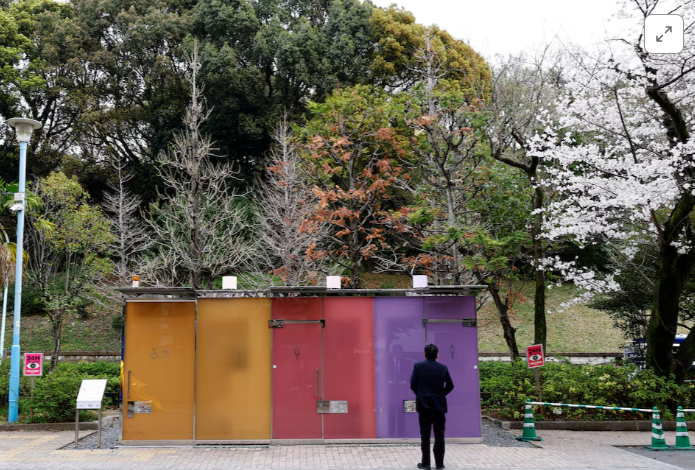
In addition to visiting temples and viewing cherry blossoms, tourists in Tokyo can now explore a curated tour of the city’s modern wonders: its public toilets.
Penelope Panczuk, inspired by the Oscar-nominated film “Perfect Days,” which portrays a toilet cleaner in Tokyo’s Shibuya district, decided to join the Tokyo Toilet Shuttle. This two-hour tour showcases artistically enhanced public conveniences across the city.
“In the U.S. or in France where I originally come from, you just don’t go,” Panczuk said of using public facilities.
“Here in Tokyo you’re really happy to go because they’re extremely clean, they’re very safe and each one is so different it feels like it’s a new discovery each time,” she added.
The Tokyo Toilet Shuttle, launched in March, has attracted visitors to Japan at a record pace. The slide in the yen’s value has made it more affordable for many superfans of Japanese culture to explore its sights and quirks for the first time.
In recent years, Japan’s toilets, manufactured by companies like TOTO and LIXIL, have become highly revered technological exports.
These toilets boast features such as cleansing sprays, heated seats, music, and more.
They have gained international attention, with the animated comedy “South Park” dedicating an entire episode to them, and DJ Khaled expressing excitement on Instagram about receiving four TOTO bowls as a gift from rapper Drake.
The Tokyo Toilet Project, initiated in 2020 by The Nippon Foundation non-profit, enlisted creators including Pritzker Prize-winning architect Tadao Ando to enhance accessibility and artistry in 17 public toilets in the Shibuya district.
While the project was not initially intended as a tourist attraction, the Shibuya government seized the opportunity to enhance the area’s appeal to visitors, diverting attention from its famously chaotic Scramble crossing.
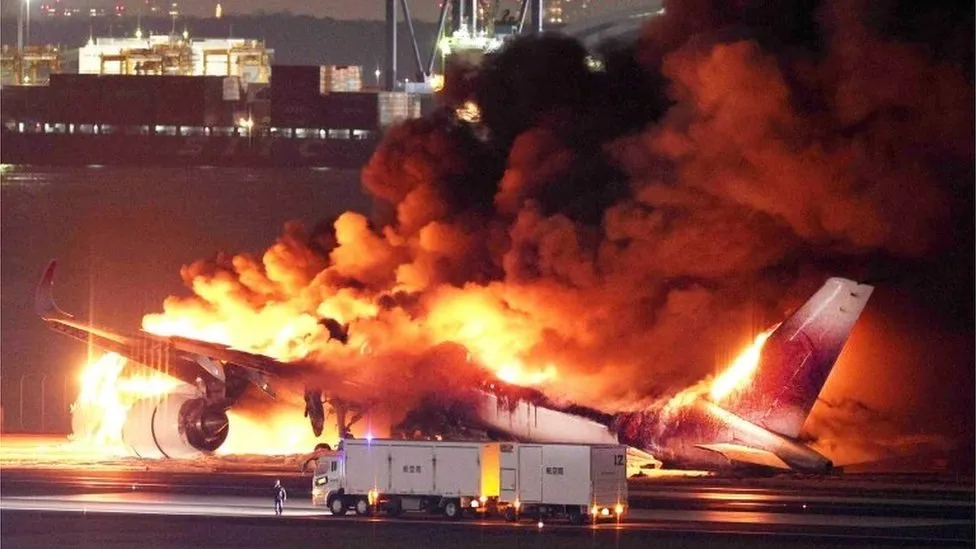
A Japan Airlines plane caught fire after an apparent collision with a smaller coast guard plane on the runway at Tokyo’s Haneda airport.
Police said all 379 passengers and crew on board were evacuated, but five of the Coast Guard plane’s six crew members were killed.
The captain was injured. Flames engulfed the plane after landing, sliding on the burning runway. Firefighters spent many hours putting out the fire. The plane took off from Sapporo, on the northern island of Hokkaido.
Aviation safety experts praised the crew for safely evacuating all passengers. Four Haneda runways were closed following the incident, disrupting the travel plans of thousands of passengers.
Japan Airlines Flight 516 took off from Sapporo’s New Chitose Airport at 4pm local time (07:00 GMT) and landed in Haneda just before 6pm.
Video shows him bursting into flames as he taxied down the runway after landing. One passenger told Kyodo news agency: “I felt a loud bang as if we hit something and I bounced as soon as the plane landed. ”
“I saw sparks outside the window and the cabin was filled with gasoline and smoke. ” Passengers escaped via emergency slides and ran onto the runway to safety, videos and photos showed.
Officials said the flight crew did not report any problems before landing. Communication with the flight controller is being investigated.
The cause of the collision is still unclear. The Coast Guard said an investigation is underway to determine how and when the two planes came into contact.
Five people die on coast guard plane after crash in Tokyo – watch live Dramatic video shows plane destroyed by fire at Haneda airport Japan Airlines’ statement said flight JL516 “was involved in a collision with a Japan Coast Guard aircraft while landing at Haneda Airport, causing a fire on the runway”.
“We want to assure you that all passengers and crew on board our flight were evacuated safely. Our thoughts are with the fallen members of the Japan Coast Guard Copy. ” The Coast Guard aircraft – a De Havilland Dash 8 turboprop – is heading rescue and relief efforts after Monday’s earthquake in Ishikawa. It was one of four planes on a mission to the site of the earthquake.
Television footage showed several fire engines at the scene as smoke and flames rose from the Airbus. Images from inside the plane showed passengers surrounded by thick smoke.
The passenger plane’s body was burned to the ground. One woman posted a photo of a huge crowd watching the scene. “I was on the train.
I’m safeThank God,” she wrote on X, the platform formerly known as Twitter. But hours after the fire, Tokyo police confirmed reports that all five members of the coast guard were killed and said the pilot was seriously injured.
Prime Minister Fumio Kishida said authorities were trying to ensure the accident did not hinder the transport of earthquake relief materials. He said: “It is unfortunate because the crew members performed their duties with a high sense of mission and responsibility towards the victims of the disaster area. ”
NHK television quoted firefighters as saying at least 14 passengers and crew members evacuated from the Japan Airlines flight suffered minor injuries.
Flights at Haneda one of two international airports serving the Japanese capital were grounded and many flights had to be diverted to other airports in Japan while emergency rescue workers dealt with the “fire” situation.
All but one of the tracks where the crash occurred were open to traffic Tuesday night, the Department of Transportation said.
This is the first major accident involving the A350, a new generation aircraft made mainly from advanced materials such as carbon fiber reinforced plastic. Airbus is sending a team of experts to Japan to participate in the investigation.
The efforts of Japan Airlines cabin crew and pilots were also praised. Professor Graham Braithwaite, director of transport systems, told the media at Cranfield University in the US: “They were focused on safety.
They were the last to evacuate the plane and at first glance it looked like they were did an amazing job. ” Kingdom
During Manchester City’s pre-season tour in Tokyo,superstar striker Erling Haaland received a delightful surprise from his teammates on his 23rd birthday.
Jack Grealish warmly welcomed him into a room where a birthday cake had been prepared, and the team serenaded Haaland with a cheerful rendition of the happy birthday song.
City will play friendly matches in Japan and South Korea as they prepare to defend their Champions League, Premier League, and FA Cup titles next season.
Haaland will use the tour to get back to full fitness and boost his hopes of improving on last season’sGolden Boot-winning tally of 36 Premier League goals.
Haaland and his co-stars will take on Yokohama F. Marinos in their first pre-season match on Sunday.
Kinzaburo Shiga, 77, returns to Onahama harbor in the early hours of the morning after catching a trawler full of fish off the eastern coast of Japan.
The third-generation fisherman, though, won’t go right to the market. He will first check his catch for radioactivity.
Since a horrific earthquake and tsunami in 2011 caused a nuclear meltdown at the Fukushima Daiichi power plant, releasing deadly toxic particles into the surrounding area, he has been performing it as part of a ritual.
Three prefectures that had previously supplied Japan with half of its catch had their fishing operations off their coasts suspended as a result of radiation leaks from the damaged nuclear facility.
That ban lasted over a year and even after it was lifted, Fukushima-based fishermen like Shiga were for years mostly limited to collecting samples for radioactivity tests on behalf of the state-owned electricity firm Tokyo Electric Power Company, or TEPCO, rather than taking their catches to market.
Ocean currents have since dispersed the contaminated water enough that radioactive Cesiumis nearly undetectable in fishfrom Fukushima prefecture.Japan lifted its last remaining restrictions on fish from the area in 2021,and mostcountries have eased import restrictions.
Shiga and others in the industry thought they’d put the nightmare of the past years behind them.
So when Japan followed through on plans to gradually release more than 1 million metric tons of filtered wastewaterinto the Pacific Ocean from the summer of 2023 – an action the government says is necessary to decommission the plant safely – the industry reeled.
The Japanese government and the International Atomic Energy Agency (IAEA), a United Nations body promoting the peaceful use of nuclear energy, say the controlled release, which is expected to take decades, will meet international safety regulations and not harm the environment, as the water will be treated to remove radioactive elements – with the exception of tritium – and diluted more than 100 times.
But with the deadline for the planned water release looming this summer, Fukushima’s fishermen fear that– whether the release is safe or not – the move will undermine consumer confidence in their catches and once again threaten the way of life they have fought so hard to recover.
A year before the 2011 disaster, government data shows Fukushima’s coastal fishing industry landed catches worth around $69 million. By 2018, that figure had dwindled to little more than $17 million. By 2022, while it had recovered somewhat to around $26 million, it was still just a fraction of what it once was.
“I know that the government has decided to go ahead with the policy of releasing treated wastewater into the sea, but for us fishers, it really feels like they made this decision without our full consent,” said Shiga, adding that it made his “blood boil.”
In 2011, the earthquake and tsunami cut off the power supply to the Fukushima plant,disabling its cooling systems. This caused the reactor cores to overheat and contaminate water within the plant with highly radioactive material.
Since then, new water has been pumped in to cool fuel debris in the reactors. At the same time, ground and rainwater have leaked in, creating more radioactive wastewater that now needs to be stored and treated.
TEPCO has built over 1,000 massive tanks on the site to store what is now 1.32 million metric tonsof wastewater – enough to fill more than 500 Olympic pools.
But space is running out and the company says building more tanks isn’t an option. As decommissioning work approaches a critical stage, it says it needs to free up space to store the fuel debris from the stricken plant.
A Trade Ministry officialtold CNN the government considered five options, including hydrogen release, underground burial and vapor release, which would have seen wastewater boiled and released into the atmosphere, but in April 2021, officialsapproved the controlled release of the water into the sea. They reasoned that other nuclear facilities around the world had done this and it would be easier to monitor.
The IAEA told CNN it will also monitor and review the release for as long as necessary, at the request of the Japanese government.
While radioactive wastewater contains dangerous elements including Cesium and Strontium, TEPCO says the majority of those particles can be separated from the water and removed. TEPCO claims its filtering system, called advanced liquid processing (ALPS), can bring down the amount of those elements far below regulatory standards.
But one hydrogen isotope cannot be taken away, as there is currently no technology available to do so. Thisisotope is radioactive tritium, and the scientific community is divided on the risk its dissemination carries.
TEPCO and the Japanese government say that tritium occurs naturally in the environment. They say that the concentration of tritiated water it plans to discharge would be on par or lower than the amount other countries allow. Since 2021, they’ve been on a mission to promote public awareness about the wastewater and their plans for it, releasing videos and creating a multilingual portal.
The IAEA also says that releasing small amounts of tritium can be safe because it is already present in small quantities in everything from rain and sea water to tap water; small amounts even exist naturally in the human body.
However, experts are divided over the concept of “safe” radiation, with some arguing it is to a large extent a political rather than a scientific concept.
“For decades, nuclear power plants worldwide – including in the United States, Canada, Britain, France, China and South Korea – have been releasing waste contaminated with tritium, each under its own national quota,” said Tim Mousseau, an environmental scientist at the University of South Carolina.
But Mousseau argues tritium is overlooked because many countries are invested in nuclear energy, and “there’s no way to produce it without also generating vast amounts of tritium.”
“If people started picking on TEPCO in Fukushima, then the practice of releasing tritium to the environment in all of these other nuclear power plants would need to be examined as well. So, it opens up a can of worms,” he said, adding the biological consequences of exposure to tritium have not been studied sufficiently.
In 2012, a French literature review study said tritium can be toxic to the DNA and reproductive processes of aquatic animals, particularly invertebrates, and the sensitivity of different species to various levels of tritium needs to be further investigated.
TEPCO’s website states that it started assessing the effect of tritium on fish from Fukushima last year. A technical document published by the company in 2022 stated that “fish tritium measurement is very difficult.” It says “there are only a few analysis agencies capable of performing this measurement,” and they do not all produce the same findings.
Currently, countries set different standards for the concentration of tritium allowed in drinking water. For example. Australia, which has no nuclear power plants, allows more than 76,000 becquerel per liter, a measure used to gauge radioactivity, while the WHO’s limit is 10,000. Meanwhile, the US and the European Union have much more conservative limits – 740 and 100 becquerel per liter respectively.
Ian Fairlie, an independent consultant on radioactivity in the environment, told CNN that “two wrongs don’t make a right” when it comes to Japan’s decision to release tritiated water. He argues TEPCO should build more storage tanks to allow for the decay of the radioactive tritium, which has a half-life of 12.3 years.
In Japan, the Fukushima wastewater issue has become highly contentious due to a lack of trust among influential advocates of nuclear energy, or what’s locally known as the “nuclear village.”
The informal group includes members of Japan’s ruling party (the Liberal Democratic Party), the Ministry of Economy Trade and Industry and the nuclear industry.
“(The nuclear village) used to tell us that nuclear energy is 100% safe – but it wasn’t, as the Fukushima Daiichi plant accident revealed,” said Koichi Nakano, a political scientist at Sophia University, in Tokyo.
A series of missteps after the disasterfurther eroded public trust, according to a 2016 report written by Kohta Juraku, a researcher at Tokyo Denki University.
For instance, in 2012, the government and TEPCO presented a proposed action plan to local fishing representatives that involved pumping up groundwater before it flooded into the nuclear reactor buildings and releasing it into the sea. Fishing bodies were on board but the plan was it postponed until 2014 after 300 tons of radioactive water leaked from the plant into the sea, infuriating fishers.
Standing between the towering wastewater tanks, Kenichi Takahara, a risk communicator at TEPCO told CNN that the company is aware that people in Japan and overseas are skeptical of the company’s assurances.
“While TEPCO has been promoting nuclear safety in the first place, the nuclear accident happened in 2011. So, we understand that there are many people who can’t trust us,” said the TEPCO official.
“We are hoping that if the IAEA and other organizations can show them that there is no problem, people will understand us,” Takahara added.
Japanese officials told CNN that they have taken the voices of locals in Fukushima into consideration and will send a message to other nations andconsumers around the world that the treated water is safe to release.
Tokyo has also created a fund of 30 billion yen ($225 million) to buy and store freezable seafood if consumer confidence takes a hit following the release, an official from the Ministry of Economy, Trade and Industry told CNN.
And in an effort to convince both fishermen and consumers that the water to be released is safe, in March 2022 TEPCO started conducting tests on the tritium concentrations in fish, shellfish and seaweed reared in regular seawater as compared to those raised in ALPS-treated water.
But Satsuki Takahashi, an anthropologist specializing in sustainability studies at Hosei University, warned that changing mindsets is no easy feat.
“From the consumer’s perspective, whether it’s processed or not, this is wastewater. It’s hard for (people) to grasp what safety means or what risks mean,” she said.
“One of the biggest issues in terms of this wastewater, for those who used to purchase the fish from Fukushima before the disaster, is whether they are going to come back and buy the fish once the label states its provenance.”
For fishers like Shiga, the work to restore their way of life is far from over.
“We’re taking the initiative and appealing to consumers so they understand (our products are safe), but we have a hard time reaching them,” said Shiga, who fears that countries may reimpose bans on imports of Fukushima fish following the wastewater release.
“If the government releases the water into the sea off Fukushima now, everything we’ve done so far and our current efforts will be wasted,” he said.
In what looks to be a calculated escalation to grab the attention of Tokyo and Washington, North Korea fired a suspected missile over Japan.
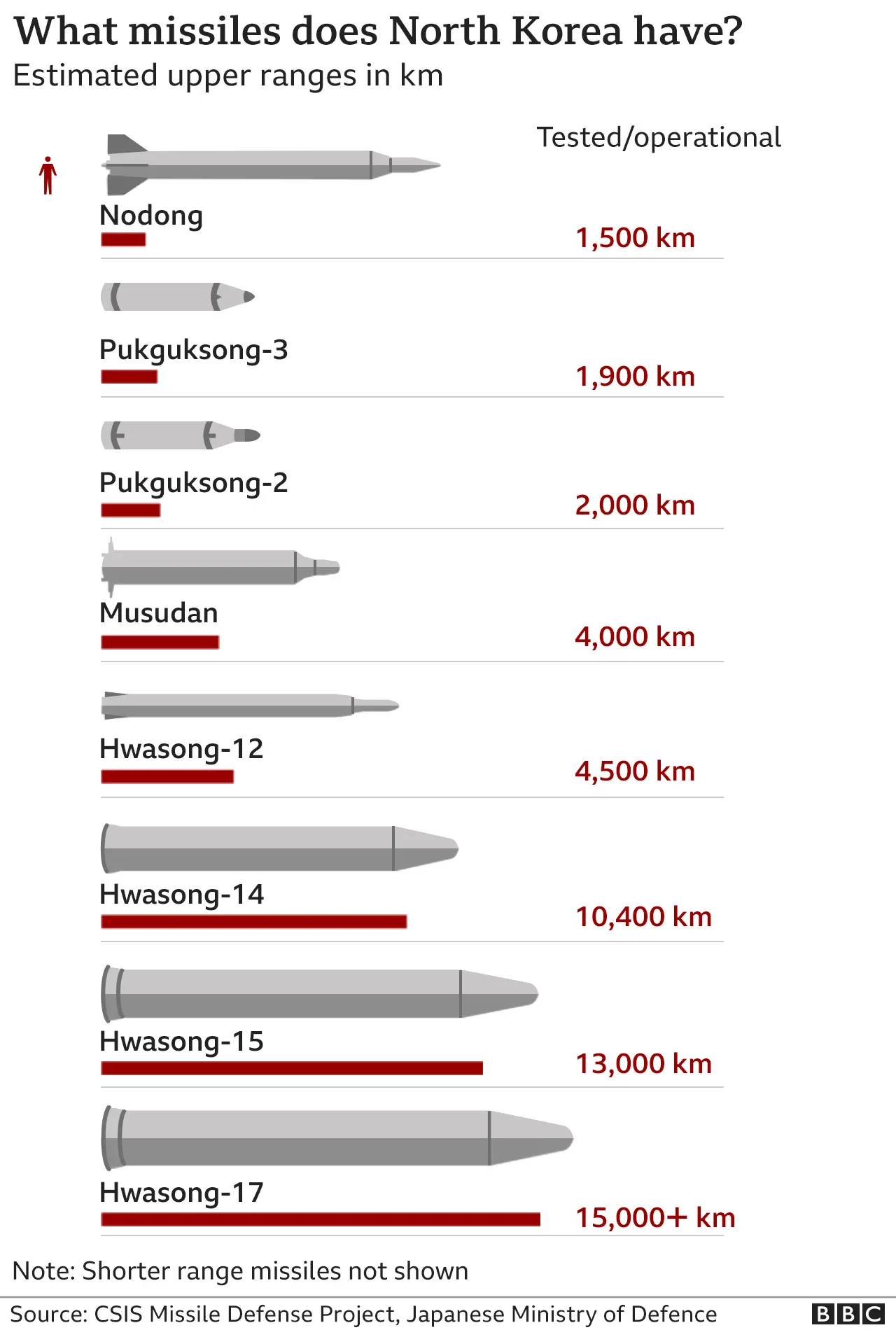
The ballistic missile travelled about 4,000 kilometres (2,800 miles) before crashing into the Pacific Ocean; on another trajectory, it may have struck the US territory of Guam.
It is the first missile launch by North Korea over Japan since 2017.
The launch saw Japan issue a rare alert to some citizens to take cover.
The UN prohibits North Korea from testing ballistic and nuclear weapons. Flying missiles towards or over other countrieswithout any pre-warning or consultation also contravenes international norms.
Most countries avoid doing it completely as it can easily be mistaken for an attack. While it is not as big as a nuclear test – which could be next – it can be considered hugely provocative.
People in the north of Japan, including Hokkaido island and Aomori city, reportedly woke up to the noise of sirens and text alerts that read: “North Korea appears to have launched a missile. Please evacuate into buildings or underground.”
As the missile flew overhead, they were warned to look out for falling debris. Many appeared to remain calm according to reports, with one video showing Tokyo commuters walking calmly as loudspeakers blared out warnings.
But others were more shaken. “If a missile hit, I was worried it would be a big problem not only here but also nationwide,” Aomori resident Kazuko Ebina told the Asahi Shimbun newspaper.
Officials later said the intermediate-range ballistic missile fell into the Pacific Ocean far from Japan, and there were no reported injuries.
It had covered the longest distance ever travelled by a North Korean missile, and reached a height of around 1000km – higher than the International Space Station.
Japan’s Prime Minister Fumio Kishida described the launch as “violent behaviour”, while defence minister Yasukazu Hamada said Japan would not rule out any options to strengthen its defences including “counterattack capabilities”.
The US National Security Council spokesperson Adrienne Watson called it a “dangerous and reckless decision” that was “destabilising” to the region.
The launch comes as Japan, the US and South Korea have been working together to strengthen their defences, in response to the growing threat posed by the North.
Last week, the three countries conducted naval exercises together for the first time since 2017. Such drills have long antagonised Pyongyang leader Kim Jong-un, who views them as proof that his enemies are preparing for war.
Following the combined exercises in 2017, North Korea fired two missiles over Japan in response. A week later, it conducted a nuclear test.
Recent intelligence has suggested that North Korea is getting ready to test another nuclear weapon.
It is expected that North Korea would wait till after China – its main ally – holds its Communist party congress later this month.
The missile launch is the fifth carried out by Pyongyang in a week. On Saturday, two rockets came down in waters outside Japan’s exclusive economic zone.
Many of North Korea’s missile tests are conducted on a high, lofted flight path – reaching a high altitude, avoiding flights over its neighbours.
But firing over or past Japan allows North Korean scientists to test missiles under circumstances “that are more representative of the conditions they’d endure in real-world use”, analyst Ankit Panda told news agency Reuters.
These actions have contributed to enduring tensions between North Korea and Japan, rooted in Japan’s previous colonisation of Korea from 1910 to 1945 and the North’s abduction of Japanese citizens in the past.
Earlier this month, North Korea passed a law declaring itself to be a nuclear weapons state, with leader Kim Jong-un ruling out the possibility of talks on denuclearisation.
Pyongyang conducted six nuclear tests between 2006 and 2017, incurring widespread sanctions.
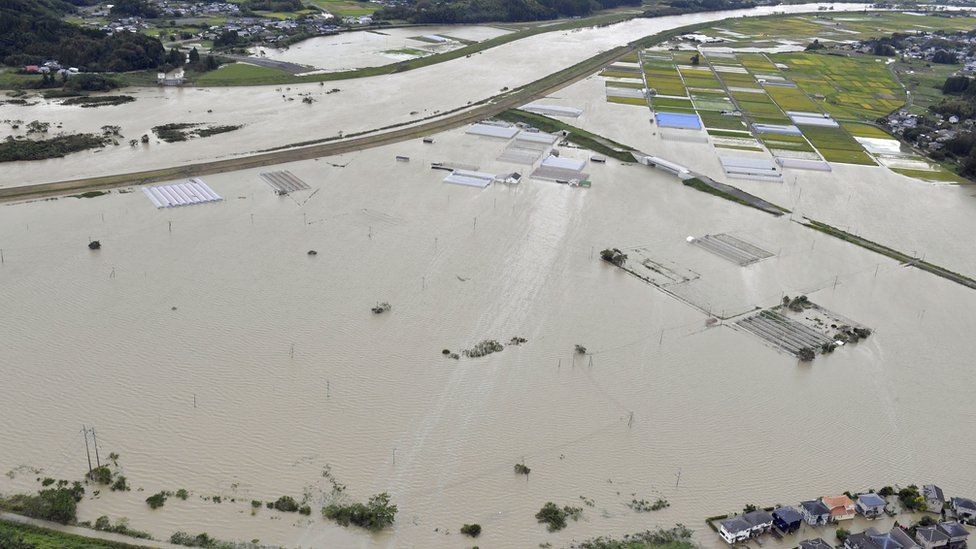
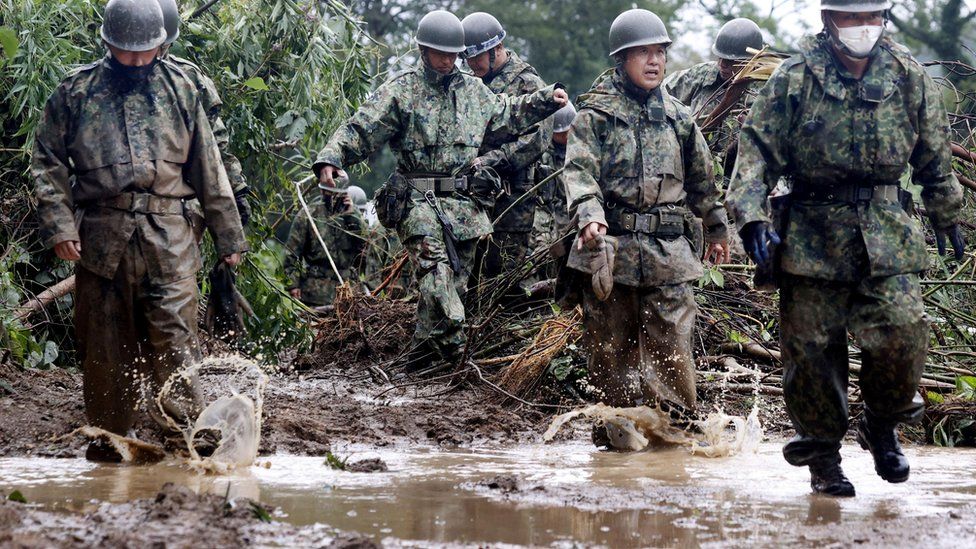
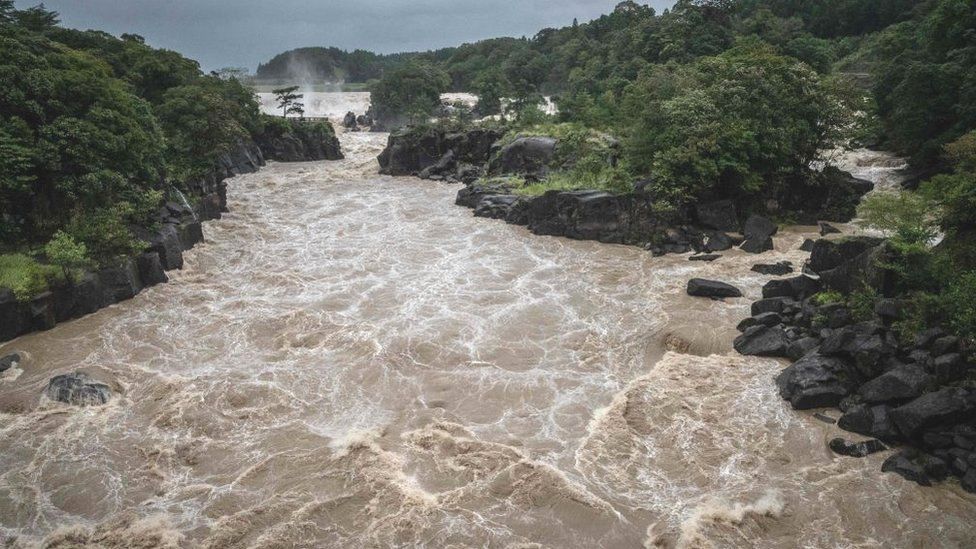
Rescuers in Japan have issued a warning about flooding and mudslides following one of the worst storms to hit the nation in recent years.
At least four people were killed and more than one hundred others were hurt as typhoon Nanmadol made landfall on the southern island of Kyushu on Sunday morning.
140,000 houses were still without electricity as of Tuesday.
After traversing a large portion of the nation and moving offshore, the storm has now been downgraded to a cyclone.
State broadcaster NHK said one man was killed when his car was submerged in flooding, and another died after being buried in a landslide. Two more people were found “without vital signs”, a term often used to refer to death before it is certified by a coroner. At least 114 people have been injured, 14 of them seriously.
The super typhoon brought gusts of up to 234km/h (145mph), destroying homes, and disrupting transport and businesses. It is equivalent to category four or five hurricanes.
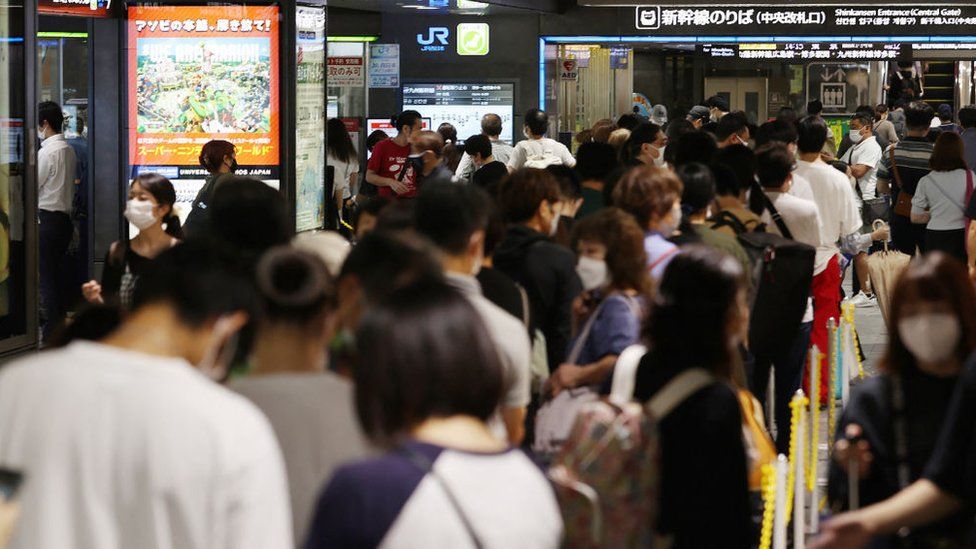
Passengers were stranded at Hakata station as train services were suspended when Typhoon Nanmadol approached Kyushu
An aerial view of houses submerged by flooding in Kunitomi on the island of Kyushu
The capital, Tokyo, experienced heavy rain, with the Tozai underground line suspended because of flooding. Bullet train services, ferries, and hundreds of flights have been canceled; shops and businesses have shut. Local video footage showed roofs ripped off buildingsand billboards toppled over.
Prime Minister Fumio Kishida delayed a visit to New York, where he was due to give a speech at the UN General Assembly, until Tuesday, to monitor the storm’s impact.
IMAGE SOURCE, REUTERS Image caption, Japanese Self-Defence Force soldiers conducting search and rescue operation at sites of landslides
GETTY IMAGES Image caption, Raging waters flow along the Sendai River in Isa in Kagoshima prefecture
Scientists have predicted an active hurricane season this year, influenced by a natural phenomenon known as La Niña.
Warmer sea surface temperatures in the Atlantic and Caribbean as a result of climate change may also impact the frequency and intensity of hurricanes.
In Japan, hundreds of thousands of people have been ordered to leave their homes because of “unprecedented” storm risks.
On Sunday, Typhoon Nanmadol is anticipated to make landfall on Kyushu Island.
Winds might gust as high as 270 km/h (168 mph), and some regions could receive 500 mm (20 inches) of rain in a single day.
A “special alert” is in force for Kyushu, with warnings of landslides and flooding. Train services and flights have been canceled.
Kyushu is the southernmost of the four islands that make up the main body of Japan and has a population of over 13 million people.
This is the first special alert ever issued outside the Okinawa Prefecture, which consists of the smaller, remote islands in the East China Sea, the Japan Times reports.
Once the typhoon makes landfall, it is expected to turn northeast and move up through central Japan towards Tokyo.
It is also expected to maintain much of its strength even after making landfall.
An official from Japan’s meteorological agency told reporters on Saturday: “There are risks of unprecedented storms, high waves, storm surges, and record rainfall.”
Nanmadol, the official added, had the potential to be worse than both Typhoon Jebi in 2018, which left 14 people dead, and Typhoon Hagibis, which caused widespread power cuts in 2019.
The agency also warned that some homes, particularly in southern Kyushu, would be at risk of collapse, and urged residents to seek refuge in sturdy buildings.
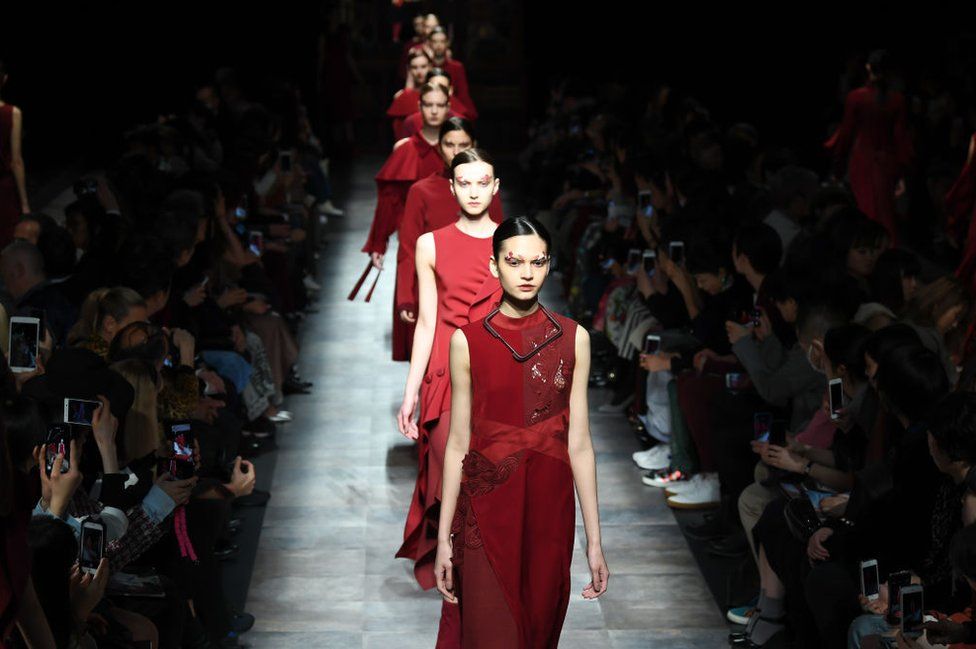
Japanese fashion designer Hanae Mori, nicknamed “Madame Butterfly” for her signature winged motifs, has died. She was 96.
She died of old age in her Tokyo home on 11 August and was given a private funeral, local media reported.
Mori was most famous for being the first Japanese – and Asian – designer to join the hallowed ranks of haute couture designers in 1977.
The exclusive Parisian club is seen as the pinnacle of high-end fashion.
Born in western Japan in 1926, Mori graduated from the Tokyo Woman’s Christian University.
She opened her first atelier above a noodle shop in Tokyo in 1951. She has described meeting Coco Chanel during a trip to Paris in the 1960s as a “turning point” in her career, and said Chanel inspired her to design for women to stand out rather than fit in.
Â
Mori went on to dress Hollywood celebrities such as Grace Kelly and famous personalities such as Nancy Reagan. Japan’s then-Crown Princess Masako – now empress – wore a Hanae Mori wedding gown for her marriage to Emperor Naruhito in 1993.
Her outfits, often featuring butterfly prints, were also popular among career women. When she began to make a name herself in the fashion world, it was still unusual for a woman to head business, much less one of global fame.
Mori’s designs often mixed elements from the East and West, such as dresses with inspired by kimonos.
She also created costumes for on-stage performances, including traditional Japanese Noh and Kabuki theatre and a performance of “Madame Butterfly” in 1985.
She was presented with the Legion of Honor by the French government in 2002.
In January, the designer reflected on the industry in a column for the Yomiuri Shimbun newspaper.
“Fashion is something that pushes you, gives you courage to spread your wings and allows you to have adventures,” she wrote.
Mori’s husband of almost 50 years, Ken Mori, died in 1996, and she is survived by two sons. Two of her granddaughters, Hikari Mori and Izumi Mori, are fashion models.
Mori continued working into her advancing years – these designs were modelled on the catwalk in Tokyo in 2018
Hanae Mori pictured with her granddaughter, model Hikari Mori, in 2016
Samuel Takyi – one of Ghana’s candidate for the 2020 Olympic Games is harboring fears of battling with his weight following the postponement of the 2020 Olympic Games in Tokyo.
Takyi qualified at the Africa Olympic Qualifier in Dakar, Senegal early this year as a featherweight boxer but with the postponement of the Games in Tokyo due to the coronavirus pandemic, the young boxer is afraid he might not make the exact weight next year.
The International Olympic Committee (IOC) together with the Local Organising Committee (LOC), called off the Games due to the coronavirus pandemic that has hit the world.
Takyi said in an interview with the GNA Sports that, after explanations from his coaches on the need to postpone the Games, he came to the realization that life was more important but added that, he may struggle to make weight in 2021.
The featherweight boxer said, he was worried about his weight but was encouraged to train daily and keep on checking on the scale regularly to ensure he was within weight each day.
Takyi, 19, said he cannot afford to miss the Games due to challenges with his weight hence had been regular at the gym to ensure he was in the best of shapes and within his weight whilst he awaits 2021
“It’s a difficult thing to do especially when you have to make sure you are within weight but that is my profession I have to remain disciplined and ready for battle all the time,” he stated.
Takyi, also known as the “The Ring Warrior” said boxing is my talent and now my profession and I do it with passion.
“Qualifying into the national team was a surprise, but with hard work and determination I made it to the Olympics and I will not let anything to distract me,” he added.
Takyi has over amateur fights to his credit and remains one of Ghana’s medal hopeful for the Games.
Tokyo 2020 organisers on Monday rolled out the motto for this year’s Olympics, “United by Emotion”, which they said reflected the “universal values” and “unifying power of sport”.
“Crowds of spectators who do not know each other prior to the Games will come together and learn that there is more that unites them than divides them,” Tokyo 2020 said as it unveiled the motto.
The official Olympic motto is “Citius, Altius, Fortius” or “Faster, Higher, Stronger”, but each host city chooses its own motto to accompany that edition of the Games.
London’s motto in 2012 was “Inspire a Generation”, whereas Athens in 2004 went for “Welcome Home” — a nod to the birthplace of the Games in Olympia.
Less well-received was Sochi, which plumped for “Hot. Cool. Yours”, sparking derision in some quarters.
Tokyo said the motto would be beamed onto the Skytree tower in the Japanese capital to raise awareness as it will be seen for miles around.
The opening ceremony will be on July 24 and organisers have stressed there is no discussion about changing this date despite the coronavirus crisis hitting global transport.
Tokyo 2020 roll-outs have not always been smooth. In September 2015, the Games logo was ditched after accusations of plagiarism.
Designer Olivier Debie said the design was stolen from his logo for a Belgian theatre and threatened court action before officials withdrew the emblem, saying it “no longer has public support”.