Tag: Trade and Industry

  • KT Hammond names achievements as Deputy Energy Minister

    KT Hammond names achievements as Deputy Energy Minister

    The minister designate for Trade and Industry has touted one of his biggest achievements as a deputy energy minister between the year 2001 to 2007.

    According to him, his personal work was what led to the discovery of oil in the country by Tullow Oil and Kosmos Energy in the western region of Ghana.

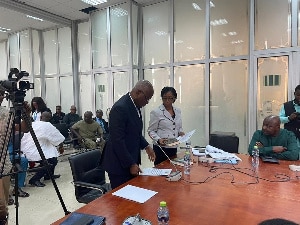
    His response comes after the minority chief whip asked what his achievements were after he served as deputy minister from 2001 to 2007, when he appeared before the committee for vetting.

    “…it was through the administration of J. A. Kufuor under the ministry of energy and myself. My minister at the time was Kan Dapaah. He gave me the portfolio of petroleum. GNPC was literally not in existence, it had collapsed. He gave me that responsibility to make sure GNPC was on its two feet to make sure that they entered into proper exploration and so to develop and make sure we find oil in this country.

    “I was mandated to travel all over the world to look for entrepreneurs, companies and to see if they could make sense of our potential. Mr Speaker it was I, KT Hammond, in May 2004 who signed [an] MOU which eventually led to KOSMOS discovering that oil in Ghana. That was the big achievement,” KT Hammond said.

    Parliament’s Appointments Committee on Monday, February 20, 2023, started vetting ministers and deputy minister-nominees recently announced by President Nana Addo Dankwa Akufo-Addo.

    The nominees to appear before the committee include Member of Parliament (MP) for Adansi Asokwa, K.T. Hammond, the Minister-designate for Trade and Industry and the MP for Nhyiaeso, Stephen Amoah (Sticka) who would be serving as his deputy.

    MP for Abetifi, Bryan Acheampong was also nominated as the Minister for Food and Agriculture while Stephen Asamoah Boateng is going to the Chieftaincy and Religious Affairs Ministry as minister.

    Karaga MP, Mohammed Amin Adam, was named by the president as Minister of State at the Finance Ministry while Herbert Krapah was nominated deputy Minister for Energy.

    Source: Ghanaweb

  • Government inaugurates Export Development Strategy Steering committee

    The Steering Committee for the National Export Development Strategy (NEDS), comprised of top executives, was established by the Ministry of Trade and Industry (MoTI) to bring on board their expertise and gather resources to achieve a successful national export strategy.

    The Coordinating Committee and other agencies are above the Steering Committee, which is the second-highest body under the NEDS and is made up of the CEOs of some of the largest state agencies and businesses.

    The 13-member Steering Committee has the principal roles of providing overall oversight and direction for effective implementation of the Strategy; considering and streamlining projects implementation issues; making recommendations to the inter-ministerial oversight body; and undertaking advocacy and promotion for the NEDS to both external and internal organisations.

    The committee also has a mandate to provide quarterly and annual reports to the Inter-ministerial Committee on implementation progress, and make recommendations to the committee as well as mobilise financial resources.

    Deputy Minister of Trade and Industry, Herbert Krapa – speaking on sector minister’s behalf at the inaugural ceremony, mentioned that the NEDS provides an objective picture of Ghana’s current export environment and a clear vision of the desired evolution for Ghana’s non-traditional export sector from 2020 to 2029.

    “The NEDS is a national export development blueprint for significantly increasing Non-traditional Export (NTE) revenue within 10 years, with total NTE revenue of US$25.3billion by 2029,” he said.

    He emphasised that because membership of the Committee is a result of being CEO of their respective institution, a member’s tenure is tied to that of the position. Therefore, once a person resigns or is redeployed, their membership of the Committee comes to an end.

    The Committee is chaired by the Chief Director at the Ministry of Trade and Industry.

    The team comprises representatives from the following institutions: The Ministry of Trade and Industry, Ministry of Food and Agriculture, Ministry of Local Government Decentralisation and Rural Development, National Coordination Office of AfCFTA, National Development Planning Commission, Food and Drugs Authority, Ghana Export-Import Bank, and Ghana Standards Board among others.

    The trade minister emphasised that AfCFTA provides a great opportunity for countries like Ghana to harness effective implementation of the National Export Development Strategy. The recently launched NTE statistics Report revealed a 17 percent increment, which reflects US$3.3billion in export revenue.

    Steering Committee Members

    Board members included Patrick Yaw Nimo, Chief Director-Ministry of Trade and Industry; Dr. Afua Asabea Asare, CEO-GEPA; Kosi Yankey-Ayeh, CEO-Ghana Enterprises Agency; Reginal Yofi Grant, CEO-Ghana Investment Promotion Centre; Seth Twum Akwaboah, CEO-Association of Ghanaian Industries; and Marjorie Abdin, Vice President-Federation of Association of Ghana Exporters.

    The others are Mark Badu Aboagye, CEO-Ghana National Chamber of Commerce and Industry; Lawrence Agyinsam, CEO-Ghana Export-Import Bank; Mike Oquaye Jnr.-CEO, Ghana Free Zones Authority; Prof. Alexander Dodoo, Director-General – Ghana Standards Authority; Benonita Bismarck, CEO-Ghana Shippers’ Authority; and Delese Mimi Darko, CEO-Food and Drugs Authority; Eric Bentsil Quaye, Director-Plant Protection and Regulatory Services Directorate.

    Activities under NEDS so far

    The Ghana Export Promotion Authority (GEPA) and its partners have been on the road to sensitise 261 districts across the country on the National Export Development Strategy and African Continental Free Trade Area (AfCFTA).

    The sensitisation’s first phase covered 30 of the 74 clusters in the country’s 261 districts. There were 115 districts in the first 30 clusters covered. Three teams were composed – namely the Northern Team, the Middle Team and the Southern Team – to cover the northern zone, middle-belt and southern zone respectively.

    So far, 249 potential exporters have been identified through this exercise, and they will be guided as they develop their products to be exported.

  • Ghana International Trade and Finance Conference slated for October 27

    The Ghana International Trade and Finance Conference (GITFIC) in partnership with the Accra Metropolitan Assembly (AMA) will a host dialogue on the African Continental Free Trade Area (AfCFTA)on October 27, 2020.

    The AfCFTA dialogue is also in collaboration with the Association of Ghana Industries (AGI) to raise awareness, empower and encourage all Member States to take actions necessary to build the logistics and the infrastructure critical for the successful outcome of the Free Trade.

    Mr Mohammed Adjei Sowah, AMA Chief Executive Officer speaking at a press conference to announce a new date for the 4th GITFIC event postponed from April 9-10, 2020 due to COVID-19 to October 27 and 28.

    The dialogue is on the theme: “Optimizing AfCFTA for Africans: The Role of Logistics Infrastructure.”

    The event is intended to display the urban economic resilience of Accra in particular and Ghana as a whole in the face of a global pandemic that has ravaged most economies.

    He said the event seeks to discuss the details of preparations being made by Members States of the African Union in building up the necessary logistics and infrastructure identified as the main challenge in implementing the Protocols of the AfCFTA.

    Mr Adjei said through the medium of the conference: “we also hope to alert corporate Ghana in particular and Africa in general about the networking and investment opportunities the AfCFTA will create in Africa and to empower the private sector take advantage of those opportunities.”

    He said the City of Accra has deep historical roots in commerce and has always remained a major trading center in Africa; “Our City is well equipped with the infrastructure, governance framework and the markets required to provide the leadership in AfCFTA implementation.”

    The CEO said over the years, Accra has developed the right policies and enabling environment to represent both an investment destination and gateway to the African markets.

    He said it would also enable participants to learn about the preparedness of sister African Countries for the commencement of trade in January 2021.

    “We will learn about trade barriers and restrictions, which will be lifted through the commencement of the AfCFTA and market opportunities it can create for your businesses in an enhanced African supply chain,” he said.

    Mr Tsonam Cleanse Akpeloo, the Association of Ghana Industries Accra Chairman and Head of Industries, said Ghana needs to position itself well enough to protect its local industries with the coming in force of the AfCFTA.

    He said this was because “we will wake up one day and Ghana will be flooded with products that are cheap and we will be helpless.”

    He said the government needed to put in place measures to make the Ghanaian market competitive and suggested that the government looks to industries like textiles, salt, and pharmaceuticals as possible launching pads.

    He called on businesses to get ready and take advantage of the implementation of the AfCFTA, indicating that they should leverage on technology infrastructure and e-commerce to expand.

    On regulatory framework, Mr Akpeloo said all laws must be harmonized with international laws together with standardization.

    Mr Selasi Koffi Ackom, Chief Executive Officer of GITFIC said the conference would be educative, be directive, be authoritative and most importantly, it would expose participants to all there is to know on the African Continental Free Trade Area.

    He said speakers on the 4th Conference would be from diverse technical fields from more than five countries including Nigeria, Gambia, Sudan, Morocco, Sierra Leone, and Liberia.

    The CEO said the conference would border on the important and delicate sub-themes including physical connectivity, digital connectivity, infrastructure deficits, tariff reforms, non-tariff reforms, port Harmonization, and a single continental payment harmonization system.

    Other are a single continental digital platform, a harmonized trading platform for Member States, a harmonized continental cybersecurity system, and standardization of Member State trading protocols.

    Source: GNA

  • West African Auto Hub: Ghana accepted what Nigeria rejected

    West Africa, with about 380 million people, is the final frontier for global automakers looking to increase manufacturing capacity in a region where they currently have little presence.

    While local assemblers in Nigeria, home to nearly half of the region’s population, have partnered with companies such as Volkswagen AG to make vehicles in the country, President Muhammadu Buhari last year rejected a bill that would give carmakers a 10-year tax holiday, dealing a blow to their efforts to expand manufacturing capabilities there.

    Now, smaller neighbors like Ghana are stepping up to the plate.

    The country approved its own auto policy last year, offering tax breaks to carmakers and promising to restrict second-hand cars, which account for 70% of vehicle imports in a country with barely any local manufacturing. Within months, parliament banned imports of cars that are more than 10 years in a bid to lure the likes of Volkswagen, Nissan, Toyota and Renault.

    On Aug. 3, Ghana became the fifth location on the continent where VW cars are assembled, even though the bulk of the work – at the initial stage, at least – will be done by a local partner that’s the German carmaker’s main dealer in the nation of 30 million people.

    Volkswagen provided training to the staff of the Accra-based Universal Motors Ltd.’s assembly plant through video conferencing after the pandemic forced borders shut. But Covid-19 has only worsened another roadblock for consumers: affordability.

    People have embraced second-hand cars, coming up with nicknames for the most common brands, because new ones are too expensive and auto-financing is scarce.

    In Ghana, less than 5% of cars are financed by banks, according to the Ghana Automobile Dealers Association. Until that’s addressed, the auto policy’s success will remain in question.

    Source: The Herald

  • Angry workers spurn Ethiopia’s ‘industrial revolution’

    Zemen Zerihun thought he’d left farming behind and found the ticket to a better life when he began a job cutting fabric for a clothing company at a massive industrial park in southern Ethiopia.

    But the 22-year-old ended up quitting within months, weary of working eight hours a day, six days a week and still not making ends meet earning $35 a month.

    Managers were so strict they would go into bathrooms and yank out workers deemed to be taking too long, he said.

    His supervisor would loudly berate him as “slow” and “lazy” when he failed to keep pace on the production line, he told AFP.

    “After I joined the company, I suffered,” he said. “The supervisors treat you like animals.”

    Experiences like his highlight a major challenge facing Ethiopia’s push to embrace industrialisation and become less dependant on agriculture.

    By attracting foreign investors through cheap labour, it wants to follow the model of China and other Asian nations in creating a robust manufacturing sector that can offer badly needed jobs for its young workforce.

    But despite high unemployment, young Ethiopians are not going along with it, preferring to quit rather than stay in jobs where they feel underpaid and disrespected.

    Thousands of employees have already walked out of the country’s new and burgeoning network of industrial parks.

    At the Hawassa Industrial Park, where Zemen worked, staff turnover in 2017-18 “hovered around 100 percent,” according to a May 2019 report from the Stern Center for Business and Human Rights at New York University.

    The added recruitment and training costs are a main reason why, in the eyes of manufacturers, Ethiopian labour has “turned out to be considerably more costly than the government had initially advertised,” the report said.

    Government officials say they are taking steps to address workers’ concerns while balancing them with industry representatives’ interests.

    But labour organisers argue the measures are too little, too late, leaving them no choice but to begin unionising the parks — a development Zemen says is long overdue.

    “The government needs to pay attention to what is happening in the industrial parks,” he said.

    “They think they are giving everyone good jobs, but some of the workers, they are really struggling.”

    A lofty vision

    Prime Minister Abiy Ahmed sees industrial parks as an important engine of growth that can help stave off unrest ahead of elections tentatively planned for August.

    Yet the strategy was adopted several years before Abiy came to power, after the government realised in 2014 that agriculture couldn’t provide enough jobs for a booming population, said Arkebe Oqubay, an architect of the strategy and now special adviser to the premier.

    Ethiopia is one of Africa’s fastest-growing economies but youth unemployment remains a major problem.

    The World Bank estimates that two million people enter the workforce every year.

    Despite long-running efforts to restructure the economy, officials estimate that manufacturing still only makes up 10 percent of economic activity.

    As they work to ramp up the sector, officials say they have learned the lessons of places like Bangladesh — where at least 1,134 people were killed in the Rana Plaza factory collapse in 2013 — and are committed to avoiding unsafe and unsustainable working conditions.

    The flagship Hawassa park, a campus of 52 factory sheds occupied by American, European and Asian companies producing garments and textiles, opened in 2017.

    Its roughly 30,000 workers sew fabric into T-shirts, sportswear or other sought-after items.

    By year’s end, some 30 industrial parks will be operating across Ethiopia, specialising in sectors like machinery production and information and communications technology, Arkebe said.

    Currently 12 parks have been built.

    The parks have already yielded dividends, Arkebe said, raising foreign direct investment to $4.3 billion in 2017 — a fourfold increase over five years earlier.

    But wage levels are under the spotlight.

    – Attracting investment –

    The $26 monthly base pay at Hawassa makes Ethiopian garment workers the lowest paid in the world, the NYU Stern Center report said.

    Though the amount is not uncommon for entry-level employees in a country with no minimum wage, workers say it barely covers food, transport and rent.

    Even those leasing cramped apartments with three or four co-workers and sleeping in shifts on shared mattresses say they don’t make a decent living.

    Eight months after resigning, Zemen is living with his family and still looking for a new job, but he has no regrets.

    He’d rather grow food for himself on the family farm than toil at the factory which he’d initially seen as his escape, he said.

    He is far from the only worker to have quickly grown disillusioned when the reality of factory life failed to match his expectations.

    Tony Kao, deputy general manager of JP Textile, said Hawassa workers faced challenges switching from agricultural to industrial work.

    “It took some time for them just to learn industrial work. They now have to be on time to work and now they have to learn new skills, they have to learn how to operate the machines which is a whole new chapter for them,” he said.

    Medihant Fehene left her Hawassa factory job, too.

    “I’d have to wake up to catch the bus at 5:30 to start work at 6:00, or if I took the afternoon shift I would not get home until 11:30, when it’s dark and not safe for a woman to be outside,” she said.

    Among measures the government is exploring to address such frustrations is giving companies land for dormitories for workers to rent at subsidised rates, Arkebe said.

    However, he also defended low wages, saying they help ensure firms invest in Ethiopia rather than countries where manufacturing is more established.

    “If wages are high and investment doesn’t come, new employment is not going to be created,” Arkebe said.

    “The livelihood of workers can improve when their productivity improves,” Arkebe added, comparing the process to the “industrial revolution” in Britain and the United States.

    ‘It’s the future’

    Such statements play well with industry representatives.

    “Ethiopia is the garment future. Everybody’s looking at Ethiopia now,” said Raghavendra Pattar, head of Nasa Garment Plc in Hawassa.

    Ethiopian workers have had the right to organise since the 1960s, but Pattar said he saw no need for unions to be established at the industrial park.

    But Ayalew Ahmed, vice president of the Confederation of Ethiopian Trade Unions, told AFP that the first “task forces” to begin organising workers would form early this year.

    “If the employers volunteer to have trade unions in the company, that will be OK. Otherwise we will establish them outside the company,” he said.

    The government backs workers’ right to organise, provided it is not too disruptive, Eyob Tekalign Tolina, a state minister of finance and one of Abiy’s top economic advisers, said.

    Factory owners at Hawassa meanwhile seem to face no shortage of potential replacements for those who quit.

    On a recent morning, dozens of applicants waited in line to be tested on tasks such as threading needles or placing nails on a pegboard.

    Inside the park, 22-year-old Tekle Baraso Bonsa took a break from dyeing yarn to explain how he was using his $33 a month wage to put himself through university.

    “If I weren’t doing this,” he said, “I’d be shining shoes.”

    source: AFP