Tag: tradition

  • Story of the Yoruba metal art of the mediaeval age – A world class civilization

    Story of the Yoruba metal art of the mediaeval age – A world class civilization

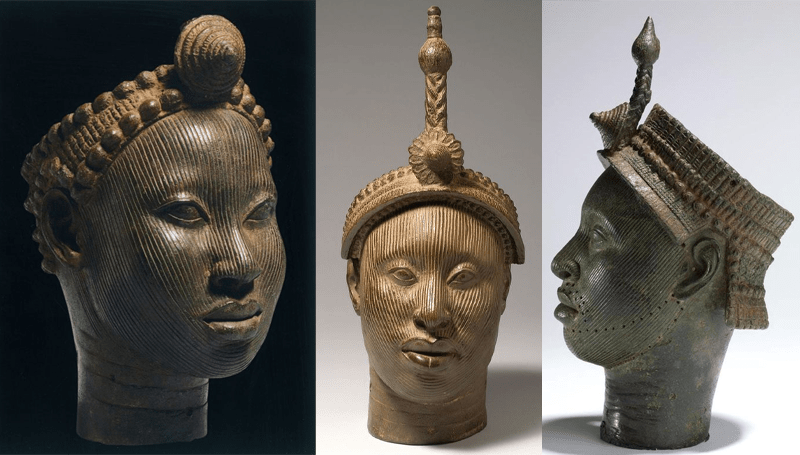
    Yoruba Metal Art: There is well-documented evidence that iron smelting and forging technologies may have existed in West Africa as early as the 6th century BC among the Nok people of Nigeria. Iron technology appears to have played a critical role in the fundamental social assets that fuelled the growth of significant centralized civilizations in the West African region between 1400 and 1600.

    The development of iron tools and weapons resulted in extensive mechanized agriculture, efficient hunting, and successful warfare, all of which contributed to the growth of large urban centers.

    Iron was also important in the rise of Yoruba kingdoms, particularly the Ife and Oyo Empires. They had a lot of contact with one another, so they have similar beliefs about the properties of iron and the methods for smelting it. Ife metal castings appear to be some of the finest Sub-Saharan art; they are mostly hollow-cast heads used in ancestral rites and have a naturalistic appearance.

    There are indications that the first caster originated in Ife around the 14th century, according to tradition. And the most common forms were heads of dead Benin kings, usually supported by a carved-out ivory tusk.

    These were placed on altars alongside other figurative castings and bells and dedicated to early kings. Figured plaques were also used as architectural designs and decorations.

    For example, among the Yorubas, Ogun, the god of iron, is a revered deity. It is widely regarded as the first warrior and hunter, as well as the inventor of iron. Furthermore, Ogun is known for opening roads, clearing fields, and establishing great dynasties.

    The distinctive iron sword of Ogun, a Yoruba Metal Art that is often regarded as a symbolic cultural motif, is associated with both civilizing and aggressive actions.

    The Bronze Head of Ife is one of the most well-known Yoruba metal works. The copper alloy sculpture, discovered in Ife in 1938, is thought to represent a king and was most likely made between the 13th and 14th centuries, long before European contact with the local population.

    The sophisticated sculptures’ realism and authenticity challenged the western conceptualization of African art at the time. The Ife head was transported to the British Museum a year after its exhumation.

    Because of their historical significance and as a testament to the Yorubas’ rich civilization, Ife heads are now widely used in logos and branding of Nigerian corporations and educational institutions, such as the one used for Obafemi Awolowo University in Ile-Ife.

    Because of its symbolic importance, the British Museum’s Ife head was included in the major exhibition Kingdom of Ife: Sculptures from West Africa, which was organized in collaboration with Nigeria’s National Commission for Museums and Monuments, the Museum for African Art in New York, and the British Museum. The entire exhibition was part of a series of events commemorating Nigeria’s 50th anniversary of independence.

    All of this demonstrates that, long before European contact with West Africa, the Yorubas developed a highly sophisticated iron industry that reflected their civilization and ingenuity.

  • Man arrested for having sex with daughter, claims it’s ‘tradition’

    Man arrested for having sex with daughter, claims it’s ‘tradition’

    A 35-year-old man reported to have sexually assaulted his 15-year-old daughter and says the behavior “is a tradition” has been brought before a court for gender-based violence at the police headquarters in Accra.

    In the Greater Accra Region’s Okushiebiade, close to Amasaman, Bless Gatogo is accused of abusing his daughter three times. He has been charged with incest and defilement.

    The accuser has refuted the allegations.

    The court presided over by Dora Eshun has admitted Gatogo to bail in the sum of GH¢20,000 with two sureties who are to be known by the Police.

    The court has adjourned the matter to March 27 for the case management conference.

    Chief Inspector Simon Tekpor said the victim was a 15-year-old JHS two pupil while the accused was a mason and the biological father of the victim.

    The prosecution said the victim resided with the father (accused) and her stepmother and that in 2022, the victim’s stepmother travelled for a funeral leaving the accused person and the victim alone in the house.

    It said the next day at about 0500 hours, while the accused person and the victim were alone in a room, the accused person allegedly with a cane, ordered the victim to undress.

    The prosecution said out of fear, the victim obliged, and the accused person forcibly had sexual intercourse with her on a blanket spread on the floor, allegedly.

    It said on October 20, 2022, the victim’s stepmother travelled again and at about 0400 hours, while the victim and her younger brother were asleep in the room, the accused allegedly went into the room and had sexual intercourse with her.

    In November 2022, the prosecution said Gatogo travelled with the victim to a village known as Sanga in the Volta Region and the same day at night, he allegedly lured the victim into a room and had sex with her for the third time.

    It said the next day, when the victim and the accused person had returned home, he allegedly told the victim that “it is tradition for him to be having sexual intercourse with her”.

    According to the prosecution, on January 19, 2023, the victim confided in her teacher who was also a Girl-Child Coordinator.

    The prosecution said on February 6, 2023, the Coordinator brought the victim to the Amasaman DOVVSU and reported the matter and on February 13, 2023, Gatogo was arrested.

  • Psyche of Africans have been damaged – Lecturer explains disdain for tradition

    Lecturer at the Department of Dance Studies, School of Performing Arts, University of Ghana, Dr. Terry Kweku Ofosu, says colonization has led to Africans appreciating their culture less.

    “Unfortunately for us, I say very passionately we were damaged by the colonialists so they actually made us repudiate our traditional dance performances. So, in fact even within Christianity you were not allowed to wear cloth and Ephraim Amu was sacked from the church premises for wearing cloth. Imagine if the church was disgusted by the wearing of cloth then how much our traditional dance and all that.”

    Dr. Terry Kweku Ofosu made this revelation in an interview with e.tv Ghana’s Fati Shaibu Ali on a special Made In Ghana discussion on the topic; “Passing on the Ghanaian Heritage through Dance”.

    As a lecturer, Dr. Ofosu more often than not experiences first hand mockery of students of performing arts who are labeled ‘dondologists’. “These people although Ghanaians have been damaged and that has been transferred from one person to another and it is just sad. Most Ghanaians will prefer for their children to learn ballet dance as they assign prestige to it but these same people will frown on their children learning our traditional dance.”

    Citing China as a country which cherishes tradition and has imbued that in its citizens, he shared the country’s dragon dance has been instituted and treated with passion.

    “Our psyche is so damaged that we don’t want or like what belongs to us. But what does not belong to us we rush in for that sadly,” he reiterated.

    Subscribe to be notified whenever a new post is published. We promise to be discrete.